 Скачать презентацию WTO Hong Kong ministerial conference 13 -18 December
a84d015340b1b1a88374d9f14a52f910.ppt
- Количество слайдов: 33



WTO Hong Kong ministerial conference (13 -18 December) 5 December 2005 Levente Császi, DG Ex. Po Policy Department lcsaszi@europarl. eu. int
Topics for discussion n n n What is trade and why is trade important? What is the WTO? Timeline What is new in this round? The stakes of the DDA and Hong Kong The structure of the negotiations n n n n The main actors The EU agenda Agriculture NAMA Services Is it a “Development” round? The EP and Hong Kong
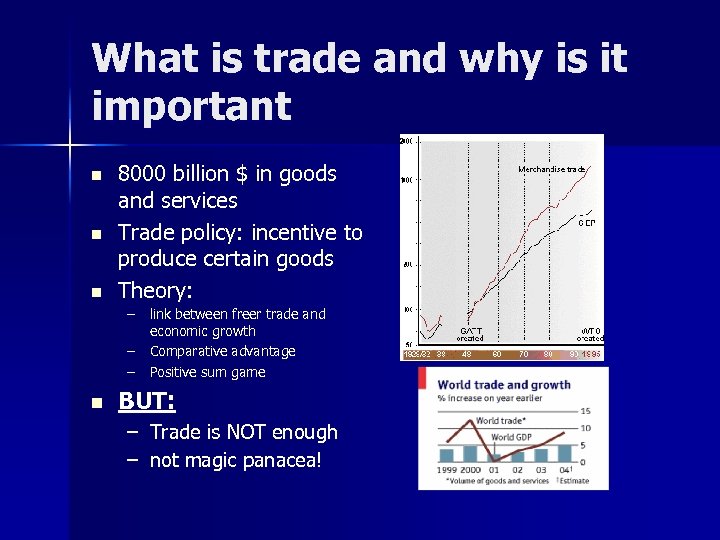
What is trade and why is it important n n n 8000 billion $ in goods and services Trade policy: incentive to produce certain goods Theory: – link between freer trade and economic growth – Comparative advantage – Positive sum game n BUT: – Trade is NOT enough – not magic panacea!
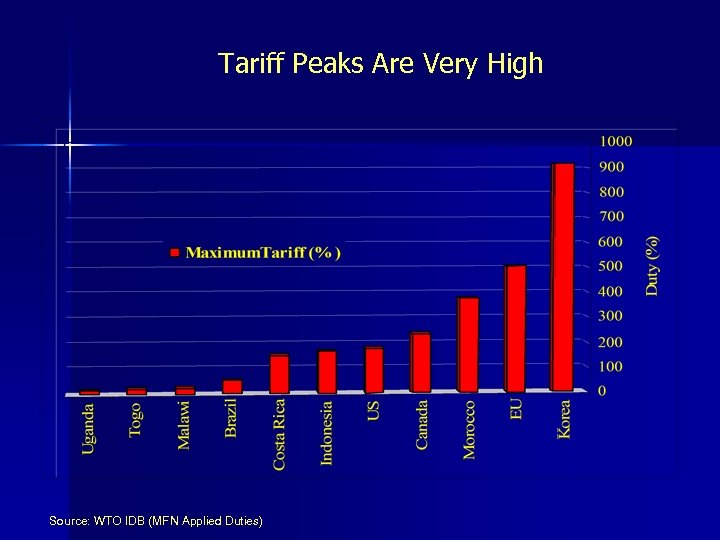
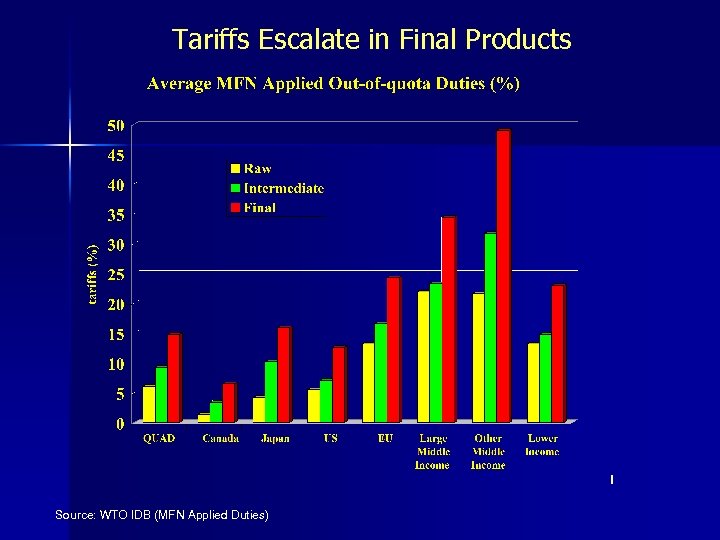
Myriad of instruments, policies and tools n Tariffs (tariffication, binding tariffs, tariff peaks, tariff escalation, tariff reducing formula), quotas, tariff rate quotas (TRQs), standards, non-tariff barriers, subsidies, investment rules, intellectual property rights (IPRs), geographical indications (GIs), environment, labour standards, services regulation, movement of people, export credits, enforcement of the rules, technical assistance, trade facilitation, aid for trade, customs valuation, rules of origin, implementation issues, dispute settlement, anti-dumping, sanitary and phytosanitary measures, investment…
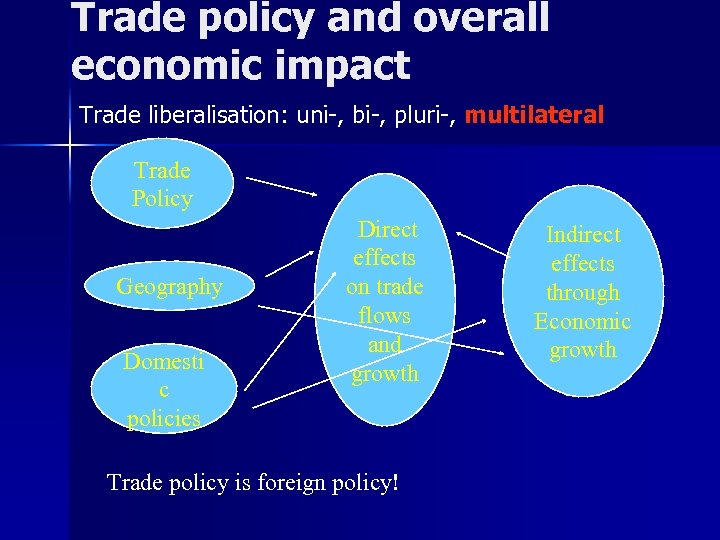
Trade policy and overall economic impact Trade liberalisation: uni-, bi-, pluri-, multilateral Trade Policy Geography Domesti c policies Direct effects on trade flows and growth Trade policy is foreign policy! Indirect effects through Economic growth
What is the WTO? n n n n Creation in Uruguay round (1995) 148+ Members Member-driven intergovernmental organisation? Champion of free trade? Negotiating mechanism to create economic opportunities? "Unidentified object of global governance"? – no common understanding Development organisation? Obscure organisation with 23 agreements where fisheries are discussed under the “Rules” chapter
Basic principles Non-discrimination (MFN principle) n Transparency of rules (e. g. “tarrification”, notification system) n Progressive liberalisation through multilateral trade rounds n Consensus n Enforcement of rules (Dispute Settlement) n
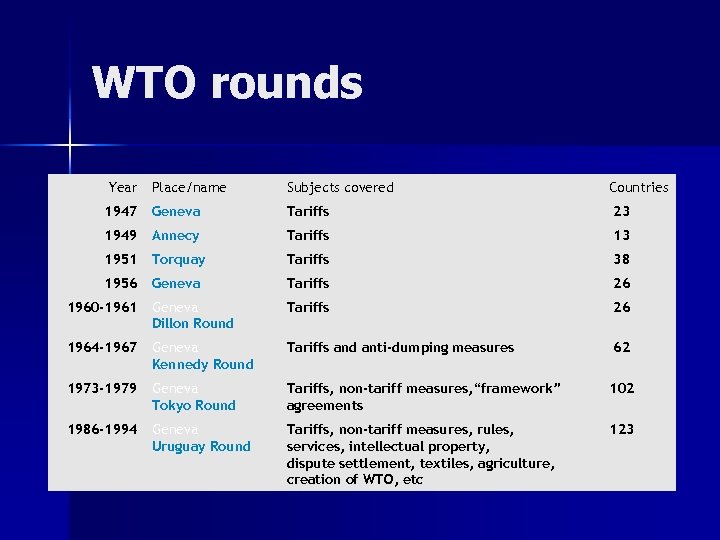
WTO rounds Year Place/name Subjects covered Countries 1947 Geneva Tariffs 23 1949 Annecy Tariffs 13 1951 Torquay Tariffs 38 1956 Geneva Tariffs 26 1960 -1961 Geneva Dillon Round Tariffs 26 1964 -1967 Geneva Kennedy Round Tariffs and anti-dumping measures 62 1973 -1979 Geneva Tokyo Round Tariffs, non-tariff measures, “framework” agreements 102 1986 -1994 Geneva Uruguay Round Tariffs, non-tariff measures, rules, services, intellectual property, dispute settlement, textiles, agriculture, creation of WTO, etc 123
Globalisation and the WTO n n n “Asymmetrical economic order” WTO: part of the problem - part of the solution? The world without the WTO… – “rules based system” vs “rule of the jungle” – asymmetrical trade regime would exist without the WTO (bilateral and biregional agreements) – DSU – protects the weak? – consensus?
Timeline of negotiations n n n 2001 - Launch of Doha Development Agenda 2003 - EU-US renewal too late, Cancun failure 2004 - July framework agreement 2005 – August: “approximations” 2005 – November – draft ministerial text 2005 - December - Hong Kong Ministerial – “recalibration” & new road map 2006 - Countries table offers based on Hong Kong guidance 2006 - December – negotiations conclude 2007 - Submit implementing legislation to US Congress 2007 - July – US Trade Promotion Authority expires 2007 - New domestic reforms? (Farm Bill Renewal, CAP? ) 2010 - Most reforms start to kick in
What is new in this round? Growing membership (China, DCs) n Growing agenda affecting policy space n Increasingly inflexible negotiating positions n Grand bargain: agri vs NAMA and services n Developing countries split (G 20, G 33, G 90) n
What is at stake in the DDA and at Hong Kong? n n n Economic terms – expectations on gains from DDA scaled down (World Bank projections) Credibility of multilateralism - key concern for Europe (alternative: bilaterals…) Reducing global trade asymmetry – what about the DDA? Policy space? Paradigm shift in agriculture?
The structure of the negotiations n n n n July framework – basic guidelines “Single undertaking” General Council, TNC, Committees defensive and offensive interests issue-based coalitions shifting power constellations, G-20 emerging Core group, “green room deals”? consensus – developing countries have “negative power”
Main actors n n n n n Five interested parties (FIPs - EU, US, Australia, India, Brazil) Quad (EU, US, Japan, Canada) New Quad (EU, US, India, Brazil) Cairns group G 10 G 20 (Brazil, India, China – marriage of convenience) G 33 – one issue: special products and SSM G 77/90 – Africa + LDCs - defensive Who else is driving negotiations? (NGOs, multinationals…) Parliamentarians? ? ?
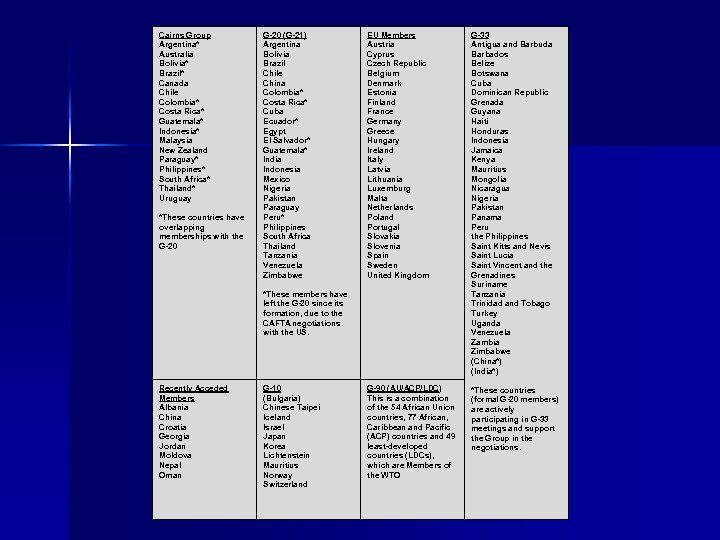
Cairns Group Argentina* Australia Bolivia* Brazil* Canada Chile Colombia* Costa Rica* Guatemala* Indonesia* Malaysia New Zealand Paraguay* Philippines* South Africa* Thailand* Uruguay *These countries have overlapping memberships with the G-20 (G-21) Argentina Bolivia Brazil Chile China Colombia* Costa Rica* Cuba Ecuador* Egypt El Salvador* Guatemala* India Indonesia Mexico Nigeria Pakistan Paraguay Peru* Philippines South Africa Thailand Tanzania Venezuela Zimbabwe EU Members Austria Cyprus Czech Republic Belgium Denmark Estonia Finland France Germany Greece Hungary Ireland Italy Latvia Lithuania Luxemburg Malta Netherlands Poland Portugal Slovakia Slovenia Spain Sweden United Kingdom G-33 Antigua and Barbuda Barbados Belize Botswana Cuba Dominican Republic Grenada Guyana Haiti Honduras Indonesia Jamaica Kenya Mauritius Mongolia Nicaragua Nigeria Pakistan Panama Peru the Philippines Saint Kitts and Nevis Saint Lucia Saint Vincent and the Grenadines Suriname Tanzania Trinidad and Tobago Turkey Uganda Venezuela Zambia Zimbabwe (China*) (India*) G-90 (AU/ACP/LDC) This is a combination of the 54 African Union countries, 77 African, Caribbean and Pacific (ACP) countries and 49 least-developed countries (LDCs), which are Members of the WTO *These countries (formal G-20 members) are actively participating in G-33 meetings and support the Group in the negotiations. *These members have left the G-20 since its formation, due to the CAFTA negotiations with the US. Recently Acceded Members Albania China Croatia Georgia Jordan Moldova Nepal Oman G-10 (Bulgaria) Chinese Taipei Iceland Israel Japan Korea Lichtenstein Mauritius Norway Switzerland
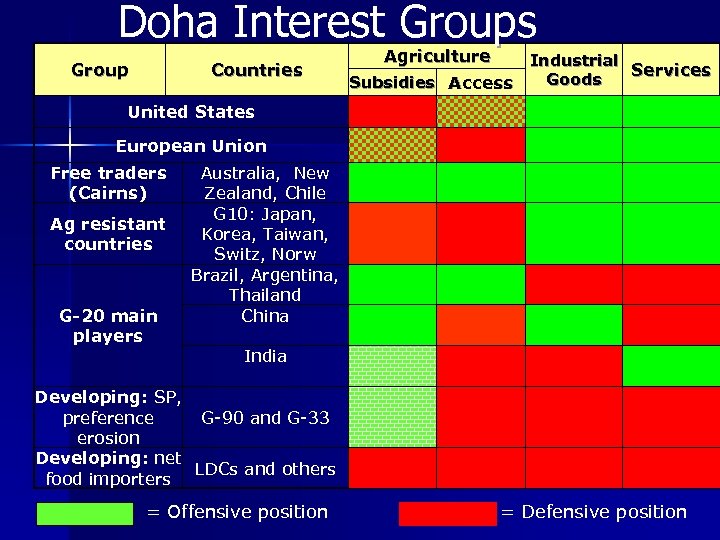
Doha Interest Groups Group Countries Agriculture Industrial Services Goods Subsidies Access United States European Union Free traders (Cairns) Ag resistant countries G-20 main players Australia, New Zealand, Chile G 10: Japan, Korea, Taiwan, Switz, Norw Brazil, Argentina, Thailand China India Developing: SP, G-90 and G-33 preference erosion Developing: net LDCs and others food importers = Offensive position = Defensive position
The EU Agenda I Starting off with a broad “post-modern” agenda (Seattle to Doha, “Singapore issues”) n Defensive interests: n Agriculture: CAP Goods: footwear, textiles and clothing Services: transport, audiovisual, education, healthcare Offensive: services & goods (professional services, e-commerce, etc) n
The EU Agenda II n n n n Trade facilitation (other 3 Singapore issues dropped) Trade and the environment + core labour standards controversial Development: global EBA, openness to S&D, phasing out export subsidies Challenge: “preference erosion” (ACP) Agriculture is the sticking point – locking in 2003 CAP reform Policy linkages: CAP, budget, development Three-level game
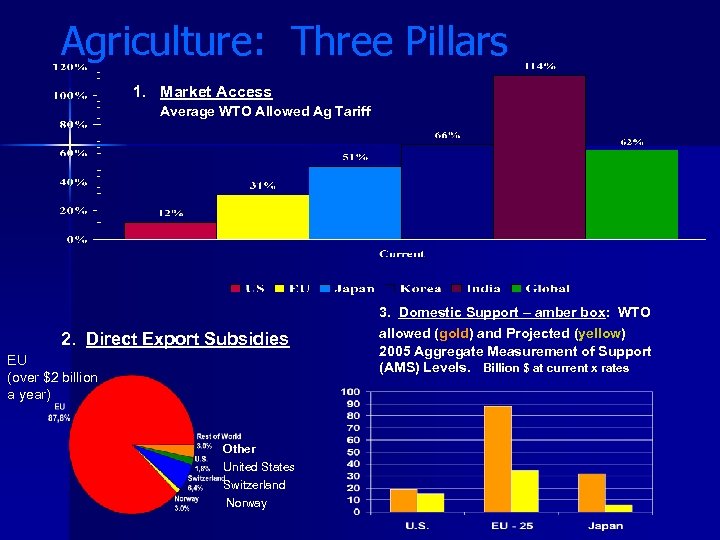
Agriculture I n n July framework: market access: substantial tariff reductions exports subsidies: reductions of, with a view to phasing out, all forms of these (in the 1 August 2004 “framework” members agreed to eliminate export subsidies by a date to be negotiated) domestic support: substantial reductions for supports that distort trade (in the 1 August 2004 “framework”, developed countries pledged to slash trade-distorting domestic subsidies by 20% from the first day any Doha Agenda agreement is implemented.
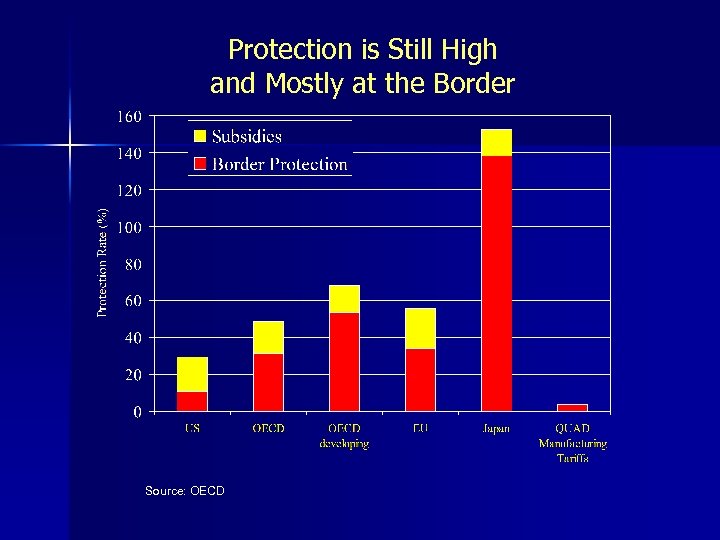
Protection is Still High and Mostly at the Border Source: OECD
Tariff Peaks Are Very High Source: WTO IDB (MFN Applied Duties)
Tariffs Escalate in Final Products Source: WTO IDB (MFN Applied Duties)
Agriculture: Three Pillars 1. Market Access Average WTO Allowed Ag Tariff 2. Direct Export Subsidies EU (over $2 billion a year) Other United States Switzerland Norway 3. Domestic Support – amber box: WTO allowed (gold) and Projected (yellow) 2005 Aggregate Measurement of Support (AMS) Levels. Billion $ at current x rates
Agriculture: Proposals for market access Market Access: Average WTO Allowed Ag Tariff (1% sensitive products) (8% sensitive products) (Based on WTO AVEs)
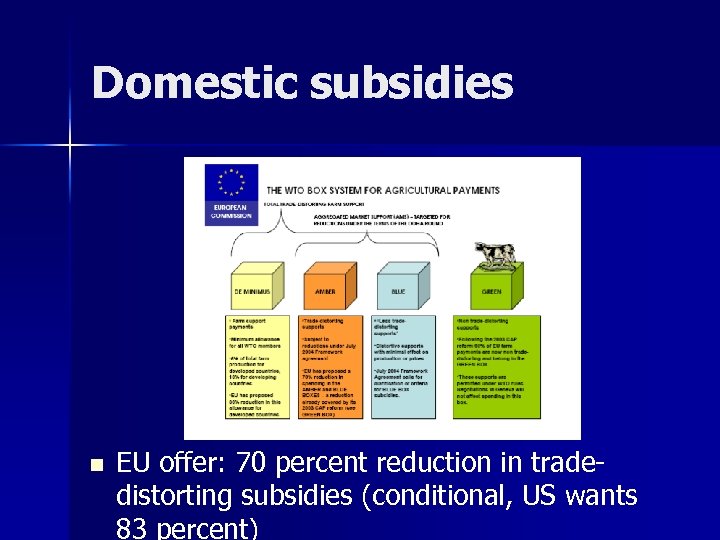
Domestic subsidies n EU offer: 70 percent reduction in tradedistorting subsidies (conditional, US wants 83 percent)
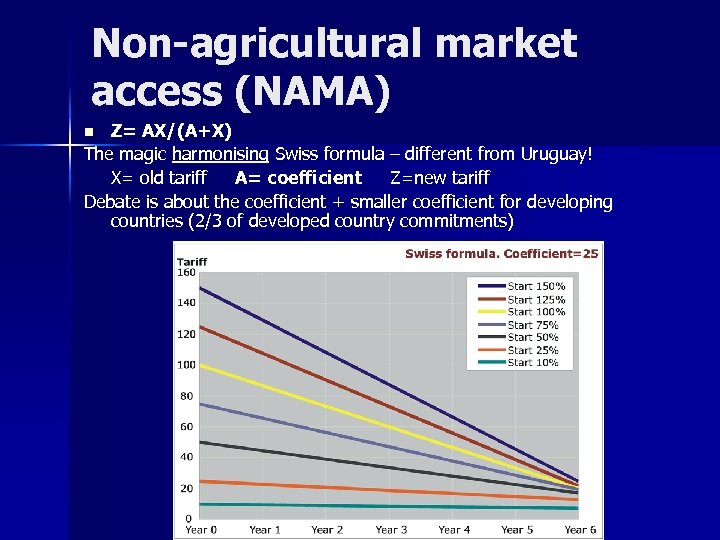
Non-agricultural market access (NAMA) Z= AX/(A+X) The magic harmonising Swiss formula – different from Uruguay! X= old tariff A= coefficient Z=new tariff Debate is about the coefficient + smaller coefficient for developing countries (2/3 of developed country commitments) n
Services I n n 1. 2. 3. 4. GATS flexible “offer-request” process The 4 modes of supply: cross-border (trade that takes place from the territory of one country into another, e. g. e-commerce or telecoms) consumption abroad (consumption of services in another country e. g. tourism) commercial presence (establishment of a firm from one country in the territory of another – particularly important for financial services and professional services) movement of natural persons (the ability for nationals to work overseas for a temporary period to provide services, which is not a synonym for cross-border labour movement in general
Services II n n n Significant gains possible from services liberalisation No progress so far EU proposed benchmarks: – Voluntary commitments according to certain criteria – Smaller commitment from DCs – Not forced liberalisation or privatisation n Resentment from DCs and NGOs
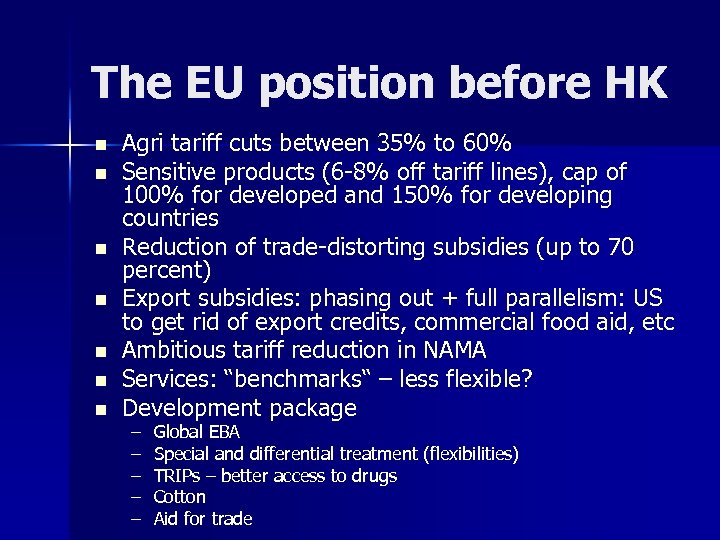
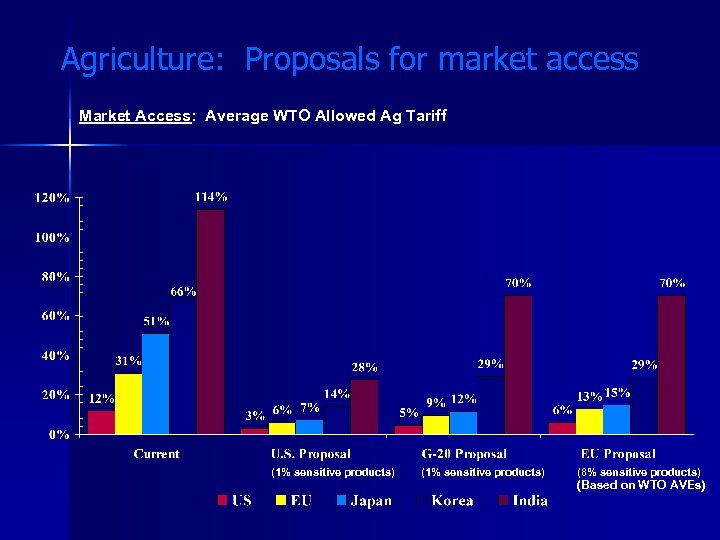
The EU position before HK n n n n Agri tariff cuts between 35% to 60% Sensitive products (6 -8% off tariff lines), cap of 100% for developed and 150% for developing countries Reduction of trade-distorting subsidies (up to 70 percent) Export subsidies: phasing out + full parallelism: US to get rid of export credits, commercial food aid, etc Ambitious tariff reduction in NAMA Services: “benchmarks“ – less flexible? Development package – – – Global EBA Special and differential treatment (flexibilities) TRIPs – better access to drugs Cotton Aid for trade
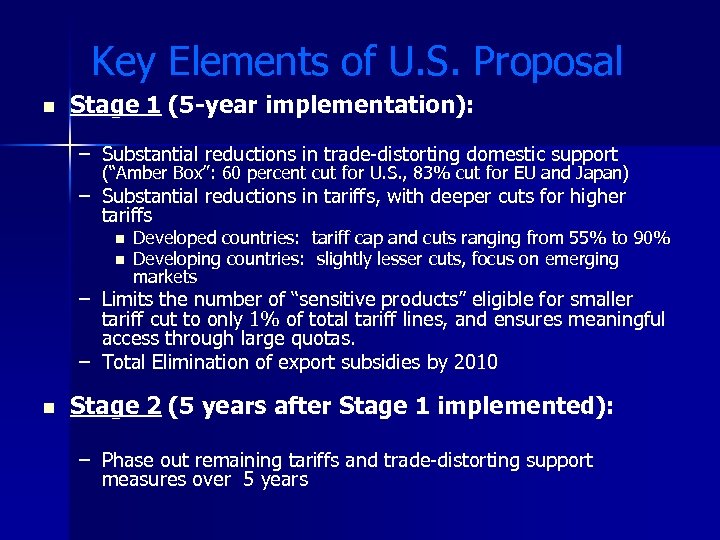
Key Elements of U. S. Proposal n Stage 1 (5 -year implementation): – Substantial reductions in trade-distorting domestic support (“Amber Box”: 60 percent cut for U. S. , 83% cut for EU and Japan) – Substantial reductions in tariffs, with deeper cuts for higher tariffs n n Developed countries: tariff cap and cuts ranging from 55% to 90% Developing countries: slightly lesser cuts, focus on emerging markets – Limits the number of “sensitive products” eligible for smaller tariff cut to only 1% of total tariff lines, and ensures meaningful access through large quotas. – Total Elimination of export subsidies by 2010 n Stage 2 (5 years after Stage 1 implemented): – Phase out remaining tariffs and trade-distorting support measures over 5 years
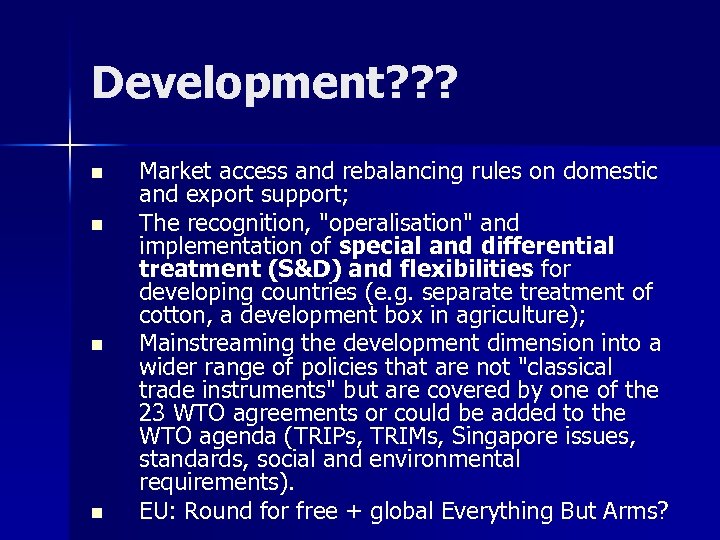
Development? ? ? n n Market access and rebalancing rules on domestic and export support; The recognition, "operalisation" and implementation of special and differential treatment (S&D) and flexibilities for developing countries (e. g. separate treatment of cotton, a development box in agriculture); Mainstreaming the development dimension into a wider range of policies that are not "classical trade instruments" but are covered by one of the 23 WTO agreements or could be added to the WTO agenda (TRIPs, TRIMs, Singapore issues, standards, social and environmental requirements). EU: Round for free + global Everything But Arms?
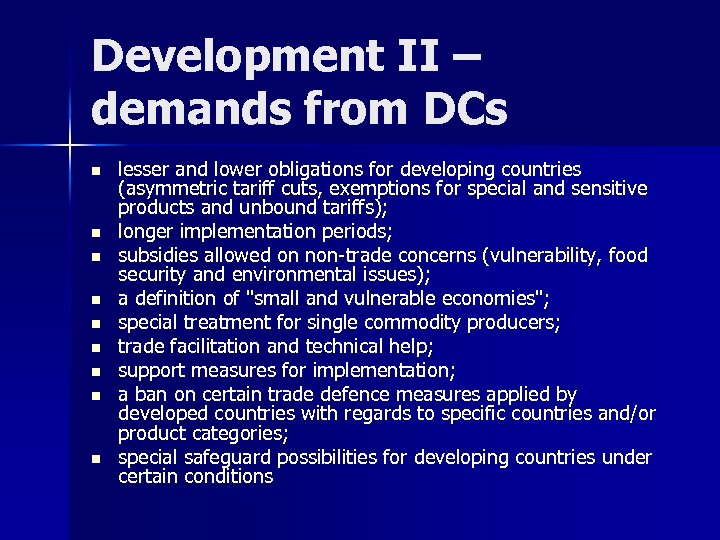
Development II – demands from DCs n n n n n lesser and lower obligations for developing countries (asymmetric tariff cuts, exemptions for special and sensitive products and unbound tariffs); longer implementation periods; subsidies allowed on non-trade concerns (vulnerability, food security and environmental issues); a definition of "small and vulnerable economies"; special treatment for single commodity producers; trade facilitation and technical help; support measures for implementation; a ban on certain trade defence measures applied by developed countries with regards to specific countries and/or product categories; special safeguard possibilities for developing countries under certain conditions
The EP and Hong Kong 4 th Parliamentary Conference on the WTO – IPU + EP n 30 MEPs n Meetings with senior representatives n Two main topics: n – Concluding the round – International coherence
Скачать презентацию WTO Hong Kong ministerial conference 13 -18 December
a84d015340b1b1a88374d9f14a52f910.ppt