 Скачать презентацию WTO Bilaterals and Mediterranean product policy Pierluigi Londero
242846c9bc9bec5687d4e44693633f67.ppt
- Количество слайдов: 22



WTO, Bilaterals and Mediterranean product policy Pierluigi Londero – Dangiris Nekrasius Agricultural Trade Policy Analysis DG for Agriculture and Rural Development European Commission CAL/MED Consortium Workshop II Washington DC 7 December 2006
Outline § Introduction § WTO negotiations: market access and Mediterranean products § Free Trade Areas, Regional Trade Agreements: where are we? § An example: the EU-South Africa Trade Agreement § Conclusions Pierluigi Londero – Dangiris Nekrasius CAL/MED Consortium Workshop II 7 December 2006 2
Outline § Introduction – Current state of play in DDA § WTO negotiations: market access and Mediterranean products – Fruit and vegetables: tariff structure and trade pattern – Market access and sensitive products: steps of the analysis § Free Trade Areas, Regional Trade Agreements – Ongoing negotiations and new areas of interest § An example: lessons to be learned from the EU-South Africa Trade Agreement (TDCA) § Conclusions Pierluigi Londero – Dangiris Nekrasius CAL/MED Consortium Workshop II 7 December 2006 3
Current state of play in market access / sensitive products § Market access remains one of the main areas of contention in DDA – Different interests in approach of exporters and importers logical – Lack of any objective basis for discussion more problematic § TRQ expansion: differences in approach are fundamental – Exporters opt for a general link of TRQ expansion to consumption – Importers insist on relevance of current trade parameters – The result is lack of transparency on potential product coverage § Formula for TRQ expansion is the key – Percentage of sensitive tariff lines directly linked to their treatment – Percentage of Special Product indirectly linked to Sensitive Products Pierluigi Londero – Dangiris Nekrasius CAL/MED Consortium Workshop II 7 December 2006 4
Fruit and Vegetables: Tariff structure and recent trade developments § EU Tariffs (AVEs) concentrate in the lower tariff bands – Tariff peaks for garlic and mushrooms § Entry price system § Most traded (non tropical) fruits show remarkable world trade growth – Grapes trade doubled since early 90’s – Oranges essential for US and MED countries – Apples most traded fruit, China has joined the export club Pierluigi Londero – Dangiris Nekrasius CAL/MED Consortium Workshop II 7 December 2006 5
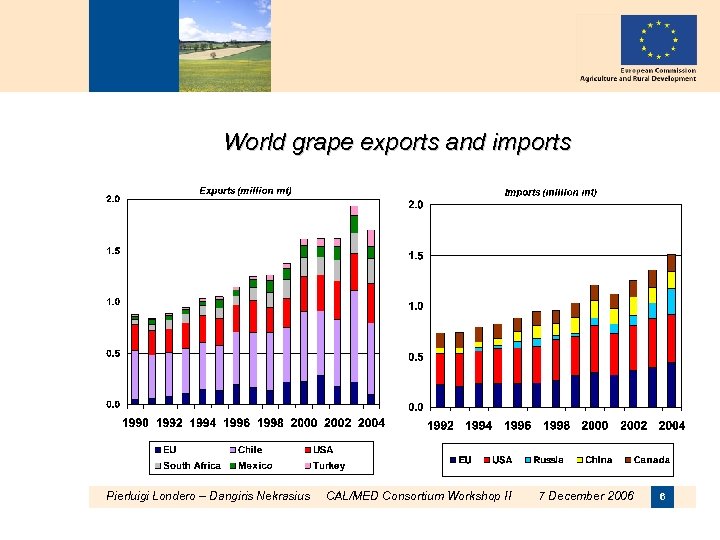
World grape exports and imports Pierluigi Londero – Dangiris Nekrasius CAL/MED Consortium Workshop II 7 December 2006 6
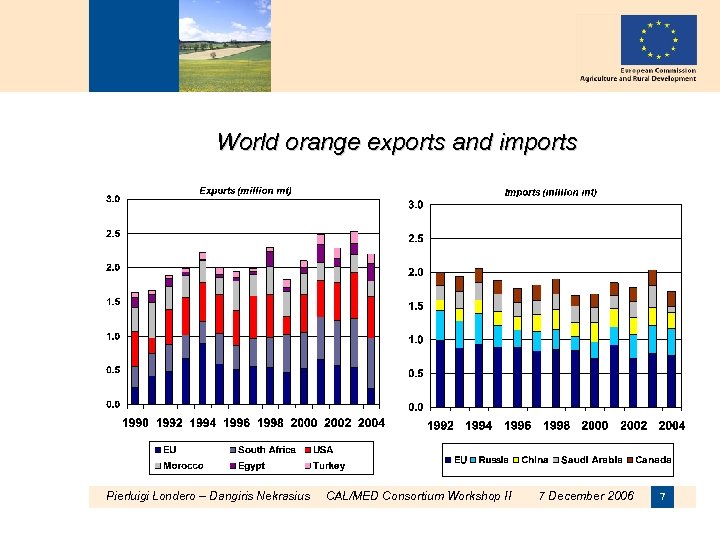
World orange exports and imports Pierluigi Londero – Dangiris Nekrasius CAL/MED Consortium Workshop II 7 December 2006 7
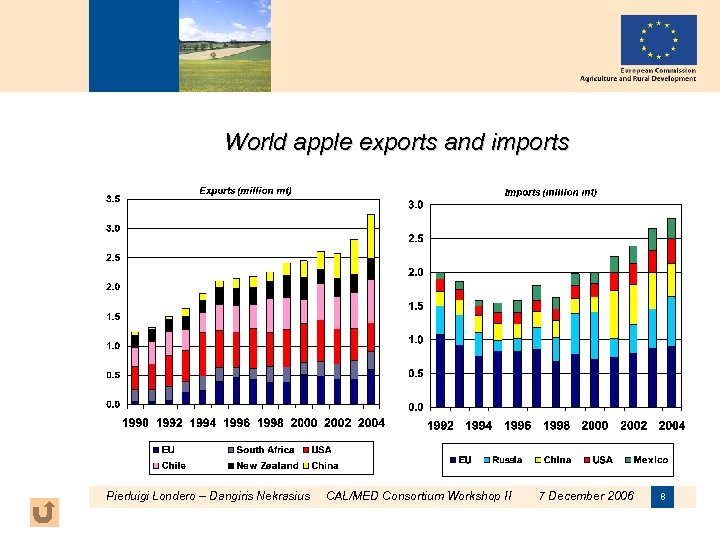
World apple exports and imports Pierluigi Londero – Dangiris Nekrasius CAL/MED Consortium Workshop II 7 December 2006 8
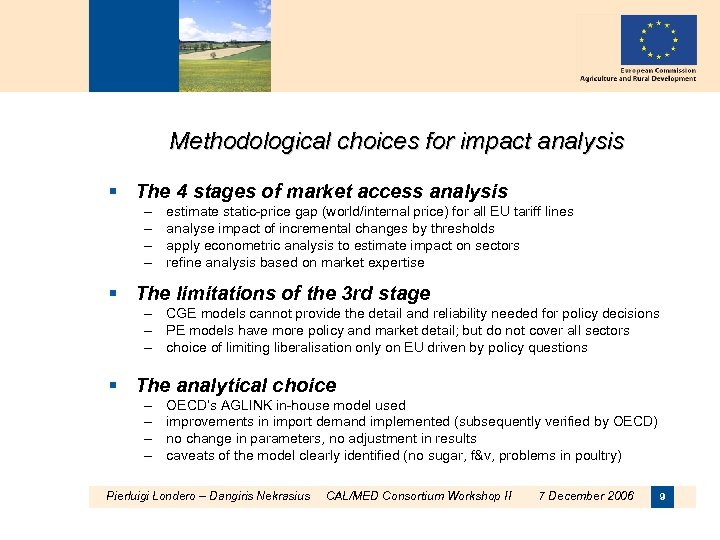
Methodological choices for impact analysis § The 4 stages of market access analysis – – estimate static-price gap (world/internal price) for all EU tariff lines analyse impact of incremental changes by thresholds apply econometric analysis to estimate impact on sectors refine analysis based on market expertise § The limitations of the 3 rd stage – CGE models cannot provide the detail and reliability needed for policy decisions – PE models have more policy and market detail; but do not cover all sectors – choice of limiting liberalisation only on EU driven by policy questions § The analytical choice – – OECD’s AGLINK in-house model used improvements in import demand implemented (subsequently verified by OECD) no change in parameters, no adjustment in results caveats of the model clearly identified (no sugar, f&v, problems in poultry) Pierluigi Londero – Dangiris Nekrasius CAL/MED Consortium Workshop II 7 December 2006 9
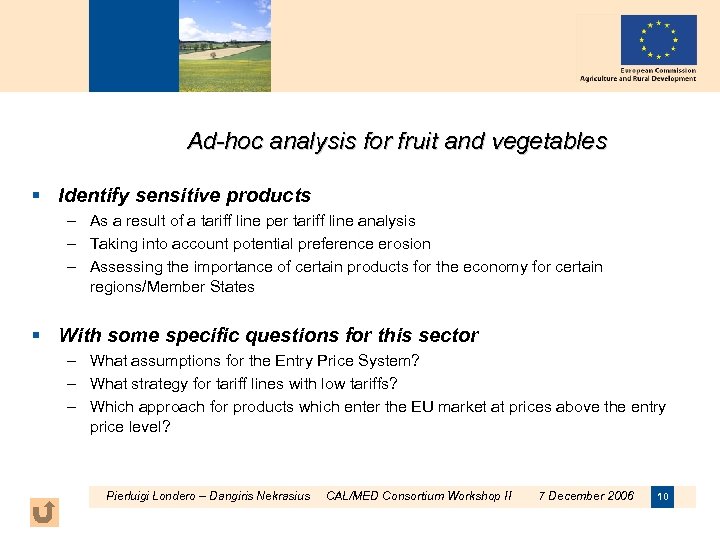
Ad-hoc analysis for fruit and vegetables § Identify sensitive products – As a result of a tariff line per tariff line analysis – Taking into account potential preference erosion – Assessing the importance of certain products for the economy for certain regions/Member States § With some specific questions for this sector – What assumptions for the Entry Price System? – What strategy for tariff lines with low tariffs? – Which approach for products which enter the EU market at prices above the entry price level? Pierluigi Londero – Dangiris Nekrasius CAL/MED Consortium Workshop II 7 December 2006 10
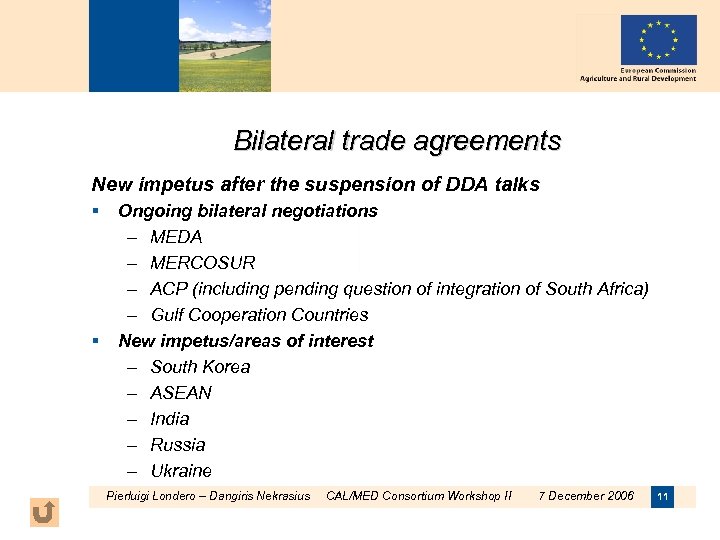
Bilateral trade agreements New impetus after the suspension of DDA talks § § Ongoing bilateral negotiations – MEDA – MERCOSUR – ACP (including pending question of integration of South Africa) – Gulf Cooperation Countries New impetus/areas of interest – South Korea – ASEAN – India – Russia – Ukraine Pierluigi Londero – Dangiris Nekrasius CAL/MED Consortium Workshop II 7 December 2006 11
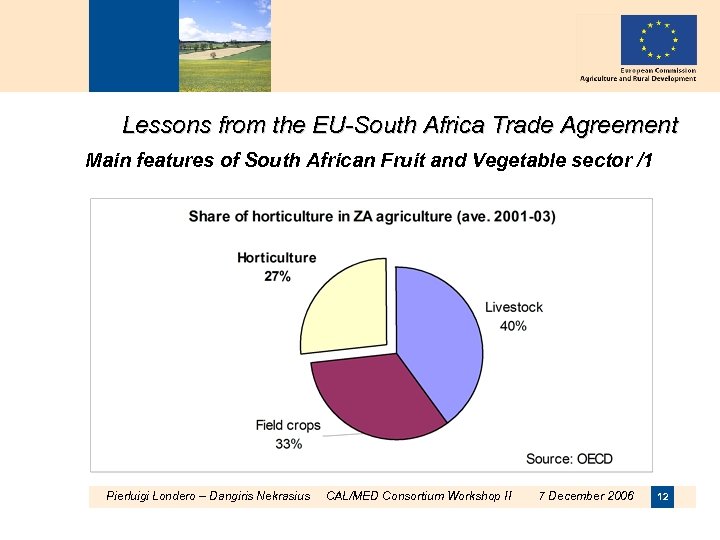
Lessons from the EU-South Africa Trade Agreement Main features of South African Fruit and Vegetable sector /1 Pierluigi Londero – Dangiris Nekrasius CAL/MED Consortium Workshop II 7 December 2006 12
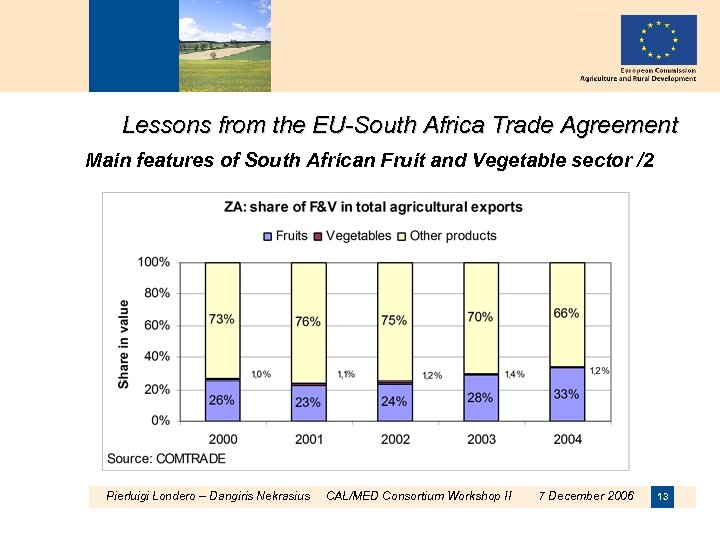
Lessons from the EU-South Africa Trade Agreement Main features of South African Fruit and Vegetable sector /2 Pierluigi Londero – Dangiris Nekrasius CAL/MED Consortium Workshop II 7 December 2006 13
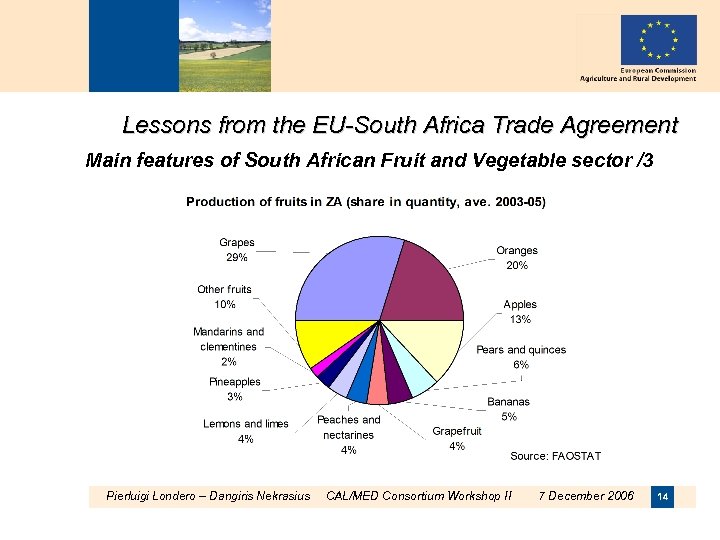
Lessons from the EU-South Africa Trade Agreement Main features of South African Fruit and Vegetable sector /3 Pierluigi Londero – Dangiris Nekrasius CAL/MED Consortium Workshop II 7 December 2006 14
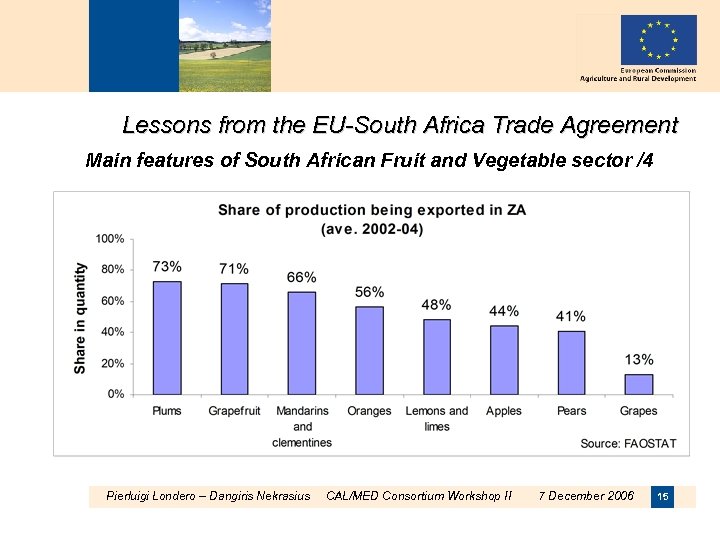
Lessons from the EU-South Africa Trade Agreement Main features of South African Fruit and Vegetable sector /4 Pierluigi Londero – Dangiris Nekrasius CAL/MED Consortium Workshop II 7 December 2006 15
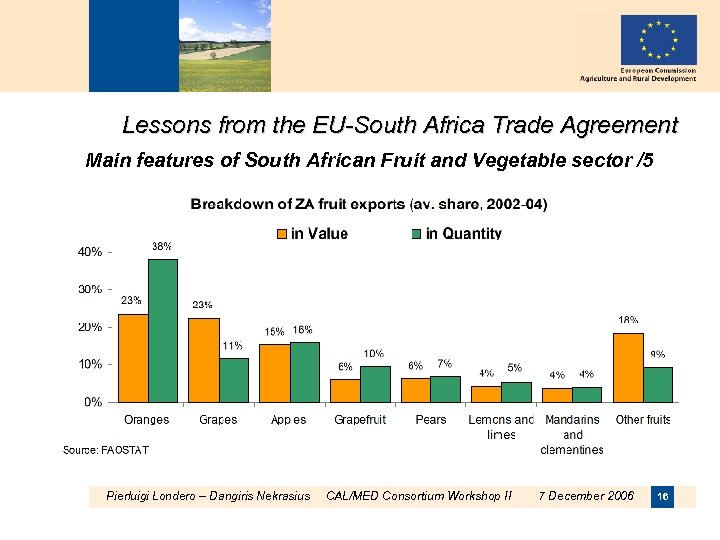
Lessons from the EU-South Africa Trade Agreement Main features of South African Fruit and Vegetable sector /5 Pierluigi Londero – Dangiris Nekrasius CAL/MED Consortium Workshop II 7 December 2006 16
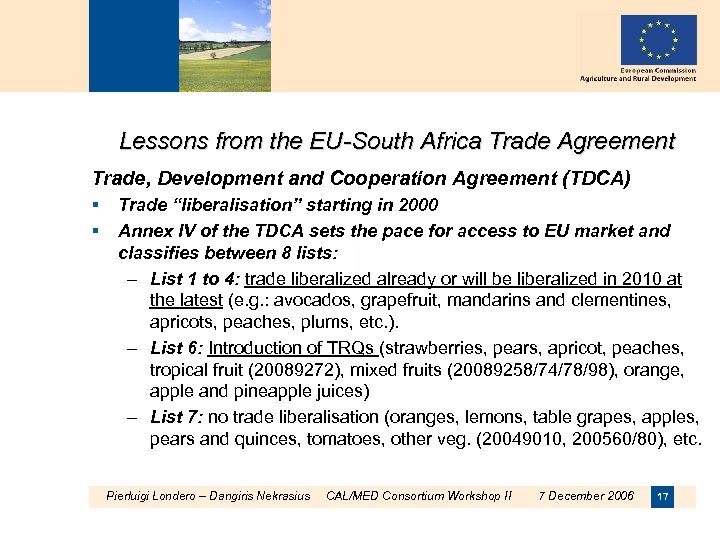
Lessons from the EU-South Africa Trade Agreement Trade, Development and Cooperation Agreement (TDCA) § § Trade “liberalisation” starting in 2000 Annex IV of the TDCA sets the pace for access to EU market and classifies between 8 lists: – List 1 to 4: trade liberalized already or will be liberalized in 2010 at the latest (e. g. : avocados, grapefruit, mandarins and clementines, apricots, peaches, plums, etc. ). – List 6: Introduction of TRQs (strawberries, pears, apricot, peaches, tropical fruit (20089272), mixed fruits (20089258/74/78/98), orange, apple and pineapple juices) – List 7: no trade liberalisation (oranges, lemons, table grapes, apples, pears and quinces, tomatoes, other veg. (20049010, 200560/80), etc. Pierluigi Londero – Dangiris Nekrasius CAL/MED Consortium Workshop II 7 December 2006 17
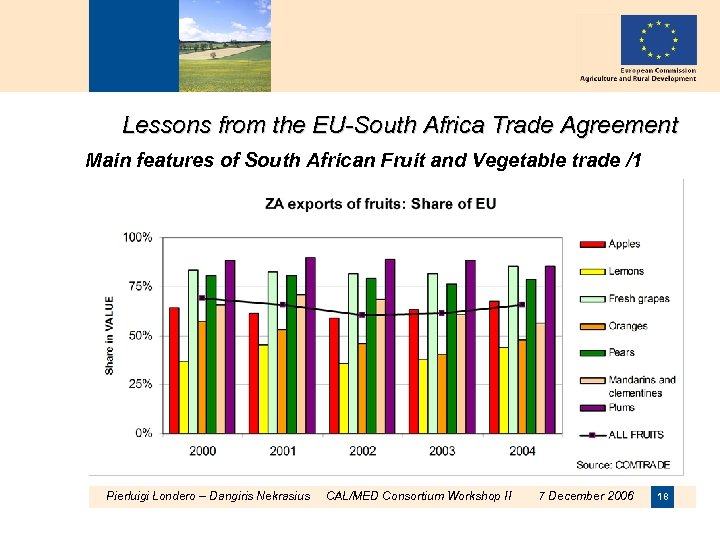
Lessons from the EU-South Africa Trade Agreement Main features of South African Fruit and Vegetable trade /1 Pierluigi Londero – Dangiris Nekrasius CAL/MED Consortium Workshop II 7 December 2006 18
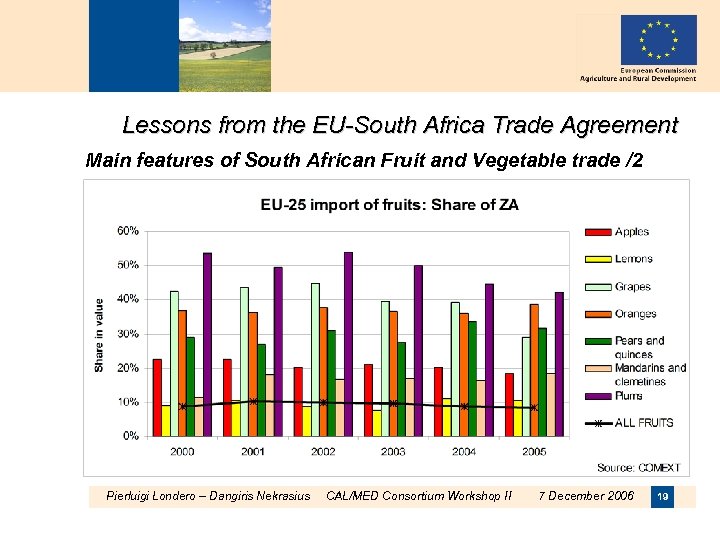
Lessons from the EU-South Africa Trade Agreement Main features of South African Fruit and Vegetable trade /2 Pierluigi Londero – Dangiris Nekrasius CAL/MED Consortium Workshop II 7 December 2006 19
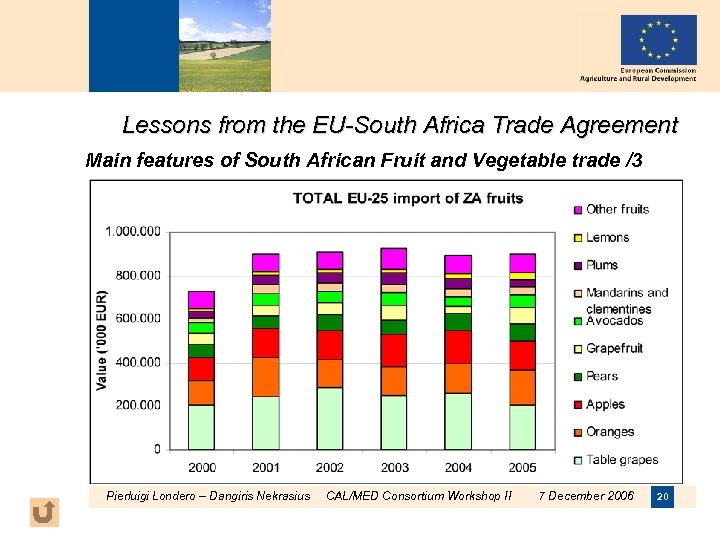
Lessons from the EU-South Africa Trade Agreement Main features of South African Fruit and Vegetable trade /3 Pierluigi Londero – Dangiris Nekrasius CAL/MED Consortium Workshop II 7 December 2006 20
Some tentative conclusions § WTO negotiations: Market access parameters (in particular sensitive products) far from reaching an agreement § The suspension of WTO talks has brought a new impetus to bilateral and regional trade negotiations § It is difficult to assess the impact of past trade agreement if they have not yet come into full implementation Pierluigi Londero – Dangiris Nekrasius CAL/MED Consortium Workshop II 7 December 2006 21
For further information § EU agriculture and CAP reform http: //europa. eu. int/comm/agriculture/index_en. htm § EU agriculture and trade http: //europa. eu. int/comm/agriculture/external/wto/index_en. htm § Agricultural Trade Policy Analysis http: //europa. eu. int/comm/agriculture/publi/map/index_en. htm Pierluigi Londero – Dangiris Nekrasius CAL/MED Consortium Workshop II 7 December 2006 22
Скачать презентацию WTO Bilaterals and Mediterranean product policy Pierluigi Londero
242846c9bc9bec5687d4e44693633f67.ppt