


 Скачать презентацию WTO and India-S Africa Relations Convergence and Divergence
fe6918ab057a163a5abaf014c12afaec.ppt
- Количество слайдов: 18
 WTO and India-S. Africa Relations Convergence and Divergence By Pradeep S Mehta Secretary General, CUTS International, India www. cuts-international. org 1
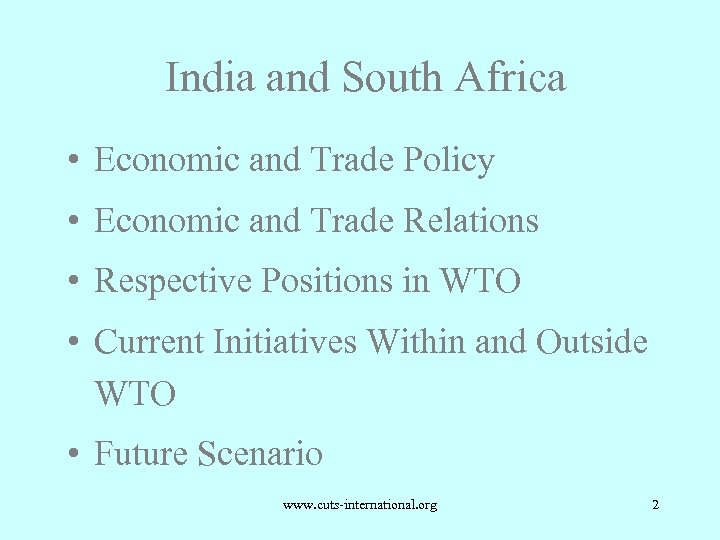 India and South Africa • Economic and Trade Policy • Economic and Trade Relations • Respective Positions in WTO • Current Initiatives Within and Outside WTO • Future Scenario www. cuts-international. org 2
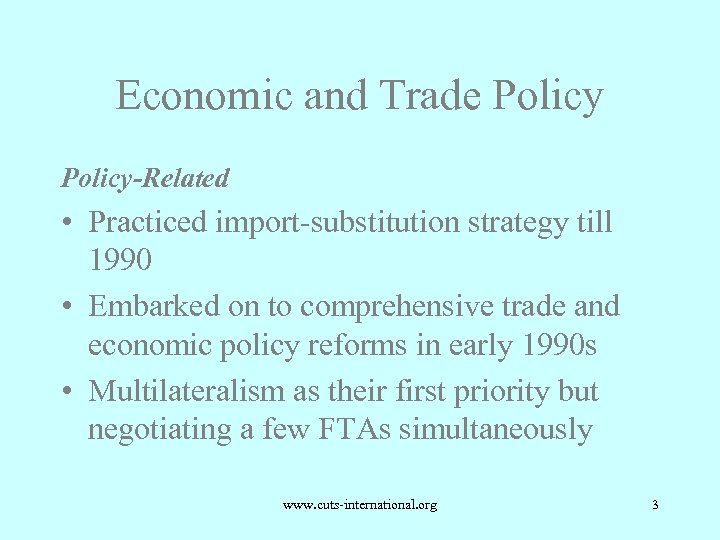 Economic and Trade Policy-Related • Practiced import-substitution strategy till 1990 • Embarked on to comprehensive trade and economic policy reforms in early 1990 s • Multilateralism as their first priority but negotiating a few FTAs simultaneously www. cuts-international. org 3
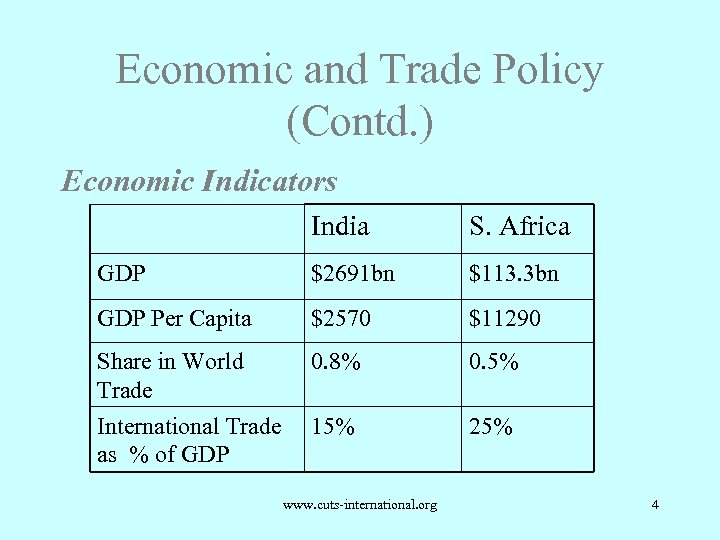 Economic and Trade Policy (Contd. ) Economic Indicators India S. Africa GDP $2691 bn $113. 3 bn GDP Per Capita $2570 $11290 Share in World Trade 0. 8% 0. 5% International Trade as % of GDP 15% 25% www. cuts-international. org 4
 Economic and Trade Relations • Strong cultural and social ties but weak economic and trade relations • S. Africa’s exports to India: 6 -7% of total exports • India’s exports to S. Africa: Approx. 1% of total exports www. cuts-international. org 5
 India and S. Africa: Positions in WTO Background • Both are founder members of WTO • Both are key regional players • Being a ‘developed’ developing country S. Africa identifies its interests more with developed nations • India prefers to adopt a more orthodox line in negotiations www. cuts-international. org 6
 India and S. Africa: Positions in WTO On Major WTO Issues: Commonality • Agriculture: Being the architects of G-20 alliance; hold common position against North • TRIPs and Public Health: Both played a crucial role in brokering the deal at Doha • Bring effective disciplines on the use of trade remedy instruments www. cuts-international. org 7
 India and S. Africa: Positions in WTO On Major WTO Issues: Divergence • On “New Round”: S. Africa supported New Round consisting of a wider negotiating agenda; India opposed till the end at Doha • Singapore Issues: S. Africa favours a modified less ambitious and carefully defined Agenda; India strongly opposes any negotiations www. cuts-international. org 8
 India and S. Africa: Positions in WTO On Negotiating Strategy: S. Africa • Holds a more flexible approach • Priority to trade interests over political diplomacy • Negotiate outcomes favourable to economic development in general and to S. Africa in particular • Positions in Africa Group awkward and ambiguous www. cuts-international. org 9
 India and S. Africa: Positions in WTO (Contd. ) On Negotiating Strategy: India • Normally holds a hardline stance • Political diplomacy gets precedence over trade interests • Often sacrifices own trading interests for larger political gain • Go along well with its regional partners and other developing nations www. cuts-international. org 10
 Current Initiatives: In and Outside the WTO S. Africa: Major Shift from Doha • At Doha, sided with developed countries on the new round and new issues; at Cancun went along with developing countries • Active member of G-20 at Cancun but did not join LMG at Doha www. cuts-international. org 11
 Current Initiatives: In and Outside the WTO (Contd. ) • Working to strengthen the IBSA group that includes India and Brazil • Supported the demand of four W African countries on cotton subsidy • Prioritised eleven “strategic partner” countries outside Africa; India is one of them www. cuts-international. org 12
 Current Initiatives: In and Outside the WTO (Contd. ) India: Holding on from Doha • Opposed “New Issues” at Cancun • Led G-20 alliance along with Brazil and South Africa • Working to further consolidate G-20 positions in post-Cancun era • Working towards enhancing South-South trade – negotiating FTAs with ASEAN, S. Africa, IBSA, Mercosur and SAARC www. cuts-international. org 13
 Emerging Future Scenario • No major breakthrough after Cancun • Negotiating positions on agriculture are still polarised • G-20 has emerged as a third axis on the global trading landscape along with US and EU • Both Northern and Southern countries are on FTAs spree www. cuts-international. org 14
 Emerging Future Scenario (Contd. ) • Initiatives from within South and from WTO to enhance South-South trade • EU will have new Trade Commissioner by year end • USA may have new administration after election • India may also have new government but positions unlikely to change www. cuts-international. org 15
 India and S. Africa: What Should be their Response? Enhancing South-South Trade: Capitalise on G-20 Alliance • Accounts for only 10% of global trade • Means to reduce dependence on North • Increase diversification of Southern exports beyond primary commodities • A better bargaining strength in trade negotiations www. cuts-international. org 16
 India and S. Africa: What Should be their Response? (Contd. ) Synergy with Smaller Regional Partners • Demonstrated at Cancun; it should be continued • To pursue a broader Southern alliance • Smaller countries are vulnerable to “armtwisting” and sops offered by rich countries www. cuts-international. org 17
 India and S. Africa: What Should be Their Response? (Contd. ) Challenges/Opportunities from Cancun • Developing countries showed a new kind of solidarity at Cancun – How to sustain it? • G-20; Alliance on Cotton; Alliance on Singapore Issues – How to consolidate it further? • After Cancun, developed countries cannot take developing countries for granted – Be proactive in negotiations. www. cuts-international. org 18