 Скачать презентацию WSBI and ESBG Human Capital Investment in
90d8f2da2427a72d170dd9e21f4c6be0.ppt
- Количество слайдов: 19



WSBI and ESBG Human Capital & Investment in the Mediterranean Ian Radcliffe Euro-Mediterranean Investment Conference 16 March 2011
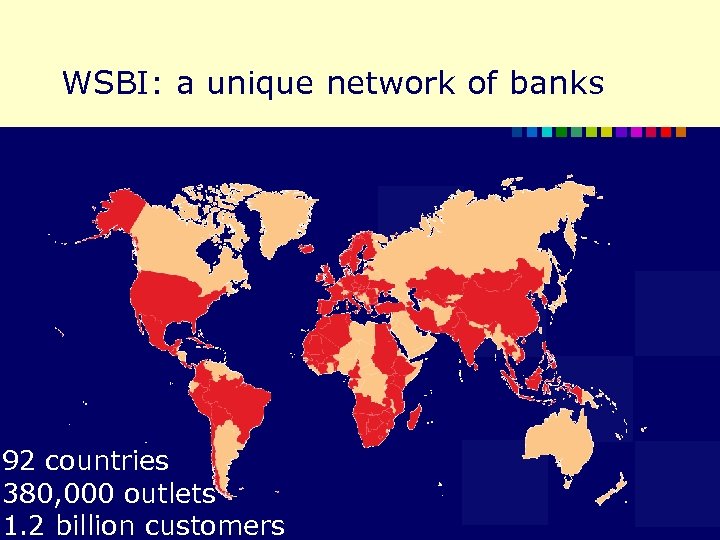
WSBI: a unique network of banks 92 countries 380, 000 outlets 1. 2 billion customers
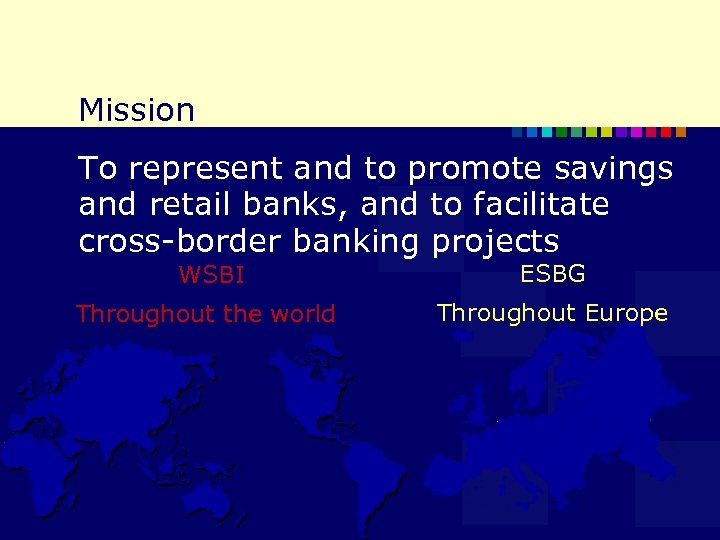
Mission To represent and to promote savings and retail banks, and to facilitate cross-border banking projects WSBI ESBG Throughout the world Throughout Europe
WSBI in the Mediterranean region § Members in: Albania, Algeria, Croatia, Egypt, Morocco, Tunisia, Turkey as well as EU countries in the region § Regional experience in delivering Training & Consultancy § Current project in Morocco (part of a global savings programme supported with funding from the Bill & Melinda Gates Foundation)
Why Human Capital issues are important to us § Sound, well governed and inclusive retail banking sectors are key drivers of economic development § The stock of competences and knowledge attributes in the ability to perform labour produces economic value § (M)SME Finance is a core activity of our members § Financial literacy is today’s ‘hot’ topic
Global considerations
NB. The financial crisis has changed everything Widespread consensus on root causes: § Ample liquidity; global imbalances; search for yield; increasing leverage § Financial innovation gone astray § Flawed incentives structure § Poor risk management § Supervisory deficiencies § International governance deficiencies European Commission, Economic & Financial Affairs
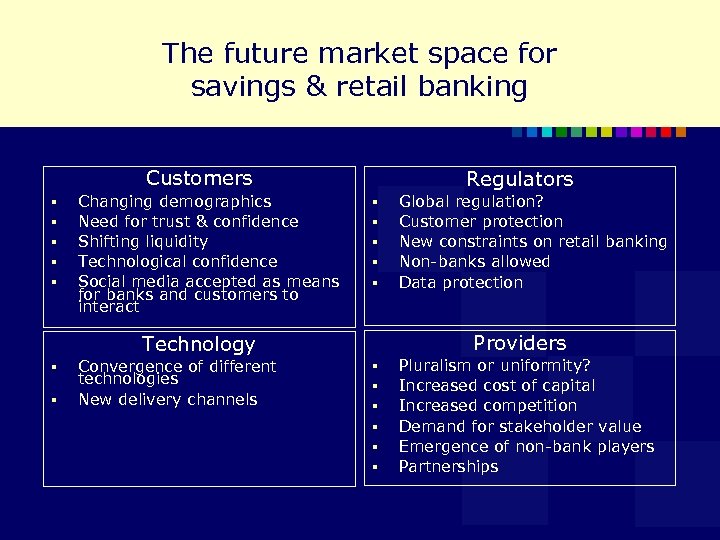
The future market space for savings & retail banking Customers § § § Changing demographics Need for trust & confidence Shifting liquidity Technological confidence Social media accepted as means for banks and customers to interact Regulators § § § Providers Technology § § Convergence of different technologies New delivery channels Global regulation? Customer protection New constraints on retail banking Non-banks allowed Data protection § § § Pluralism or uniformity? Increased cost of capital Increased competition Demand for stakeholder value Emergence of non-bank players Partnerships
Global skill needs in retail banking § Shortage of management and leadership skills across the sector § Basic demand for skills in mathematics, IT, commercial skills; cultural and language skills becoming more important § Product knowledge and advisory / sales skills § Need to respond to the global crisis: q q Strengthened corporate governance Risk management and risk assessment have come to the fore
A digression: what we learned from Central & Eastern Europe (1/2) …although "nowhere in Europe has economic growth been as impressive and durable as in the countries of central and eastern Europe" a major challenge remains overcoming the gap in human capital investment and utilisation in these countries 'Lisbon Council for Economic Competitiveness and Social Renewal‘ Nov 2007.
A digression: what we learned from Central & Eastern Europe (2/2) Recommendations: § Improve public investment in education and skills; § Leave no socio-demographic group behind. The low birth rate and the brain drain make it compulsory to make every possible effort to integrate everybody into modern labour market, argue the authors; Link the economy to the knowledge networks of the world by supporting the participation of universities, research institutions in technology and research networks in Europe; Prepare for the ageing society to limit the impact of this demographic shift § §
Access to finance § Access to finance is a key need § Efforts over the past 30 years have focused almost exclusively on the provision of credit § Research shows savings mobilisation helps the poor out of poverty q 75% of 1. 4 billion low-cost accounts provided by savings banks
The WSBI savings programme § Global effort to significantly increase the number of usable savings accounts for poor people § Mission: q Implement viable projects at selected WSBI member banks Spread lessons learned throughout WSBI membership and beyond Supported by funding from the Bill & Melinda Gates Foundation More info on: q § § http: //www. wsbi. org/template/content. aspx? id=3958
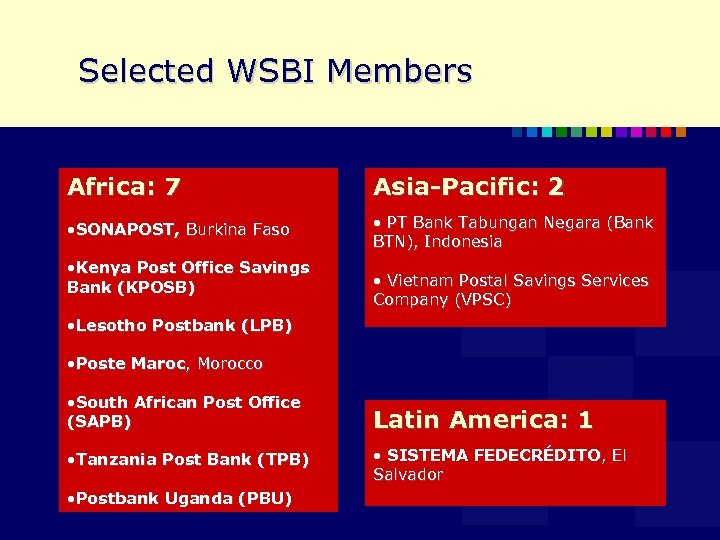
Selected WSBI Members Africa: 7 Asia-Pacific: 2 • SONAPOST, Burkina Faso • PT Bank Tabungan Negara (Bank BTN), Indonesia • Kenya Post Office Savings Bank (KPOSB) • Vietnam Postal Savings Services Company (VPSC) • Lesotho Postbank (LPB) • Poste Maroc, Morocco • South African Post Office (SAPB) Latin America: 1 • Tanzania Post Bank (TPB) • SISTEMA FEDECRÉDITO, El Salvador • Postbank Uganda (PBU)
How do the poor perceive suppliers? § Perception that the bank, or someone else, would take their money if left in an account. Registrations forms: too complicated Passbooks: slow, inaccurate, fraud Keeping money in an account is more expensive (bank charges) than to receive payments at a goods store or in cash. Bank branches too far away Queues are unbearably long. § Lack of understanding and confidence in using an ATM machine. § Agents cash shortages, sometimes not authorized to accept deposits, affected by robbery § Inappropriate staff attitudes § § §
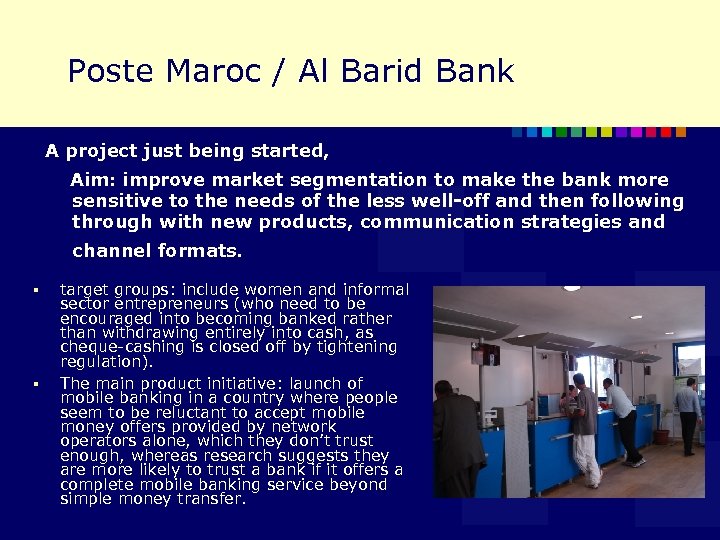
Poste Maroc / Al Barid Bank A project just being started, Aim: improve market segmentation to make the bank more sensitive to the needs of the less well-off and then following through with new products, communication strategies and channel formats. § § target groups: include women and informal sector entrepreneurs (who need to be encouraged into becoming banked rather than withdrawing entirely into cash, as cheque-cashing is closed off by tightening regulation). The main product initiative: launch of mobile banking in a country where people seem to be reluctant to accept mobile money offers provided by network operators alone, which they don’t trust enough, whereas research suggests they are more likely to trust a bank if it offers a complete mobile banking service beyond simple money transfer.
Human capital issues from the programme § § § Understanding amongst member banks is now moving from what prevents the client from accessing services towards what prevents banks from providing accessible services to the client Improving staff sensitivity to the needs of poor people and proficiency in the execution of the savings services designed for them Market sensitisation and training staff is a bigger necessary investment than IT systems and equipment
Conclusions § At a global level, ‘up-skilling’ is back in vogue § More people want to save than borrow § Staff training & marketing to the customer where he or she is at is just as important as infrastructure investment
For further info: www. savings-banks. com e-mail: info@savings-banks. com
Скачать презентацию WSBI and ESBG Human Capital Investment in
90d8f2da2427a72d170dd9e21f4c6be0.ppt