


 Скачать презентацию Writing Workshop PLOS Neglected Tropical Diseases Updated Nov
9df4ac65c382a1af290a353b1079cfc9.ppt
- Количество слайдов: 72
 Writing Workshop PLOS Neglected Tropical Diseases Updated Nov 2015
 Transforming Science Communication PLOS is a nonprofit publisher and advocacy organization with a mission to accelerate progress in science and medicine by leading a transformation in research communication.
 Scientific Ideas and Discoveries are a Public Good PLOS was founded to realize the potential of digital technology and the Internet to create and promote the most effective means of scientific communication possible.
 All PLOS Journals are Gold Open Access* • Free, immediate access online • Unrestricted distribution and reuse • Author retains rights to attribution and copyright • Papers are deposited in a public online archive, such as Pub. Med Central *Bethesda Principles, April 2003
 Open Access Means Everyone, everywhere can: • Read, redistribute and reuse your research without cost • Including colleagues, policy makers, journalists and the next generation of researchers
 Open Access Does Not Tell You About • The scope of a journal • The quality of a journal • The review process of a journal • Whether the publishing organization is for profit or nonprofit 6
 PLOS Neglected Tropical Diseases The first journal solely devoted to the world’s most neglected tropical diseases Initial support provided by a grant from the Bill and Melinda Gates Foundation Features rigorously peer-reviewed research articles and a robust magazine section to provide a rich forum for the global NTDs community
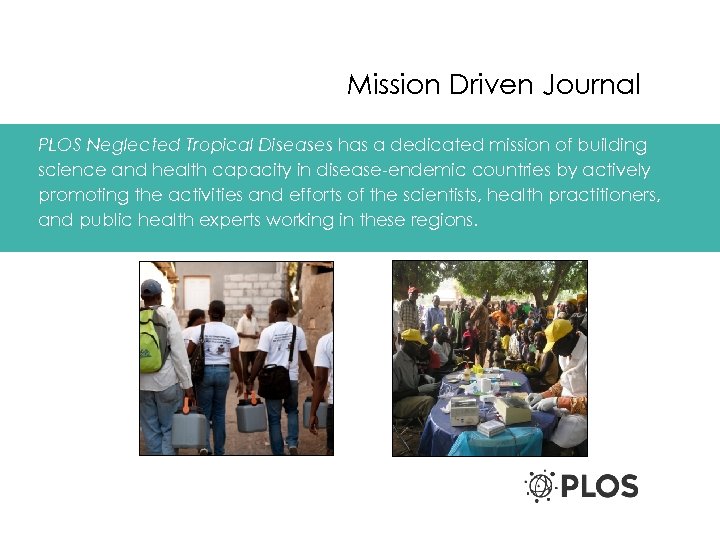 Mission Driven Journal PLOS Neglected Tropical Diseases has a dedicated mission of building science and health capacity in disease-endemic countries by actively promoting the activities and efforts of the scientists, health practitioners, and public health experts working in these regions.
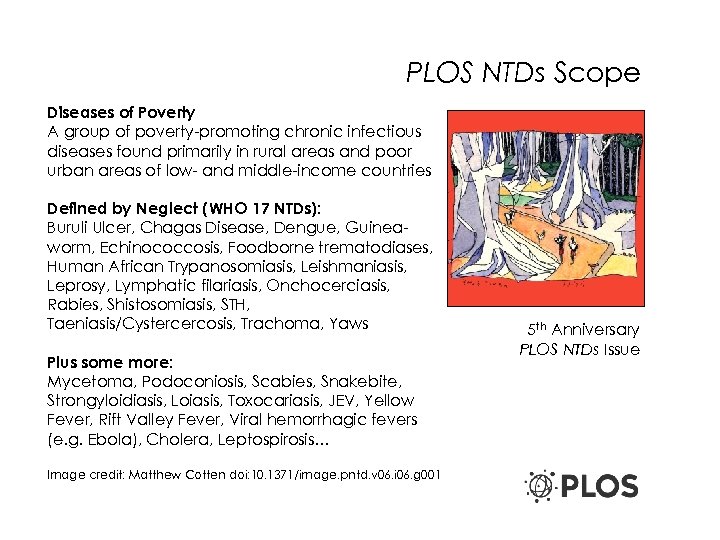 PLOS NTDs Scope Diseases of Poverty A group of poverty-promoting chronic infectious diseases found primarily in rural areas and poor urban areas of low- and middle-income countries Defined by Neglect (WHO 17 NTDs): Buruli Ulcer, Chagas Disease, Dengue, Guineaworm, Echinococcosis, Foodborne trematodiases, Human African Trypanosomiasis, Leishmaniasis, Leprosy, Lymphatic filariasis, Onchocerciasis, Rabies, Shistosomiasis, STH, Taeniasis/Cystercercosis, Trachoma, Yaws Plus some more: Mycetoma, Podoconiosis, Scabies, Snakebite, Strongyloidiasis, Loiasis, Toxocariasis, JEV, Yellow Fever, Rift Valley Fever, Viral hemorrhagic fevers (e. g. Ebola), Cholera, Leptospirosis… Image credit: Matthew Cotten doi: 10. 1371/image. pntd. v 06. i 06. g 001 5 th Anniversary PLOS NTDs Issue
 Capacity, Representation, Access • Diversity of article content covering all aspects of NTDs research ü pathology, epidemiology, prevention, treatment, control, public policy and global health • Broad Collections scope ü from individual diseases to the geopolitics of NTDs • Large magazine section with policy and education focus • 50% acceptance rate • Builds science and health capacity in disease endemic countries ü promotes the efforts of these scientists, health practitioners and public health experts ü publishes research from these authors International conference attendance
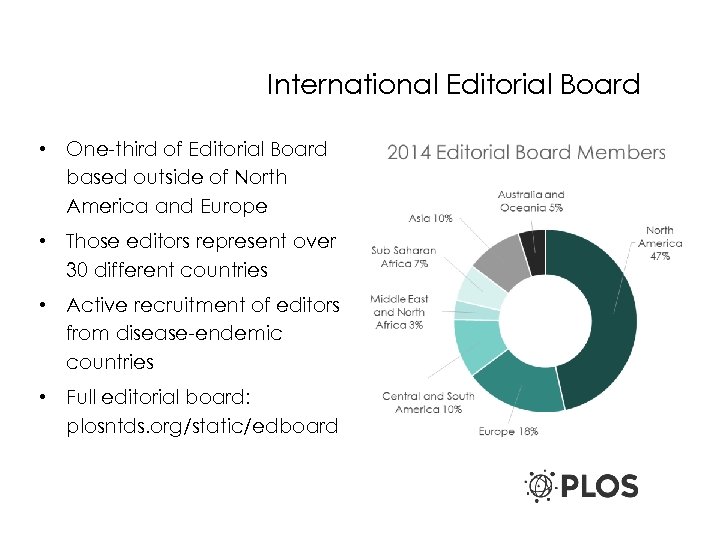 International Editorial Board • One-third of Editorial Board based outside of North America and Europe • Those editors represent over 30 different countries • Active recruitment of editors from disease-endemic countries • Full editorial board: plosntds. org/static/edboard
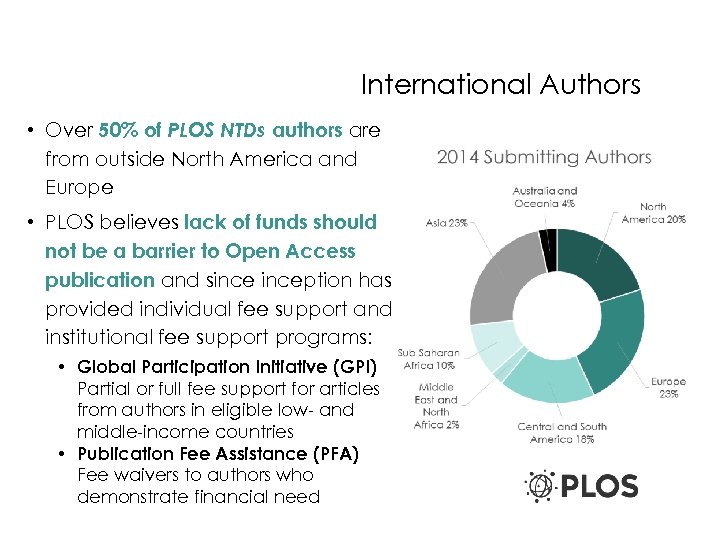 International Authors • Over 50% of PLOS NTDs authors are from outside North America and Europe • PLOS believes lack of funds should not be a barrier to Open Access publication and sinception has provided individual fee support and institutional fee support programs: • Global Participation Initiative (GPI) Partial or full fee support for articles from authors in eligible low- and middle-income countries • Publication Fee Assistance (PFA) Fee waivers to authors who demonstrate financial need
 Let us look at ways to make sure that your results can be successfully published!
 How to Avoid a Rejection Letter from an Editor Dear Sir, Many thanks for asking whether we would like to publish your paper. Your paper is good and original, but unfortunately we are simply not willing to publish it. The trouble is that the good bits were not original and the original bits were not good. Yours faithfully, The Editors
 Why Do Journals Reject Our Utterly Groundbreaking, Brilliant Work? The paper was so poorly written and so poorly structured that the editor simply couldn’t fathom its meaning. Editors are human beings: impressed by papers that are short, easy to read, and contain a clear message. What’s yours?
 Road Map • PREPARATION: things to think about before you even put pen to paper • SELLING YOURSELF: how to capture an editor’s attention • STRUCTURE: without a clear structure, you (and the editor) will be lost • EFFECTIVE WRITING: there are some simple rules that can make a huge difference
 Before You Start Writing, Ask: What? Where? How?
 What is My Message? If the editors cannot work out your single takehome message, they will reject your paper. They will also reject it if you haven’t convinced them of your study’s importance.
 Where Will the Paper End Up? (Audience) • You MUST choose a journal and write for that journal’s audience. • Make sure the journal publishes your type of study. • What does this audience already know about this topic and what do they want to know now? • Read the author guidelines specific for the journal you are submitting to.
 How Will I Write It? (Style) • Read and follow the journal’s author guidelines and style guide • Make sure you’ve followed the guidelines for specific types of studies: • RCTs: CONSORT • Systematic reviews: PRISMA • Observational epi: STROBE • Studies of diagnostic accuracy: STARD • Microarray data: MIAME
 There are many resources that provide technical and editorial help to new authors especially from DEC settings. TAKE ADVANTAGE !
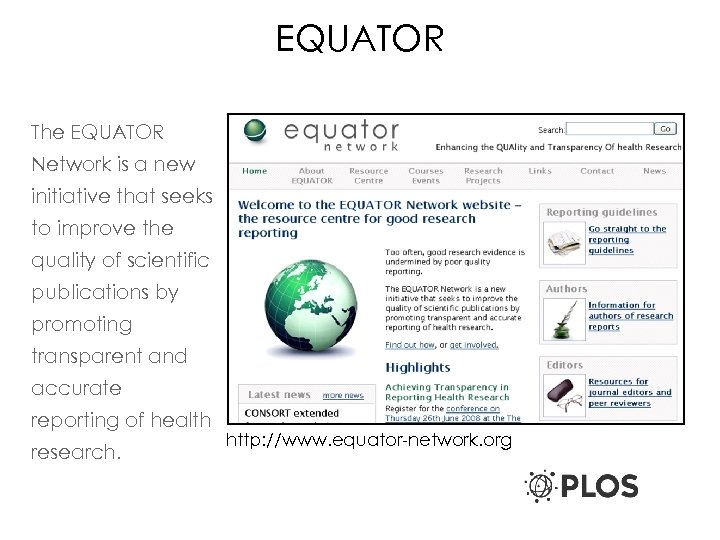 EQUATOR The EQUATOR Network is a new initiative that seeks to improve the quality of scientific publications by promoting transparent and accurate reporting of health research. http: //www. equator-network. org
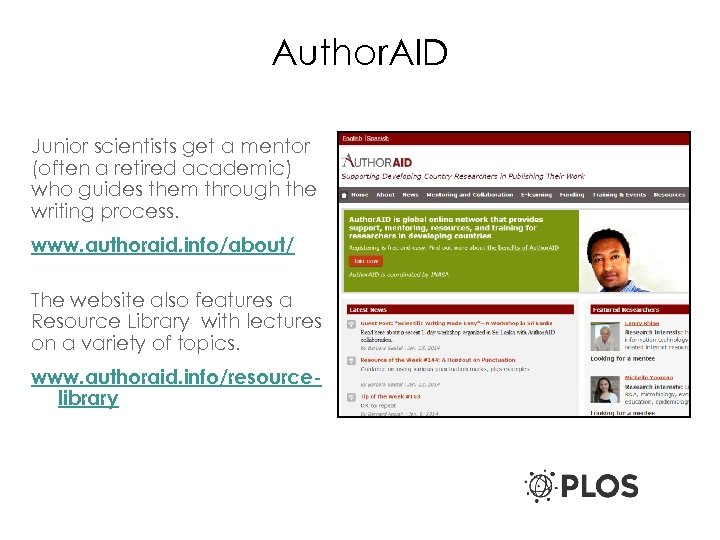 Author. AID Junior scientists get a mentor (often a retired academic) who guides them through the writing process. www. authoraid. info/about/ The website also features a Resource Library with lectures on a variety of topics. www. authoraid. info/resourcelibrary
 Writing Your Paper
 The First Step: Editorial Triage Criteria • • • Is the scope within our journal’s interest? Does this article have a clear message? Is it original? Is it important? Is it true? Is it relevant to our readers? You have to “sell yourself” to get through triage
 What Is the First Thing an Editor Looks At?
 The Cover Letter is Crucial • Don’t waste the opportunity to “sell” your work • Don’t write something dull or derivative: “Please consider this manuscript for publication in your esteemed journal” • Do tell the editor why they should take your work seriously
 Pre-submission Inquiry Saves time if you are not sure about the suitability of your research for the journal’s interests Evaluated based on your abstract
 What Is the Second Thing an Editor Looks At?
 The Title: Make It Compelling • Concise and informative • Should contain the most important words related to the topic • Entices the reader without giving away the punch-line • Not overly-sensationalized • Some journals now insist on including information on study design
 Sample Research Article Titles Bad Title: The amazing effect of bednets on malaria Good Title: A randomized controlled trial of efficacy of insecticide treated bednet use for malaria control
 Titles of News Stories/Editorials/ Commentaries Bad Titles: Doctor in fraud case Stress in doctors Better Titles: Doctor convicted in $4 m fraud case Stress levels in doctors soar to a new high GOOD PRACTICE POINT (GPP): Editorials/commentaries/news: put a verb in the title
 What Is the Third Thing an Editor Looks At?
 The Abstract MANY JOURNALS NOW BASE THEIR DECISIONS ON THE ABSTRACT ALONE • Sadly, many authors write the abstract in a great rush, almost as an afterthought. • It should be a concise “standalone” piece with a very clear message. • It must accurately reflect the full text of the paper. • Why did you do the study? What did you do? What did you find? What did you conclude?
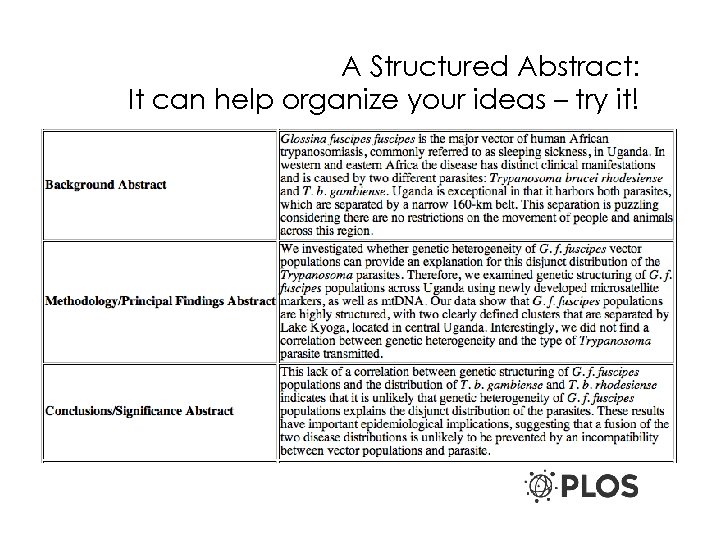 A Structured Abstract: It can help organize your ideas – try it!
 Abstract Writing Tips • Many students and researchers use search engines to look for information • In search engine terms, the title of your article is the most interesting element • Reiterate key words or phrases from the title in your abstract • Best to focus on a maximum of 3 -4 different keyword phrases in the abstract
 Structure: The Most Crucial Element Readers should know throughout the piece: Where they’ve come from Where they are now Where they are heading
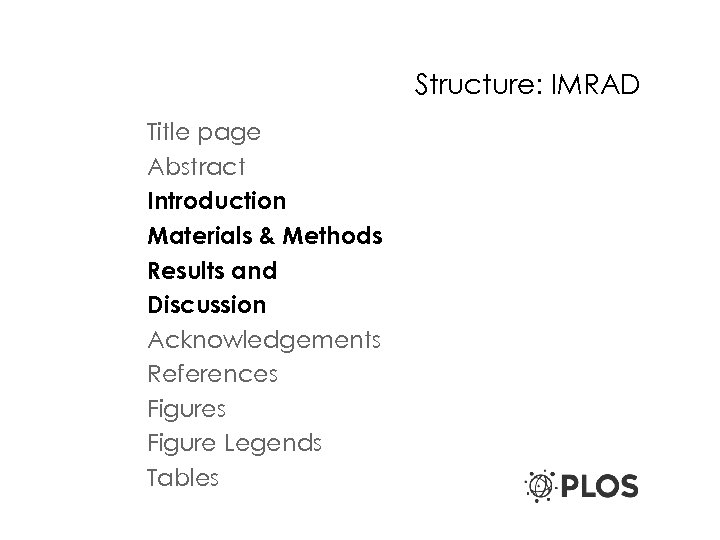 Structure: IMRAD Title page Abstract Introduction Materials & Methods Results and Discussion Acknowledgements References Figure Legends Tables
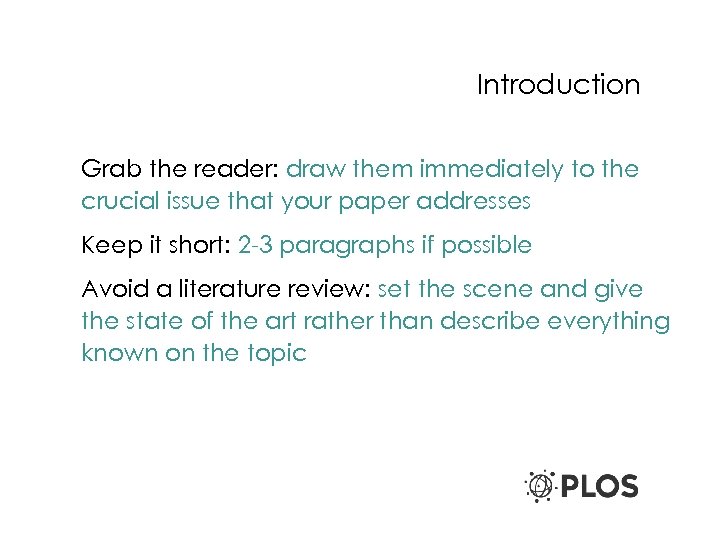 Introduction Grab the reader: draw them immediately to the crucial issue that your paper addresses Keep it short: 2 -3 paragraphs if possible Avoid a literature review: set the scene and give the state of the art rather than describe everything known on the topic
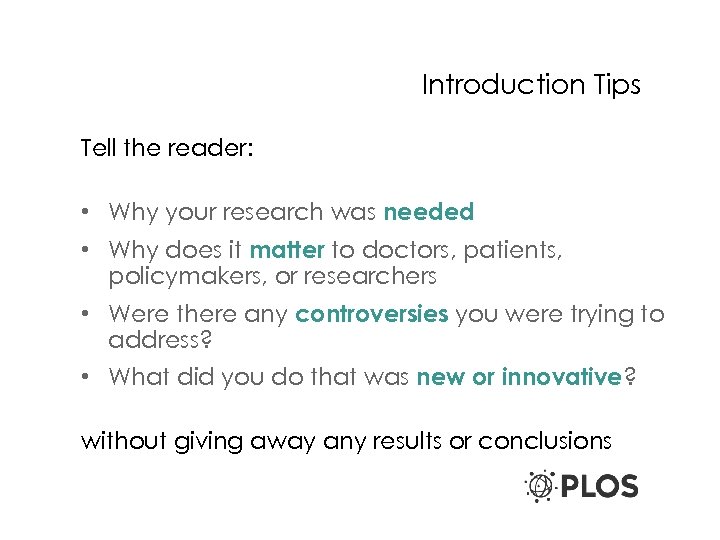 Introduction Tips Tell the reader: • Why your research was needed • Why does it matter to doctors, patients, policymakers, or researchers • Were there any controversies you were trying to address? • What did you do that was new or innovative? without giving away any results or conclusions
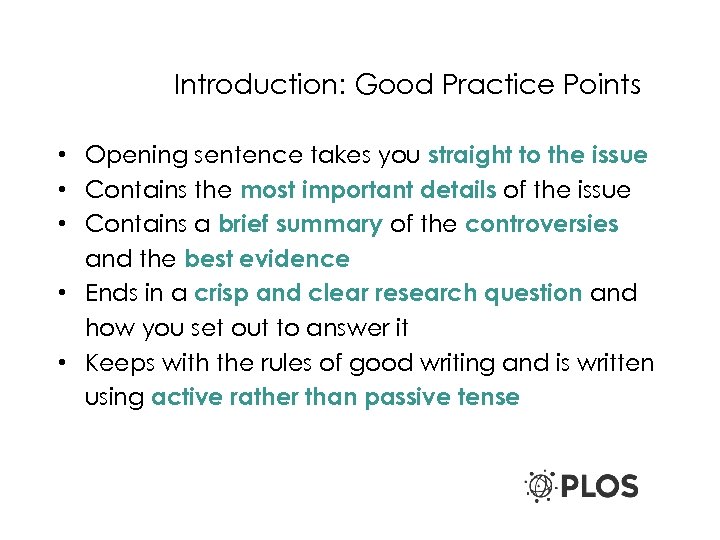 Introduction: Good Practice Points • Opening sentence takes you straight to the issue • Contains the most important details of the issue • Contains a brief summary of the controversies and the best evidence • Ends in a crisp and clear research question and how you set out to answer it • Keeps with the rules of good writing and is written using active rather than passive tense
 Methods • Crucial in the triage process • Extremely common for editors to reject a paper because authors used the wrong method to answer their question • Give enough detail so that a qualified reader could repeat the study • If your methods section is “thin on details” editors worry that you are hiding something
 Methods: Quantitative Studies The editor will focus on 6 things: • • • Design Sample Intervention Outcomes Measures Data Analysis Ethics: informed consent & IRB approval Walk the editor through by dividing the Methods section with 6 subheads
 Design: State Clearly the Design Used • • • Observational or interventional? Prospective or retrospective? Controlled or uncontrolled? If controlled, randomized or not? For randomized controlled studies, exactly how was the randomization done ? • What was the unit of randomization? • Was it a cohort study, cross-sectional survey or case-controlled study?
 Biological Samples: How Did You Choose Them? • How did you determine your sample size? (include the power calculation) • How did you recruit participants? • How did you ensure that your sample was representative of the population you wanted to study? • What measures did you use to reduce bias in the way you chose your sample? • What were your inclusion and exclusion criteria?
 Intervention • Describe the intervention you studied and what happened to the control group. • What measures did you take to blind participants to which group they were in? • Could contamination of the groups have occurred?
 Outcome Measures • Which outcomes did you decide to measure when you designed your study? • Specify your primary and secondary outcomes. • Did you use a validated tool to measure these? • What steps did you use to reduce bias in the recording of outcomes?
 Data Analysis What statistical methods did you use to analyze your data?
 Ethical Considerations Informed consent Institutional review board approval IRB approval from DEC countries needed as well Studies involving human participants must include IRB approval information and proof that participants gave their written informed consent to be entered in the trial. Paper will be held up from review if ethical considerations are not sufficiently described.
 Methods: Qualitative Studies The editor will focus on 5 things: • Was a qualitative approach appropriate? ü Qualitative: What stops people from using bednets? ü Quantitative: What proportion of people in Tanzania use bednets? • How were the setting and the subjects selected? • Have the authors been explicit about their own views on the issue being studied? • What methods did the researcher use for collecting data, and are these described in enough detail? • What methods did the researcher use to analyze the data, and what quality control measures were implemented?
 Figures and Tables • Each figure or table should have one standalone message • Don’t overload figures or tables with numbers or text • Figures and tables should be entirely understandable on their own, without reference to the whole paper or need to read Methods or Results • Do not discuss what your findings mean in figure legends
 Results: The Facts and Nothing But the Facts • Should be ordered around primary and secondary outcomes in the same order as listed in the Methods section • State clearly and simply what you found using words and numbers • Use tables and figures for the main numbers • Don’t duplicate information in text and tables
 Discussion • Don’t write an expansive essay that extrapolates widely from what you found • Start the discussion with a single sentence that states your main findings • Discuss both strengths and weaknesses
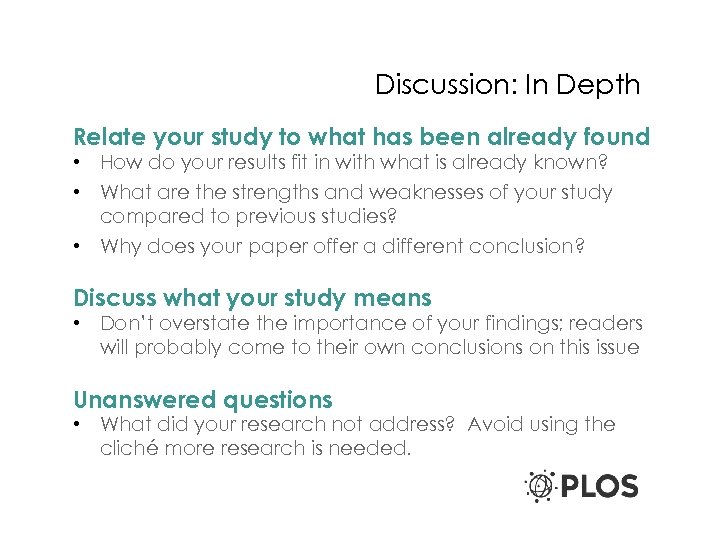 Discussion: In Depth Relate your study to what has been already found • How do your results fit in with what is already known? • What are the strengths and weaknesses of your study compared to previous studies? • Why does your paper offer a different conclusion? Discuss what your study means • Don’t overstate the importance of your findings; readers will probably come to their own conclusions on this issue Unanswered questions • What did your research not address? Avoid using the cliché more research is needed.
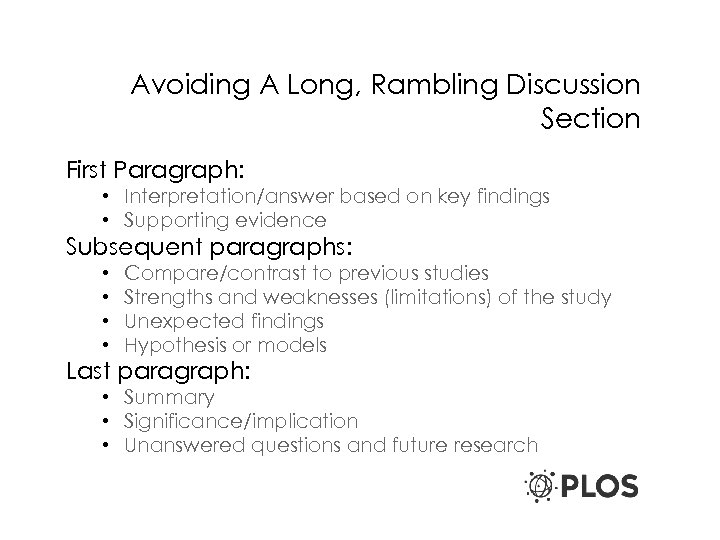 Avoiding A Long, Rambling Discussion Section First Paragraph: • Interpretation/answer based on key findings • Supporting evidence Subsequent paragraphs: • • Compare/contrast to previous studies Strengths and weaknesses (limitations) of the study Unexpected findings Hypothesis or models Last paragraph: • Summary • Significance/implication • Unanswered questions and future research
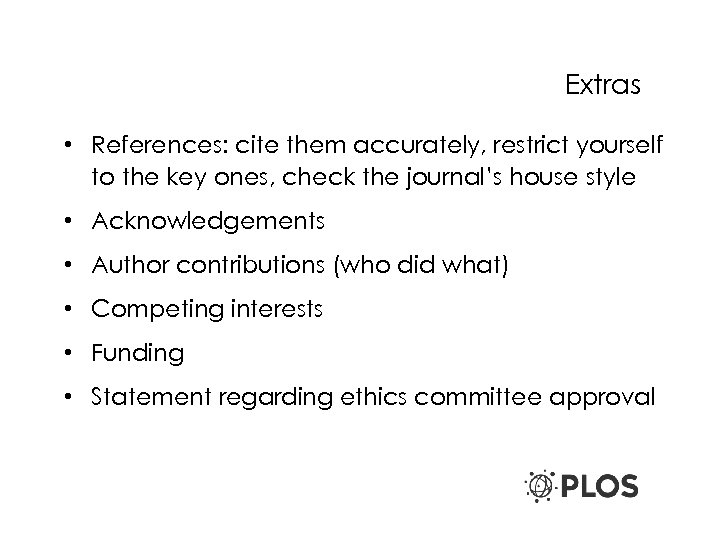 Extras • References: cite them accurately, restrict yourself to the key ones, check the journal’s house style • Acknowledgements • Author contributions (who did what) • Competing interests • Funding • Statement regarding ethics committee approval
 Some Rules of Writing
 The Basics • Avoid long words, long sentences and passive tense: “We concluded” not “It can be concluded that” • One or two complex ideas max in one sentence • Short sentences (average 20 words, never longer than 50 words) • Cut out unnecessary adjectives • Avoid jargon, use short and simple words • Avoid double negatives: “Malaria is not uncommon”
 Clear Writing Techniques • Signal the research question • Keep a consistent order • Repeat key terms • Keep a consistent point of view • Put parallel ideas in a parallel form • Use topic sentences with transitions and key terms Zieger, M. (2000) Essentials of Writing Biomedical Research Papers, 2 nd Ed
 Signal the Question • Lets the reader know explicitly what is the research question being addressed • Sets up an expectation for the rest of the paper (or grant) • Use explicit phrases • Use question words (whether or which) • State the hypothesized effect • Identify the type of variables and study design
 Keep a Consistent Order • • Ideas must be well organized Each paragraph captures just one topic Each sentence has just one idea Paragraph structure üThe first sentence of each paragraph captures the main message üTopic sentence should be followed by supporting sentences üExplicit relationship must exist between sentences üExplicit relationship must also exist between paragraphs and between sections
 Topic Sentences with Transitions and Key Terms • Use a global topic sentence at the beginning of each section • Use another topic sentence at the beginning of each paragraph within the section • Use transition words, phrases, and/or clauses that contain key terms in the topic sentences ü Key terms are words or phrases that describe important concepts, variables, research methods or study groups ü This is the strongest technique for providing continuity ü Key terms unmistakably link together sentences, paragraphs and sections
 Writing is “not a test of personal worth but a tool for achieving a particular objective. When your writing achieves what you set out to do, then you can consider it a good piece of writing and get on with your life. ” Tim Albert, trainer in medical writing
 Setting Aside Time to Write It can be a major challenge to find time to write. Most professional writers recommend: • Setting aside 20 minutes every day to write • Planning before you write • Only the best and most practiced can effectively squeeze it in between other work
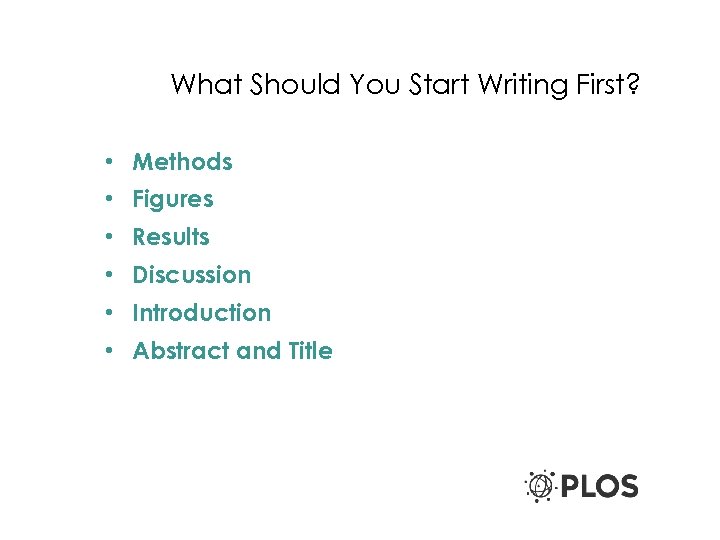 What Should You Start Writing First? • Methods • Figures • Results • Discussion • Introduction • Abstract and Title
 Reviewers Will Request Revisions How to respond: Fully incorporate reviewers’ suggestions into a revised manuscript Address all reviewer concerns in your rebuttal letter Address rebuttal letter to the editor
 Paper Rejected! If you genuinely think that your research was important, well done, well-written and deserves to reach the journal's audience, you can write an appeal letter to the editor.
 The Bottom Line: You Will Get Published If… • You picked an important research question • You used the right method to answer it • You wrote a short, clear account of the study that followed a tight structure and used effective writing to convey your message clearly • You keep in mind that science has become more cross-disciplinary, but reviewers have not
 How the Editorial Office Can Help • Trial registration • Data deposition • Reporting guidelines • Ethical approval • Data availability • Competing interests • Financial disclosures • Permissions
 What Do We Ask Reviewers to Check? • Methods • Techniques • Concepts • Statistics • Presentation • Conclusions • Ethics
 After Publication: Understanding Impact • Impact Factor : #citations/#articles ü ü Rates journal, not article Not a good measure of individual performance Subject to manipulation (denominator) Used nonetheless in assessments for funding, promotion and tenure • How and where to advance better alternatives? ü Promotions committees ü Funding agencies ü Within the scientific community
 Connect with PLOS NTDs plosntds. org How to Submit: plosntds. org/static/checklist Blog: blogs. plos. org/speakingofmedicine Twitter: @PLOSNTDs Contact: plosntds@plos. org