Скачать презентацию Writing in English as an additional language in
ec150c0be677a680023b8436ba0d7a0a.ppt
- Количество слайдов: 68
 Writing in English as an additional language in UK schools Lynne Cameron University of Leeds
 The research projects z. KS 4 and post-16: OFSTED funded (2003) z. KS 2: Df. ES funded (2004) z“Writing in EAL” z. Aims: yto identify in detail features of written English that bilingual students find difficult, and thus enable teachers to address them more systematically in their teaching.
 Research procedures z. Scripts and writer details provided by schools. z. Close analysis of scripts. z. Comparison of results across three groups: y. EAL students achieving at average or below y. English mother tongue (EMT) peer group y. High achieving EAL students
 Key Stage 4 z. Year 11 students z. Mock GSCE exams - English and other subjects. z. Focus group (N=103) y. EAL, at least 5 years in UK, C/D borderline or below in English GCSE y. Gujerati, Punjabi, Bengali, Urdu + others y. Time in UK education: 10 years 4 months.
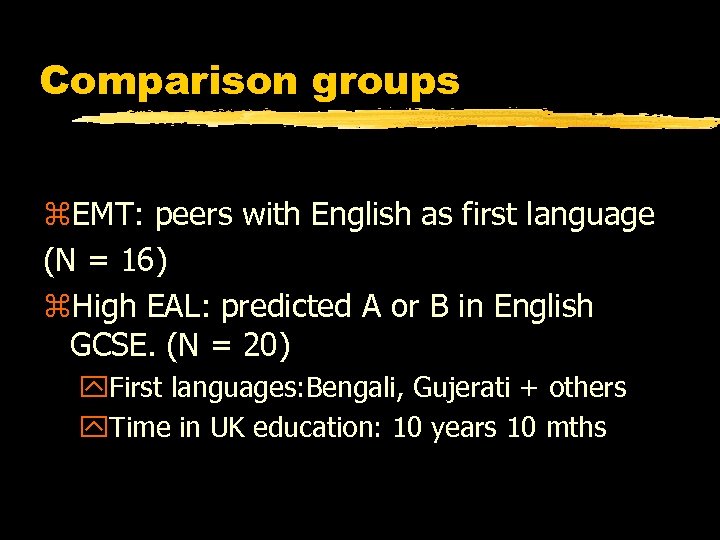 Comparison groups z. EMT: peers with English as first language (N = 16) z. High EAL: predicted A or B in English GCSE. (N = 20) y. First languages: Bengali, Gujerati + others y. Time in UK education: 10 years 10 mths
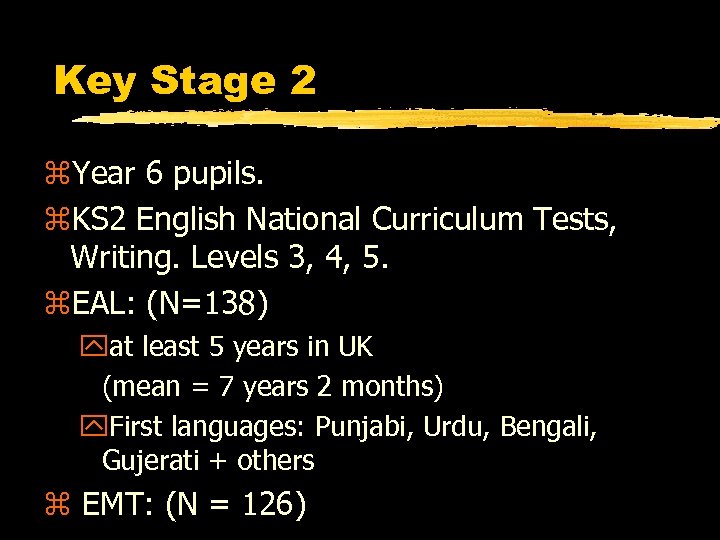 Key Stage 2 z. Year 6 pupils. z. KS 2 English National Curriculum Tests, Writing. Levels 3, 4, 5. z. EAL: (N=138) yat least 5 years in UK (mean = 7 years 2 months) y. First languages: Punjabi, Urdu, Bengali, Gujerati + others z EMT: (N = 126)
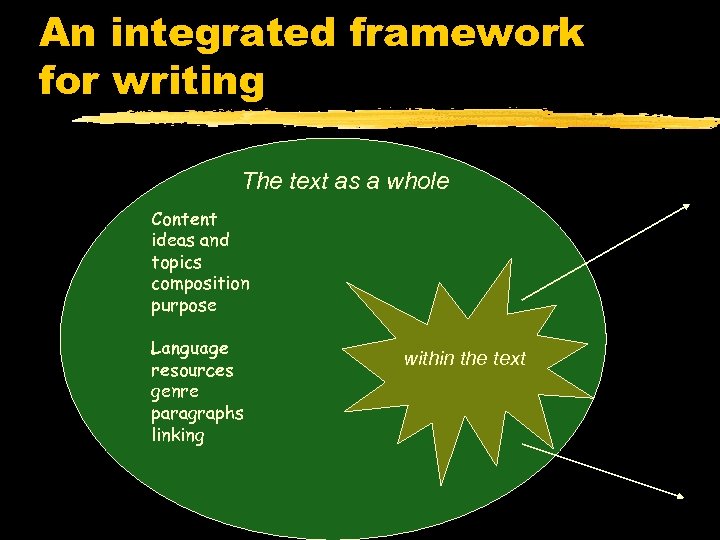 An integrated framework for writing The text as a whole Content ideas and topics composition purpose Language resources genre paragraphs linking within the text
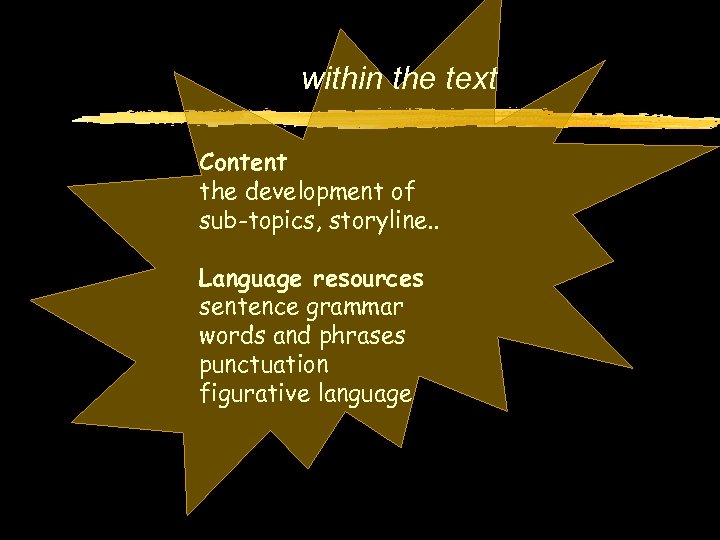 within the text Content the development of sub-topics, storyline. . Language resources sentence grammar words and phrases punctuation figurative language
 Evaluating the whole text: Genres as socially conventionalised ways of writing: a letter to a newspaper (KS 4) a story, a radio advert (KS 2) yformat ystyle yvoice and purpose ystance Does the writer consistently and effectively use the genre required?
 Format z. Letter openings and closings òExplicit teaching of format seemed to help EAL students.
 KS 4 Findings - style òEAL students need support in developing their awareness of degrees of formality and the language typical of different genres (rhetorical adaptability). ò High EAL students need more advanced awareness to judge nuances of style. ò EMT students need more familiarity with written genres and their language.
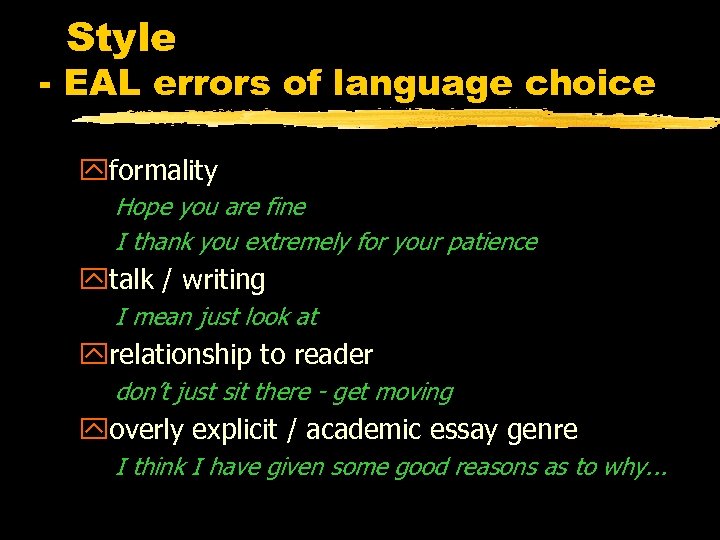 Style - EAL errors of language choice yformality Hope you are fine I thank you extremely for your patience ytalk / writing I mean just look at yrelationship to reader don’t just sit there - get moving yoverly explicit / academic essay genre I think I have given some good reasons as to why. . .
 KS 4 Findings - voice and purpose z. Writing in specific genres requires students to adopt and use multiple layers of voices. This seemed to lead to confusion about the writer’s role and purpose, audience, and how to address the audience.
 KS 4 Findings - Content and Linking Ideas z. Texts were too short. z. Focus EAL group had most problems with content. z. Some had ideas but did not express them clearly. z. Ideas were not developed into detail. z. Paragraphing was not used well, by all writers.
 To produce extended writing on a topic needs. . . za range of connected ideas about the topic zdevelopment of each idea zconnections made between the ideas as the writing progresses zlinking the sequence of ideas to the topic and to the purpose of the writing.
 Finding ideas to write about zyour experience zyour world knowledge ztask materials yreading demands yunfamiliar contexts ydifferent genre and register y. KS 2: pictures
 Developing an idea zget more precise zgive examples zexplain connections
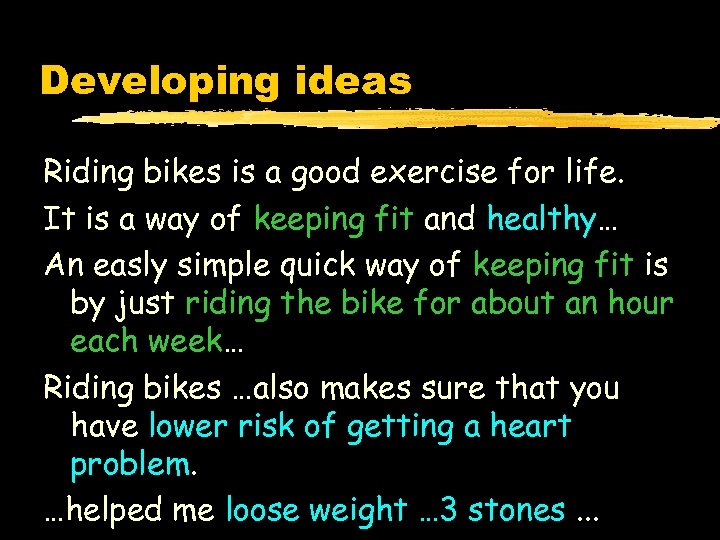 Developing ideas Riding bikes is a good exercise for life. It is a way of keeping fit and healthy… An easly simple quick way of keeping fit is by just riding the bike for about an hour each week… Riding bikes …also makes sure that you have lower risk of getting a heart problem. …helped me loose weight … 3 stones. . .
 Generating ideas to write about z. Think yourself into the writer’s role in the genre and situation. z. Use of drama to clarify voice and purpose. z. Practise changing voice and style. z. Brainstorm, mind-map around key words. z. Break topics down into sub-topics. z. Extract key words from task materials and use for ideas.
 Story genre: format zsetting zcharacters zproblem zresolution z(moral)
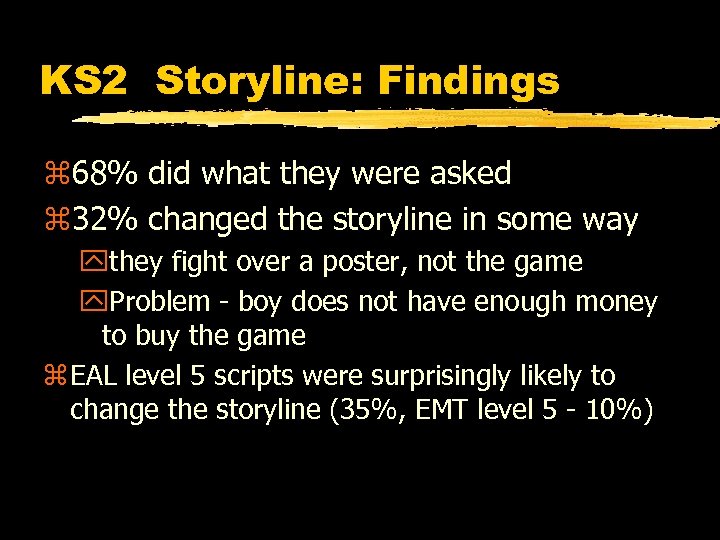 KS 2 Storyline: Findings z 68% did what they were asked z 32% changed the storyline in some way ythey fight over a poster, not the game y. Problem - boy does not have enough money to buy the game z EAL level 5 scripts were surprisingly likely to change the storyline (35%, EMT level 5 - 10%)
 Why, and does it matter? z. Do EAL students interpret the pictures in the same way as EMT / as intended? z. Do EAL students attach less importance to sticking close to the storyline? z. Do they change because of difficulties finding the language to describe the given storyline? z. Does it matter in NC tests?
 Narrative development strategies z. Description z. Direct Speech z. Figurative language - metaphors and similes.
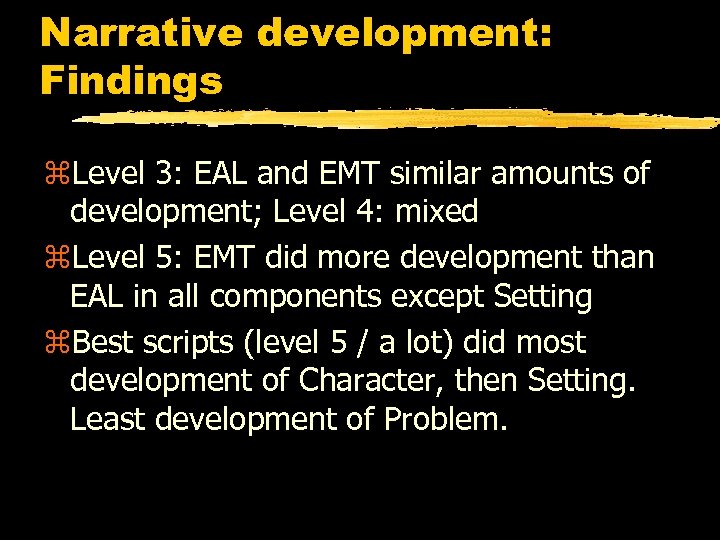 Narrative development: Findings z. Level 3: EAL and EMT similar amounts of development; Level 4: mixed z. Level 5: EMT did more development than EAL in all components except Setting z. Best scripts (level 5 / a lot) did most development of Character, then Setting. Least development of Problem.
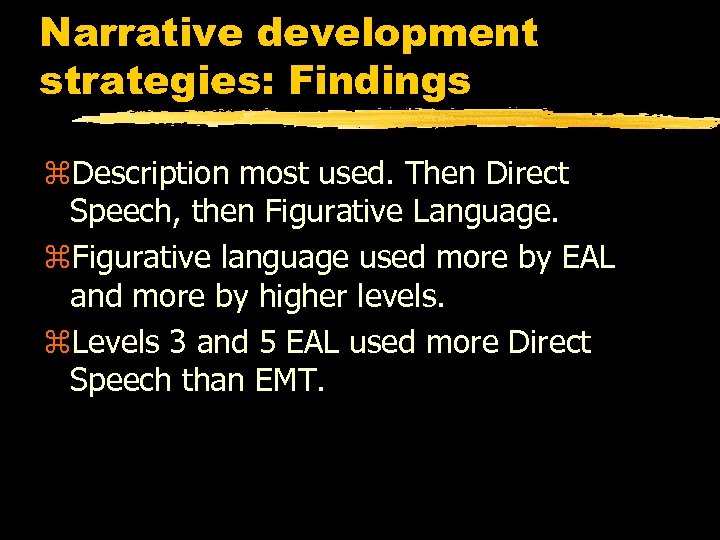 Narrative development strategies: Findings z. Description most used. Then Direct Speech, then Figurative Language. z. Figurative language used more by EAL and more by higher levels. z. Levels 3 and 5 EAL used more Direct Speech than EMT.
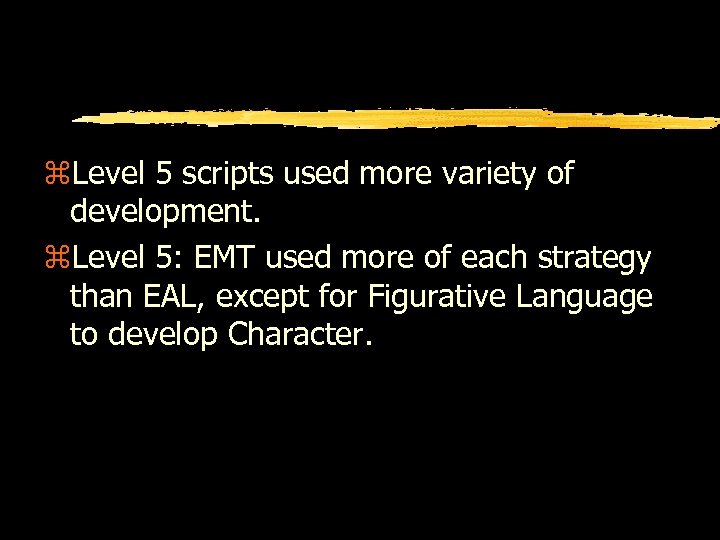 z. Level 5 scripts used more variety of development. z. Level 5: EMT used more of each strategy than EAL, except for Figurative Language to develop Character.
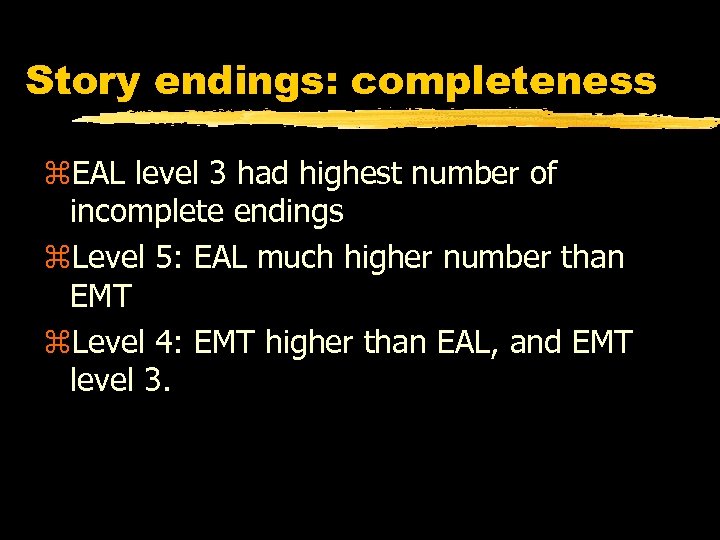 Story endings: completeness z. EAL level 3 had highest number of incomplete endings z. Level 5: EAL much higher number than EMT z. Level 4: EMT higher than EAL, and EMT level 3.
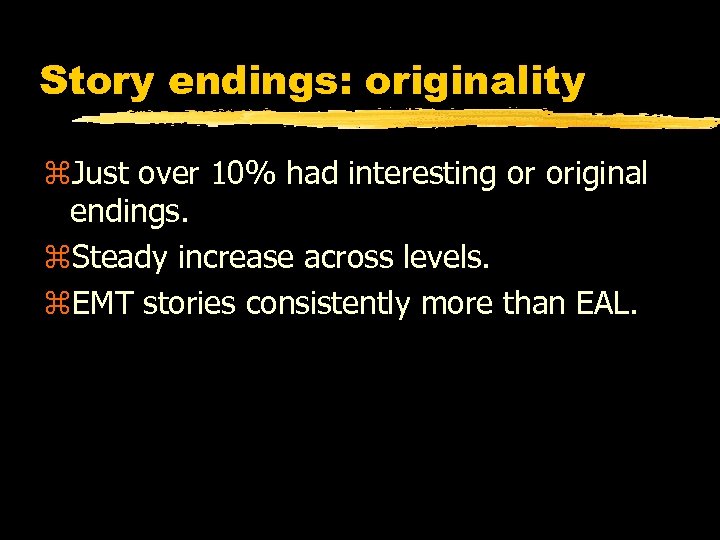 Story endings: originality z. Just over 10% had interesting or original endings. z. Steady increase across levels. z. EMT stories consistently more than EAL.
 Helping with endings z. Listen to and read stories with different types of endings. z. Notice how writers end their stories and the effect on the reader of a satisfying ending. z. Work out how a story will end before starting to write. z. Write a story with a given ending.
 Paragraphing: Findings z. Use varied by level, rather than language. z. Level 3: 20% of stories showed no use of paragraphs. z. Overall use of paragraphing better than in Key Stage 4 project.
 Evaluating language use within the text z. Sentence level language y. What use is made of the possibilities of English clauses and sentence grammar? z. Words and Phrases y. What use is made of the possibilities of phrases within clauses? y. Range of vocabulary used. z. Accuracy y. How accurate is the use of language?
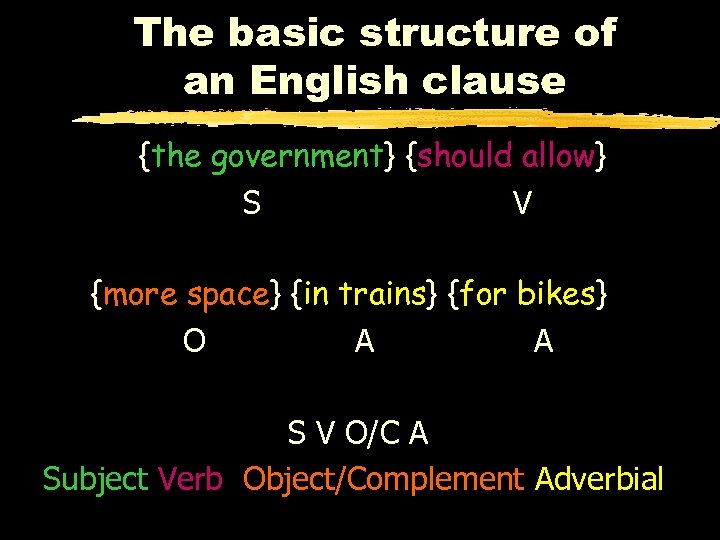 The basic structure of an English clause {the government} {should allow} S V {more space} {in trains} {for bikes} O A A S V O/C A Subject Verb Object/Complement Adverbial
 Joining clauses z. Co-ordination and, but, or z. Sub-ordination when, if, because, who, that
 KS 4 Findings - sentence and clause grammar z. High EAL make most use of grammar resources z. High EAL show most variety in clause and sentence types. z. Focus EAL use simple clause and sentence structure.
 Sub-ordinators z. Basic sub-ordinators: that, because, if, so, as, when, who z. Advanced sub-ordinators: which, where, although, after, until, unless etc. z. High EAL made twice as much use of ‘advanced sub-ordinators’ as Focus and EMT.
 Sub-ordination at KS 4 • High EAL used lowest number of subordinators. • EMT used most. • High EAL used most variety of sentence types.
 Subordination at KS 2 • Different pattern from KS 4. • EMT use more subordination than EAL. • For both groups, the amount of subordination increases from level 3 to level 4 to level 5. • Does the use of variety of clause types come with maturity?
 z. At KS 4, very little use of Subject relative clauses: the people (who) I talked to all agreed … z. At KS 2, EAL use more Subject relative clauses than EMT. z. Not much use of Adverbial clauses: As you may already know, there are. . .
 Filling the Adverbial slot: non-finite clauses z. High EAL used more non-finite clauses, I have written this letter to tell you my reasons By Burning body fat and raising your metabolic rate, you can loose weight zbut there were very few of the more advanced types of non-finite clause: after listing the reasons, … in agreeing to this, …
 Filling the Adverbial slot z. More Adverbials could be used. z. More phrases could be extended into clauses.
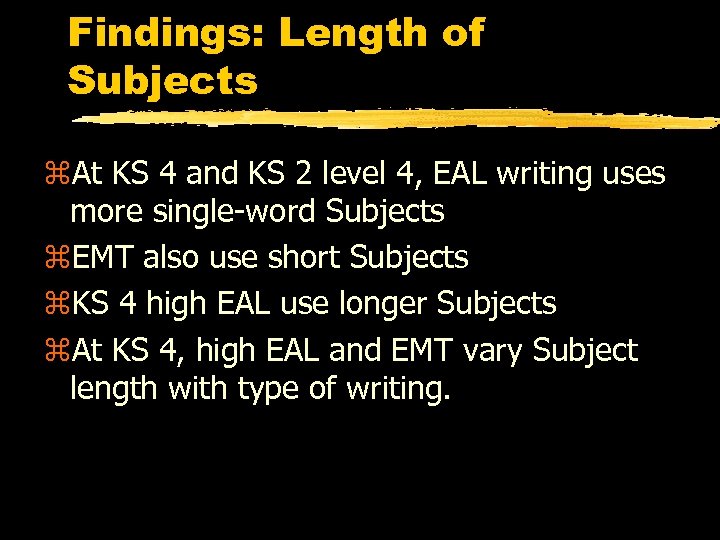 Findings: Length of Subjects z. At KS 4 and KS 2 level 4, EAL writing uses more single-word Subjects z. EMT also use short Subjects z. KS 4 high EAL use longer Subjects z. At KS 4, high EAL and EMT vary Subject length with type of writing.
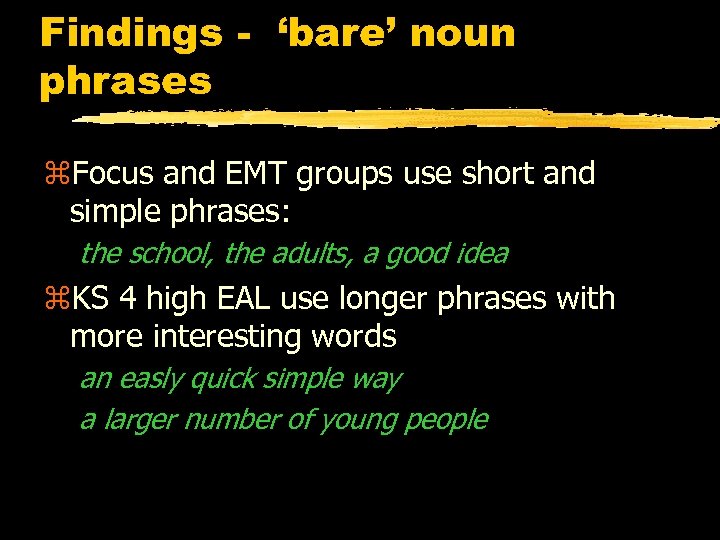 Findings - ‘bare’ noun phrases z. Focus and EMT groups use short and simple phrases: the school, the adults, a good idea z. KS 4 high EAL use longer phrases with more interesting words an easly quick simple way a larger number of young people
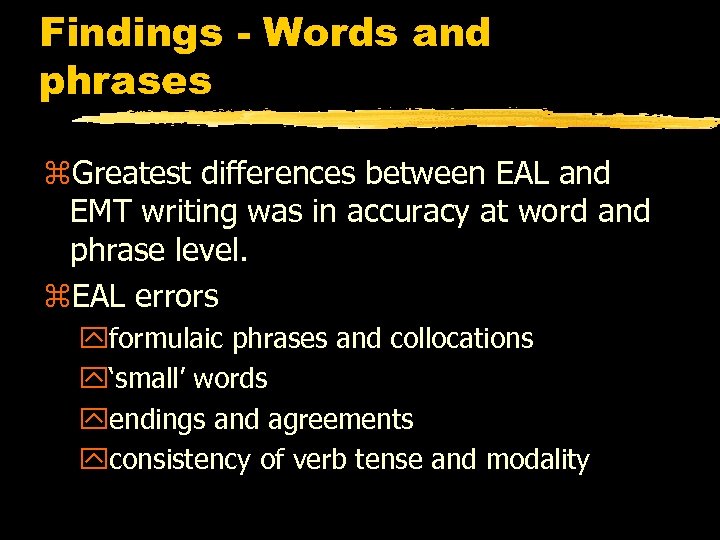 Findings - Words and phrases z. Greatest differences between EAL and EMT writing was in accuracy at word and phrase level. z. EAL errors yformulaic phrases and collocations y‘small’ words yendings and agreements yconsistency of verb tense and modality
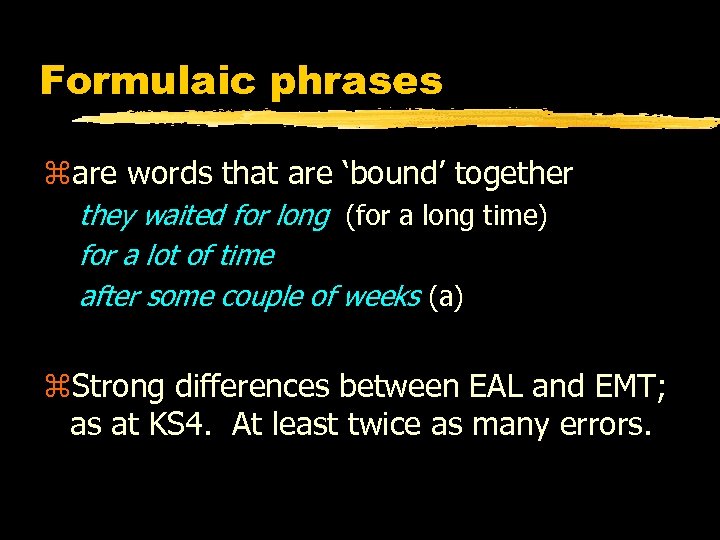 Formulaic phrases zare words that are ‘bound’ together they waited for long (for a long time) for a lot of time after some couple of weeks (a) z. Strong differences between EAL and EMT; as at KS 4. At least twice as many errors.
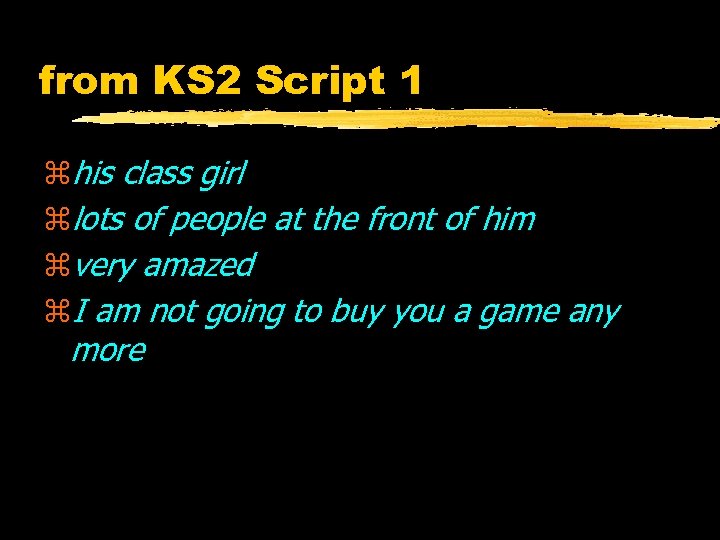 from KS 2 Script 1 zhis class girl zlots of people at the front of him zvery amazed z. I am not going to buy you a game any more
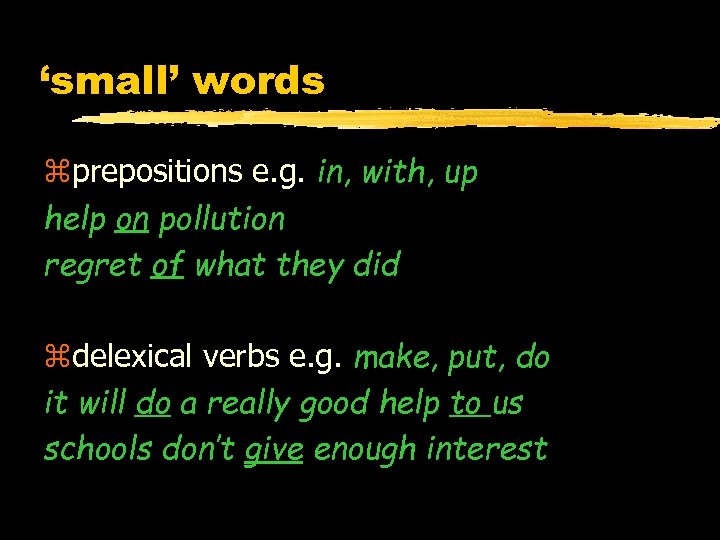 ‘small’ words zprepositions e. g. in, with, up help on pollution regret of what they did zdelexical verbs e. g. make, put, do it will do a really good help to us schools don’t give enough interest
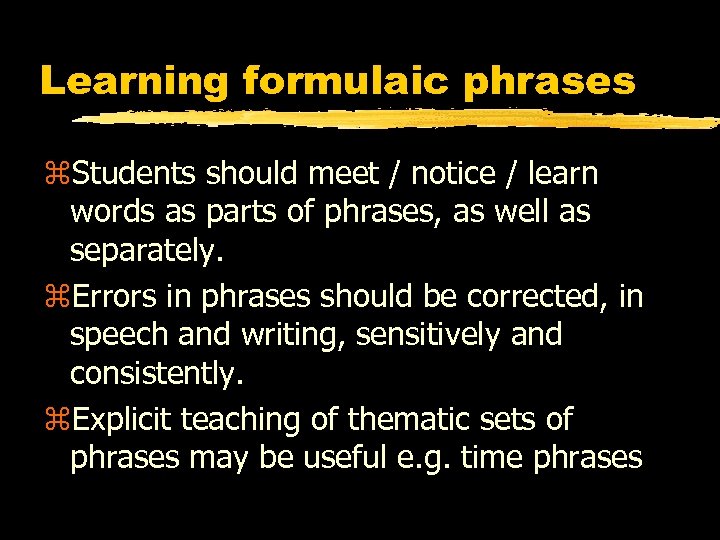 Learning formulaic phrases z. Students should meet / notice / learn words as parts of phrases, as well as separately. z. Errors in phrases should be corrected, in speech and writing, sensitively and consistently. z. Explicit teaching of thematic sets of phrases may be useful e. g. time phrases
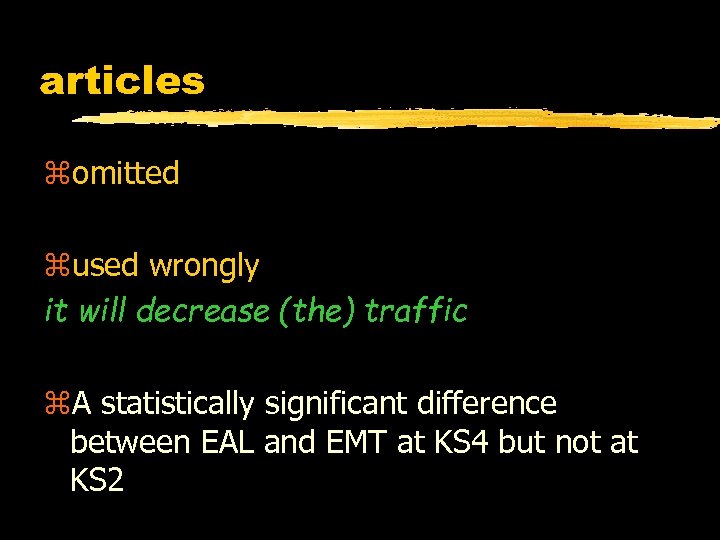 articles zomitted zused wrongly it will decrease (the) traffic z. A statistically significant difference between EAL and EMT at KS 4 but not at KS 2
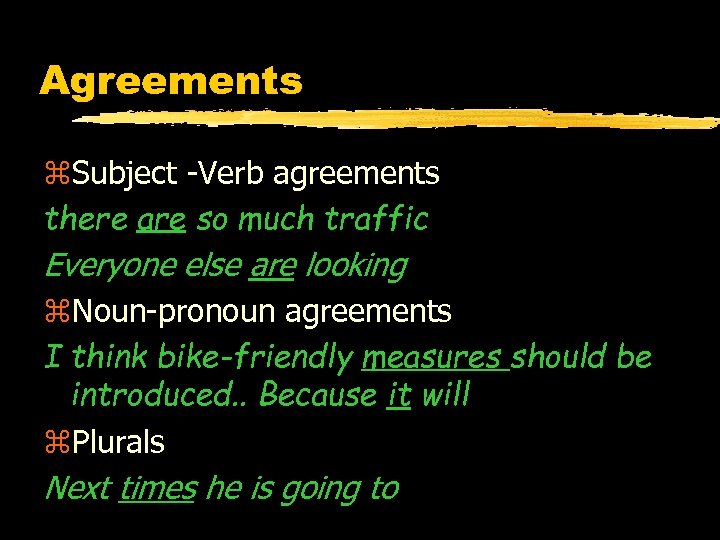 Agreements z. Subject -Verb agreements there are so much traffic Everyone else are looking z. Noun-pronoun agreements I think bike-friendly measures should be introduced. . Because it will z. Plurals Next times he is going to
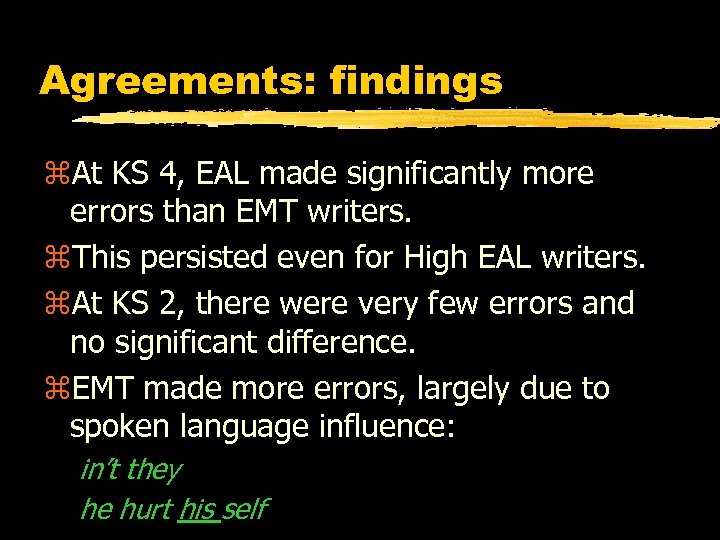 Agreements: findings z. At KS 4, EAL made significantly more errors than EMT writers. z. This persisted even for High EAL writers. z. At KS 2, there were very few errors and no significant difference. z. EMT made more errors, largely due to spoken language influence: in’t they he hurt his self
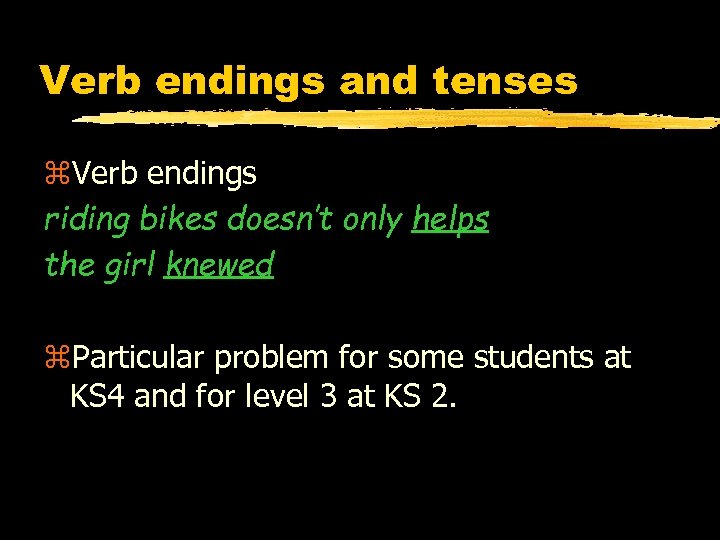 Verb endings and tenses z. Verb endings riding bikes doesn’t only helps the girl knewed z. Particular problem for some students at KS 4 and for level 3 at KS 2.
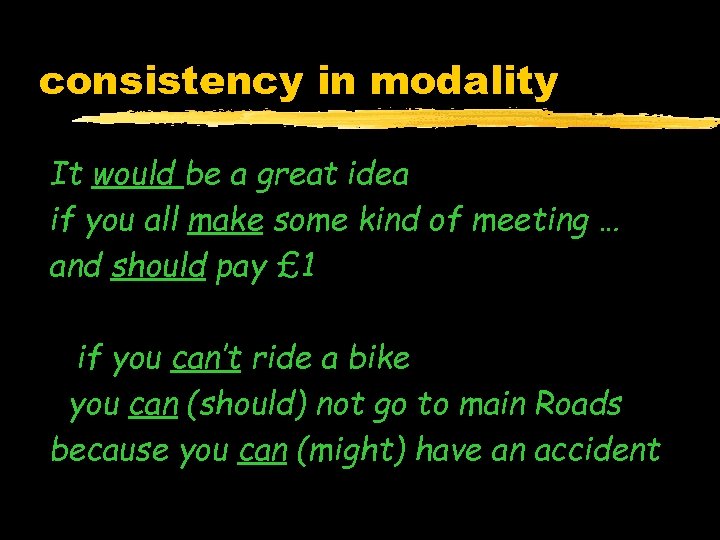 consistency in modality It would be a great idea if you all make some kind of meeting … and should pay £ 1 if you can’t ride a bike you can (should) not go to main Roads because you can (might) have an accident
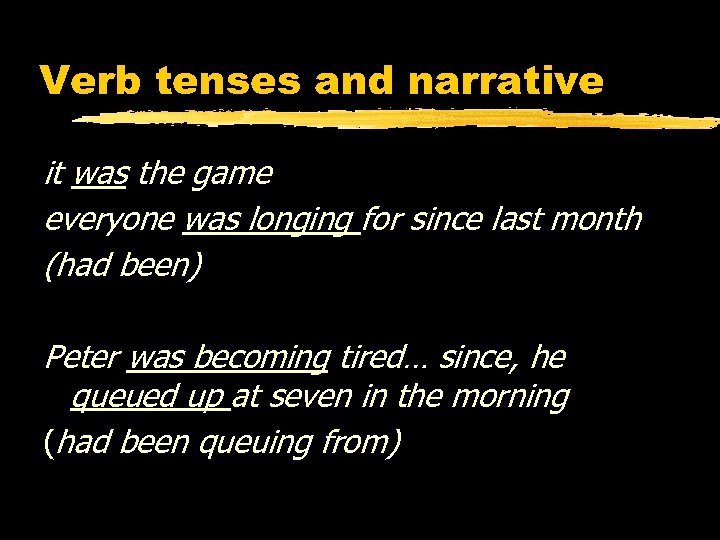 Verb tenses and narrative it was the game everyone was longing for since last month (had been) Peter was becoming tired… since, he queued up at seven in the morning (had been queuing from)
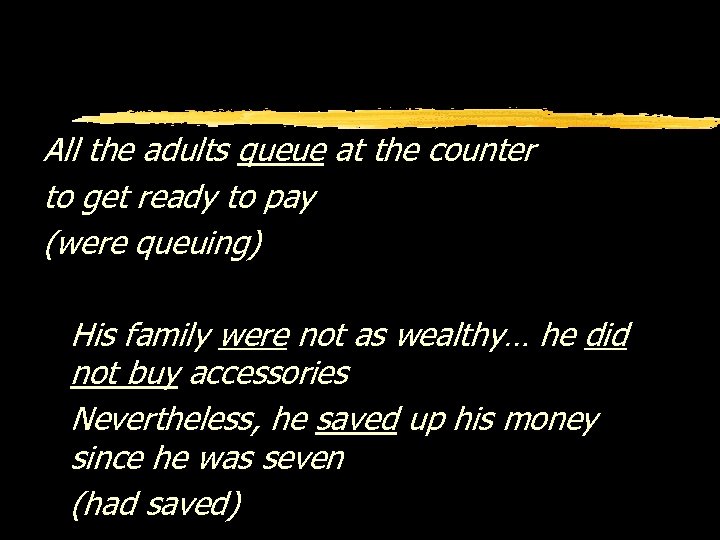 All the adults queue at the counter to get ready to pay (were queuing) His family were not as wealthy… he did not buy accessories Nevertheless, he saved up his money since he was seven (had saved)
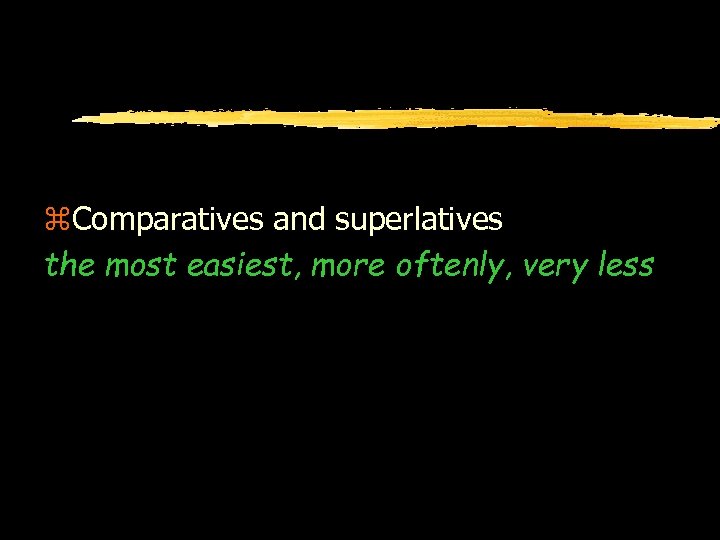 z. Comparatives and superlatives the most easiest, more oftenly, very less
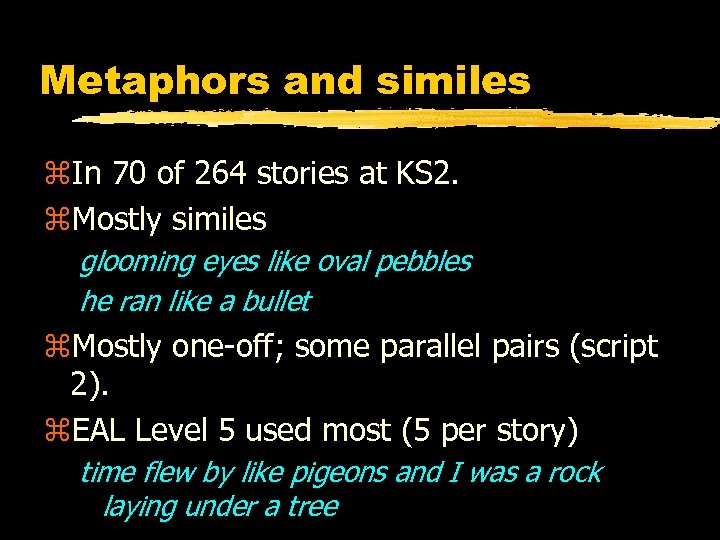 Metaphors and similes z. In 70 of 264 stories at KS 2. z. Mostly similes glooming eyes like oval pebbles he ran like a bullet z. Mostly one-off; some parallel pairs (script 2). z. EAL Level 5 used most (5 per story) time flew by like pigeons and I was a rock laying under a tree
 Animal metaphors and similes the children rushed in like if loads of elephants saw one little rat like a group of cheetahs
 Errors in figurative language z. Comparison doesn’t quite work: eyes sparkled like fireworks looked like dog’s eyes z. Inaccurate: burst into happiness pouring with tears down their faces
 Conclusions z. Written language makes different demands from spoken language. yto organise long stretches of text yto imagine the reader yto use variety of clause and sentence types yvisible accuracy z. EAL students had learnt what had been taught
 Teaching writing z. We need to teach written English. z. Different aspects of written English need different teaching approaches yawareness raising ystrategy training ypractice yexplicit instruction ycorrective feedback
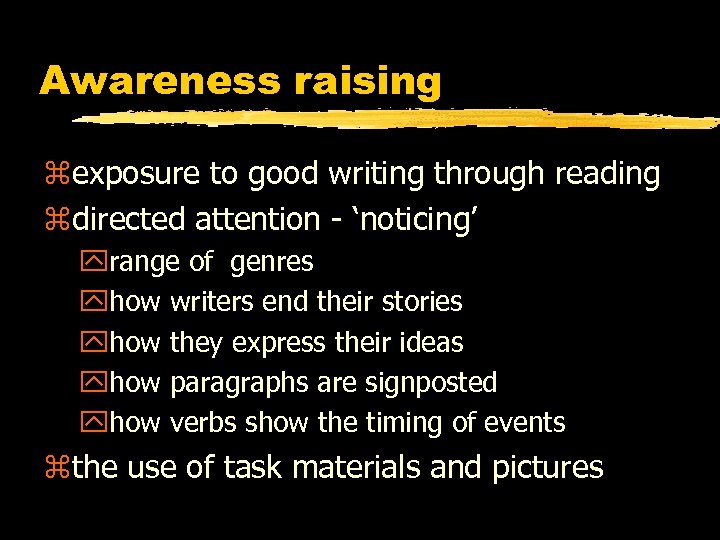 Awareness raising zexposure to good writing through reading zdirected attention - ‘noticing’ yrange of genres yhow writers end their stories yhow they express their ideas yhow paragraphs are signposted yhow verbs show the timing of events zthe use of task materials and pictures
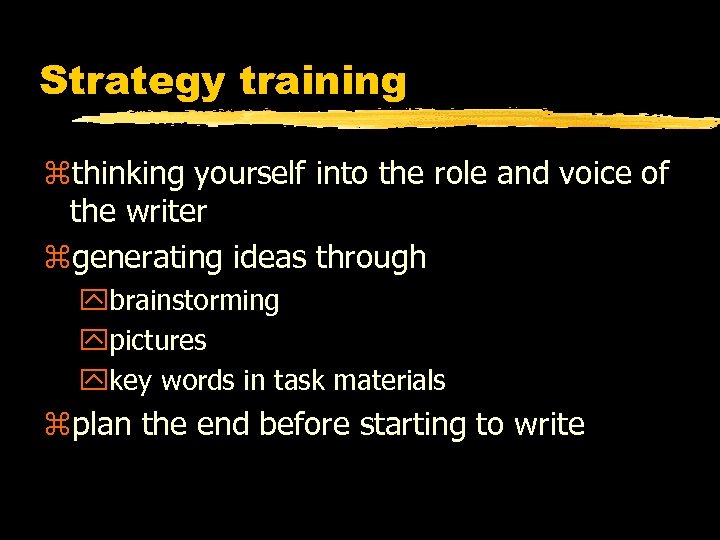 Strategy training zthinking yourself into the role and voice of the writer zgenerating ideas through ybrainstorming ypictures ykey words in task materials zplan the end before starting to write
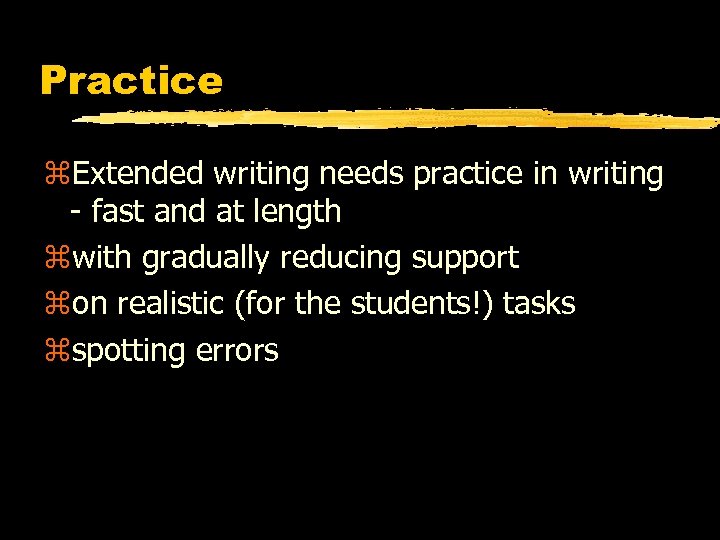 Practice z. Extended writing needs practice in writing - fast and at length zwith gradually reducing support zon realistic (for the students!) tasks zspotting errors
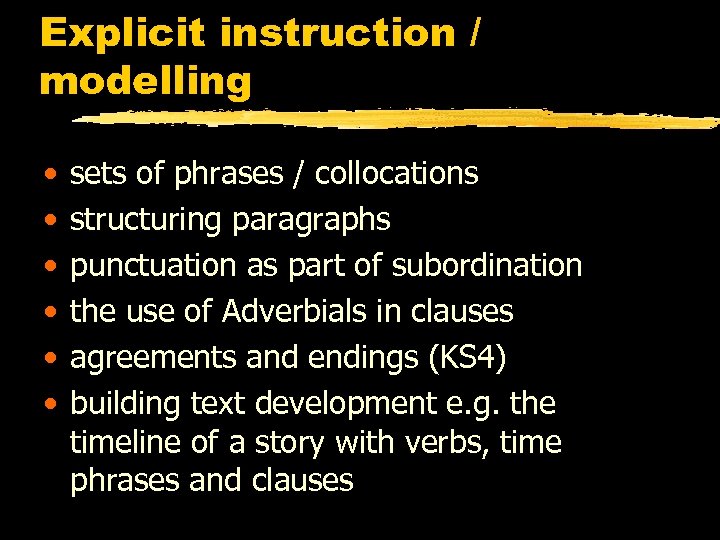 Explicit instruction / modelling • • • sets of phrases / collocations structuring paragraphs punctuation as part of subordination the use of Adverbials in clauses agreements and endings (KS 4) building text development e. g. the timeline of a story with verbs, time phrases and clauses
 Corrective feedback z. Writing makes correct and incorrect forms visible; is slow enough to notice. z. Feedback on errors + modelling of correct forms: yprepositions and formulaic phrases yarticles (KS 4) yagreements (KS 4 and KS 2 level 3)
 The process of writing? z. How do pupils find ideas to write about? z. How do they interpret pictures? z. How do they organise their ideas? z. Do they think themselves into the genre? z. How do they compose sentences? z. Do they check their writing for errors?
 Research reports: (1) Writing in EAL at Key Stage 4 and post-16. + Inspection report “More advanced learners of EAL in secondary schools and colleges. ” www. ofsted. gov. uk (Publications) (2) Writing in EAL at Key Stage 2. www. dfes. gov. uk/research + Inspection report “Could they do better? The writing of advanced bilingual learners at KS 2: HMI survey of good practice. ”