


 Скачать презентацию Writing Hard Science Fiction A Personal Account John
2c6b63add0ea687a07ad5e6571e5ed8c.ppt
- Количество слайдов: 11
 Writing “Hard” Science Fiction: A Personal Account John G. Cramer Professor of Physics E-Mail: cramer@phys. washington. edu Web: http: //faculty. washington. edu/jcramer Department of Physics University of Washington Seattle, Washington 98195 -1560 Presented to Bellevue Rotary Club Seattle, Washington, May 20, 2003 John G. Cramer
 Outline of Talk • • • How did I get into all this? “The Alternate View” Columns in Analog What is “Hard” Science Fiction? Twistor – 1989 Einstein’s Bridge – 1997 Real vs. “Rubber” Science Writing your novel: “The Cramer Method” Getting it published Conclusion May 20, 2003 John G. Cramer
 How did I get into all this? • Chair (1977 - 81) of APS/DNP Nuclear Science Resources Committee, providing physics information to Congress (not lobbying!). • Popular science writing, “The Alternate View” bimonthly science column in Analog Magazine, 1983 to present. 108 columns written. (See http: //www. npl. washington. edu/AV). • Twistor (written 1986 -88) about an unexpected breakthrough from a “small” table-top physics experiment in a university physics lab (UW). • Einstein’s Bridge (written 1989 -96) about “big” physics at the SSC in Waxahachie, Texas. May 20, 2003 John G. Cramer
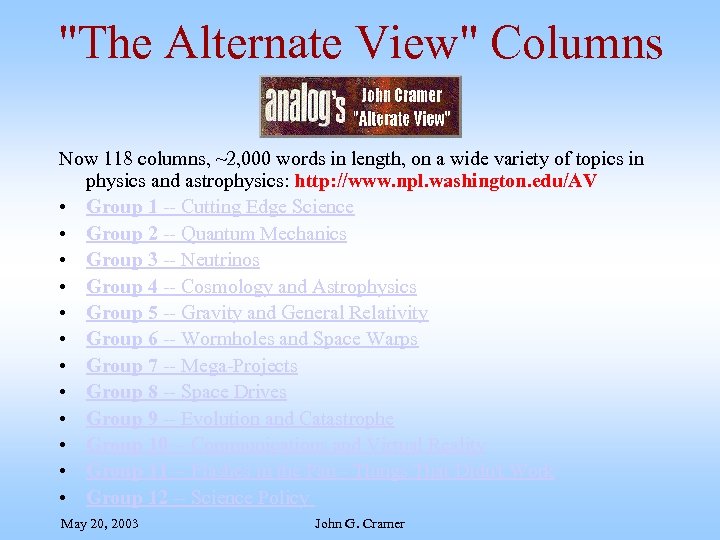 "The Alternate View" Columns Now 118 columns, ~2, 000 words in length, on a wide variety of topics in physics and astrophysics: http: //www. npl. washington. edu/AV • Group 1 -- Cutting Edge Science • Group 2 -- Quantum Mechanics • Group 3 -- Neutrinos • Group 4 -- Cosmology and Astrophysics • Group 5 -- Gravity and General Relativity • Group 6 -- Wormholes and Space Warps • Group 7 -- Mega-Projects • Group 8 -- Space Drives • Group 9 -- Evolution and Catastrophe • Group 10 -- Communications and Virtual Reality • Group 11 -- Flashes in the Pan - Things That Didn't Work • Group 12 -- Science Policy May 20, 2003 John G. Cramer
 What is “Hard” Science Fiction? • Serious attempt to portray science and scientists as accurately as possible. • Scientists are often principal characters. • Scientific problem solving is a major plot element. • Authors are often scientists or engineers. • Examples of hard SF by physicists and astronomers: – – – A for Andromeda – Fred Hoyle Timescape and Cosm – Gregory Benford Dragon’s Egg – Robert W. Forward Contact – Carl Sagan Twistor and Einstein’s Bridge – John Cramer May 20, 2003 John G. Cramer
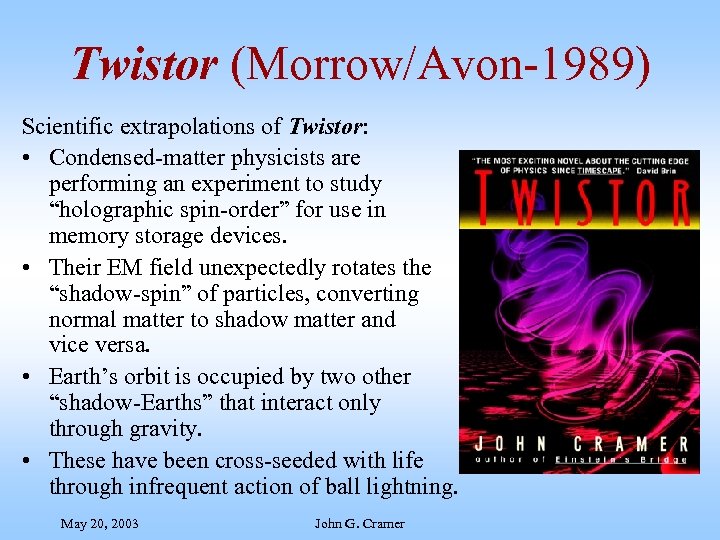 Twistor (Morrow/Avon-1989) Scientific extrapolations of Twistor: • Condensed-matter physicists are performing an experiment to study “holographic spin-order” for use in memory storage devices. • Their EM field unexpectedly rotates the “shadow-spin” of particles, converting normal matter to shadow matter and vice versa. • Earth’s orbit is occupied by two other “shadow-Earths” that interact only through gravity. • These have been cross-seeded with life through infrequent action of ball lightning. May 20, 2003 John G. Cramer
 Einstein’s Bridge (Avon-1996) Scientific extrapolations of Einstein’s Bridge: • Collisions at the SSC produce extradimensional signals that propagate to other bubble-universes. • Intelligent aliens in another universe use such signals to establish wormhole contact with other intelligent species who are doing high energy physics. • Creation of time-like loops using wormholes can destroy the universe back to start of the wormhole, so that the universe can re-evolve from that point. May 20, 2003 John G. Cramer
 Real vs. “Rubber” Science • Hard SF uses both real science and extrapolative “rubber” science in the plot. • The real science must be completely accurate, or at least as accurate as the writer can manage. • The made-up rubber science must be convincing and plausible. Twistor used extrapolations of 1986 condensed -matter physics ideas. Einstein’s Bridge started with SSC physics from design study reports. • The joint between the real and rubber science must be invisible to the reader, like a root-graft on a fruit tree. • I like to include an Afterword to inform the reader what was real and what was not. May 20, 2003 John G. Cramer
 Writing Your Novel: “The Cramer Method” • Construct a set of memorable images and scientific extrapolations that appeal to you. • Design a plot that will use the science and conjure up the images. • Design characters to fit the plot. Write their biographies. Have conversations with them. • Choose the setting. Learn as much as possible about it. • Outline the novel in scenes and chapters. • Write the scenes. Write the dialog first. Then use third person point of view and sentence length to create effects. • Rewrite and rewrite and … May 20, 2003 John G. Cramer
 Getting Your Novel Published • • • DO NOT self publish! Who do you know? Meeting writers and editors. Surviving the slush pile. (First page is crucial!) Get an agent after you have an offer. (DO NOT pay an “agent” to read your manuscript!) The book contract. (That’s what agents are for. ) Dealing with editors (They’re not journal editors). Rewrites (expect them) and copy editing (“stet”). Cover art (DO NOT expect to have any input!) Time to publication (Hurry up and wait). May 20, 2003 John G. Cramer
 Conclusion • There is a good market for hard SF. Both of my novels are now in their 4 th Avon mass-market paperback printings, and editors and readers are asking for more. • The readers of hard SF really appreciate works of fiction in which the science is represented as accurately as possible. • There is a need for good hard SF that portrays science and scientists in a positive light and communicates the challenge, excitement, and sheer fun of doing science. • Hard SF reading and writing: Try it. You’ll like it. May 20, 2003 John G. Cramer