


 Скачать презентацию WRITING EFFECTIVE PRESENT LEVELS OF PERFORMANCE STATEMENTS AND
b20414be50a1f6dc3731e5bbba123a89.ppt
- Количество слайдов: 103
 WRITING EFFECTIVE PRESENT LEVELS OF PERFORMANCE STATEMENTS AND ANNUAL GOALS AND OBJECTIVES Annie Margaret Harris Office of Special Education Division of Technical Assistance 2011 -2012 Mississippi Department of Education Office of Instructional Enhancement and Internal Operations/Office of Special Education 1
 Why are Present Levels of Performance so Important? The Present Levels of Performance (PLP) is the FOUNDATION of the IEP. Basing an IEP on a poorly written PLP is like building a new house on a crumbling foundation…it won’t stand up. 2011 -2012 Mississippi Department of Education Office of Instructional Enhancement and Internal Operations/Office of Special Education 2
 Why are Present Levels of Performance so Important? The PLP provides the informational basis for generating goals, objectives, supports, accommodations, and services that are specifically designed to meet the student’s individual needs. 2011 -2012 Mississippi Department of Education Office of Instructional Enhancement and Internal Operations/Office of Special Education 3
 REMEMBER!! “A problem well stated…is a problem half-solved” (Charles F. Kettering) 2011 -2012 Mississippi Department of Education Office of Instructional Enhancement and Internal Operations/Office of Special Education 4
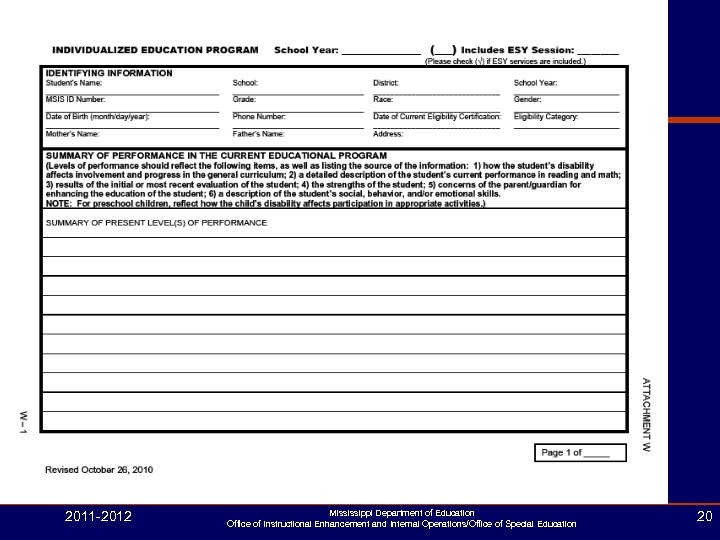
 Purpose of the Present Levels of Performance (PLP) • To establish the foundation on which the rest of the IEP is developed • To identify the impact of the disability on participation in the general curriculum • Align student’s PLP information with the following: content standards & benchmarks, annual goals, supplementary aids/services/supports, and secondary transition services 2011 -2012 Mississippi Department of Education Office of Instructional Enhancement and Internal Operations/Office of Special Education 5
 Statements to Address During IEP Development • How the student’s disability affects involvement and progress in the general curriculum; • Detailed description of the student’s current performance in reading and math; • Results of the initial or most recent evaluation of the student; • Strengths of the student; 2011 -2012 Mississippi Department of Education Office of Instructional Enhancement and Internal Operations/Office of Special Education 6
 Statements to Address During IEP Development • Concerns of the parent/guardian for enhancing the education of the student; • Description of the student’s social, behavioral, and/or emotional skills; *For preschool children, how the child’s disability affects participation in appropriate activities Spring 2010 Mississippi Department of Education Office of Instructional Enhancement and Internal Operations/Office of Special Education 7
 PLPs Must: • Identify where the student is NOW, including their unique strengths, preferences and needs, parent and student concerns, and post-secondary interests/needs (Baseline). - Student voice - How student has grown or changed • Address how the student’s disability impacts his/her involvement and progress in the general curriculum (relationship to standards). • Identify areas of educational need. 2011 -2012 Mississippi Department of Education Office of Instructional Enhancement and Internal Operations/Office of Special Education 8
 PLPs Must: • Use clear, understandable language that all can understand. No jargon. Avoid vague terms such as: “understands”, “good student”, “misbehaves”. • Identify supports and accommodations that have been used successfully in the past. • Be specific and use data. Without data, the PLP is only your opinion! 2011 -2012 Mississippi Department of Education Office of Instructional Enhancement and Internal Operations/Office of Special Education 9
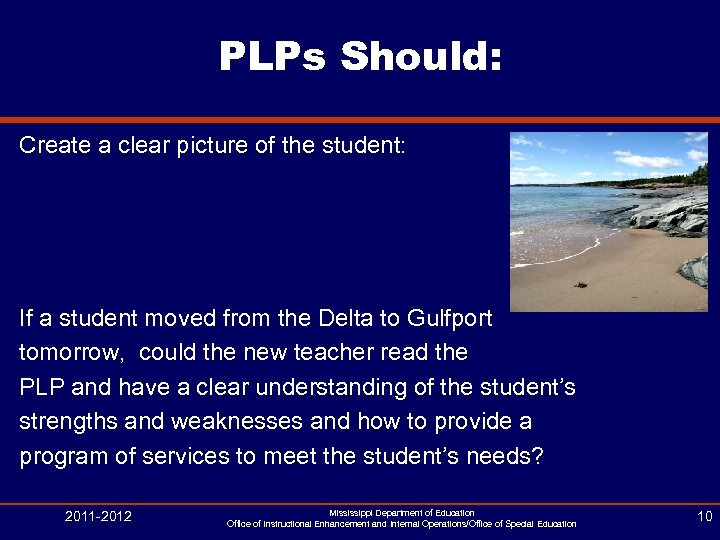 PLPs Should: Create a clear picture of the student: If a student moved from the Delta to Gulfport tomorrow, could the new teacher read the PLP and have a clear understanding of the student’s strengths and weaknesses and how to provide a program of services to meet the student’s needs? 2011 -2012 Mississippi Department of Education Office of Instructional Enhancement and Internal Operations/Office of Special Education 10
 Questions To Think About 1. What is the child’s learning style? • • Visual (Picture) Auditory (Listen) Tactile (Hands-on) Kinesthetic (Movement) 2011 -2012 Mississippi Department of Education Office of Instructional Enhancement and Internal Operations/Office of Special Education 11
 Questions To Think About 2. What skills are the student’s strengths? • • • Decoding words Comprehending Rote memory Creativity Listening 2011 -2012 Mississippi Department of Education Office of Instructional Enhancement and Internal Operations/Office of Special Education 12
 Questions To Think About 3. What is the student’s current independent learning levels? 4. What does this child need in order to learn? 5. If 14 years of age, what are the student’s strengths, needs, preferences and interests, as they relate to transition from school to post-school activities? 2011 -2012 Mississippi Department of Education Office of Instructional Enhancement and Internal Operations/Office of Special Education 13
 Questions To Think About 6. What type of relationship does this student have with his/her peers and adults? 7. How does he/she interact with others? Does this student have difficulty meeting new people, making friends, or keeping friends? 2011 -2012 Mississippi Department of Education Office of Instructional Enhancement and Internal Operations/Office of Special Education 14
 Questions To Think About 8. How does this student feel about himself? 9. How does this student adjust socially to the school and community? 10. Does this child have physical limitations that impact the learning process? 2011 -2012 Mississippi Department of Education Office of Instructional Enhancement and Internal Operations/Office of Special Education 15
 Questions To Think About 11. Are there motor, sensory, or health development concerns? 12. Is fatigue a concern? 13. What are the results of the latest physical, hearing, and vision exams? 14. Does the student need daily assistance organizing material? 2011 -2012 Mississippi Department of Education Office of Instructional Enhancement and Internal Operations/Office of Special Education 16
 Questions To Think About 15. Does this student require: small group instruction, cooperative learning groups or independent work? 2011 -2012 Mississippi Department of Education Office of Instructional Enhancement and Internal Operations/Office of Special Education 17
 Questions To Think About 16. Does this student need: referential seating to have a consistent room arrangement and seating assignment, to have a consistent routine? 2011 -2012 Mississippi Department of Education Office of Instructional Enhancement and Internal Operations/Office of Special Education 18
 Questions To Think About 17. Does this student require a paraprofessional to assist the student to locate classes and follow a schedule? 18. Does the student need assistance with extracurricular activities? 2011 -2012 Mississippi Department of Education Office of Instructional Enhancement and Internal Operations/Office of Special Education 19
 2011 -2012 Mississippi Department of Education Office of Instructional Enhancement and Internal Operations/Office of Special Education 20
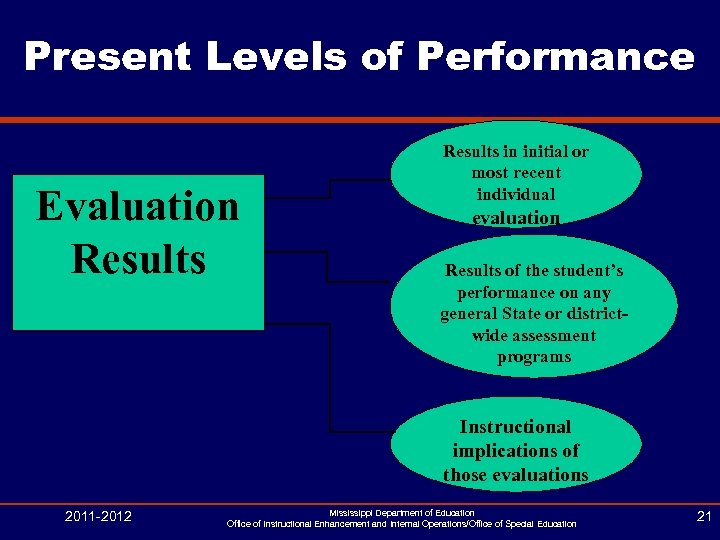 Present Levels of Performance Evaluation Results in initial or most recent individual evaluation Results of the student’s performance on any general State or districtwide assessment programs Instructional implications of those evaluations 2011 -2012 Mississippi Department of Education Office of Instructional Enhancement and Internal Operations/Office of Special Education 21
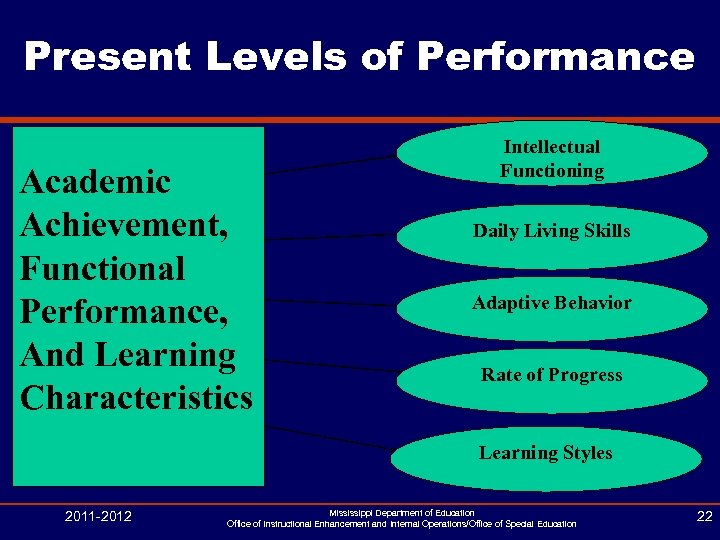 Present Levels of Performance Academic Achievement, Functional Performance, And Learning Characteristics Intellectual Functioning Daily Living Skills Adaptive Behavior Rate of Progress Learning Styles 2011 -2012 Mississippi Department of Education Office of Instructional Enhancement and Internal Operations/Office of Special Education 22
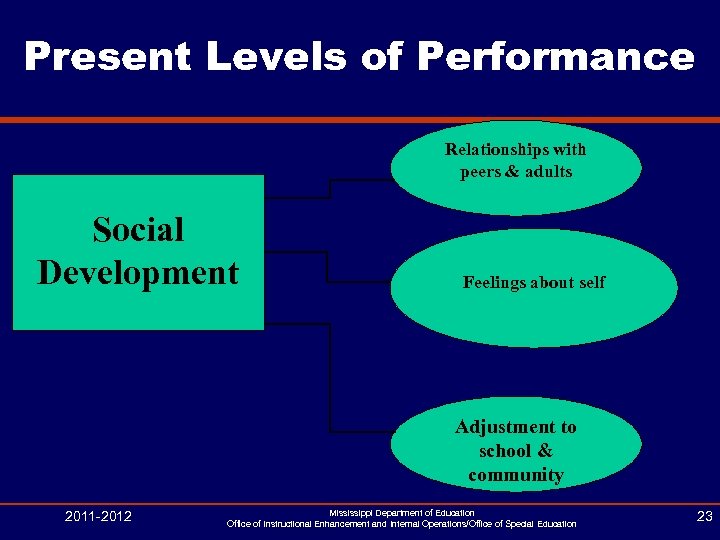 Present Levels of Performance Relationships with peers & adults Social Development Feelings about self Adjustment to school & community 2011 -2012 Mississippi Department of Education Office of Instructional Enhancement and Internal Operations/Office of Special Education 23
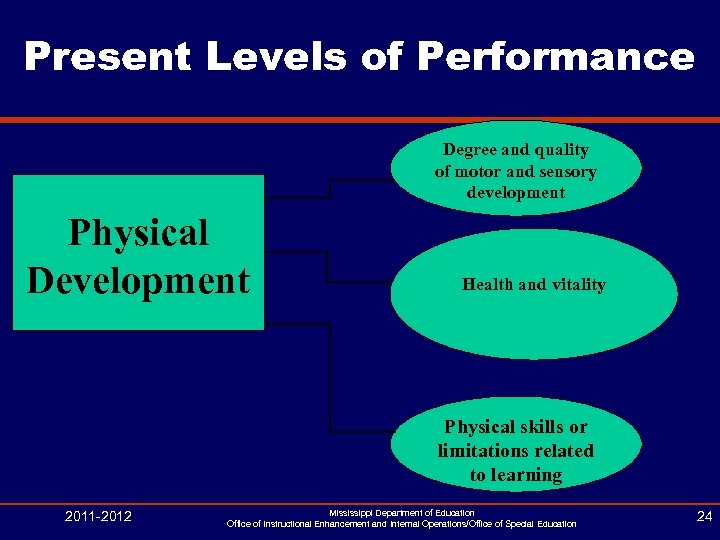 Present Levels of Performance Degree and quality of motor and sensory development Physical Development Health and vitality Physical skills or limitations related to learning 2011 -2012 Mississippi Department of Education Office of Instructional Enhancement and Internal Operations/Office of Special Education 24
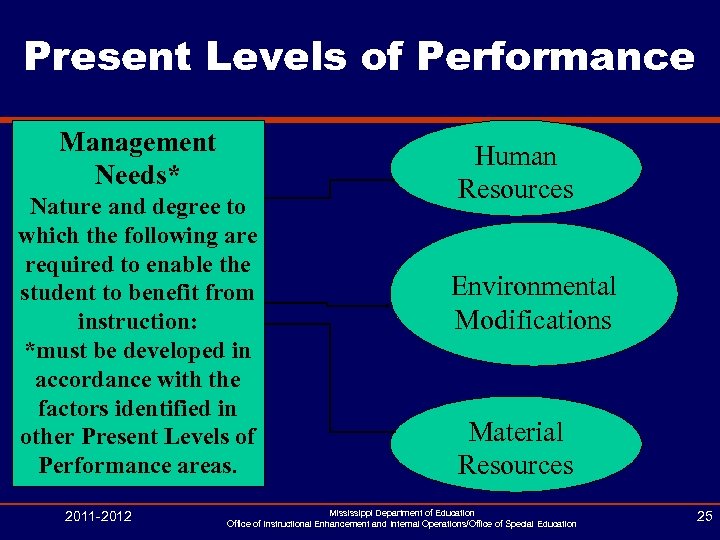 Present Levels of Performance Management Needs* Nature and degree to which the following are required to enable the student to benefit from instruction: *must be developed in accordance with the factors identified in other Present Levels of Performance areas. 2011 -2012 Human Resources Environmental Modifications Material Resources Mississippi Department of Education Office of Instructional Enhancement and Internal Operations/Office of Special Education 25
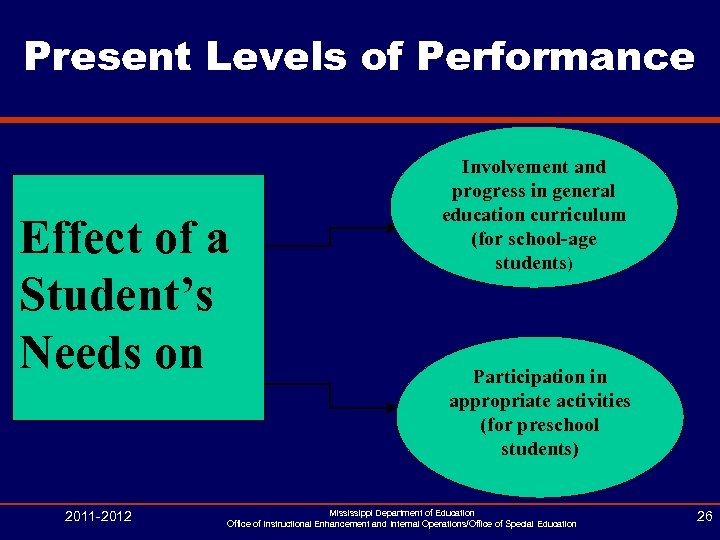 Present Levels of Performance Effect of a Student’s Needs on 2011 -2012 Involvement and progress in general education curriculum (for school-age students) Participation in appropriate activities (for preschool students) Mississippi Department of Education Office of Instructional Enhancement and Internal Operations/Office of Special Education 26
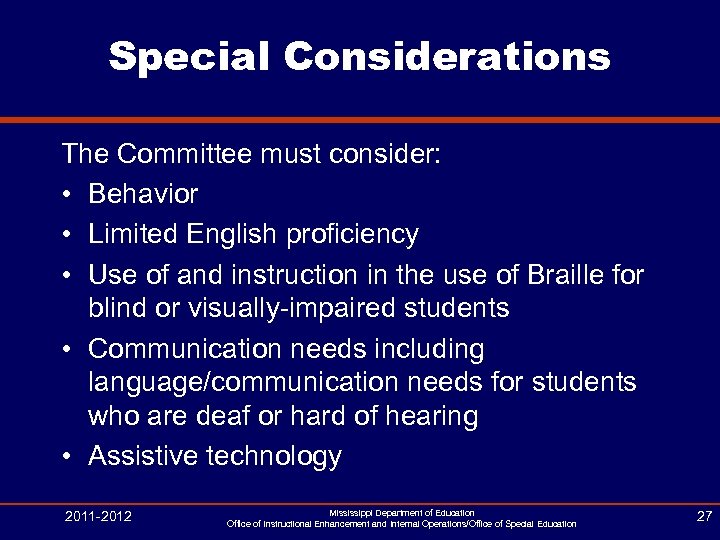 Special Considerations The Committee must consider: • Behavior • Limited English proficiency • Use of and instruction in the use of Braille for blind or visually-impaired students • Communication needs including language/communication needs for students who are deaf or hard of hearing • Assistive technology 2011 -2012 Mississippi Department of Education Office of Instructional Enhancement and Internal Operations/Office of Special Education 27
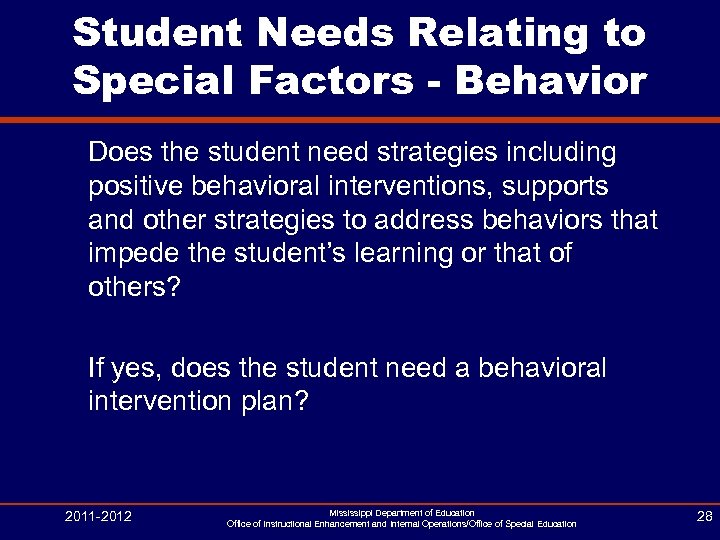 Student Needs Relating to Special Factors - Behavior Does the student need strategies including positive behavioral interventions, supports and other strategies to address behaviors that impede the student’s learning or that of others? If yes, does the student need a behavioral intervention plan? 2011 -2012 Mississippi Department of Education Office of Instructional Enhancement and Internal Operations/Office of Special Education 28
 Student Needs Relating to Special Factors – Limited English Proficiency For a student who is limited English proficient, does he/she need a special education service to address language needs as they relate to the IEP? 2011 -2012 Mississippi Department of Education Office of Instructional Enhancement and Internal Operations/Office of Special Education 29
 Student Needs Relating to Special Factors – Students who are Blind or Visually Impaired Does he/she need instruction in Braille and the use of Braille? 2011 -2012 Mississippi Department of Education Office of Instructional Enhancement and Internal Operations/Office of Special Education 30
 Student Needs Relating to Special Factors – Communication Needs • Does the student need a particular device or service to address his/her communication needs? • For a student who is deaf or hard of hearing, does the student need a particular device or service in consideration of the student’s language and communication needs, opportunities for direct communication with peers and professional personnel in the student’s language and communication modes? 2011 -2012 Mississippi Department of Education Office of Instructional Enhancement and Internal Operations/Office of Special Education 31
 Student Needs Relating to Special Factors – Assistive Technology • Does the student need an assistive technology device and/or service? • If yes, does the IEP Committee recommend that the device(s) be used in the student’s home? 2011 -2012 Mississippi Department of Education Office of Instructional Enhancement and Internal Operations/Office of Special Education 32
 For School-Age Students, Consider Such Factors As: • • • Content/skill expectations Materials/equipment Instructional approaches Environment Demonstration of knowledge 2011 -2012 Mississippi Department of Education Office of Instructional Enhancement and Internal Operations/Office of Special Education 33
 Present Levels of Performance (PLP) • Describe the impact of the disability on the child’s ability to progress and be involved in the general curriculum • Summarize the student’s current functioning (including standardized or classroom-based assessment) in areas of strengths, as well as difficulties • Identify the student's instructional needs that may be written as goals • Prioritize needs that will be addressed during the duration of the IEP 2011 -2012 Mississippi Department of Education Office of Instructional Enhancement and Internal Operations/Office of Special Education 34
 How the Disability Impacts. . . How does the student perform independently and with support compared to other children in general education activities in the following areas: Academics, Language/Communication, Motor, Behavior, Health/Medical, and Transition/Career Prep? 2011 -2012 Mississippi Department of Education Office of Instructional Enhancement and Internal Operations/Office of Special Education 35
 Present Levels of Performance (PLP) • This area must describe what the student does (strengths) and does not do (weaknesses) in objective, measurable terms. • When appropriate, the present levels must reference the student’s performance on district level benchmarks and progress from the previous IEP. 2011 -2012 Mississippi Department of Education Office of Instructional Enhancement and Internal Operations/Office of Special Education 36
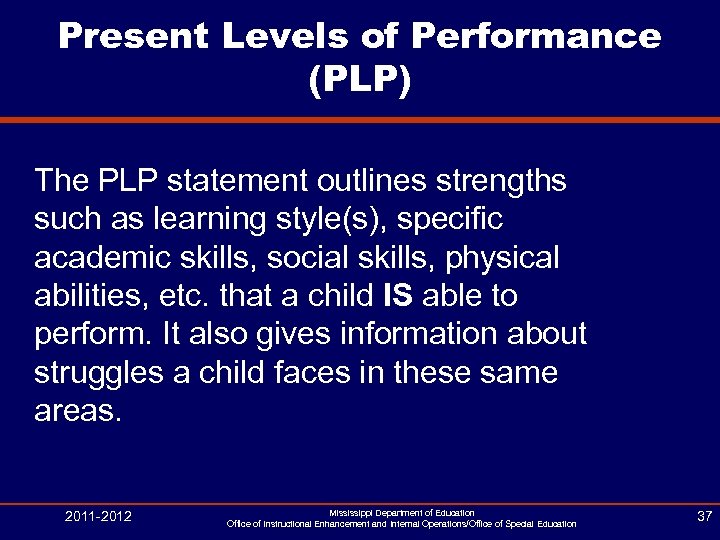 Present Levels of Performance (PLP) The PLP statement outlines strengths such as learning style(s), specific academic skills, social skills, physical abilities, etc. that a child IS able to perform. It also gives information about struggles a child faces in these same areas. 2011 -2012 Mississippi Department of Education Office of Instructional Enhancement and Internal Operations/Office of Special Education 37
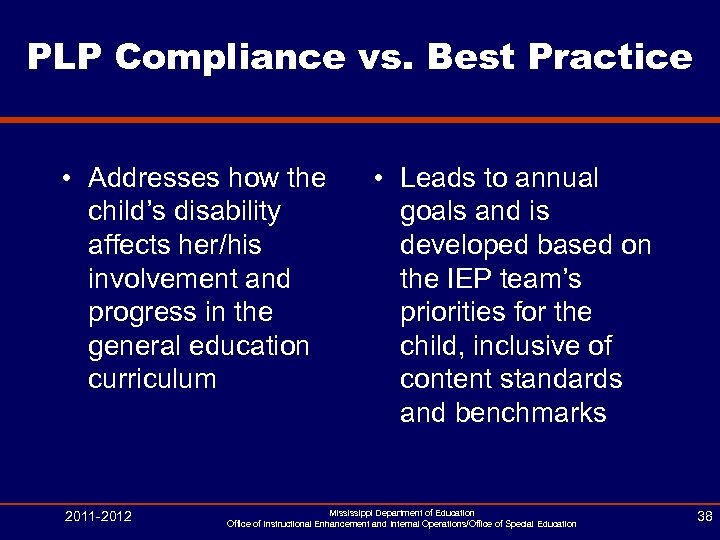 PLP Compliance vs. Best Practice • Addresses how the child’s disability affects her/his involvement and progress in the general education curriculum 2011 -2012 • Leads to annual goals and is developed based on the IEP team’s priorities for the child, inclusive of content standards and benchmarks Mississippi Department of Education Office of Instructional Enhancement and Internal Operations/Office of Special Education 38
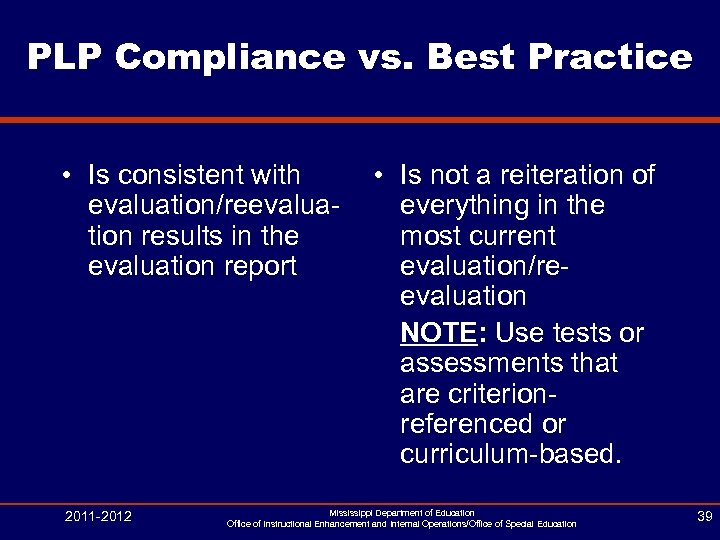 PLP Compliance vs. Best Practice • Is consistent with evaluation/reevaluation results in the evaluation report 2011 -2012 • Is not a reiteration of everything in the most current evaluation/reevaluation NOTE: Use tests or assessments that are criterionreferenced or curriculum-based. Mississippi Department of Education Office of Instructional Enhancement and Internal Operations/Office of Special Education 39
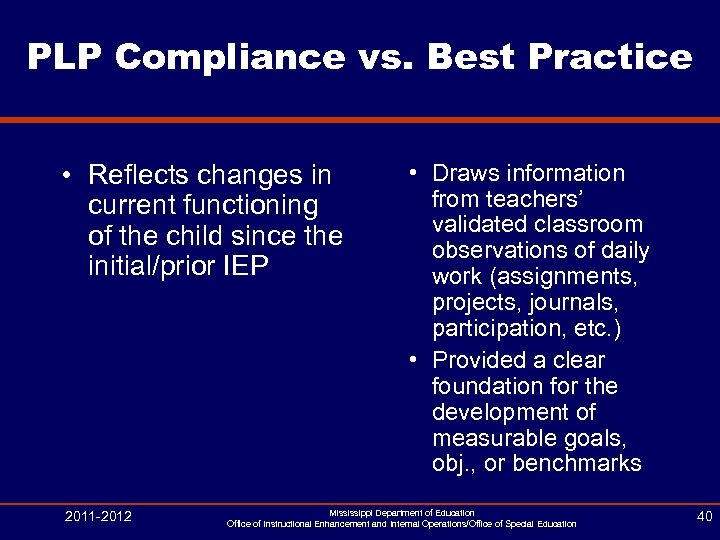 PLP Compliance vs. Best Practice • Reflects changes in current functioning of the child since the initial/prior IEP 2011 -2012 • Draws information from teachers’ validated classroom observations of daily work (assignments, projects, journals, participation, etc. ) • Provided a clear foundation for the development of measurable goals, obj. , or benchmarks Mississippi Department of Education Office of Instructional Enhancement and Internal Operations/Office of Special Education 40
 PLP Compliance vs. Best Practice • Considers, as appropriate, the results of the child’s performance on any State and districtwide assessments 2011 -2012 • Address State and district-wide assessment results in relation to gradelevel peers and/or specific skills Note: Do not list scores. Mississippi Department of Education Office of Instructional Enhancement and Internal Operations/Office of Special Education 41
 PLP Compliance vs. Best Practice • Addresses the • Includes information strengths of the child from parents and the concerns of others who have the parent for daily interaction with enhancing the student education of their • Written language child that is clearly understood by parents and potential providers 2011 -2012 Mississippi Department of Education Office of Instructional Enhancement and Internal Operations/Office of Special Education 42
 PLP Statements Should Answer These Questions: 1. What are the student’s unique needs that resulted from his/her disability? 2. How do these needs affect the student’s participation and progress in the general curriculum or, for a preschool student, participation in ageappropriate activities? 3. What are the parent’s concerns for the education of their child? 2011 -2012 Mississippi Department of Education Office of Instructional Enhancement and Internal Operations/Office of Special Education 43
 PLP Statements Should Answer These Questions: 4. What instructional and/or behavioral supports or services have been effective or not effective in addressing the area of need in the past year? 5. What accommodations and/or program modifications or supplementary aids and services have been effective or not effective in addressing the area of need in the past year? 2011 -2012 Mississippi Department of Education Office of Instructional Enhancement and Internal Operations/Office of Special Education 44
 PLP Statements Should Answer These Questions: 6. What instructional supports and services will likely be supported and used by the student? 7. What transition needs of the student must be addressed to prepare the student for living, learning and working in the community as an adult? 2011 -2012 Mississippi Department of Education Office of Instructional Enhancement and Internal Operations/Office of Special Education 45
 Where Does PLP Data Come From? Evaluations - Individual, group, curriculum-based, norm-referenced assessments - State and district assessments - Structured observations - Functional Behavioral Assessment (FBA) - Work samples - Student interviews 2011 -2012 Mississippi Department of Education Office of Instructional Enhancement and Internal Operations/Office of Special Education 46
 Where Does PLP Data Come From? • • The student, parents, past teachers Factors related to the disability Transcripts, cumulative records, exams Student’s performance in relation to his/her same-aged peers 2011 -2012 Mississippi Department of Education Office of Instructional Enhancement and Internal Operations/Office of Special Education 47
 PLP Quality Indicators • Cover all 4 areas: Academic Social Physical Management • Uses data from multiple sources to describe current functioning • Includes student strengths • Focuses on priority needs 2011 -2012 Mississippi Department of Education Office of Instructional Enhancement and Internal Operations/Office of Special Education 48
 PLP Quality Indicators • Includes parent(s) and student concerns, desires, needs and preferences for the future • Includes progress on current IEP goals • Includes how the disability impacts performance in general education curriculum 2011 -2012 Mississippi Department of Education Office of Instructional Enhancement and Internal Operations/Office of Special Education 49
 PLP Quality Indicators • Identifies supports and accommodations that have been successful • Uses clear language & avoids jargon in order to create a clear picture of the learner 2011 -2012 Mississippi Department of Education Office of Instructional Enhancement and Internal Operations/Office of Special Education 50
 Activity I Critique This Academic PLP Billie is a 3 rd grader who has difficulty with language. What is the difficulty? REWRITE: 2011 -2012 Mississippi Department of Education Office of Instructional Enhancement and Internal Operations/Office of Special Education 51
 Activity II Critique This Social PLP Dolly dislikes school and teachers. She violates rules. She refuses to take responsibility for her actions. What do “dislikes school and teachers” and “refusal to take responsibility” look like? What rules does she violate? REWRITE: 2011 -2012 Mississippi Department of Education Office of Instructional Enhancement and Internal Operations/Office of Special Education 52
 Activity III Critique This Academic PLP Bob has moderate academic delays that adversely affect his educational performance. What are the specific delay areas & the degree of delay? Impact? REWRITE: 2011 -2012 Mississippi Department of Education Office of Instructional Enhancement and Internal Operations/Office of Special Education 53
 Activity IV handout contains profiles of students with disabilities from elementary to high school. You are to use this information to write Present Levels of Performance (PLP) for not less than four (4) students from this group. Choose at least one student from each grade level using the blank PLP form provided. 2011 -2012 Mississippi Department of Education Office of Instructional Enhancement and Internal Operations/Office of Special Education 54
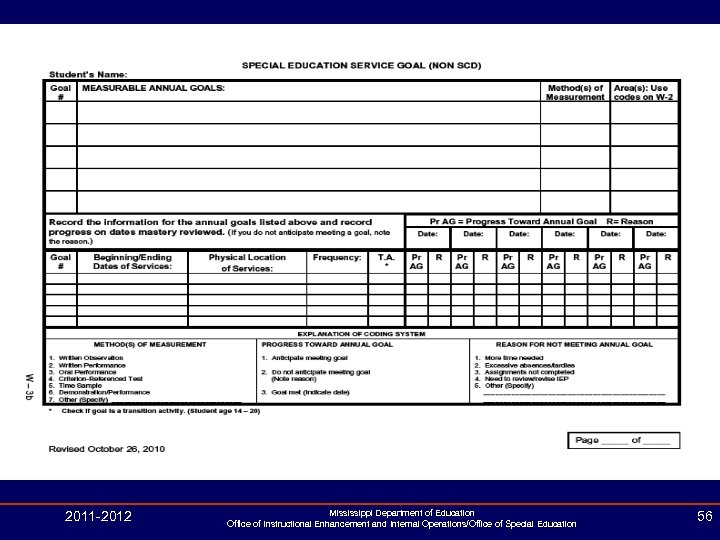
 IDEA 2004 IEPs for all students must include a statement of measurable annual goals, including academic and functional goals. Benchmarks or shortterm instructional objectives must be included in an IEP for a student with significant cognitive disabilities. (P. L. 108 -446, Section 614(d)) 2011 -2012 Mississippi Department of Education Office of Instructional Enhancement and Internal Operations/Office of Special Education 55
 2011 -2012 Mississippi Department of Education Office of Instructional Enhancement and Internal Operations/Office of Special Education 56
 Purpose of Annual Goals The purpose of the measurable annual goals are to clearly communicate what the student is expected to accomplish and to specify the criterion or measure that will be used to determine whether or not the student has achieved the goal. 2011 -2012 Mississippi Department of Education Office of Instructional Enhancement and Internal Operations/Office of Special Education 57
 Purpose of Annual Goals Annual goals should reflect the student’s priority educational needs that are most critical for the student to accomplish during the year to be able to benefit from his/her educational program. The measurable annual goal sets up the process for how progress can be measured and reported to meet the requirements of IDEA. 2011 -2012 Mississippi Department of Education Office of Instructional Enhancement and Internal Operations/Office of Special Education 58
 Measurable Annual Goals What exactly does “measurable” mean? Unfortunately, IDEA doesn’t define it. Characteristics of Measurability: • Reveals what to do to measure whether the goal has been accomplished • Yields the same conclusion if measured by several people 2011 -2012 Mississippi Department of Education Office of Instructional Enhancement and Internal Operations/Office of Special Education 59
 Measurable Annual Goals • A measurable goal allows us to know how much progress has been made since the last measured performance. • A measurable goal can be measured as written, without additional information. • Measurable goals contain givens (if necessary), the learner performance, and the criterion (level of performance) to be reached. 2011 -2012 Mississippi Department of Education Office of Instructional Enhancement and Internal Operations/Office of Special Education 60
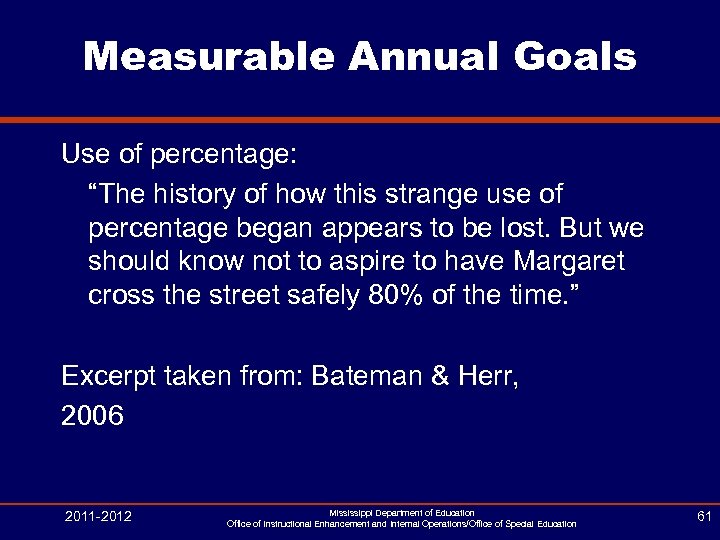 Measurable Annual Goals Use of percentage: “The history of how this strange use of percentage began appears to be lost. But we should know not to aspire to have Margaret cross the street safely 80% of the time. ” Excerpt taken from: Bateman & Herr, 2006 2011 -2012 Mississippi Department of Education Office of Instructional Enhancement and Internal Operations/Office of Special Education 61
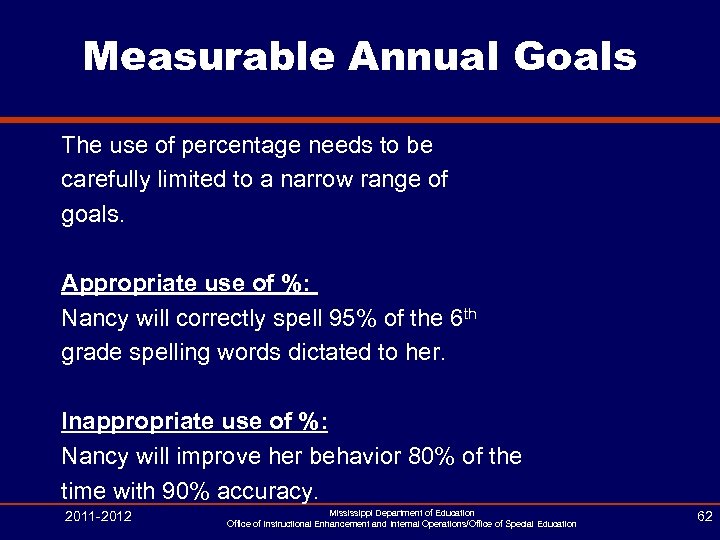 Measurable Annual Goals The use of percentage needs to be carefully limited to a narrow range of goals. Appropriate use of %: Nancy will correctly spell 95% of the 6 th grade spelling words dictated to her. Inappropriate use of %: Nancy will improve her behavior 80% of the time with 90% accuracy. 2011 -2012 Mississippi Department of Education Office of Instructional Enhancement and Internal Operations/Office of Special Education 62
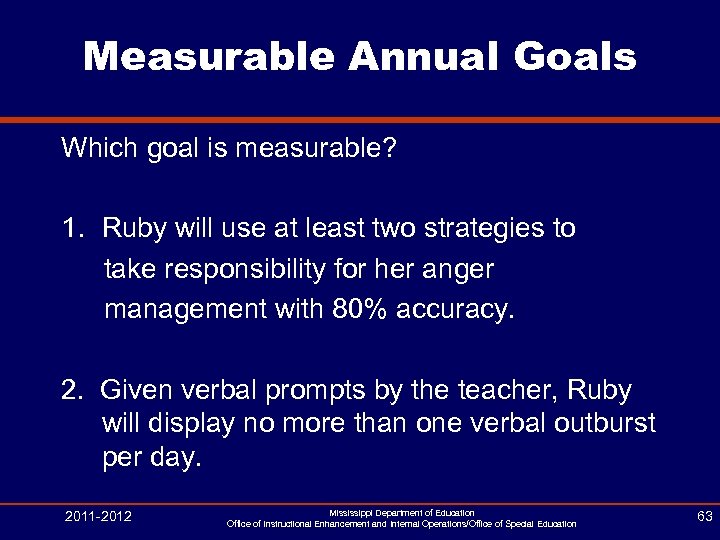 Measurable Annual Goals Which goal is measurable? 1. Ruby will use at least two strategies to take responsibility for her anger management with 80% accuracy. 2. Given verbal prompts by the teacher, Ruby will display no more than one verbal outburst per day. 2011 -2012 Mississippi Department of Education Office of Instructional Enhancement and Internal Operations/Office of Special Education 63
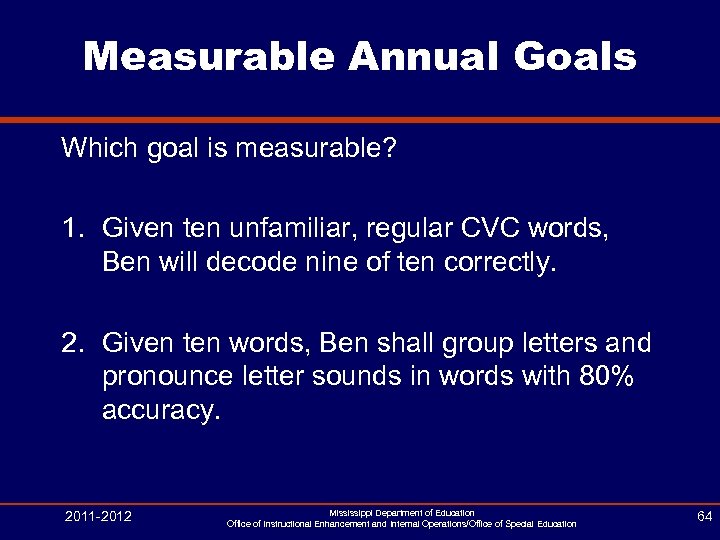 Measurable Annual Goals Which goal is measurable? 1. Given ten unfamiliar, regular CVC words, Ben will decode nine of ten correctly. 2. Given ten words, Ben shall group letters and pronounce letter sounds in words with 80% accuracy. 2011 -2012 Mississippi Department of Education Office of Instructional Enhancement and Internal Operations/Office of Special Education 64
 Measurable Annual Goals • The IEP must list measurable annual goals consistent with the student’s needs and abilities, as identified in the present levels of performance. • Annual goals are statements that identify what knowledge, skills and/or behaviors a student is expected to be able to demonstrate during year the IEP will be in effect. 2011 -2012 Mississippi Department of Education Office of Instructional Enhancement and Internal Operations/Office of Special Education 65
 Measurable Annual Goals – Quality Indicators • All directly related to student’s present levels of performance • Are written in terms that parents and teachers can understand • Are written in observable and measurable terms • Identify objective procedures to evaluate progress • Track achieving post-secondary goals 2011 -2012 Mississippi Department of Education Office of Instructional Enhancement and Internal Operations/Office of Special Education 66
 Measurable Annual Goals – Quality Indicators • Are instructionally relevant • Should be reasonable in number and achievable within a one-year period • Support participation and progress in the general education curriculum or, for preschoolers, participation in age-appropriate activities • Incrementally provide knowledge and skills toward desired outcomes 2011 -2012 Mississippi Department of Education Office of Instructional Enhancement and Internal Operations/Office of Special Education 67
 Measurable Annual Goals A measurable goal • Reveals what to do to measure whether the goal has been accomplished • Yields the same conclusion if measured by several people • Allows a calculation of how much progress it represents • Can be understood without additional information 2011 -2012 Mississippi Department of Education Office of Instructional Enhancement and Internal Operations/Office of Special Education 68
 Measurable Annual Goals • The goals on a student’s IEP should relate to the student’s need for specially-designed instruction to address the student’s area of deficits and how those deficits interfere with the student’s ability to participate and progress in the general curriculum. • In developing the IEP goals, the IEP Committee needs to select goals to answer the question: "What skills does the student require to master the content of the curriculum? " rather than "What curriculum content does the student need to master? " 2011 -2012 Mississippi Department of Education Office of Instructional Enhancement and Internal Operations/Office of Special Education 69
 Writing Measurable Annual Goals To write measurable annual goals, the following elements should be included: • Behavior – an explicit, observable statement of what the student will be able to do • Conditions – circumstances the student will need to be able to perform the behavior • Criterion – what will be measured and how well the student must perform to meet the goal 2011 -2012 Mississippi Department of Education Office of Instructional Enhancement and Internal Operations/Office of Special Education 70
 Developing Annual Goals • If a large number of needs are identified in the PLP, the IEP Committee must consider how each need impacts the students’ progress in the general education curriculum. • Select the need that has the greatest impact on progress, and develop a goal to address that need. 2011 -2012 Mississippi Department of Education Office of Instructional Enhancement and Internal Operations/Office of Special Education 71
 Writing Goal Statements • Focus on what you want the student to do versus the process for getting there. • Use behavioral terminology. • Add the measure. 2011 -2012 Mississippi Department of Education Office of Instructional Enhancement and Internal Operations/Office of Special Education 72
 Measurable Annual Goals Measurable annual goals should include the following: • The student. . . (WHO) • Will do what…(BEHAVIOR) • To what level or degree…(CRITERION) • Under what conditions or timeframe… (CONDITIONS) 2011 -2012 Mississippi Department of Education Office of Instructional Enhancement and Internal Operations/Office of Special Education 73
 Behavior • Think of the behavior in terms of the action the student must do or exhibit. • Use words that describe an observable action so people can easily know whether or not the student has accomplished the goal and was able to demonstrate what was learned. • “The student will. . . ” can be used to state the behavior to be learned. 2011 -2012 Mississippi Department of Education Office of Instructional Enhancement and Internal Operations/Office of Special Education 74
 Conditions • The conditions in a goal describe the circumstances or assistance that will be given while the student performs the behavior. • Conditions may include a description of a specific setting or context; a particular format that will be used; time restrictions; or prompts, tools, or materials that will be used. • Typically, the word “given” is used to signal the conditions in an annual goal. 2011 -2012 Mississippi Department of Education Office of Instructional Enhancement and Internal Operations/Office of Special Education 75
 Criterion • The criterion refers to how well the student will be expected to perform. • It is a description of the level of mastery or proficiency that the student is expected to reach. • Describe in terms of an explicit description of the quality of performance (at least 100 wpm with random errors), number of trials (8 to 10), accuracy or number of allowed errors (with fewer than 3 errors, correctly or other objective markers of success). 2011 -2012 Mississippi Department of Education Office of Instructional Enhancement and Internal Operations/Office of Special Education 76
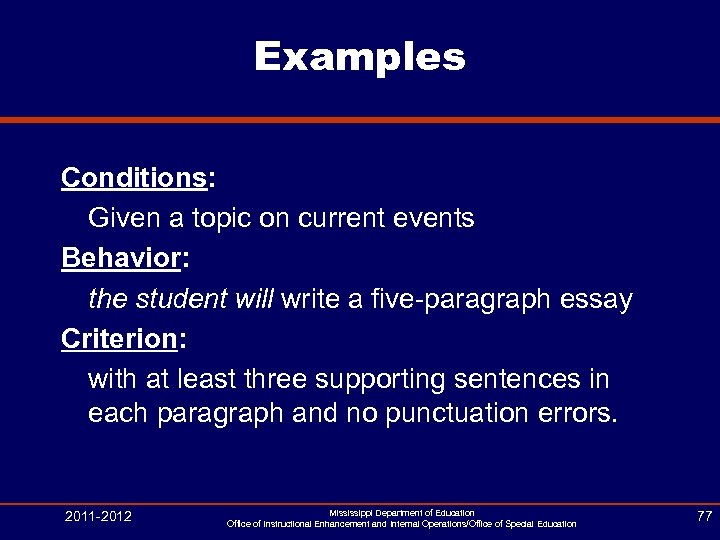 Examples Conditions: Given a topic on current events Behavior: the student will write a five-paragraph essay Criterion: with at least three supporting sentences in each paragraph and no punctuation errors. 2011 -2012 Mississippi Department of Education Office of Instructional Enhancement and Internal Operations/Office of Special Education 77
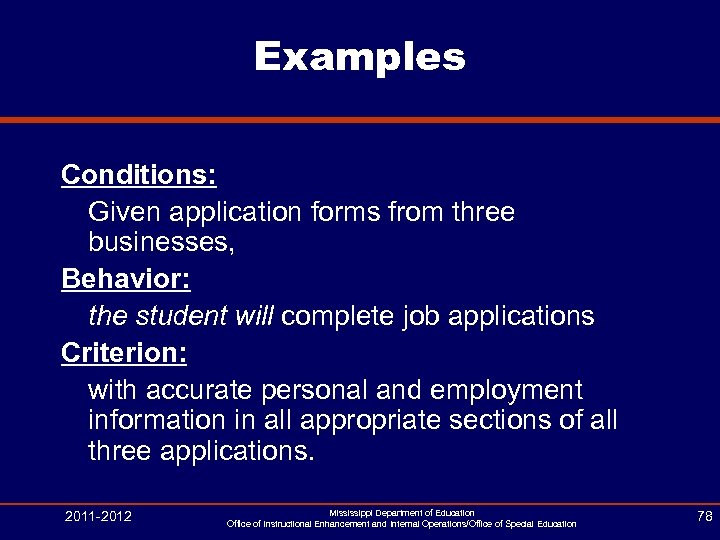 Examples Conditions: Given application forms from three businesses, Behavior: the student will complete job applications Criterion: with accurate personal and employment information in all appropriate sections of all three applications. 2011 -2012 Mississippi Department of Education Office of Instructional Enhancement and Internal Operations/Office of Special Education 78
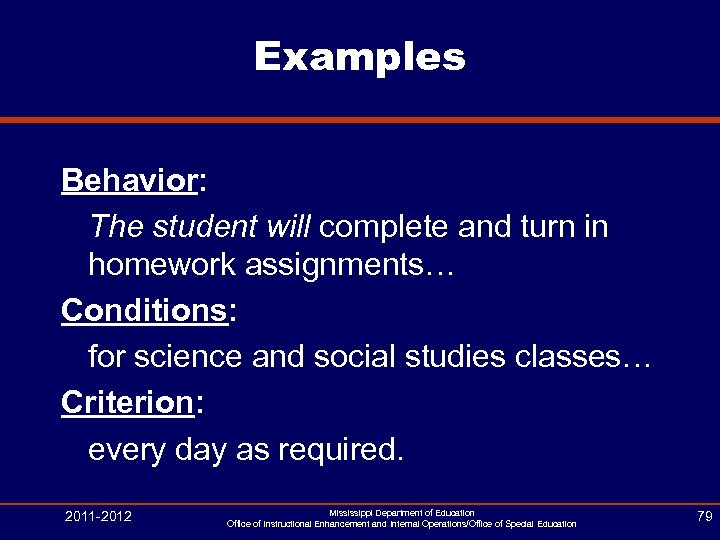 Examples Behavior: The student will complete and turn in homework assignments… Conditions: for science and social studies classes… Criterion: every day as required. 2011 -2012 Mississippi Department of Education Office of Instructional Enhancement and Internal Operations/Office of Special Education 79
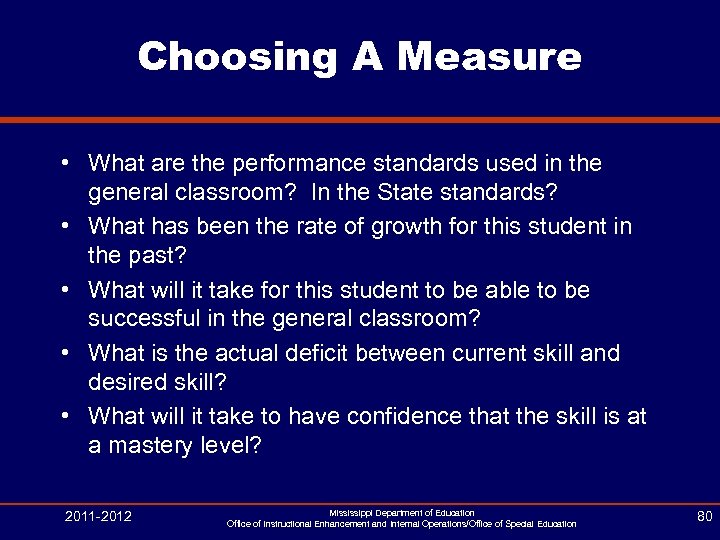 Choosing A Measure • What are the performance standards used in the general classroom? In the State standards? • What has been the rate of growth for this student in the past? • What will it take for this student to be able to be successful in the general classroom? • What is the actual deficit between current skill and desired skill? • What will it take to have confidence that the skill is at a mastery level? 2011 -2012 Mississippi Department of Education Office of Instructional Enhancement and Internal Operations/Office of Special Education 80
 2011 -2012 Mississippi Department of Education Office of Instructional Enhancement and Internal Operations/Office of Special Education 81
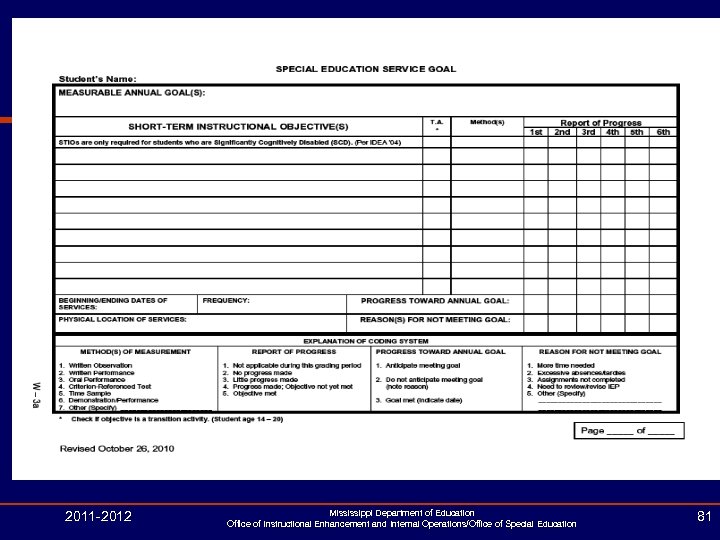
 Short-Term Instructional Objectives (STIOs) Regulations • STIOs are intermediate steps that the student will take to reach the measurable annual goal. As an alternative to STIOs, the IEP Committee may develop benchmarks, which describe the amount of progress the student is expected to make within specified segments of the year. 2011 -2012 Mississippi Department of Education Office of Instructional Enhancement and Internal Operations/Office of Special Education 82
 Short-Term Instructional Objectives • Short-term instructional objectives (STIOs) are required on a student’s IEP if the student has been classified as Significantly Cognitively Disabled (SCD). • STIOs may be used for students who are not SCD. 2011 -2012 Mississippi Department of Education Office of Instructional Enhancement and Internal Operations/Office of Special Education 83
 Appendix A to Part 300 – Notice of Interpretation (CFR, Vo. 64, No 48) clearly indicates that the purpose of both STIOs and benchmarks is to enable the IEP Committee “to gauge, at intermediate times during the year, how well the child is progressing toward achievement of the annual goals”. 2011 -2012 Mississippi Department of Education Office of Instructional Enhancement and Internal Operations/Office of Special Education 84
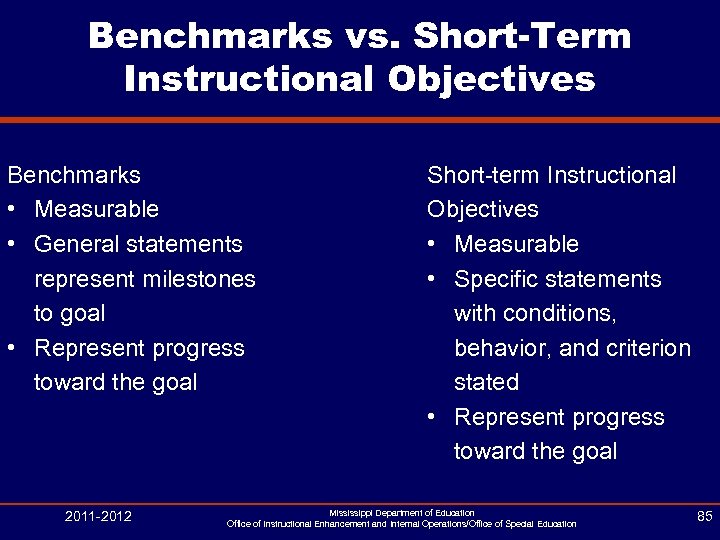 Benchmarks vs. Short-Term Instructional Objectives Benchmarks • Measurable • General statements represent milestones to goal • Represent progress toward the goal 2011 -2012 Short-term Instructional Objectives • Measurable • Specific statements with conditions, behavior, and criterion stated • Represent progress toward the goal Mississippi Department of Education Office of Instructional Enhancement and Internal Operations/Office of Special Education 85
 Remember It is important to remember that benchmarks must clearly communicate the expected progress or level of skill or behavior the student will reach for specified segments of the year. 2011 -2012 Mississippi Department of Education Office of Instructional Enhancement and Internal Operations/Office of Special Education 86
 Identifying Needs – An Example • Jan is in the sixth grade. She has a reading fluency rate of 120 wpm when given passages written at the 3 rd grade level. She is able to read two syllable nonsense words that follow common letter sound correspondence with 100% accuracy. 2011 -2012 Mississippi Department of Education Office of Instructional Enhancement and Internal Operations/Office of Special Education 87
 Identifying Needs – An Example • Jan demonstrates understanding of grade-level materials when information is presented orally, including science, math and social studies information. Spring 2010 Mississippi Department of Education Office of Instructional Enhancement and Internal Operations/Office of Special Education 88
 Identifying Needs – An Example • The requirement to read material at grade level interferes with Jan’s ability to perform proficiently or to expectations without support or adaptations. • To meet Jan’s goals for the future, continued intervention to develop independent reading skills is required. 2011 -2012 Mississippi Department of Education Office of Instructional Enhancement and Internal Operations/Office of Special Education 89
 Getting Started Review what we know • Area of need—reading fluency and comprehension. • What do we know about past instruction and progress? • What has been our experience with similar students/situations? 2011 -2012 Mississippi Department of Education Office of Instructional Enhancement and Internal Operations/Office of Special Education 90
 Activity V Given what we know and what we think we can expect, write a goal statement for Jan. 2011 -2012 Mississippi Department of Education Office of Instructional Enhancement and Internal Operations/Office of Special Education 91
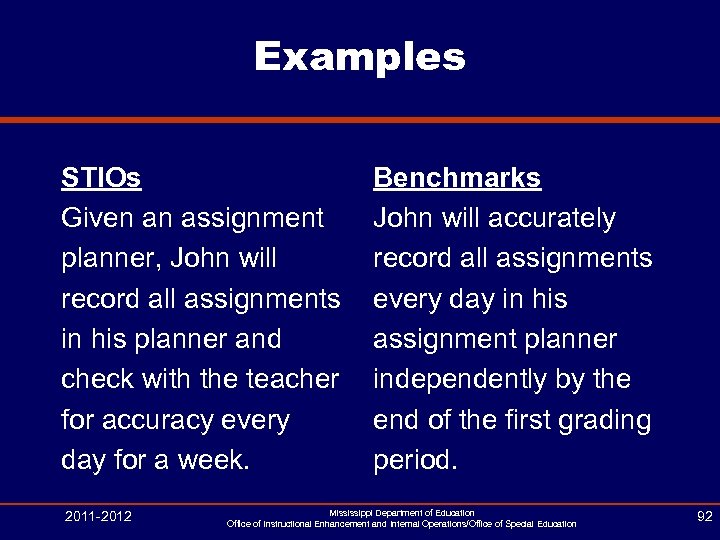 Examples STIOs Given an assignment planner, John will record all assignments in his planner and check with the teacher for accuracy every day for a week. 2011 -2012 Benchmarks John will accurately record all assignments every day in his assignment planner independently by the end of the first grading period. Mississippi Department of Education Office of Instructional Enhancement and Internal Operations/Office of Special Education 92
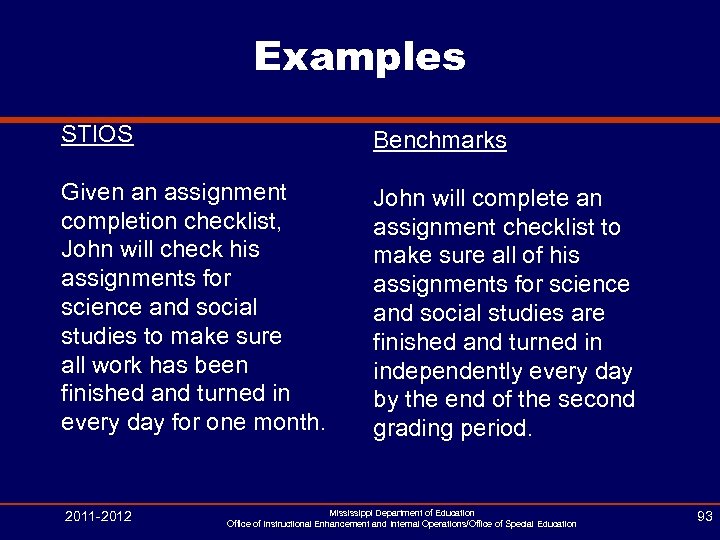 Examples STIOS Benchmarks Given an assignment completion checklist, John will check his assignments for science and social studies to make sure all work has been finished and turned in every day for one month. John will complete an assignment checklist to make sure all of his assignments for science and social studies are finished and turned in independently every day by the end of the second grading period. 2011 -2012 Mississippi Department of Education Office of Instructional Enhancement and Internal Operations/Office of Special Education 93
 The STRANGER Test (Kaplan 1990) Goals and objectives must be written so someone who did not write them (a stranger) could use them to develop appropriate instructional plans and assess the student’s progress. 2011 -2012 Mississippi Department of Education Office of Instructional Enhancement and Internal Operations/Office of Special Education 94
 The "SO WHAT" Test • Embodies validity. • Asks: “Are the goals and objectives written to be educationally relevant? ” 2011 -2012 Mississippi Department of Education Office of Instructional Enhancement and Internal Operations/Office of Special Education 95
 Goal Writing Consideration • Goals can be organized by essential components of instruction: For reading, may include phonemic awareness, phonics, vocabulary development, reading fluency, and reading comprehension. For math, may include understanding, computing, applying, reasoning, and engaging. • Goals may also be organized by a more general intended outcome as well. 2011 -2012 Mississippi Department of Education Office of Instructional Enhancement and Internal Operations/Office of Special Education 96
 ACTIVITY VI Rewrite the following goals (Slides 96 & 97) and identify the: who, behavior, criterion, and condition. 2011 -2012 Mississippi Department of Education Office of Instructional Enhancement and Internal Operations/Office of Special Education 97
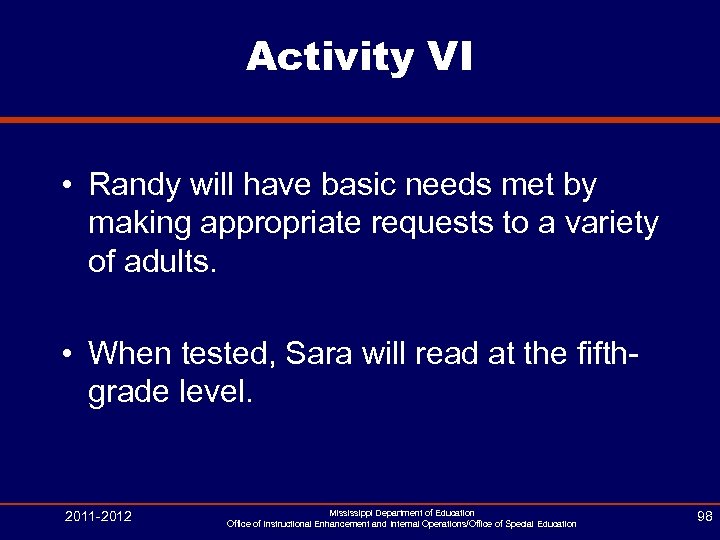 Activity VI • Randy will have basic needs met by making appropriate requests to a variety of adults. • When tested, Sara will read at the fifthgrade level. 2011 -2012 Mississippi Department of Education Office of Instructional Enhancement and Internal Operations/Office of Special Education 98
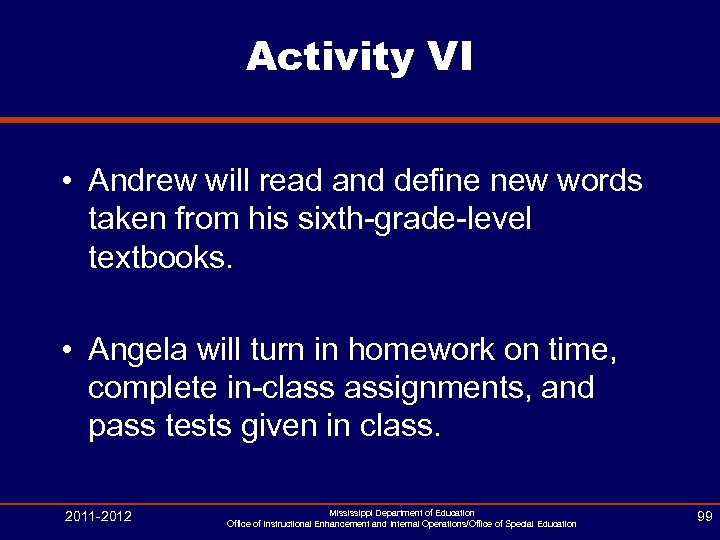 Activity VI • Andrew will read and define new words taken from his sixth-grade-level textbooks. • Angela will turn in homework on time, complete in-class assignments, and pass tests given in class. 2011 -2012 Mississippi Department of Education Office of Instructional Enhancement and Internal Operations/Office of Special Education 99
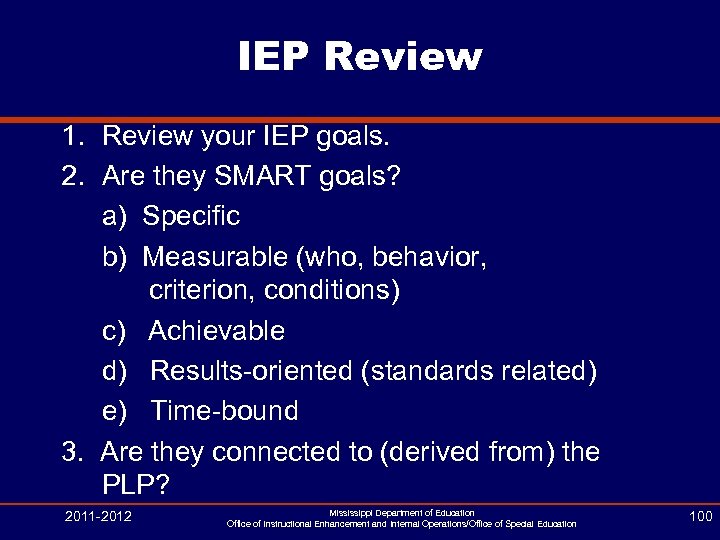 IEP Review 1. Review your IEP goals. 2. Are they SMART goals? a) Specific b) Measurable (who, behavior, criterion, conditions) c) Achievable d) Results-oriented (standards related) e) Time-bound 3. Are they connected to (derived from) the PLP? 2011 -2012 Mississippi Department of Education Office of Instructional Enhancement and Internal Operations/Office of Special Education 100
 Resource Documents • A Seven-Step Process to Creating Standards-based IEPs (NASDSE) • Connecting the IEP to the General Curriculum: A Talking Paper (Carol B. Massanair) 2011 -2012 Mississippi Department of Education Office of Instructional Enhancement and Internal Operations/Office of Special Education 101
 Resource Documents • Advocacy Brief: Understanding the Standards-based Individualized Education Program (IEP) – National Center for Learning Disabilities (NCLD) • Writing Measurable IEP Goals and Objectives by Barbara D. Bateman and Cynthia M. Herr 2011 -2012 Mississippi Department of Education Office of Instructional Enhancement and Internal Operations/Office of Special Education 102
 CONTACT INFORMATION Annie Margaret Harris marobinson@mde. k 12. ms. us Desma Mc. Elveen dmcelveen@mde. k 12. ms. us Tanya Bradley tbradley@mde. k 12. ms. us Office of Special Education Division of Technical Assistance (601) 359 -3498 2011 -2012 Mississippi Department of Education Office of Instructional Enhancement and Internal Operations/Office of Special Education 103