


 Скачать презентацию Wrangling with Uncertainty in Complex Adaptive Systems of
dab11f54acd992119e35d0a518654a98.ppt
- Количество слайдов: 38
 Wrangling with Uncertainty in Complex Adaptive Systems of Systems (CASo. S) Engineering or “Why CASo. S Engineering is both an Opportunity and Challenge for Uncertainty Quantification” Robert Glass with Arlo Ames, Walter Beyeler, and many others Sandia National Laboratories NSF Workshop “Opportunities and Challenges in Uncertainty Quantification for Complex Interacting systems” April 13, 2009
 Outline What is a CASo. S? Where does uncertainty arise? Engineering within a CASo. S: Example of Influenza Pandemic Mitigation Policy Design Towards a General CASo. S Engineering Framework
 What is a CASo. S? System: A system is a set of entities, real or abstract, comprising a whole where each component interacts with or is related to at least one other component and that interact to accomplish some function. Individual components may pursue their own objectives, with or without the intention of contributing to the system function. Any object which has no relation with any other element of the system is not part of that system. System of Systems: The system is composed of other systems (“of systems”). The other systems are natural to think of as systems in their own right, can’t be replaced by a single entity, and may be enormously complicated. Complex: The system has behavior involving interrelationships among its elements and these interrelationships can yield emergent behavior that is nonlinear, of greater complexity than the sum of behaviors of its parts, not due to system complication. Adaptive: The system’s behavior changes in time. These changes may be within entities or their interaction, within sub-systems or their interaction, and may result in a change in the overall system’s behavior relative to its environment.
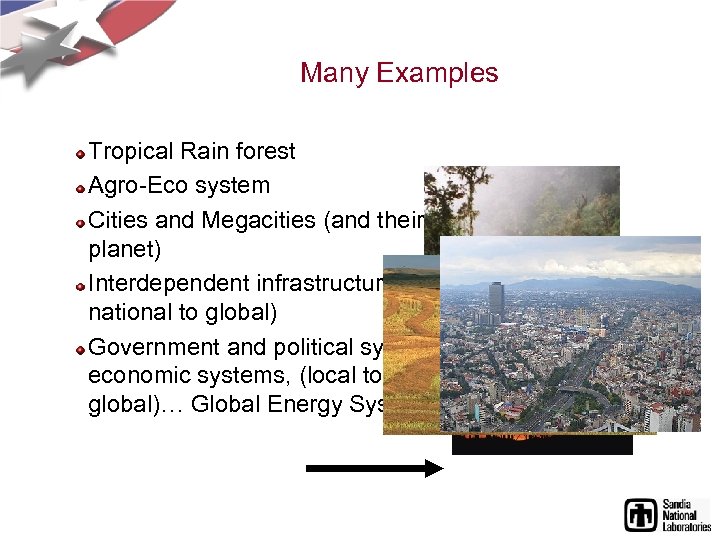 Many Examples Tropical Rain forest Agro-Eco system Cities and Megacities (and their network on the planet) Interdependent infrastructure (local to regional to national to global) Government and political systems, financial systems, economic systems, (local to regional to national to global)… Global Energy System
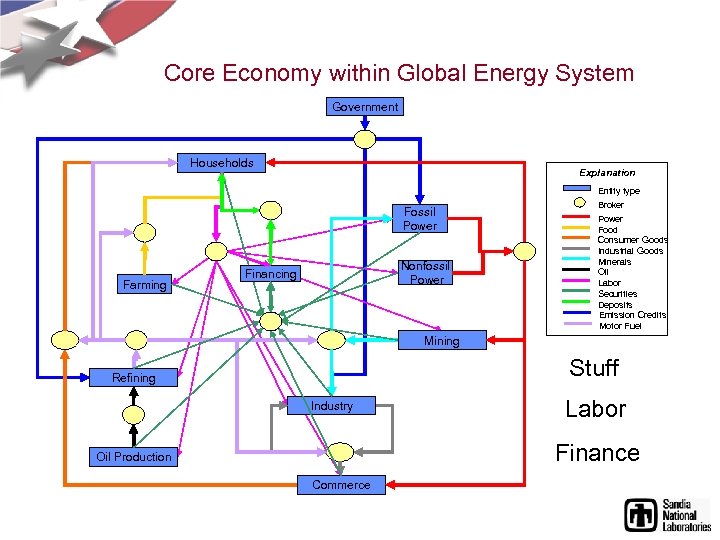 Core Economy within Global Energy System Government Households Explanation Entity type Fossil Power Farming Nonfossil Power Financing Broker Power Food Consumer Goods Industrial Goods Minerals Oil Labor Securities Deposits Emission Credits Motor Fuel Mining Stuff Refining Industry Labor Finance Oil Production Commerce
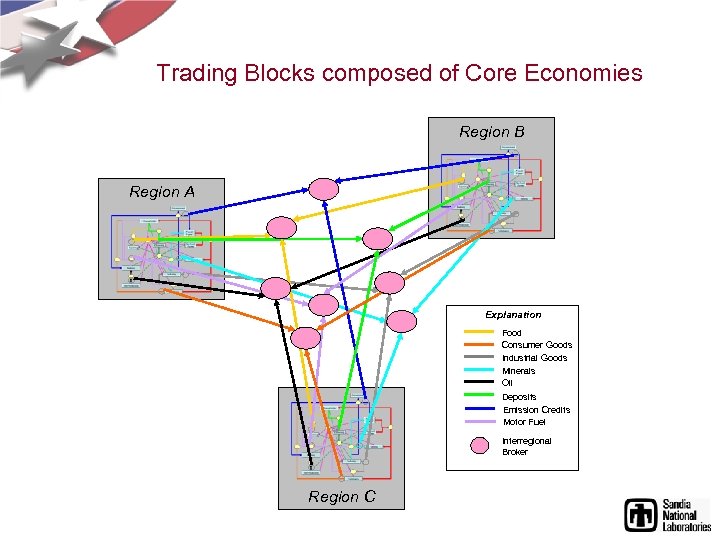 Trading Blocks composed of Core Economies Region B Region A Explanation Food Consumer Goods Industrial Goods Minerals Oil Deposits Emission Credits Motor Fuel Interregional Broker Region C
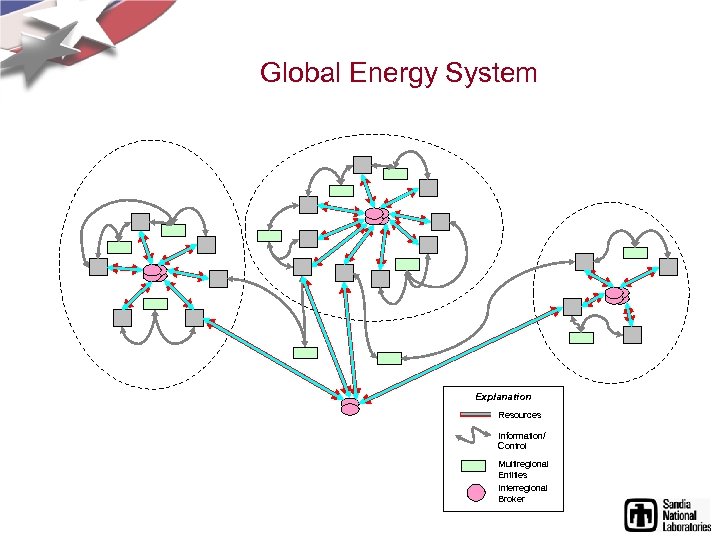 Global Energy System Explanation Resources Information/ Control Multiregional Entities Interregional Broker
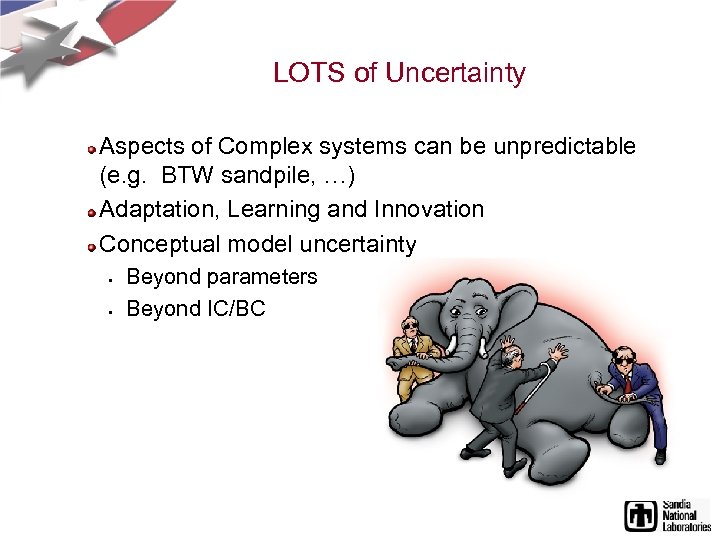 LOTS of Uncertainty Aspects of Complex systems can be unpredictable (e. g. BTW sandpile, …) Adaptation, Learning and Innovation Conceptual model uncertainty § § Beyond parameters Beyond IC/BC
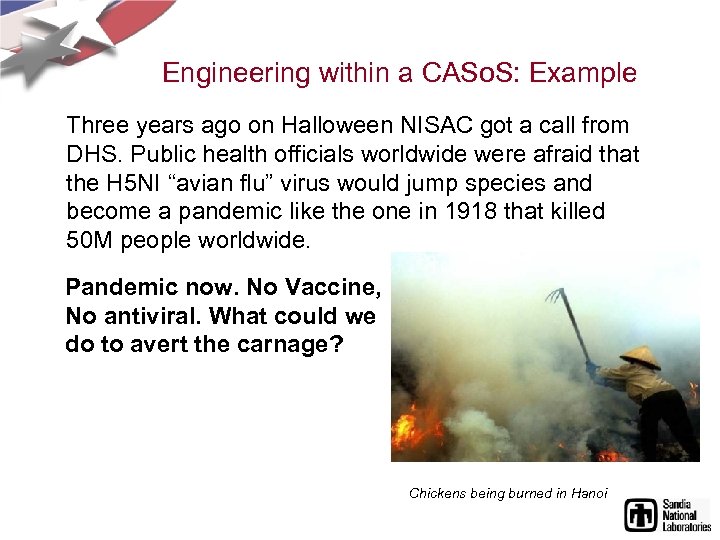 Engineering within a CASo. S: Example Three years ago on Halloween NISAC got a call from DHS. Public health officials worldwide were afraid that the H 5 NI “avian flu” virus would jump species and become a pandemic like the one in 1918 that killed 50 M people worldwide. Pandemic now. No Vaccine, No antiviral. What could we do to avert the carnage? Chickens being burned in Hanoi
 Definition of the CASo. S System: Global transmission network composed of person to person interactions beginning from the point of origin (within coughing distance, touching each other or surfaces…) System of Systems: People belong to and interact within many groups: Households, Schools, Workplaces, Transport (local to regional to global), etc. , and health care systems, corporations and governments place controls on interactions at larger scales… Complex: many, many similar components (Billions of people on planet) and groups Adaptive: each culture has evolved different social interaction processes, each will react differently and adapt to the progress of the disease, this in turn causes the change in the pathway and even the genetic make-up of the virus HUGE UNCERTAINTY
 Analogy with other Complex Systems Simple analog: Forest fires: You can build fire breaks based on where people throw cigarettes… or you can thin the forest so no that matter where a cigarette is thrown, a percolating fire (like an epidemic) will not burn. Aspirations: Could we target the social network within individual communities and thin it? Could we thin it intelligently so as to minimize impact and keep the economy rolling?
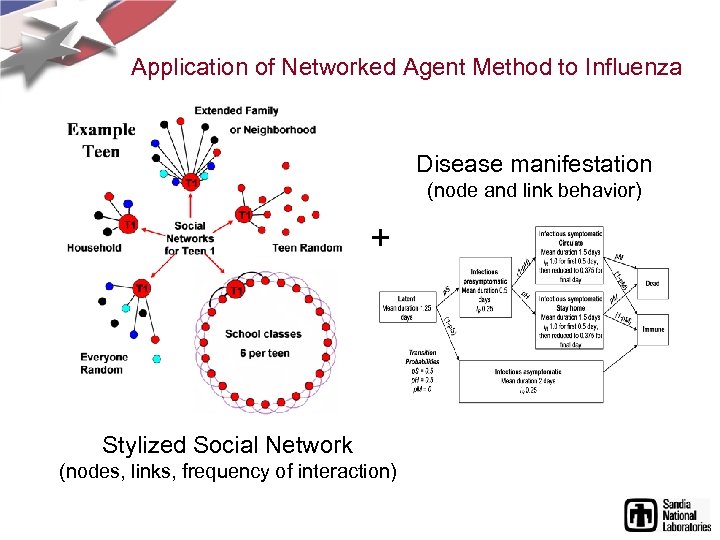 Application of Networked Agent Method to Influenza Disease manifestation (node and link behavior) + Stylized Social Network (nodes, links, frequency of interaction)
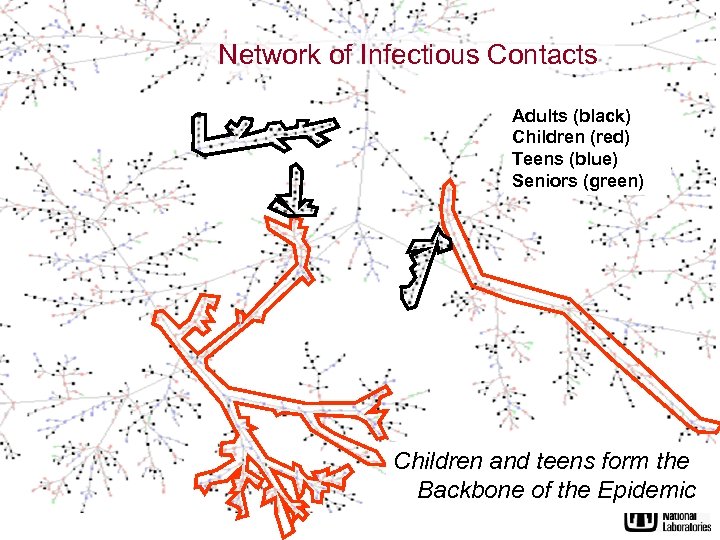 Network of Infectious Contacts Adults (black) Children (red) Teens (blue) Seniors (green) Children and teens form the Backbone of the Epidemic
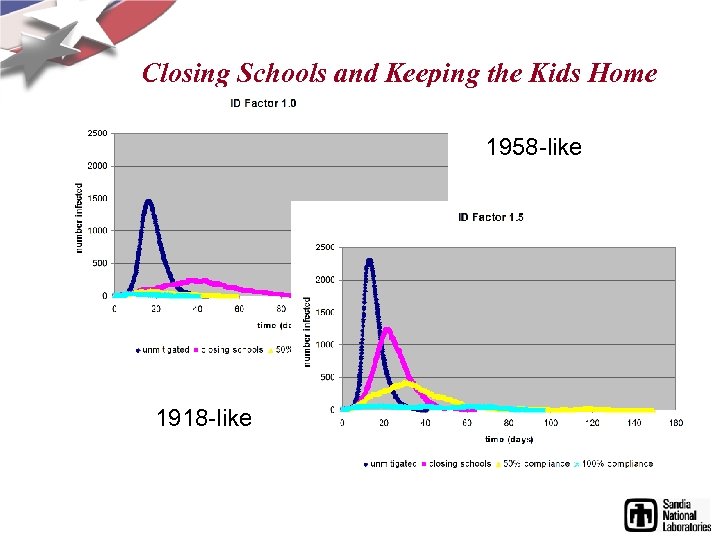 Closing Schools and Keeping the Kids Home 1958 -like 1918 -like
 Connected to HSC Pandemic Implementation Plan writing team They identified critical questions/issues and worked with us to answer/resolve them How sensitive were results to the social net? Disease manifestation? How sensitive to compliance? Implementation threshold? Disease infectivity? How did the model results compare to past epidemics and results from the models of others? Is there any evidence from past pandemics that these strategies worked? What about adding or “layering” additional strategies including home quarantine, antiviral treatment and prophylaxis, and pre-pandemic vaccine? We extended the model and put it on Tbird… 10’s of millions of runs later we had the answers to: What is the best mitigation strategy combination? (choice) How robust is the combination to model assumptions and uncertainty? (robustness of choice) What is required for the choice to be most effective? (evolving towards resilience) These answers guided the formulation of national pandemic policy, Actualization is still in progress.
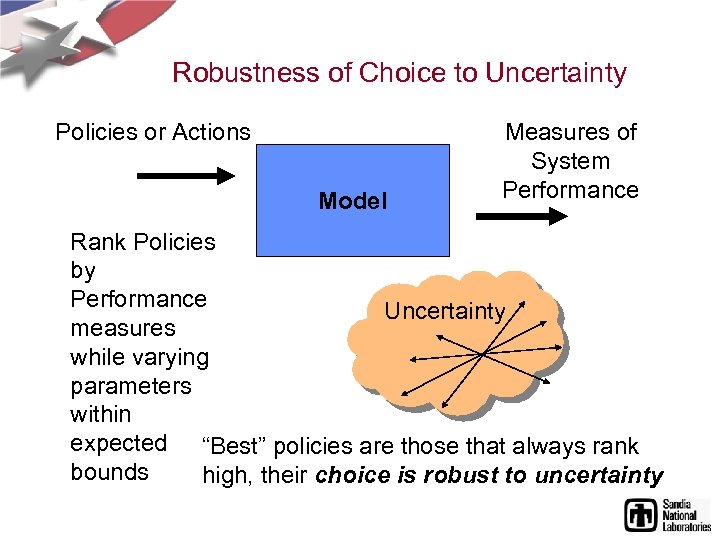 Robustness of Choice to Uncertainty Policies or Actions Model Measures of System Performance Rank Policies by Performance Uncertainty measures while varying parameters within expected “Best” policies are those that always rank bounds high, their choice is robust to uncertainty
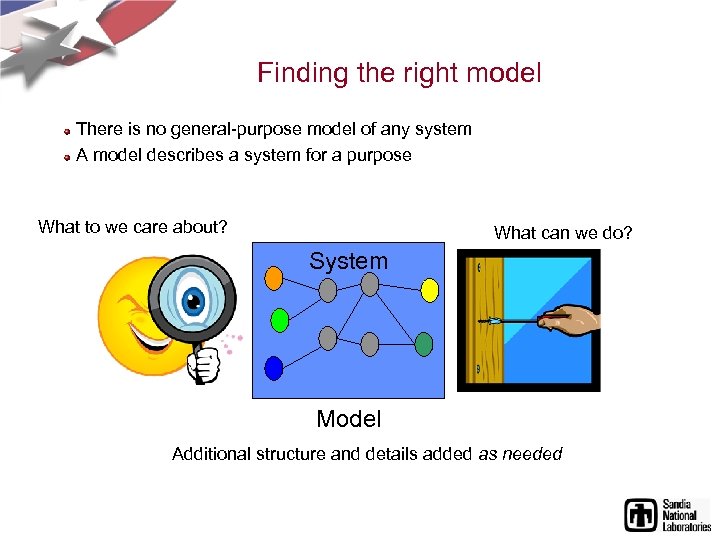 Finding the right model There is no general-purpose model of any system A model describes a system for a purpose What to we care about? What can we do? System Model Additional structure and details added as needed
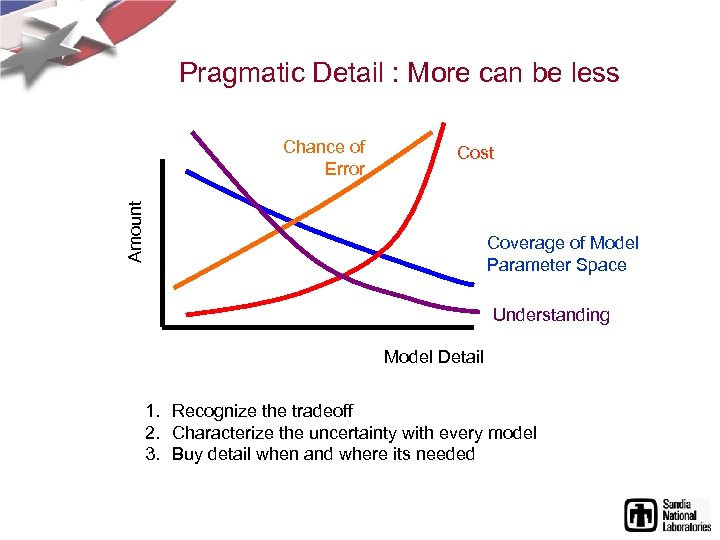 Pragmatic Detail : More can be less Cost Amount Chance of Error Coverage of Model Parameter Space Understanding Model Detail 1. Recognize the tradeoff 2. Characterize the uncertainty with every model 3. Buy detail when and where its needed
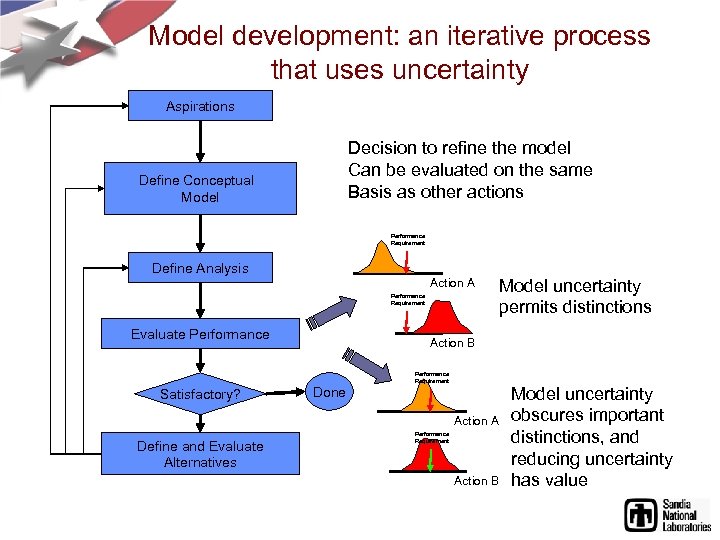 Model development: an iterative process that uses uncertainty Aspirations Decision to refine the model Can be evaluated on the same Basis as other actions Define Conceptual Model Performance Requirement Define Analysis Action A Performance Requirement Evaluate Performance Satisfactory? Model uncertainty permits distinctions Action B Done Performance Requirement Action A Define and Evaluate Alternatives Performance Requirement Action B Model uncertainty obscures important distinctions, and reducing uncertainty has value
 CASo. S Engineering: An Opportunity and Challenge for Uncertainty Quantification
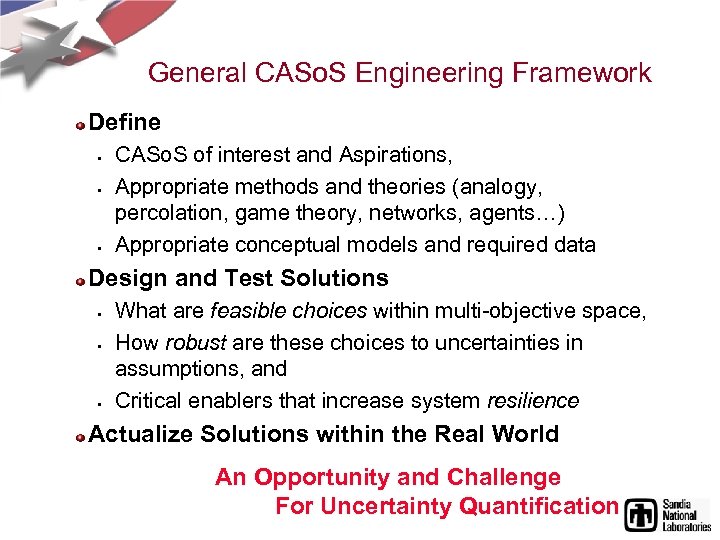 General CASo. S Engineering Framework Define § § § CASo. S of interest and Aspirations, Appropriate methods and theories (analogy, percolation, game theory, networks, agents…) Appropriate conceptual models and required data Design and Test Solutions § § § What are feasible choices within multi-objective space, How robust are these choices to uncertainties in assumptions, and Critical enablers that increase system resilience Actualize Solutions within the Real World An Opportunity and Challenge For Uncertainty Quantification
 Extra NISAC Related
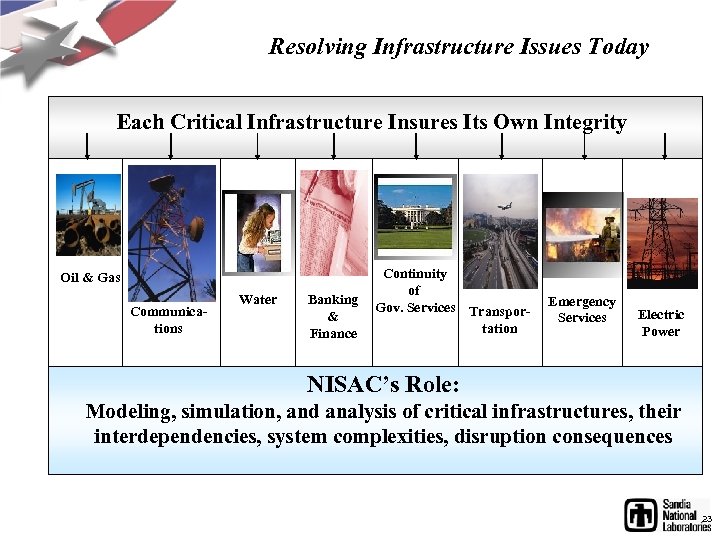 Resolving Infrastructure Issues Today Each Critical Infrastructure Insures Its Own Integrity Oil & Gas Communications Water Banking & Finance Continuity of Gov. Services Transportation Emergency Services Electric Power NISAC’s Role: Modeling, simulation, and analysis of critical infrastructures, their interdependencies, system complexities, disruption consequences 23
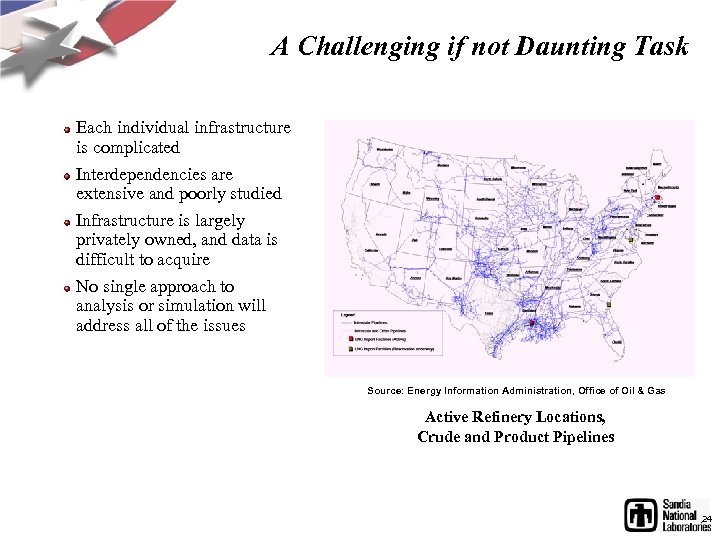 A Challenging if not Daunting Task Each individual infrastructure is complicated Interdependencies are extensive and poorly studied Infrastructure is largely privately owned, and data is difficult to acquire No single approach to analysis or simulation will address all of the issues Source: Energy Information Administration, Office of Oil & Gas Active Refinery Locations, Crude and Product Pipelines 24
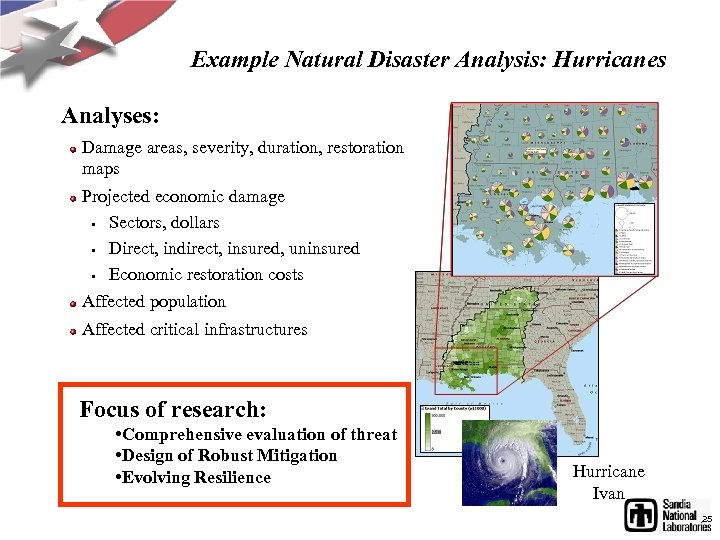 Example Natural Disaster Analysis: Hurricanes Analyses: Damage areas, severity, duration, restoration maps Projected economic damage § Sectors, dollars § Direct, indirect, insured, uninsured § Economic restoration costs Affected population Affected critical infrastructures Focus of research: • Comprehensive evaluation of threat • Design of Robust Mitigation • Evolving Resilience Hurricane Ivan 25
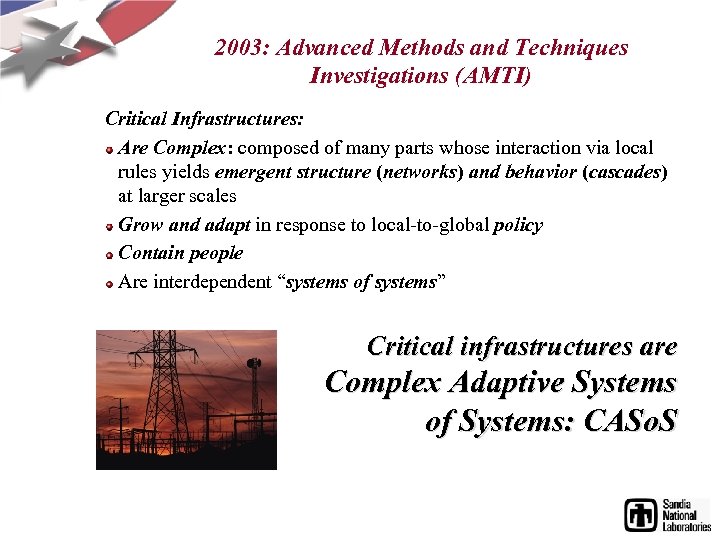 2003: Advanced Methods and Techniques Investigations (AMTI) Critical Infrastructures: Are Complex: composed of many parts whose interaction via local rules yields emergent structure (networks) and behavior (cascades) at larger scales Grow and adapt in response to local-to-global policy Contain people Are interdependent “systems of systems” Critical infrastructures are Complex Adaptive Systems of Systems: CASo. S
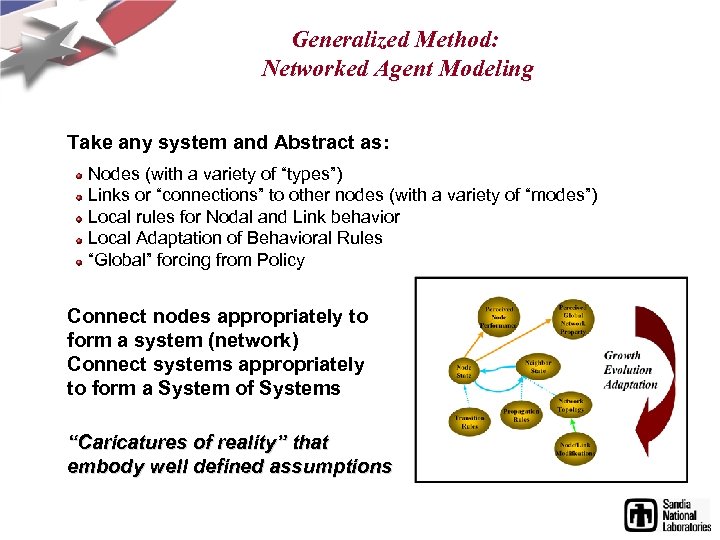 Generalized Method: Networked Agent Modeling Take any system and Abstract as: Nodes (with a variety of “types”) Links or “connections” to other nodes (with a variety of “modes”) Local rules for Nodal and Link behavior Local Adaptation of Behavioral Rules “Global” forcing from Policy Connect nodes appropriately to form a system (network) Connect systems appropriately to form a System of Systems “Caricatures of reality” that embody well defined assumptions
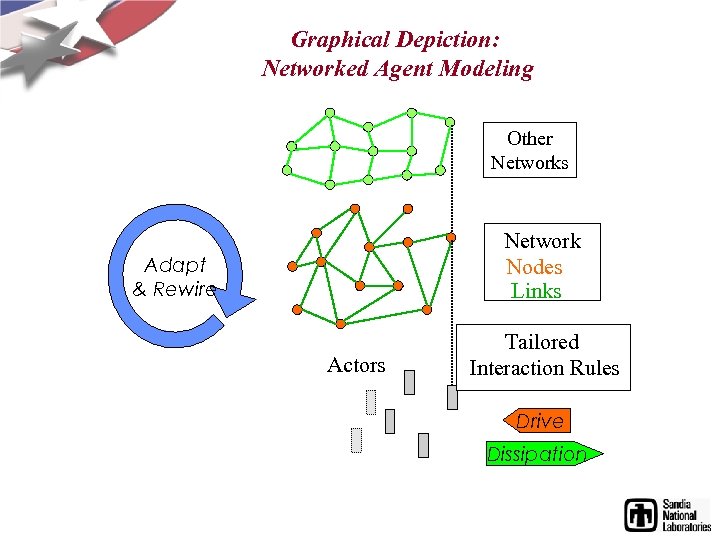 Graphical Depiction: Networked Agent Modeling Other Networks Network Nodes Links Adapt & Rewire Actors Tailored Interaction Rules Drive Dissipation
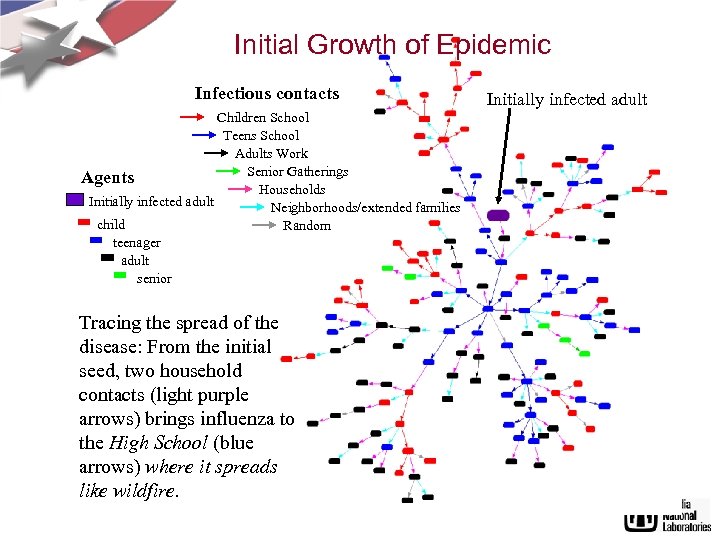 Initial Growth of Epidemic Infectious contacts Children School Teens School Adults Work Senior Gatherings Agents Households Initially infected adult Neighborhoods/extended families child Random teenager adult senior Tracing the spread of the disease: From the initial seed, two household contacts (light purple arrows) brings influenza to the High School (blue arrows) where it spreads like wildfire. Initially infected adult
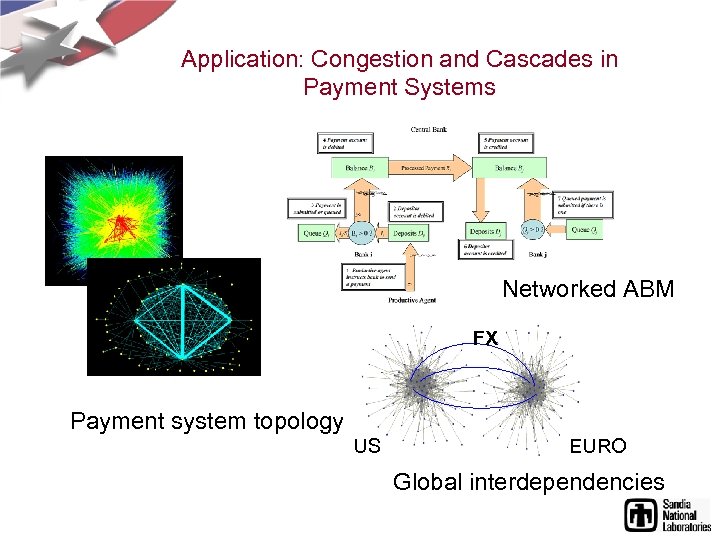 Application: Congestion and Cascades in Payment Systems Networked ABM FX Payment system topology US EURO Global interdependencies
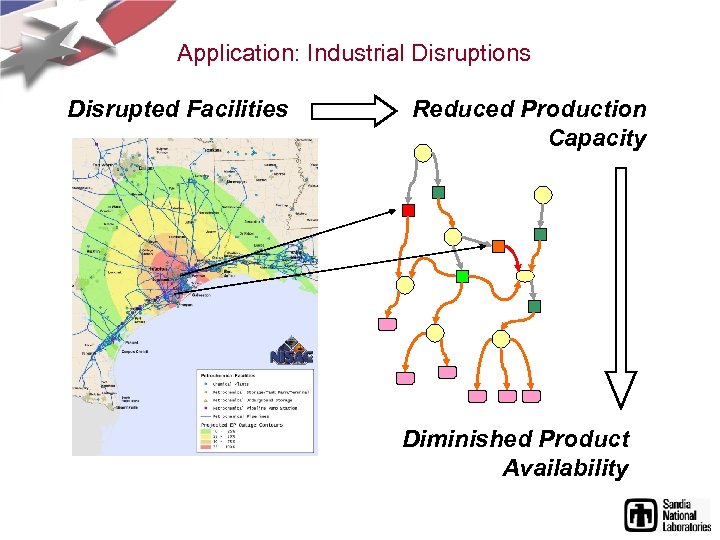 Application: Industrial Disruptions Disrupted Facilities Reduced Production Capacity Diminished Product Availability
 Complexity Primer Slides
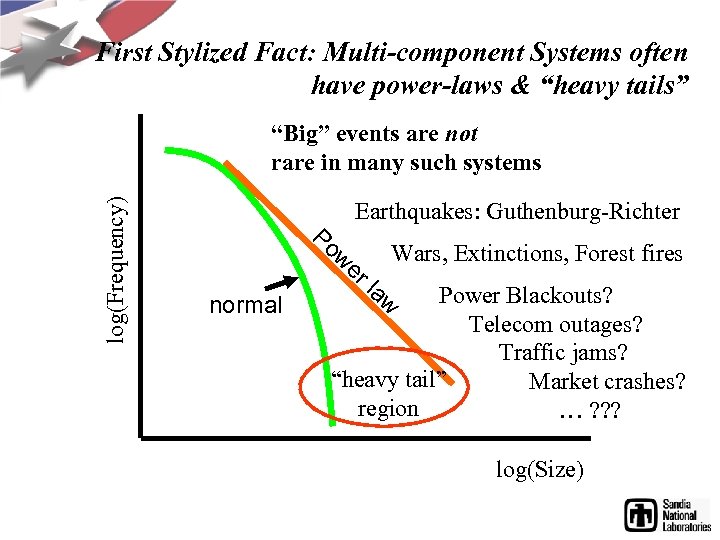 First Stylized Fact: Multi-component Systems often have power-laws & “heavy tails” log(Frequency) “Big” events are not rare in many such systems Po Earthquakes: Guthenburg-Richter w normal er Wars, Extinctions, Forest fires la Power Blackouts? w Telecom outages? Traffic jams? “heavy tail” Market crashes? region … ? ? ? log(Size)
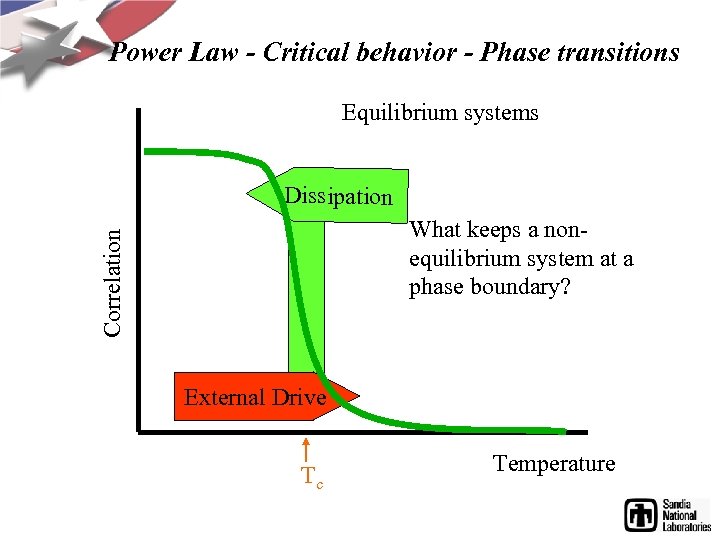 Power Law - Critical behavior - Phase transitions Equilibrium systems Dissipation Correlation What keeps a nonequilibrium system at a phase boundary? External Drive Tc Temperature
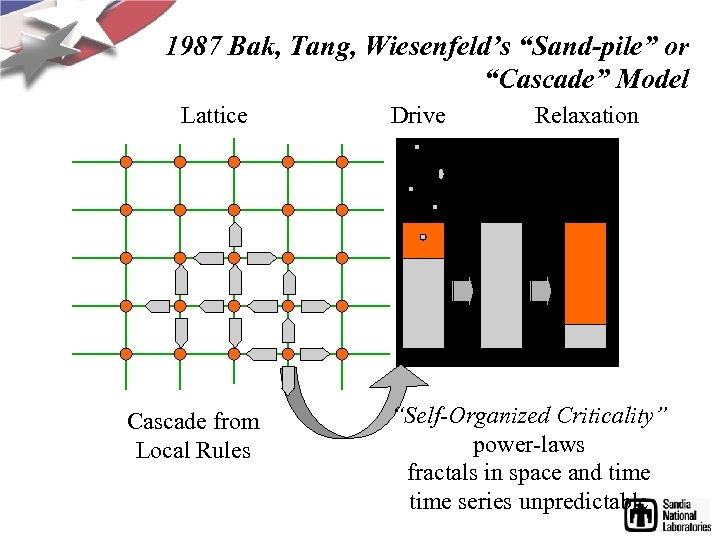 1987 Bak, Tang, Wiesenfeld’s “Sand-pile” or “Cascade” Model Lattice Cascade from Local Rules Drive Relaxation “Self-Organized Criticality” power-laws fractals in space and time series unpredictable
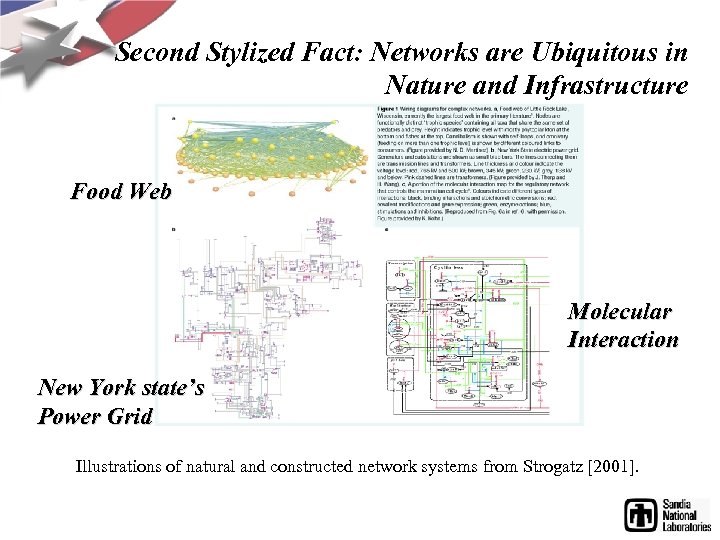 Second Stylized Fact: Networks are Ubiquitous in Nature and Infrastructure Food Web Molecular Interaction New York state’s Power Grid Illustrations of natural and constructed network systems from Strogatz [2001].
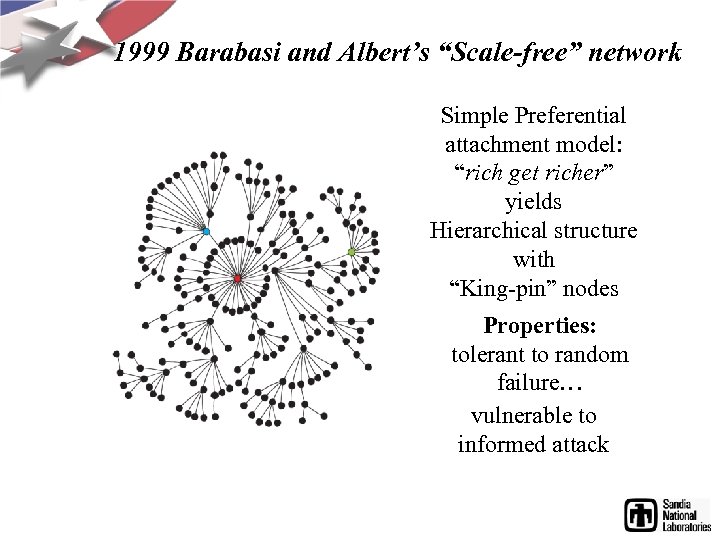 1999 Barabasi and Albert’s “Scale-free” network Simple Preferential attachment model: “rich get richer” yields Hierarchical structure with “King-pin” nodes Properties: tolerant to random failure… vulnerable to informed attack
 Evolving towards Resilience Robustness of choice to uncertainty also shows those factors that good system performance depends on, in order: § Implementation threshold § Compliance § Regional mitigation § Rescinding threshold Planning and Training required to push the system where it needs to be (carrots and sticks) Because eliciting appropriate behavior of humans is inherently uncertain (fatigue, hysteria, false positives), this policy is “interim”, meanwhile: § Research to develop broad spectrum vaccine for influenza § Resolving supply chain issues for antivirals