 Скачать презентацию WPI US-AFRICA Business Conference Capacity Building for African
9466811271bf3a923fbc816ada4dfe94.ppt
- Количество слайдов: 24



WPI US-AFRICA Business Conference Capacity Building for African Small & Medium Enterprises: EXPERIENCES, CHALLENGES AND OPPORTUNITIES March 9, 2008
SOUTH AFRICAN INTERNATIONAL BUSINESS LINKAGES United States Agency for International Development Corporate Council on Africa (CCA) ECI Africa (Pty) Ltd
SAIBL OPERATIONS Facilitates and leverages: • business linkages between South African blackowned/partnered SMEs and large corporations • access to US & SADC export markets • access to business development services • access to finance for SMEs
SAIBL 1998 – 2008 • Assisted over 500 black-owned/partnered SMEs • Total reported turnover of $1. 44 billion) • Total reported exports of $130 million • Total reported net new jobs of 17, 323
AFRICAN ECONOMIC LANDSCAPE • Dominant public sector • Dominant role by large corporations in private sector & commanding heights • Globalization a reality • Increasing recognition & role of emerging indigenous small & medium enterprises
CHALLENGES & OPPORTUNITIES Creating and growing business partnerships between private and public corporations and local small and medium enterprises Business Linkages
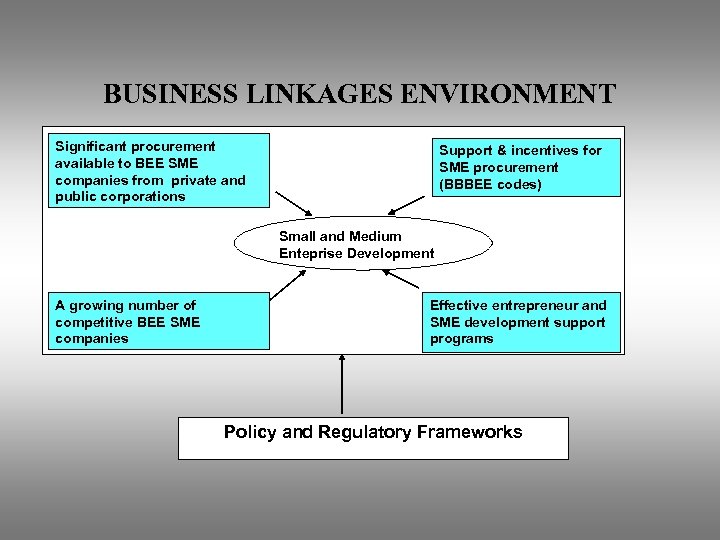
BUSINESS LINKAGES ENVIRONMENT Significant procurement available to BEE SME companies from private and public corporations Support & incentives for SME procurement (BBBEE codes) Small and Medium Enteprise Development A growing number of competitive BEE SME companies Effective entrepreneur and SME development support programs Policy and Regulatory Frameworks
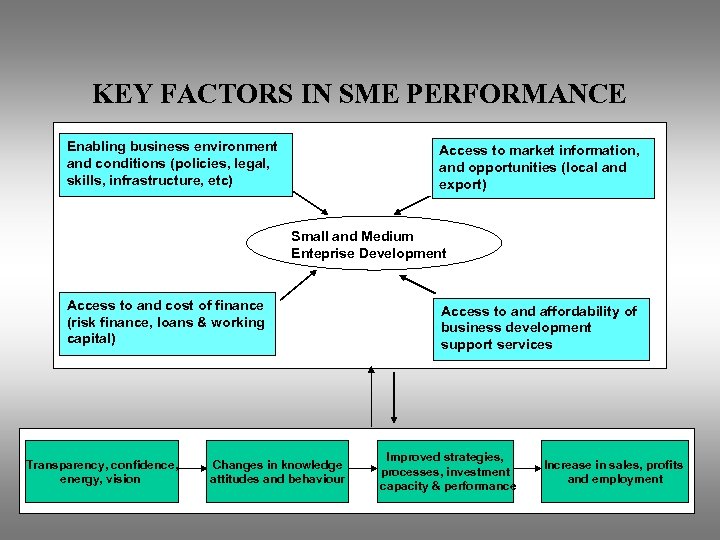
KEY FACTORS IN SME PERFORMANCE Enabling business environment and conditions (policies, legal, skills, infrastructure, etc) Access to market information, and opportunities (local and export) Small and Medium Enteprise Development Access to and cost of finance (risk finance, loans & working capital) Transparency, confidence, energy, vision Changes in knowledge attitudes and behaviour Access to and affordability of business development support services Improved strategies, processes, investment capacity & performance Increase in sales, profits and employment
![Linkage Framework Corporate expectations • Quality; • Cost; • Delivery [time; spec] SME Supply](https://present5.com/presentation/9466811271bf3a923fbc816ada4dfe94/image-9.jpg "Linkage Framework Corporate expectations • Quality; • Cost; • Delivery [time; spec] SME Supply")
Linkage Framework Corporate expectations • Quality; • Cost; • Delivery [time; spec] SME Supply Of Goods & Services Linkage Program SME expectations • Information • Skills • Finance [s/up & w/capital] Large Company Demand for Goods and Services
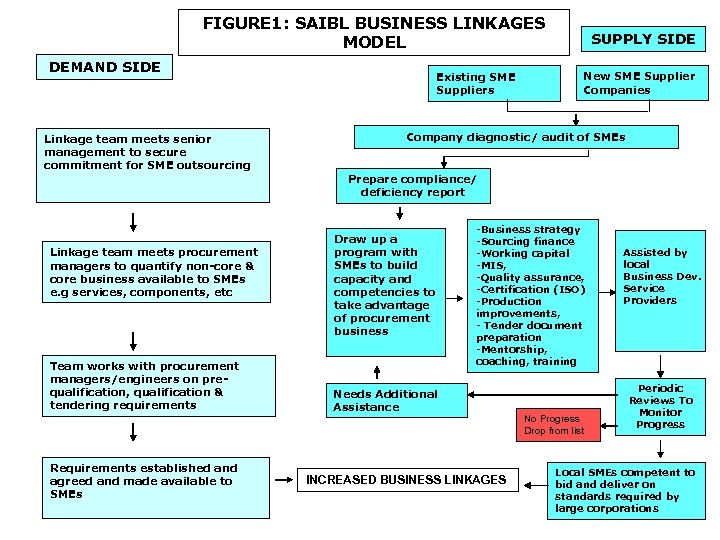
FIGURE 1: SAIBL BUSINESS LINKAGES MODEL DEMAND SIDE Linkage team meets senior management to secure commitment for SME outsourcing Existing SME Suppliers SUPPLY SIDE New SME Supplier Companies Company diagnostic/ audit of SMEs Prepare compliance/ deficiency report Linkage team meets procurement managers to quantify non-core & core business available to SMEs e. g services, components, etc Team works with procurement managers/engineers on prequalification, qualification & tendering requirements Requirements established and agreed and made available to SMEs Draw up a program with SMEs to build capacity and competencies to take advantage of procurement business -Business strategy -Sourcing finance -Working capital -MIS, -Quality assurance, -Certification (ISO) -Production improvements, - Tender document preparation -Mentorship, coaching, training Needs Additional Assistance INCREASED BUSINESS LINKAGES No Progress Drop from list Assisted by local Business Dev. Service Providers Periodic Reviews To Monitor Progress Local SMEs competent to bid and deliver on standards required by large corporations
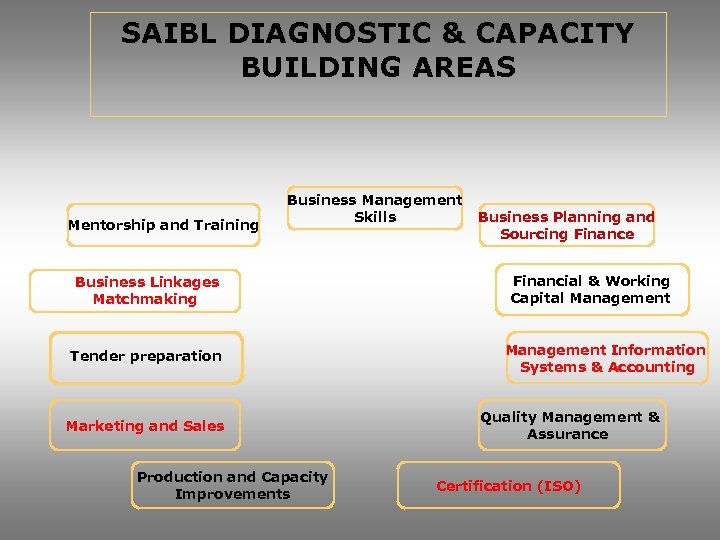
SAIBL DIAGNOSTIC & CAPACITY BUILDING AREAS Mentorship and Training Business Management Skills Business Linkages Matchmaking Tender preparation Marketing and Sales Production and Capacity Improvements Business Planning and Sourcing Finance Financial & Working Capital Management Information Systems & Accounting Quality Management & Assurance Certification (ISO)
CONSTRAINTS FOR CORPORATES • • • Corporate policy Local autonomy Risk aversion Scale Capability & competence of local SMEs
THE CASE FOR BUSINESS LINKAGES • • • Deepening & broadening local economy Create jobs and income Improve capability of local companies Improve supplier base Attract inward investment Provides sustainable market solutions
RECOMMENDED PRACTICES • • • “High level” corporate champion Include in procurement managers’ KPAs Pragmatism- one building block at a time Enlist and work with partners Input-output SMEs as business partners, not beneficiaries
Program Deliverables • Stakeholder buy-in and establishment of champions at Board and management level. • Streamlined and written policies & practices. • Linking accountability, performance to incentives • Increased number of SMEs doing business with corporations • Increased Rand value of business with BEE sector SMEs • Improved access to capacity building support for SMEs. • Improved monitoring and reporting
The Three Step Process: Market and Client Identification Includes; a Rapid Assessment and our company Diagnostic Tool, sector selection and market research, and identifying the key players in the market Synchronization between Client and Market Needs Includes; preparing clients through our rigorous training program and developing a business and export plan, a market exposure workshop, and developing a critical path to market penetration Market Penetration and Development Includes; a group trade mission to export market, an extensive to do list based on feedback, a return trade mission that is more focused on matchmaking and closing deals, and then another follow up visit to help partner promote clients products
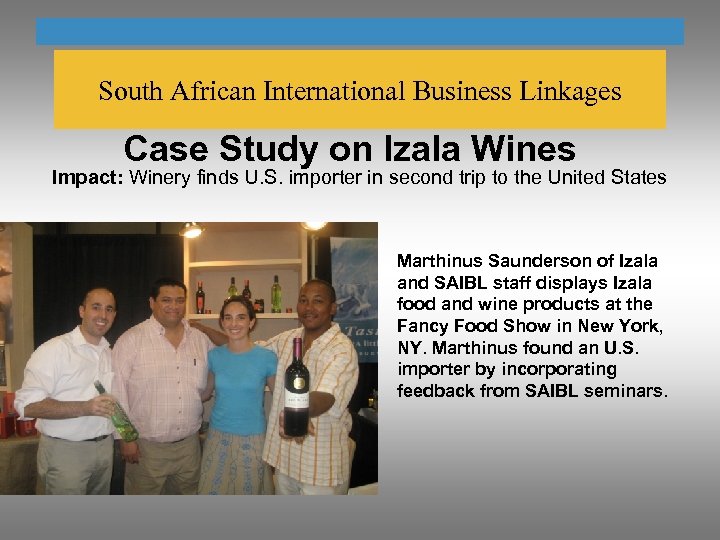
South African International Business Linkages Case Study on Izala Wines Impact: Winery finds U. S. importer in second trip to the United States Marthinus Saunderson of Izala and SAIBL staff displays Izala food and wine products at the Fancy Food Show in New York, NY. Marthinus found an U. S. importer by incorporating feedback from SAIBL seminars.
Challenge: Marthinus Saunderson of Izala Warehousing and Exports wanted to export his Lutouw wine and Afri. Deli specialty food products to the United States. His own attempts to penetrate the U. S. market were not successful. Despite a 350 -year tradition of wine making, South Africa is not well-known to American consumers for its wines. Small, Black-owned wineries face additional challenges trying to enter the U. S. market e. g. the average wine company trying to enter the U. S. market spend on average $750, 000 a year to that end. • His objectives included a greater understanding of U. S. marketing strategies such as restaurant vs. retail, packaging, price points, and the three tier system. Izala also prioritized the economic and social impact potential of successful market enter to the local community. By growing his exports, Mr. Saunderson hopes to increase the financial independence and job security of the surrounding community.
• Initiative: In 2006, Izala became a client of the SAIBL program which assists Black Empowered South African SMEs. SAIBL staff in the Western Cape worked with Mr. Saunderson to improve his company's business operations, and to develop a long-term business plan. After having worked with local staff, SAIBL contracted a U. S. wine consultant to improve Izala's market entry strategy, packaging, and labeling for the U. S. market. • Late in 2006, Mr. Saunderson made his first market research trip to the United States where he and four other Black-owned wineries met with wine experts and conducted tasting seminars that evaluated their wines and packaging. After returning to South Africa, he incorporated the experts' suggestions and returned to the United States in 2007 to exhibit his new product ranges at a premier U. S. trade show.
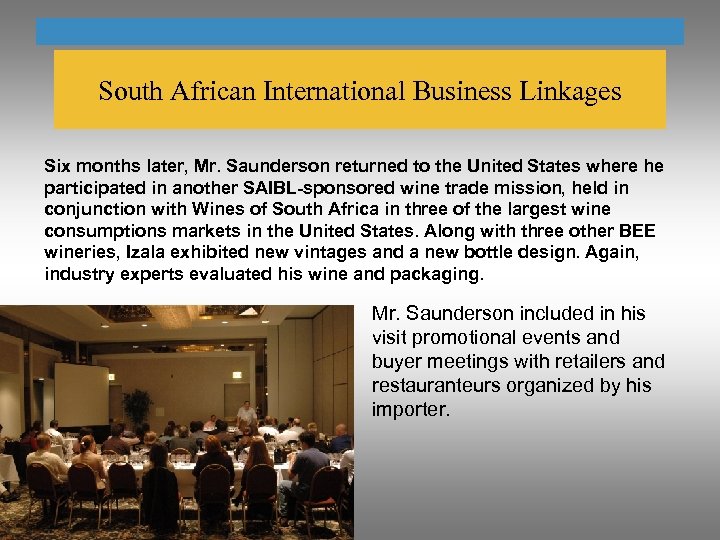
South African International Business Linkages Six months later, Mr. Saunderson returned to the United States where he participated in another SAIBL-sponsored wine trade mission, held in conjunction with Wines of South Africa in three of the largest wine consumptions markets in the United States. Along with three other BEE wineries, Izala exhibited new vintages and a new bottle design. Again, industry experts evaluated his wine and packaging. Mr. Saunderson included in his visit promotional events and buyer meetings with retailers and restauranteurs organized by his importer.
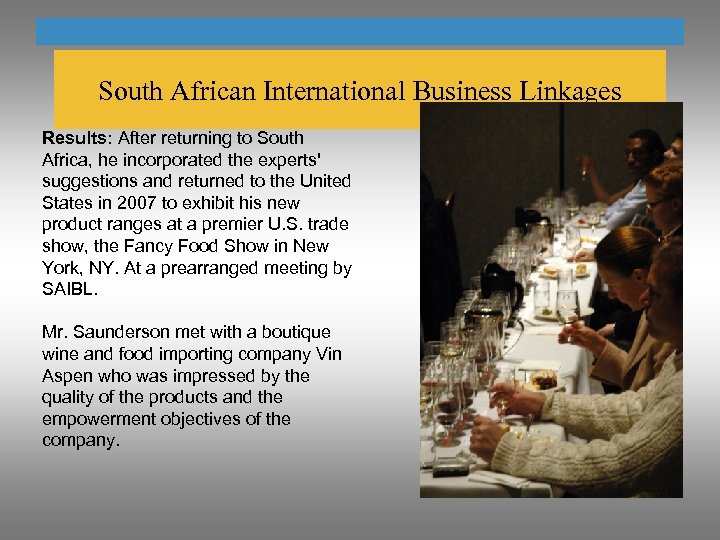
South African International Business Linkages Results: After returning to South Africa, he incorporated the experts' suggestions and returned to the United States in 2007 to exhibit his new product ranges at a premier U. S. trade show, the Fancy Food Show in New York, NY. At a prearranged meeting by SAIBL. Mr. Saunderson met with a boutique wine and food importing company Vin Aspen who was impressed by the quality of the products and the empowerment objectives of the company.
THANK YOU South African International Business Linkages (SAIBL)
Скачать презентацию WPI US-AFRICA Business Conference Capacity Building for African
9466811271bf3a923fbc816ada4dfe94.ppt