 Скачать презентацию WP 34 On-line verification and incremental behaviour
a8162f728e5d9dc4adb7488d232bd7c8.ppt
- Количество слайдов: 22



WP 34 – On-line verification and incremental behaviour testing J. Bicevskis, A. Gaujens, J. Kalnins, I. Oditis (IMCS) Slide 1
Zinātniskie rezultāti ARTEMIS Joint Undertaking tika novērtējis R 3 -COP projektu ar balvu ARTEMIS Recognition Award 2013 Slide 2
Termiņi, finansējums § R 5 COP ir viens no 4 projektiem, kurus akceptēja trešajā § § § ARTEMIS konkursā (2014). 36 mēneši 01. 04. 2014 => 30. 04. 2017 Projekta finansējums 2014. gadā – 2, 195 milj. Eiro Latvijas līdzfinansējums – 44 000 Eiro Dalībnieki Slide 3
Dalībnieki 1 TECHNISCHE UNIVERSITAT BRAUNSCHWEIG TUBS Germany 2 ALTEN NEDERLAND BV ALT Netherlands 3 BUDAPESTI MUSZAKI ES GAZDASAGTUDOMANYI EGYETEM BME Hungary 4 Vysoke uceni technicke v Brne BUT Czech Republic 5 CAMEA, spol. s r. o. CAM Czech Republic 6 DSI DIGITALE SIGNALVERARBEITUNGSSYSTEME & INFORMATIONSTECHNIK GMBH DSI Germany 7 TEKNOLOGISK INSTITUT DTI Denmark 8 EMTE S. L. U. EMTE Spain 9 FRIEDRICH ALEXANDER UNIVERSITAT ERLANGEN NURNBERG FAU Germany 10 Stichting Hogeschool Utrecht HUT Netherlands 11 LATVIJAS UNIVERSITATES MATEMATIKAS UN INFORMATIKAS INSTITUTS IMCS Latvia 12 KEBA AG KEBA Austria 13 LULEA TEKNISKA UNIVERSITET LTU Sweden Slide 4
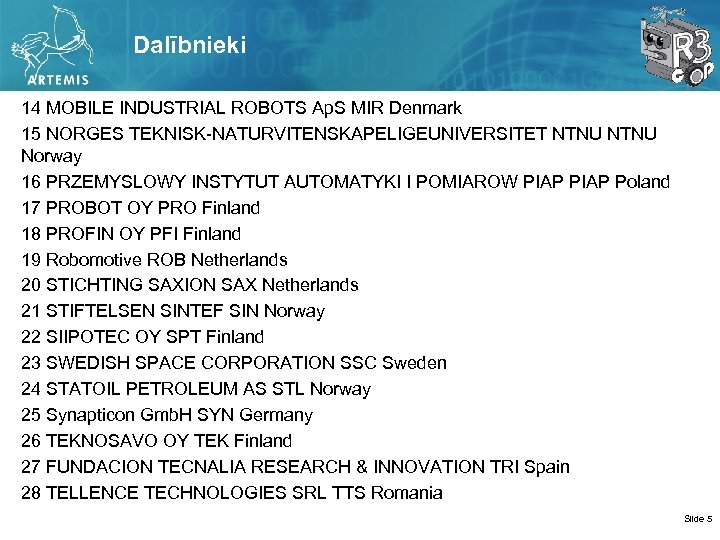
Dalībnieki 14 MOBILE INDUSTRIAL ROBOTS Ap. S MIR Denmark 15 NORGES TEKNISK NATURVITENSKAPELIGEUNIVERSITET NTNU Norway 16 PRZEMYSLOWY INSTYTUT AUTOMATYKI I POMIAROW PIAP Poland 17 PROBOT OY PRO Finland 18 PROFIN OY PFI Finland 19 Robomotive ROB Netherlands 20 STICHTING SAXION SAX Netherlands 21 STIFTELSEN SINTEF SIN Norway 22 SIIPOTEC OY SPT Finland 23 SWEDISH SPACE CORPORATION SSC Sweden 24 STATOIL PETROLEUM AS STL Norway 25 Synapticon Gmb. H SYN Germany 26 TEKNOSAVO OY TEK Finland 27 FUNDACION TECNALIA RESEARCH & INNOVATION TRI Spain 28 TELLENCE TECHNOLOGIES SRL TTS Romania Slide 5
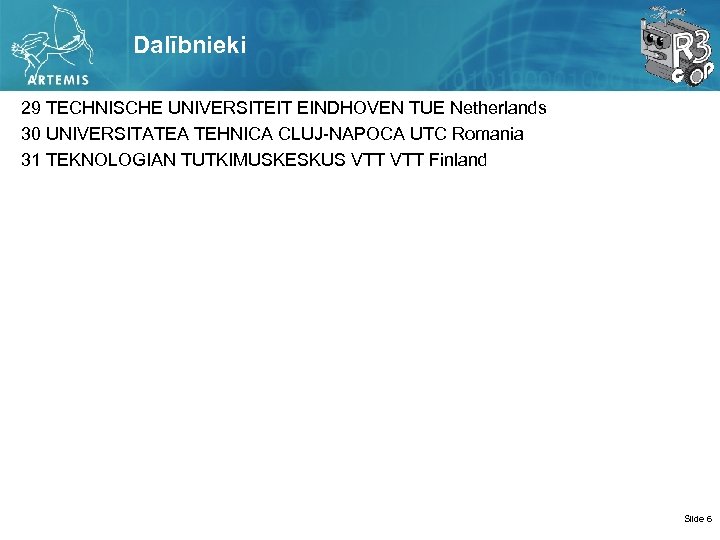
Dalībnieki 29 TECHNISCHE UNIVERSITEIT EINDHOVEN TUE Netherlands 30 UNIVERSITATEA TEHNICA CLUJ NAPOCA UTC Romania 31 TEKNOLOGIAN TUTKIMUSKESKUS VTT Finland Slide 6
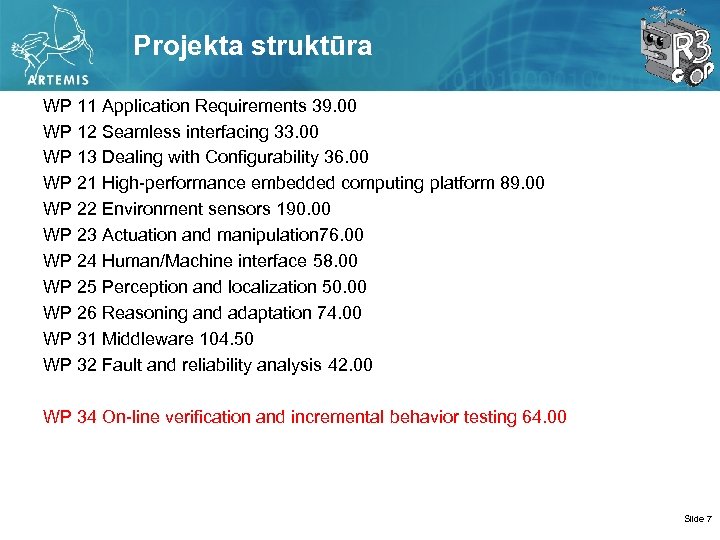
Projekta struktūra WP 11 Application Requirements 39. 00 WP 12 Seamless interfacing 33. 00 WP 13 Dealing with Configurability 36. 00 WP 21 High performance embedded computing platform 89. 00 WP 22 Environment sensors 190. 00 WP 23 Actuation and manipulation 76. 00 WP 24 Human/Machine interface 58. 00 WP 25 Perception and localization 50. 00 WP 26 Reasoning and adaptation 74. 00 WP 31 Middleware 104. 50 WP 32 Fault and reliability analysis 42. 00 WP 34 On line verification and incremental behavior testing 64. 00 Slide 7
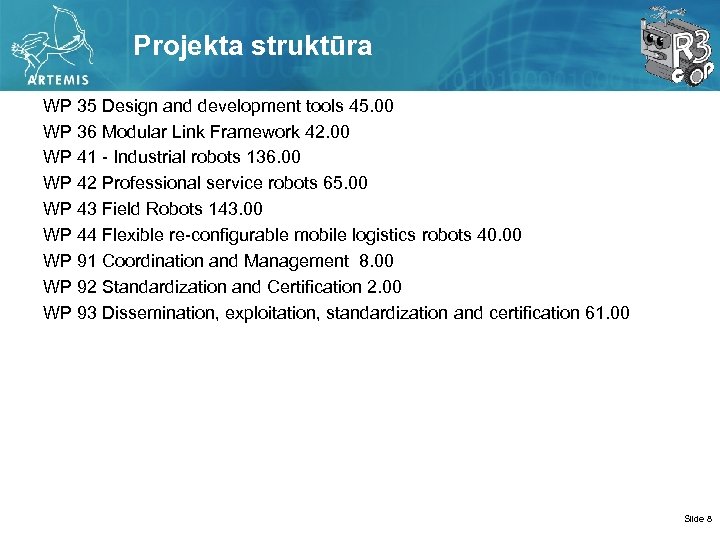
Projekta struktūra WP 35 Design and development tools 45. 00 WP 36 Modular Link Framework 42. 00 WP 41 Industrial robots 136. 00 WP 42 Professional service robots 65. 00 WP 43 Field Robots 143. 00 WP 44 Flexible re configurable mobile logistics robots 40. 00 WP 91 Coordination and Management 8. 00 WP 92 Standardization and Certification 2. 00 WP 93 Dissemination, exploitation, standardization and certification 61. 00 Slide 8
WP 34. 1 – WP 34. 5 This work package aims at supporting the off line and on line verification of the behavior of reconfigurable R 5 COP systems by elaborating methods and tools for incremental testing and runtime monitoring. Incremental testing focuses on checking the permanent effects of reconfiguration on basic safety and robustness properties, while runtime monitoring focuses also on checking the effects of runtime errors, this way also supervising error handling and self healing policies. Slide 9
Runtime monitoring addresses the detection of errors and malfunctions that manifest themselves in runtime (e. g. , due to random hardware faults, configuration faults, operator faults, faults in adaptation and self healing). A technology is to be developed that allows automated construction of hardware and software monitors to check formally specified system properties. The monitors perform on line checking and state classification to decide whether the specified properties are satisfied. Slide 10
Runtime monitoring Task 34. 4: On line V&V using SIL methodology (Lead: IMCS) On line V&V will be used in a Software In the Loop (SIL) approach to check the collaboration between autonomous Rotorcraft Unmanned Aerial Vehicles (RUAV) and Wireless Sensor Networks (WSN). The monitoring algorithms will be implemented and validated in this environment. Slide 11
R 5 -COP demonstration 1. 2. Outdoor demonstration, will execute a mission RUAV after receiving a call from WSN (Wireless Sensor Network) node flies to WSN node using GPS coordinates, visually finds the node and after going closer to node , will receive actual info from WSN node which will be transferred to GCS According the outdoor demonstration SIL model is developed, in which software will be developed and tested, including mission code and communication protocols. SIL model will be demonstrated on LAN, which will consist of MATLAB/Simulink models for RUAV and GCS and virtual reality model for RUAV developed in Unity 3 D Slide 12
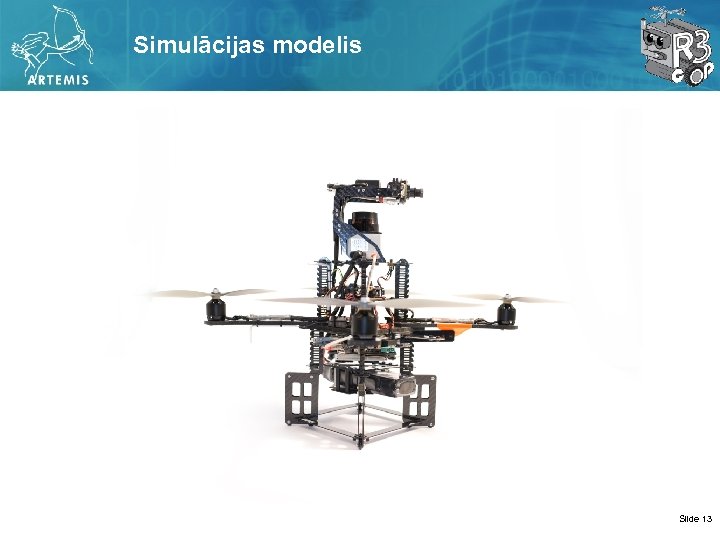
Simulācijas modelis Slide 13
The Localization System for UAV Ø Ø Ø Ø inertial measurement unit (IMU) an electronic device that measures and reports a craft's velocity, orientation, and gravitational forces, using a combination of accelerometers and gyroscopes and magnetometers; GPS Global Positioning System; visual positioning; programmable autonomous control with processing power to do video image processing; moving camera looking down; moving camera looking forward; GSM based bonding communication device; WSN node. Slide 14
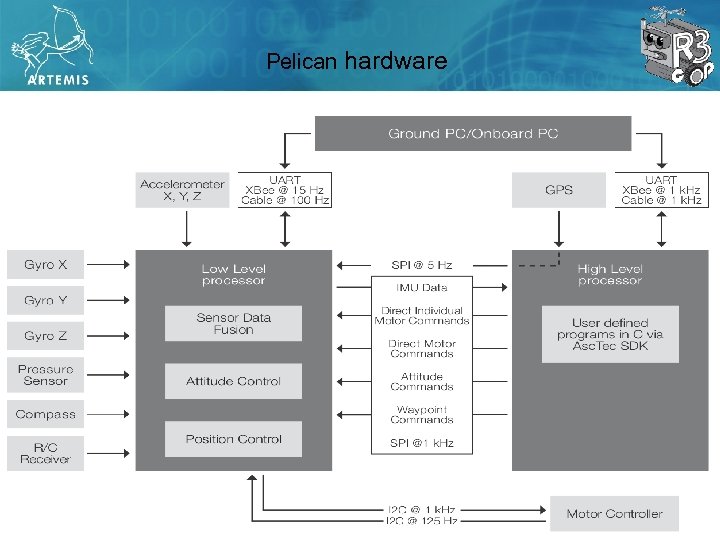
Pelican hardware Slide 15
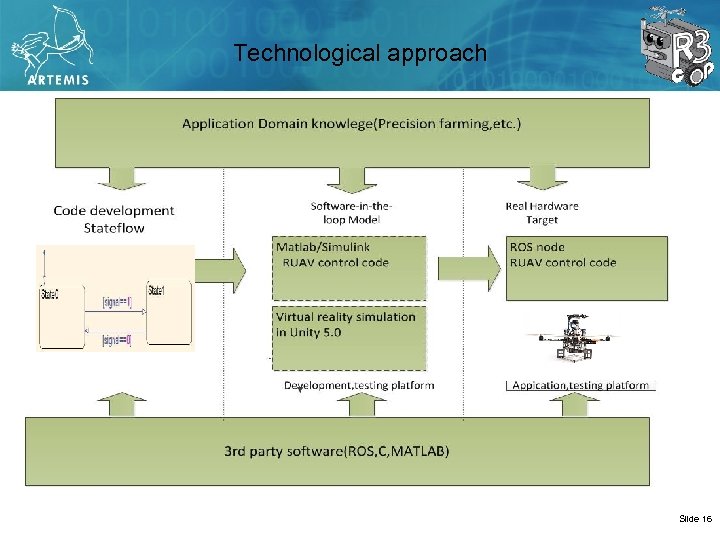
Technological approach Slide 16
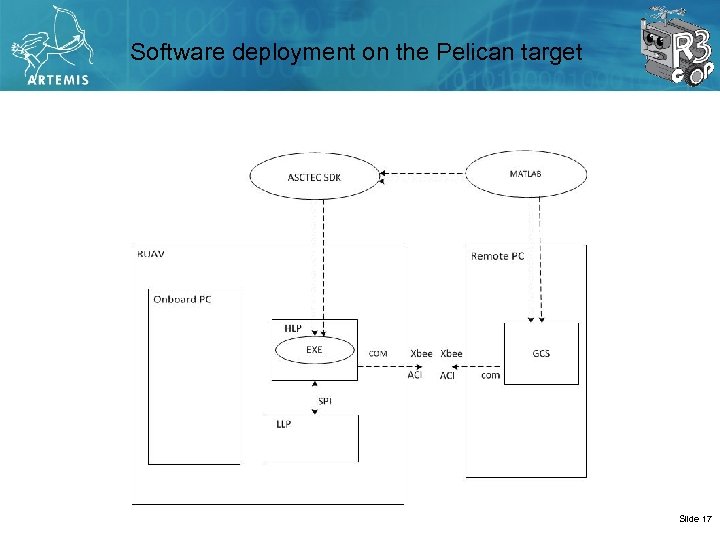
Software deployment on the Pelican target Slide 17
Visualization Current § § the environment is procedurally generated and resembles real world Supports simulation of many RUAVs if a powerful enough computer is given Future • Importing of point cloud data from real world for development and testing of real • missions that could be run as is in both real and simulated worlds Improvement of physical model of the RUAV to be closer to real world • Creation of a system where other types of RUAVs can be easily added and modified Slide 18
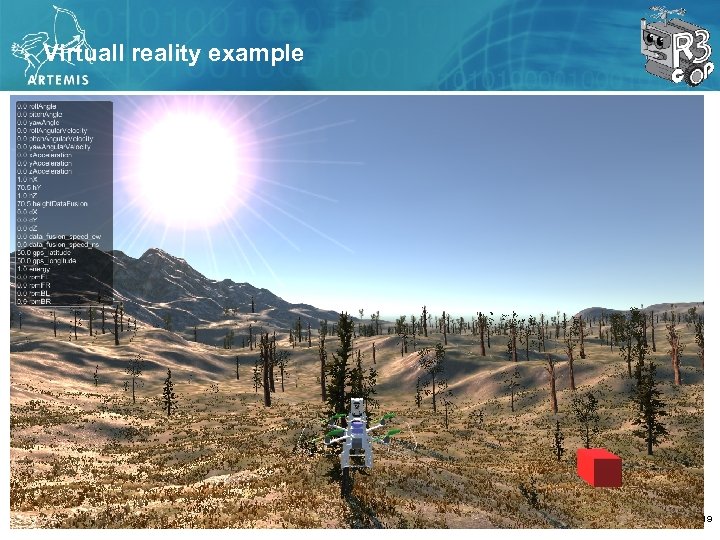
Virtuall reality example Slide 19
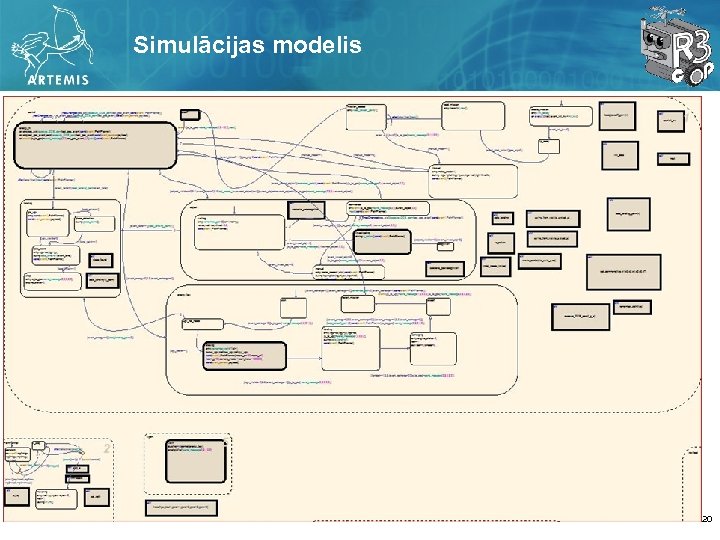
Simulācijas modelis Slide 20
Simulācijas modelis DEMO Slide 21
Thank you for your attention We value your opinion and questions R 5 -COP Resilient Reasoning Robotic Co operating Systems
Скачать презентацию WP 34 On-line verification and incremental behaviour
a8162f728e5d9dc4adb7488d232bd7c8.ppt