


 Скачать презентацию WP 2 Physics Analysis and Simulation P Coyle
de6578a123ae3a976a2ba3bbdeab7907.ppt
- Количество слайдов: 30
 WP 2: Physics Analysis and Simulation P. Coyle, J. Brunner, CPPMarseille • • Objectives & Priorities Deliverables & Milestones Manpower Optimisation considerations
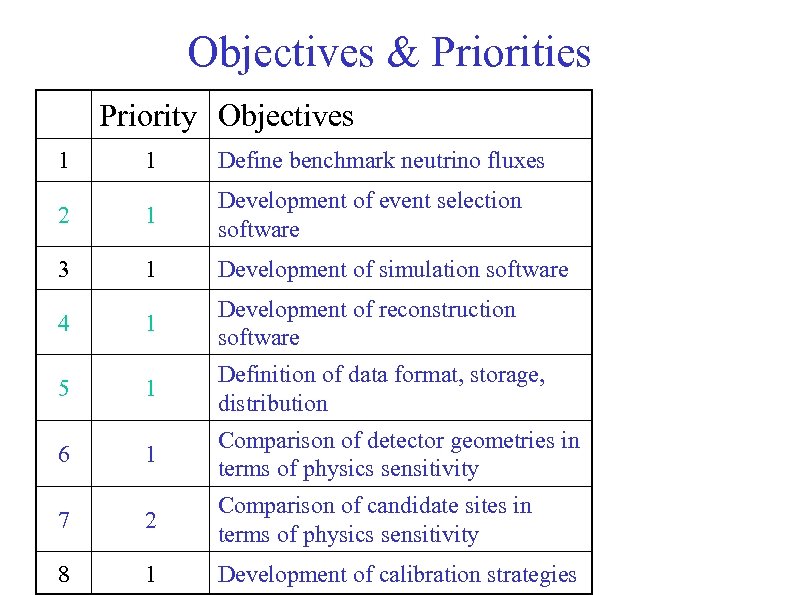 Objectives & Priorities Priority Objectives 1 1 Define benchmark neutrino fluxes 2 1 Development of event selection software 3 1 Development of simulation software 4 1 Development of reconstruction software 1 Definition of data format, storage, distribution 6 1 Comparison of detector geometries in terms of physics sensitivity 7 2 Comparison of candidate sites in terms of physics sensitivity 8 1 Development of calibration strategies 5
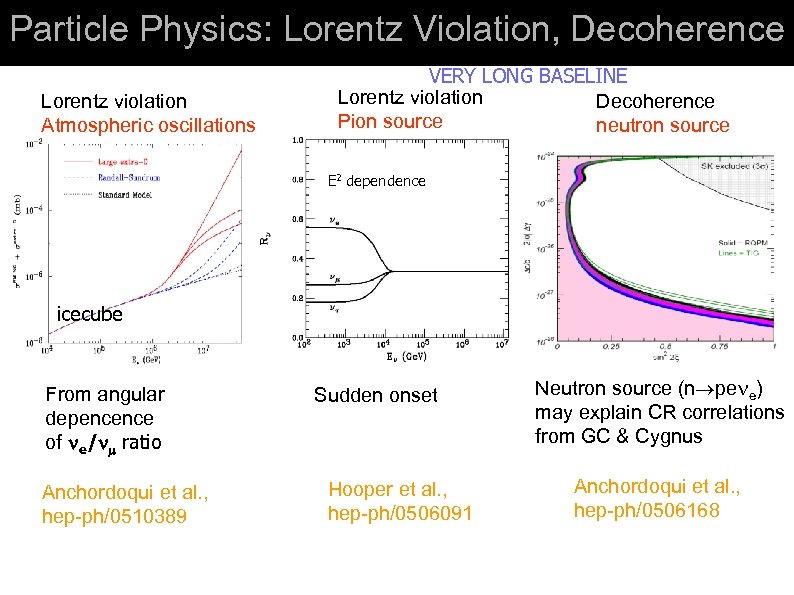
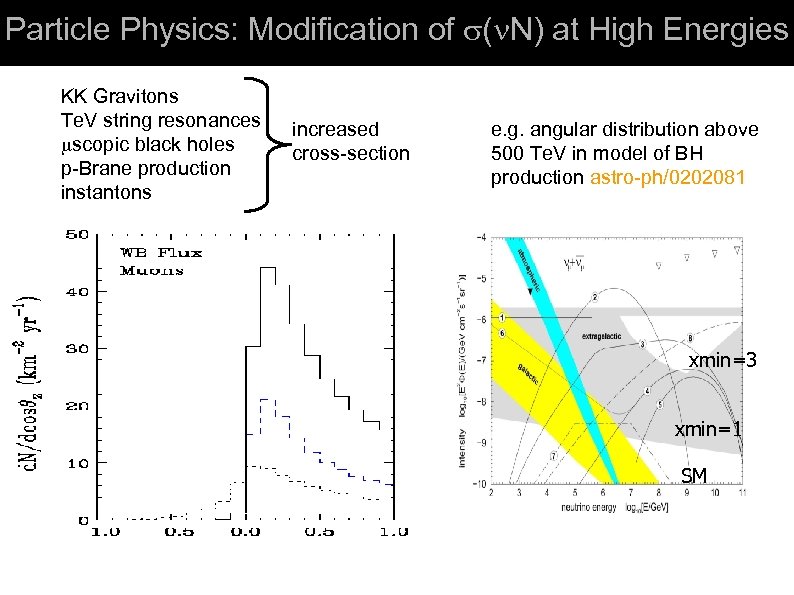
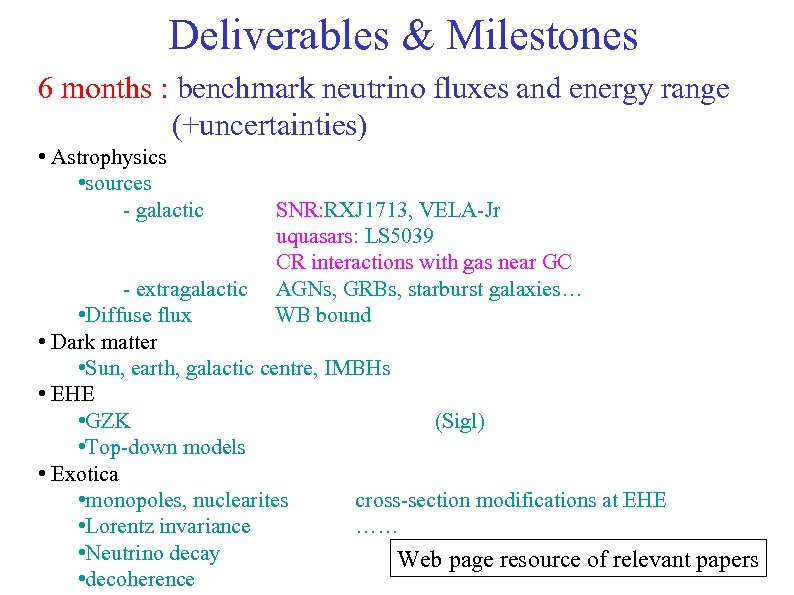 Deliverables & Milestones 6 months : benchmark neutrino fluxes and energy range (+uncertainties) • Astrophysics • sources - galactic SNR: RXJ 1713, VELA-Jr uquasars: LS 5039 CR interactions with gas near GC AGNs, GRBs, starburst galaxies… WB bound - extragalactic • Diffuse flux • Dark matter • Sun, earth, galactic centre, IMBHs • EHE • GZK (Sigl) • Top-down models • Exotica • monopoles, nuclearites cross-section modifications at EHE • Lorentz invariance …… • Neutrino decay Web page resource of relevant papers • decoherence
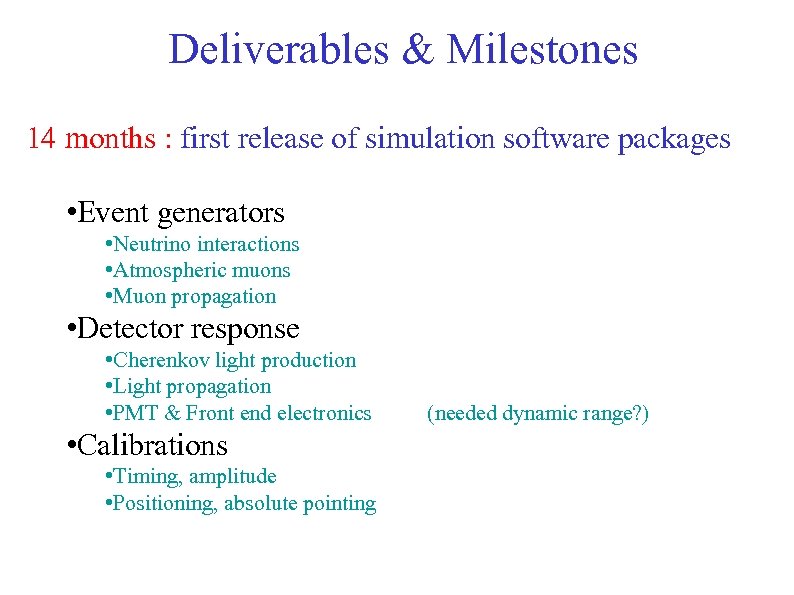 Deliverables & Milestones 14 months : first release of simulation software packages • Event generators • Neutrino interactions • Atmospheric muons • Muon propagation • Detector response • Cherenkov light production • Light propagation • PMT & Front end electronics • Calibrations • Timing, amplitude • Positioning, absolute pointing (needed dynamic range? )
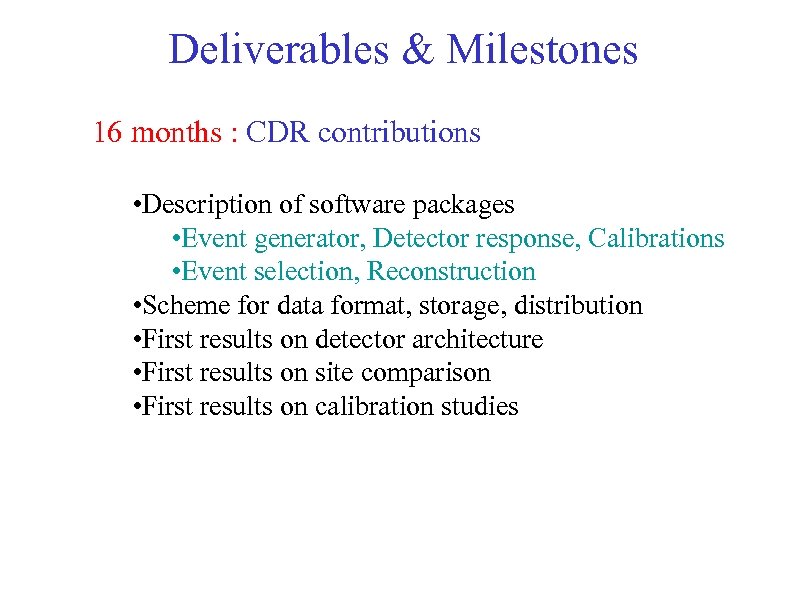 Deliverables & Milestones 16 months : CDR contributions • Description of software packages • Event generator, Detector response, Calibrations • Event selection, Reconstruction • Scheme for data format, storage, distribution • First results on detector architecture • First results on site comparison • First results on calibration studies
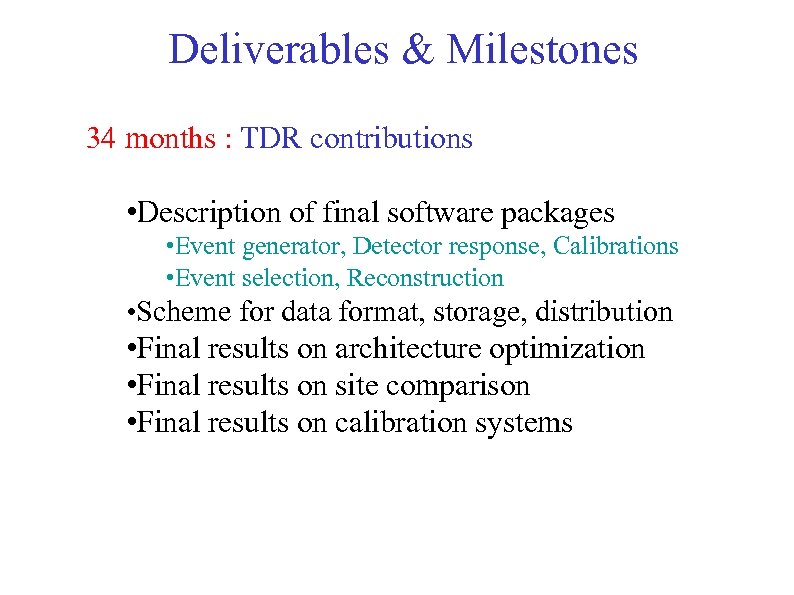 Deliverables & Milestones 34 months : TDR contributions • Description of final software packages • Event generator, Detector response, Calibrations • Event selection, Reconstruction • Scheme for data format, storage, distribution • Final results on architecture optimization • Final results on site comparison • Final results on calibration systems
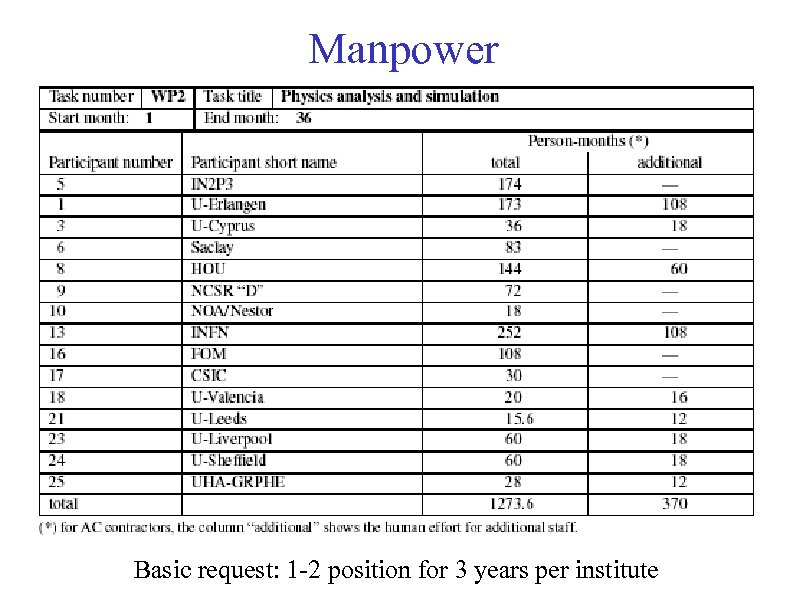 Manpower FTEM total FTEM requested Personnel total Personnel requested total IN 2 P 3 144 72 900 354 930 CEA 250 36 650 171 821 Erlangen 36 36 193 (*2) 274 INFN 252 FOM 108 Sheffield 42 108 225 112. 5 (+42 travel +21. 5 cons) 306 18 133 352 317 57 (*2) (+5 travel) 172 Basic request: 1 -2 position for 3 years per institute
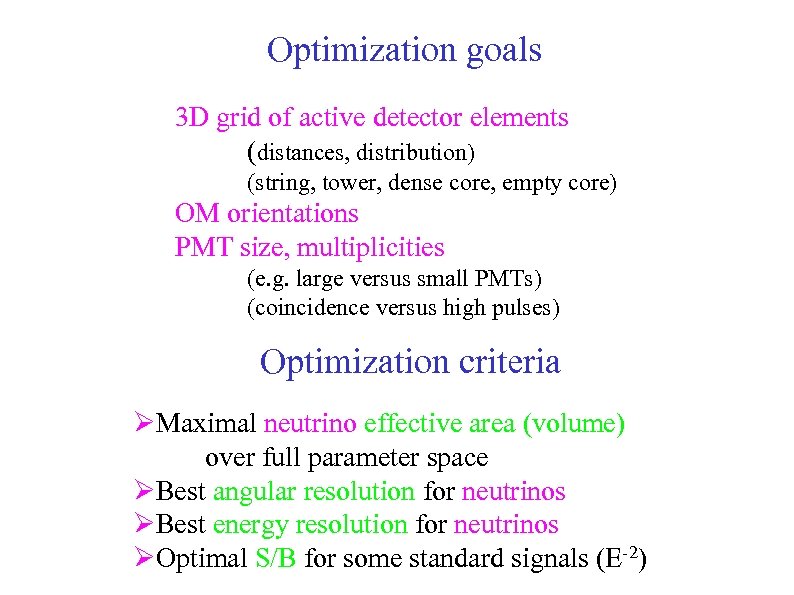 Optimization goals 3 D grid of active detector elements (distances, distribution) (string, tower, dense core, empty core) OM orientations PMT size, multiplicities (e. g. large versus small PMTs) (coincidence versus high pulses) Optimization criteria ØMaximal neutrino effective area (volume) over full parameter space ØBest angular resolution for neutrinos ØBest energy resolution for neutrinos ØOptimal S/B for some standard signals (E-2)
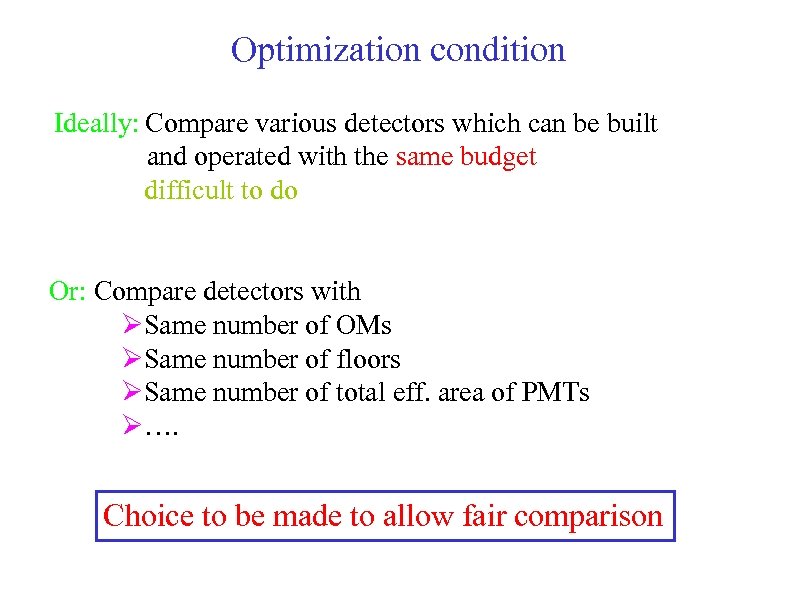 Optimization condition Ideally: Compare various detectors which can be built and operated with the same budget difficult to do Or: Compare detectors with ØSame number of OMs ØSame number of floors ØSame number of total eff. area of PMTs Ø…. Choice to be made to allow fair comparison
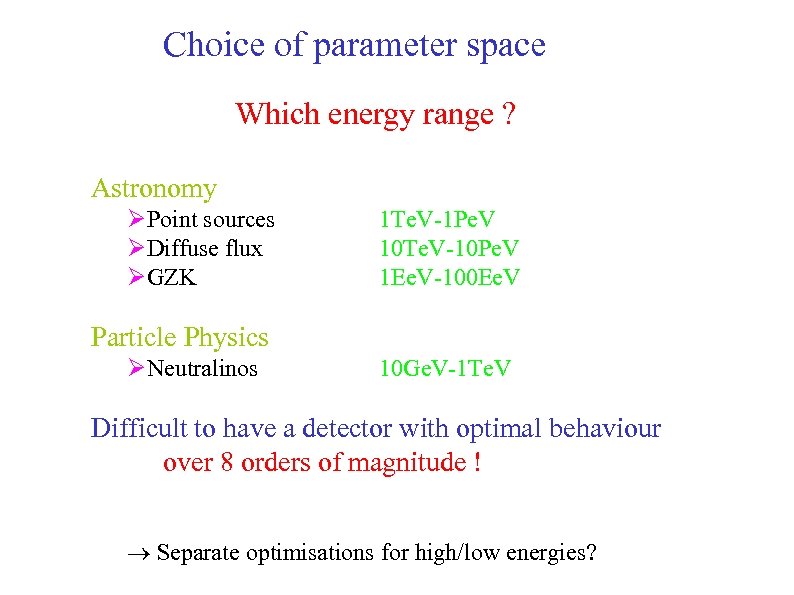 Choice of parameter space Which energy range ? Astronomy ØPoint sources ØDiffuse flux ØGZK 1 Te. V-1 Pe. V 10 Te. V-10 Pe. V 1 Ee. V-100 Ee. V Particle Physics ØNeutralinos 10 Ge. V-1 Te. V Difficult to have a detector with optimal behaviour over 8 orders of magnitude ! Separate optimisations for high/low energies?
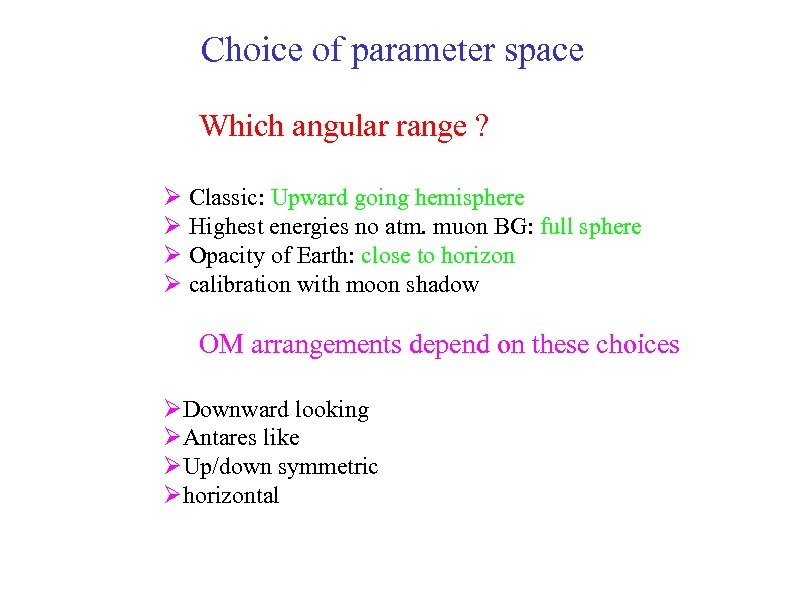 Choice of parameter space Which angular range ? Ø Classic: Upward going hemisphere Ø Highest energies no atm. muon BG: full sphere Ø Opacity of Earth: close to horizon Ø calibration with moon shadow OM arrangements depend on these choices ØDownward looking ØAntares like ØUp/down symmetric Øhorizontal
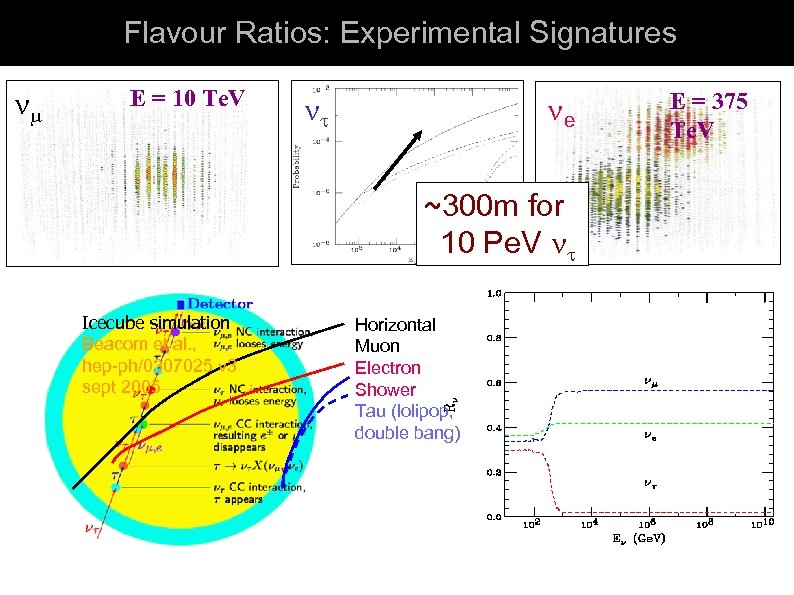
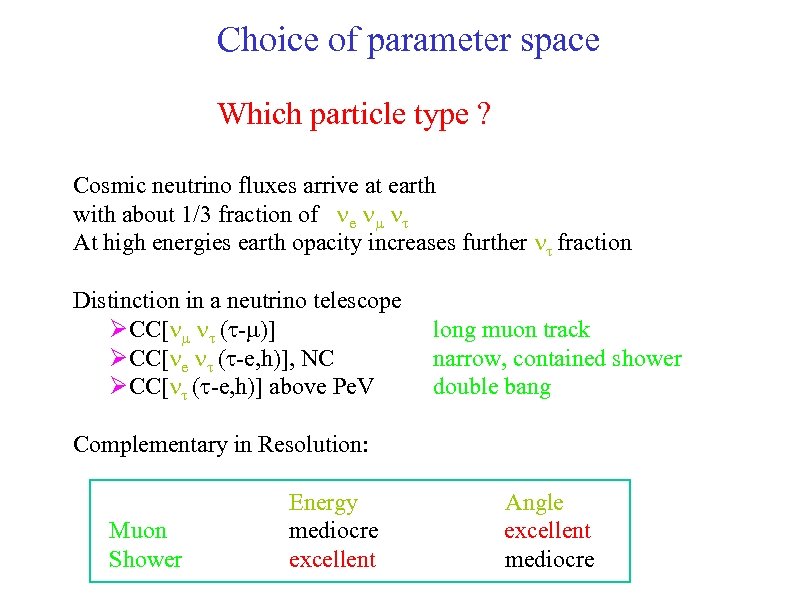 Choice of parameter space Which particle type ? Cosmic neutrino fluxes arrive at earth with about 1/3 fraction of e At high energies earth opacity increases further fraction Distinction in a neutrino telescope ØCC[ ( - )] ØCC[ e ( -e, h)], NC ØCC[ ( -e, h)] above Pe. V long muon track narrow, contained shower double bang Complementary in Resolution: Muon Shower Energy mediocre excellent Angle excellent mediocre
 Choice of parameter space Site parameters influence result ØAbsorption length of water ØLight diffusion in water ØDepth (atmosph. muon background) ØNoise light (bioluminescence level) Optimized detector geometry in one site might be different from detector in another site Need feedback from WP 5
 For the WP 2 session at 11/04 in Erlangen I would like to have a short presentation from each institute which intends to participate in this work package. In this presentation you should: - redefine the physics and software projects to which you would like to contribute - describe the current state of this work - estimate possible contributions for the first year of KM 3 NET - make reference to the "Objectives" and "Milestones" of the contract document (WP 2) This round of introduction talks will be followed by presentations of "first results" as some of you have already started to do KM 3 Net related analyses.
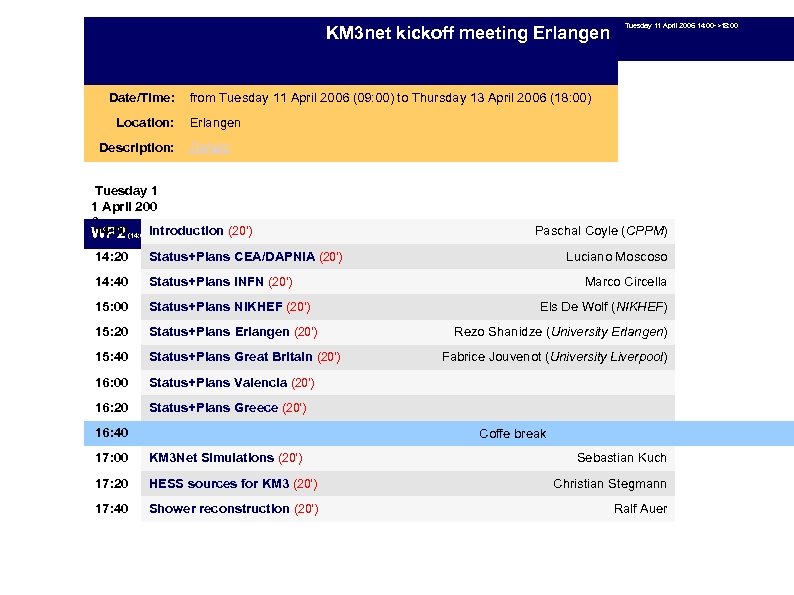 KM 3 net kickoff meeting Erlangen Tuesday 11 April 2006 14: 00 ->18: 00 Date/Time: from Tuesday 11 April 2006 (09: 00) to Thursday 13 April 2006 (18: 00) Location: Erlangen Description: Details Tuesday 1 1 April 200 6 Introduction (20') 14: 00 WP 2 (14: 00 ->18: 00) 14: 40 Loc Erl atio ang Status+Plans CEA/DAPNIA (20') en n: Status+Plans INFN (20') 15: 00 Status+Plans NIKHEF (20') 15: 20 Status+Plans Erlangen (20') 15: 40 Status+Plans Great Britain (20') 16: 00 Status+Plans Valencia (20') 16: 20 Paschal Coyle (CPPM) Status+Plans Greece (20') 14: 20 16: 40 Luciano Moscoso Marco Circella Els De Wolf (NIKHEF) Rezo Shanidze (University Erlangen) Fabrice Jouvenot (University Liverpool) Coffe break 17: 00 KM 3 Net Simulations (20') Sebastian Kuch 17: 20 HESS sources for KM 3 (20') Christian Stegmann 17: 40 Shower reconstruction (20') Ralf Auer
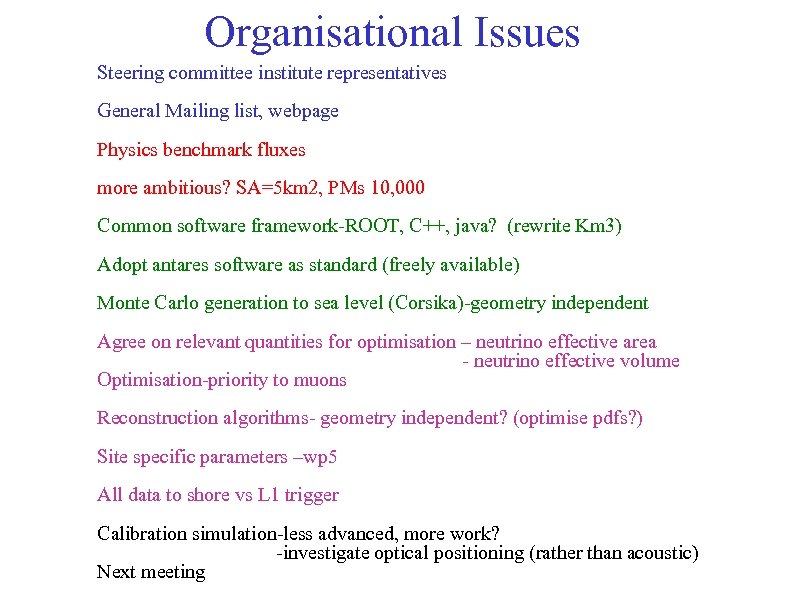 Organisational Issues Steering committee institute representatives General Mailing list, webpage Physics benchmark fluxes more ambitious? SA=5 km 2, PMs 10, 000 Common software framework-ROOT, C++, java? (rewrite Km 3) Adopt antares software as standard (freely available) Monte Carlo generation to sea level (Corsika)-geometry independent Agree on relevant quantities for optimisation – neutrino effective area - neutrino effective volume Optimisation-priority to muons Reconstruction algorithms- geometry independent? (optimise pdfs? ) Site specific parameters –wp 5 All data to shore vs L 1 trigger Calibration simulation-less advanced, more work? -investigate optical positioning (rather than acoustic) Next meeting
 Software Framework
 Interfaces to other WPs WP 1 – Cost Model software WP 3 – simulation of front-end costs WP 4 – simulation of data filter costs WP 5 – site parameters
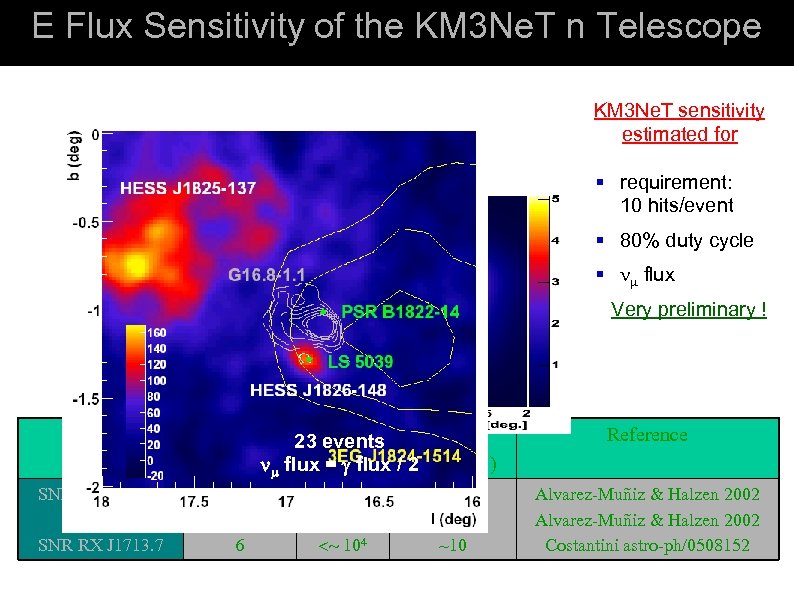 E Flux Sensitivity of the KM 3 Ne. T n Telescope KM 3 Ne. T sensitivity estimated for § requirement: 10 hits/event § 80% duty cycle § flux Very preliminary ! source SNR RX J 1713. 7 Sgr A East SNR RX J 1713. 7 Distance 23 events E N μ (kpc) m flux = g flux / 2 -2 yr-1 ) (Ge. V) (km 6 8 6 104 105 104 ~40 ~10 Reference Alvarez-Muñiz & Halzen 2002 Costantini astro-ph/0508152
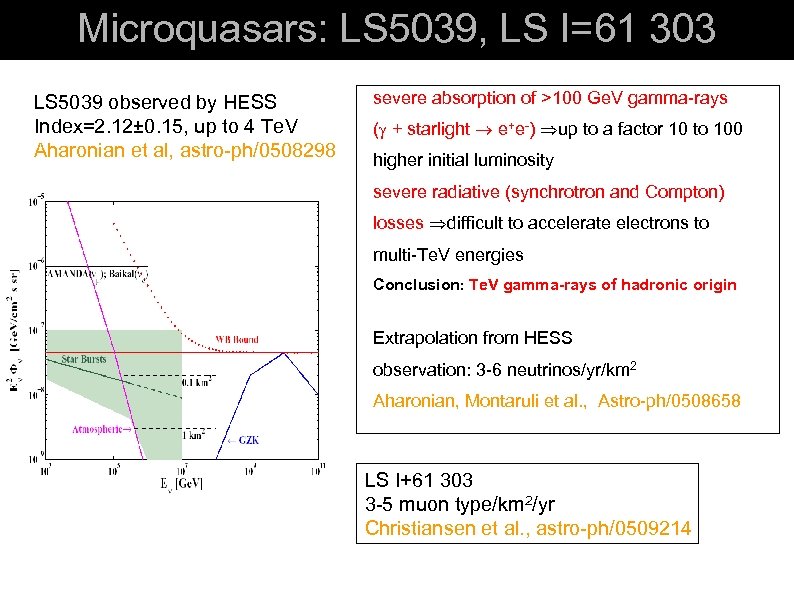 Microquasars: LS 5039, LS I=61 303 LS 5039 observed by HESS Index=2. 12± 0. 15, up to 4 Te. V Aharonian et al, astro-ph/0508298 severe absorption of >100 Ge. V gamma-rays (g + starlight e+e-) up to a factor 10 to 100 higher initial luminosity severe radiative (synchrotron and Compton) losses difficult to accelerate electrons to multi-Te. V energies Conclusion: Te. V gamma-rays of hadronic origin Extrapolation from HESS observation: 3 -6 neutrinos/yr/km 2 Aharonian, Montaruli et al. , Astro-ph/0508658 LS I+61 303 3 -5 muon type/km 2/yr Christiansen et al. , astro-ph/0509214
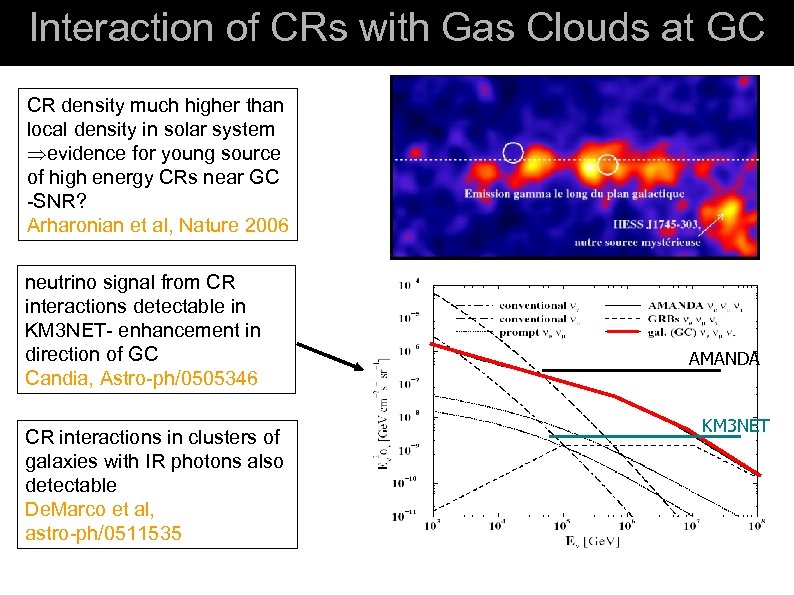 Interaction of CRs with Gas Clouds at GC CR density much higher than local density in solar system evidence for young source of high energy CRs near GC -SNR? Arharonian et al, Nature 2006 neutrino signal from CR interactions detectable in KM 3 NET- enhancement in direction of GC Candia, Astro-ph/0505346 CR interactions in clusters of galaxies with IR photons also detectable De. Marco et al, astro-ph/0511535 AMANDA KM 3 NET
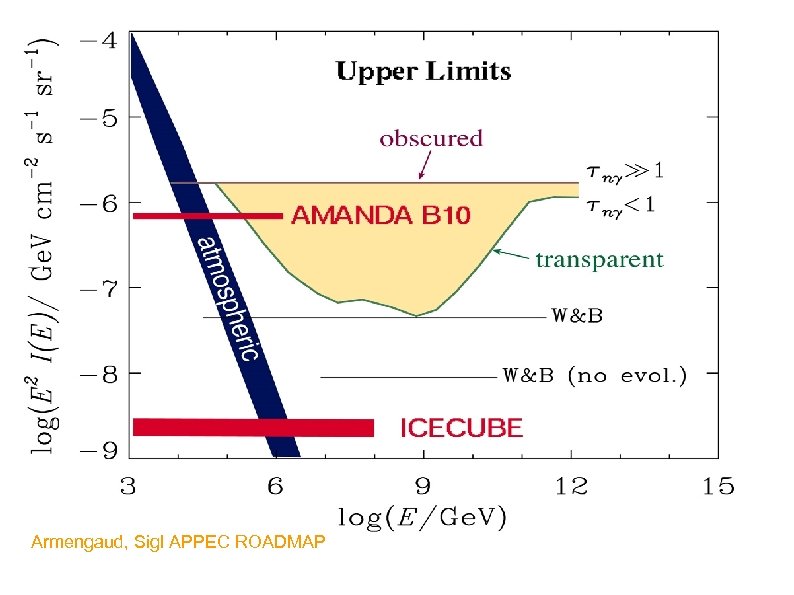
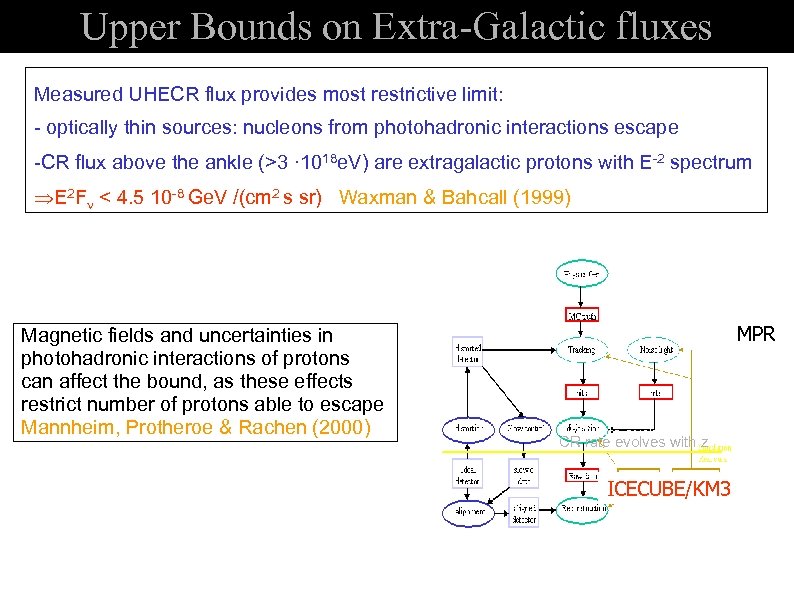 Upper Bounds on Extra-Galactic fluxes Measured UHECR flux provides most restrictive limit: - optically thin sources: nucleons from photohadronic interactions escape -CR flux above the ankle (>3 · 1018 e. V) are extragalactic protons with E-2 spectrum E 2 F < 4. 5 10 -8 Ge. V /(cm 2 s sr) Waxman & Bahcall (1999) Magnetic fields and uncertainties in photohadronic interactions of protons can affect the bound, as these effects restrict number of protons able to escape Mannheim, Protheroe & Rachen (2000) MPR CR rate evolves with z ICECUBE/KM 3
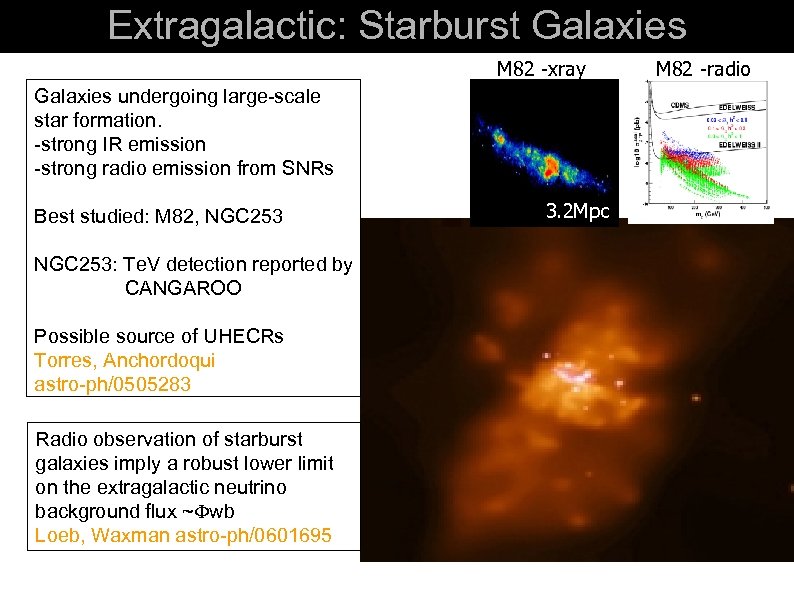 Extragalactic: Starburst Galaxies M 82 -xray M 82 -radio Galaxies undergoing large-scale star formation. -strong IR emission -strong radio emission from SNRs 3. 2 Mpc Best studied: M 82, NGC 253: Te. V detection reported by CANGAROO Possible source of UHECRs Torres, Anchordoqui astro-ph/0505283 Radio observation of starburst galaxies imply a robust lower limit on the extragalactic neutrino background flux ~ wb Loeb, Waxman astro-ph/0601695 CR rate evolves with z
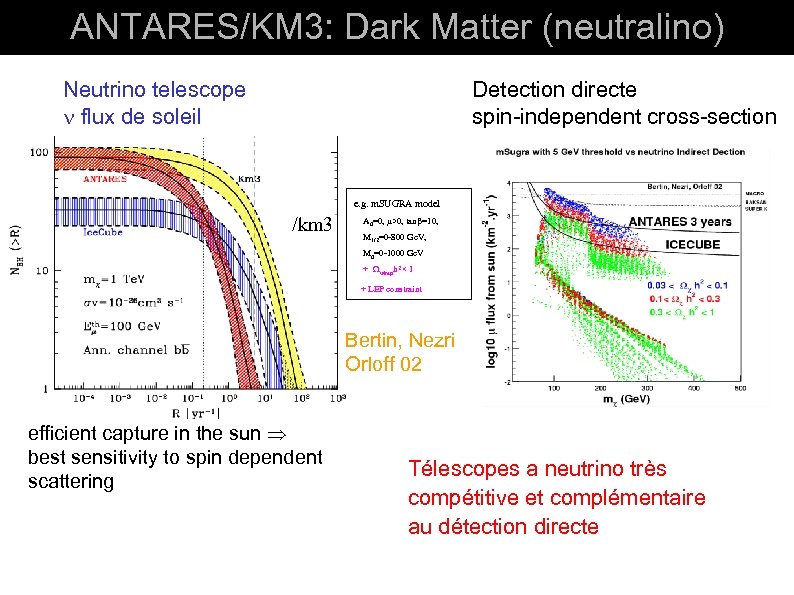 ANTARES/KM 3: Dark Matter (neutralino) Neutrino telescope flux de soleil Detection directe spin-independent cross-section e. g. m. SUGRA model /km 3 A 0=0, >0, tan =10, M 1/2=0 -800 Ge. V, M 0=0 -1000 Ge. V + wimph 2 < 1 + LEP constraint Bertin, Nezri Orloff 02 efficient capture in the sun best sensitivity to spin dependent scattering Télescopes a neutrino très compétitive et complémentaire au détection directe
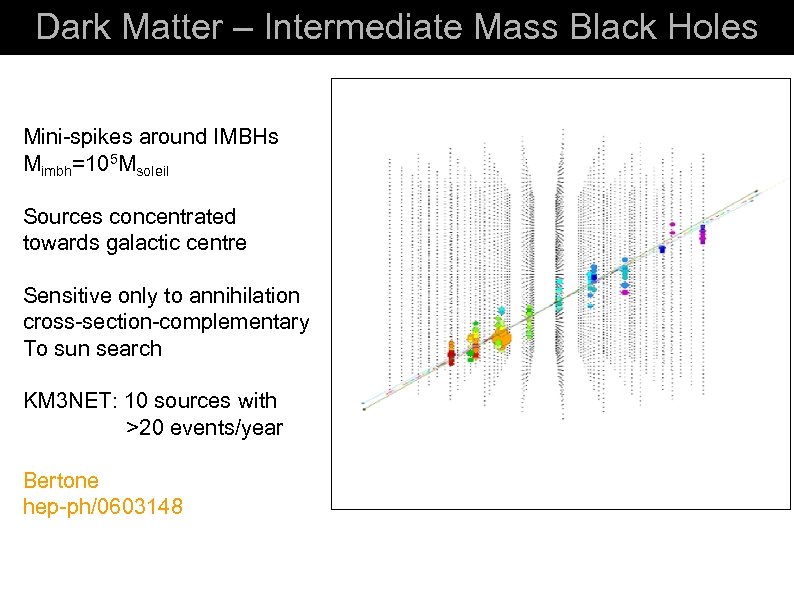 Dark Matter – Intermediate Mass Black Holes Mini-spikes around IMBHs Mimbh=105 Msoleil Sources concentrated towards galactic centre Sensitive only to annihilation cross-section-complementary To sun search KM 3 NET: 10 sources with >20 events/year Bertone hep-ph/0603148
 Armengaud, Sigl APPEC ROADMAP
 Tau neutrinos Flavour Ratios: Experimental Signatures E = 10 Te. V 104 ly e ~300 m for 10 Pe. V Icecube simulation Beacom et al. , hep-ph/0307025 v 3 sept 2005 Horizontal Muon Electron Shower Tau (lolipop, double bang) E = 375 Te. V
 Particle Physics: Lorentz Violation, Decoherence Lorentz violation Atmospheric oscillations VERY LONG BASELINE Lorentz violation Decoherence Pion source neutron source E 2 dependence icecube From angular depencence of e/ m ratio Anchordoqui et al. , hep-ph/0510389 Sudden onset Hooper et al. , hep-ph/0506091 Neutron source (n pe e) may explain CR correlations from GC & Cygnus Anchordoqui et al. , hep-ph/0506168
 Particle Physics: Modification of ( N) at High Energies KK Gravitons Te. V string resonances scopic black holes p-Brane production instantons increased cross-section e. g. angular distribution above 500 Te. V in model of BH production astro-ph/0202081 xmin=3 xmin=1 SM
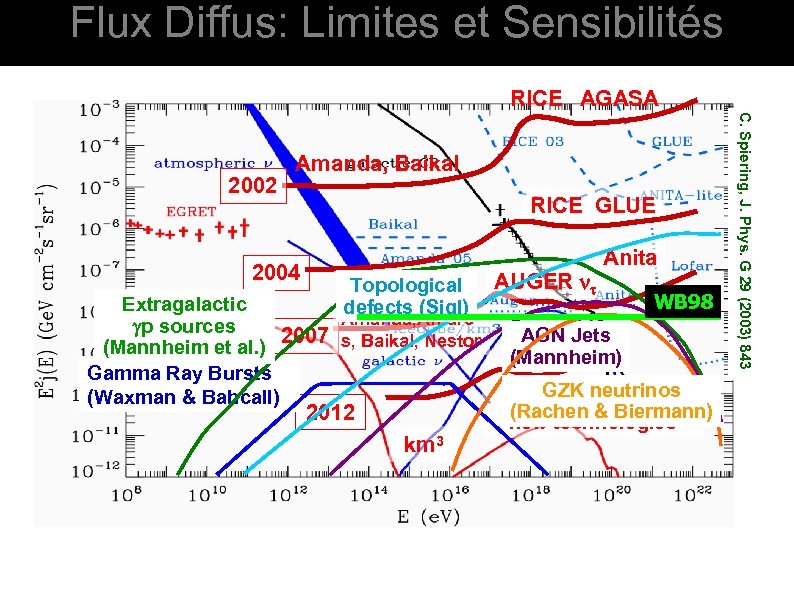 Flux Diffus: Limites et Sensibilités RICE AGASA 2004 RICE GLUE Anita Topological defects (Sigl) Extragalactic Amanda, Antare gp sources 2007 s, Baikal, Nestor (Mannheim et al. ) Gamma Ray Bursts (Waxman & Bahcall) 2012 km 3 AUGER t WB 98 AGN Jets (Mannheim) GZK neutrinos Auger + (Rachen & Biermann) new technologies C. Spiering, J. Phys. G 29 (2003) 843 2002 Amanda, Baikal