 Скачать презентацию Wortham Laboratories Fast Act Fast Act Product
abe9a46d72477b2c3374d0bd71978af6.ppt
- Количество слайдов: 68



Wortham Laboratories Fast. Act ® Fast. Act Product Information And Training Presentation ® © 2004
n. Fast. Act ® This presentation is intended to inform our international distributor network and professional medical practitioners about the revolutionary medical device Fast. Act®. This presentation is made available with the following important conditions inherent to the delivery of product information to the medicalsurgical community and our distributor network: While the information prepared herein is presented in good faith, changes may occur which affect the intended result of this presentation. Please understand that literature and training regarding the proper utilization of Fast. Act® may be updated at any time. Material changes in product information are available from your distributor and our international office. This presentation was prepared in March of 2004. Each WLI Presentation will be dated. The use of any medical device requires specific instruction which exceeds the scope of this presentation. Please consult any Wortham Laboratories product inserts, your distributor and/or our international support desk with any product questions. We are devoted to your satisfaction and success. While this presentation represents Fast. Act® as suitable for a particular purpose, the presentation alone cannot act as a sole source of information for introducing this medical device into your practice or surgical theater setting. We will provide many supporting tools and documentation to assist you. The contents of this presentation are Copyright © 2004 Wortham Laboratories. Fast. Act® is an internationally recognized trademark of Wortham Laboratories, Incorporated. Other trademarks referenced herein are the absolute property of their specific owners, and are incorporated throughout for the exclusive purpose of information, education and training. WELCOME TO WORTHAM LABORATORIES – TOMORROW’S TECHNOLOGY TODAY

What is Fast. Act ? ®
What is Fast. Act ? ® n ® Fast. Act is a single component hemostatic agent, designed to arrest most bleeds within a few seconds and arterial bleeds in less than 10 seconds. It is comprised of bovine factor proteins: II, VII, IX, and X.

Where can Fast. Act ® be used?
Where can Fast. Act® be used? n ® Fast. Act can be used in invasive, semiinvasive, and noninvasive, procedures.

How is Fast. Act ® delivered to the bleeding site?

How is Fast. Act delivered to the bleeding site? ® n Fast. Act® has multiple delivery systems to address the many areas where bleeding may occur. Listed here are the different delivery systems of the product:
Fast. Act Delivery Systems: ® n Injectable vials: A syringe is used to draw up as much of the hemostatic agent as needed (multiple use).
Fast. Act Delivery Systems: ® n Sprays - General: Used for large surface areas such as debridement of burns and wounds, abrasions, and mastectomies. Fast. Act® can be used on small areas, too (multiple use).
Fast. Act Delivery Systems: ® n Sprays – Nasal: Used for nose bleeds (epistasis), sinus surgeries, polyps, deviated septums, broken nasal bone (multiple use).
Fast. Act Delivery Systems: ® n Sprays, for throat: used for tonsillectomies, thyroidectomies, tongue, palate (multiple use).
Fast. Act Delivery Systems: ® n Sprays for OB/GYN use: Dispenses as a stream up to one meter for hard to reach areas of the uterus, vaginal vault, and can be used in other hard to reach areas, such as hip replacements, prostate surgeries (multiple use).
Fast. Act Delivery Systems: ® n Sprays - Dental: Gum and dental surgery (multiple use).
Fast. Act Delivery Systems: ® n Dressings - Trauma: used for any lethal wound, such as severed femoral vein or artery, punctured inferior vena cava, or any major vein or artery (single use).
Fast. Act Delivery Systems: ® n Dressings - Surgical sponges: used throughout most surgical procedures (single use).
Fast. Act Delivery Systems: ® n Dressings - Swabs: designed for hard to reach minor bleeds, such as the ear canal, throat (single use).
Fast. Act Delivery Systems: ® n Dressings - Bandage strips: used for minor cuts or abrasions (single use).
Fast. Act Delivery Systems: ® n Foam - Designed for gunshot or puncture wounds (stabbings, impalements), or can be used in the clinical setting (single use).
Fast. Act Delivery Systems: ® n Fiber optics - Liquid Fast. Act® is delivered through a fiber optic port, such as found in the endoscope and proctoscope (multiple use).

How do you apply Fast. Act ® to the wound?
How do you apply Fast. Act to the wound? ® n Liquid: To lacerations or incisions, ® Fast. Act is applied to the base of the wound, then brought to the surface of the wound. This will of capture all the bleeds below the surface of the wound. After applying Fast. Act® , leave it undisturbed for 60 seconds. This allows the fibrin strands to cross-link to form a more stable clot. (continues…)
How do you apply Fast. Act to the wound? ® n The surgeon can work on another area during this time. Later, check for hidden bleeds by dabbing at the wound. If a large clot is to be removed, it is recommended to wait 2 -5 minutes, or before closing, to remove the clot. This will allow maximum tensile strength of the clot, and when it is wiped away the clot below the surface of the wound will not be uprooted. Premature dabbing or wiping may reintroduce bleeding. If bleeding reoccurs, usually a drop or two of Fast. Act® is sufficient to stop the bleed. (continues…)
How do you apply Fast. Act to the wound? ® n To apply the liquid Fast. Act® to arterial bleeds requires a rapid and continuous succession of drops of the hemostatic agent to the bleeding site. Each drop of Fast. Act® causes the opening of the wound to get smaller, and smaller, until the clot covers the opening to the wound. Note: A small amount of Fast. Act® goes a long way. Example: An incision of 10 cm long and 1 cm deep may only take 0. 2 -0. 4 ml of Fast. Act® to stop all the bleeding.
How do you apply Fast. Act to the wound? ® n Spray: Depending on the size of the wound, hold the sprayer about 5 -15 cm from the wound, and cover the surface with Fast. Act®. Dab at the wound after 60 seconds to be sure that all bleeding has stopped.
How do you apply Fast. Act to the wound? ® n Dressing: Applying the dressing to most venous bleeds requires only a few seconds of pressure to stop the bleeding. To large venous wounds and arterial bleeds, apply pressure to the wound with the dressing for 15 -30 seconds. Gently remove the dressing to assure that hemostasis has occurred. If the clot should be dislodged from the wound when the dressing is removed, reapply the dressing as before, and then apply saline or water to the dressing before removing it from the wound for the second time. This helps to prevent the blood clot from adhering to the dressing.
How do you apply Fast. Act to the wound? ® n Foam: To a closed wound, insert the nozzle of the actuator into the portal wound, then press the button to release the foam. Continue to inject the foam into the cavity until the foam begins to backup out of the portal wound. To an open wound, apply the Fast. Act® foam to cover the entire wound. If the wound is a major vessel, after applying the foam to the wound, it is recommended to apply pressure with a dry surgical sponge for 15 -30 seconds. Gently remove the surgical sponge, then visualize the area to assure that hemostasis has occurred.

How does Fast. Act ® work?
® How does Fast. Act work? n Fast. Act® effects both the intrinsic and extrinsic pathways of the cascade system for clot formation, through the active proteins, Factors II, VII, IX, and X. As a result, Fast. Act® is able to overcome anticoagulant drugs, like heparin and coumadin, or a variety of factor deficiencies.
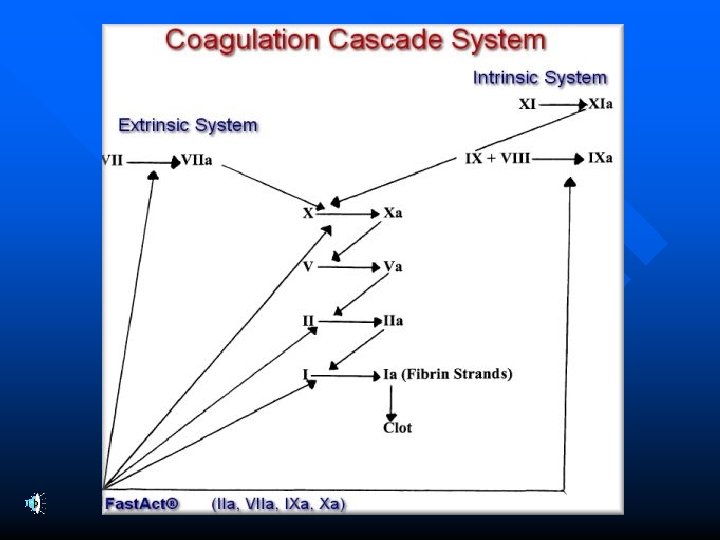
How does Fast. Act work? ® n For example: If a patient is on heparin, the intrinsic system is impaired , since heparin inhibits Factor IX. Although the intrinsic system is impaired, the extrinsic system is not, allowing Fast. Act® to accelerate this pathway. Likewise, if a patient is on coumadin, Factor VII of the extrinsic system is impaired, leaving the intrinsic pathway to be accelerated by Fast. Act®. On the other hand, if the patient should have a factor deficiency, Fast. Act® can by-pass these points of deficiencies.

Fast. Act ® versus Competition

Who are the competitors? n There a number of suppliers of hemostatic agents, but the two major ® competitors are Baxter’s Tisseel and Johnson & Johnson’s Flo. Seal®.
How do their products work? n ® ® Tisseel and Flo. Seal are each a two component fibrin glue, delivered by a double barrel syringe. The two components are mixed in a common duct, then applied to the bleeding site. An analogy would be forming a patch, and putting it on a tire. The patch impedes the blood flow, allowing the patient’s cascade system to form a clot.
In which markets are the competitors’ products found? n They are both found in the cardio-vascular field. They are also used in some liver surgeries.
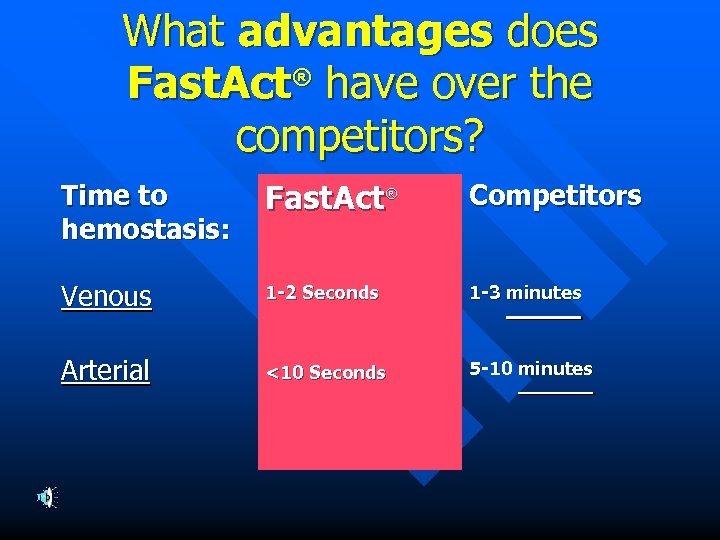
What advantages does Fast. Act® have over the competitors? Time to hemostasis: Fast. Act® Competitors Venous 1 -2 Seconds 1 -3 minutes Arterial <10 Seconds 5 -10 minutes

What advantages does Fast. Act® have over the competitors? Active in the presence of anticoagulant drugs Fast. Act® Competitors YES NO

What advantages does Fast. Act® have over the competitors? Active in the presence of factor deficiencies Fast. Act® Competitors YES NO

What advantages does Fast. Act® have over the competitors? Multiple Delivery Systems Fast. Act® Competitors YES NO

What advantages does Fast. Act® have over the competitors? Limits in Application Fast. Act® Competitors NO Yes, mostly cardiovascular

What advantages does Fast. Act® have over the competitors? Any Preparations Fast. Act® Competitors NO YES

What advantages does Fast. Act® have over the competitors? Reduces Surgical Fast. Act® Time YES Competitors NO

What advantages does Fast. Act® have over the competitors? Cost per Surgery in U. S. Dollars Fast. Act® Competitors $50 -100 $350 -$700

Fast. Act ® How and where to market ® Fast. Act

Fast. Act ® In hospitals, seek out 2 -3 departments to introduce ® Fast. Act for evaluation. It is helpful if the head of the department is progressive in thinking, and is not afraid to try new technology.
Fast. Act ® Introduce Fast. Act® in those departments where bleeding is a problem for certain surgical procedures. Examples: Liver resection, ruptured spleen, a TURP (trans-uretha-resection of the prostate), D & C, C-section, bladder tumors, epistasis, orthopedic surgery, neuro and spinal surgery, debridement of burn tissue, partial nephrictomy.

Fast. Act ® Introduce Fast. Act to the medical schools and teaching hospitals. ®

Fast. Act ® To the dentists, seek those who perform oral and maxillofacial surgery.
Fast. Act ® Paramedic or emergency response teams have very limited resources to control bleeding.
Fast. Act ® Law enforcement, like the paramedics, are faced with challenging situations to control bleeding.
Fast. Act ® The military has always faced bleeding on the battlefield, and in the operating room.

Fast. Act ® Limitations
Fast. Act ® Fast. Act® has been used on over 5000 patients to date without any contra-indications. The product has also been effective in all forms of hemorrhages. There have been five cases, out of hundreds of cardio-vascular surgical cases, in which Fast. Act® did not seem to work. All five of these cases were by-pass surgery, at the site of anastomosis.
Fast. Act ® The reason why these five cases failed is the following: Fibrinogen, the protein that forms the clot, is a cryogenic protein. When this protein is exposed to temperatures below 37° C, it will fold up on itself, and fall out of solution. Patients undergoing bypass surgery are placed on a heart pump machine, which lowers the blood temperature. If the patient has a low normal fibrinogen count (150 mg/dl) or lower, the patient would have a tendency to have less fibrinogen in solution in their blood to coagulate normally when first taken off the heart pump machine. Therefore, when Fast. Act® is applied as a liquid to the site of anastomosis, clot formation does not occur in the few seconds as normally expected. It is recommended to use an impregnated Fast. Act® surgical sponge, and apply a little pressure at the bleeding site for 15 -30 seconds. Hemostasis will then be achieved.

The Financial Advantages of Fast. Act ®

Fast. Act ® Reduces surgical time as much as 50%; therefore, the cost for the surgical room is also reduced.
Fast. Act ® Less surgical time equals less anesthetic drugs.
Fast. Act ® No loss of tissue, as seen with cauterization , resulting in less inflammation and pain management drugs.
Fast. Act ® Healing time is faster ® with Fast. Act , as there is no loss of tissue, resulting in a shorter hospital stay.

Fast. Act ® Frequently Asked Questions
What is Fast. Act ? ® n A one component hemostatic agent designed to arrest all forms of hemorrhages in seconds. It can be used invasively, semi-invasively, and non-invasively.
What is in Fast. Act ? ® n ® Fast. Act contains bovine proteins: Factors II, VII, IX, and X.
Is Fast. Act BSE Free? ® n Yes. n The CE Certificate can only be issued by demonstrating that the product is BSE free. The source proteins come from U. S. cows only, which have never had a documented case of BSE infection. The one case in the news recently, was a cow that was initially infected in Ontario, Canada, five years before being sold to a farmer in the U. S. All the plasma collected is from cows, which at the time of slaughter are only 18 months old. The gestation period for BSE is 5 years. All of the cows are inspected and certified by a USDA veterinarian, to be free of BSE.
Is Fast. Act a drug? ® n. No. Fast. Act is a Class III Medical ® Device. The product is applied topically to the wound, and it is not introduced into the vascular system, nor enters the cell, as per the definition of a drug.
Have there been any adverse reactions? n. No. Fast. Act has been applied ® more than 5, 000 cases, with no reported adverse effects. It is estimated that less than 0. 05% of the population would be sensitive to Fast. Act® , and they would be patients sensitive to bovine proteins, and a few lupus patients.
Have there been any ® publications of Fast. Act ? n Not at this time. There a few papers that will be submitted for publication very soon.
What is the cost of Fast. Act ? ® n Fast. Act sells for $50/ml. Most ® surgeries require 1 ml or less, and major surgeries such as heart transplant or liver resection, may only use 2 ml, or $100.
Presentation is Complete. Thank You Fast. Act ® Wortham Laboratories, Inc. www. worthamlabs. com © 2004 Wortham Laboratories, Inc. All Rights Reserved International Office: USA 1+423. 296. 0090
Скачать презентацию Wortham Laboratories Fast Act Fast Act Product
abe9a46d72477b2c3374d0bd71978af6.ppt