


 Скачать презентацию Worldwide telecoms market shares 2011 Research Report Worldwide
79e761ddf60fc5a22f50e20a246871fc.ppt
- Количество слайдов: 48
 Worldwide telecoms market shares 2011 Research Report Worldwide telecoms market shares 2011 November 2012 Larry Goldman, Johanne Mayer and Dean Ramsay © Analysys Mason Limited 2012
 2 Worldwide telecoms market shares 2011 Contents Slide no. 5. 6. 7. 8. 9. 10. 11. 12. 13. 23. CALA’s telecoms market grew by 13%, demonstrating the attractiveness of investing in a fast-growing region 24. Video service revenue showed the fastest growth in CALA, at 47% 25. Voice services accounted for the majority (57%) of CALA’s telecoms revenue in 2011 26. Prepaid services continue to be the growth engine in CALA 27. América Móvil maintains its lead in CALA 28. EMEA’s telecoms revenue was down slightly from 2010 29. EMEA’s telecoms revenue trends reflect the region’s weak economy 30. Voice services generated more than half of EMEA’s telecoms revenue in 2011 31. Prepaid subscribers accounted for more than 60% of EMEA’s telecoms subscribers in 2011 32. France Telecom has narrowly taken the lead as EMEA’s largest operator in terms of revenue 33. NA’s telecoms market grew by 5% in comparison with 2010 34. Messaging and non-messaging revenue is growing at the expense of voice revenue in NA 35. Mobile voice services drive telecoms revenue in NA, while video, PSTN and business services have almost equal shares 36. The migration from prepaid to postpaid services continues in NA 37. The top-six operators were unchanged from 2010 in NA, although Deutsche Telekom and DIRECTV swapped places 14. 15. 16. 17. 18. 19. 20. 21. 22. Executive summary and recommendations Executive summary Recommendations [1] Recommendations [2] Market shares – Worldwide telecoms market grew by 3. 9% to reach USD 2 trillion in 2011 All service types except PSTN registered revenue growth in 2011 Mobile voice and PSTN revenue still account for 50% of the total telecoms service revenue worldwide APAC and CALA service revenue grew at the expense of EMEA The worldwide number of subscribers increased in all categories except PSTN, which declined by 4% The top-six telecoms operators accounted for 31% of service revenue worldwide in 2011 Market share – By region APAC’s telecoms revenue increased by USD 35 billion, or 6%, in comparison with 2010 Mobile non-messaging services are generating more revenue than broadband services in APAC Voice services account for almost half of APAC’s telecoms revenue The mobile subscriber base continues to grow in APAC: the number of postpaid subscribers increased by 27% in 2011 The top-six operators in APAC retained their market share positions in 2011 © Analysys Mason Limited 2012
 Worldwide telecoms market shares 2011 Contents Slide no. 38. 39. 40. 41. 42. 43. 44. 45. 46. 47. Market definition Definition of geographical regions [1] Definition of geographical regions [2] Definition of geographical regions [3] Data series definitions About the authors and Analysys Mason About the authors About Analysys Mason Research from Analysys Mason Consulting from Analysys Mason © Analysys Mason Limited 2012 3
 4 Worldwide telecoms market shares 2011 List of figures Figure 1: CSPs’ telecoms service revenue and average revenue per subscriber, by region, 2010 and 2011 Figure 17: Telecoms service subscribers by service type, CALA, 2010 and 2011 Figure 2: Mobile CSPs’ IT spending per subscriber, by region and CSP type, worldwide, 2011 Figure 3: Telecoms service revenue by service type and region, 2011 Figure 3: Telecoms market financials, worldwide, 2010 and 2011 Figure 4: Telecoms service revenue by service type, worldwide, 2010 and 2011 Figure 5: Telecoms service revenue by service type, worldwide, 2010 and 2011 Figure 6: Telecoms service revenue by region, worldwide, 2010 and 2011 Figure 7: Telecoms service subscribers or lines by service type, worldwide, 2010 and 2011 Figure 8: Telecoms service revenue by operator, worldwide, 2010 and 2011 Figure 9: Telecoms market financials, APAC, 2010 and 2011 Figure 10: Telecoms service revenue by service type, APAC, 2010 and 2011 Figure 11: Telecoms service revenue by service type, APAC, 2010 and 2011 Figure 12: Telecoms service subscribers or lines by service type, APAC, 2010 and 2011 Figure 13: Telecoms service revenue by operator, APAC, 2011 Figure 14: Telecoms market financials, CALA, 2010 and 2011 Figure 15: Telecoms service revenue by service type, CALA, 2010 and 2011 Figure 16: Telecoms service revenue by service type, CALA, 2010 and 2011 Figure 18: Figure 19: Figure 20: Telecoms service revenue by operator, CALA, 2011 Telecoms market financials, EMEA, 2010 and 2011 Telecoms service revenue by service type, EMEA, 2010 and 2011 Telecoms service subscribers or lines by service type, EMEA, 2010 and 2011 Telecoms service revenue by operator, EMEA, 2011 Telecoms market financials, NA, 2010 and 2011 Telecoms service revenue by service type, NA, 2010 and 2011 Telecoms service subscribers or lines by service type, NA, 2010 and 2011 Telecoms service revenue by operator, NA, 2011 Regional breakdown used in this report © Analysys Mason Limited 2012 Figure 21: Figure 22: Figure 23: Figure 24: Figure 25: Figure 26: Figure 27: Figure 28: Figure 29: Figure 30 a–b: Regional breakdown used in this report Figure 31: Definitions of the data series in this report
 Worldwide telecoms market shares 2011 Executive summary and recommendations Market shares Market definition About the authors and Analysys Mason © Analysys Mason Limited 2012 5
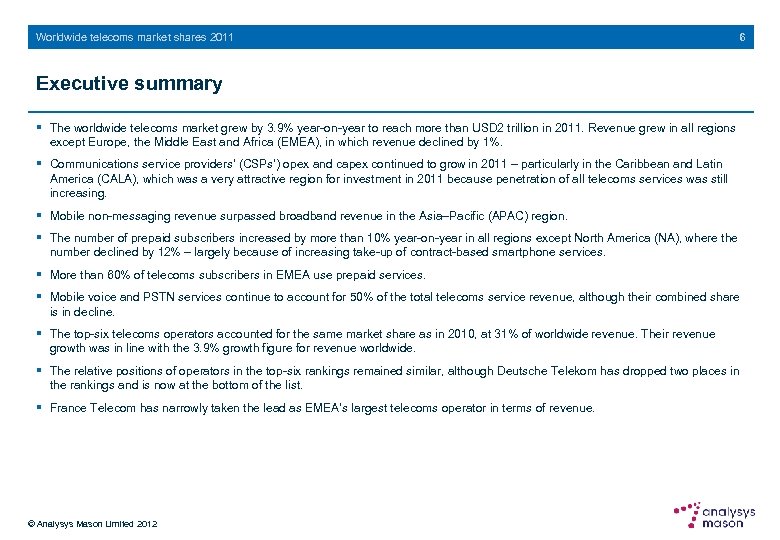 Worldwide telecoms market shares 2011 6 Executive summary § The worldwide telecoms market grew by 3. 9% year-on-year to reach more than USD 2 trillion in 2011. Revenue grew in all regions except Europe, the Middle East and Africa (EMEA), in which revenue declined by 1%. § Communications service providers’ (CSPs’) opex and capex continued to grow in 2011 – particularly in the Caribbean and Latin America (CALA), which was a very attractive region for investment in 2011 because penetration of all telecoms services was still increasing. § Mobile non-messaging revenue surpassed broadband revenue in the Asia–Pacific (APAC) region. § The number of prepaid subscribers increased by more than 10% year-on-year in all regions except North America (NA), where the number declined by 12% – largely because of increasing take-up of contract-based smartphone services. § More than 60% of telecoms subscribers in EMEA use prepaid services. § Mobile voice and PSTN services continue to account for 50% of the total telecoms service revenue, although their combined share is in decline. § The top-six telecoms operators accounted for the same market share as in 2010, at 31% of worldwide revenue. Their revenue growth was in line with the 3. 9% growth figure for revenue worldwide. § The relative positions of operators in the top-six rankings remained similar, although Deutsche Telekom has dropped two places in the rankings and is now at the bottom of the list. § France Telecom has narrowly taken the lead as EMEA’s largest telecoms operator in terms of revenue. © Analysys Mason Limited 2012
![7 Worldwide telecoms market shares 2011 Recommendations [1] § Operators in most markets must](https://present5.com/presentation/79e761ddf60fc5a22f50e20a246871fc/image-7.jpg "7 Worldwide telecoms market shares 2011 Recommendations [1] § Operators in most markets must") 7 Worldwide telecoms market shares 2011 Recommendations [1] § Operators in most markets must focus on profitability. NA has the healthiest revenue per subscriber rate, at almost USD 800 per year, while other regions’ revenue is much lower. The lowest rate is in APAC, at USD 156. To increase profitability, CSPs should: Figure 1: CSPs’ telecoms service revenue and average revenue per subscriber, by region, 2010 and 2011 [Source: Analysys Mason, 2012]2 - limit their engagement in damaging price wars - continue to invest in the development of services that encourage less-price-sensitive subscribers to spend more – particularly mobile data services - maintain high levels of control over operating costs. 1 § Operators in all markets must develop an integrated offering. Service bundling is cannibalising the number of PSTN lines as well as reducing the prices of Vo. IP, broadband video services – particularly, but not only, in mature markets. Operators that lack an integrated offering are now highly vulnerable to churn and declining revenue. 1 For further details, see Analysys Mason’s Report IT spending by communications service providers worldwide 2011. Available at www. analysysmason. com/ITspend 2012. © Analysys Mason Limited 2012 Figure 2: Mobile CSPs’ IT spending per subscriber, by region and CSP type, worldwide, 2011 [Source: Analysys Mason, 2012] 2 APAC = Asia–Pacific; CALA = Caribbean and Latin America; EMEA = Europe, the Middle East and Africa; NA = North America.
7 Worldwide telecoms market shares 2011 Recommendations [1] § Operators in most markets must focus on profitability. NA has the healthiest revenue per subscriber rate, at almost USD 800 per year, while other regions’ revenue is much lower. The lowest rate is in APAC, at USD 156. To increase profitability, CSPs should: Figure 1: CSPs’ telecoms service revenue and average revenue per subscriber, by region, 2010 and 2011 [Source: Analysys Mason, 2012]2 - limit their engagement in damaging price wars - continue to invest in the development of services that encourage less-price-sensitive subscribers to spend more – particularly mobile data services - maintain high levels of control over operating costs. 1 § Operators in all markets must develop an integrated offering. Service bundling is cannibalising the number of PSTN lines as well as reducing the prices of Vo. IP, broadband video services – particularly, but not only, in mature markets. Operators that lack an integrated offering are now highly vulnerable to churn and declining revenue. 1 For further details, see Analysys Mason’s Report IT spending by communications service providers worldwide 2011. Available at www. analysysmason. com/ITspend 2012. © Analysys Mason Limited 2012 Figure 2: Mobile CSPs’ IT spending per subscriber, by region and CSP type, worldwide, 2011 [Source: Analysys Mason, 2012] 2 APAC = Asia–Pacific; CALA = Caribbean and Latin America; EMEA = Europe, the Middle East and Africa; NA = North America.
![8 Worldwide telecoms market shares 2011 Recommendations [2] § Operators in mature markets must](https://present5.com/presentation/79e761ddf60fc5a22f50e20a246871fc/image-8.jpg "8 Worldwide telecoms market shares 2011 Recommendations [2] § Operators in mature markets must") 8 Worldwide telecoms market shares 2011 Recommendations [2] § Operators in mature markets must continue the search for genuinely new revenue opportunities. Advanced mobile data services are delivering on their promise to create revenue growth – particularly in emerging markets, such as APAC, where the non-messaging revenue was higher than overall broadband services revenue for the year. However, operators in mature markets should be aware that this growth comes mainly at the expense of mobile voice and messaging revenue. They must continue their search for new business models and services that can increase customer loyalty and create new revenue opportunities, such as revenue-sharing with content providers. © Analysys Mason Limited 2012 Figure 3: Telecoms service revenue by service type and region, 2011 [Source: Analysys Mason, 2012]
8 Worldwide telecoms market shares 2011 Recommendations [2] § Operators in mature markets must continue the search for genuinely new revenue opportunities. Advanced mobile data services are delivering on their promise to create revenue growth – particularly in emerging markets, such as APAC, where the non-messaging revenue was higher than overall broadband services revenue for the year. However, operators in mature markets should be aware that this growth comes mainly at the expense of mobile voice and messaging revenue. They must continue their search for new business models and services that can increase customer loyalty and create new revenue opportunities, such as revenue-sharing with content providers. © Analysys Mason Limited 2012 Figure 3: Telecoms service revenue by service type and region, 2011 [Source: Analysys Mason, 2012]
 Worldwide telecoms market shares 2011 Executive summary and recommendations Market shares Market definition About the authors and Analysys Mason © Analysys Mason Limited 2012 9
 Worldwide telecoms market shares 2011 Market shares Worldwide By region © Analysys Mason Limited 2012 10
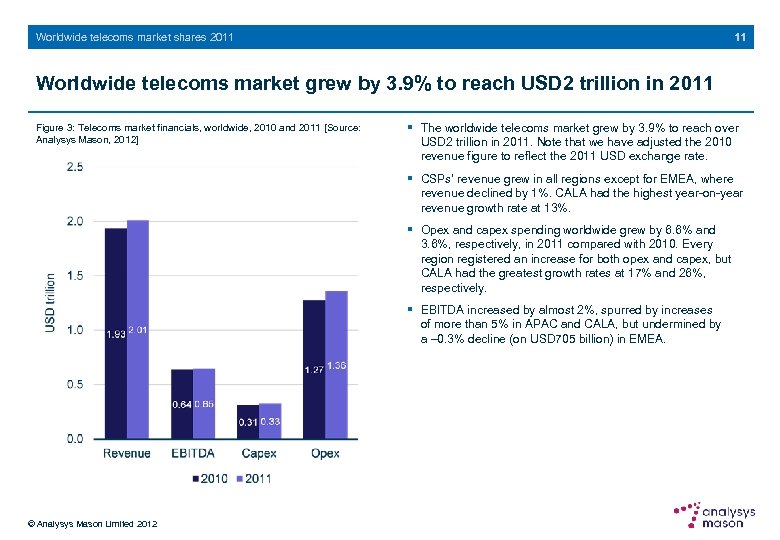 11 Worldwide telecoms market shares 2011 Worldwide telecoms market grew by 3. 9% to reach USD 2 trillion in 2011 Figure 3: Telecoms market financials, worldwide, 2010 and 2011 [Source: Analysys Mason, 2012] § The worldwide telecoms market grew by 3. 9% to reach over USD 2 trillion in 2011. Note that we have adjusted the 2010 revenue figure to reflect the 2011 USD exchange rate. § CSPs’ revenue grew in all regions except for EMEA, where revenue declined by 1%. CALA had the highest year-on-year revenue growth rate at 13%. § Opex and capex spending worldwide grew by 6. 6% and 3. 6%, respectively, in 2011 compared with 2010. Every region registered an increase for both opex and capex, but CALA had the greatest growth rates at 17% and 26%, respectively. § EBITDA increased by almost 2%, spurred by increases of more than 5% in APAC and CALA, but undermined by a – 0. 3% decline (on USD 705 billion) in EMEA. © Analysys Mason Limited 2012
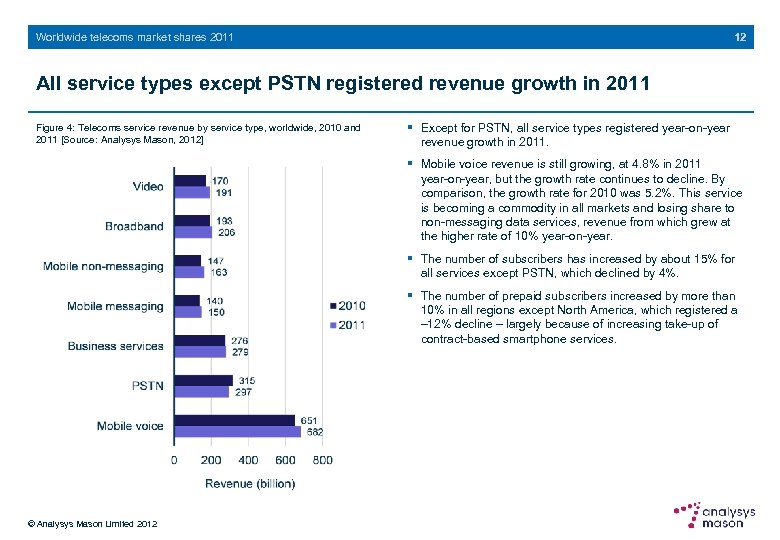 12 Worldwide telecoms market shares 2011 All service types except PSTN registered revenue growth in 2011 Figure 4: Telecoms service revenue by service type, worldwide, 2010 and 2011 [Source: Analysys Mason, 2012] § Except for PSTN, all service types registered year-on-year revenue growth in 2011. § Mobile voice revenue is still growing, at 4. 8% in 2011 year-on-year, but the growth rate continues to decline. By comparison, the growth rate for 2010 was 5. 2%. This service is becoming a commodity in all markets and losing share to non-messaging data services, revenue from which grew at the higher rate of 10% year-on-year. § The number of subscribers has increased by about 15% for all services except PSTN, which declined by 4%. § The number of prepaid subscribers increased by more than 10% in all regions except North America, which registered a – 12% decline – largely because of increasing take-up of contract-based smartphone services. © Analysys Mason Limited 2012
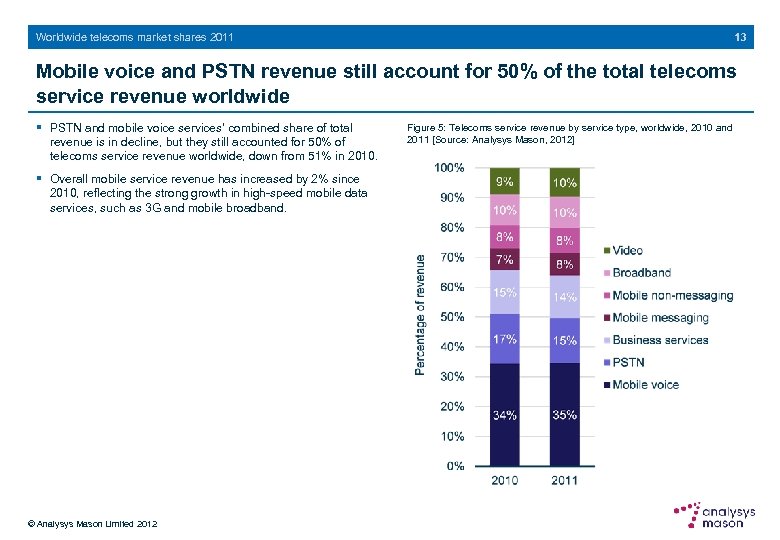 Worldwide telecoms market shares 2011 13 Mobile voice and PSTN revenue still account for 50% of the total telecoms service revenue worldwide § PSTN and mobile voice services’ combined share of total revenue is in decline, but they still accounted for 50% of telecoms service revenue worldwide, down from 51% in 2010. § Overall mobile service revenue has increased by 2% since 2010, reflecting the strong growth in high-speed mobile data services, such as 3 G and mobile broadband. © Analysys Mason Limited 2012 Figure 5: Telecoms service revenue by service type, worldwide, 2010 and 2011 [Source: Analysys Mason, 2012]
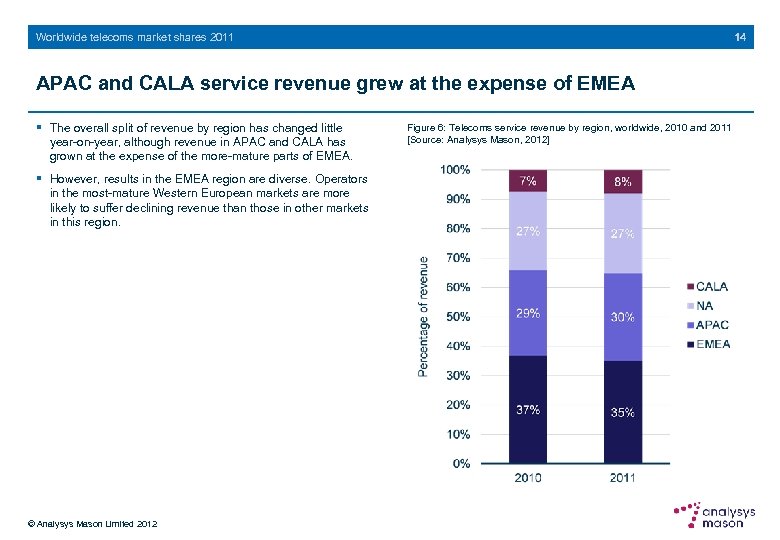 14 Worldwide telecoms market shares 2011 APAC and CALA service revenue grew at the expense of EMEA § The overall split of revenue by region has changed little year-on-year, although revenue in APAC and CALA has grown at the expense of the more-mature parts of EMEA. § However, results in the EMEA region are diverse. Operators in the most-mature Western European markets are more likely to suffer declining revenue than those in other markets in this region. © Analysys Mason Limited 2012 Figure 6: Telecoms service revenue by region, worldwide, 2010 and 2011 [Source: Analysys Mason, 2012]
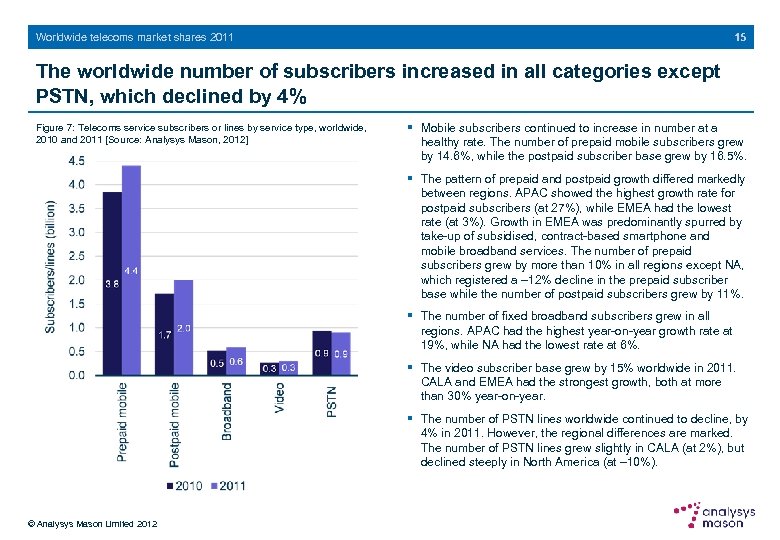 15 Worldwide telecoms market shares 2011 The worldwide number of subscribers increased in all categories except PSTN, which declined by 4% Figure 7: Telecoms service subscribers or lines by service type, worldwide, 2010 and 2011 [Source: Analysys Mason, 2012] § Mobile subscribers continued to increase in number at a healthy rate. The number of prepaid mobile subscribers grew by 14. 6%, while the postpaid subscriber base grew by 16. 5%. § The pattern of prepaid and postpaid growth differed markedly between regions. APAC showed the highest growth rate for postpaid subscribers (at 27%), while EMEA had the lowest rate (at 3%). Growth in EMEA was predominantly spurred by take-up of subsidised, contract-based smartphone and mobile broadband services. The number of prepaid subscribers grew by more than 10% in all regions except NA, which registered a – 12% decline in the prepaid subscriber base while the number of postpaid subscribers grew by 11%. § The number of fixed broadband subscribers grew in all regions. APAC had the highest year-on-year growth rate at 19%, while NA had the lowest rate at 6%. § The video subscriber base grew by 15% worldwide in 2011. CALA and EMEA had the strongest growth, both at more than 30% year-on-year. § The number of PSTN lines worldwide continued to decline, by 4% in 2011. However, the regional differences are marked. The number of PSTN lines grew slightly in CALA (at 2%), but declined steeply in North America (at – 10%). © Analysys Mason Limited 2012
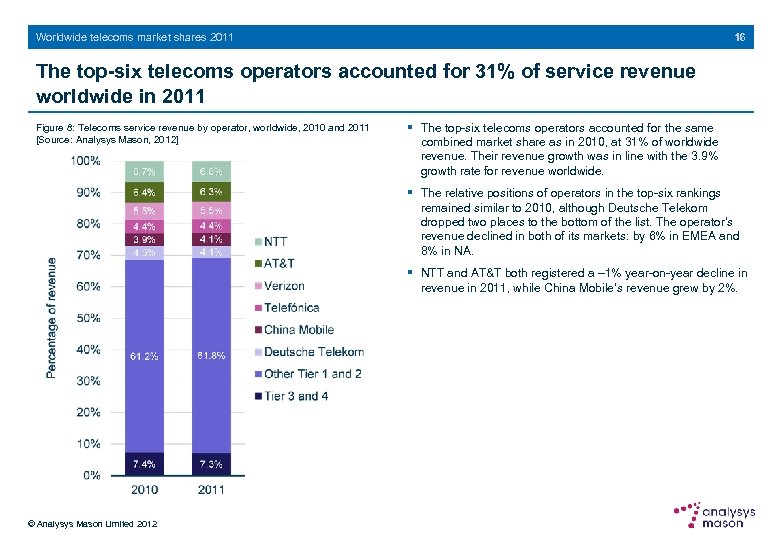 16 Worldwide telecoms market shares 2011 The top-six telecoms operators accounted for 31% of service revenue worldwide in 2011 Figure 8: Telecoms service revenue by operator, worldwide, 2010 and 2011 [Source: Analysys Mason, 2012] § The top-six telecoms operators accounted for the same combined market share as in 2010, at 31% of worldwide revenue. Their revenue growth was in line with the 3. 9% growth rate for revenue worldwide. § The relative positions of operators in the top-six rankings remained similar to 2010, although Deutsche Telekom dropped two places to the bottom of the list. The operator’s revenue declined in both of its markets: by 6% in EMEA and 8% in NA. § NTT and AT&T both registered a – 1% year-on-year decline in revenue in 2011, while China Mobile’s revenue grew by 2%. © Analysys Mason Limited 2012
 Worldwide telecoms market shares 2011 Market shares Worldwide By region © Analysys Mason Limited 2012 17
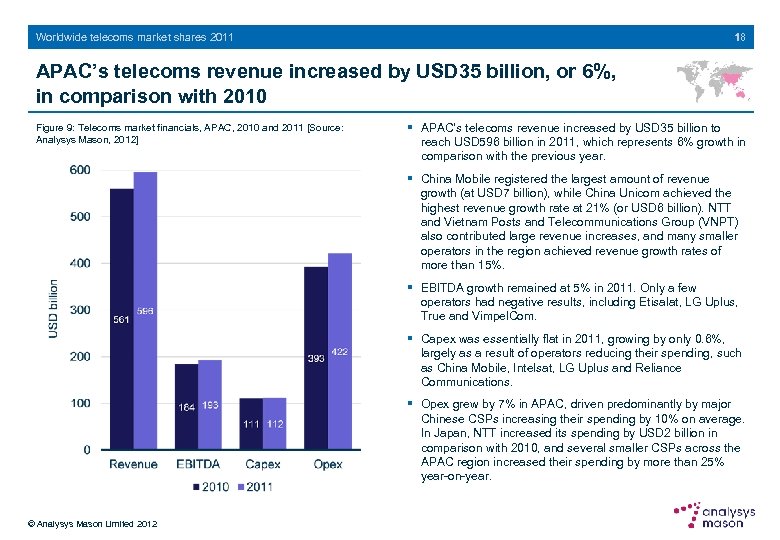 18 Worldwide telecoms market shares 2011 APAC’s telecoms revenue increased by USD 35 billion, or 6%, in comparison with 2010 Figure 9: Telecoms market financials, APAC, 2010 and 2011 [Source: Analysys Mason, 2012] § APAC’s telecoms revenue increased by USD 35 billion to reach USD 596 billion in 2011, which represents 6% growth in comparison with the previous year. § China Mobile registered the largest amount of revenue growth (at USD 7 billion), while China Unicom achieved the highest revenue growth rate at 21% (or USD 6 billion). NTT and Vietnam Posts and Telecommunications Group (VNPT) also contributed large revenue increases, and many smaller operators in the region achieved revenue growth rates of more than 15%. § EBITDA growth remained at 5% in 2011. Only a few operators had negative results, including Etisalat, LG Uplus, True and Vimpel. Com. § Capex was essentially flat in 2011, growing by only 0. 6%, largely as a result of operators reducing their spending, such as China Mobile, Intelsat, LG Uplus and Reliance Communications. § Opex grew by 7% in APAC, driven predominantly by major Chinese CSPs increasing their spending by 10% on average. In Japan, NTT increased its spending by USD 2 billion in comparison with 2010, and several smaller CSPs across the APAC region increased their spending by more than 25% year-on-year. © Analysys Mason Limited 2012
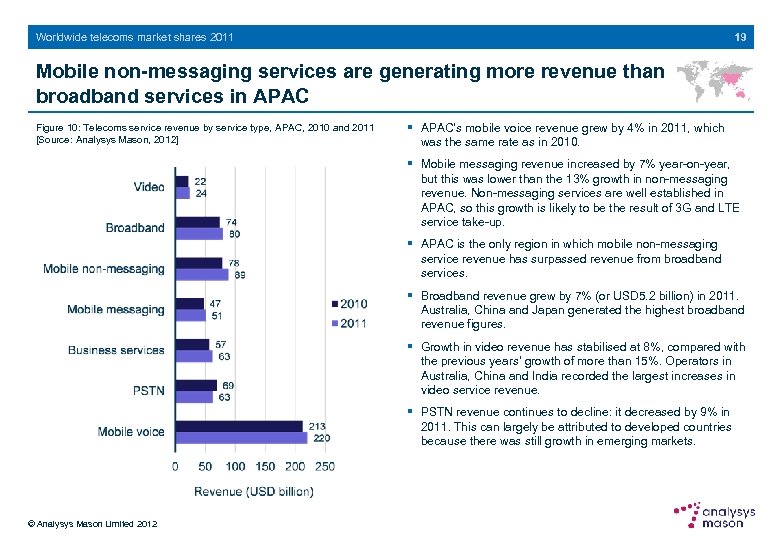 19 Worldwide telecoms market shares 2011 Mobile non-messaging services are generating more revenue than broadband services in APAC Figure 10: Telecoms service revenue by service type, APAC, 2010 and 2011 [Source: Analysys Mason, 2012] § APAC’s mobile voice revenue grew by 4% in 2011, which was the same rate as in 2010. § Mobile messaging revenue increased by 7% year-on-year, but this was lower than the 13% growth in non-messaging revenue. Non-messaging services are well established in APAC, so this growth is likely to be the result of 3 G and LTE service take-up. § APAC is the only region in which mobile non-messaging service revenue has surpassed revenue from broadband services. § Broadband revenue grew by 7% (or USD 5. 2 billion) in 2011. Australia, China and Japan generated the highest broadband revenue figures. § Growth in video revenue has stabilised at 8%, compared with the previous years’ growth of more than 15%. Operators in Australia, China and India recorded the largest increases in video service revenue. § PSTN revenue continues to decline: it decreased by 9% in 2011. This can largely be attributed to developed countries because there was still growth in emerging markets. © Analysys Mason Limited 2012
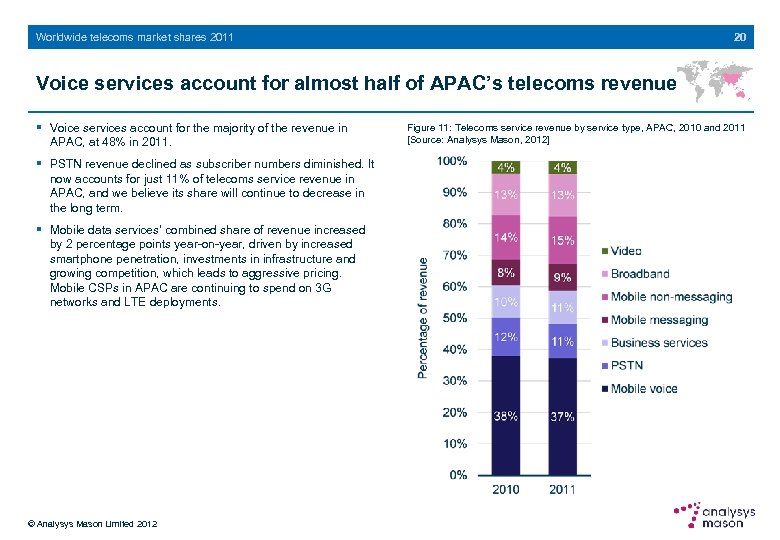 20 Worldwide telecoms market shares 2011 Voice services account for almost half of APAC’s telecoms revenue § Voice services account for the majority of the revenue in APAC, at 48% in 2011. § PSTN revenue declined as subscriber numbers diminished. It now accounts for just 11% of telecoms service revenue in APAC, and we believe its share will continue to decrease in the long term. § Mobile data services’ combined share of revenue increased by 2 percentage points year-on-year, driven by increased smartphone penetration, investments in infrastructure and growing competition, which leads to aggressive pricing. Mobile CSPs in APAC are continuing to spend on 3 G networks and LTE deployments. © Analysys Mason Limited 2012 Figure 11: Telecoms service revenue by service type, APAC, 2010 and 2011 [Source: Analysys Mason, 2012]
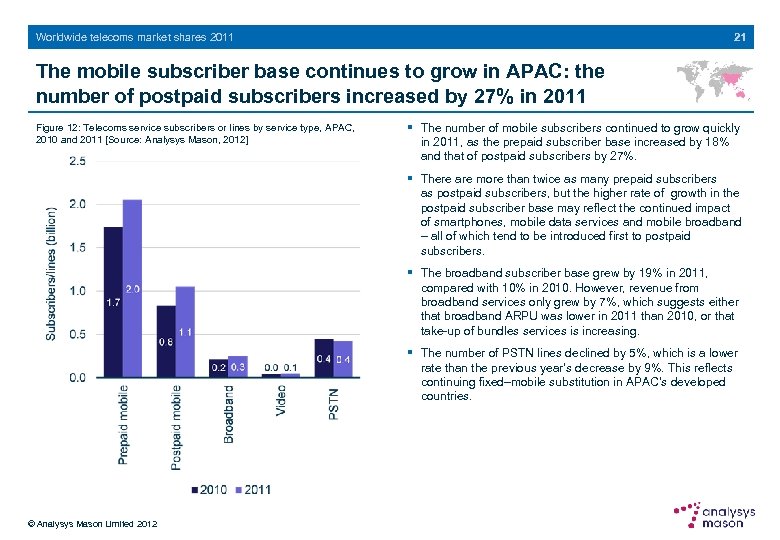 21 Worldwide telecoms market shares 2011 The mobile subscriber base continues to grow in APAC: the number of postpaid subscribers increased by 27% in 2011 Figure 12: Telecoms service subscribers or lines by service type, APAC, 2010 and 2011 [Source: Analysys Mason, 2012] § The number of mobile subscribers continued to grow quickly in 2011, as the prepaid subscriber base increased by 18% and that of postpaid subscribers by 27%. § There are more than twice as many prepaid subscribers as postpaid subscribers, but the higher rate of growth in the postpaid subscriber base may reflect the continued impact of smartphones, mobile data services and mobile broadband – all of which tend to be introduced first to postpaid subscribers. § The broadband subscriber base grew by 19% in 2011, compared with 10% in 2010. However, revenue from broadband services only grew by 7%, which suggests either that broadband ARPU was lower in 2011 than 2010, or that take-up of bundles services is increasing. § The number of PSTN lines declined by 5%, which is a lower rate than the previous year’s decrease by 9%. This reflects continuing fixed–mobile substitution in APAC’s developed countries. © Analysys Mason Limited 2012
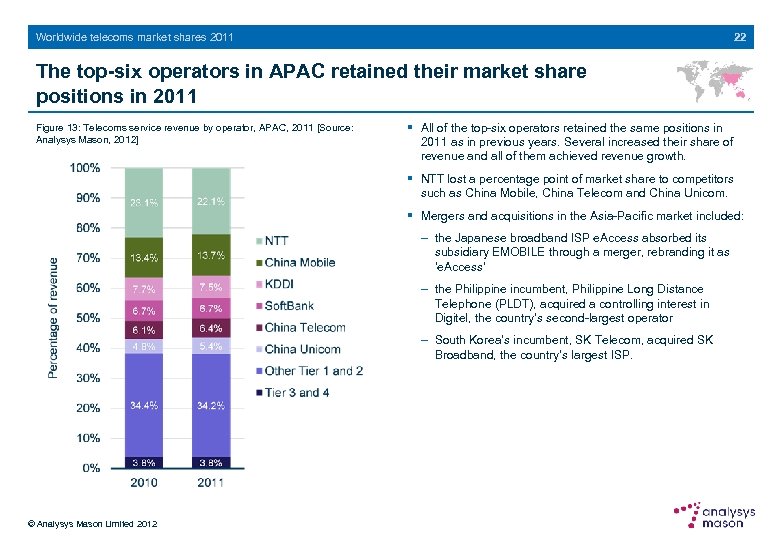 22 Worldwide telecoms market shares 2011 The top-six operators in APAC retained their market share positions in 2011 Figure 13: Telecoms service revenue by operator, APAC, 2011 [Source: Analysys Mason, 2012] § All of the top-six operators retained the same positions in 2011 as in previous years. Several increased their share of revenue and all of them achieved revenue growth. § NTT lost a percentage point of market share to competitors such as China Mobile, China Telecom and China Unicom. § Mergers and acquisitions in the Asia-Pacific market included: - the Japanese broadband ISP e. Access absorbed its subsidiary EMOBILE through a merger, rebranding it as ‘e. Access’ - the Philippine incumbent, Philippine Long Distance Telephone (PLDT), acquired a controlling interest in Digitel, the country’s second-largest operator - South Korea’s incumbent, SK Telecom, acquired SK Broadband, the country’s largest ISP. © Analysys Mason Limited 2012
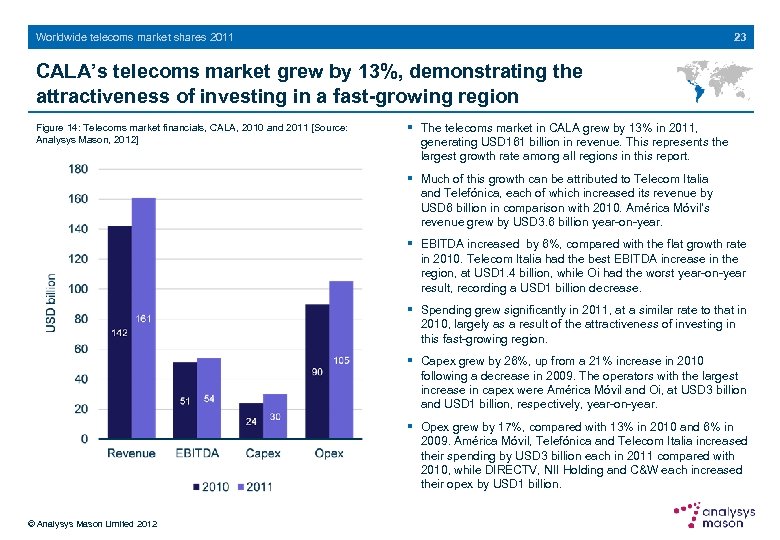 23 Worldwide telecoms market shares 2011 CALA’s telecoms market grew by 13%, demonstrating the attractiveness of investing in a fast-growing region Figure 14: Telecoms market financials, CALA, 2010 and 2011 [Source: Analysys Mason, 2012] § The telecoms market in CALA grew by 13% in 2011, generating USD 161 billion in revenue. This represents the largest growth rate among all regions in this report. § Much of this growth can be attributed to Telecom Italia and Telefónica, each of which increased its revenue by USD 6 billion in comparison with 2010. América Móvil’s revenue grew by USD 3. 6 billion year-on-year. § EBITDA increased by 6%, compared with the flat growth rate in 2010. Telecom Italia had the best EBITDA increase in the region, at USD 1. 4 billion, while Oi had the worst year-on-year result, recording a USD 1 billion decrease. § Spending grew significantly in 2011, at a similar rate to that in 2010, largely as a result of the attractiveness of investing in this fast-growing region. § Capex grew by 26%, up from a 21% increase in 2010 following a decrease in 2009. The operators with the largest increase in capex were América Móvil and Oi, at USD 3 billion and USD 1 billion, respectively, year-on-year. § Opex grew by 17%, compared with 13% in 2010 and 6% in 2009. América Móvil, Telefónica and Telecom Italia increased their spending by USD 3 billion each in 2011 compared with 2010, while DIRECTV, NII Holding and C&W each increased their opex by USD 1 billion. © Analysys Mason Limited 2012
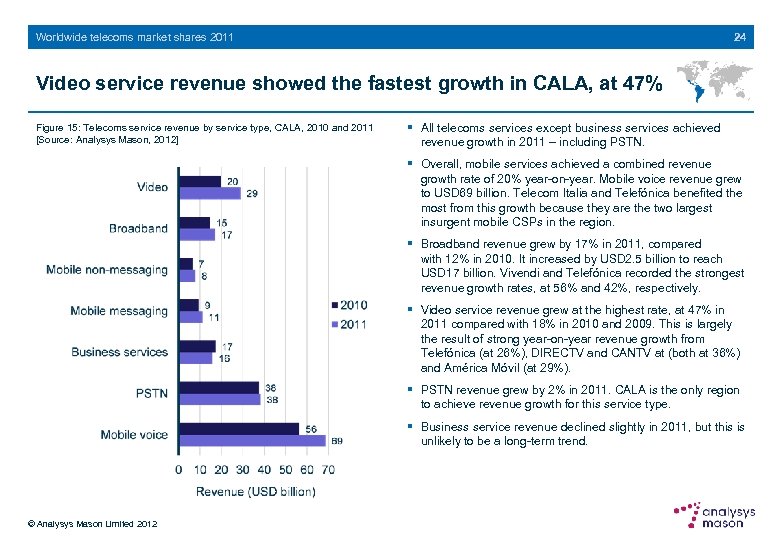 24 Worldwide telecoms market shares 2011 Video service revenue showed the fastest growth in CALA, at 47% Figure 15: Telecoms service revenue by service type, CALA, 2010 and 2011 [Source: Analysys Mason, 2012] § All telecoms services except business services achieved revenue growth in 2011 – including PSTN. § Overall, mobile services achieved a combined revenue growth rate of 20% year-on-year. Mobile voice revenue grew to USD 69 billion. Telecom Italia and Telefónica benefited the most from this growth because they are the two largest insurgent mobile CSPs in the region. § Broadband revenue grew by 17% in 2011, compared with 12% in 2010. It increased by USD 2. 5 billion to reach USD 17 billion. Vivendi and Telefónica recorded the strongest revenue growth rates, at 56% and 42%, respectively. § Video service revenue grew at the highest rate, at 47% in 2011 compared with 18% in 2010 and 2009. This is largely the result of strong year-on-year revenue growth from Telefónica (at 26%), DIRECTV and CANTV at (both at 36%) and América Móvil (at 29%). § PSTN revenue grew by 2% in 2011. CALA is the only region to achieve revenue growth for this service type. § Business service revenue declined slightly in 2011, but this is unlikely to be a long-term trend. © Analysys Mason Limited 2012
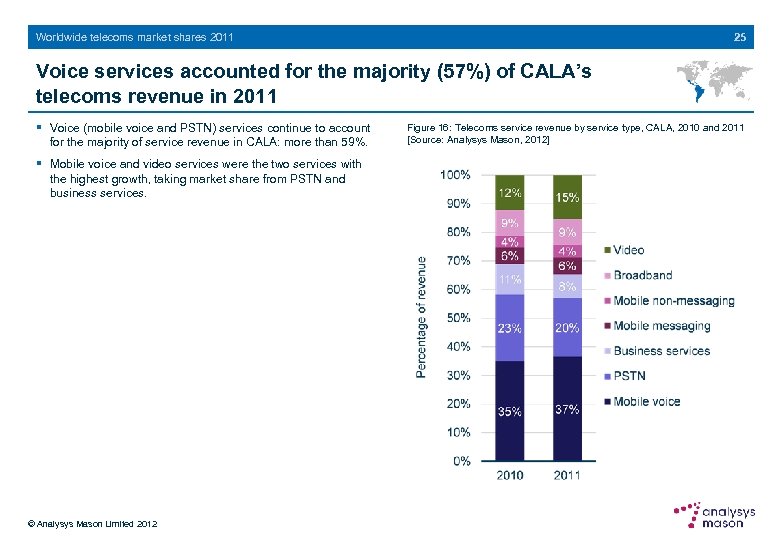 25 Worldwide telecoms market shares 2011 Voice services accounted for the majority (57%) of CALA’s telecoms revenue in 2011 § Voice (mobile voice and PSTN) services continue to account for the majority of service revenue in CALA: more than 59%. § Mobile voice and video services were the two services with the highest growth, taking market share from PSTN and business services. © Analysys Mason Limited 2012 Figure 16: Telecoms service revenue by service type, CALA, 2010 and 2011 [Source: Analysys Mason, 2012]
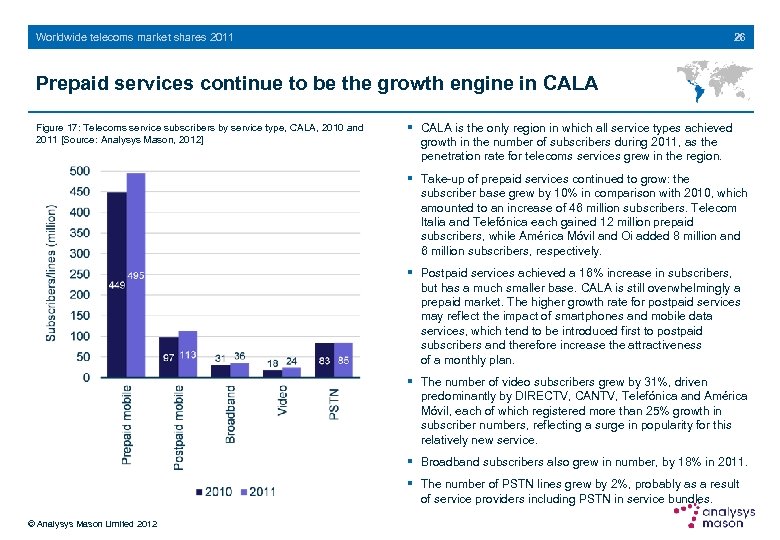 26 Worldwide telecoms market shares 2011 Prepaid services continue to be the growth engine in CALA Figure 17: Telecoms service subscribers by service type, CALA, 2010 and 2011 [Source: Analysys Mason, 2012] § CALA is the only region in which all service types achieved growth in the number of subscribers during 2011, as the penetration rate for telecoms services grew in the region. § Take-up of prepaid services continued to grow: the subscriber base grew by 10% in comparison with 2010, which amounted to an increase of 46 million subscribers. Telecom Italia and Telefónica each gained 12 million prepaid subscribers, while América Móvil and Oi added 8 million and 6 million subscribers, respectively. § Postpaid services achieved a 16% increase in subscribers, but has a much smaller base. CALA is still overwhelmingly a prepaid market. The higher growth rate for postpaid services may reflect the impact of smartphones and mobile data services, which tend to be introduced first to postpaid subscribers and therefore increase the attractiveness of a monthly plan. § The number of video subscribers grew by 31%, driven predominantly by DIRECTV, CANTV, Telefónica and América Móvil, each of which registered more than 25% growth in subscriber numbers, reflecting a surge in popularity for this relatively new service. § Broadband subscribers also grew in number, by 18% in 2011. § The number of PSTN lines grew by 2%, probably as a result of service providers including PSTN in service bundles. © Analysys Mason Limited 2012
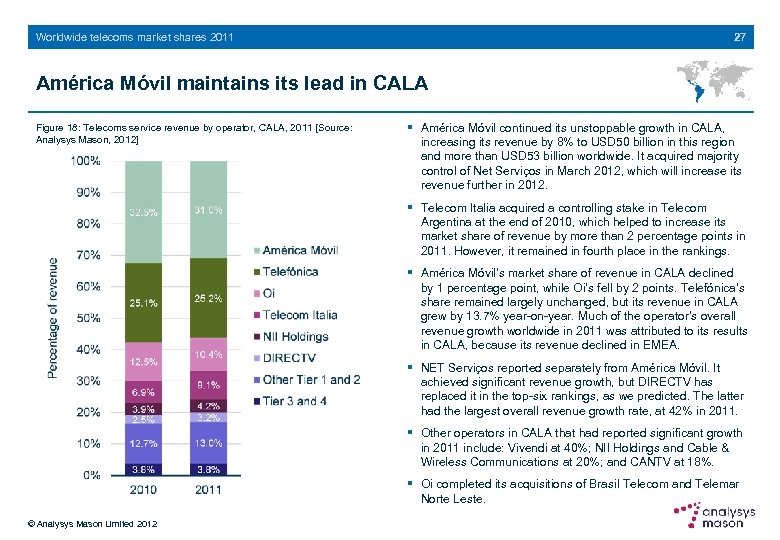 27 Worldwide telecoms market shares 2011 América Móvil maintains its lead in CALA Figure 18: Telecoms service revenue by operator, CALA, 2011 [Source: Analysys Mason, 2012] § América Móvil continued its unstoppable growth in CALA, increasing its revenue by 8% to USD 50 billion in this region and more than USD 53 billion worldwide. It acquired majority control of Net Serviços in March 2012, which will increase its revenue further in 2012. § Telecom Italia acquired a controlling stake in Telecom Argentina at the end of 2010, which helped to increase its market share of revenue by more than 2 percentage points in 2011. However, it remained in fourth place in the rankings. § América Móvil’s market share of revenue in CALA declined by 1 percentage point, while Oi’s fell by 2 points. Telefónica’s share remained largely unchanged, but its revenue in CALA grew by 13. 7% year-on-year. Much of the operator’s overall revenue growth worldwide in 2011 was attributed to its results in CALA, because its revenue declined in EMEA. § NET Serviços reported separately from América Móvil. It achieved significant revenue growth, but DIRECTV has replaced it in the top-six rankings, as we predicted. The latter had the largest overall revenue growth rate, at 42% in 2011. § Other operators in CALA that had reported significant growth in 2011 include: Vivendi at 40%; NII Holdings and Cable & Wireless Communications at 20%; and CANTV at 18%. § Oi completed its acquisitions of Brasil Telecom and Telemar Norte Leste. © Analysys Mason Limited 2012
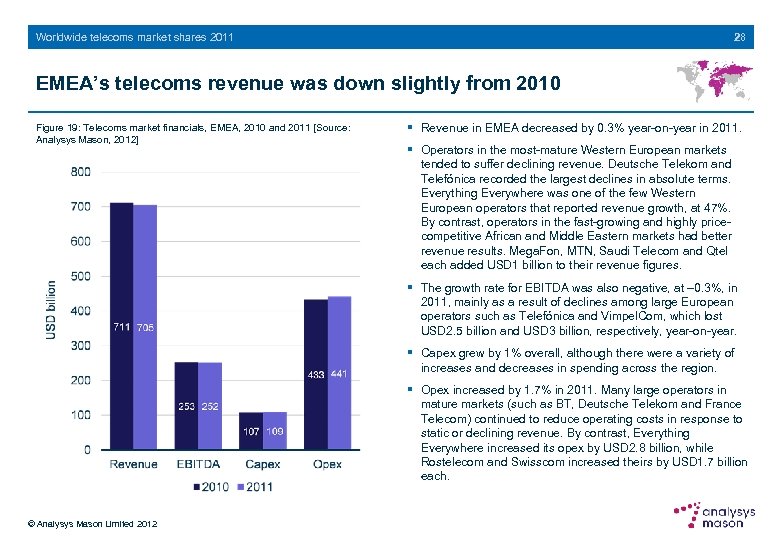 28 Worldwide telecoms market shares 2011 EMEA’s telecoms revenue was down slightly from 2010 Figure 19: Telecoms market financials, EMEA, 2010 and 2011 [Source: Analysys Mason, 2012] § Revenue in EMEA decreased by 0. 3% year-on-year in 2011. § Operators in the most-mature Western European markets tended to suffer declining revenue. Deutsche Telekom and Telefónica recorded the largest declines in absolute terms. Everything Everywhere was one of the few Western European operators that reported revenue growth, at 47%. By contrast, operators in the fast-growing and highly pricecompetitive African and Middle Eastern markets had better revenue results. Mega. Fon, MTN, Saudi Telecom and Qtel each added USD 1 billion to their revenue figures. § The growth rate for EBITDA was also negative, at – 0. 3%, in 2011, mainly as a result of declines among large European operators such as Telefónica and Vimpel. Com, which lost USD 2. 5 billion and USD 3 billion, respectively, year-on-year. § Capex grew by 1% overall, although there were a variety of increases and decreases in spending across the region. § Opex increased by 1. 7% in 2011. Many large operators in mature markets (such as BT, Deutsche Telekom and France Telecom) continued to reduce operating costs in response to static or declining revenue. By contrast, Everything Everywhere increased its opex by USD 2. 8 billion, while Rostelecom and Swisscom increased theirs by USD 1. 7 billion each. © Analysys Mason Limited 2012
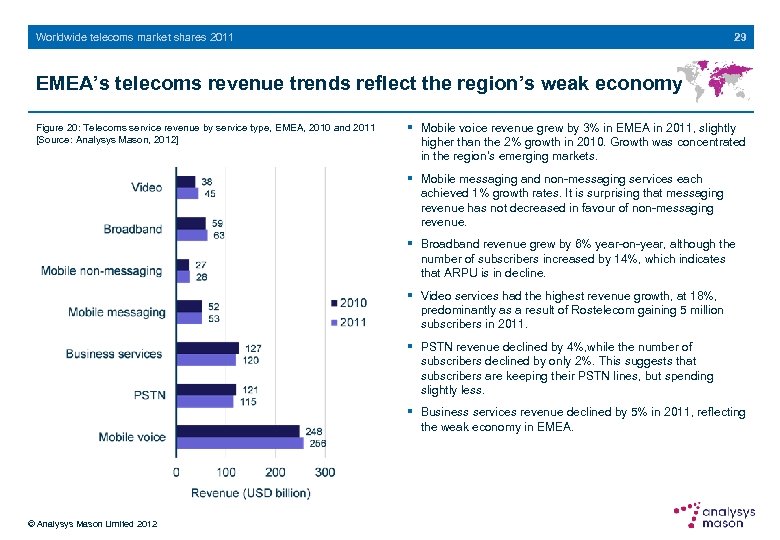 29 Worldwide telecoms market shares 2011 EMEA’s telecoms revenue trends reflect the region’s weak economy Figure 20: Telecoms service revenue by service type, EMEA, 2010 and 2011 [Source: Analysys Mason, 2012] § Mobile voice revenue grew by 3% in EMEA in 2011, slightly higher than the 2% growth in 2010. Growth was concentrated in the region’s emerging markets. § Mobile messaging and non-messaging services each achieved 1% growth rates. It is surprising that messaging revenue has not decreased in favour of non-messaging revenue. § Broadband revenue grew by 6% year-on-year, although the number of subscribers increased by 14%, which indicates that ARPU is in decline. § Video services had the highest revenue growth, at 18%, predominantly as a result of Rostelecom gaining 5 million subscribers in 2011. § PSTN revenue declined by 4%, while the number of subscribers declined by only 2%. This suggests that subscribers are keeping their PSTN lines, but spending slightly less. § Business services revenue declined by 5% in 2011, reflecting the weak economy in EMEA. © Analysys Mason Limited 2012
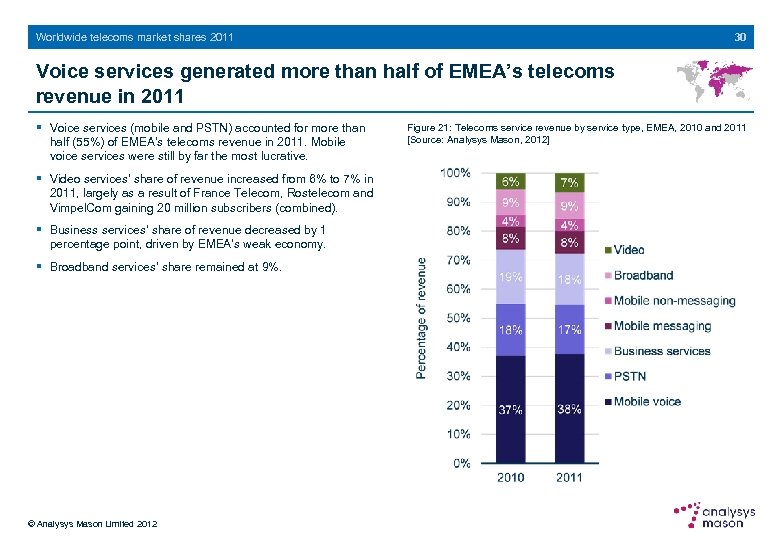 30 Worldwide telecoms market shares 2011 Voice services generated more than half of EMEA’s telecoms revenue in 2011 § Voice services (mobile and PSTN) accounted for more than half (55%) of EMEA’s telecoms revenue in 2011. Mobile voice services were still by far the most lucrative. § Video services’ share of revenue increased from 6% to 7% in 2011, largely as a result of France Telecom, Rostelecom and Vimpel. Com gaining 20 million subscribers (combined). § Business services’ share of revenue decreased by 1 percentage point, driven by EMEA’s weak economy. § Broadband services’ share remained at 9%. © Analysys Mason Limited 2012 Figure 21: Telecoms service revenue by service type, EMEA, 2010 and 2011 [Source: Analysys Mason, 2012]
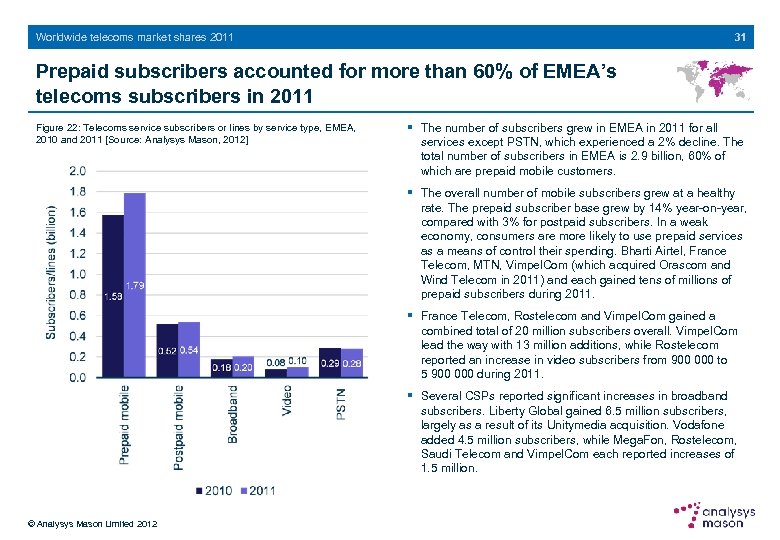 31 Worldwide telecoms market shares 2011 Prepaid subscribers accounted for more than 60% of EMEA’s telecoms subscribers in 2011 Figure 22: Telecoms service subscribers or lines by service type, EMEA, 2010 and 2011 [Source: Analysys Mason, 2012] § The number of subscribers grew in EMEA in 2011 for all services except PSTN, which experienced a 2% decline. The total number of subscribers in EMEA is 2. 9 billion, 60% of which are prepaid mobile customers. § The overall number of mobile subscribers grew at a healthy rate. The prepaid subscriber base grew by 14% year-on-year, compared with 3% for postpaid subscribers. In a weak economy, consumers are more likely to use prepaid services as a means of control their spending. Bharti Airtel, France Telecom, MTN, Vimpel. Com (which acquired Orascom and Wind Telecom in 2011) and each gained tens of millions of prepaid subscribers during 2011. § France Telecom, Rostelecom and Vimpel. Com gained a combined total of 20 million subscribers overall. Vimpel. Com lead the way with 13 million additions, while Rostelecom reported an increase in video subscribers from 900 000 to 5 900 000 during 2011. § Several CSPs reported significant increases in broadband subscribers. Liberty Global gained 6. 5 million subscribers, largely as a result of its Unitymedia acquisition. Vodafone added 4. 5 million subscribers, while Mega. Fon, Rostelecom, Saudi Telecom and Vimpel. Com each reported increases of 1. 5 million. © Analysys Mason Limited 2012
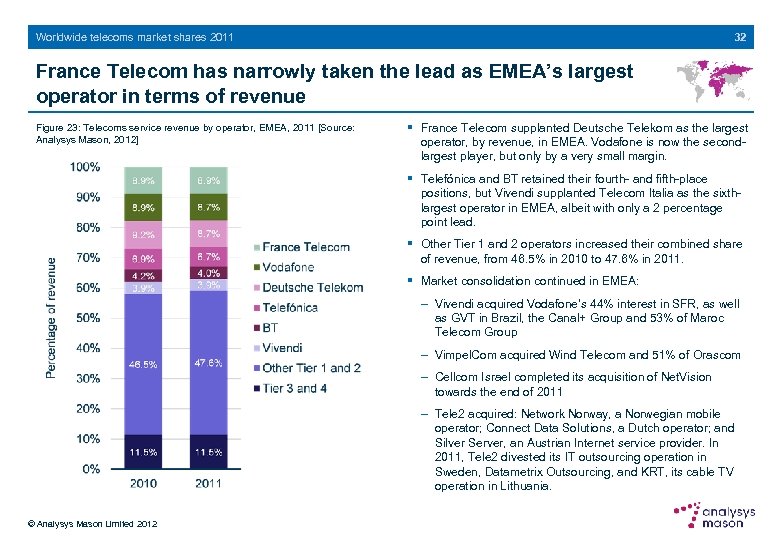 32 Worldwide telecoms market shares 2011 France Telecom has narrowly taken the lead as EMEA’s largest operator in terms of revenue Figure 23: Telecoms service revenue by operator, EMEA, 2011 [Source: Analysys Mason, 2012] § France Telecom supplanted Deutsche Telekom as the largest operator, by revenue, in EMEA. Vodafone is now the secondlargest player, but only by a very small margin. § Telefónica and BT retained their fourth- and fifth-place positions, but Vivendi supplanted Telecom Italia as the sixthlargest operator in EMEA, albeit with only a 2 percentage point lead. § Other Tier 1 and 2 operators increased their combined share of revenue, from 46. 5% in 2010 to 47. 6% in 2011. § Market consolidation continued in EMEA: - Vivendi acquired Vodafone’s 44% interest in SFR, as well as GVT in Brazil, the Canal+ Group and 53% of Maroc Telecom Group - Vimpel. Com acquired Wind Telecom and 51% of Orascom - Cellcom Israel completed its acquisition of Net. Vision towards the end of 2011 - Tele 2 acquired: Network Norway, a Norwegian mobile operator; Connect Data Solutions, a Dutch operator; and Silver Server, an Austrian Internet service provider. In 2011, Tele 2 divested its IT outsourcing operation in Sweden, Datametrix Outsourcing, and KRT, its cable TV operation in Lithuania. © Analysys Mason Limited 2012
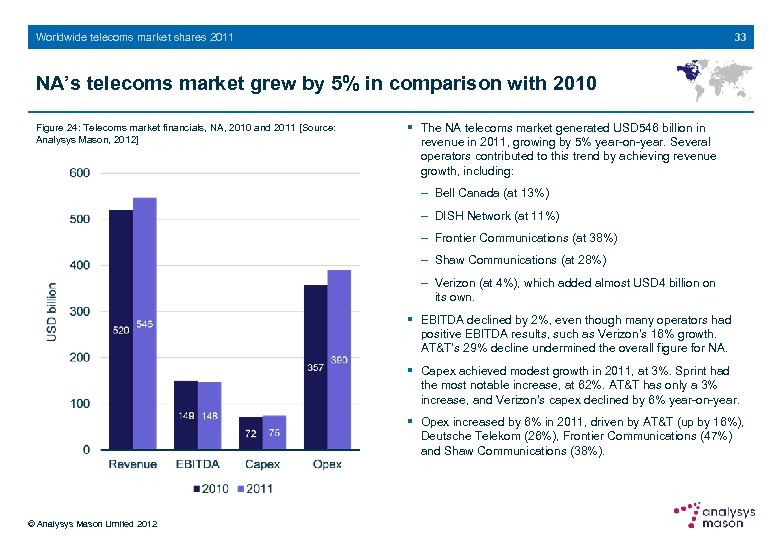 33 Worldwide telecoms market shares 2011 NA’s telecoms market grew by 5% in comparison with 2010 Figure 24: Telecoms market financials, NA, 2010 and 2011 [Source: Analysys Mason, 2012] § The NA telecoms market generated USD 546 billion in revenue in 2011, growing by 5% year-on-year. Several operators contributed to this trend by achieving revenue growth, including: - Bell Canada (at 13%) - DISH Network (at 11%) - Frontier Communications (at 38%) - Shaw Communications (at 28%) - Verizon (at 4%), which added almost USD 4 billion on its own. § EBITDA declined by 2%, even though many operators had positive EBITDA results, such as Verizon’s 16% growth. AT&T’s 29% decline undermined the overall figure for NA. § Capex achieved modest growth in 2011, at 3%. Sprint had the most notable increase, at 62%. AT&T has only a 3% increase, and Verizon’s capex declined by 6% year-on-year. § Opex increased by 6% in 2011, driven by AT&T (up by 16%), Deutsche Telekom (26%), Frontier Communications (47%) and Shaw Communications (38%). © Analysys Mason Limited 2012
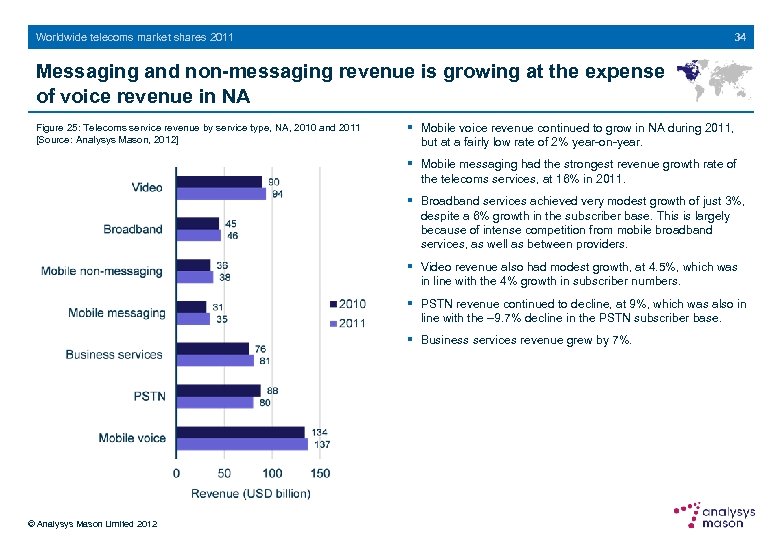 34 Worldwide telecoms market shares 2011 Messaging and non-messaging revenue is growing at the expense of voice revenue in NA Figure 25: Telecoms service revenue by service type, NA, 2010 and 2011 [Source: Analysys Mason, 2012] § Mobile voice revenue continued to grow in NA during 2011, but at a fairly low rate of 2% year-on-year. § Mobile messaging had the strongest revenue growth rate of the telecoms services, at 16% in 2011. § Broadband services achieved very modest growth of just 3%, despite a 6% growth in the subscriber base. This is largely because of intense competition from mobile broadband services, as well as between providers. § Video revenue also had modest growth, at 4. 5%, which was in line with the 4% growth in subscriber numbers. § PSTN revenue continued to decline, at 9%, which was also in line with the – 9. 7% decline in the PSTN subscriber base. § Business services revenue grew by 7%. © Analysys Mason Limited 2012
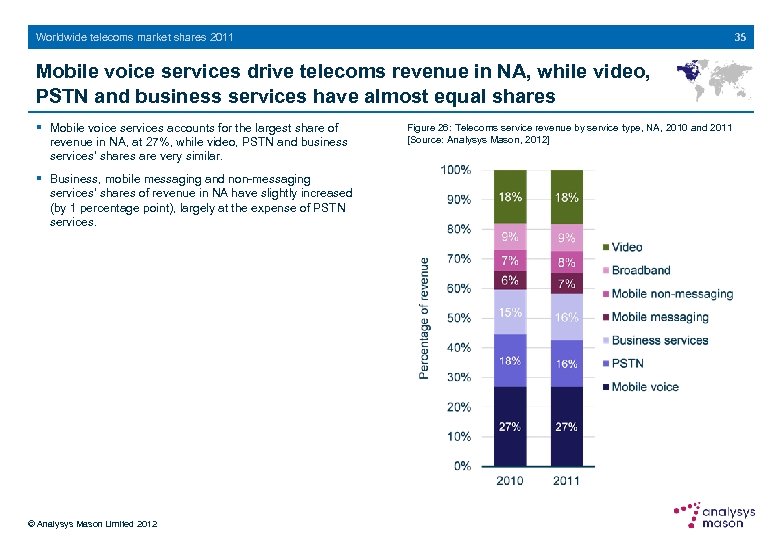 35 Worldwide telecoms market shares 2011 Mobile voice services drive telecoms revenue in NA, while video, PSTN and business services have almost equal shares § Mobile voice services accounts for the largest share of revenue in NA, at 27%, while video, PSTN and business services’ shares are very similar. § Business, mobile messaging and non-messaging services’ shares of revenue in NA have slightly increased (by 1 percentage point), largely at the expense of PSTN services. © Analysys Mason Limited 2012 Figure 26: Telecoms service revenue by service type, NA, 2010 and 2011 [Source: Analysys Mason, 2012]
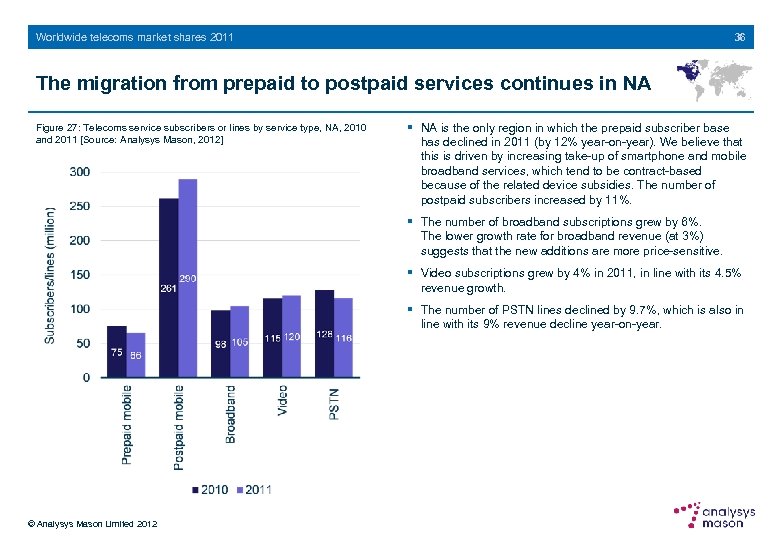 36 Worldwide telecoms market shares 2011 The migration from prepaid to postpaid services continues in NA Figure 27: Telecoms service subscribers or lines by service type, NA, 2010 and 2011 [Source: Analysys Mason, 2012] § NA is the only region in which the prepaid subscriber base has declined in 2011 (by 12% year-on-year). We believe that this is driven by increasing take-up of smartphone and mobile broadband services, which tend to be contract-based because of the related device subsidies. The number of postpaid subscribers increased by 11%. § The number of broadband subscriptions grew by 6%. The lower growth rate for broadband revenue (at 3%) suggests that the new additions are more price-sensitive. § Video subscriptions grew by 4% in 2011, in line with its 4. 5% revenue growth. § The number of PSTN lines declined by 9. 7%, which is also in line with its 9% revenue decline year-on-year. © Analysys Mason Limited 2012
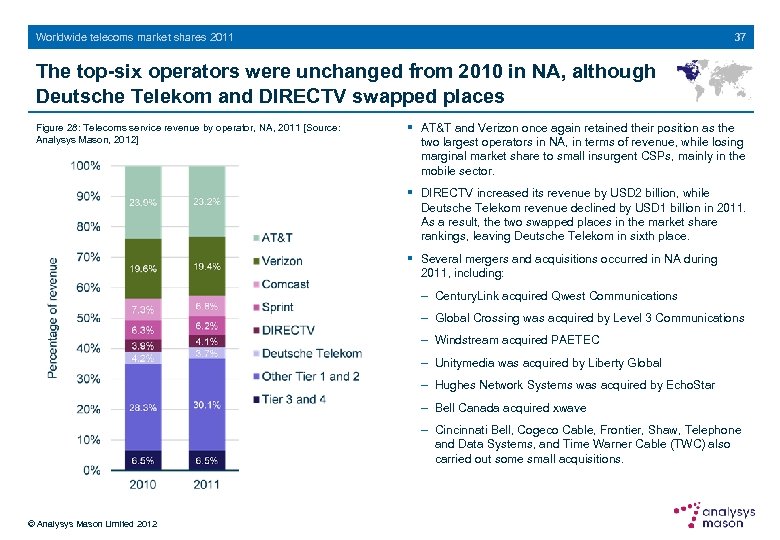 37 Worldwide telecoms market shares 2011 The top-six operators were unchanged from 2010 in NA, although Deutsche Telekom and DIRECTV swapped places Figure 28: Telecoms service revenue by operator, NA, 2011 [Source: Analysys Mason, 2012] § AT&T and Verizon once again retained their position as the two largest operators in NA, in terms of revenue, while losing marginal market share to small insurgent CSPs, mainly in the mobile sector. § DIRECTV increased its revenue by USD 2 billion, while Deutsche Telekom revenue declined by USD 1 billion in 2011. As a result, the two swapped places in the market share rankings, leaving Deutsche Telekom in sixth place. § Several mergers and acquisitions occurred in NA during 2011, including: - Century. Link acquired Qwest Communications - Global Crossing was acquired by Level 3 Communications - Windstream acquired PAETEC - Unitymedia was acquired by Liberty Global - Hughes Network Systems was acquired by Echo. Star - Bell Canada acquired xwave - Cincinnati Bell, Cogeco Cable, Frontier, Shaw, Telephone and Data Systems, and Time Warner Cable (TWC) also carried out some small acquisitions. © Analysys Mason Limited 2012
 Worldwide telecoms market shares 2011 Executive summary and recommendations Market shares Market definition About the authors and Analysys Mason © Analysys Mason Limited 2012 38
![39 Worldwide telecoms market shares 2011 Definition of geographical regions [1] Figure 29: Regional](https://present5.com/presentation/79e761ddf60fc5a22f50e20a246871fc/image-39.jpg "39 Worldwide telecoms market shares 2011 Definition of geographical regions [1] Figure 29: Regional") 39 Worldwide telecoms market shares 2011 Definition of geographical regions [1] Figure 29: Regional breakdown used in this report [Source: Analysys Mason, 2012] Asia–Pacific (APAC) Europe, the Middle East and Africa (EMEA) Caribbean and Latin America (CALA) North America (NA) © Analysys Mason Limited 2012
39 Worldwide telecoms market shares 2011 Definition of geographical regions [1] Figure 29: Regional breakdown used in this report [Source: Analysys Mason, 2012] Asia–Pacific (APAC) Europe, the Middle East and Africa (EMEA) Caribbean and Latin America (CALA) North America (NA) © Analysys Mason Limited 2012
![40 Worldwide telecoms market shares 2011 Definition of geographical regions [2] Figure 30 a:](https://present5.com/presentation/79e761ddf60fc5a22f50e20a246871fc/image-40.jpg "40 Worldwide telecoms market shares 2011 Definition of geographical regions [2] Figure 30 a:") 40 Worldwide telecoms market shares 2011 Definition of geographical regions [2] Figure 30 a: Regional breakdown used in this report [Source: Analysys Mason, 2012] Europe, the Middle East and Africa Albania Central African Republic Finland Jordan Mauritania Portugal Somalia Yemen Algeria Chad France Kenya Mauritius Qatar Spain Zambia Andorra Comoros Gabon Kuwait Mayotte Réunion South Africa Zimbabwe Angola Congo Gambia Latvia Moldova Romania Sudan Austria Côte d'Ivoire Germany Lebanon Monaco Russia Swaziland Bahrain Croatia Ghana Lesotho Montenegro Rwanda Sweden Belarus Cyprus Greece Liberia Morocco St Helena Switzerland Belgium Czech Republic Guinea Libya Mozambique San Marino Syria Benin Democratic Republic of Congo Guinea-Bissau Liechtenstein Namibia Saudi Arabia Tanzania Bosnia-Herzegovina Denmark Hungary Lithuania Netherlands São Tomé and Principe Togo Botswana Djibouti Iceland Luxembourg Niger Senegal Tunisia Bulgaria Egypt Iran Macedonia Nigeria Serbia Turkey Burkina Faso Equatorial Guinea Iraq Madagascar Norway Seychelles Uganda Burundi Eritrea Ireland Malawi Oman Sierra Leone UK Cameroon Estonia Israel Mali Palestine Slovakia Ukraine Cape Verde Ethiopia Italy Malta Poland Slovenia United Arab Emirates © Analysys Mason Limited 2012
40 Worldwide telecoms market shares 2011 Definition of geographical regions [2] Figure 30 a: Regional breakdown used in this report [Source: Analysys Mason, 2012] Europe, the Middle East and Africa Albania Central African Republic Finland Jordan Mauritania Portugal Somalia Yemen Algeria Chad France Kenya Mauritius Qatar Spain Zambia Andorra Comoros Gabon Kuwait Mayotte Réunion South Africa Zimbabwe Angola Congo Gambia Latvia Moldova Romania Sudan Austria Côte d'Ivoire Germany Lebanon Monaco Russia Swaziland Bahrain Croatia Ghana Lesotho Montenegro Rwanda Sweden Belarus Cyprus Greece Liberia Morocco St Helena Switzerland Belgium Czech Republic Guinea Libya Mozambique San Marino Syria Benin Democratic Republic of Congo Guinea-Bissau Liechtenstein Namibia Saudi Arabia Tanzania Bosnia-Herzegovina Denmark Hungary Lithuania Netherlands São Tomé and Principe Togo Botswana Djibouti Iceland Luxembourg Niger Senegal Tunisia Bulgaria Egypt Iran Macedonia Nigeria Serbia Turkey Burkina Faso Equatorial Guinea Iraq Madagascar Norway Seychelles Uganda Burundi Eritrea Ireland Malawi Oman Sierra Leone UK Cameroon Estonia Israel Mali Palestine Slovakia Ukraine Cape Verde Ethiopia Italy Malta Poland Slovenia United Arab Emirates © Analysys Mason Limited 2012
![41 Worldwide telecoms market shares 2011 Definition of geographical regions [3] Figure 30 b:](https://present5.com/presentation/79e761ddf60fc5a22f50e20a246871fc/image-41.jpg "41 Worldwide telecoms market shares 2011 Definition of geographical regions [3] Figure 30 b:") 41 Worldwide telecoms market shares 2011 Definition of geographical regions [3] Figure 30 b: Regional breakdown used in this report [Source: Analysys Mason, 2012] North America Caribbean and Latin America Asia–Pacific Canada Anguilla Chile Honduras Trinidad and Tobago Afghanistan French Polynesia Malaysia Northern Marianas USA Antigua and Barbuda Colombia Jamaica Turks and Caicos Islands American Samoa Georgia Maldives Pakistan Antilles Costa Rica Mexico Uruguay Armenia Guam Marshall Islands Palau Argentina Cuba Montserrat Venezuela Australia Hong Kong Micronesia Philippines Aruba Dominica Nicaragua Virgin Islands (UK) Azerbaijan India Mongolia Singapore Bahamas Dominican Republic Panama Virgin Islands (USA) Bangladesh Indonesia Myanmar South Korea Barbados Ecuador Paraguay Bhutan Japan Nauru Sri Lanka Belize El Salvador Peru Brunei Darussalam Kazakhstan Nepal Tadzhikistan Bermuda Grenada Puerto Rico Cambodia Kiribati New Caledonia Taiwan Bolivia Guatemala St Kitts and Nevis China Kyrgyzstan New Zealand Thailand Brazil Guyana St Lucia Cook Islands Laos Niue Turkmenistan Cayman Islands Haiti St Vincent and the Grenadines Fiji Macau North Korea Uzbekistan © Analysys Mason Limited 2012
41 Worldwide telecoms market shares 2011 Definition of geographical regions [3] Figure 30 b: Regional breakdown used in this report [Source: Analysys Mason, 2012] North America Caribbean and Latin America Asia–Pacific Canada Anguilla Chile Honduras Trinidad and Tobago Afghanistan French Polynesia Malaysia Northern Marianas USA Antigua and Barbuda Colombia Jamaica Turks and Caicos Islands American Samoa Georgia Maldives Pakistan Antilles Costa Rica Mexico Uruguay Armenia Guam Marshall Islands Palau Argentina Cuba Montserrat Venezuela Australia Hong Kong Micronesia Philippines Aruba Dominica Nicaragua Virgin Islands (UK) Azerbaijan India Mongolia Singapore Bahamas Dominican Republic Panama Virgin Islands (USA) Bangladesh Indonesia Myanmar South Korea Barbados Ecuador Paraguay Bhutan Japan Nauru Sri Lanka Belize El Salvador Peru Brunei Darussalam Kazakhstan Nepal Tadzhikistan Bermuda Grenada Puerto Rico Cambodia Kiribati New Caledonia Taiwan Bolivia Guatemala St Kitts and Nevis China Kyrgyzstan New Zealand Thailand Brazil Guyana St Lucia Cook Islands Laos Niue Turkmenistan Cayman Islands Haiti St Vincent and the Grenadines Fiji Macau North Korea Uzbekistan © Analysys Mason Limited 2012
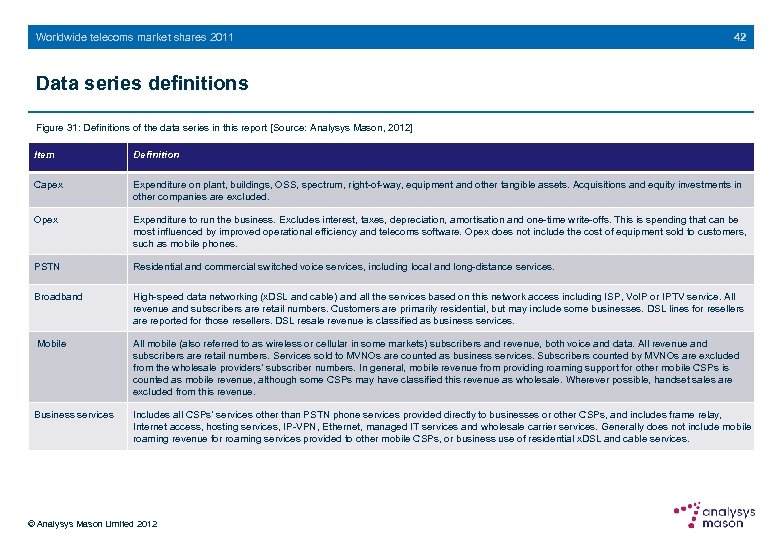 Worldwide telecoms market shares 2011 42 Data series definitions Figure 31: Definitions of the data series in this report [Source: Analysys Mason, 2012] Item Definition Capex Expenditure on plant, buildings, OSS, spectrum, right-of-way, equipment and other tangible assets. Acquisitions and equity investments in other companies are excluded. Opex Expenditure to run the business. Excludes interest, taxes, depreciation, amortisation and one-time write-offs. This is spending that can be most influenced by improved operational efficiency and telecoms software. Opex does not include the cost of equipment sold to customers, such as mobile phones. PSTN Residential and commercial switched voice services, including local and long-distance services. Broadband High-speed data networking (x. DSL and cable) and all the services based on this network access including ISP, Vo. IP or IPTV service. All revenue and subscribers are retail numbers. Customers are primarily residential, but may include some businesses. DSL lines for resellers are reported for those resellers. DSL resale revenue is classified as business services. Mobile All mobile (also referred to as wireless or cellular in some markets) subscribers and revenue, both voice and data. All revenue and subscribers are retail numbers. Services sold to MVNOs are counted as business services. Subscribers counted by MVNOs are excluded from the wholesale providers’ subscriber numbers. In general, mobile revenue from providing roaming support for other mobile CSPs is counted as mobile revenue, although some CSPs may have classified this revenue as wholesale. Wherever possible, handset sales are excluded from this revenue. Business services Includes all CSPs’ services other than PSTN phone services provided directly to businesses or other CSPs, and includes frame relay, Internet access, hosting services, IP-VPN, Ethernet, managed IT services and wholesale carrier services. Generally does not include mobile roaming revenue for roaming services provided to other mobile CSPs, or business use of residential x. DSL and cable services. © Analysys Mason Limited 2012
 Worldwide telecoms market shares 2011 Executive summary and recommendations Market shares Market definition About the authors and Analysys Mason © Analysys Mason Limited 2012 43
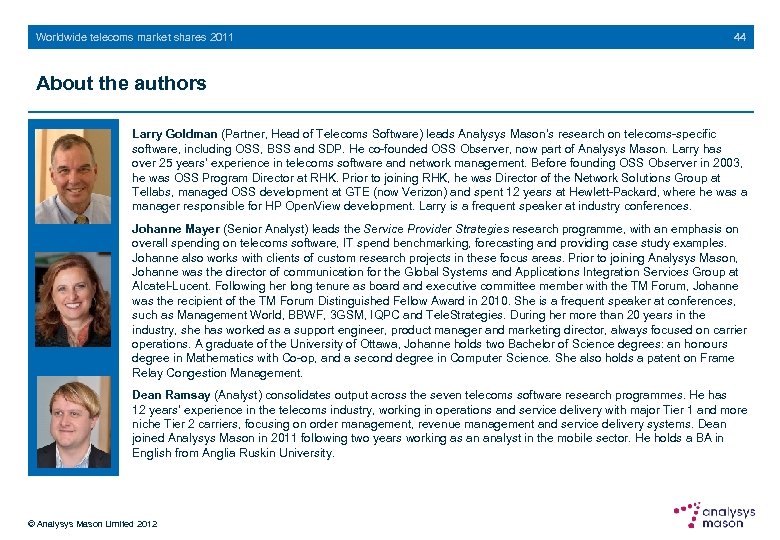 Worldwide telecoms market shares 2011 44 About the authors Larry Goldman (Partner, Head of Telecoms Software) leads Analysys Mason’s research on telecoms-specific software, including OSS, BSS and SDP. He co-founded OSS Observer, now part of Analysys Mason. Larry has over 25 years’ experience in telecoms software and network management. Before founding OSS Observer in 2003, he was OSS Program Director at RHK. Prior to joining RHK, he was Director of the Network Solutions Group at Tellabs, managed OSS development at GTE (now Verizon) and spent 12 years at Hewlett-Packard, where he was a manager responsible for HP Open. View development. Larry is a frequent speaker at industry conferences. Johanne Mayer (Senior Analyst) leads the Service Provider Strategies research programme, with an emphasis on overall spending on telecoms software, IT spend benchmarking, forecasting and providing case study examples. Johanne also works with clients of custom research projects in these focus areas. Prior to joining Analysys Mason, Johanne was the director of communication for the Global Systems and Applications Integration Services Group at Alcatel-Lucent. Following her long tenure as board and executive committee member with the TM Forum, Johanne was the recipient of the TM Forum Distinguished Fellow Award in 2010. She is a frequent speaker at conferences, such as Management World, BBWF, 3 GSM, IQPC and Tele. Strategies. During her more than 20 years in the industry, she has worked as a support engineer, product manager and marketing director, always focused on carrier operations. A graduate of the University of Ottawa, Johanne holds two Bachelor of Science degrees: an honours degree in Mathematics with Co-op, and a second degree in Computer Science. She also holds a patent on Frame Relay Congestion Management. Dean Ramsay (Analyst) consolidates output across the seven telecoms software research programmes. He has 12 years’ experience in the telecoms industry, working in operations and service delivery with major Tier 1 and more niche Tier 2 carriers, focusing on order management, revenue management and service delivery systems. Dean joined Analysys Mason in 2011 following two years working as an analyst in the mobile sector. He holds a BA in English from Anglia Ruskin University. © Analysys Mason Limited 2012
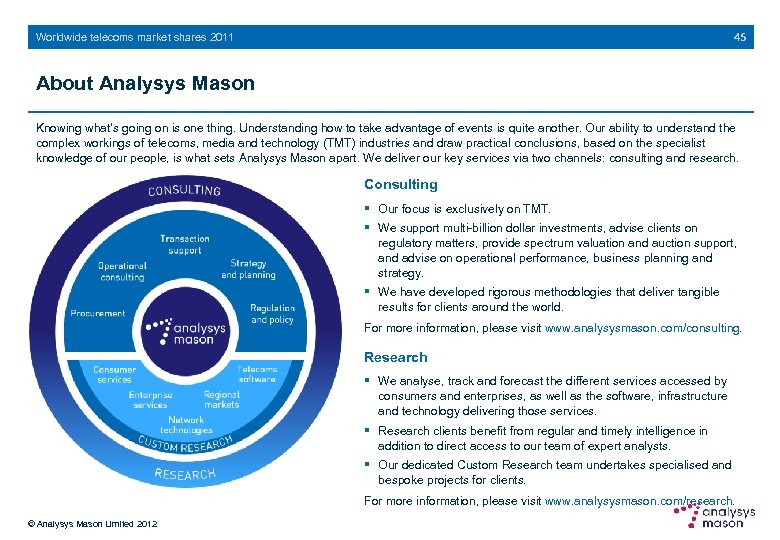 45 Worldwide telecoms market shares 2011 About Analysys Mason Knowing what’s going on is one thing. Understanding how to take advantage of events is quite another. Our ability to understand the complex workings of telecoms, media and technology (TMT) industries and draw practical conclusions, based on the specialist knowledge of our people, is what sets Analysys Mason apart. We deliver our key services via two channels: consulting and research. Consulting § Our focus is exclusively on TMT. § We support multi-billion dollar investments, advise clients on regulatory matters, provide spectrum valuation and auction support, and advise on operational performance, business planning and strategy. § We have developed rigorous methodologies that deliver tangible results for clients around the world. For more information, please visit www. analysysmason. com/consulting. Research § We analyse, track and forecast the different services accessed by consumers and enterprises, as well as the software, infrastructure and technology delivering those services. § Research clients benefit from regular and timely intelligence in addition to direct access to our team of expert analysts. § Our dedicated Custom Research team undertakes specialised and bespoke projects for clients. For more information, please visit www. analysysmason. com/research. © Analysys Mason Limited 2012
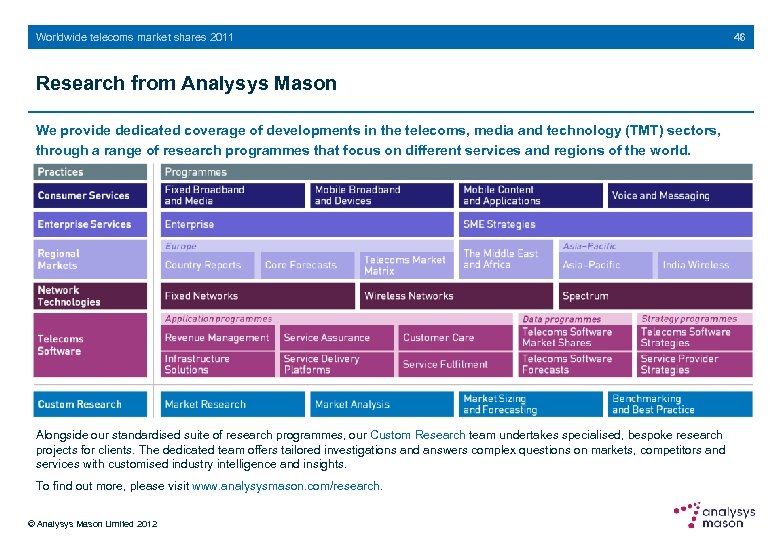 Worldwide telecoms market shares 2011 Research from Analysys Mason We provide dedicated coverage of developments in the telecoms, media and technology (TMT) sectors, through a range of research programmes that focus on different services and regions of the world. Alongside our standardised suite of research programmes, our Custom Research team undertakes specialised, bespoke research projects for clients. The dedicated team offers tailored investigations and answers complex questions on markets, competitors and services with customised industry intelligence and insights. To find out more, please visit www. analysysmason. com/research. © Analysys Mason Limited 2012 46
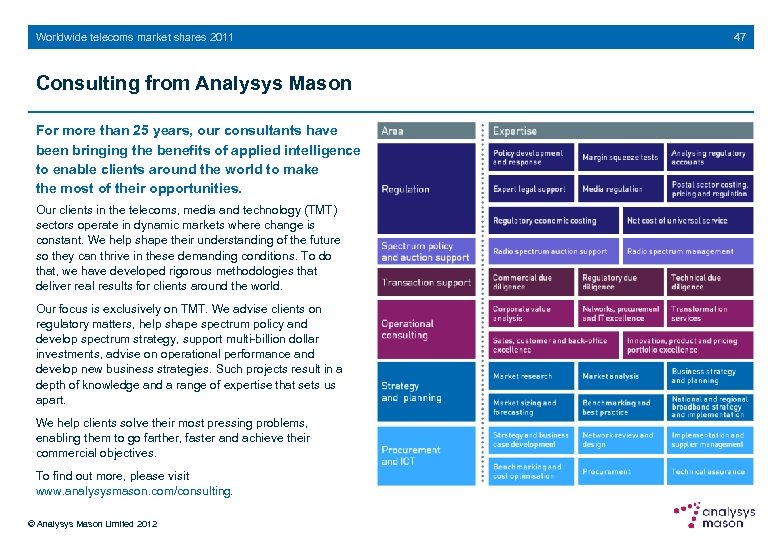 Worldwide telecoms market shares 2011 Consulting from Analysys Mason For more than 25 years, our consultants have been bringing the benefits of applied intelligence to enable clients around the world to make the most of their opportunities. Our clients in the telecoms, media and technology (TMT) sectors operate in dynamic markets where change is constant. We help shape their understanding of the future so they can thrive in these demanding conditions. To do that, we have developed rigorous methodologies that deliver real results for clients around the world. Our focus is exclusively on TMT. We advise clients on regulatory matters, help shape spectrum policy and develop spectrum strategy, support multi-billion dollar investments, advise on operational performance and develop new business strategies. Such projects result in a depth of knowledge and a range of expertise that sets us apart. We help clients solve their most pressing problems, enabling them to go farther, faster and achieve their commercial objectives. To find out more, please visit www. analysysmason. com/consulting. © Analysys Mason Limited 2012 47
 Worldwide telecoms market shares 2011 Published by Analysys Mason Limited • Bush House • North West Wing • Aldwych • London • WC 2 B 4 PJ • UK Tel: +44 (0)845 600 5244 • Fax: +44 (0)845 528 0760 • Email: research@analysysmason. com • www. analysysmason. com/research • Registered in England No. 5177472 © Analysys Mason Limited 2012. All rights reserved. No part of this publication may be reproduced, stored in a retrieval system or transmitted in any form or by any means – electronic, mechanical, photocopying, recording or otherwise – without the prior written permission of the publisher. Figures and projections contained in this report are based on publicly available information only and are produced by the Research Division of Analysys Mason Limited independently of any clientspecific work within Analysys Mason Limited. The opinions expressed are those of the stated authors only. Analysys Mason Limited recognises that many terms appearing in this report are proprietary; all such trademarks are acknowledged and every effort has been made to indicate them by the normal UK publishing practice of capitalisation. However, the presence of a term, in whatever form, does not affect its legal status as a trademark. Analysys Mason Limited maintains that all reasonable care and skill have been used in the compilation of this publication. However, Analysys Mason Limited shall not be under any liability for loss or damage (including consequential loss) whatsoever or howsoever arising as a result of the use of this publication by the customer, his servants, agents or any third party. © Analysys Mason Limited 2012