


 Скачать презентацию World Wide Fund for Nature Has executed The
World Wide Fund for Nature.pptx
- Количество слайдов: 6
 World Wide Fund for Nature Has executed The student l-B groups Gazda Sofia
 The World Wide Fund for Nature (WWF) is an international nongovernmental organization founded on April 29, 1961, and is working on issues regarding the conservation, research and restoration of the environment. It was formerly named the World Wildlife Fund, which remains its official name in Canada and the United States. It is the world's largest conservation organization with over 5 million supporters worldwide, working in more than 100 countries, supporting around 1, 300 conservation and environmental projects.
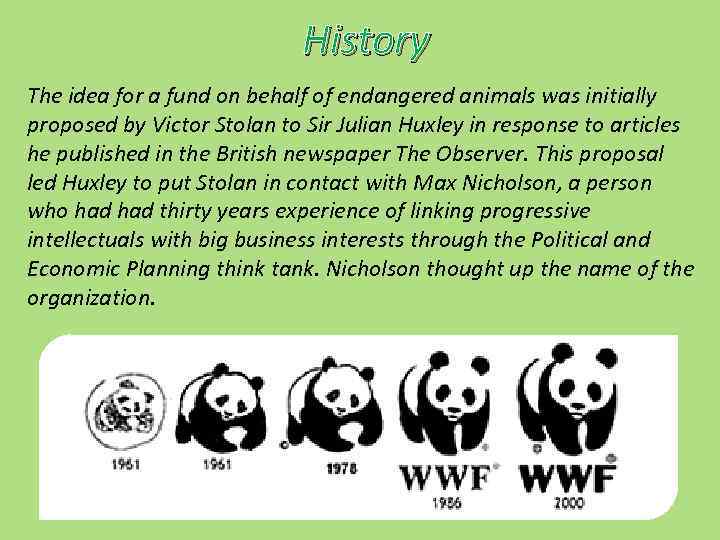 History The idea for a fund on behalf of endangered animals was initially proposed by Victor Stolan to Sir Julian Huxley in response to articles he published in the British newspaper The Observer. This proposal led Huxley to put Stolan in contact with Max Nicholson, a person who had thirty years experience of linking progressive intellectuals with big business interests through the Political and Economic Planning think tank. Nicholson thought up the name of the organization.
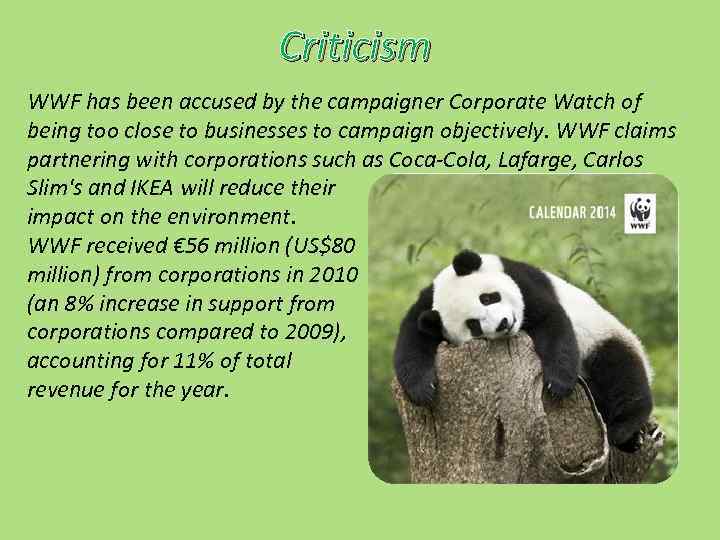
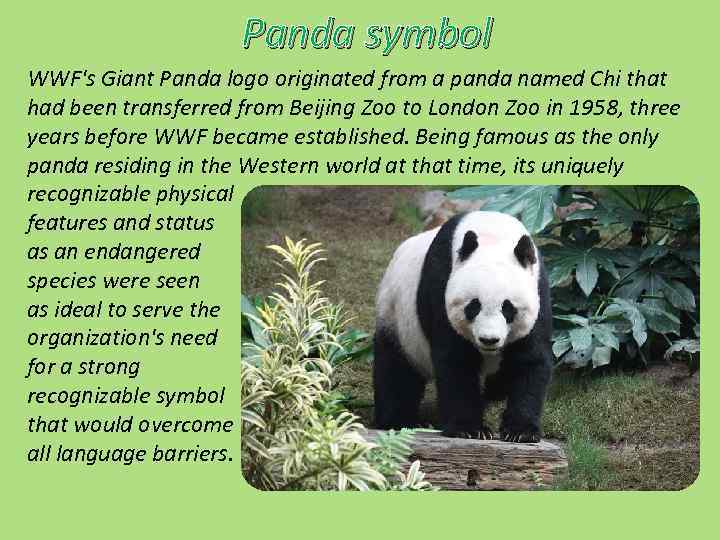 Panda symbol WWF's Giant Panda logo originated from a panda named Chi that had been transferred from Beijing Zoo to London Zoo in 1958, three years before WWF became established. Being famous as the only panda residing in the Western world at that time, its uniquely recognizable physical features and status as an endangered species were seen as ideal to serve the organization's need for a strong recognizable symbol that would overcome all language barriers.
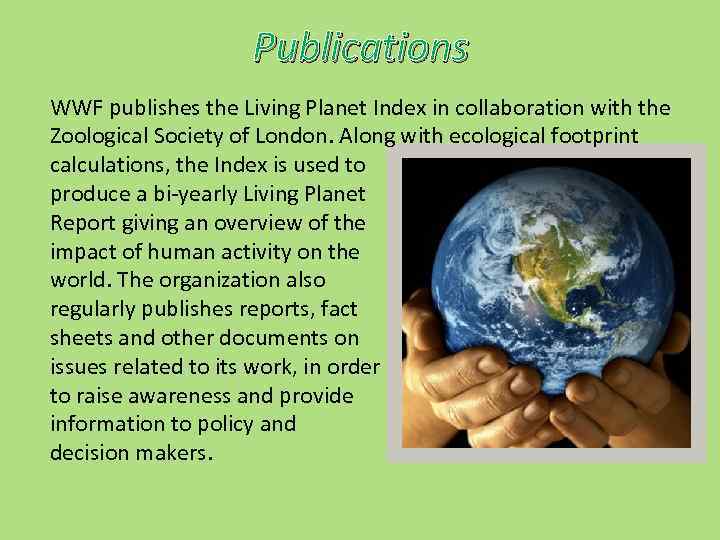 Publications WWF publishes the Living Planet Index in collaboration with the Zoological Society of London. Along with ecological footprint calculations, the Index is used to produce a bi-yearly Living Planet Report giving an overview of the impact of human activity on the world. The organization also regularly publishes reports, fact sheets and other documents on issues related to its work, in order to raise awareness and provide information to policy and decision makers.
 Criticism WWF has been accused by the campaigner Corporate Watch of being too close to businesses to campaign objectively. WWF claims partnering with corporations such as Coca-Cola, Lafarge, Carlos Slim's and IKEA will reduce their impact on the environment. WWF received € 56 million (US$80 million) from corporations in 2010 (an 8% increase in support from corporations compared to 2009), accounting for 11% of total revenue for the year.