


 Скачать презентацию World Water Day 22 March World Water Day
091222eda51ad85cf1c1285438aadbe8.ppt
- Количество слайдов: 68
 World Water Day 22 March World Water Day is an annual event celebrated on March 22. The day focuses attention on the importance of fresh water and advocates for the sustainable management of freshwater resources. World Water Day is also used to highlight required improvements for access to WASH (water, sanitation, hygiene) facilities in developing countries.
 જળ aej જ વન SAVE DRINKING WATER AS PRECIOUS COMMODITY
 Sustainable Development Goal (SDG) target requires us by 2030 to ” Improve water quality by reducing pollution, eliminating dumping and minimizing release of hazardous chemicals and materials, having the proportion of untreated wastewater and substantially increasing re-cycling and safe re-use globally”. DUAL PLUMBING SYSTEM & RECYCLING OF GRAY WATER IN HOMES : Presentation by : J. B. Kagathara (ME Environment) LFIWWA, MIAEM NEERI, MIWA(London) Ex. Special City Engineer RMC & Consultant
 DUAL PLUMBING SYSTEM & RECYCLING OF GRAY WATER IN HOMES An Approach to lower down consumption of water supply & Reduce Pollution load in Urban
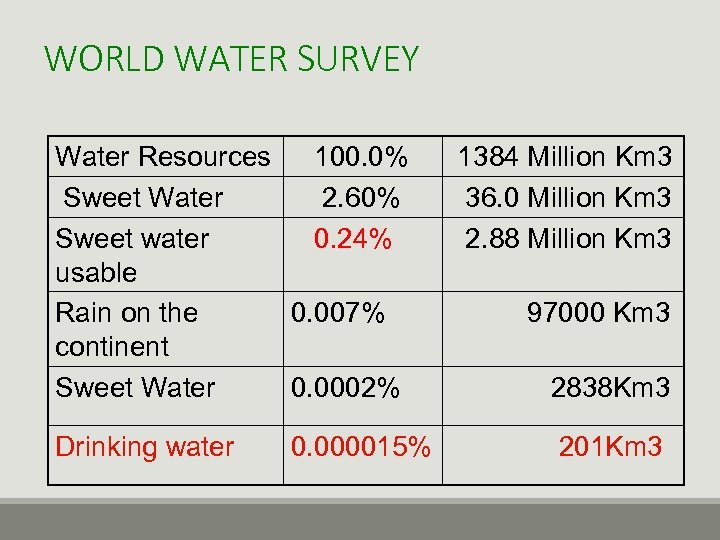 WORLD WATER SURVEY Water Resources Sweet Water Sweet water usable Rain on the continent Sweet Water 100. 0% 1384 Million Km 3 2. 60% 36. 0 Million Km 3 0. 24% 2. 88 Million Km 3 Drinking water 0. 000015% 201 Km 3 0. 007% 97000 Km 3 0. 0002% 2838 Km 3
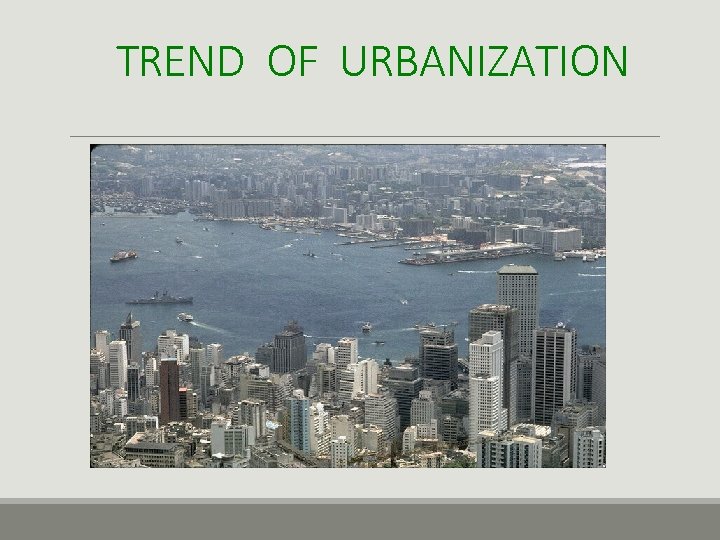 TREND OF URBANIZATION
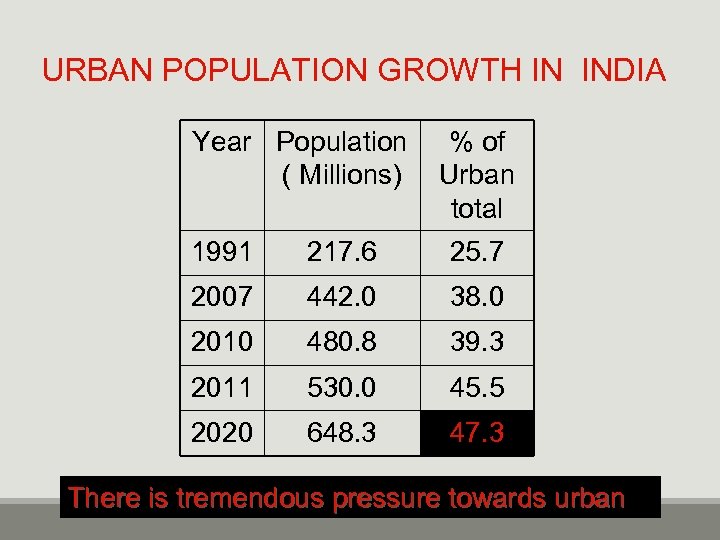 URBAN POPULATION GROWTH IN INDIA Year Population % of ( Millions) Urban total 1991 217. 6 25. 7 2007 442. 0 38. 0 2010 480. 8 39. 3 2011 530. 0 45. 5 2020 648. 3 47. 3 There is tremendous pressure towards urban
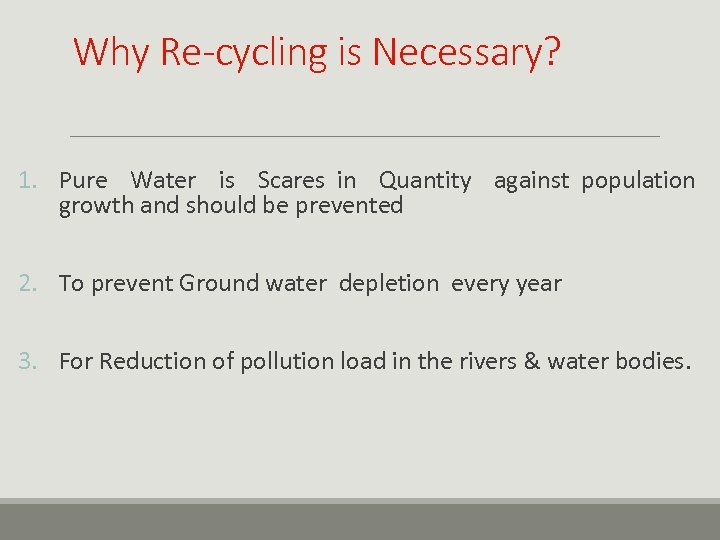 Why Re-cycling is Necessary? 1. Pure Water is Scares in Quantity against population growth and should be prevented 2. To prevent Ground water depletion every year 3. For Reduction of pollution load in the rivers & water bodies.
 What we can do? Proper Re- charging of rain water Water conservation concept to be adopted & people should have to change their habits /mindsets for wasting of water during domestic use in their homes. Leak detection & prevention program should be implemented by Govt. agencies. Hotels, public buildings etc should have to use such techniques for controlled use of water. Re-cycling concept should be adopted largely and promote such rules & regulations
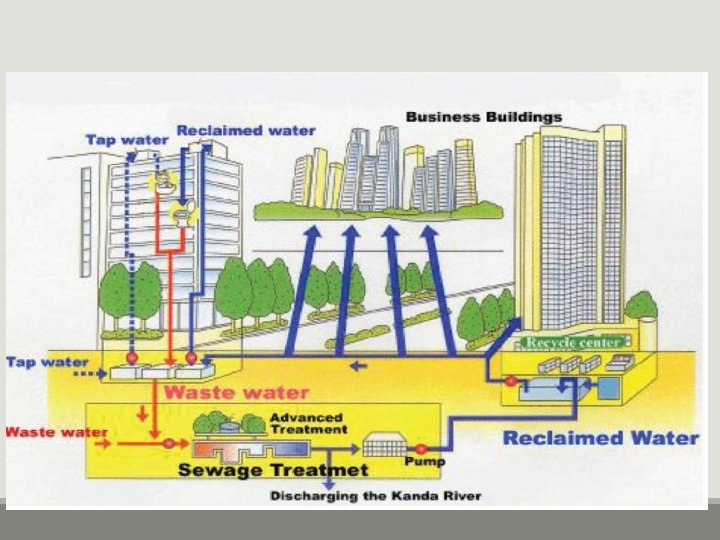
 Recycling-Reuse of water offers great possibilities of saving fresh / drinking water in mass quantity Treated wastewater can be used for following purposes 1. Irrigation 2. Gardening , Plantation , Floor washing 3. Toilet Flushing 4. Cooling, Construction activities (other than concreting ) 5. In air conditioning system 6. As boiler feed water for boilers 7. As process water for industries depending upon required degree of treatment
 Classification of Domestic wastewater/Sewage from household IN ORDER TO PROPERLY TREAT WASTEWATER, IT IS ESSENTIAL TO UNDERSTAND THE NATURE OF THE WASTEWATER. THERE ARE 4 BROAD TYPES OF WASTEWATER FROM THE HOUSEHOLD, WHICH CAN BE CHARACTERIZED AS FOLLOW. 1) GREY WATER : WASHING WATER FR OM KI TCHEN, BATHROOMS, LAUNDRY, ETC. WITHOU T F AECES AND URINE ( KITCHEN WATER CAN BE ELIMINATED TO REDUCE THE ORGANIC LOAD IN GREY WATER QUALITY) 2) BLACK WATER : WATER FROM FLUSH TOI LE TS (FAECES AND URINE WITH FLUSH WATER) 3) YELLOW W ATER : URI NE FROM SEPAR ATION TOILETS AND URINALS (WITH OR WITHOU T WATER FOR FL USHING) 4) BROWN W ATER : BLACK WATER W ITH OUT U RINE OR YELLOW WATER
 COMPOSITION OF GREYWATER 1. Greywater from Bathroom Water used in hand washing and bathing generates around 50 -60% of total greywater and is considered to be the least contaminated type of greywater. Common chemical contaminants include soap, shampoo, hair dye, toothpaste and cleaning products. It also has some faecal contamination and the associated bacteria and viruses through body washing.
 2. Greywater from Cloth Washing Water used in cloth washing generates around 25 -35% of total greywater. Wastewater from the cloth washing varies in quality from wash water to rinse water to second rinse water. Greywater generated due to cloth washing can have faecal contamination with the associated pathogens and parasites such as bacteria.
 3. Greywater from Kitchen greywater contributes about 10% of the total greywater volume. It is contaminated with food particles, oils, fats and other wastes. It readily promotes and supports the growth of micro-organisms. Kitchen greywater also contains chemical pollutants such as detergents and cleaning agents which are alkaline in nature and contain various chemicals. Therefore kitchen wastewater may not be well suited for reuse in all types of greywater systems.
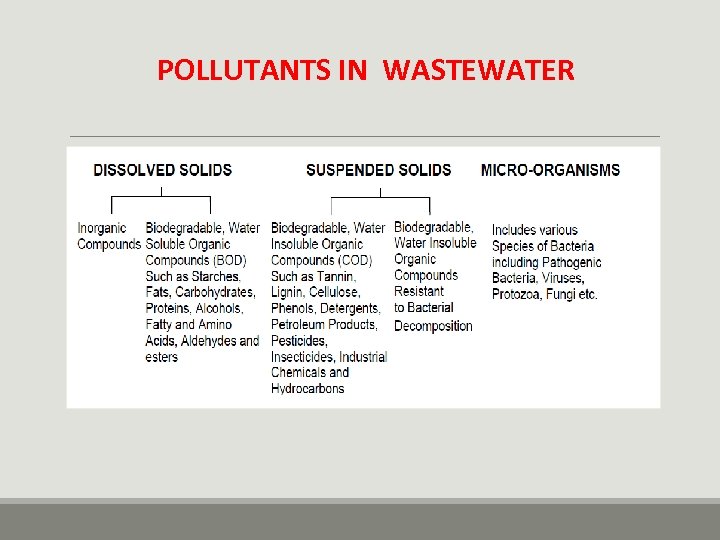 POLLUTANTS IN WASTEWATER
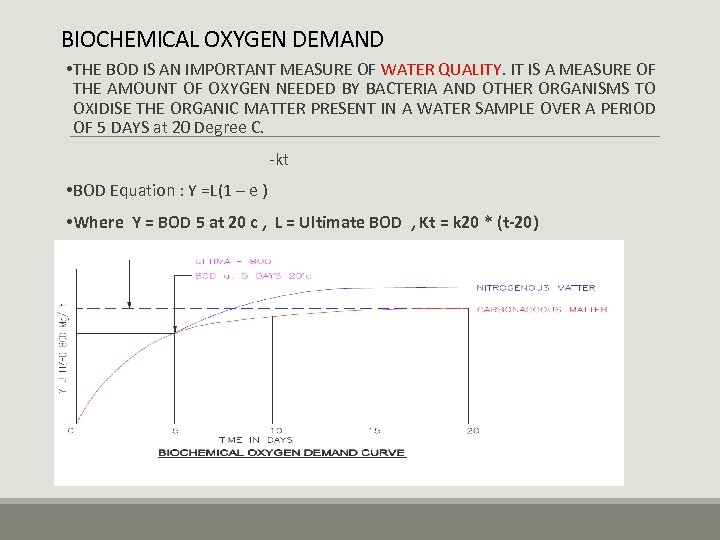 BIOCHEMICAL OXYGEN DEMAND • THE BOD IS AN IMPORTANT MEASURE OF WATER QUALITY. IT IS A MEASURE OF THE AMOUNT OF OXYGEN NEEDED BY BACTERIA AND OTHER ORGANISMS TO OXIDISE THE ORGANIC MATTER PRESENT IN A WATER SAMPLE OVER A PERIOD OF 5 DAYS at 20 Degree C. -kt • BOD Equation : Y =L(1 – e ) • Where Y = BOD 5 at 20 c , L = Ultimate BOD , Kt = k 20 * (t-20)
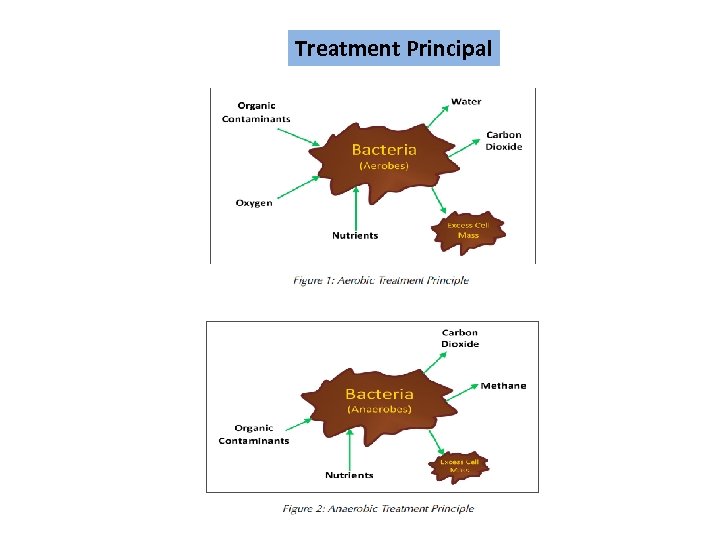 Treatment Principal
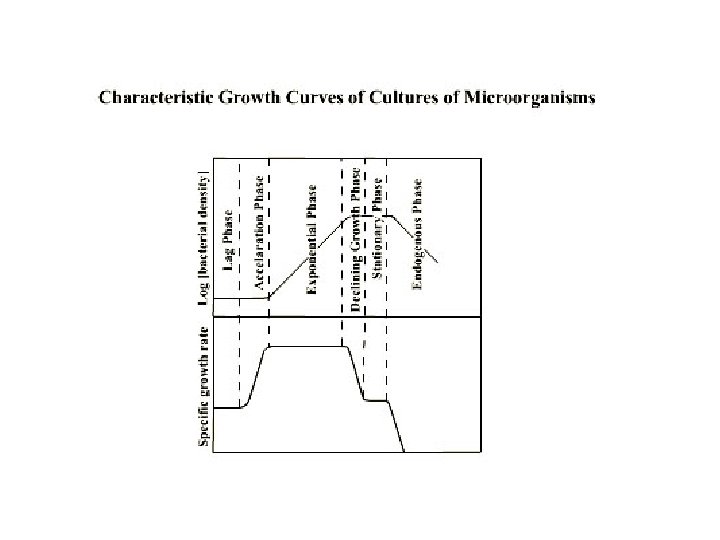
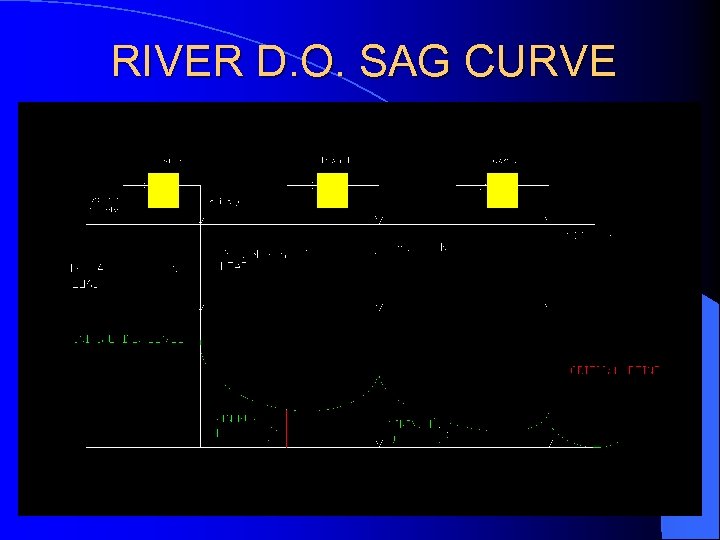 RIVER D. O. SAG CURVE
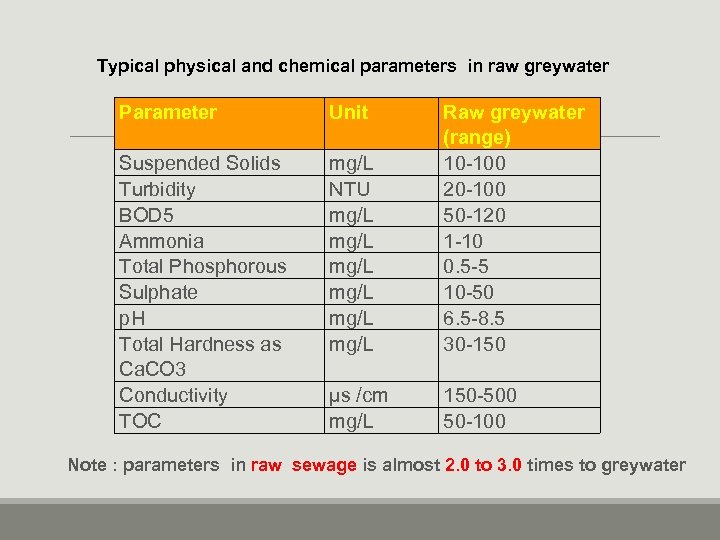 Typical physical and chemical parameters in raw greywater Parameter Unit Suspended Solids Turbidity BOD 5 Ammonia Total Phosphorous Sulphate p. H Total Hardness as Ca. CO 3 Conductivity TOC mg/L NTU mg/L mg/L Raw greywater (range) 10 -100 20 -100 50 -120 1 -10 0. 5 -5 10 -50 6. 5 -8. 5 30 -150 μs /cm mg/L 150 -500 50 -100 Note : parameters in raw sewage is almost 2. 0 to 3. 0 times to greywater
 Treatment of Gray water The recycling of low-load greywater is much easier and cost effective than other types of waste water. Simple low-cost treatment technologies can be applied for recycling it. Physical processes were preferred earlier. Now-a-days, combination of physical and chemical treatment or physical and biological treatment or combination of physical, chemical and biological treatment processes followed by disinfection unit is preferred.
 RE-CYCLING OF TREATED GRAY WATER IN HOMES For toilet flushing, Gardening, floor washing & Other secondary use purpose What is Recycling? Why it is Required?
 FRESH DRINKING WATER CAN BE SAVED IN URBAN IN LARGE QUANTITY BY PROVIDING RECHARGING OF RAIN WATER BY PROVIDING DOUBLE PLUMBING SYSTEM IN THE BUILDINGS FOR RE-CYCLING IS ONLY POSSIBLE IF BUILDING HAS DOUBLE PLUMBING SYSTEM
 USE OF WATER FOR DOMESTIC PURPOSE IN URBAN 1. 2. 3. 4. 5. 6. 7. Drinking purpose 3. 0 lit / person / day Kitchen-Cooking 10. 0 , , Bathing 45. 0 , , Flushing / Cleaning 40. 0 , , Washing of cloths 30. 0 , , Other Misc purpose 07. 0 , , Total Requirement /person/day = 135 Lit 8. Adnl. Burden as Domestic RO is used now a days in most of the houses. Reject water = 20 to 25 Litres / house /day.
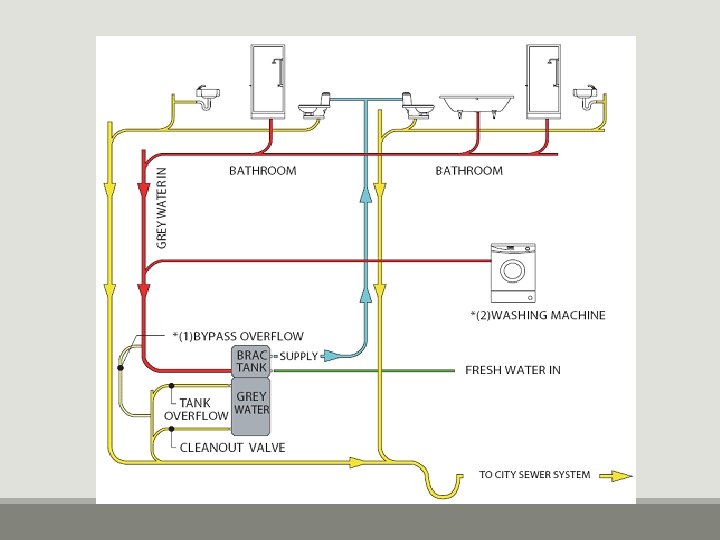
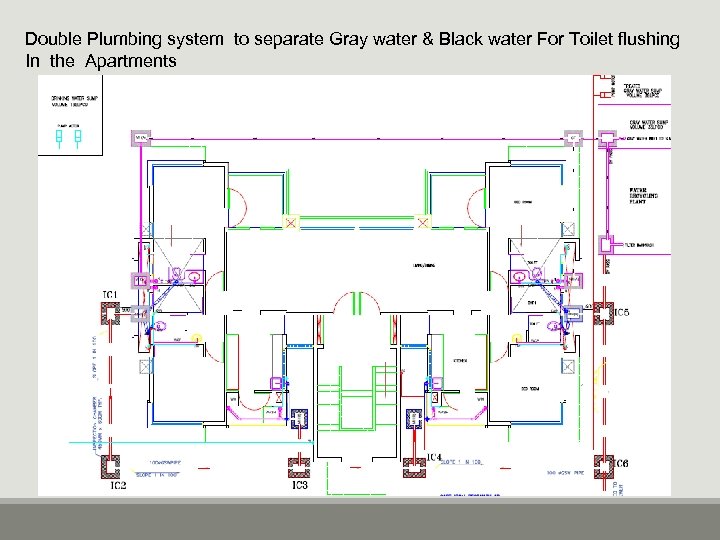 Double Plumbing system to separate Gray water & Black water For Toilet flushing In the Apartments
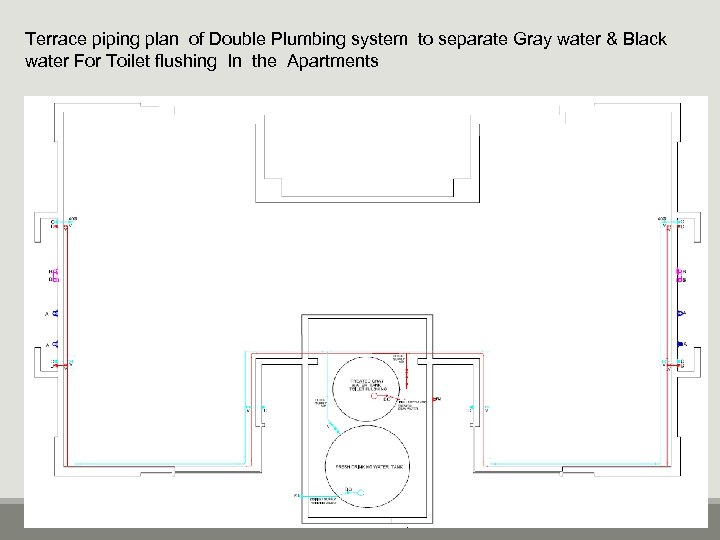 Terrace piping plan of Double Plumbing system to separate Gray water & Black water For Toilet flushing In the Apartments
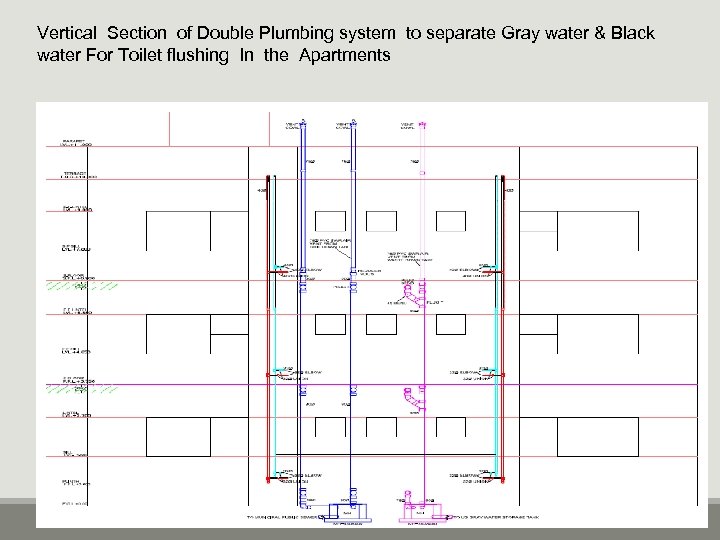 Vertical Section of Double Plumbing system to separate Gray water & Black water For Toilet flushing In the Apartments
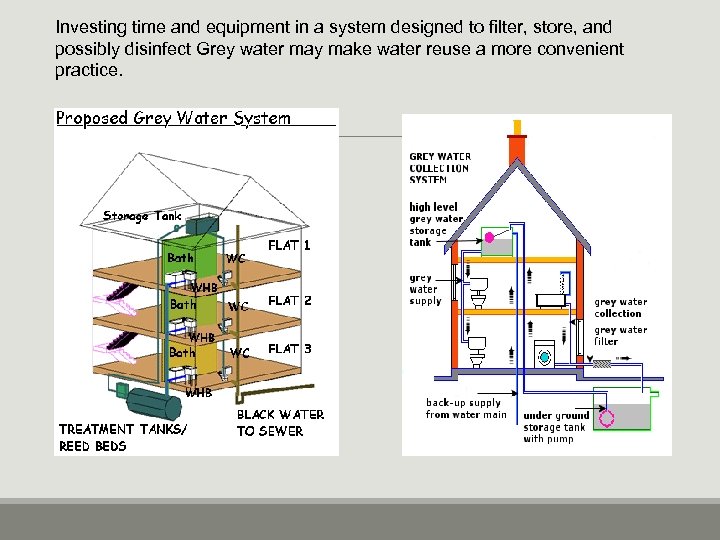 Investing time and equipment in a system designed to filter, store, and possibly disinfect Grey water may make water reuse a more convenient practice.
 Re cycling of Gray Water as Flushing of Toilets in Housing Complex 1. All Bathing water Gray water) can be collected separately by separate plumbing & collected at GF in separate tank. ( DUAL PLUMBING ) 2. Flushing supply pipeline can be separated completely from terrace providing additional tank of suitable capacity 3. A suitable re-cycling plant having screen, settling tank and filter domestically made can be sufficient without Complicated Biological Plant. • SUCH PROCESS WILL SAVE ATLEAST OF 30% OF PORTABLE DRINKING WATER QUANTITY IN URBAN SECTOR • LEGISLATION OR ADDITION IN BUILDING BYLAWS FOR RE_CYCLING & DOUBLE PLUMBING IN THE NEW CONSTRUCTION SHOULE BE APPLIED & SHOULD BE FULLY GUIDED BY THE AUTUORITY / MUNICIPAL CORPORATION • Govt. Of Gujarat has made an amendment in their GDCR for inclusion of double plumbing system and use of grey water after simple treatment of filtration should be adopted and implemented.
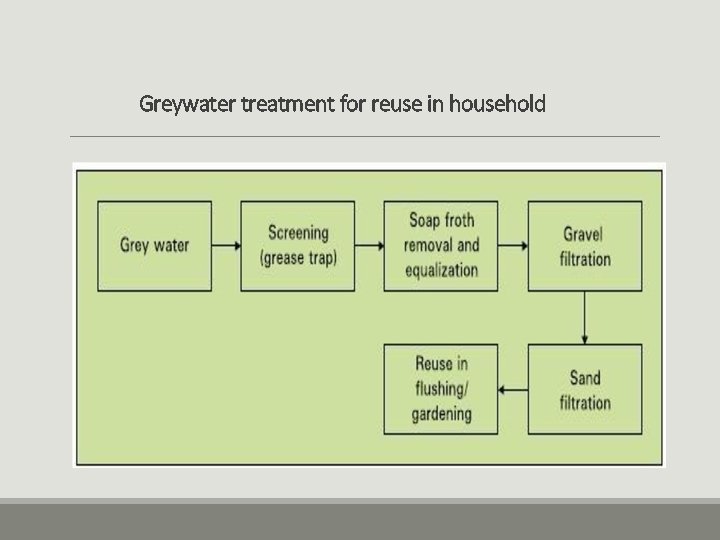 Greywater treatment for reuse in household
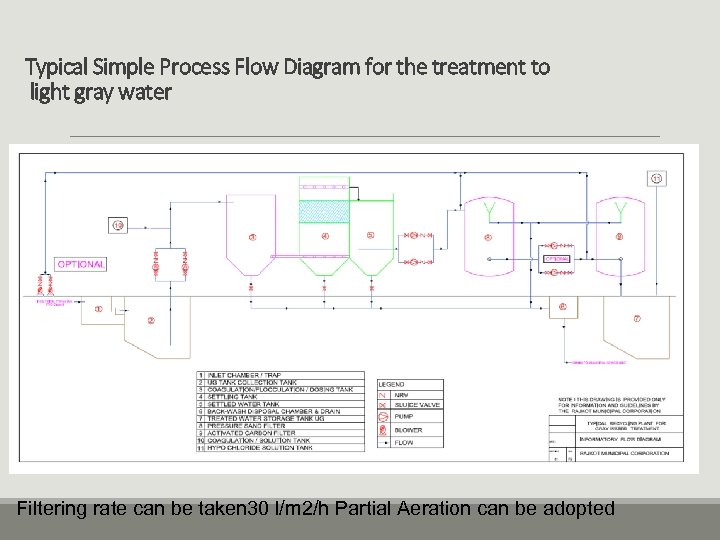 Typical Simple Process Flow Diagram for the treatment to light gray water Filtering rate can be taken 30 l/m 2/h Partial Aeration can be adopted
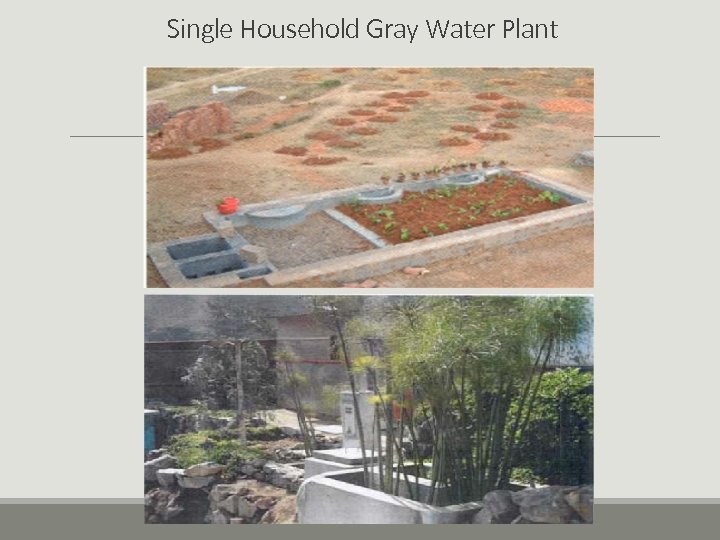 Single Household Gray Water Plant
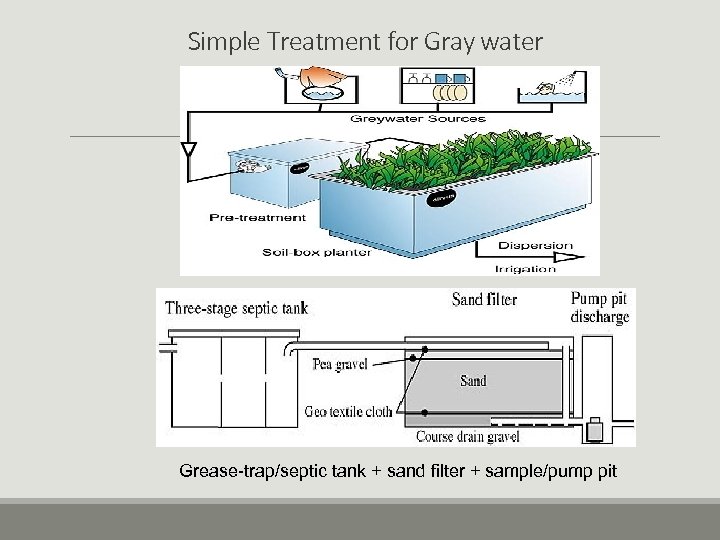 Simple Treatment for Gray water Grease-trap/septic tank + sand filter + sample/pump pit
 Grey water recycling system includes process of collecting Grey water, removing the large suspended particles / debris, aeration or freshening, filtration and ‘polishing’ to get it to Class A standard, which is required for indoor home usage. As the composition of greywater is different to domestic wastewater in terms of organics, nutrients and microbiological contamination; the required level of treatment to use it for toilet flushing and garden irrigation is not high
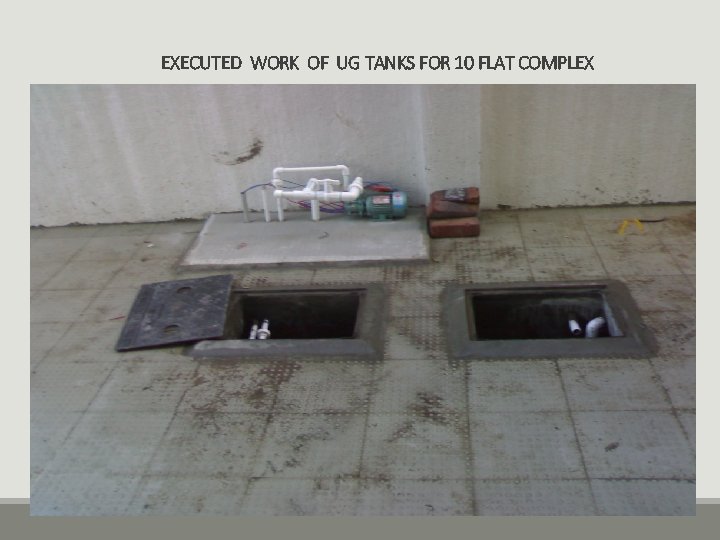 EXECUTED WORK OF UG TANKS FOR 10 FLAT COMPLEX
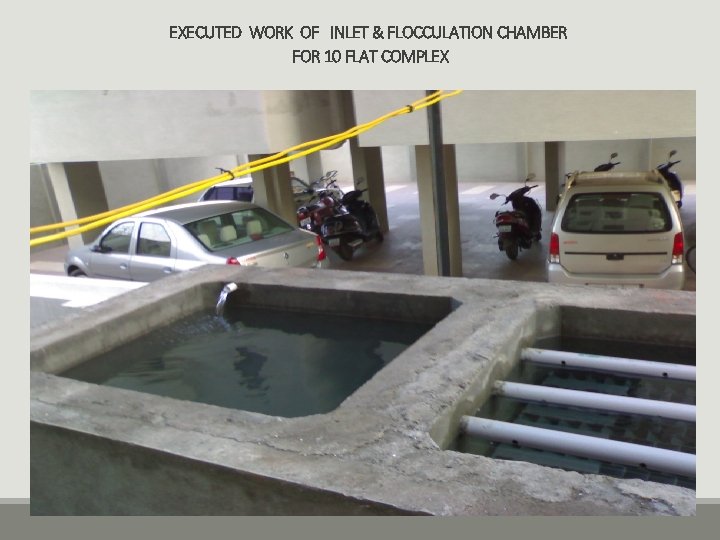 EXECUTED WORK OF INLET & FLOCCULATION CHAMBER FOR 10 FLAT COMPLEX
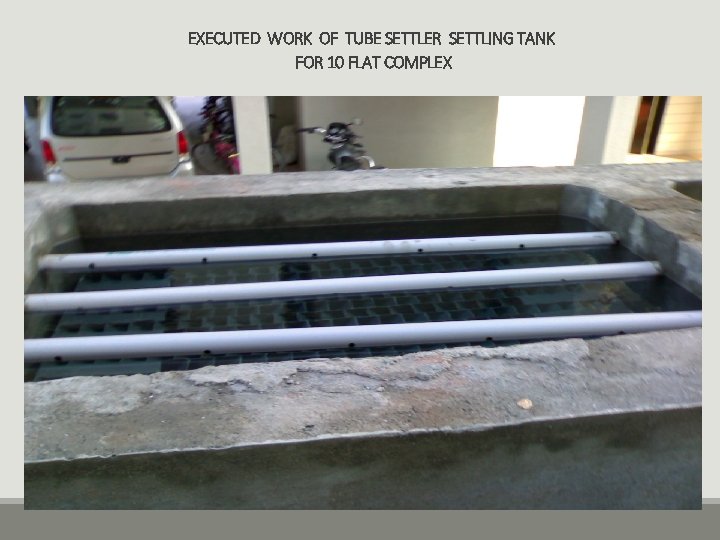 EXECUTED WORK OF TUBE SETTLER SETTLING TANK FOR 10 FLAT COMPLEX
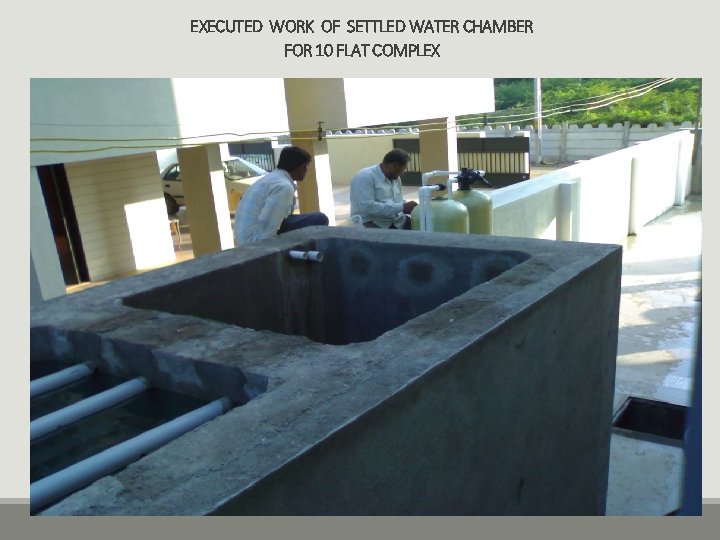 EXECUTED WORK OF SETTLED WATER CHAMBER FOR 10 FLAT COMPLEX
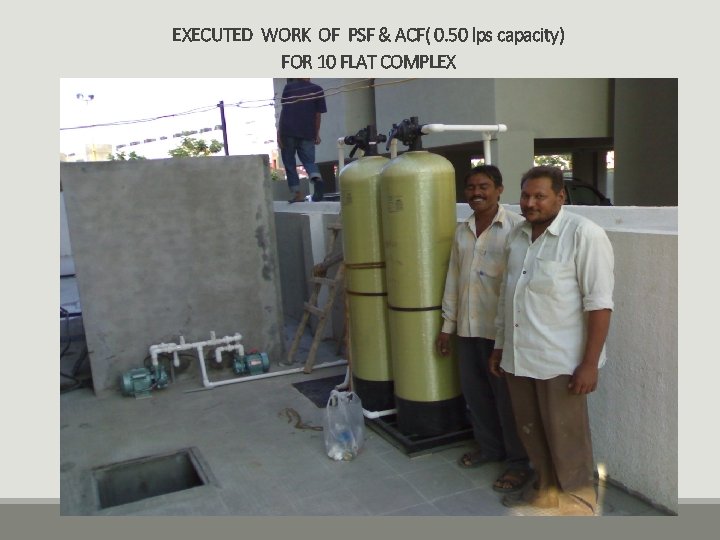 EXECUTED WORK OF PSF & ACF( 0. 50 lps capacity) FOR 10 FLAT COMPLEX
 Operation & Maintenance Before plant put in to operation, Check whole plumbing system drawings at site to avoid contamination any. • Periodical cleaning of grease & oil trap, filters and tanks • Gravels and sand from the filtration unit need to be washed periodically • Sedimentation tanks require de-sludging every month. • Plumbing pipeline maps/drawings shall be kept on site for the reference any. • Pumps, motors, foot valves etc. to be checked periodically. • Do not store Treated Gray Water more than 24 hours. Keep chemicals storage minimum for one month.
 CPHEEO MANUAL 2013 PART- A ENGINEERING CHAPTER 7: RECYCLING AND REUSE OF SEWAGE With 80 countries and 40% of the world’s population facing chronic water problems and with the demand for water doubling every two decades, these extracts mentioned above merit action. The largest source of reuse resides in agriculture and the equally largest misplaced resource is sewage in the habitations. In the “Handbook on Service Level Benchmarking” by Mo. UD, reuse and recycling of sewage is defined as the percentage of sewage recycled or reused after appropriate treatment in gardens and parks, irrigation, etc. and, is to be at least 20% to begin with. The objective of this chapter is to bring out guiding principles for practice in India.
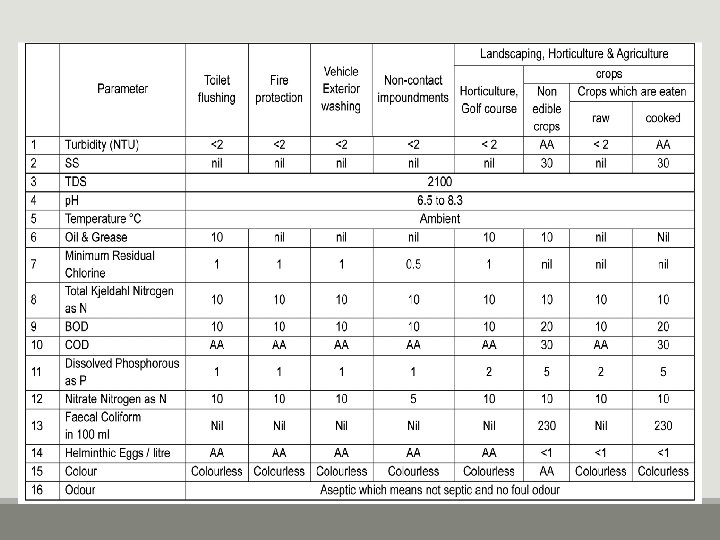
 Amendment required in CPHEEO Manual 2013 for Gray water CPHEEO Manual on sewerage and sewage treatment Part-A Engineering, Chapter – 07 which is covered with Re-cycling & re-use of treated sewage. This is giving encouragement to this country for saving of fresh water. However to use Re-cycling of gray water, criteria shall be required in place of treated sewage re-cycling which are fixed in Table. No. 7 -19. Page -7 -52, Which are too high for , TOILET FLUSHING , FIRE PROTECTION, WHICLE EXTERIOR WASHING, NON CONTACT IMPOUNDMENTS. Some practical adoption which is really needed is required by Adding GRAY WATER Quality and its Treatment with fixing its criteria for its secondary use purpose. This is required because, nobody has focused this gray water source providing less physical & biological treatment for its Re-use in domestic sector.
 Cost Aspects for Dual Plumbing 1. Plumbing cost is generally estimated to 3. 0% the building project cost which will increase only 30% i. e. 3. 90% will be the cost for DUAL PLUMBING. 2. Re-Cycling plant can be installed with domestic equipments & no expert technology is required. Also, not necessary / compulsion to apply in the initial stage of implementation of double plumbing system. 3. Such type of Re-cycling Plant for treating Gray water is very simple, maintenance free, operated by un skilled person. Total information is available on various manufacturer’s web or can be provided by the authority. 4. Re-Cycling Plant is desirable & Very small space is required.
 Cost Aspects for Re-Cycling Plant 1. Cost of Plant for 05 to 10 Flats can be installed within very nominal cost about Rs. 2. 0 to 2. 50 lakh. Break-up of Component costs are available and components readily available in the local market. ( Market rate year 2012) 1. With in three years of operation, capital investment will be recovered & start to generate income as saving of Fresh Drinking Water in quantity. 2. Very useful in housing complex , hotels, public buildings etc. 3. Cost of double plumbing is very nominal against capital investment of building, which will increase the life of building as no changes required afterwards. 4. Vertical Plumbing pipelines shall be kept away from the walls on brackets.
 An Example Consider a group of 10 Flat holders. 10 flats consumption /day = 135 lpcd x 10 x 5 =6750 liters/day. Cost of re-cycling plant ( settling, filtration & Disinfection ) for 10 flat including civil works = Rs. 2, 000. Per Flat capital cost = Rs 20, 000. 00 For filtration, only 1. 5 HP power of total small motors to run for 2. 5 Hours in a day + Chemicals. Therefore, O & M of filtration including electricity for 10 flats plant = 700/- per month. Per flat / month = Rs. 70/- per year x 10 flats = Rs. 700/- ( Rs. 8400/- for building /year)
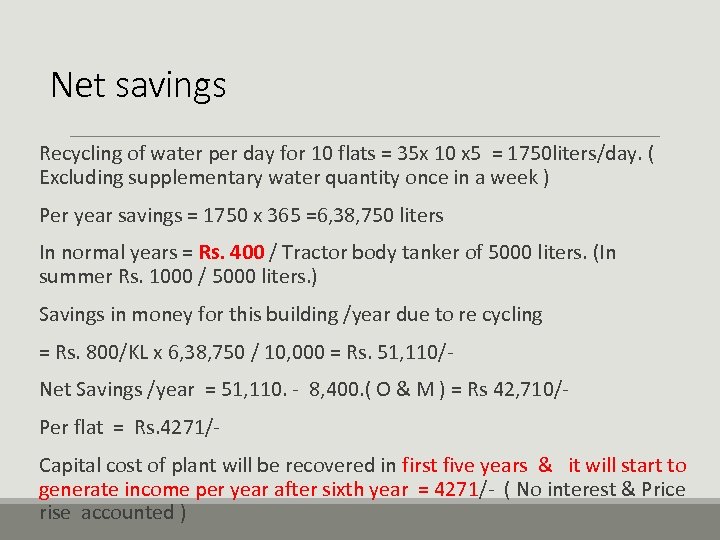 Net savings Recycling of water per day for 10 flats = 35 x 10 x 5 = 1750 liters/day. ( Excluding supplementary water quantity once in a week ) Per year savings = 1750 x 365 =6, 38, 750 liters In normal years = Rs. 400 / Tractor body tanker of 5000 liters. (In summer Rs. 1000 / 5000 liters. ) Savings in money for this building /year due to re cycling = Rs. 800/KL x 6, 38, 750 / 10, 000 = Rs. 51, 110/- Net Savings /year = 51, 110. - 8, 400. ( O & M ) = Rs 42, 710/ Per flat = Rs. 4271/ Capital cost of plant will be recovered in first five years & it will start to generate income per year after sixth year = 4271/- ( No interest & Price rise accounted )
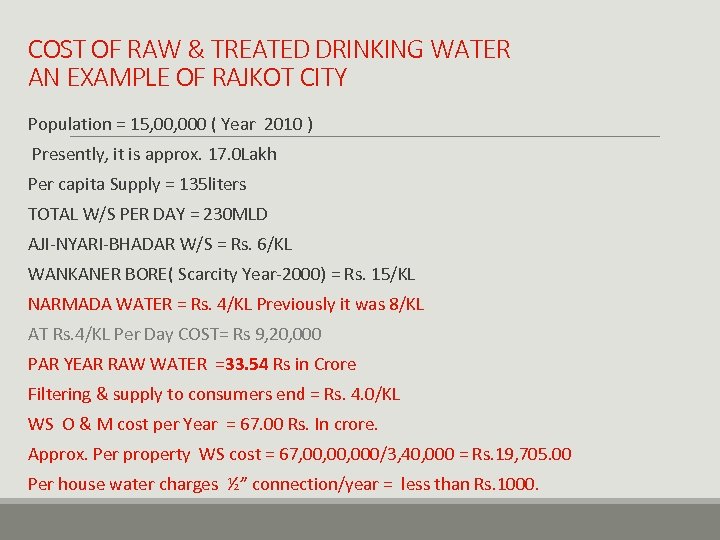 COST OF RAW & TREATED DRINKING WATER AN EXAMPLE OF RAJKOT CITY Population = 15, 000 ( Year 2010 ) Presently, it is approx. 17. 0 Lakh Per capita Supply = 135 liters TOTAL W/S PER DAY = 230 MLD AJI-NYARI-BHADAR W/S = Rs. 6/KL WANKANER BORE( Scarcity Year-2000) = Rs. 15/KL NARMADA WATER = Rs. 4/KL Previously it was 8/KL AT Rs. 4/KL Per Day COST= Rs 9, 20, 000 PAR YEAR RAW WATER =33. 54 Rs in Crore Filtering & supply to consumers end = Rs. 4. 0/KL WS O & M cost per Year = 67. 00 Rs. In crore. Approx. Per property WS cost = 67, 00, 000/3, 40, 000 = Rs. 19, 705. 00 Per house water charges ½” connection/year = less than Rs. 1000.
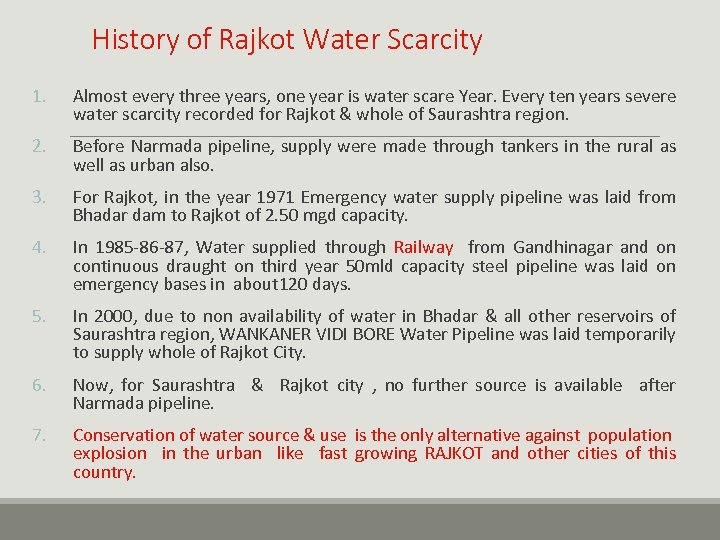 History of Rajkot Water Scarcity 1. Almost every three years, one year is water scare Year. Every ten years severe water scarcity recorded for Rajkot & whole of Saurashtra region. 2. Before Narmada pipeline, supply were made through tankers in the rural as well as urban also. 3. For Rajkot, in the year 1971 Emergency water supply pipeline was laid from Bhadar dam to Rajkot of 2. 50 mgd capacity. 4. In 1985 -86 -87, Water supplied through Railway from Gandhinagar and on continuous draught on third year 50 mld capacity steel pipeline was laid on emergency bases in about 120 days. 5. In 2000, due to non availability of water in Bhadar & all other reservoirs of Saurashtra region, WANKANER VIDI BORE Water Pipeline was laid temporarily to supply whole of Rajkot City. 6. Now, for Saurashtra & Rajkot city , no further source is available after Narmada pipeline. 7. Conservation of water source & use is the only alternative against population explosion in the urban like fast growing RAJKOT and other cities of this country.
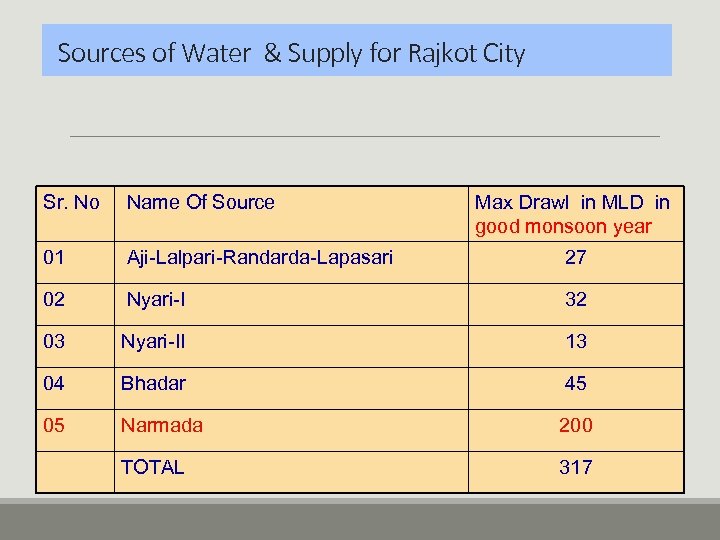 Sources of Water & Supply for Rajkot City Sr. No Name Of Source Max Drawl in MLD in good monsoon year 01 Aji-Lalpari-Randarda-Lapasari 27 02 Nyari-I 32 03 Nyari-II 13 04 Bhadar 45 05 Narmada 200 TOTAL 317
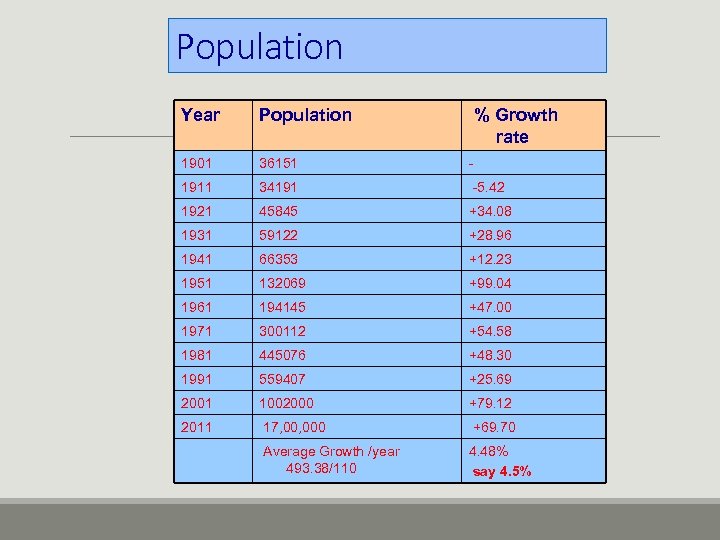 Population Year Population % Growth rate 1901 36151 - 1911 34191 -5. 42 1921 45845 +34. 08 1931 59122 +28. 96 1941 66353 +12. 23 1951 132069 +99. 04 1961 194145 +47. 00 1971 300112 +54. 58 1981 445076 +48. 30 1991 559407 +25. 69 2001 1002000 +79. 12 2011 17, 000 +69. 70 Average Growth /year 493. 38/110 4. 48% say 4. 5%
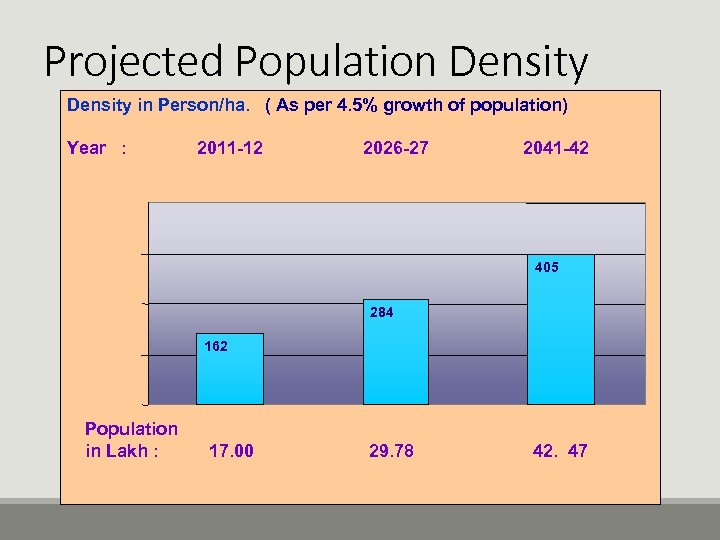 Projected Population Density in Person/ha. ( As per 4. 5% growth of population) Year : 2011 -12 2026 -27 2041 -42 405 284 162 Population in Lakh : 17. 00 29. 78 42. 47
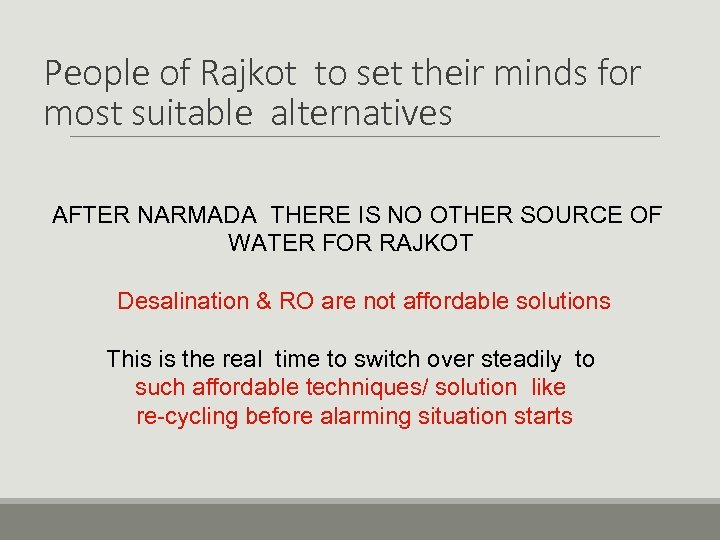 People of Rajkot to set their minds for most suitable alternatives AFTER NARMADA THERE IS NO OTHER SOURCE OF WATER FOR RAJKOT Desalination & RO are not affordable solutions This is the real time to switch over steadily to such affordable techniques/ solution like re-cycling before alarming situation starts
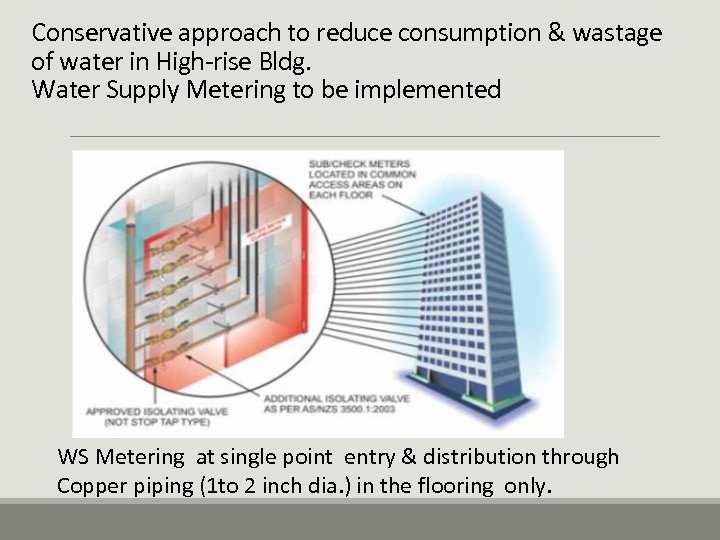 Conservative approach to reduce consumption & wastage of water in High-rise Bldg. Water Supply Metering to be implemented WS Metering at single point entry & distribution through Copper piping (1 to 2 inch dia. ) in the flooring only.
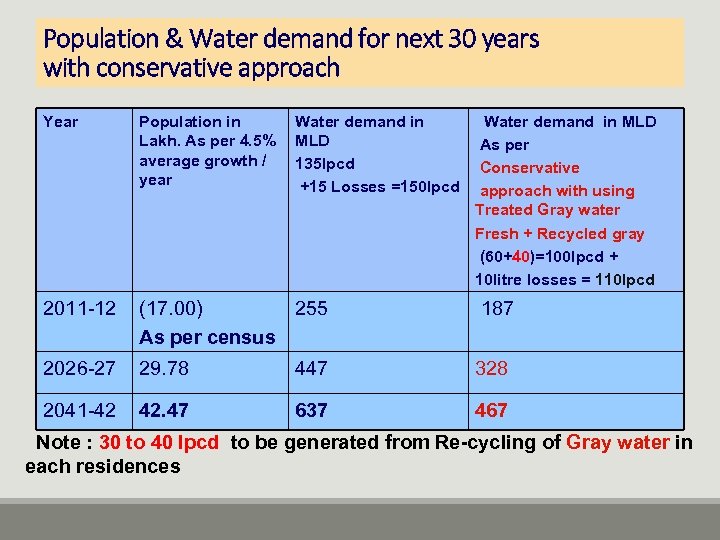 Population & Water demand for next 30 years with conservative approach Year Population in Lakh. As per 4. 5% average growth / year Water demand in MLD 135 lpcd +15 Losses =150 lpcd Water demand in MLD As per Conservative approach with using Treated Gray water Fresh + Recycled gray (60+40)=100 lpcd + 10 litre losses = 110 lpcd 2011 -12 (17. 00) 255 As per census 187 2026 -27 29. 78 447 328 2041 -42 42. 47 637 467 Note : 30 to 40 lpcd to be generated from Re-cycling of Gray water in each residences
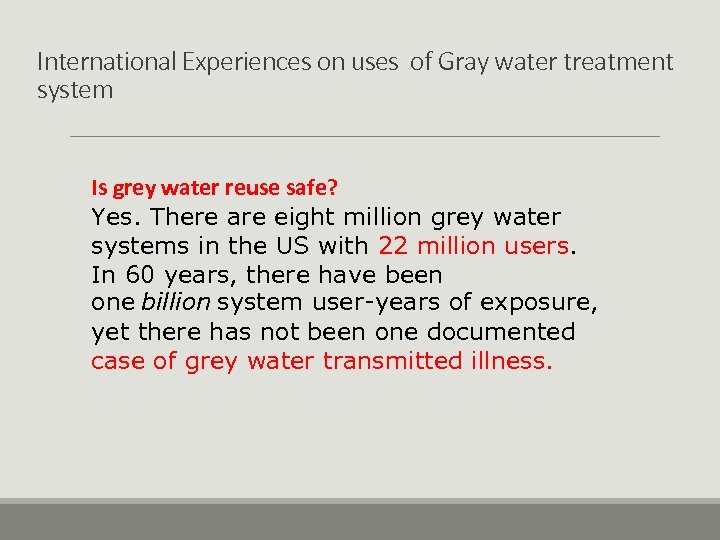 International Experiences on uses of Gray water treatment system Is grey water reuse safe? Yes. There are eight million grey water systems in the US with 22 million users. In 60 years, there have been one billion system user-years of exposure, yet there has not been one documented case of grey water transmitted illness.
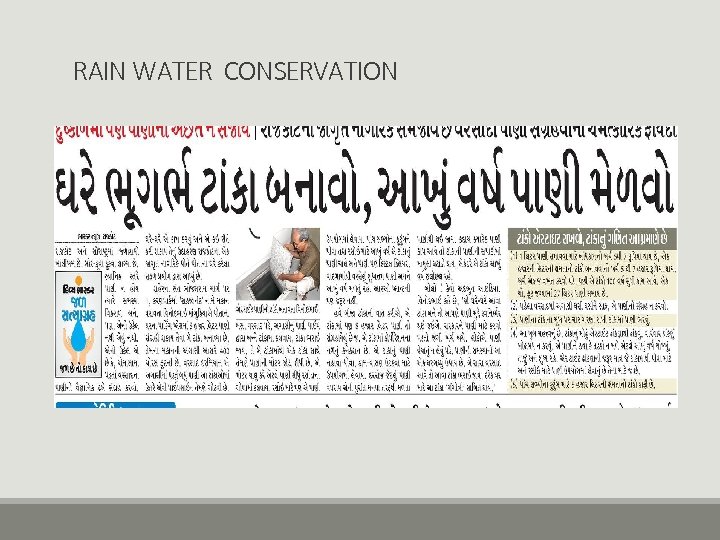 RAIN WATER CONSERVATION
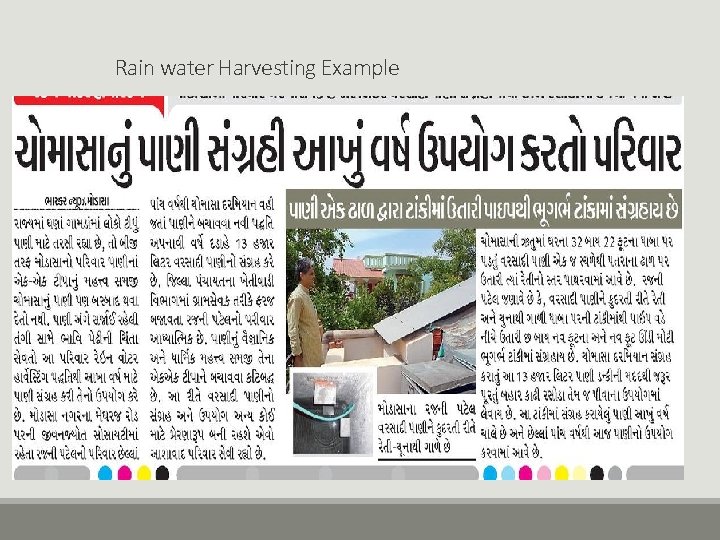 Rain water Harvesting Example
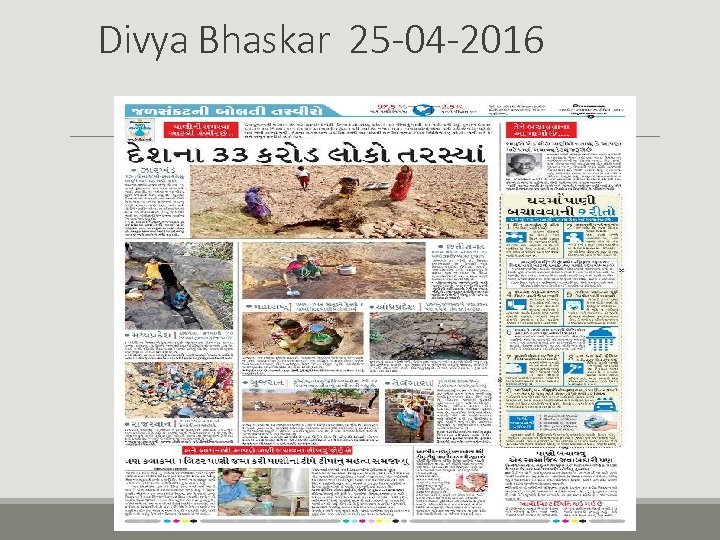 Divya Bhaskar 25 -04 -2016
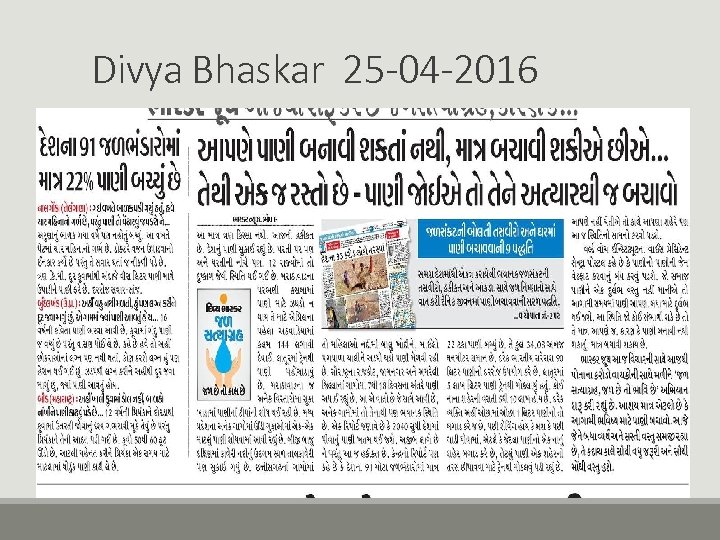 Divya Bhaskar 25 -04 -2016
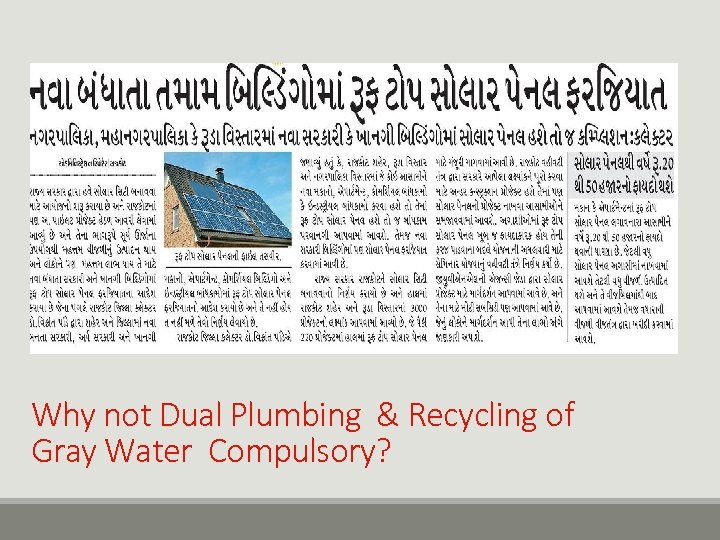 Why not Dual Plumbing & Recycling of Gray Water Compulsory?
 Recommendations Governments require master plans for reuse of reclaimed water as part of an integrated water resource management approach. Such master plan comprises technical, institutional, legislative, social, economic, financial and O&M aspects. Governments require support for the development of costrecovering water tariff systems. This highly political topic is crucial to a save and efficient reuse scheme in the long run. Government should set a target of minimum of 20 percent water recycling by 2030.
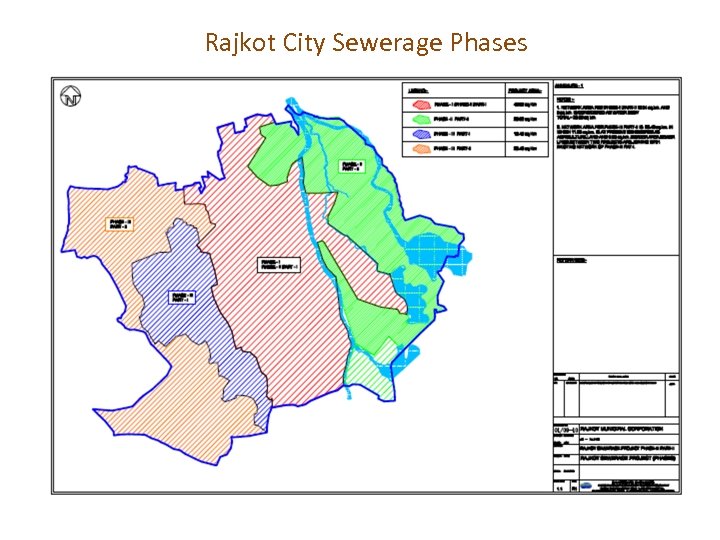 Rajkot City Sewerage Phases
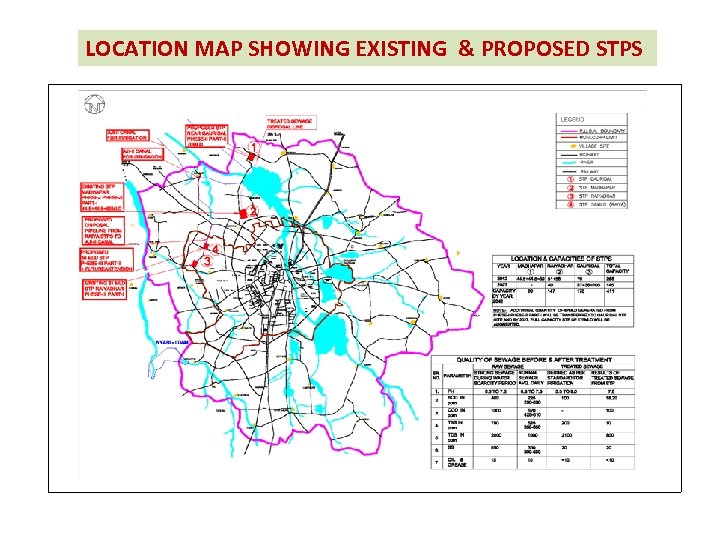 LOCATION MAP SHOWING EXISTING & PROPOSED STPS
 THINK AGAIN & AGAIN FOR RE-CYCLING OF GRAY WATER IN HOMES SAVE WATER WILL SAVE US
 THANKS