


 Скачать презентацию WORLD SPACE PROGRAMS -Extending man s knowledge of Earth
4f27216c6660600bca9c9075614a704a.ppt
- Количество слайдов: 53
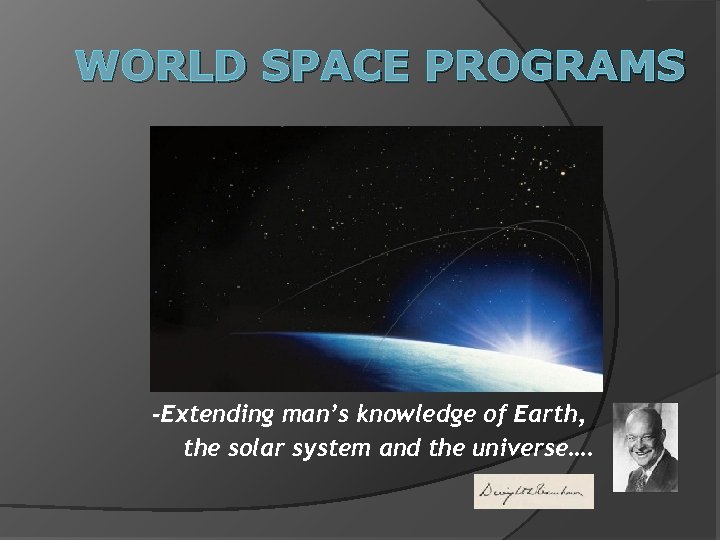 WORLD SPACE PROGRAMS -Extending man’s knowledge of Earth, the solar system and the universe….
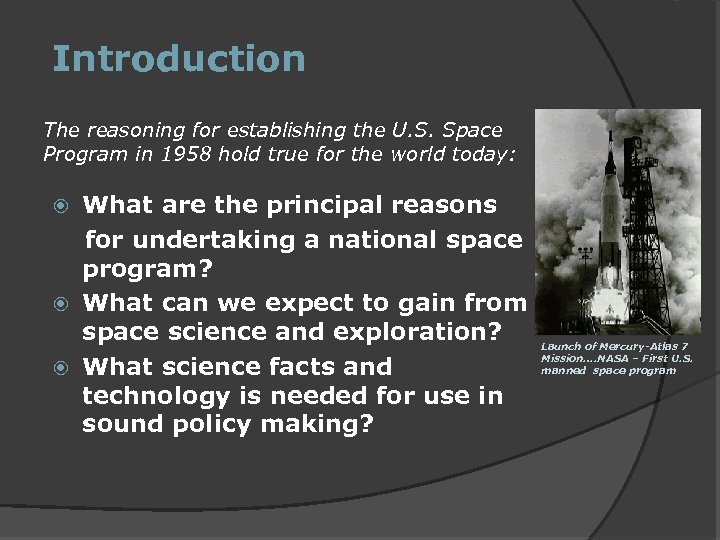 Introduction The reasoning for establishing the U. S. Space Program in 1958 hold true for the world today: What are the principal reasons for undertaking a national space program? What can we expect to gain from space science and exploration? What science facts and technology is needed for use in sound policy making? Launch of Mercury-Atlas 7 Mission…. NASA – First U. S. manned space program
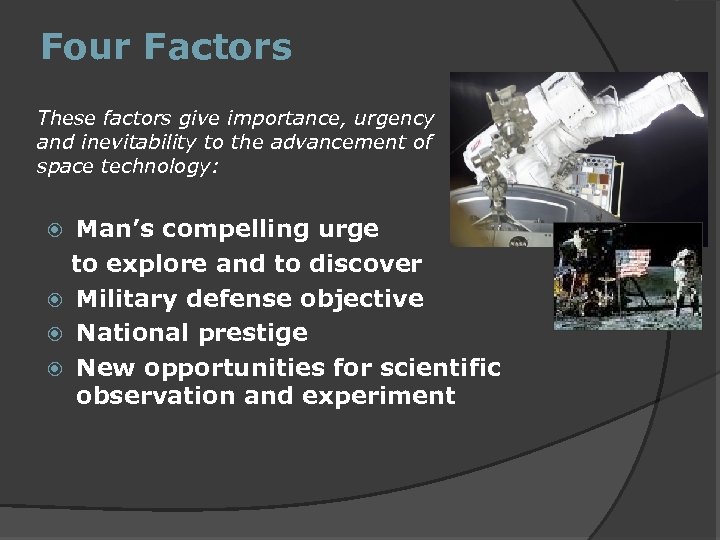 Four Factors These factors give importance, urgency and inevitability to the advancement of space technology: Man’s compelling urge to explore and to discover Military defense objective National prestige New opportunities for scientific observation and experiment
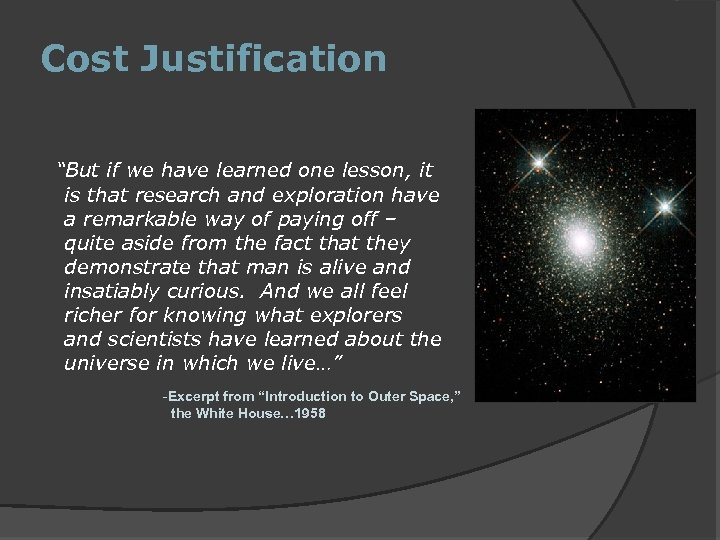 Cost Justification “But if we have learned one lesson, it is that research and exploration have a remarkable way of paying off – quite aside from the fact that they demonstrate that man is alive and insatiably curious. And we all feel richer for knowing what explorers and scientists have learned about the universe in which we live…” -Excerpt from “Introduction to Outer Space, ” the White House… 1958
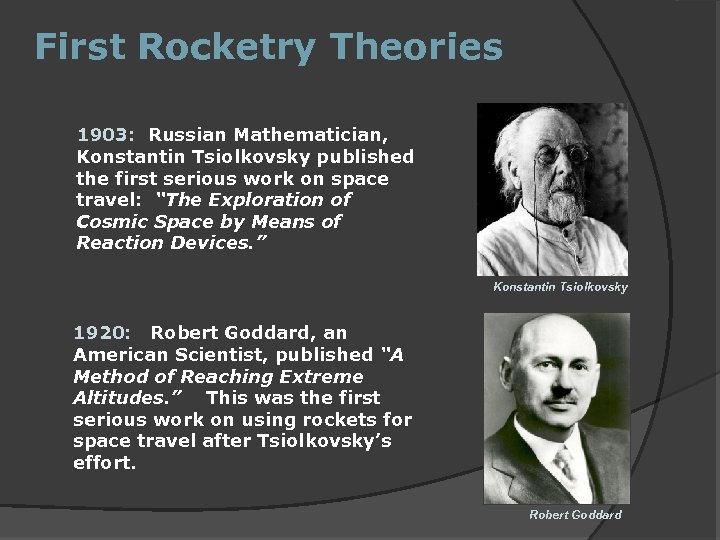 First Rocketry Theories 1903: Russian Mathematician, Konstantin Tsiolkovsky published the first serious work on space travel: “The Exploration of Cosmic Space by Means of Reaction Devices. ” Konstantin Tsiolkovsky 1920: Robert Goddard, an American Scientist, published “A Method of Reaching Extreme Altitudes. ” This was the first serious work on using rockets for space travel after Tsiolkovsky’s effort. Robert Goddard
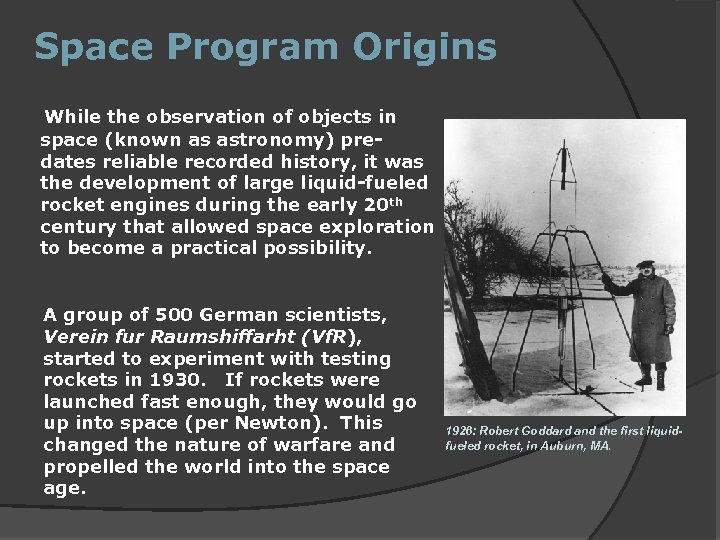 Space Program Origins While the observation of objects in space (known as astronomy) predates reliable recorded history, it was the development of large liquid-fueled rocket engines during the early 20 th century that allowed space exploration to become a practical possibility. A group of 500 German scientists, Verein fur Raumshiffarht (Vf. R), started to experiment with testing rockets in 1930. If rockets were launched fast enough, they would go up into space (per Newton). This changed the nature of warfare and propelled the world into the space age. 1926: Robert Goddard and the first liquidfueled rocket, in Auburn, MA.
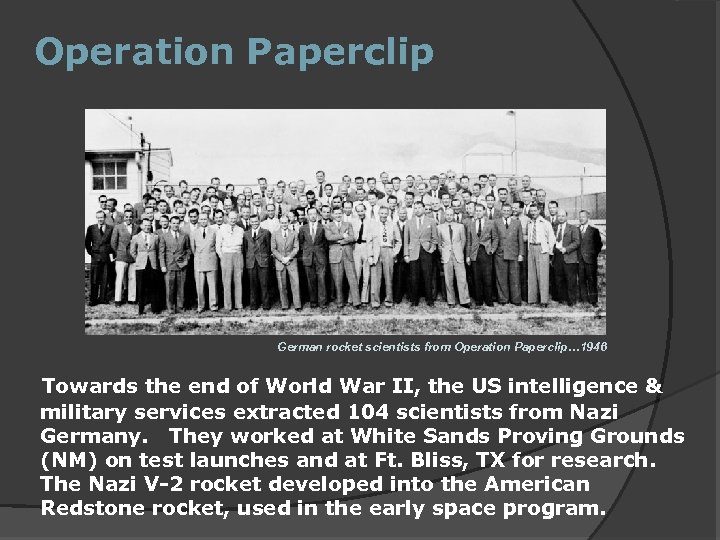 Operation Paperclip German rocket scientists from Operation Paperclip… 1946 Towards the end of World War II, the US intelligence & military services extracted 104 scientists from Nazi Germany. They worked at White Sands Proving Grounds (NM) on test launches and at Ft. Bliss, TX for research. The Nazi V-2 rocket developed into the American Redstone rocket, used in the early space program.
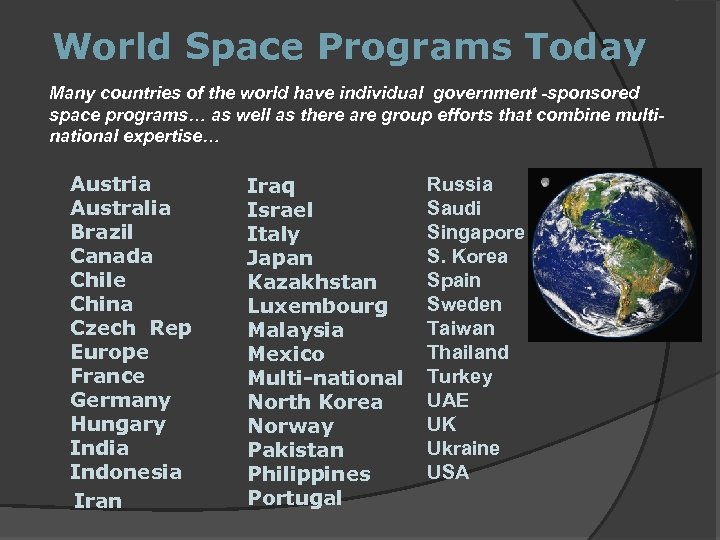 World Space Programs Today Many countries of the world have individual government -sponsored space programs… as well as there are group efforts that combine multinational expertise… Austria Australia Brazil Canada Chile China Czech Rep Europe France Germany Hungary India Indonesia Iran Iraq Israel Italy Japan Kazakhstan Luxembourg Malaysia Mexico Multi-national North Korea Norway Pakistan Philippines Portugal Russia Saudi Singapore S. Korea Spain Sweden Taiwan Thailand Turkey UAE UK Ukraine USA
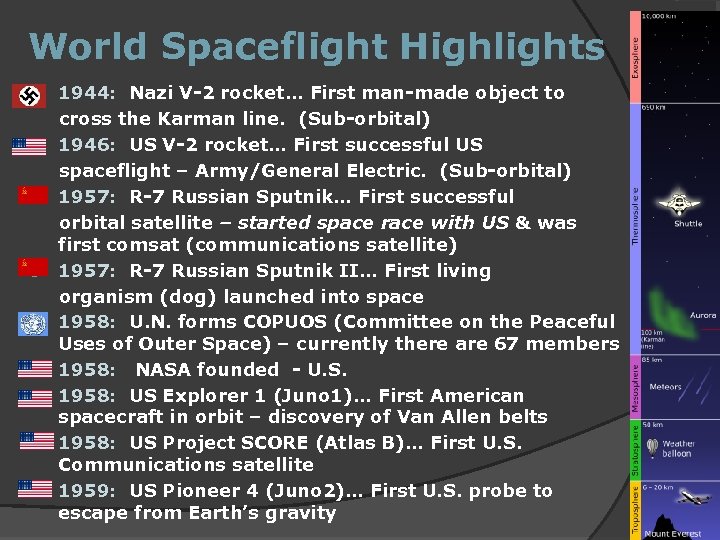 World Spaceflight Highlights 1944: Nazi V-2 rocket… First man-made object to cross the Karman line. (Sub-orbital) 1946: US V-2 rocket… First successful US spaceflight – Army/General Electric. (Sub-orbital) 1957: R-7 Russian Sputnik… First successful orbital satellite – started space race with US & was first comsat (communications satellite) 1957: R-7 Russian Sputnik II… First living organism (dog) launched into space 1958: U. N. forms COPUOS (Committee on the Peaceful Uses of Outer Space) – currently there are 67 members 1958: NASA founded - U. S. 1958: US Explorer 1 (Juno 1)… First American spacecraft in orbit – discovery of Van Allen belts 1958: US Project SCORE (Atlas B)… First U. S. Communications satellite 1959: US Pioneer 4 (Juno 2)… First U. S. probe to escape from Earth’s gravity
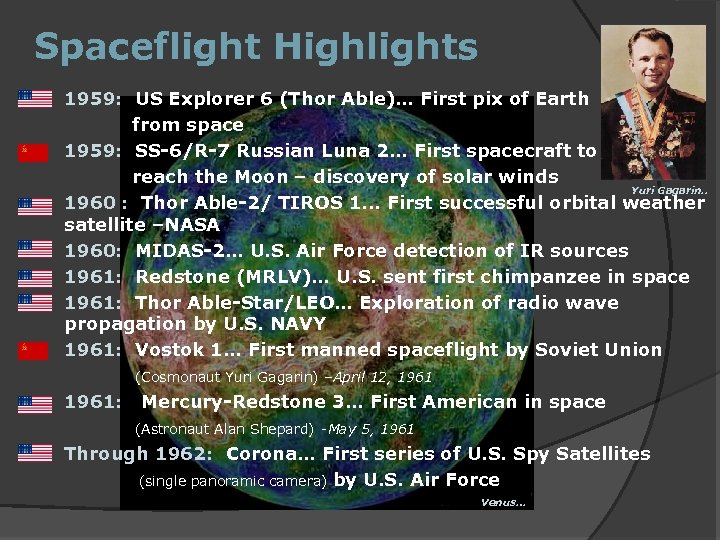 Spaceflight Highlights 1959: US Explorer 6 (Thor Able)… First pix of Earth from space 1959: SS-6/R-7 Russian Luna 2… First spacecraft to reach the Moon – discovery of solar winds Yuri Gagarin. . 1960 : Thor Able-2/ TIROS 1. . . First successful orbital weather satellite –NASA 1960: MIDAS-2… U. S. Air Force detection of IR sources 1961: Redstone (MRLV)… U. S. sent first chimpanzee in space 1961: Thor Able-Star/LEO… Exploration of radio wave propagation by U. S. NAVY 1961: Vostok 1… First manned spaceflight by Soviet Union (Cosmonaut Yuri Gagarin) –April 12, 1961: Mercury-Redstone 3… First American in space (Astronaut Alan Shepard) -May 5, 1961 Through 1962: Corona… First series of U. S. Spy Satellites (single panoramic camera) by U. S. Air Force Venus…
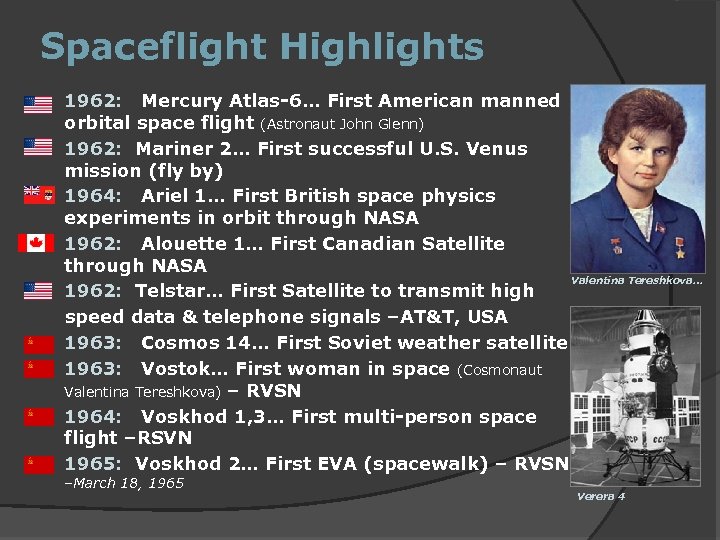 Spaceflight Highlights 1962: Mercury Atlas-6… First American manned orbital space flight (Astronaut John Glenn) 1962: Mariner 2… First successful U. S. Venus mission (fly by) 1964: Ariel 1… First British space physics experiments in orbit through NASA 1962: Alouette 1… First Canadian Satellite through NASA Valentina Tereshkova… 1962: Telstar… First Satellite to transmit high speed data & telephone signals –AT&T, USA 1963: Cosmos 14… First Soviet weather satellite 1963: Vostok… First woman in space (Cosmonaut Valentina Tereshkova) – RVSN 1964: Voskhod 1, 3… First multi-person space flight –RSVN 1965: Voskhod 2… First EVA (spacewalk) – RVSN –March 18, 1965 Verera 4
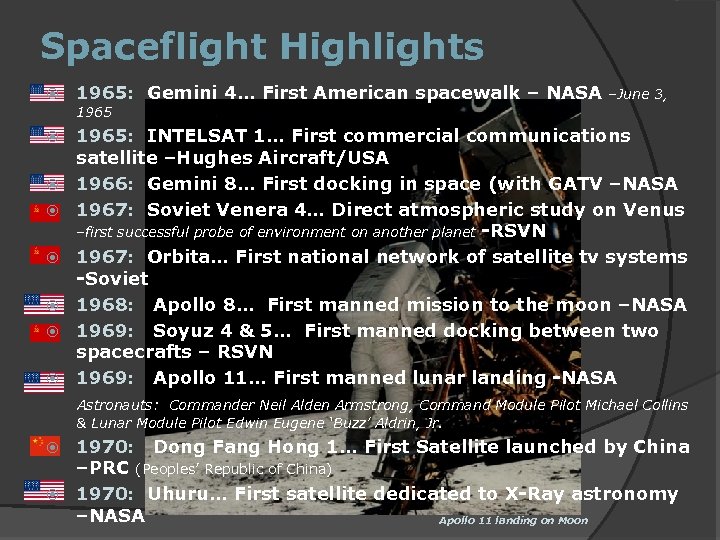 Spaceflight Highlights 1965: Gemini 4… First American spacewalk – NASA –June 3, 1965: INTELSAT 1… First commercial communications satellite –Hughes Aircraft/USA 1966: Gemini 8… First docking in space (with GATV –NASA 1967: Soviet Venera 4… Direct atmospheric study on Venus –first successful probe of environment on another planet -RSVN 1967: Orbita… First national network of satellite tv systems -Soviet 1968: Apollo 8… First manned mission to the moon –NASA 1969: Soyuz 4 & 5… First manned docking between two spacecrafts – RSVN 1969: Apollo 11… First manned lunar landing -NASA Astronauts: Commander Neil Alden Armstrong, Command Module Pilot Michael Collins & Lunar Module Pilot Edwin Eugene ‘Buzz’ Aldrin, Jr. 1970: Dong Fang Hong 1… First Satellite launched by China –PRC (Peoples’ Republic of China) 1970: Uhuru… First satellite dedicated to X-Ray astronomy –NASA Apollo 11 landing on Moon
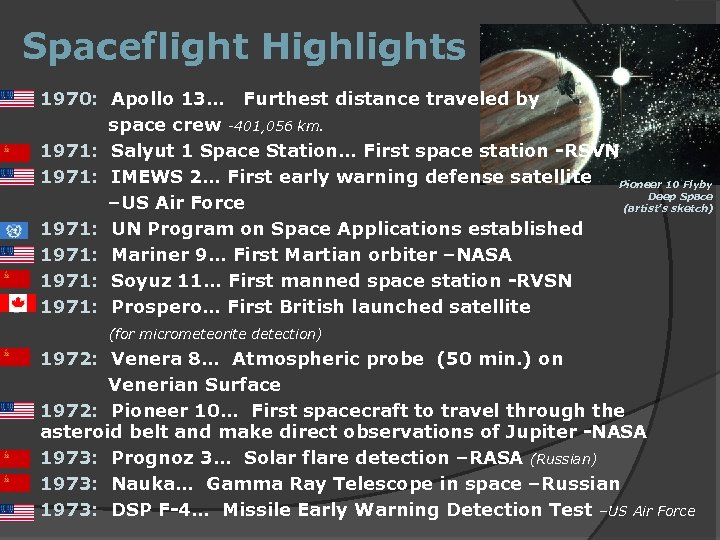 Spaceflight Highlights 1970: Apollo 13… Furthest distance traveled by space crew -401, 056 km. 1971: Salyut 1 Space Station… First space station -RSVN 1971: IMEWS 2… First early warning defense satellite Pioneer 10 Flyby Deep Space –US Air Force (artist’s sketch) 1971: UN Program on Space Applications established 1971: Mariner 9… First Martian orbiter –NASA 1971: Soyuz 11… First manned space station -RVSN 1971: Prospero… First British launched satellite (for micrometeorite detection) 1972: Venera 8… Atmospheric probe (50 min. ) on Venerian Surface 1972: Pioneer 10… First spacecraft to travel through the asteroid belt and make direct observations of Jupiter -NASA 1973: Prognoz 3… Solar flare detection –RASA (Russian) 1973: Nauka… Gamma Ray Telescope in space –Russian 1973: DSP F-4… Missile Early Warning Detection Test –US Air Force
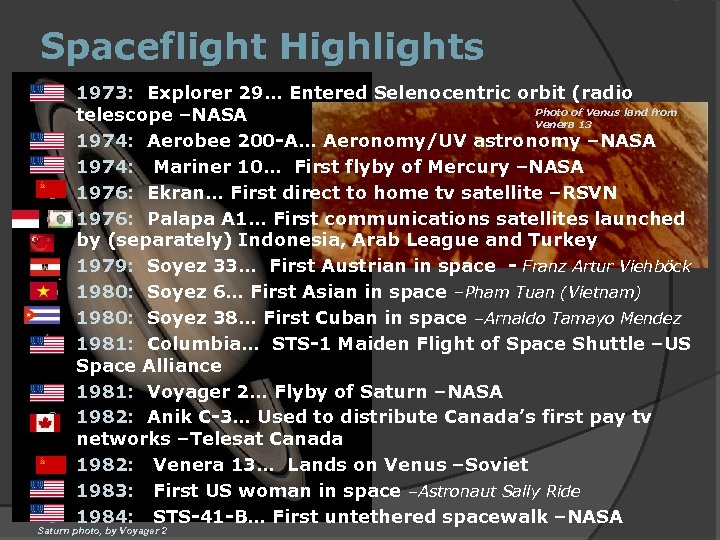 Spaceflight Highlights 1973: Explorer 29… Entered Selenocentric orbit (radio Photo of Venus land from telescope –NASA Venera 13 1974: Aerobee 200 -A… Aeronomy/UV astronomy –NASA 1974: Mariner 10… First flyby of Mercury –NASA 1976: Ekran… First direct to home tv satellite –RSVN 1976: Palapa A 1… First communications satellites launched by (separately) Indonesia, Arab League and Turkey 1979: Soyez 33… First Austrian in space - Franz Artur Viehböck 1980: Soyez 6… First Asian in space –Pham Tuan (Vietnam) 1980: Soyez 38… First Cuban in space –Arnaldo Tamayo Mendez 1981: Columbia… STS-1 Maiden Flight of Space Shuttle –US Space Alliance 1981: Voyager 2… Flyby of Saturn –NASA 1982: Anik C-3… Used to distribute Canada’s first pay tv networks –Telesat Canada 1982: Venera 13… Lands on Venus –Soviet 1983: First US woman in space –Astronaut Sally Ride 1984: STS-41 -B… First untethered spacewalk –NASA Saturn photo, by Voyager 2
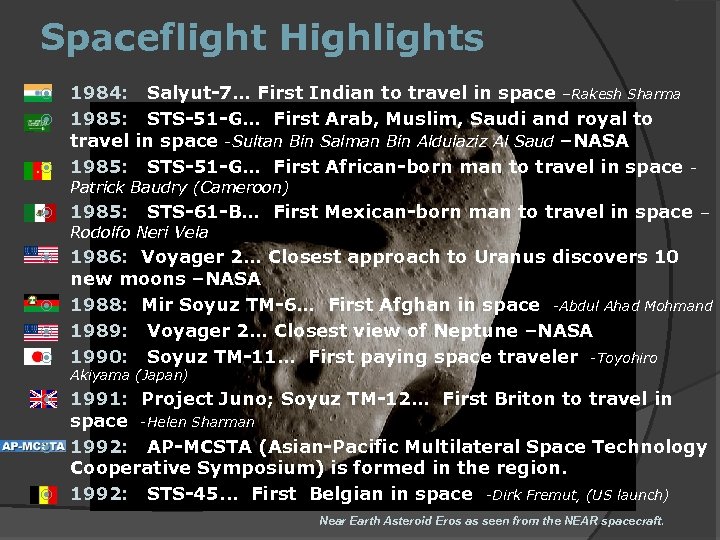 Spaceflight Highlights 1984: 1985: travel 1985: Salyut-7… First Indian to travel in space –Rakesh Sharma STS-51 -G… First Arab, Muslim, Saudi and royal to in space -Sultan Bin Salman Bin Aldulaziz Al Saud –NASA STS-51 -G… First African-born man to travel in space - Patrick Baudry (Cameroon) 1985: STS-61 -B… First Mexican-born man to travel in space – Rodolfo Neri Vela 1986: Voyager 2… Closest approach to Uranus discovers 10 new moons –NASA 1988: Mir Soyuz TM-6… First Afghan in space -Abdul Ahad Mohmand 1989: Voyager 2… Closest view of Neptune –NASA 1990: Soyuz TM-11… First paying space traveler -Toyohiro Akiyama (Japan) 1991: Project Juno; Soyuz TM-12… First Briton to travel in space -Helen Sharman 1992: AP-MCSTA (Asian-Pacific Multilateral Space Technology Cooperative Symposium) is formed in the region. 1992: STS-45. . . First Belgian in space -Dirk Fremut, (US launch) Near Earth Asteroid Eros as seen from the NEAR spacecraft.
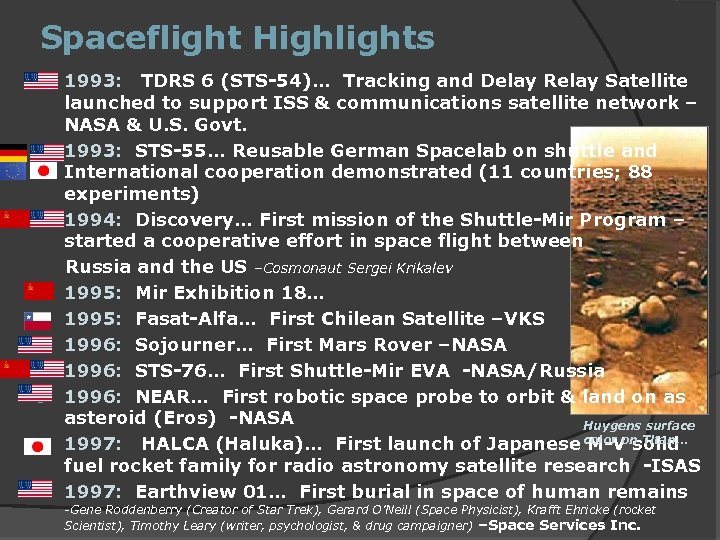 Spaceflight Highlights 1993: TDRS 6 (STS-54)… Tracking and Delay Relay Satellite launched to support ISS & communications satellite network – NASA & U. S. Govt. 1993: STS-55… Reusable German Spacelab on shuttle and International cooperation demonstrated (11 countries; 88 experiments) 1994: Discovery… First mission of the Shuttle-Mir Program – started a cooperative effort in space flight between Russia and the US –Cosmonaut Sergei Krikalev 1995: Mir Exhibition 18… 1995: Fasat-Alfa… First Chilean Satellite –VKS 1996: Sojourner… First Mars Rover –NASA 1996: STS-76… First Shuttle-Mir EVA -NASA/Russia 1996: NEAR… First robotic space probe to orbit & land on as asteroid (Eros) -NASA Huygens surface 1997: HALCA (Haluka)… First launch of Japanese color on Titan… M-V solid fuel rocket family for radio astronomy satellite research -ISAS 1997: Earthview 01… First burial in space of human remains -Gene Roddenberry (Creator of Star Trek), Gerard O’Neill (Space Physicist), Krafft Ehricke (rocket Scientist), Timothy Leary (writer, psychologist, & drug campaigner) –Space Services Inc.
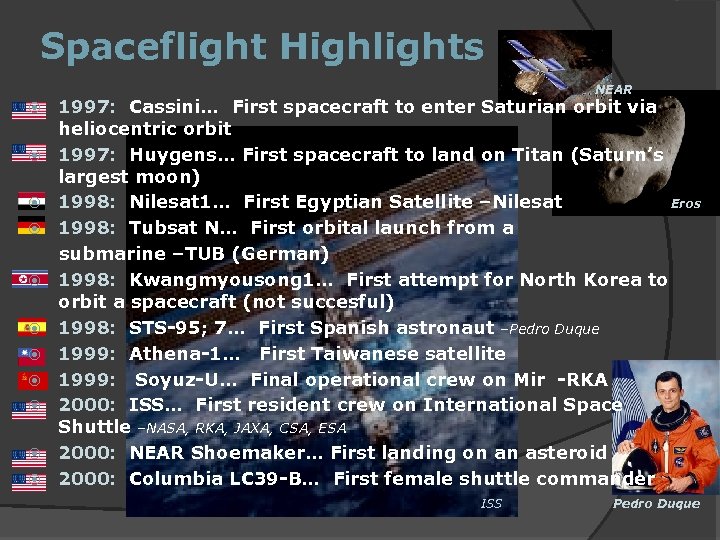 Spaceflight Highlights NEAR 1997: Cassini… First spacecraft to enter Saturian orbit via heliocentric orbit 1997: Huygens… First spacecraft to land on Titan (Saturn’s largest moon) Eros 1998: Nilesat 1… First Egyptian Satellite –Nilesat 1998: Tubsat N… First orbital launch from a submarine –TUB (German) 1998: Kwangmyousong 1… First attempt for North Korea to orbit a spacecraft (not succesful) 1998: STS-95; 7… First Spanish astronaut –Pedro Duque 1999: Athena-1… First Taiwanese satellite 1999: Soyuz-U… Final operational crew on Mir -RKA 2000: ISS… First resident crew on International Space Shuttle –NASA, RKA, JAXA, CSA, ESA 2000: NEAR Shoemaker… First landing on an asteroid 2000: Columbia LC 39 -B… First female shuttle commander ISS Pedro Duque
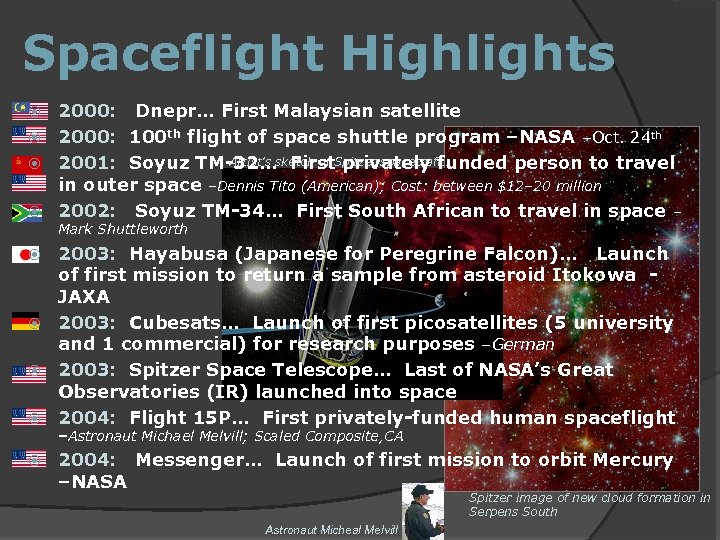 Spaceflight Highlights 2000: Dnepr… First Malaysian satellite 2000: 100 th flight of space shuttle program –NASA –Oct. 24 th Artist’s 2001: Soyuz TM-32…sketch of Spitzer spacecraft… First privately funded person to travel in outer space –Dennis Tito (American); Cost: between $12– 20 million 2002: Soyuz TM-34… First South African to travel in space – Mark Shuttleworth 2003: Hayabusa (Japanese for Peregrine Falcon)… Launch of first mission to return a sample from asteroid Itokowa JAXA 2003: Cubesats… Launch of first picosatellites (5 university and 1 commercial) for research purposes –German 2003: Spitzer Space Telescope… Last of NASA’s Great Observatories (IR) launched into space 2004: Flight 15 P… First privately-funded human spaceflight –Astronaut Michael Melvill; Scaled Composite, CA 2004: Messenger… Launch of first mission to orbit Mercury –NASA Spitzer image of new cloud formation in Serpens South Astronaut Micheal Melvill
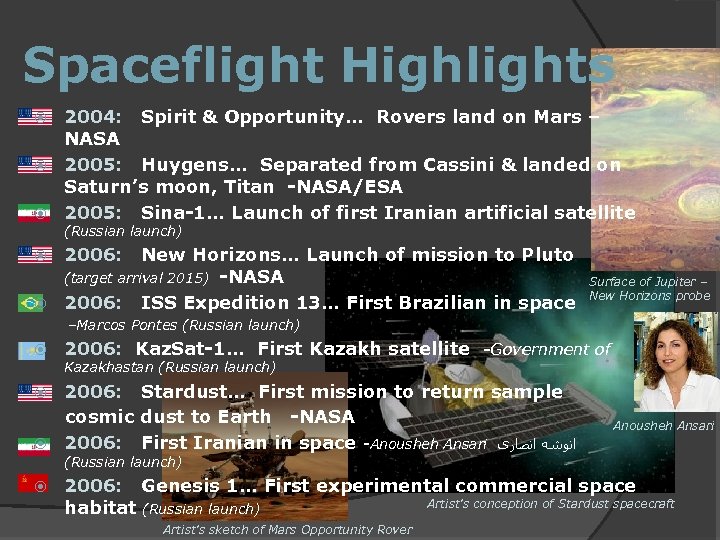 Spaceflight Highlights 2004: Spirit & Opportunity… Rovers land on Mars – NASA 2005: Huygens… Separated from Cassini & landed on Saturn’s moon, Titan -NASA/ESA 2005: Sina-1… Launch of first Iranian artificial satellite (Russian launch) New Horizons… Launch of mission to Pluto (target arrival 2015) -NASA 2006: ISS Expedition 13… First Brazilian in space 2006: Surface of Jupiter – New Horizons probe –Marcos Pontes (Russian launch) 2006: Kaz. Sat-1… First Kazakh satellite -Government of Kazakhastan (Russian launch) 2006: Stardust… First mission to return sample cosmic dust to Earth -NASA 2006: First Iranian in space -Anousheh Ansari ﺍﻧﻮﺷﻪ ﺍﻧﺼﺎﺭی Anousheh Ansari (Russian launch) 2006: Genesis 1… First experimental commercial space Artist’s conception of Stardust spacecraft habitat (Russian launch) Artist’s sketch of Mars Opportunity Rover
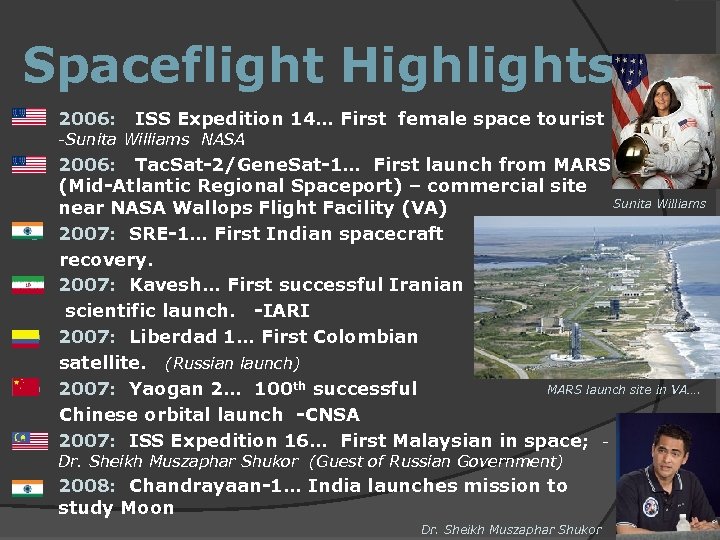 Spaceflight Highlights 2006: ISS Expedition 14… First female space tourist -Sunita Williams NASA 2006: Tac. Sat-2/Gene. Sat-1… First launch from MARS (Mid-Atlantic Regional Spaceport) – commercial site Sunita Williams near NASA Wallops Flight Facility (VA) 2007: SRE-1… First Indian spacecraft recovery. 2007: Kavesh… First successful Iranian scientific launch. -IARI 2007: Liberdad 1… First Colombian satellite. (Russian launch) MARS launch site in VA…. 2007: Yaogan 2… 100 th successful Chinese orbital launch -CNSA 2007: ISS Expedition 16… First Malaysian in space; Dr. Sheikh Muszaphar Shukor (Guest of Russian Government) 2008: Chandrayaan-1… India launches mission to study Moon Dr. Sheikh Muszaphar Shukor
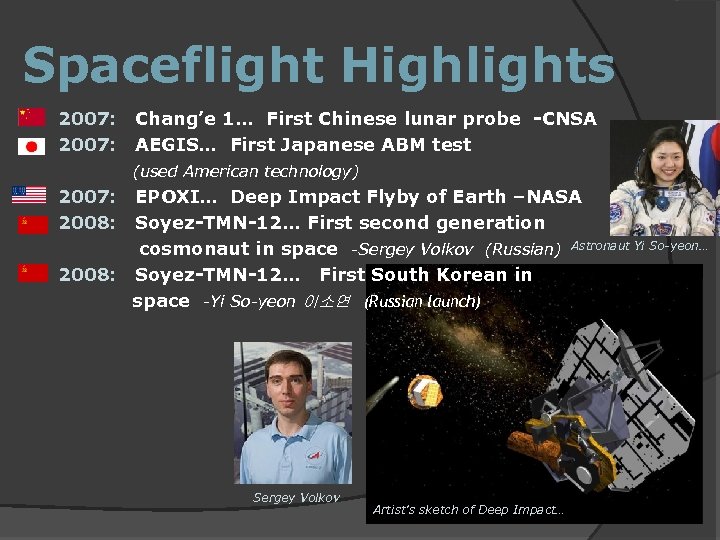 Spaceflight Highlights 2007: Chang’e 1… First Chinese lunar probe -CNSA AEGIS… First Japanese ABM test (used American technology) 2007: 2008: EPOXI… Deep Impact Flyby of Earth –NASA Soyez-TMN-12… First second generation cosmonaut in space -Sergey Volkov (Russian) Astronaut Yi So-yeon… 2008: Soyez-TMN-12… First South Korean in space -Yi So-yeon 이소연 (Russian launch) Sergey Volkov Artist’s sketch of Deep Impact…
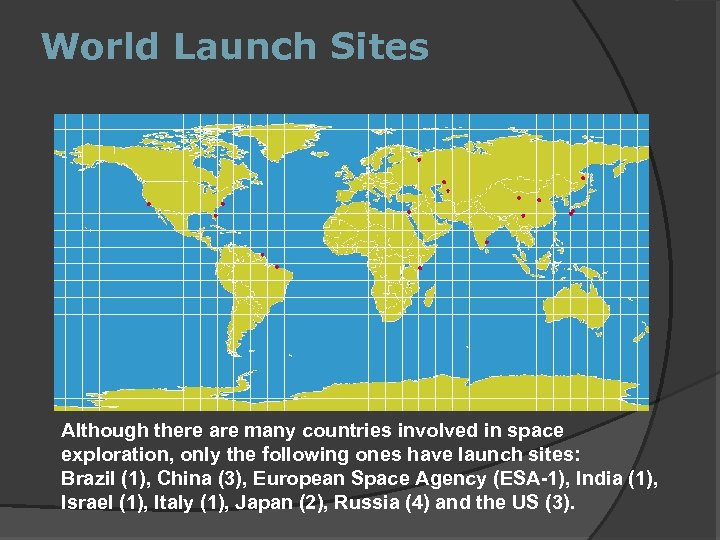 World Launch Sites Although there are many countries involved in space exploration, only the following ones have launch sites: Brazil (1), China (3), European Space Agency (ESA-1), India (1), Israel (1), Italy (1), Japan (2), Russia (4) and the US (3).
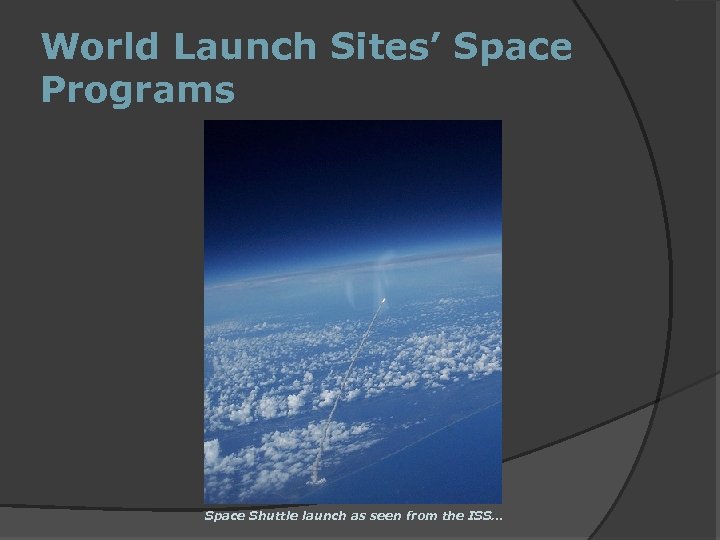 World Launch Sites’ Space Programs Space Shuttle launch as seen from the ISS…
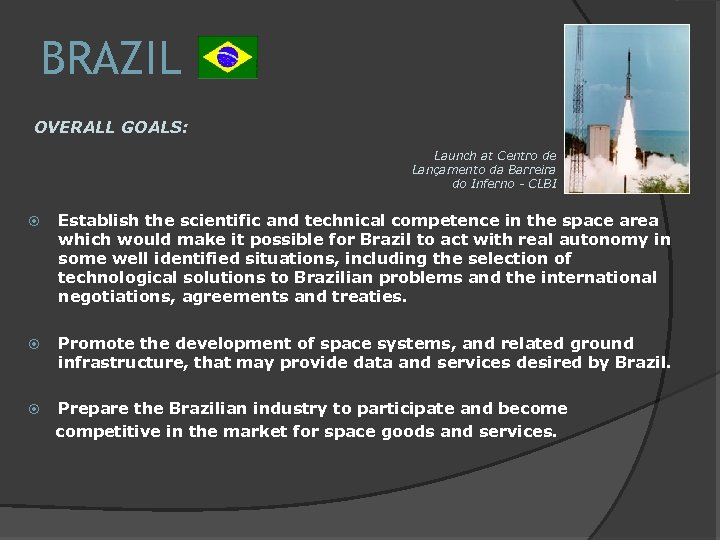 BRAZIL OVERALL GOALS: Launch at Centro de Lançamento da Barreira do Inferno - CLBI Establish the scientific and technical competence in the space area which would make it possible for Brazil to act with real autonomy in some well identified situations, including the selection of technological solutions to Brazilian problems and the international negotiations, agreements and treaties. Promote the development of space systems, and related ground infrastructure, that may provide data and services desired by Brazil. Prepare the Brazilian industry to participate and become competitive in the market for space goods and services.
 BRAZIL INPE: Instituto Nacional de Pesquisas Espaciais (INPE) 1961: GOCNAE (Grupo de Organizacao da Comissao Nacional de Atividades Espaciais) –Group for the Organization of the National Space Activities Commission (forerunner to INPE) is started. 1965: First campaigns for launching work-loaded probing rockets 1969: Remote Sensing activities started 1988: Brazil begins work with China in satellite development 1993: First launch of wholly Brazilian satellite by INPE (in USA) Marcos Pontes 1994: Civilian Authority overseen by President: AEB 2005: INPE reaches 100 thousand images – makes it the largest CBERS world distributor 2006: First Brazilian space astronaut in space -Marcos Pontes (Russian launch to ISS 2008: INPE distributes more than half a million CBERS images via internet Website: http: //www. inpe. br/
 CHINA BACKGROUND KT-1 … 2001 Since it’s birth in 1956, China's space industry was developed on the basis of weak infrastructure industries and a relatively backward scientific & technological level, under special national and historical conditions. In the process of carrying out space activities independently, China has opened a road of development unique to its national situation and scored a series of important achievements with relatively small input and within a relatively short span of time. Now, China ranks among the most advanced countries in the world in many important technological fields: satellite recovery, multisatellite launch with a single rocket, rockets with cryogenic fuel, strap-on rockets, launch of geo-stationary satellites and TT&C. Significant achievements have also been gained in the development and application of remote-sensing satellites and telecommunications satellites, and in manned spacecraft testing and space micro-gravity experiments.
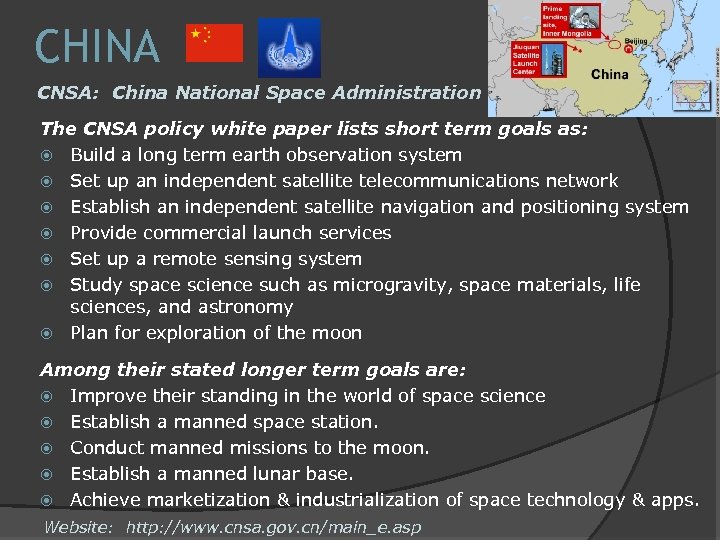 CHINA CNSA: China National Space Administration The CNSA policy white paper lists short term goals as: Build a long term earth observation system Set up an independent satellite telecommunications network Establish an independent satellite navigation and positioning system Provide commercial launch services Set up a remote sensing system Study space science such as microgravity, space materials, life sciences, and astronomy Plan for exploration of the moon Among their stated longer term goals are: Improve their standing in the world of space science Establish a manned space station. Conduct manned missions to the moon. Establish a manned lunar base. Achieve marketization & industrialization of space technology & apps. Website: http: //www. cnsa. gov. cn/main_e. asp
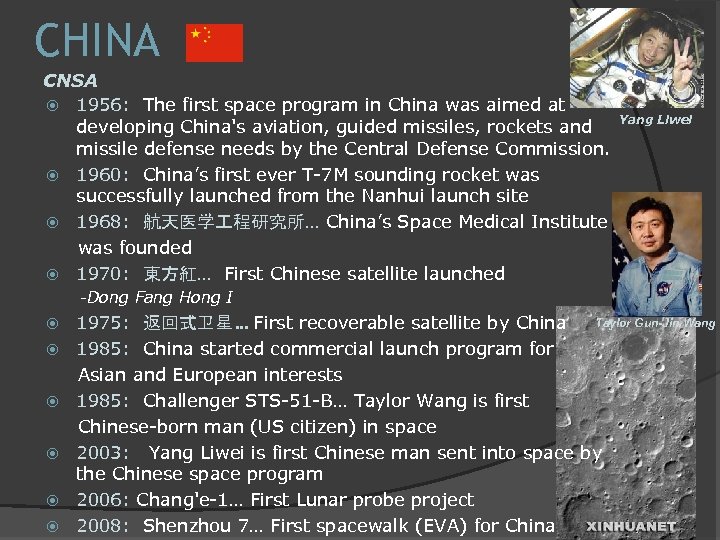 CHINA CNSA 1956: The first space program in China was aimed at developing China's aviation, guided missiles, rockets and missile defense needs by the Central Defense Commission. 1960: China’s first ever T-7 M sounding rocket was successfully launched from the Nanhui launch site 1968: 航天医学 程研究所… China’s Space Medical Institute was founded 1970: 東方紅… First Chinese satellite launched Yang Liwei -Dong Fang Hong I Taylor Gun-Jin Wang 1975: 返回式卫星 … First recoverable satellite by China 1985: China started commercial launch program for Asian and European interests 1985: Challenger STS-51 -B… Taylor Wang is first Chinese-born man (US citizen) in space 2003: Yang Liwei is first Chinese man sent into space by the Chinese space program 2006: Chang'e-1… First Lunar probe project 2008: Shenzhou 7… First spacewalk (EVA) for China
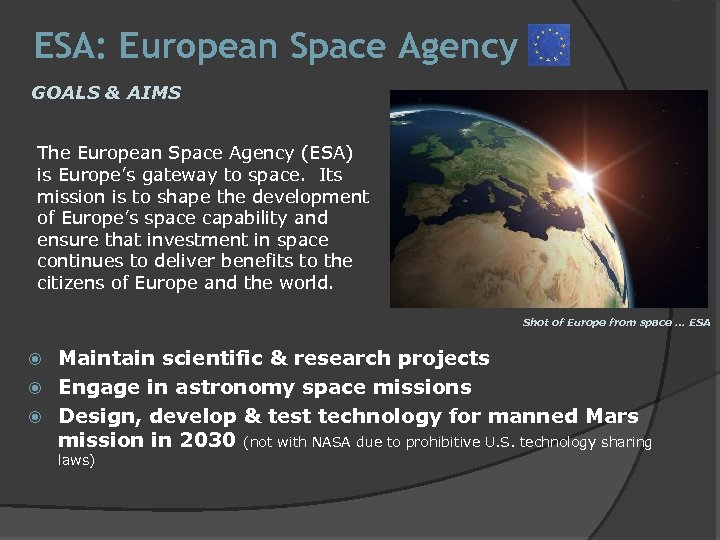 ESA: European Space Agency GOALS & AIMS The European Space Agency (ESA) is Europe’s gateway to space. Its mission is to shape the development of Europe’s space capability and ensure that investment in space continues to deliver benefits to the citizens of Europe and the world. Shot of Europe from space … ESA Maintain scientific & research projects Engage in astronomy space missions Design, develop & test technology for manned Mars mission in 2030 (not with NASA due to prohibitive U. S. technology sharing laws)
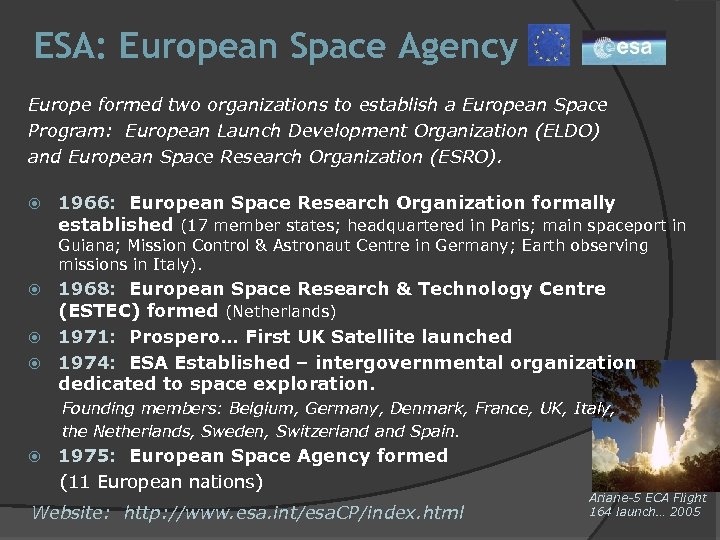 ESA: European Space Agency Europe formed two organizations to establish a European Space Program: European Launch Development Organization (ELDO) and European Space Research Organization (ESRO). 1966: European Space Research Organization formally established (17 member states; headquartered in Paris; main spaceport in Guiana; Mission Control & Astronaut Centre in Germany; Earth observing missions in Italy). 1968: European Space Research & Technology Centre (ESTEC) formed (Netherlands) 1971: Prospero… First UK Satellite launched 1974: ESA Established – intergovernmental organization dedicated to space exploration. Founding members: Belgium, Germany, Denmark, France, UK, Italy, the Netherlands, Sweden, Switzerland Spain. 1975: European Space Agency formed (11 European nations) Website: http: //www. esa. int/esa. CP/index. html Ariane-5 ECA Flight 164 launch… 2005
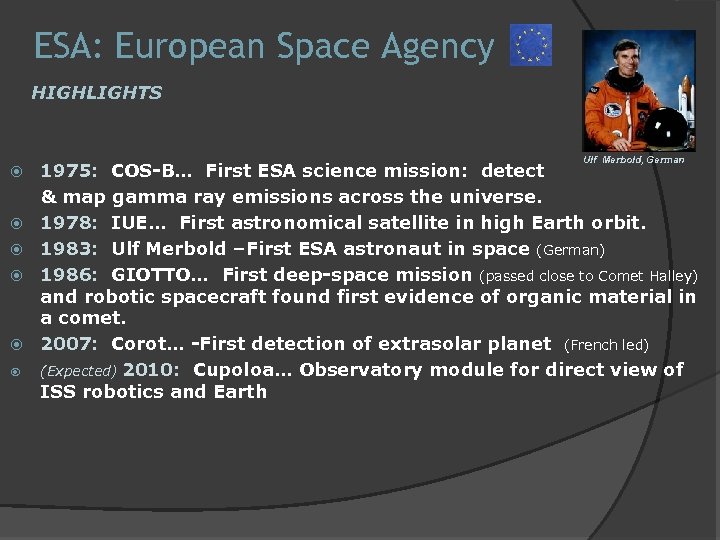 ESA: European Space Agency HIGHLIGHTS Ulf Merbold, German 1975: COS-B… First ESA science mission: detect & map gamma ray emissions across the universe. 1978: IUE… First astronomical satellite in high Earth orbit. 1983: Ulf Merbold –First ESA astronaut in space (German) 1986: GIOTTO… First deep-space mission (passed close to Comet Halley) and robotic spacecraft found first evidence of organic material in a comet. 2007: Corot… -First detection of extrasolar planet (French led) (Expected) 2010: Cupoloa… Observatory module for direct view of ISS robotics and Earth
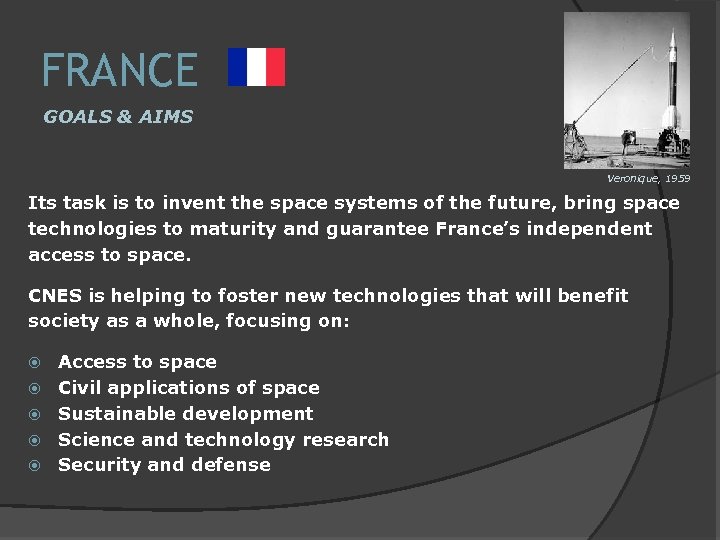 FRANCE GOALS & AIMS Veronique, 1959 Its task is to invent the space systems of the future, bring space technologies to maturity and guarantee France’s independent access to space. CNES is helping to foster new technologies that will benefit society as a whole, focusing on: Access to space Civil applications of space Sustainable development Science and technology research Security and defense
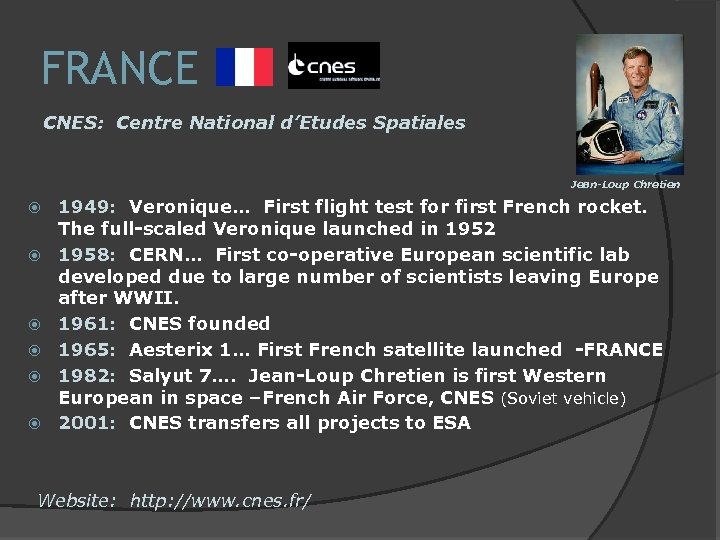 FRANCE CNES: Centre National d’Etudes Spatiales Jean-Loup Chretien 1949: Veronique… First flight test for first French rocket. The full-scaled Veronique launched in 1952 1958: CERN… First co-operative European scientific lab developed due to large number of scientists leaving Europe after WWII. 1961: CNES founded 1965: Aesterix 1… First French satellite launched -FRANCE 1982: Salyut 7…. Jean-Loup Chretien is first Western European in space –French Air Force, CNES (Soviet vehicle) 2001: CNES transfers all projects to ESA Website: http: //www. cnes. fr/
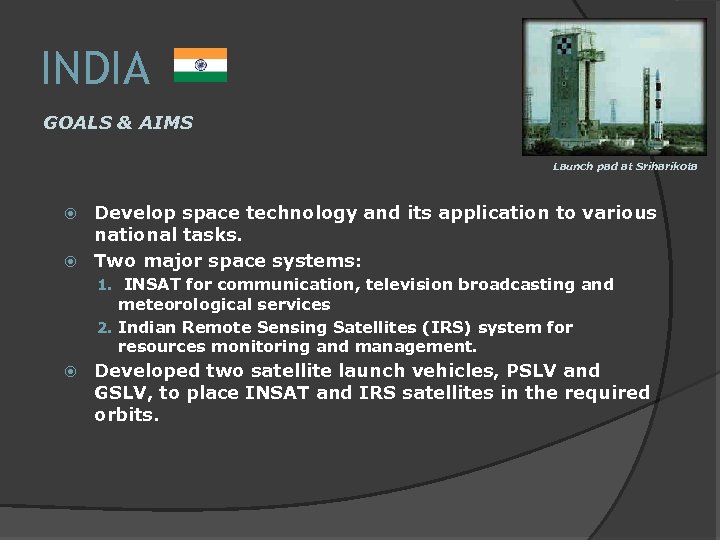 INDIA GOALS & AIMS Launch pad at Sriharikota Develop space technology and its application to various national tasks. Two major space systems: 1. INSAT for communication, television broadcasting and meteorological services 2. Indian Remote Sensing Satellites (IRS) system for resources monitoring and management. Developed two satellite launch vehicles, PSLV and GSLV, to place INSAT and IRS satellites in the required orbits.
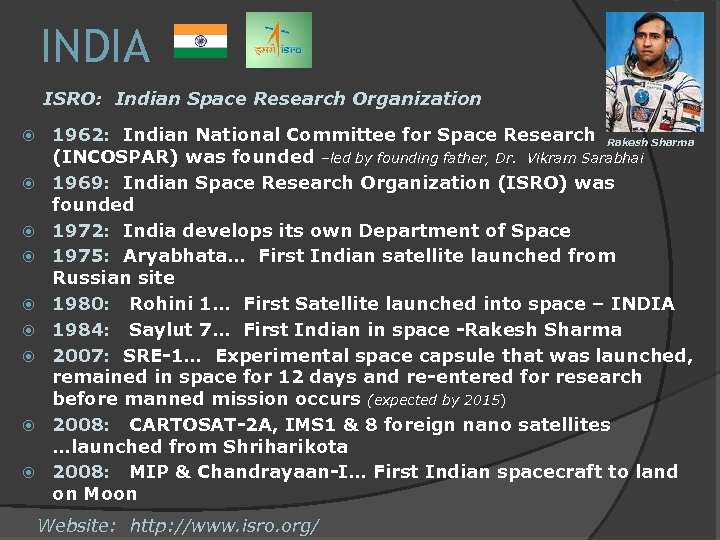 INDIA ISRO: Indian Space Research Organization 1962: Indian National Committee for Space Research Rakesh Sharma (INCOSPAR) was founded –led by founding father, Dr. Vikram Sarabhai 1969: Indian Space Research Organization (ISRO) was founded 1972: India develops its own Department of Space 1975: Aryabhata… First Indian satellite launched from Russian site 1980: Rohini 1… First Satellite launched into space – INDIA 1984: Saylut 7… First Indian in space -Rakesh Sharma 2007: SRE-1… Experimental space capsule that was launched, remained in space for 12 days and re-entered for research before manned mission occurs (expected by 2015) 2008: CARTOSAT-2 A, IMS 1 & 8 foreign nano satellites …launched from Shriharikota 2008: MIP & Chandrayaan-I… First Indian spacecraft to land on Moon Website: http: //www. isro. org/
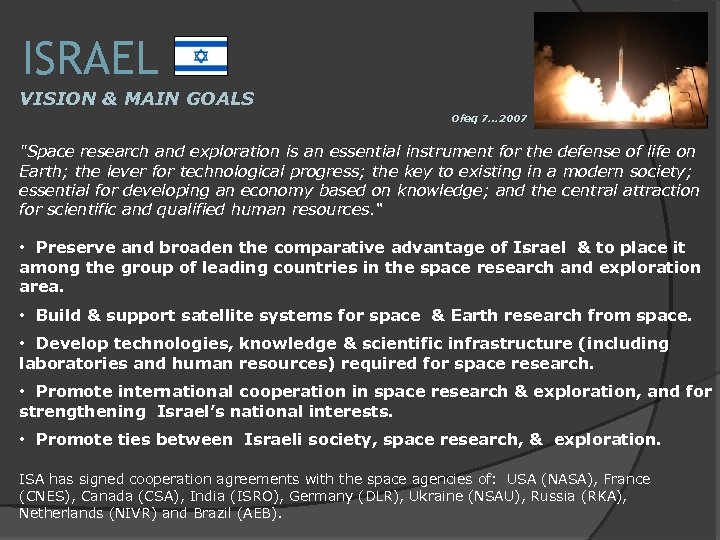 ISRAEL VISION & MAIN GOALS Ofeq 7… 2007 "Space research and exploration is an essential instrument for the defense of life on Earth; the lever for technological progress; the key to existing in a modern society; essential for developing an economy based on knowledge; and the central attraction for scientific and qualified human resources. “ • Preserve and broaden the comparative advantage of Israel & to place it among the group of leading countries in the space research and exploration area. • Build & support satellite systems for space & Earth research from space. • Develop technologies, knowledge & scientific infrastructure (including laboratories and human resources) required for space research. • Promote international cooperation in space research & exploration, and for strengthening Israel’s national interests. • Promote ties between Israeli society, space research, & exploration. ISA has signed cooperation agreements with the space agencies of: USA (NASA), France (CNES), Canada (CSA), India (ISRO), Germany (DLR), Ukraine (NSAU), Russia (RKA), Netherlands (NIVR) and Brazil (AEB).
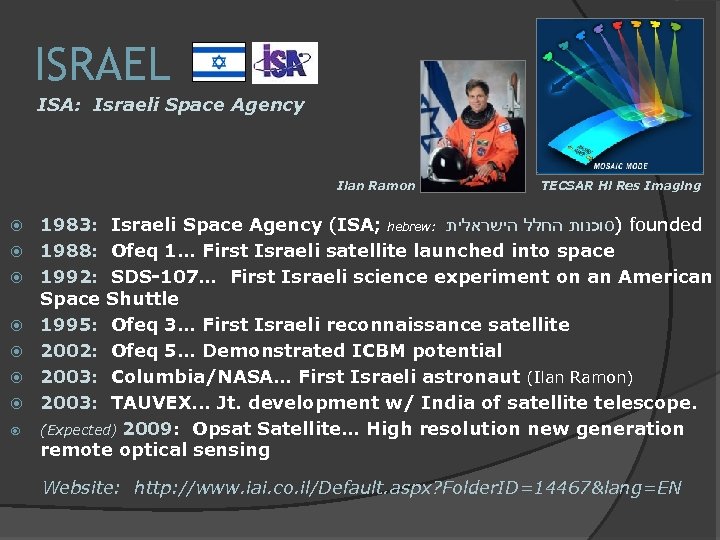 ISRAEL ISA: Israeli Space Agency Ilan Ramon TECSAR Hi Res Imaging 1983: 1988: 1992: Space 1995: 2002: 2003: Israeli Space Agency (ISA; hebrew: )סוכנות החלל הישראלית founded Ofeq 1… First Israeli satellite launched into space SDS-107… First Israeli science experiment on an American Shuttle Ofeq 3… First Israeli reconnaissance satellite Ofeq 5… Demonstrated ICBM potential Columbia/NASA… First Israeli astronaut (Ilan Ramon) TAUVEX. . . Jt. development w/ India of satellite telescope. (Expected) 2009: Opsat Satellite… High resolution new generation remote optical sensing Website: http: //www. iai. co. il/Default. aspx? Folder. ID=14467&lang=EN
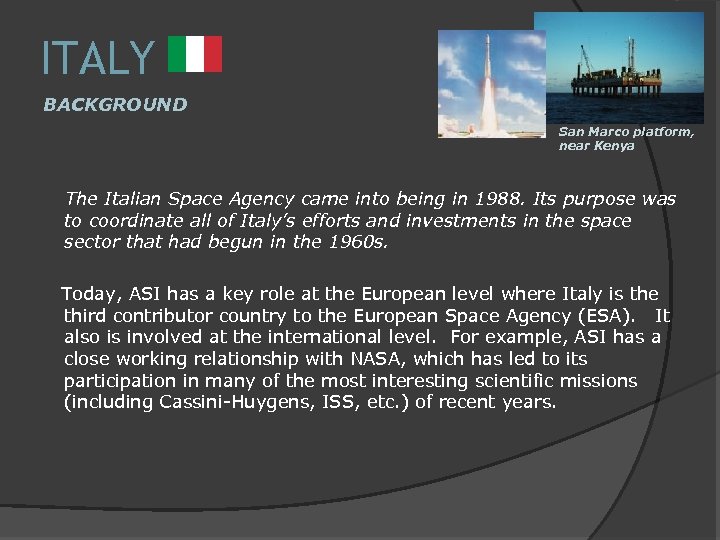 ITALY BACKGROUND San Marco platform, near Kenya The Italian Space Agency came into being in 1988. Its purpose was to coordinate all of Italy’s efforts and investments in the space sector that had begun in the 1960 s. Today, ASI has a key role at the European level where Italy is the third contributor country to the European Space Agency (ESA). It also is involved at the international level. For example, ASI has a close working relationship with NASA, which has led to its participation in many of the most interesting scientific missions (including Cassini-Huygens, ISS, etc. ) of recent years.
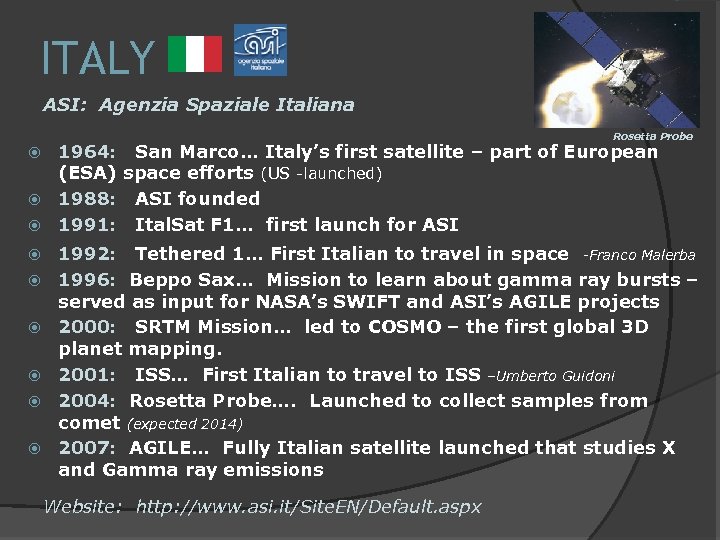 ITALY ASI: Agenzia Spaziale Italiana Rosetta Probe 1964: San Marco… Italy’s first satellite – part of European (ESA) space efforts (US -launched) 1988: ASI founded 1991: Ital. Sat F 1… first launch for ASI 1992: Tethered 1… First Italian to travel in space -Franco Malerba 1996: Beppo Sax… Mission to learn about gamma ray bursts – served as input for NASA’s SWIFT and ASI’s AGILE projects 2000: SRTM Mission… led to COSMO – the first global 3 D planet mapping. 2001: ISS… First Italian to travel to ISS –Umberto Guidoni 2004: Rosetta Probe…. Launched to collect samples from comet (expected 2014) 2007: AGILE… Fully Italian satellite launched that studies X and Gamma ray emissions Website: http: //www. asi. it/Site. EN/Default. aspx
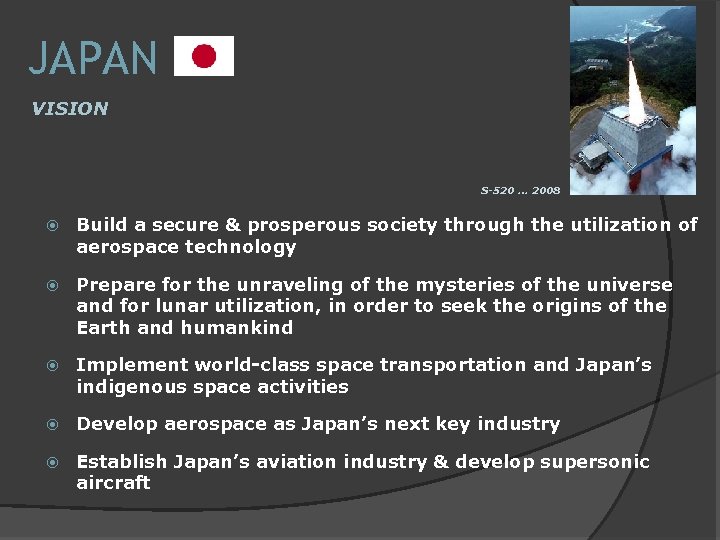 JAPAN VISION S-520 … 2008 Build a secure & prosperous society through the utilization of aerospace technology Prepare for the unraveling of the mysteries of the universe and for lunar utilization, in order to seek the origins of the Earth and humankind Implement world-class space transportation and Japan’s indigenous space activities Develop aerospace as Japan’s next key industry Establish Japan’s aviation industry & develop supersonic aircraft
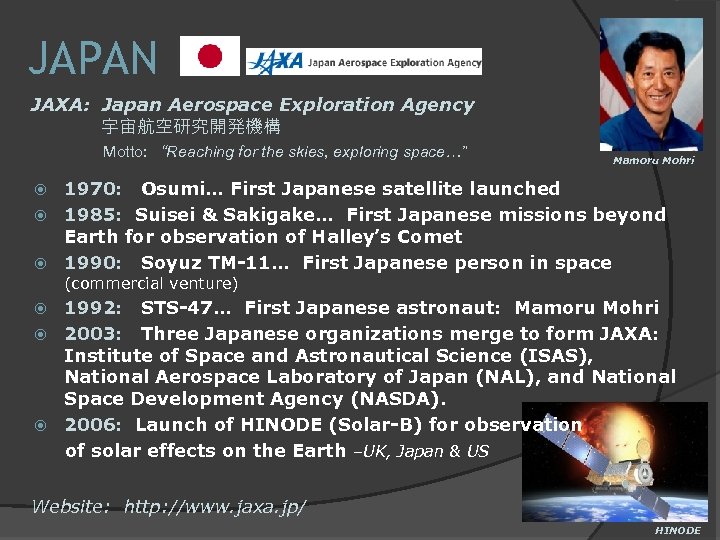 JAPAN JAXA: Japan Aerospace Exploration Agency 宇宙航空研究開発機構 Motto: “Reaching for the skies, exploring space…” Mamoru Mohri 1970: Osumi… First Japanese satellite launched 1985: Suisei & Sakigake… First Japanese missions beyond Earth for observation of Halley’s Comet 1990: Soyuz TM-11… First Japanese person in space (commercial venture) 1992: STS-47… First Japanese astronaut: Mamoru Mohri 2003: Three Japanese organizations merge to form JAXA: Institute of Space and Astronautical Science (ISAS), National Aerospace Laboratory of Japan (NAL), and National Space Development Agency (NASDA). 2006: Launch of HINODE (Solar-B) for observation of solar effects on the Earth –UK, Japan & US Website: http: //www. jaxa. jp/ HINODE
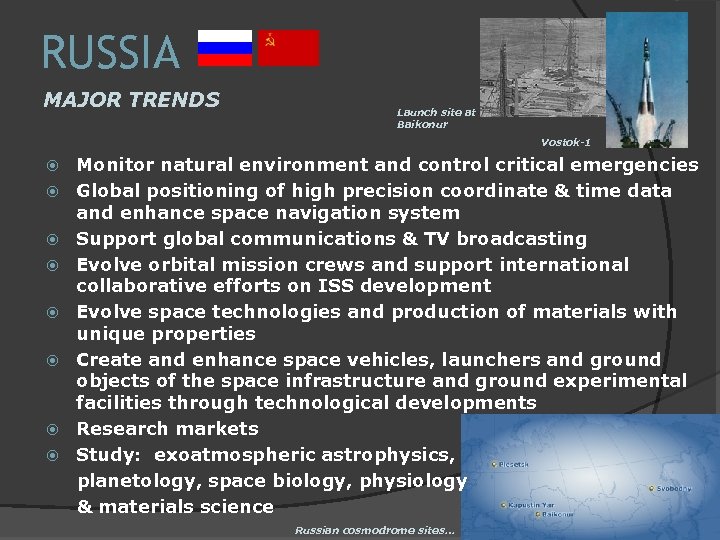 RUSSIA MAJOR TRENDS Launch site at Baikonur Vostok-1 Monitor natural environment and control critical emergencies Global positioning of high precision coordinate & time data and enhance space navigation system Support global communications & TV broadcasting Evolve orbital mission crews and support international collaborative efforts on ISS development Evolve space technologies and production of materials with unique properties Create and enhance space vehicles, launchers and ground objects of the space infrastructure and ground experimental facilities through technological developments Research markets Study: exoatmospheric astrophysics, planetology, space biology, physiology & materials science Russian cosmodrome sites…
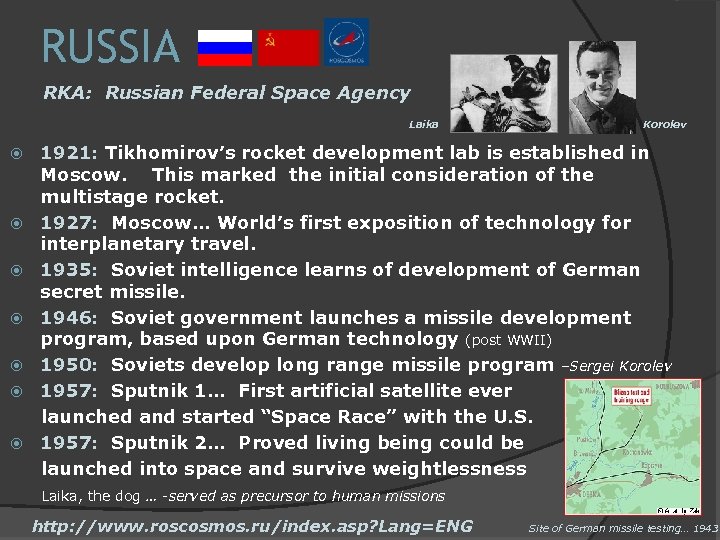 RUSSIA RKA: Russian Federal Space Agency Laika Korolev 1921: Tikhomirov’s rocket development lab is established in Moscow. This marked the initial consideration of the multistage rocket. 1927: Moscow… World’s first exposition of technology for interplanetary travel. 1935: Soviet intelligence learns of development of German secret missile. 1946: Soviet government launches a missile development program, based upon German technology (post WWII) 1950: Soviets develop long range missile program –Sergei Korolev 1957: Sputnik 1… First artificial satellite ever launched and started “Space Race” with the U. S. 1957: Sputnik 2… Proved living being could be launched into space and survive weightlessness Laika, the dog … -served as precursor to human missions http: //www. roscosmos. ru/index. asp? Lang=ENG Site of German missile testing… 1943
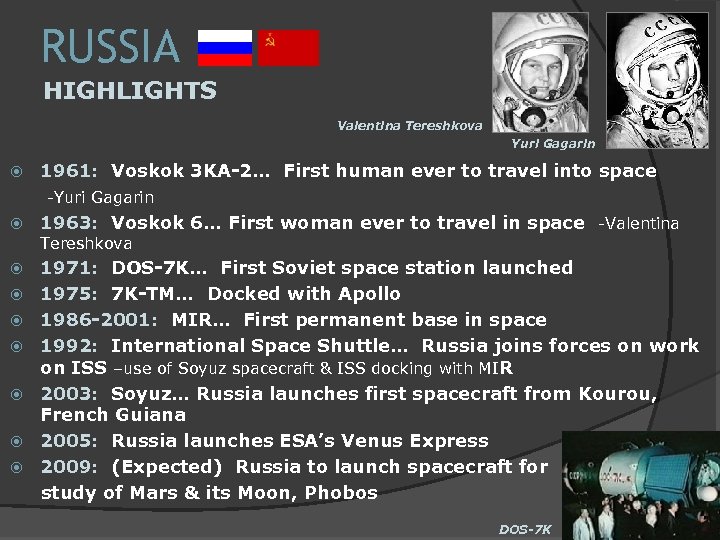 RUSSIA HIGHLIGHTS Valentina Tereshkova Yuri Gagarin 1961: Voskok 3 KA-2… First human ever to travel into space -Yuri Gagarin 1963: Voskok 6… First woman ever to travel in space -Valentina Tereshkova 1971: DOS-7 K… First Soviet space station launched 1975: 7 K-TM… Docked with Apollo 1986 -2001: MIR… First permanent base in space 1992: International Space Shuttle… Russia joins forces on work on ISS –use of Soyuz spacecraft & ISS docking with MIR 2003: Soyuz… Russia launches first spacecraft from Kourou, French Guiana 2005: Russia launches ESA’s Venus Express 2009: (Expected) Russia to launch spacecraft for study of Mars & its Moon, Phobos DOS-7 K
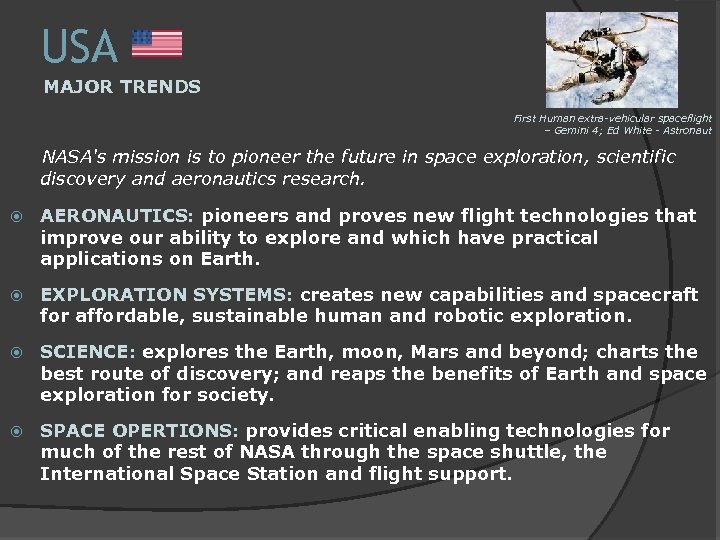 USA MAJOR TRENDS First Human extra-vehicular spaceflight – Gemini 4; Ed White - Astronaut NASA's mission is to pioneer the future in space exploration, scientific discovery and aeronautics research. AERONAUTICS: pioneers and proves new flight technologies that improve our ability to explore and which have practical applications on Earth. EXPLORATION SYSTEMS: creates new capabilities and spacecraft for affordable, sustainable human and robotic exploration. SCIENCE: explores the Earth, moon, Mars and beyond; charts the best route of discovery; and reaps the benefits of Earth and space exploration for society. SPACE OPERTIONS: provides critical enabling technologies for much of the rest of NASA through the space shuttle, the International Space Station and flight support.
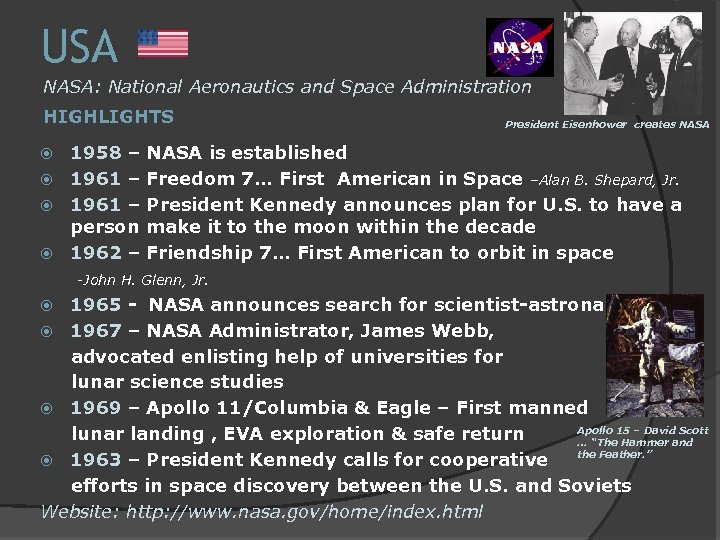 USA NASA: National Aeronautics and Space Administration HIGHLIGHTS President Eisenhower creates NASA 1958 – NASA is established 1961 – Freedom 7… First American in Space –Alan B. Shepard, Jr. 1961 – President Kennedy announces plan for U. S. to have a person make it to the moon within the decade 1962 – Friendship 7… First American to orbit in space -John H. Glenn, Jr. 1965 - NASA announces search for scientist-astronauts 1967 – NASA Administrator, James Webb, advocated enlisting help of universities for lunar science studies 1969 – Apollo 11/Columbia & Eagle – First manned Apollo 15 – David Scott lunar landing , EVA exploration & safe return … “The Hammer and the Feather. ” 1963 – President Kennedy calls for cooperative efforts in space discovery between the U. S. and Soviets Website: http: //www. nasa. gov/home/index. html
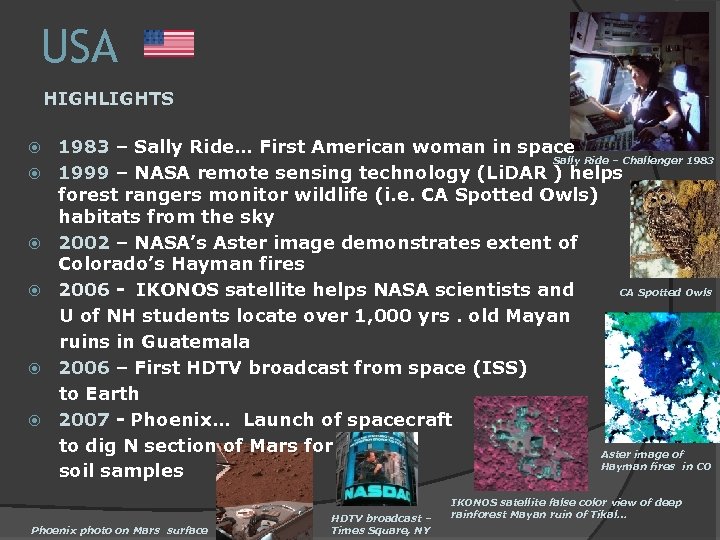 USA HIGHLIGHTS 1983 – Sally Ride… First American woman in space Sally Ride – Challenger 1983 1999 – NASA remote sensing technology (Li. DAR ) helps forest rangers monitor wildlife (i. e. CA Spotted Owls) habitats from the sky 2002 – NASA’s Aster image demonstrates extent of Colorado’s Hayman fires CA Spotted Owls 2006 - IKONOS satellite helps NASA scientists and U of NH students locate over 1, 000 yrs. old Mayan ruins in Guatemala 2006 – First HDTV broadcast from space (ISS) to Earth 2007 - Phoenix… Launch of spacecraft to dig N section of Mars for Aster image of Hayman fires in CO soil samples Phoenix photo on Mars surface HDTV broadcast – Times Square, NY IKONOS satellite false color view of deep rainforest Mayan ruin of Tikal…
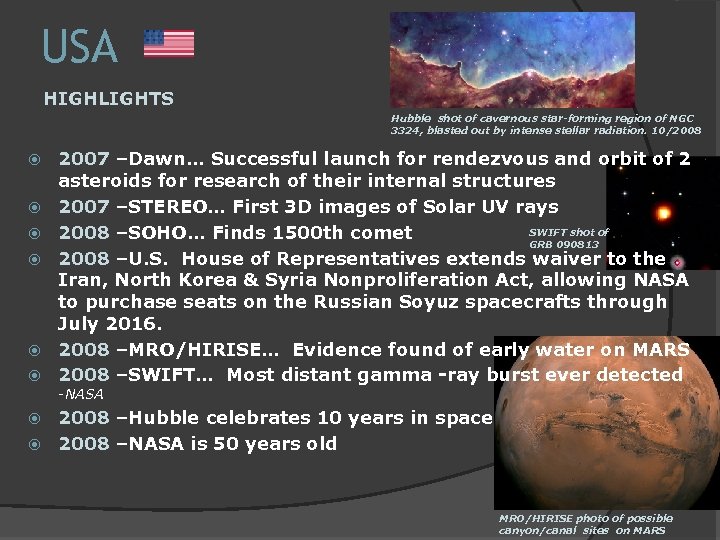 USA HIGHLIGHTS Hubble shot of cavernous star-forming region of NGC 3324, blasted out by intense stellar radiation. 10/2008 2007 –Dawn… Successful launch for rendezvous and orbit of 2 asteroids for research of their internal structures 2007 –STEREO… First 3 D images of Solar UV rays SWIFT shot of 2008 –SOHO… Finds 1500 th comet GRB 090813 2008 –U. S. House of Representatives extends waiver to the Iran, North Korea & Syria Nonproliferation Act, allowing NASA to purchase seats on the Russian Soyuz spacecrafts through July 2016. 2008 –MRO/HIRISE… Evidence found of early water on MARS 2008 –SWIFT… Most distant gamma -ray burst ever detected -NASA 2008 –Hubble celebrates 10 years in space 2008 –NASA is 50 years old MRO/HIRISE photo of possible canyon/canal sites on MARS
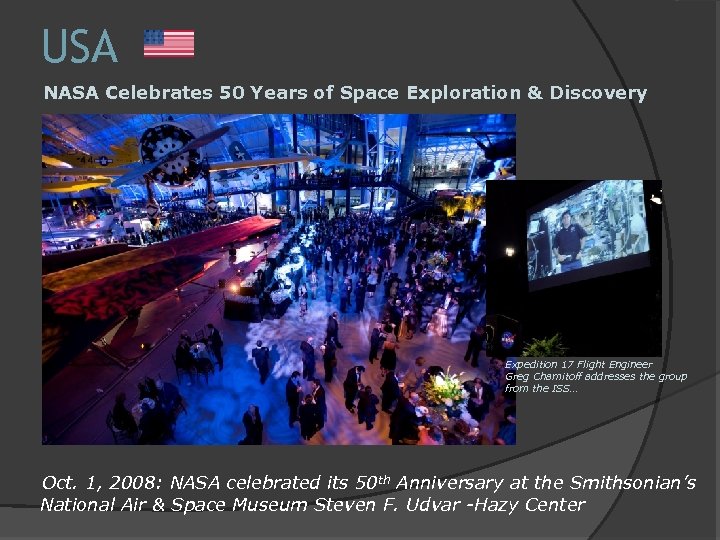 USA NASA Celebrates 50 Years of Space Exploration & Discovery Expedition 17 Flight Engineer Greg Chamitoff addresses the group from the ISS… Oct. 1, 2008: NASA celebrated its 50 th Anniversary at the Smithsonian’s National Air & Space Museum Steven F. Udvar -Hazy Center
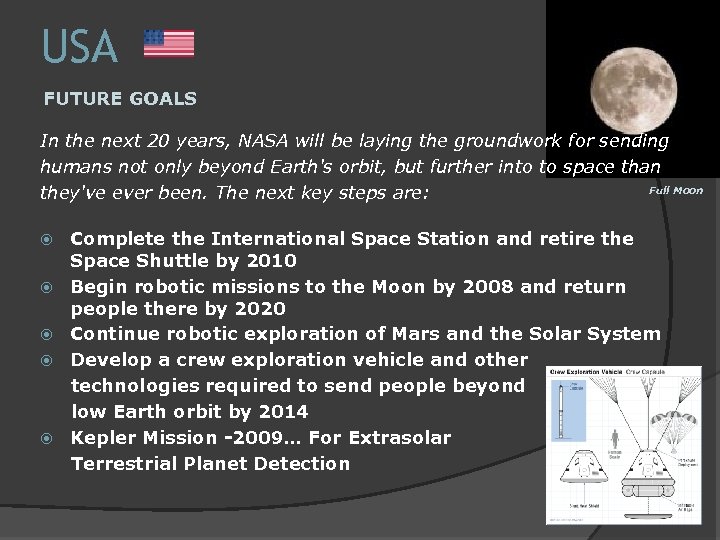 USA FUTURE GOALS In the next 20 years, NASA will be laying the groundwork for sending humans not only beyond Earth's orbit, but further into to space than Full Moon they've ever been. The next key steps are: Complete the International Space Station and retire the Space Shuttle by 2010 Begin robotic missions to the Moon by 2008 and return people there by 2020 Continue robotic exploration of Mars and the Solar System Develop a crew exploration vehicle and other technologies required to send people beyond low Earth orbit by 2014 Kepler Mission -2009… For Extrasolar Terrestrial Planet Detection
 USA FUTURE NASA PROJECTS Broaden programs in science and aeronautics, while focusing the human spaceflight endeavors on exploration Develop and expand partnerships with private industries Develop a program to return humans to the Moon, establish a lunar base and pursue subsequent exploration of Mars and other destinations Continued joint international efforts Private company Mars panorama, Spirit shot
 Barack Obama’s Plan STRENGTHEN AMERICA’S LEADERSHIP IN SPACE SCIENCE “It is essential to maintain U. S. leadership in space… In 2010, the U. S. will face a five-year gap in the ability to send astronauts to the International Space Station. The Obama Administration will restore America’s leadership in space science: • Establish a robust program for human and robotic exploration that preserves our space workforce, engages international allies and draws on expertise in the private sector. • Close the gap in NASA access to lower earth orbit and better utilize the International Space Station. • Strengthen NASA’s missions in space science, weather, climate research, and aeronautical research. • Develop a new generation of space vehicles to replace the Space Shuttle scheduled to retire in 2010. • Improve NASA’s educational outreach and programs that promote spin-off consumer technologies. ”
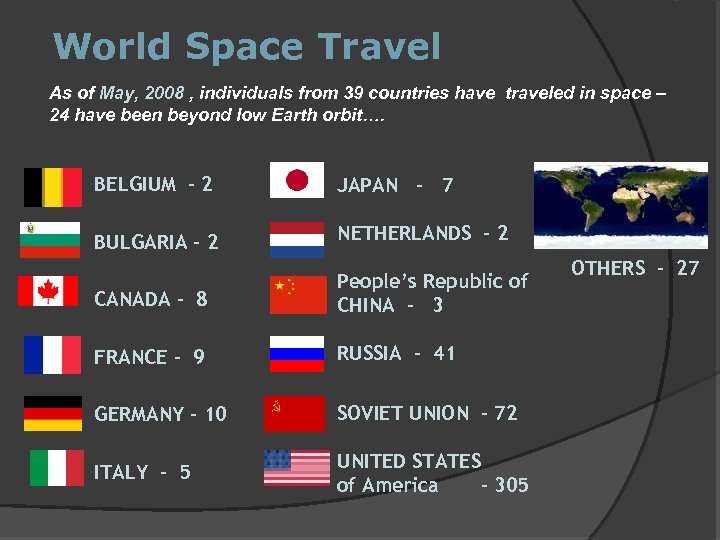 World Space Travel As of May, 2008 , individuals from 39 countries have traveled in space – 24 have been beyond low Earth orbit…. BELGIUM - 2 JAPAN - 7 BULGARIA – 2 NETHERLANDS - 2 CANADA – 8 People’s Republic of CHINA - 3 FRANCE - 9 RUSSIA - 41 GERMANY – 10 SOVIET UNION - 72 ITALY - 5 UNITED STATES of America - 305 OTHERS - 27