 Скачать презентацию World Science Forum — Budapest 11 November 2005
e8516dc00f420c62d3bbdd0327a6ae7b.ppt
- Количество слайдов: 27



World Science Forum - Budapest 11 November 2005: Hungarian Academy of Sciences Science & Technology in Society forum - Lights and Shadows Hiroyuki Yoshikawa President National Institute of Advanced Industrial Science and Technology (AIST)
STS forum: Fundamental Concept (1) This forum aims to provide a new mechanism for open discussions on an informal basis, and to build a community that would, in time, resolve new types of problems stemming from the application of science and technology.
STS forum; Fundamental Concept (2) ✯ 20 th century’s progress of Science & Technology ➣ Brought prosperity and enriched the quality of life for much mankind. ➣ However, benefits are not reaching a major part of the world’s people. ➣ Advance of science and technology raises important issues; - increasingly complex in context of the globalized world, - beyond the control of any single country, - beyond the reach of the scientific community alone, - benefit sometimes turns into evils (e. g. ) - harmonizing economic development with global warming, - preventing terrorism, - controlling infectious diseases, - assessing the potential health benefits and ethical factors related to human cloning technology, etc…
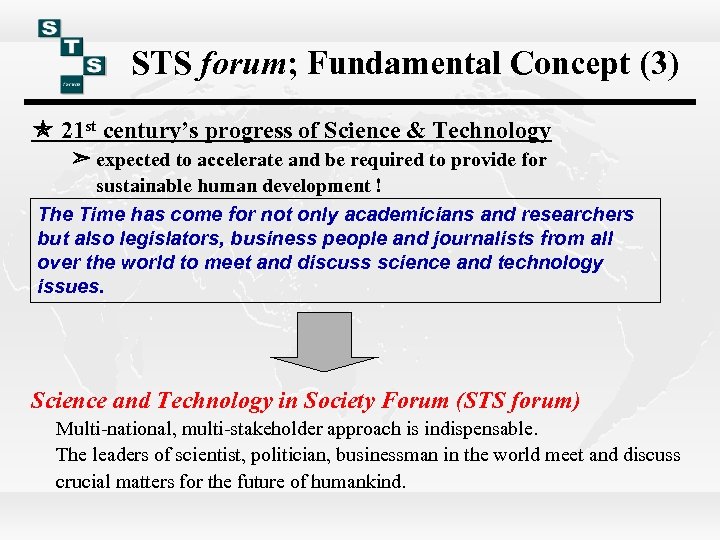
STS forum; Fundamental Concept (3) ✯ 21 st century’s progress of Science & Technology ➣ expected to accelerate and be required to provide for sustainable human development ! The Time has come for not only academicians and researchers but also legislators, business people and journalists from all over the world to meet and discuss science and technology issues. Science and Technology in Society Forum (STS forum) Multi-national, multi-stakeholder approach is indispensable. The leaders of scientist, politician, businessman in the world meet and discuss crucial matters for the future of humankind.
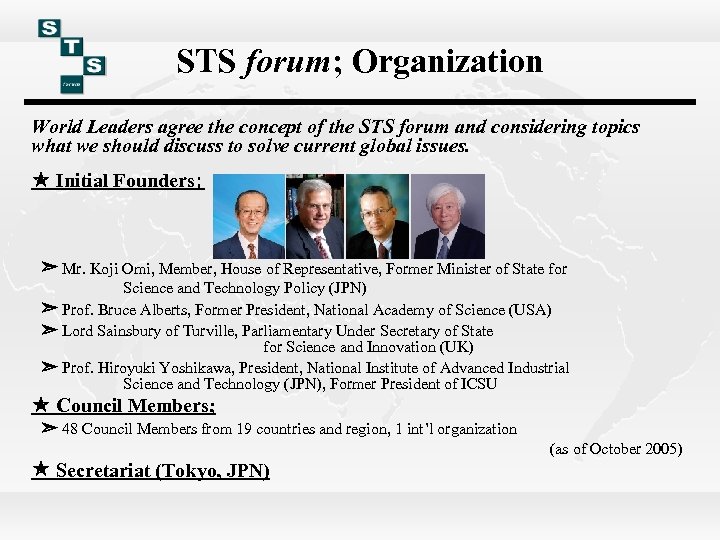
STS forum; Organization World Leaders agree the concept of the STS forum and considering topics what we should discuss to solve current global issues. ✯ Initial Founders; ➣ Mr. Koji Omi, Member, House of Representative, Former Minister of State for Science and Technology Policy (JPN) ➣ Prof. Bruce Alberts, Former President, National Academy of Science (USA) ➣ Lord Sainsbury of Turville, Parliamentary Under Secretary of State for Science and Innovation (UK) ➣ Prof. Hiroyuki Yoshikawa, President, National Institute of Advanced Industrial Science and Technology (JPN), Former President of ICSU ✯ Council Members; ➣ 48 Council Members from 19 countries and region, 1 int’l organization (as of October 2005) ✯ Secretariat (Tokyo, JPN)
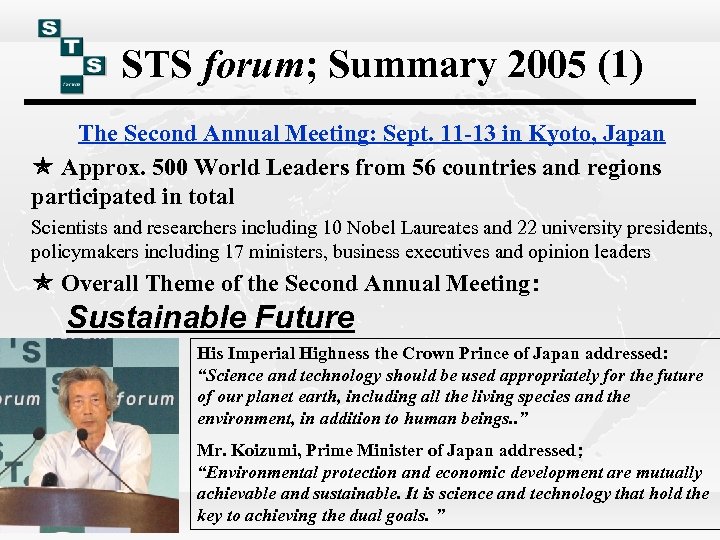
STS forum; Summary 2005 (1) The Second Annual Meeting: Sept. 11 -13 in Kyoto, Japan ✯ Approx. 500 World Leaders from 56 countries and regions participated in total Scientists and researchers including 10 Nobel Laureates and 22 university presidents, policymakers including 17 ministers, business executives and opinion leaders ✯ Overall Theme of the Second Annual Meeting: Sustainable Future His Imperial Highness the Crown Prince of Japan addressed: “Science and technology should be used appropriately for the future of our planet earth, including all the living species and the environment, in addition to human beings. . ” Mr. Koizumi, Prime Minister of Japan addressed; “Environmental protection and economic development are mutually achievable and sustainable. It is science and technology that hold the key to achieving the dual goals. ”
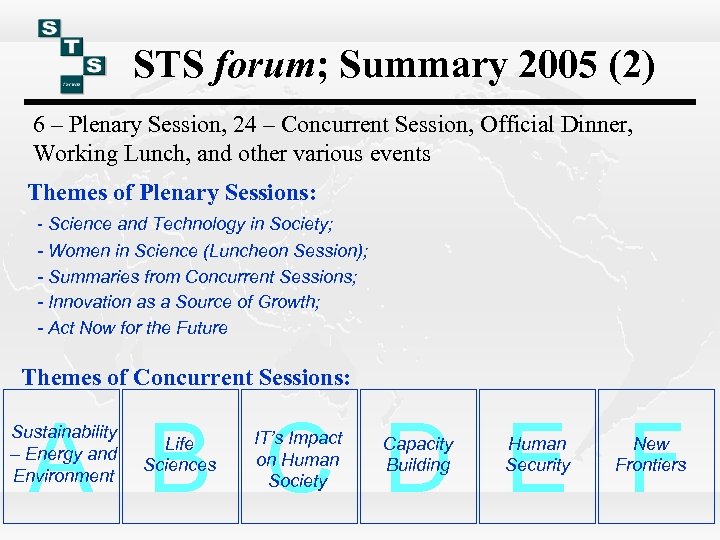
STS forum; Summary 2005 (2) 6 – Plenary Session, 24 – Concurrent Session, Official Dinner, Working Lunch, and other various events Themes of Plenary Sessions: - Science and Technology in Society; - Women in Science (Luncheon Session); - Summaries from Concurrent Sessions; - Innovation as a Source of Growth; - Act Now for the Future Themes of Concurrent Sessions: A B C D E F Sustainability – Energy and Environment Life Sciences IT’s Impact on Human Society Capacity Building Human Security New Frontiers
STS forum; Summary 2005 (3) Concurrent Sessions (A and B series): A) Sustainability – Energy and Environment - Global Warming and CO 2 Emission Control - Longterm Energy Paths - Strategies for Efficient and Renewable Energy Use B) Life Sciences: - Ethical Aspects of Stem Cells and Regenerative Medicine - New Applications of Genomics to Agriculture - Translation of Science to the Marketplace: The Development of Medicine for Global Health
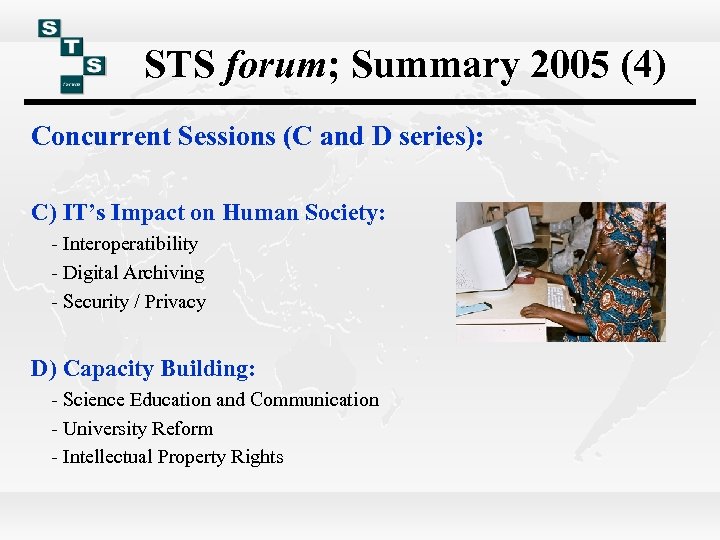
STS forum; Summary 2005 (4) Concurrent Sessions (C and D series): C) IT’s Impact on Human Society: - Interoperatibility - Digital Archiving - Security / Privacy D) Capacity Building: - Science Education and Communication - University Reform - Intellectual Property Rights
STS forum; Summary 2005 (5) Concurrent Sessions (E and F series): E) Science and Technology for Human Security: - Infectious Diseases - Science and Technology to Reduce the Vulnerability of Critical Infrastructures - Science and Technology against Natural Disasters F) New Frontiers Opened by Science and Technology: - New Frontiers Opened by IT (Information and Communication Technology) - New Frontiers Opened by NT (Nano-Technology) - New Frontiers Opened by Manufacturing
STS forum 2005: STATEMENT (1) “It is important for all people, regardless of their background, to consider Science and Technology issues as their own. Recognizing that both the Lights and Shadows of Science and Technology will have a great impact on the human race, we agreed that Science and Technology race should not control Humankind; Humankind should control Science and Technology. ” Technology
STS forum 2005: STATEMENT (2) Framework for Sustainable Future: A practical and effective framework that all countries will participate in, to deal with CO 2 emissions and other climate-forcing emissions. Renewable Energy Sources: Further Development of renewable energy sources: Solar, Biomass, Hydrogen, and, Nuclear Fission Power under strict conditions of safety and non-proliferation Bioethics Issues: To try to establish common international standards concerning bioethics that will enable researchers in all countries to collaborate and have the opportunity to be equally productive in their research activities
STS forum 2005: STATEMENT (3) ICT’s impact on Human Society: ØFurther development of ICT will build a thriving future for humankind. ØInteroperability, Security and Privacy Protection are imperative for information society. ØDigital Archiving for equal access to science and technology knowledge is important. ØResolving the digital divide issue will be of common benefit to humankind. Education for All: Universal access to education, regardless of gender, race or national origin, is vital for our future. Intellectural Property Rights (IPR): A global, integrated system of IPR was proposed and supported by many participants.
STS forum 2005: STATEMENT (4) Science and Technology for Human Security: Against Terrorism: To prevent the use of science and technology by terrorists; To use science and technology to defend against terrorism Against Infectious Diseases Developing vaccines and medical therapies against infectious diseases like AIDS is crucial for mankind’s future and is one of the most important fields where science and technology can make a contribution. Against Natural Disasters International cooperation to establish early warning, human safety and rescue systems is strongly needed. STS forum, the scene of the latest Science and Technology: STS forum serves as an important venue for exchanging views on the latest discoveries and innovations in Science and Technology and their impact on humankind.
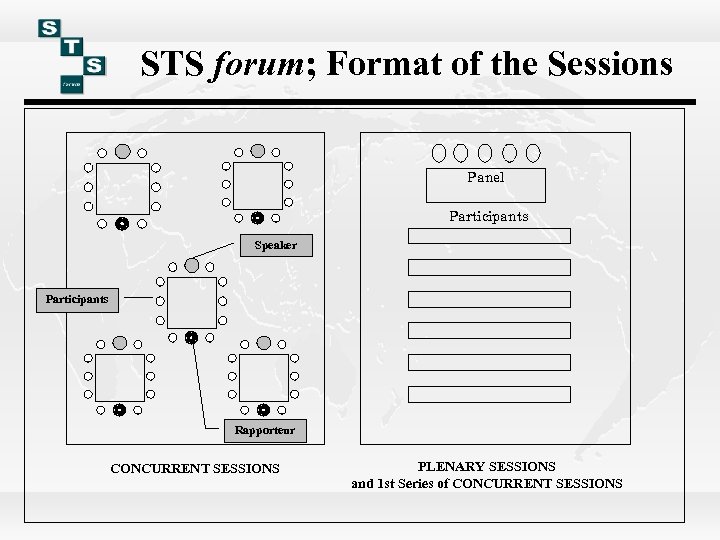
STS forum; Format of the Sessions Panel Participants Speaker Participants Rapporteur CONCURRENT SESSIONS PLENARY SESSIONS and 1 st Series of CONCURRENT SESSIONS
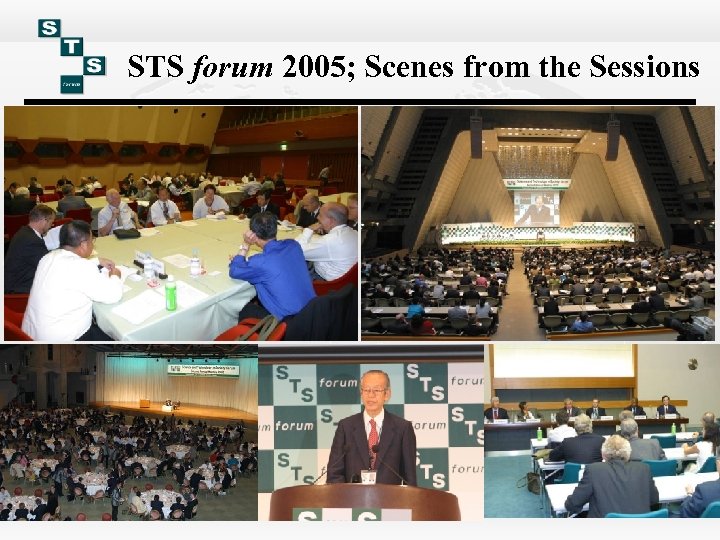
STS forum 2005; Scenes from the Sessions
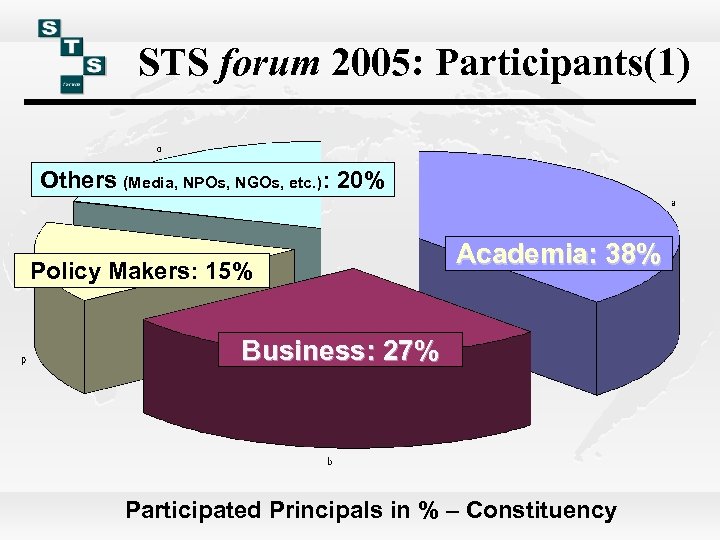
STS forum 2005: Participants(1) Others (Media, NPOs, NGOs, etc. ): 20% Policy Makers: 15% Academia: 38% Business: 27% Participated Principals in % – Constituency
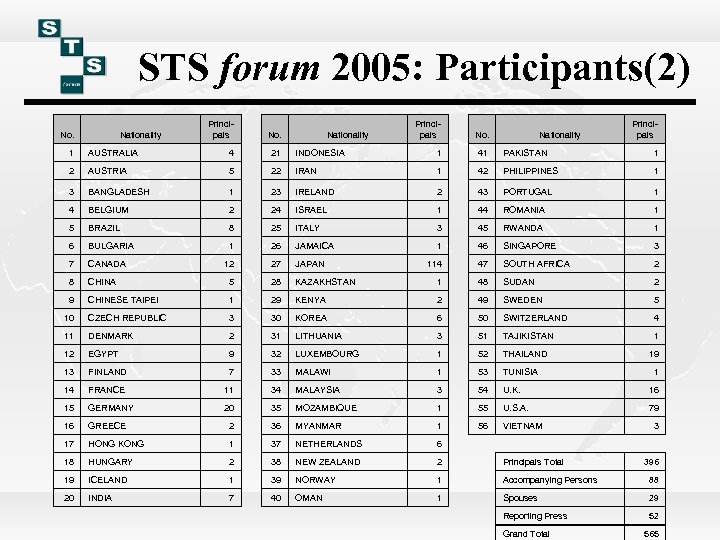
STS forum 2005: Participants(2) No. Nationality Principals 1 AUSTRALIA 4 21 INDONESIA 1 41 PAKISTAN 1 2 AUSTRIA 5 22 IRAN 1 42 PHILIPPINES 1 3 BANGLADESH 1 23 IRELAND 2 43 PORTUGAL 1 4 BELGIUM 2 24 ISRAEL 1 44 ROMANIA 1 5 BRAZIL 8 25 ITALY 3 45 RWANDA 1 6 BULGARIA 1 26 JAMAICA 1 46 SINGAPORE 3 7 CANADA 12 27 JAPAN 114 47 SOUTH AFRICA 2 8 CHINA 5 28 KAZAKHSTAN 1 48 SUDAN 2 9 CHINESE TAIPEI 1 29 KENYA 2 49 SWEDEN 5 10 CZECH REPUBLIC 3 30 KOREA 6 50 SWITZERLAND 4 11 DENMARK 2 31 LITHUANIA 3 51 TAJIKISTAN 1 12 EGYPT 9 32 LUXEMBOURG 1 52 THAILAND 13 FINLAND 7 33 MALAWI 1 53 TUNISIA 14 FRANCE 11 34 MALAYSIA 3 54 U. K. 16 15 GERMANY 20 35 MOZAMBIQUE 1 55 U. S. A. 79 16 GREECE 2 36 MYANMAR 1 56 VIETNAM 17 HONG KONG 1 37 NETHERLANDS 6 18 HUNGARY 2 38 NEW ZEALAND 2 Principals Total 19 ICELAND 1 39 NORWAY 1 Accompanying Persons 88 20 INDIA 7 40 OMAN 1 Spouses 29 Reporting Press 52 Grand Total 19 1 3 396 565
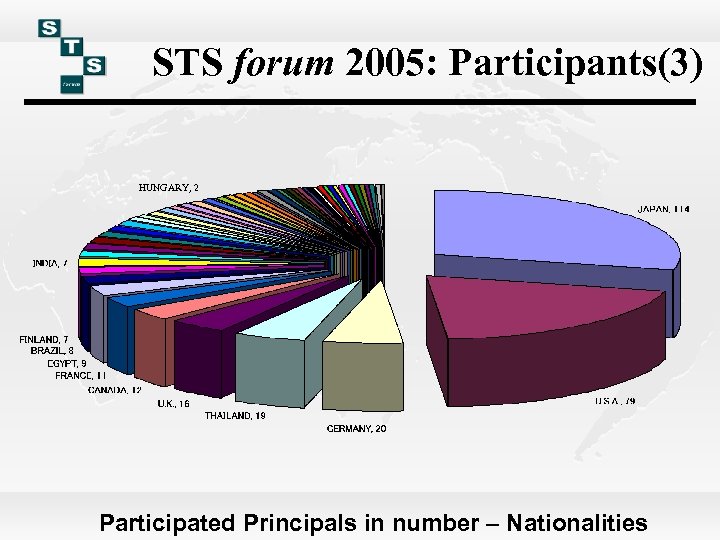
STS forum 2005: Participants(3) HUNGARY, 2 Participated Principals in number – Nationalities
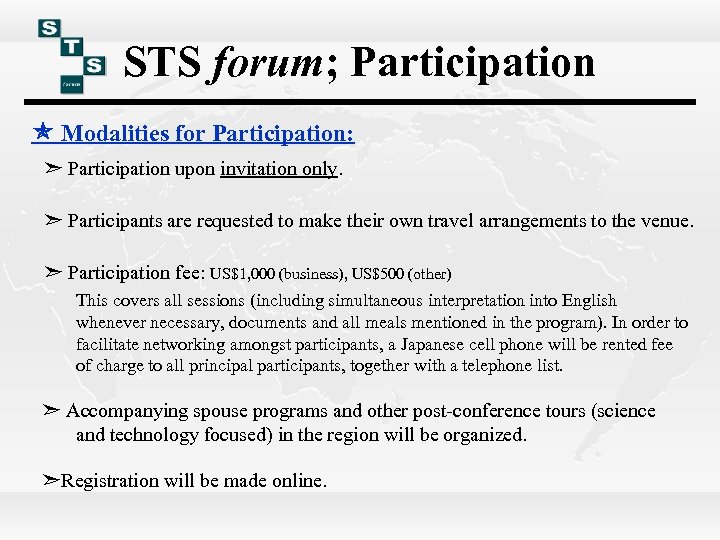
STS forum; Participation ✯ Modalities for Participation: ➣ Participation upon invitation only. ➣ Participants are requested to make their own travel arrangements to the venue. ➣ Participation fee: US$1, 000 (business), US$500 (other) This covers all sessions (including simultaneous interpretation into English whenever necessary, documents and all meals mentioned in the program). In order to facilitate networking amongst participants, a Japanese cell phone will be rented fee of charge to all principal participants, together with a telephone list. ➣ Accompanying spouse programs and other post-conference tours (science and technology focused) in the region will be organized. ➣Registration will be made online.
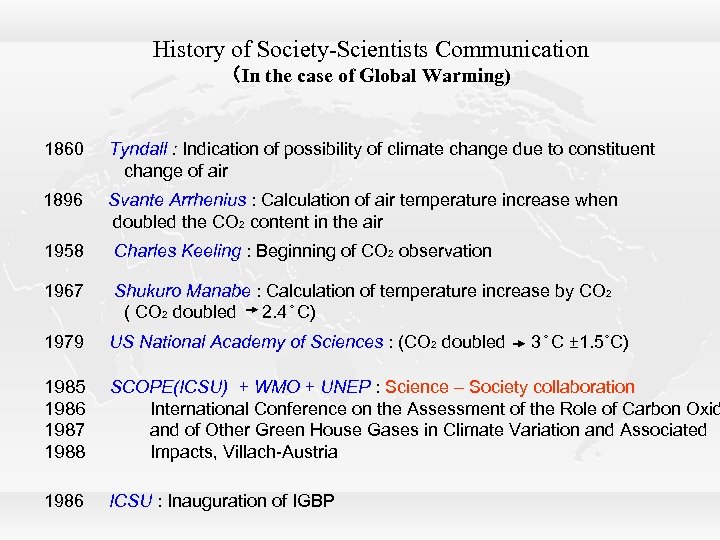
History of Society-Scientists Communication (In the case of Global Warming) 1860 Tyndall : Indication of possibility of climate change due to constituent change of air 1896 Svante Arrhenius : Calculation of air temperature increase when doubled the CO 2 content in the air 1958 Charles Keeling : Beginning of CO 2 observation 1967 Shukuro Manabe : Calculation of temperature increase by CO 2 ( CO 2 doubled 2. 4 C) 1979 US National Academy of Sciences : (CO 2 doubled 1985 1986 1987 1988 SCOPE(ICSU) + WMO + UNEP : Science – Society collaboration International Conference on the Assessment of the Role of Carbon Oxid and of Other Green House Gases in Climate Variation and Associated Impacts, Villach-Austria 1986 ICSU : Inauguration of IGBP 3 C ± 1. 5˚C)
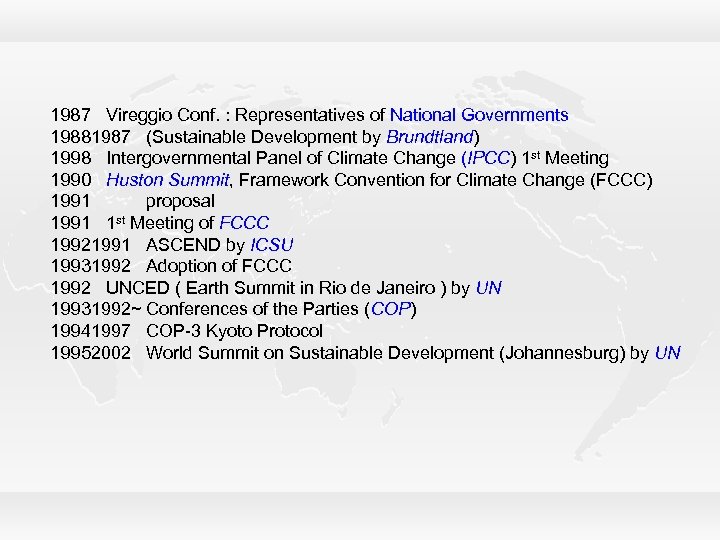
1987 Vireggio Conf. : Representatives of National Governments 19881987 (Sustainable Development by Brundtland) 1998 Intergovernmental Panel of Climate Change (IPCC) 1 st Meeting 1990 Huston Summit, Framework Convention for Climate Change (FCCC) 1991 proposal 1991 1 st Meeting of FCCC 19921991 ASCEND by ICSU 19931992 Adoption of FCCC 1992 UNCED ( Earth Summit in Rio de Janeiro ) by UN 19931992~ Conferences of the Parties (COP) 19941997 COP-3 Kyoto Protocol 19952002 World Summit on Sustainable Development (Johannesburg) by UN
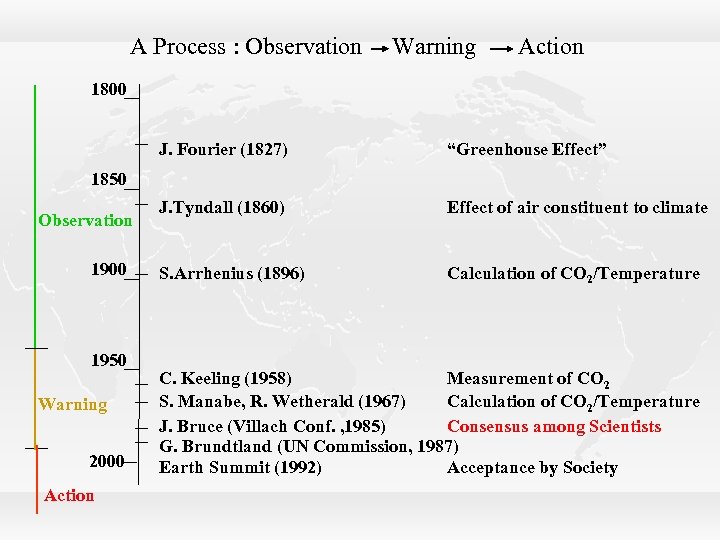
A Process : Observation Warning Action 1800 J. Fourier (1827) “Greenhouse Effect” J. Tyndall (1860) Effect of air constituent to climate S. Arrhenius (1896) Calculation of CO 2/Temperature 1850 Observation 1900 1950 Warning 2000 Action C. Keeling (1958) Measurement of CO 2 S. Manabe, R. Wetherald (1967) Calculation of CO 2/Temperature J. Bruce (Villach Conf. , 1985) Consensus among Scientists G. Brundtland (UN Commission, 1987) Earth Summit (1992) Acceptance by Society
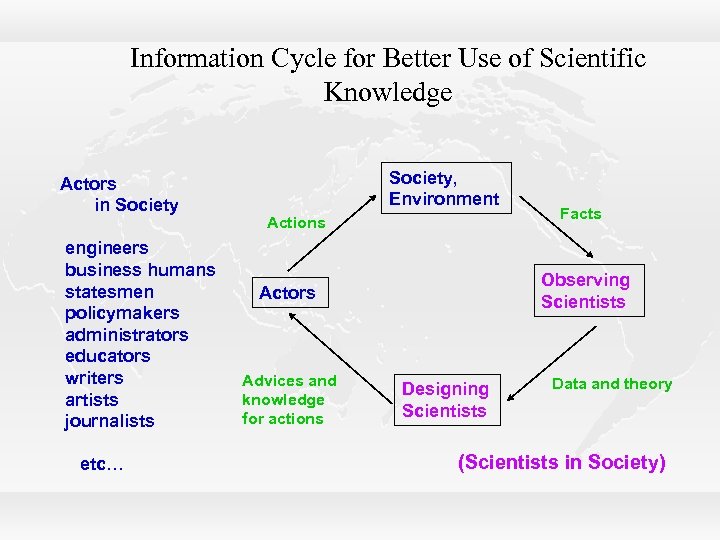
Information Cycle for Better Use of Scientific Knowledge Actors in Society engineers business humans statesmen policymakers administrators educators writers artists journalists etc… Society, Environment Actions Observing Scientists Actors Advices and knowledge for actions Facts Designing Scientists Data and theory (Scientists in Society)
Conditions of STS Forum Better Communication Between Society and Scientists 1. Equal Footing Statesmen, Businessmen and Scientists have equal responsibility for organizing and running the forum. 2. Individual Participation Any participants are not representing institutions they belong to, but personal. 3. Wide view Participants are not requested deep specific expertise but wisdom backed by wide knowledge. 4. New perspective This forum aims at creating new perspective for science and society.
STS forum; Plan 2006 ➣ Date: Sunday 10 – Tuesday 12, September, 2006 ➣ Venue: Kyoto International Conference Hall, Japan (http: //www. kich. or. jp/en/index. html)
STS forum; Contact For more information for STS forum, Please contact to: STS forum Secretariat (in Tokyo, Japan) Tel: +81 -3 -3519 -3351; Fax: +81 -3 -3519 -3352 E-Mail: information@stsforum. org; URL: http: //www. stsforum. org
Скачать презентацию World Science Forum — Budapest 11 November 2005
e8516dc00f420c62d3bbdd0327a6ae7b.ppt