


 Скачать презентацию World religions Religion Religion is an
6d1e70b6c4678116d11ea6b8cdfbb497.ppt
- Количество слайдов: 28
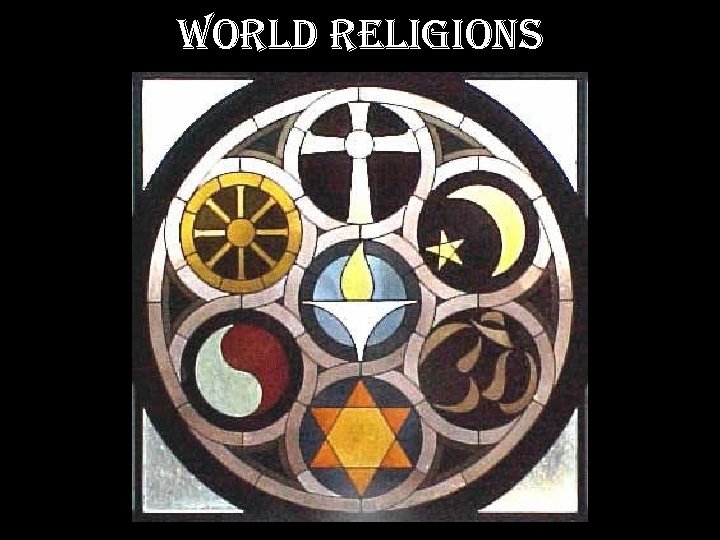 World religions
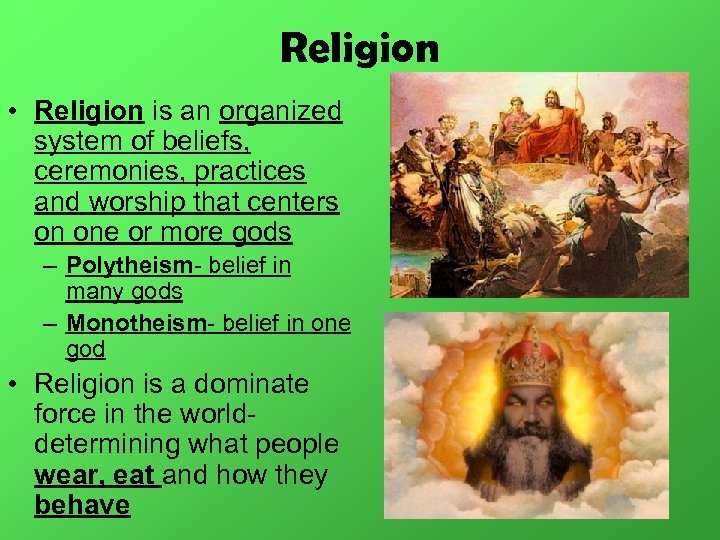 Religion • Religion is an organized system of beliefs, ceremonies, practices and worship that centers on one or more gods – Polytheism- belief in many gods – Monotheism- belief in one god • Religion is a dominate force in the worlddetermining what people wear, eat and how they behave
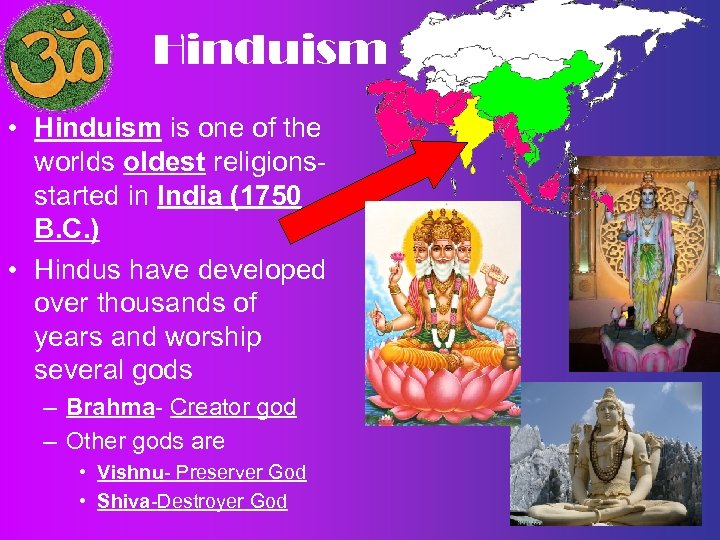 Hinduism • Hinduism is one of the worlds oldest religionsstarted in India (1750 B. C. ) • Hindus have developed over thousands of years and worship several gods – Brahma- Creator god – Other gods are • Vishnu- Preserver God • Shiva-Destroyer God
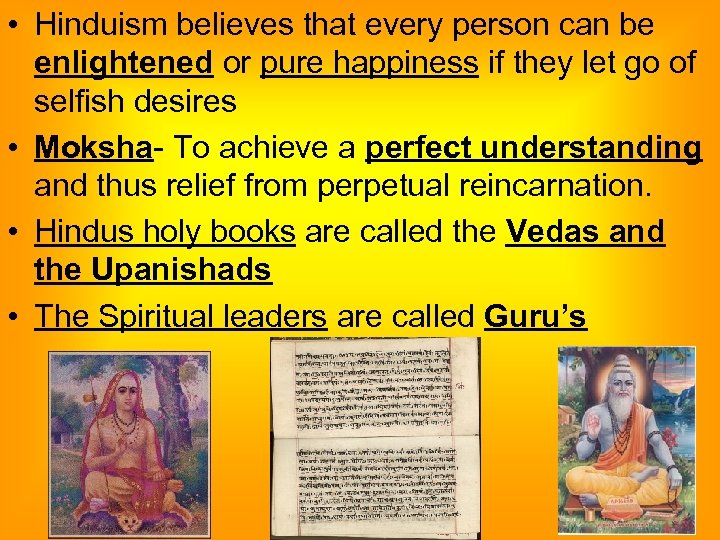 • Hinduism believes that every person can be enlightened or pure happiness if they let go of selfish desires • Moksha- To achieve a perfect understanding and thus relief from perpetual reincarnation. • Hindus holy books are called the Vedas and the Upanishads • The Spiritual leaders are called Guru’s
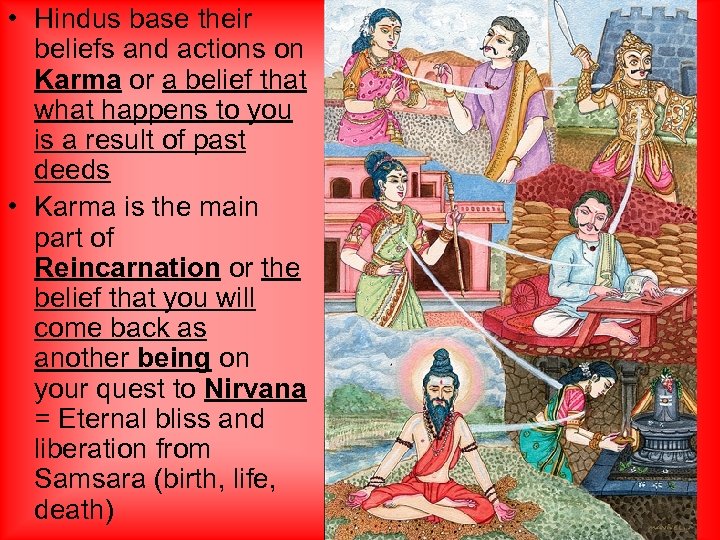 • Hindus base their beliefs and actions on Karma or a belief that what happens to you is a result of past deeds • Karma is the main part of Reincarnation or the belief that you will come back as another being on your quest to Nirvana = Eternal bliss and liberation from Samsara (birth, life, death)
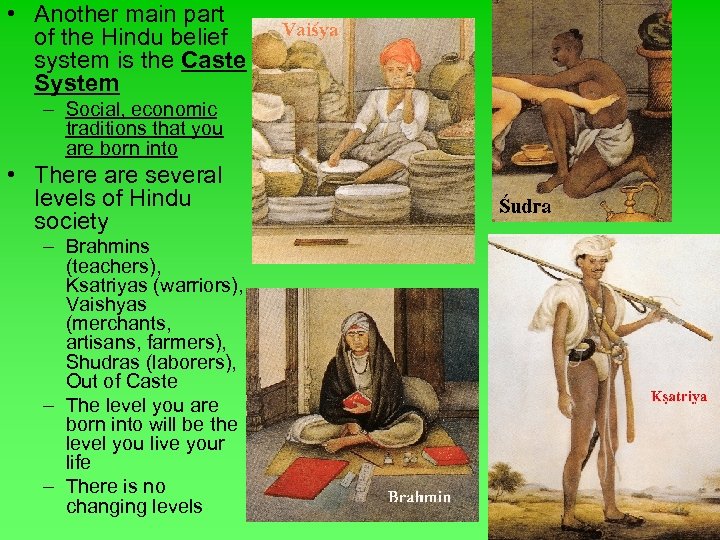 • Another main part of the Hindu belief system is the Caste System – Social, economic traditions that you are born into • There are several levels of Hindu society – Brahmins (teachers), Ksatriyas (warriors), Vaishyas (merchants, artisans, farmers), Shudras (laborers), Out of Caste – The level you are born into will be the level you live your life – There is no changing levels
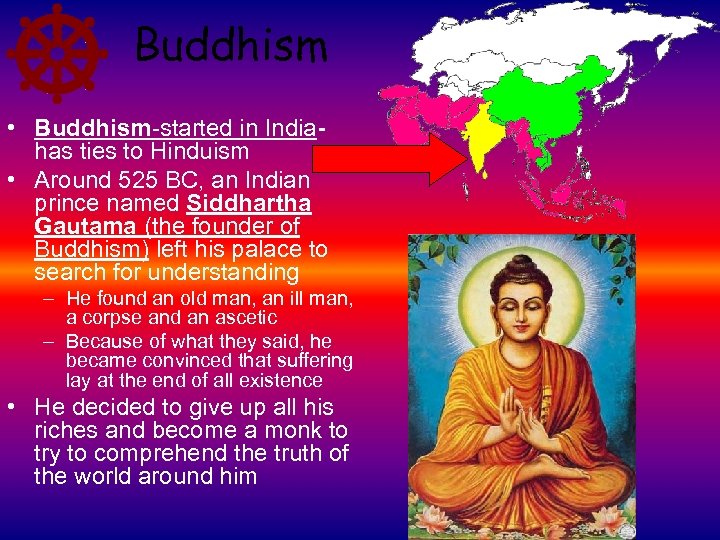 Buddhism • Buddhism-started in Indiahas ties to Hinduism • Around 525 BC, an Indian prince named Siddhartha Gautama (the founder of Buddhism) left his palace to search for understanding – He found an old man, an ill man, a corpse and an ascetic – Because of what they said, he became convinced that suffering lay at the end of all existence • He decided to give up all his riches and become a monk to try to comprehend the truth of the world around him
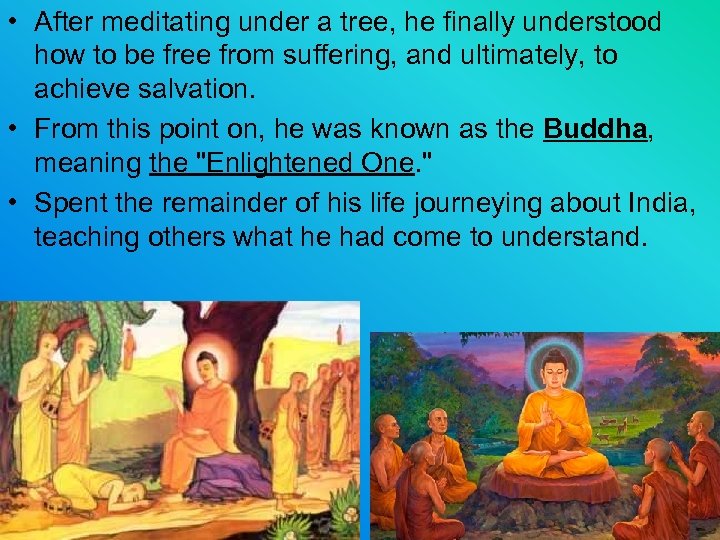 • After meditating under a tree, he finally understood how to be free from suffering, and ultimately, to achieve salvation. • From this point on, he was known as the Buddha, meaning the "Enlightened One. " • Spent the remainder of his life journeying about India, teaching others what he had come to understand.
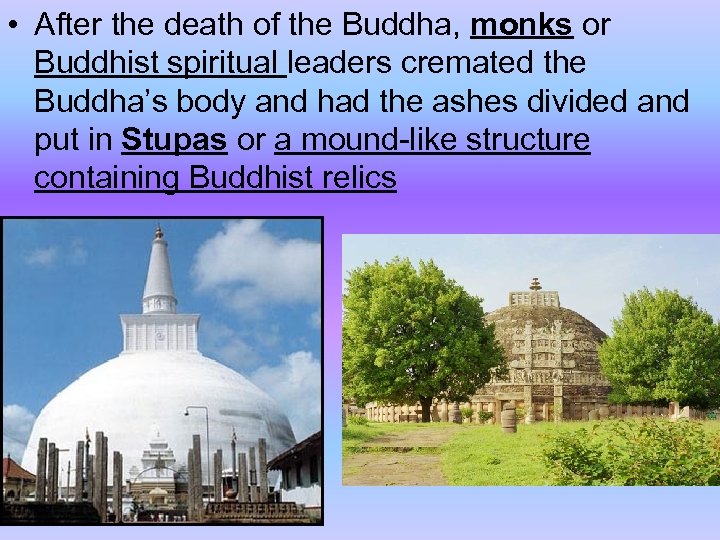 • After the death of the Buddha, monks or Buddhist spiritual leaders cremated the Buddha’s body and had the ashes divided and put in Stupas or a mound-like structure containing Buddhist relics
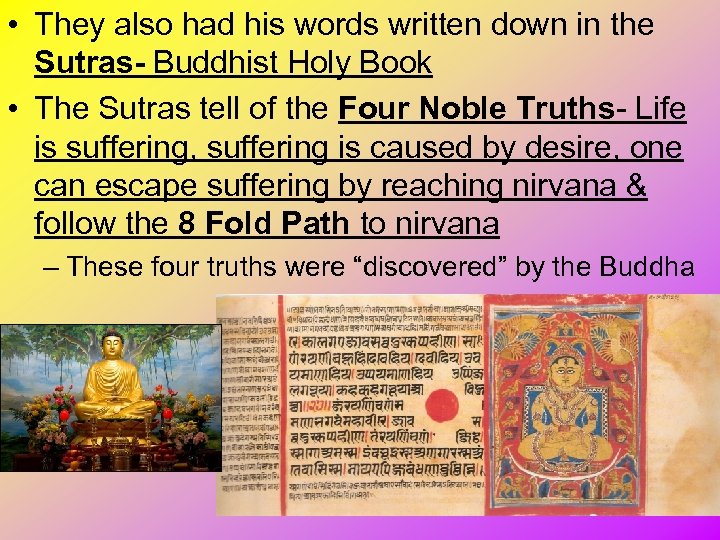 • They also had his words written down in the Sutras- Buddhist Holy Book • The Sutras tell of the Four Noble Truths- Life is suffering, suffering is caused by desire, one can escape suffering by reaching nirvana & follow the 8 Fold Path to nirvana – These four truths were “discovered” by the Buddha
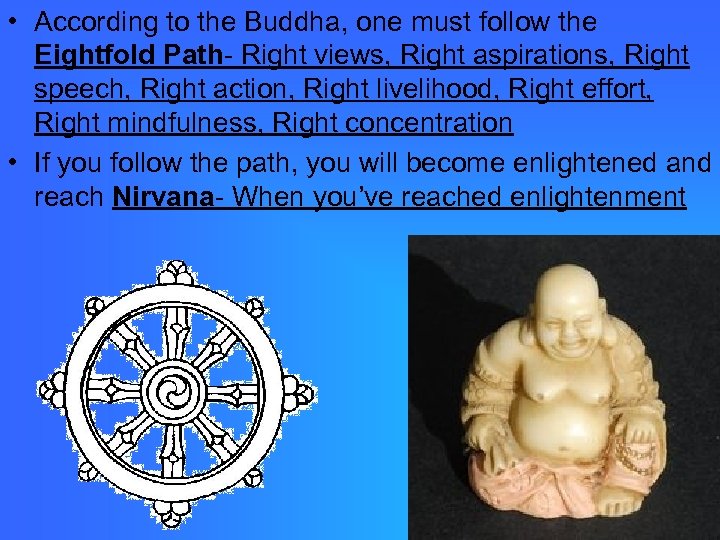 • According to the Buddha, one must follow the Eightfold Path- Right views, Right aspirations, Right speech, Right action, Right livelihood, Right effort, Right mindfulness, Right concentration • If you follow the path, you will become enlightened and reach Nirvana- When you’ve reached enlightenment
 • As in Hinduism, the Buddha accepted the idea of reincarnation. • However, Buddha rejected the many gods of Hinduism –Instead he taught a way of enlightenment. • The Buddha also rejected the caste system • The final goals of both religions-involving a perfect state of understanding and a break from the chain of reincarnation. – Hinduism: Moksha/Nirvana – Buddhism: Nirvana
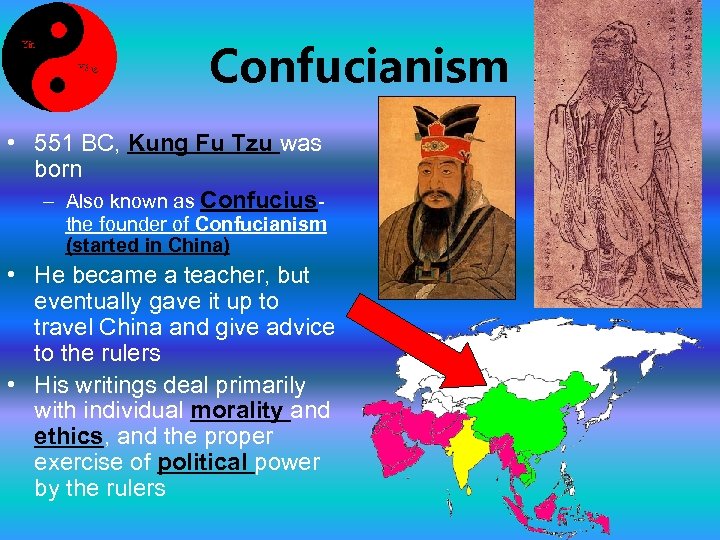 Confucianism • 551 BC, Kung Fu Tzu was born – Also known as Confucius- the founder of Confucianism (started in China) • He became a teacher, but eventually gave it up to travel China and give advice to the rulers • His writings deal primarily with individual morality and ethics, and the proper exercise of political power by the rulers
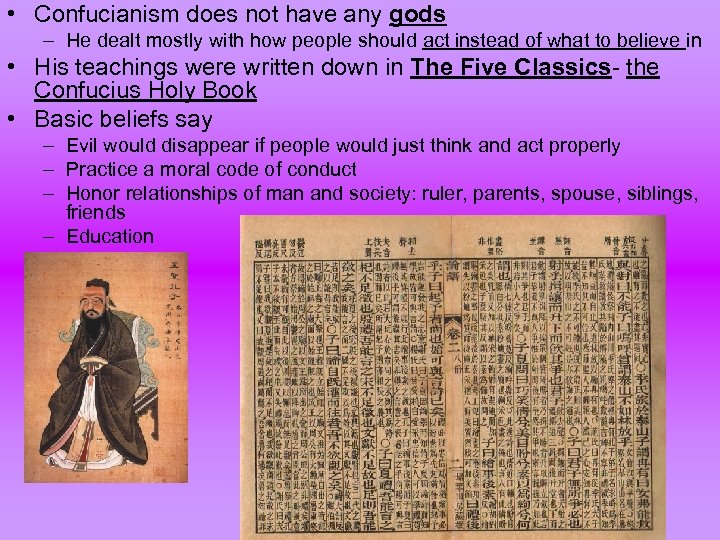 • Confucianism does not have any gods – He dealt mostly with how people should act instead of what to believe in • His teachings were written down in The Five Classics- the Confucius Holy Book • Basic beliefs say – Evil would disappear if people would just think and act properly – Practice a moral code of conduct – Honor relationships of man and society: ruler, parents, spouse, siblings, friends – Education
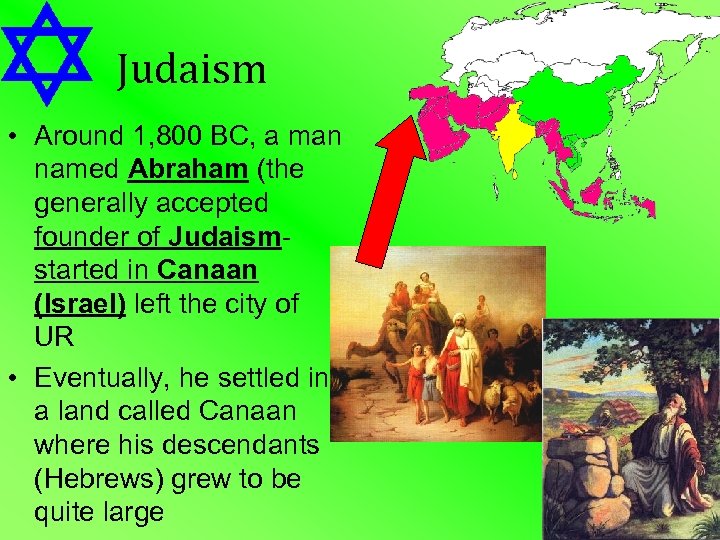 Judaism • Around 1, 800 BC, a man named Abraham (the generally accepted founder of Judaismstarted in Canaan (Israel) left the city of UR • Eventually, he settled in a land called Canaan where his descendants (Hebrews) grew to be quite large
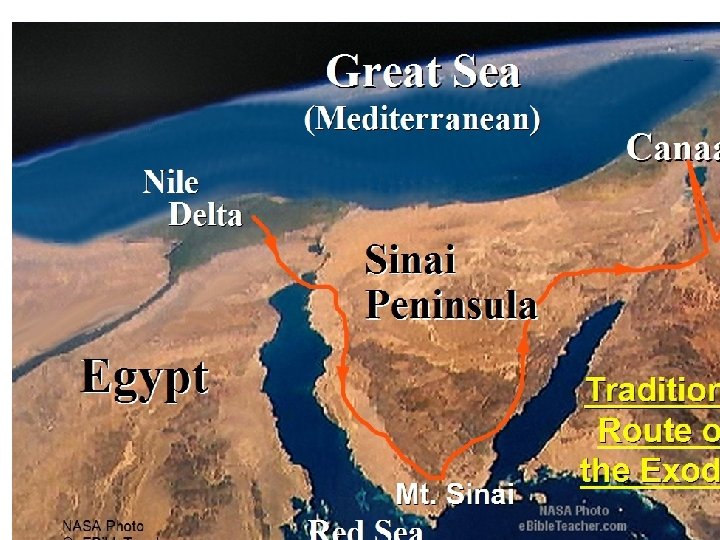
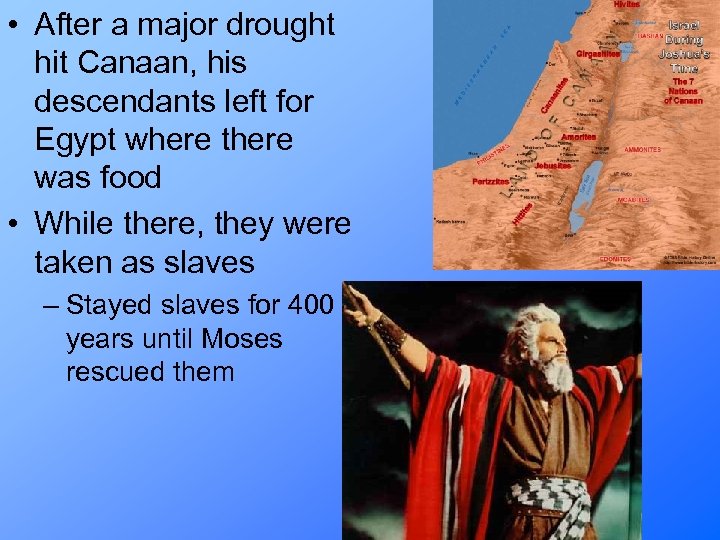 • After a major drought hit Canaan, his descendants left for Egypt where there was food • While there, they were taken as slaves – Stayed slaves for 400 years until Moses rescued them
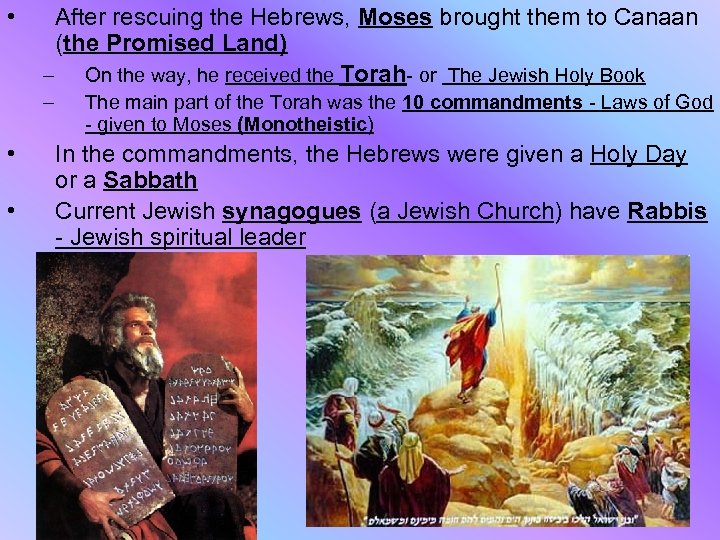 • After rescuing the Hebrews, Moses brought them to Canaan (the Promised Land) – On the way, he received the Torah- or The Jewish Holy Book – • • The main part of the Torah was the 10 commandments - Laws of God - given to Moses (Monotheistic) In the commandments, the Hebrews were given a Holy Day or a Sabbath Current Jewish synagogues (a Jewish Church) have Rabbis - Jewish spiritual leader
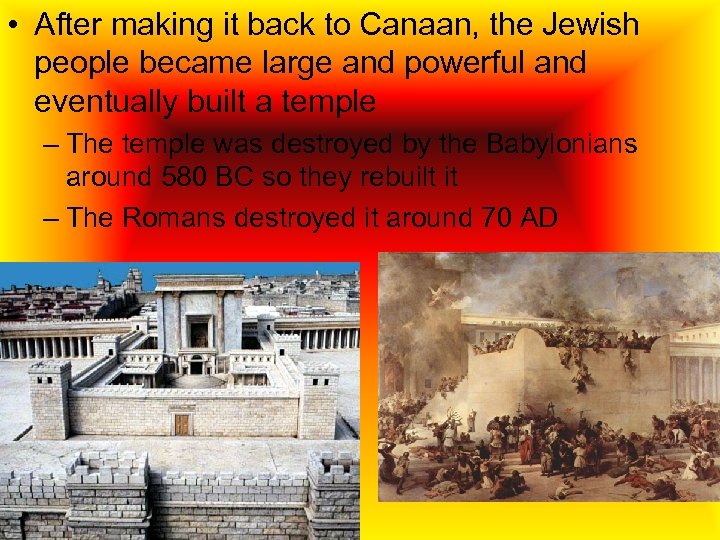 • After making it back to Canaan, the Jewish people became large and powerful and eventually built a temple – The temple was destroyed by the Babylonians around 580 BC so they rebuilt it – The Romans destroyed it around 70 AD
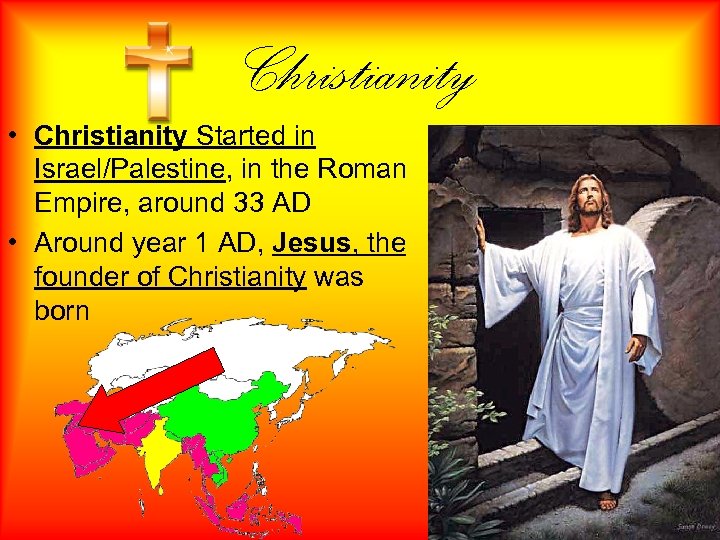 Christianity • Christianity Started in Israel/Palestine, in the Roman Empire, around 33 AD • Around year 1 AD, Jesus, the founder of Christianity was born
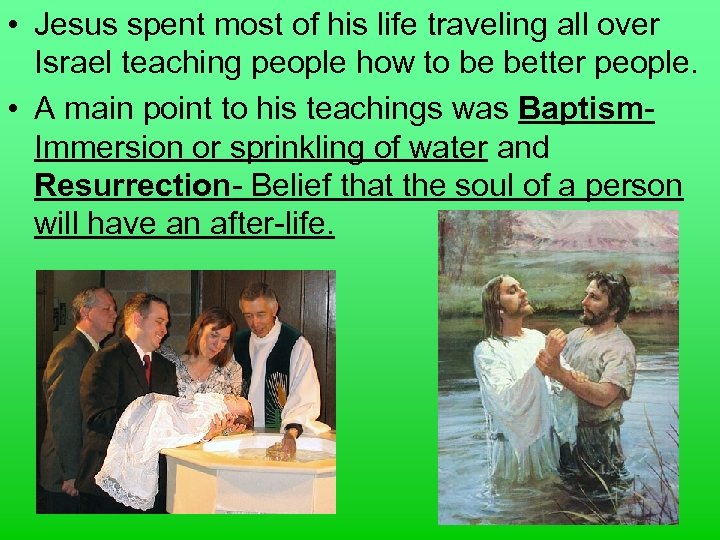 • Jesus spent most of his life traveling all over Israel teaching people how to be better people. • A main point to his teachings was Baptism. Immersion or sprinkling of water and Resurrection- Belief that the soul of a person will have an after-life.
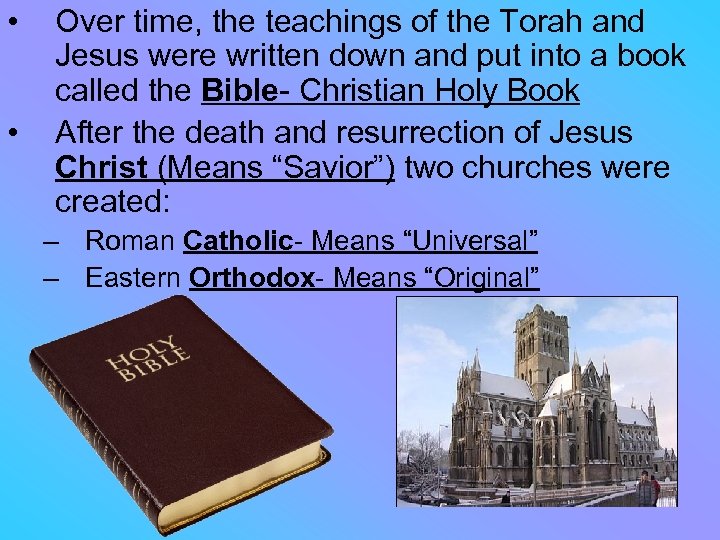 • • Over time, the teachings of the Torah and Jesus were written down and put into a book called the Bible- Christian Holy Book After the death and resurrection of Jesus Christ (Means “Savior”) two churches were created: – Roman Catholic- Means “Universal” – Eastern Orthodox- Means “Original”
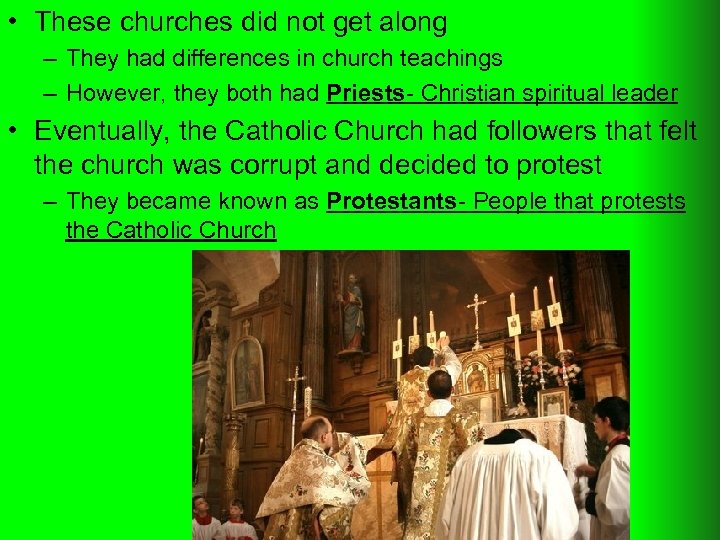 • These churches did not get along – They had differences in church teachings – However, they both had Priests- Christian spiritual leader • Eventually, the Catholic Church had followers that felt the church was corrupt and decided to protest – They became known as Protestants- People that protests the Catholic Church
 Christianity’s Key Beliefs n n Belief in God (Monotheistic) Believe Jesus as son of God Believe in Ten Commandments and that they were given to Moses Believe that Jesus died and then rose from the dead to save people from sin. n n n Call him “Christ” or “Messiah” Believe in heaven, hell, and afterlife Christians believe that they can serve God and achieve salvation by following the teachings of Jesus
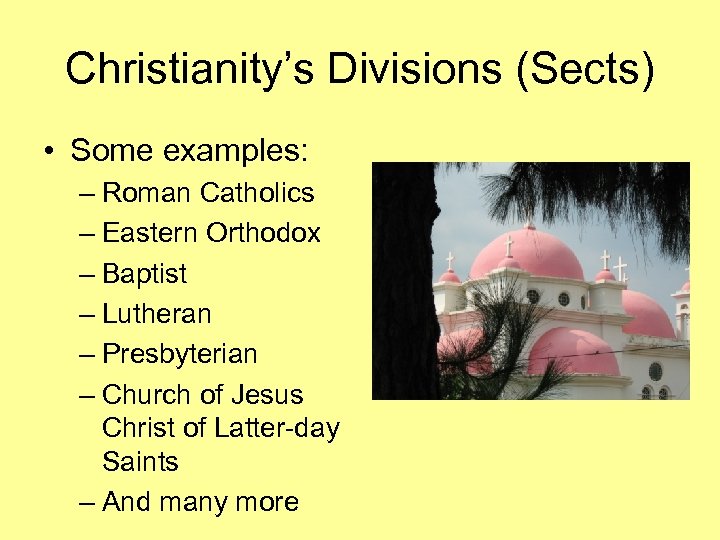 Christianity’s Divisions (Sects) • Some examples: – Roman Catholics – Eastern Orthodox – Baptist – Lutheran – Presbyterian – Church of Jesus Christ of Latter-day Saints – And many more
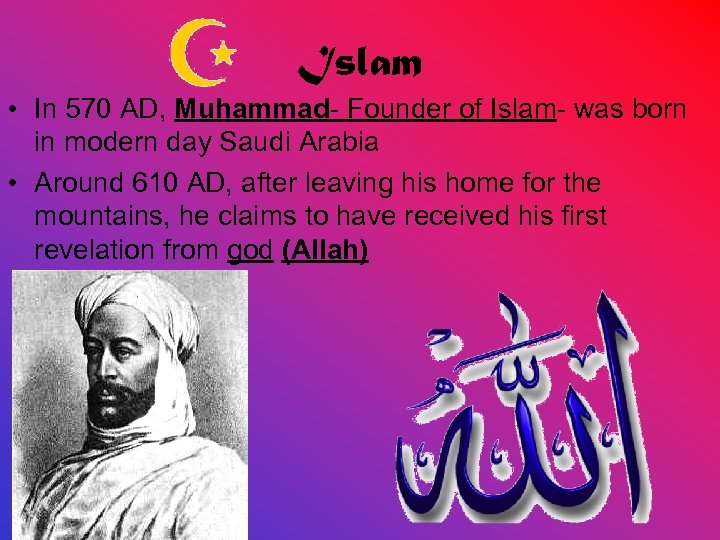 Islam • In 570 AD, Muhammad- Founder of Islam- was born in modern day Saudi Arabia • Around 610 AD, after leaving his home for the mountains, he claims to have received his first revelation from god (Allah)
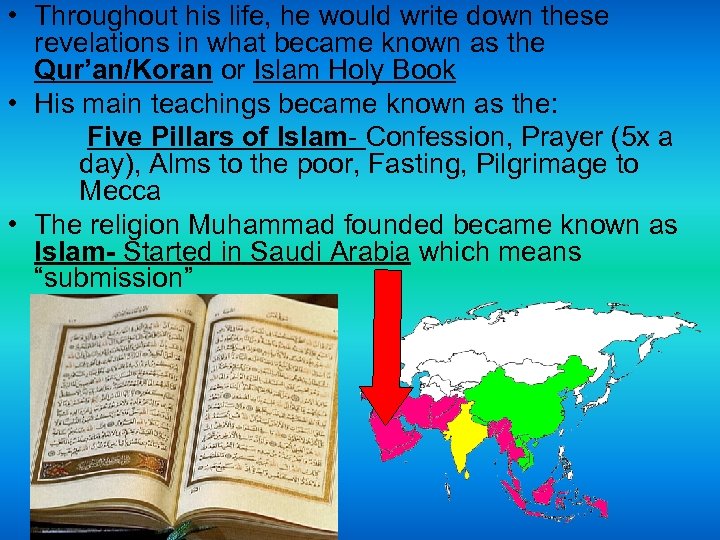 • Throughout his life, he would write down these revelations in what became known as the Qur’an/Koran or Islam Holy Book • His main teachings became known as the: Five Pillars of Islam- Confession, Prayer (5 x a day), Alms to the poor, Fasting, Pilgrimage to Mecca • The religion Muhammad founded became known as Islam- Started in Saudi Arabia which means “submission”
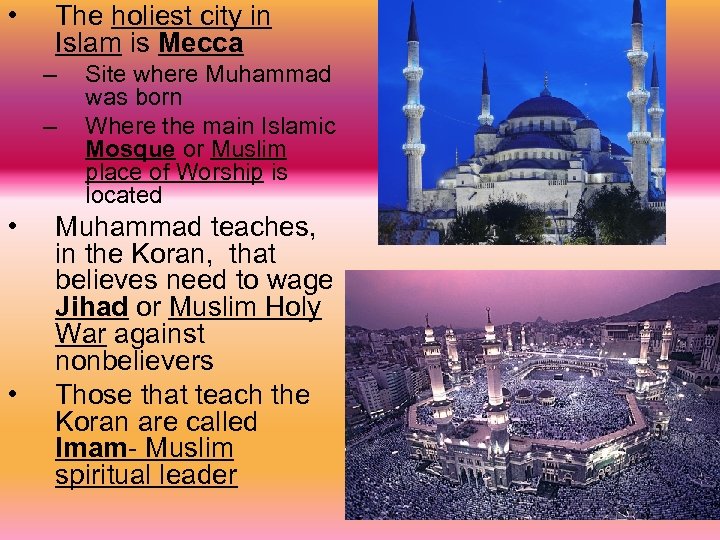 • The holiest city in Islam is Mecca – – • • Site where Muhammad was born Where the main Islamic Mosque or Muslim place of Worship is located Muhammad teaches, in the Koran, that believes need to wage Jihad or Muslim Holy War against nonbelievers Those that teach the Koran are called Imam- Muslim spiritual leader