


 Скачать презентацию World Pass Unit 1 What s the Story
59c53791a2a5fb16484df0a25a05143b.ppt
- Количество слайдов: 35
 World Pass Unit 1 What’s the Story?
 Lesson A The story of my life 1 A 1. A: What’s his story? B: He says he was at home watching TV when the robbery occurred. two police officers talking about a criminal
 2. A: I don’t want to hear any more stories out of you, young man! B: But it’s true! I didn’t eat all the cookies. I swear! a parent or grandparent talking to a little boy at home
 3. A: what’s the magazine’s cover story this week? B: The Olympics. The Games are big news right now. two friends talking about the latest issue of a magazine
 4. A: How was the movie? B: The special effects were excellent, but the story was too predictable. a fiend asking another friend about a movie he/she has just seen
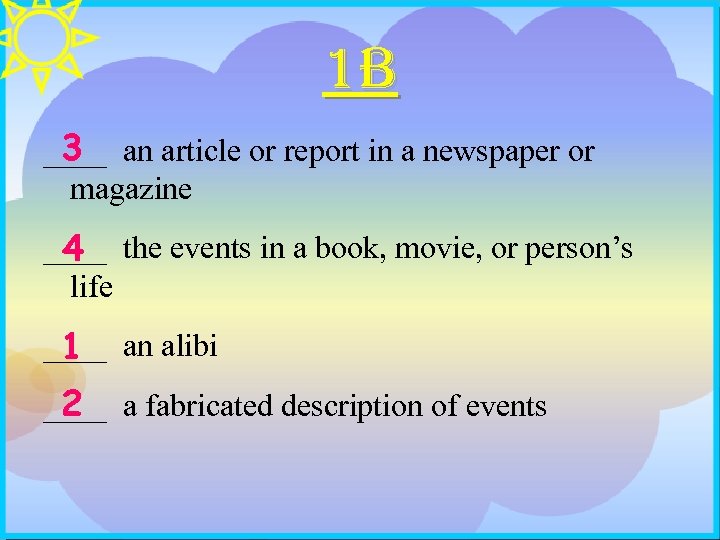 1 B 3 ____ an article or report in a newspaper or magazine ____ the events in a book, movie, or person’s 4 life ____ an alibi 1 ____ a fabricated description of events 2
 1 Vocabulary Focus C • suspect (N): someone who may have committed a crime • verify (V): check to see if something is true • inconsistent (adj): not staying the same in behavior or quality • alter (V): change
 • conflicting (adj): describes beliefs, needs, facts, etc. that are different and opposing • make up (a story) (VP): to invent something (to fool someone) • go after (VP): pursue an idea • cover (V) a story: report a news story
 • publish (V): to prepare and print a book, newspaper, magazine, article, etc so that people can buy it • go over (VP): review • interpret (V): analyze (to get the meaning) • piece together (VP): figure out what happened
 • figure out (VP): to finally understand something or someone after a lot of thought • criminal (N): someone who has committed a crime
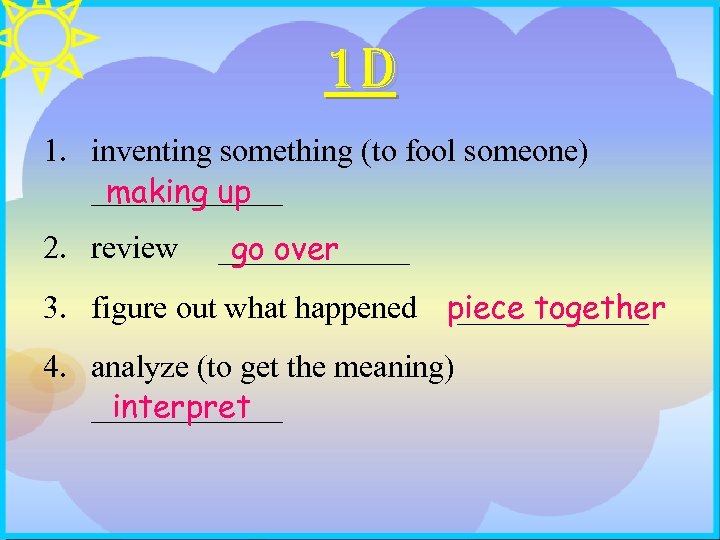 1 D 1. inventing something (to fool someone) ______ making up 2. review ______ go over 3. figure out what happened ______ piece together 4. analyze (to get the meaning) ______ interpret
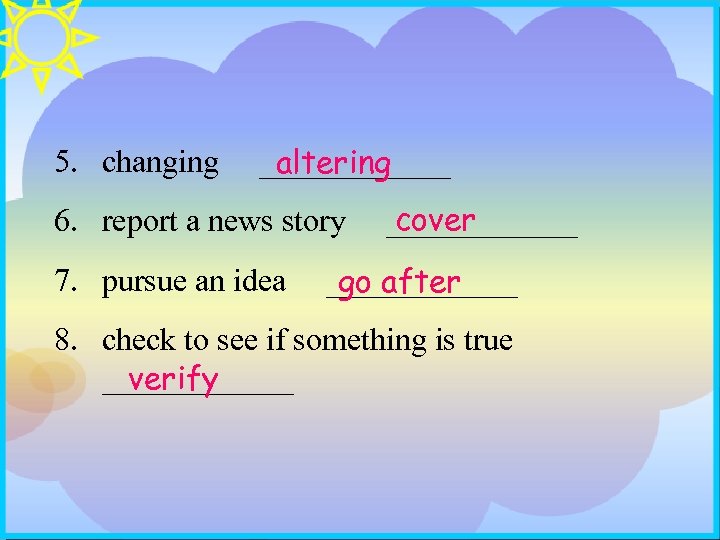 5. changing ______ altering cover 6. report a news story ______ 7. pursue an idea ______ go after 8. check to see if something is true ______ verify
 2 B 1. What is the “Everybody Has a Story” booth and how does it work? It’s a booth on the street where people come to tell stories and record them. They bring another person and interview them. 2. What is the story booth’s purpose? To save our day-to-day experiences for people in the future to study.
 2 C 1. Year she stared working in café 1957 2. What she did in the café in the 50 s worked in the kitchen, cleaning, filled in wherever they needed help
 3. What she wasn’t allowed to do serve the customers directly, eat there 4. What she does in the café now owns the café, eats lunch there every day
 3 Language Focus A • journalist (N): a person who writes news stories or articles for a newspaper or magazine or broadcasts them on radio or television
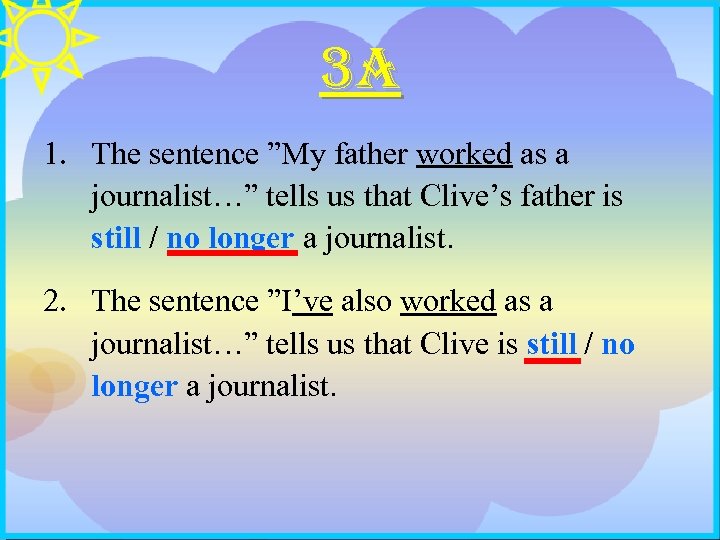 3 A 1. The sentence ”My father worked as a journalist…” tells us that Clive’s father is still / no longer a journalist. 2. The sentence ”I’ve also worked as a journalist…” tells us that Clive is still / no longer a journalist.
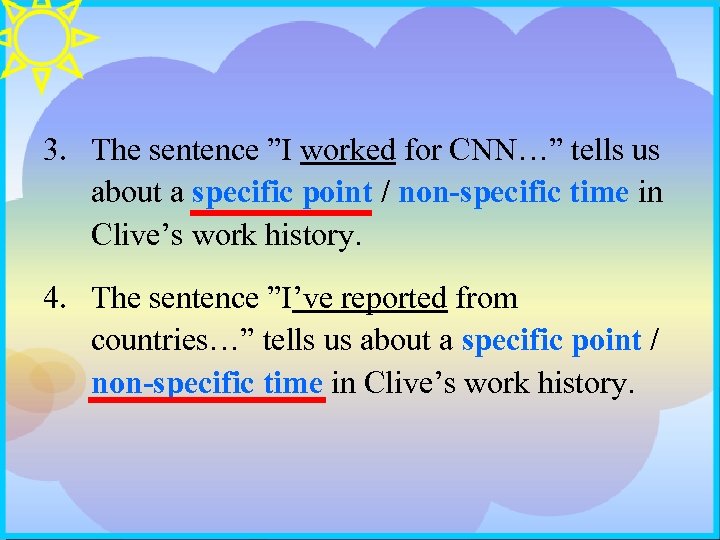 3. The sentence ”I worked for CNN…” tells us about a specific point / non-specific time in Clive’s work history. 4. The sentence ”I’ve reported from countries…” tells us about a specific point / non-specific time in Clive’s work history.
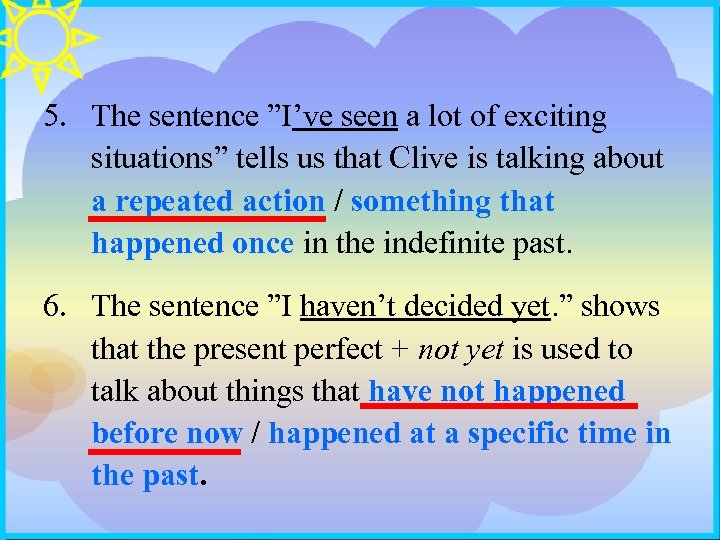 5. The sentence ”I’ve seen a lot of exciting situations” tells us that Clive is talking about a repeated action / something that happened once in the indefinite past. 6. The sentence ”I haven’t decided yet. ” shows that the present perfect + not yet is used to talk about things that have not happened before now / happened at a specific time in the past.
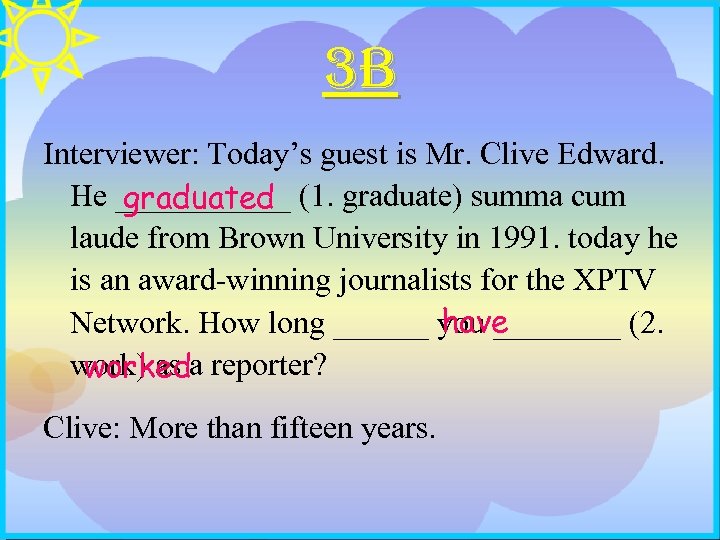 3 B Interviewer: Today’s guest is Mr. Clive Edward. He ______ (1. graduate) summa cum graduated laude from Brown University in 1991. today he is an award-winning journalists for the XPTV have Network. How long ______ you ____ (2. work) as a reporter? worked Clive: More than fifteen years.
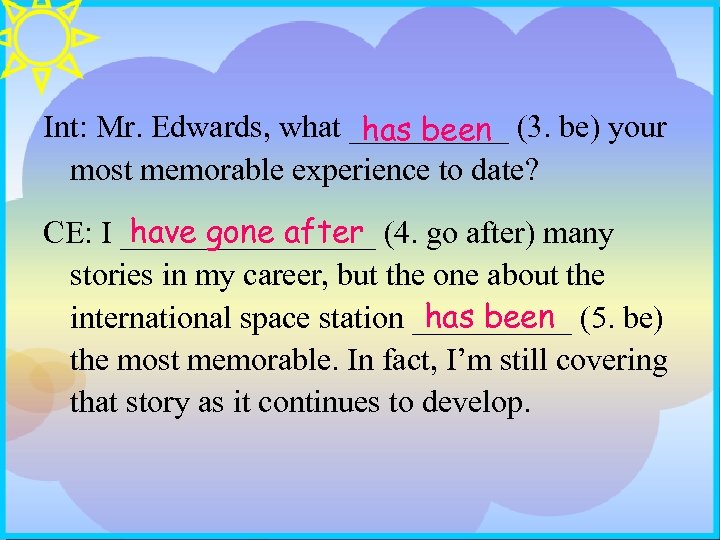 Int: Mr. Edwards, what _____ (3. be) your has been most memorable experience to date? have gone after CE: I ________ (4. go after) many stories in my career, but the one about the has been international space station _____ (5. be) the most memorable. In fact, I’m still covering that story as it continues to develop.
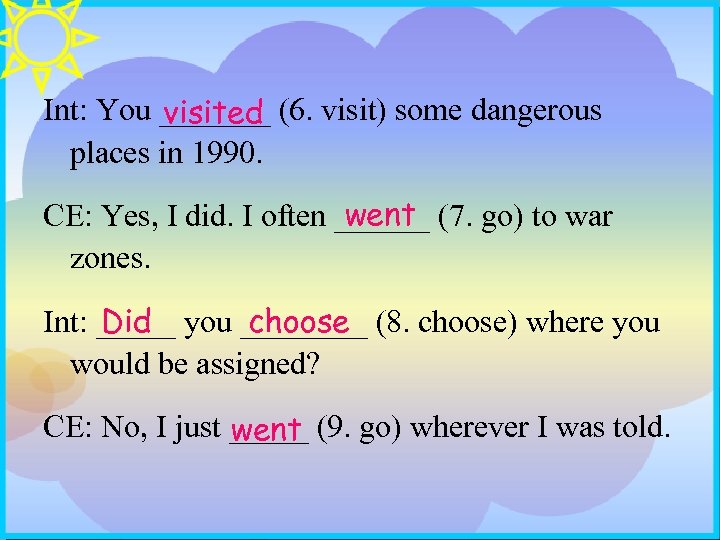 Int: You _______ (6. visit) some dangerous visited places in 1990. went CE: Yes, I did. I often ______ (7. go) to war zones. Int: _____ you ____ (8. choose) where you Did choose would be assigned? CE: No, I just _____ (9. go) wherever I was told. went
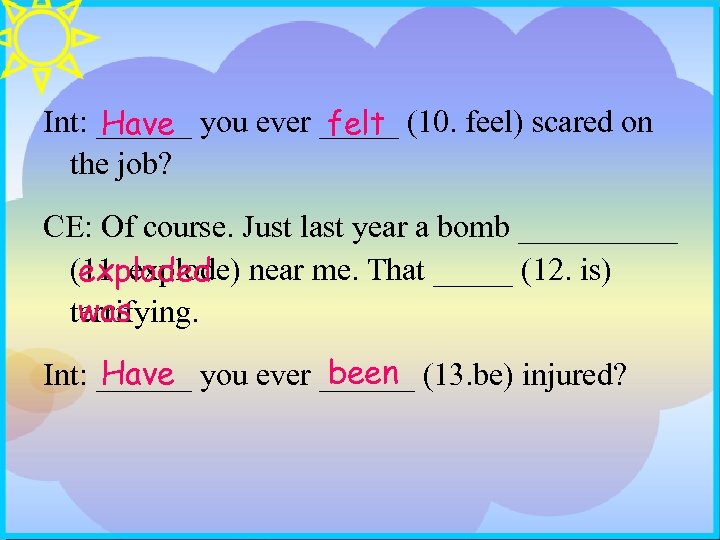 Int: ______ you ever _____ (10. feel) scared on felt Have the job? CE: Of course. Just last year a bomb _____ (11. explode) near me. That _____ (12. is) exploded was terrifying. been Have Int: ______ you ever ______ (13. be) injured?
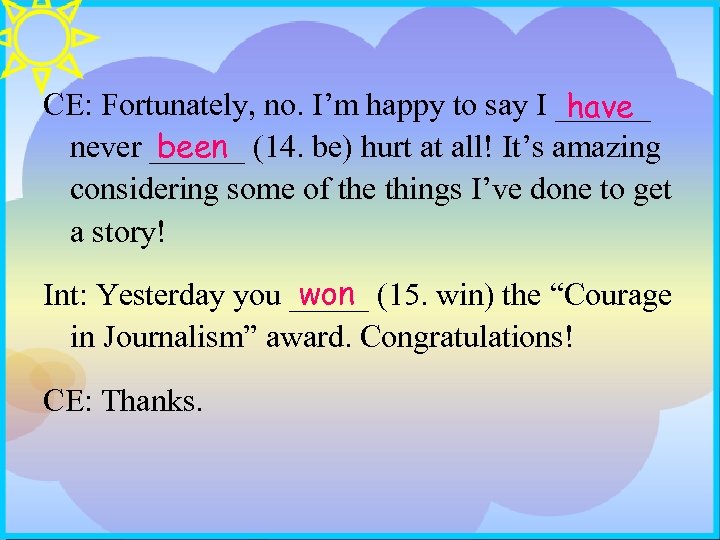 CE: Fortunately, no. I’m happy to say I ______ have been never ______ (14. be) hurt at all! It’s amazing considering some of the things I’ve done to get a story! won Int: Yesterday you _____ (15. win) the “Courage in Journalism” award. Congratulations! CE: Thanks.
 4 Speaking A • haunted (adj): (of a ghost) to appear in a place repeatedly • ignore (V): to pay no attention to something or someone • thumping (adj): very big or impressive • investigate (V): to try to discover all the facts about something, especially a crime or accident
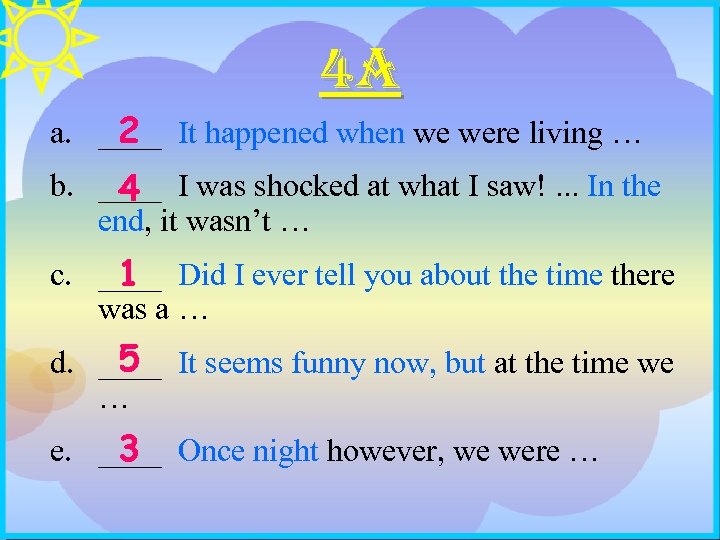 4 A a. ____ It happened when we were living … 2 b. ____ I was shocked at what I saw!. . . In the 4 end, it wasn’t … c. ____ Did I ever tell you about the time there 1 was a … 5 d. ____ It seems funny now, but at the time we … 3 e. ____ Once night however, we were …
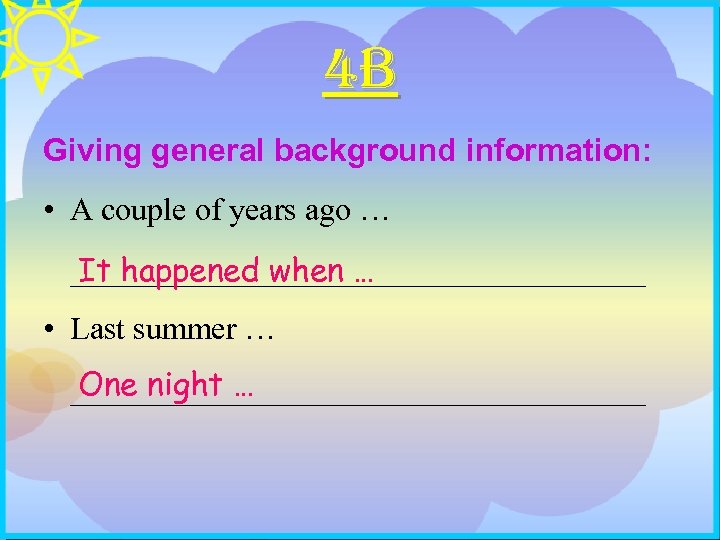 4 B Giving general background information: • A couple of years ago … __________________ It happened when … • Last summer … One night … __________________
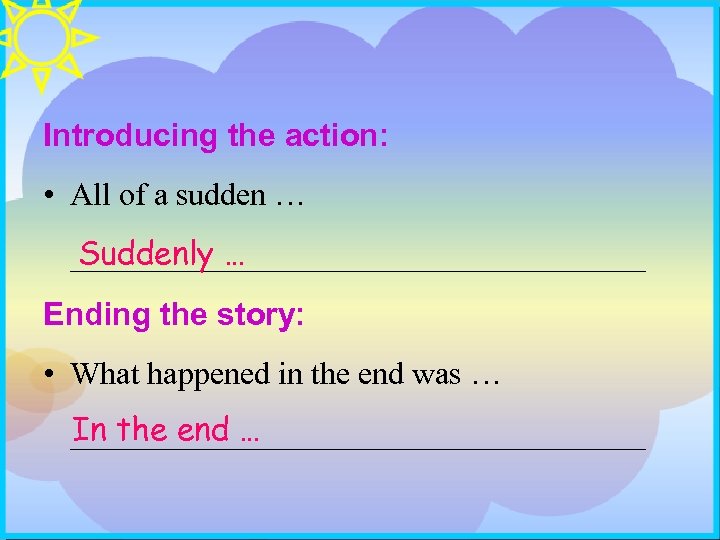 Introducing the action: • All of a sudden … Suddenly … __________________ Ending the story: • What happened in the end was … In the end … __________________
 Reflecting back on the story: • Looking back on it, … It seems funny now … __________________
 1 Get Ready to Read A • moral (N): is the message which you understand from a story, event or experience about how you should or should not behave • protest (V): to have a strong complaint expressing disagreement, disapproval, or opposition • whine (V): to complain continually • demand (V): to ask forcefully, in a way that shows that refusal is not expected and will not be accepted
 1. What’s the moral of this story? You should always do what your parents tell you. 2. Do you agree with this lesson? Why or why not? 3. Have you ever done something that you were warned not to do? What happened?
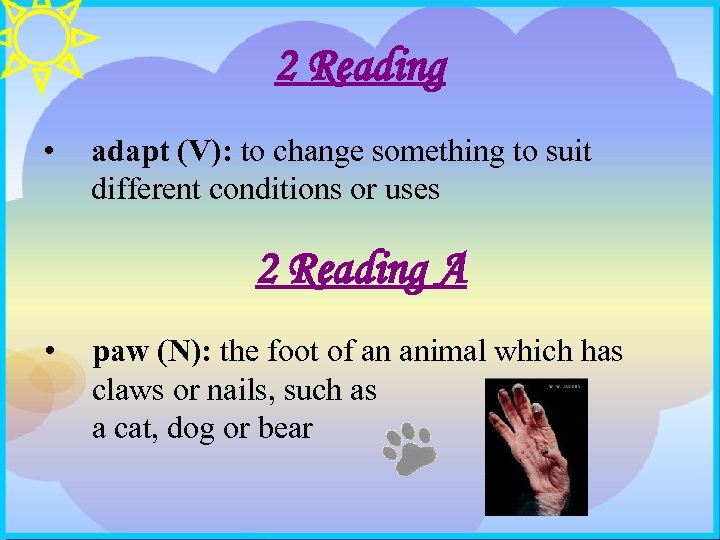 2 Reading • adapt (V): to change something to suit different conditions or uses 2 Reading A • paw (N): the foot of an animal which has claws or nails, such as a cat, dog or bear
 2 Reading B • expectantly (adv): in anticipation • sorry (adj) (Line 5): in trouble • solemnly (adv): seriously • consequences (N): bad or harmful results • misplace (V): to lose something temporarily by forgetting where you have put it • your loss (NP): the death of a loved one
 Reading C 1. Morris is afraid of the paw-he throws it in the fire. Herbert thinks it’s a joke-he winks at his mother. 2. He feels very sad about Herbert’s death. 3. The family gets the exact amount of money that they wished for.
 4 Communication A • booth (N): a small enclosed box-like space that a person can go into