


 Скачать презентацию World mythology Spring 2012 3 19 2018 1 Defining
73d5326a4558f5f9aa00db1aa6a146cf.ppt
- Количество слайдов: 70
 World mythology Spring 2012 3/19/2018 1
 Defining Mythology • “a story about something significant in which the main figures are personalities” (Segal) • “Traditional stories a society tells itself that encode or represent [its] world-view, beliefs, principles, and often fears” (Vandiver) • Stories • Old or “sacred” • “special seriousness and importance” (Fry) 3/19/2018 2
 “Mythology”: origins in western thought • Mythos: story or fiction – Created by a poet: poetry is “made” • “a beyond located in a faraway time and a distant place” – Plato: replaced by logos (“truth”) and philosophy • Five classes of inhabitants (Plato) – Gods – Daemons – Inhabitants of Hades, the dead – Heroes – Men of the past 3/19/2018 3
 “Myth” and Mythology • “-ology”: “study of” • Are we studying myth itself or the study of myth? – “Modern” Religion versus Classical “Myth” • Myths and Truth – “inside” vs. “outside” – Myth does not mean “false” – Everyone believes his/her myths are “true” • Learning Disinterestedness 3/19/2018 4
 Myths, Legends, Folktales • Myth: Gods and their rites (rituals) • Legend: traditional stories rooted in historical fact – Pre-history vs. History • Folktales: folk-tales, not aristocratic – primarily for “entertainment” – Humor rather than tragedy (“awe-ful”) – Actors are “like us”; ordinary people (or animals) • Example of alligator “urban legend” (5 -6) 3/19/2018 5
 Myth and Science • 19 th Century Views: Science replaces myth • E. B. Tylor: Myth explains and understands the world – In modern world, science does what myth did • J. G. Frazer – Not theory, but applied “science” – Myth explained how ritual worked • Example: “Creationism” vs. Evolutionary Theory 3/19/2018 6
 Understanding Myth • Aetiology: origin or cause of something – Not just scientific (contra p. 7) • Psychology: How do “I” work? – what does it mean to be a human being? • Sociology: how do groups work? – society/communities • Anthropology: cultural values • History: what happened? – Tells us about the past 3/19/2018 7
 The Trojan War: A “case study” in myth • The Judgment of Paris: who is the most beautiful goddess • Menelaus, Agamemnon, and the sacrifice of Iphigenia (“the family of Atreus”) • The Trojan War lasts 10 years • The Iliad: the last year of the war • Odyssey: journey of Odysseus home • Return of Agamemnon, and murder 3/19/2018 8
 The Trojan War: the judgment of Paris • Paris son of Priam, king of Troy, who kidnapped Helen, wife of Menelaus • Marriage of Thetis, sea-goddess – Desired by Zeus & Poseidon – Son greater than father, so married to human male – Eris (“Strife”) & Themis (justice) showed up uninvited – Eris throws in apple, “to the fairest” – Paris must decide which goddess gets the apple – Aphrodite bribes with the “most beautiful woman in the world” 3/19/2018 9
 Aphrodite (footnote) • Not goddess of love • Goddess of sexual desire and passion – Desires someone else to meet one’s own needs and urges – Not concern for the well-being of other – Not “romantic” love • ≈ Ishtar (181), sexuality and war – Desires Gilgamesh (180) – Sexual passion destroys 3/19/2018 10
 Questions • What is the story “about”? • Why tell the story? • Is it a myth? – Narrative – Role of gods • Historical Basis – H. Schliemann discovered “real Troy” and Mycenae 3/19/2018 11
 Understanding Myth and the Trojan War • Aetiology – ruins of Mycenae – why did Paris “do it”? Why did Agamemnon sacrifice his daughter? • Psychology: nature of sexual passion • Sociology: role of heroes; why does war occur? • Anthropology: glory in battle, • History: led to discovery of Troy and Mycenae 3/19/2018 12
 Processes of Mythic Production • • Oral, memorized Rhythmic and/or rhymed Formulaic: repeated, fixed, stock phrases “Paratactic” vs. “syntactic” storytelling – different parts of the narrative exist side by side – different parts are connected, added to each other • “Literary Frame”: retelling a story to make a specific point, communicate some new idea • Rationalize: make up (invent) reasons 3/19/2018 13
 3/19/2018 14
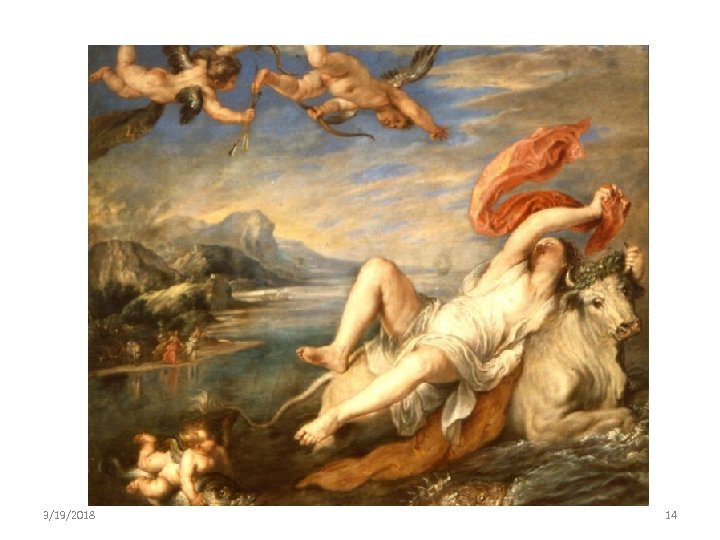
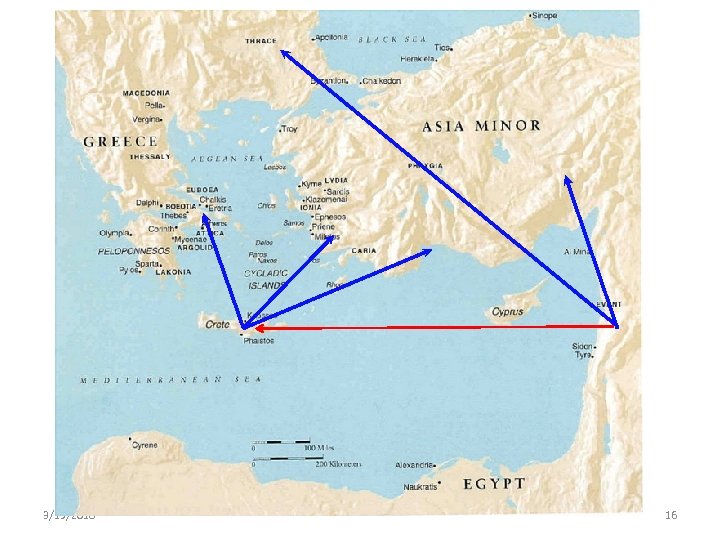
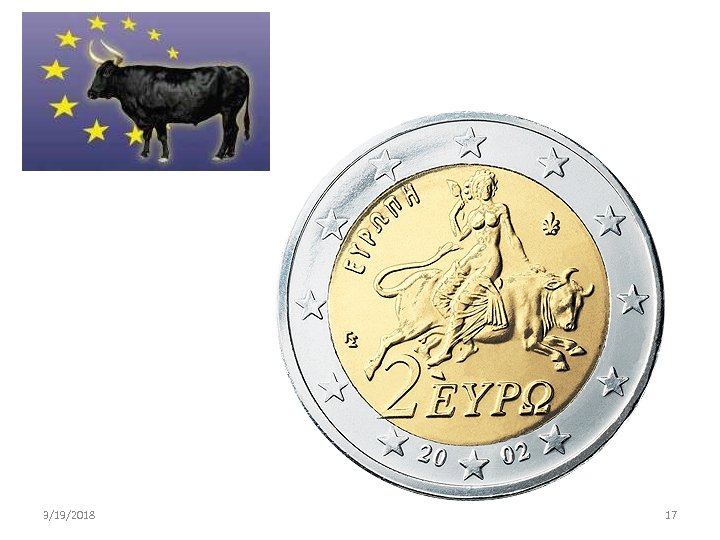
 Example of “retelling”: the Europa Myth • Europa raped by Zeus, disguised as a bull – Taken from Phoenicia to Crete – Sons and brothers look for her • Herodotus: Europe not descended from Europa • Rome used myth to justify power – Horace: “Stop your sobbing…half the world will bear your name” • European Union uses this to describe and symbolize its identity 3/19/2018 15
 3/19/2018 16
 3/19/2018 17
 Greek Creation Myths: Origins of the gods • “live forever” • Calls on Muses • Chaos (“gap”, “void”), Gaia, Ouranos – Eros “makes men weak” – Tartarus: underworld – Chaos, Night, Erebos (“darkness”) • Sea god (Pontus), fresh water (Oceanus) • Cyclopes, Hundred Handed (see 31) – Ouranos hates them 3/19/2018 18
 Muses • 3 Titans – Practice – Song – Memory – Mothers of: • “Olympian” Muses: music, song, dance – Nine “genres” of chanting and knowledge – E. g. , epic, tragedy, comedy, history 3/19/2018 19
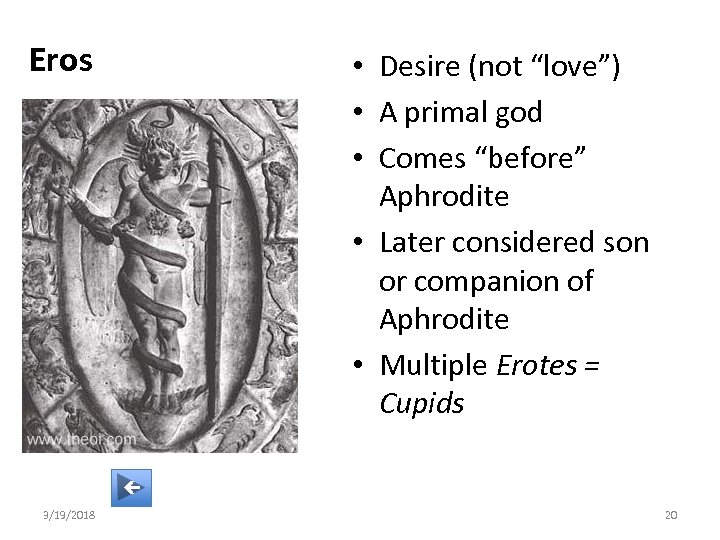 Eros • Desire (not “love”) • A primal god • Comes “before” Aphrodite • Later considered son or companion of Aphrodite • Multiple Erotes = Cupids 3/19/2018 20
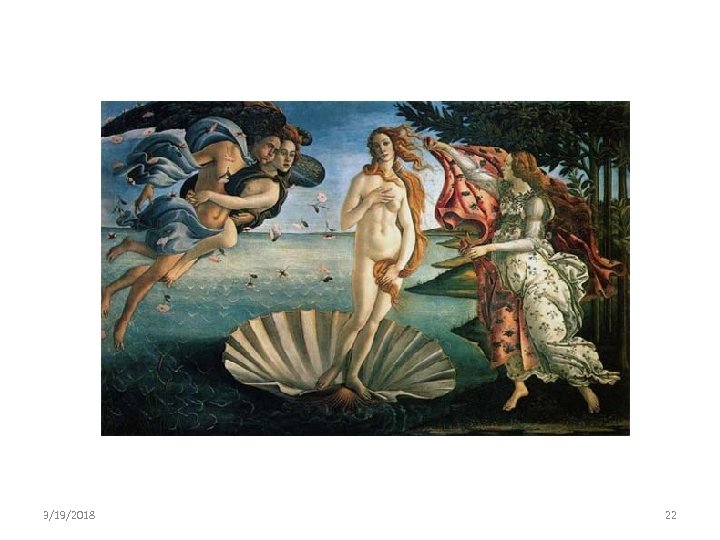
 The castration of Ouranos • Ouranos hates his children – “shameful acts” (ll. 71, 77) – Genitals removed by Kronos • Blood creates – Furies – Giants: primal powers of nature – Nymphs: spirits of ash tree • Foam becomes Aphrodite – Accompanied by Eros – Lines 114 -116 3/19/2018 21
 3/19/2018 22
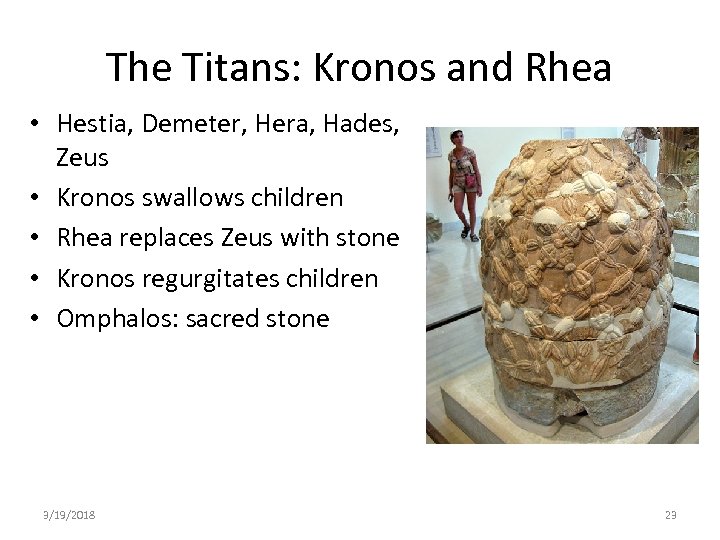 The Titans: Kronos and Rhea • Hestia, Demeter, Hera, Hades, Zeus • Kronos swallows children • Rhea replaces Zeus with stone • Kronos regurgitates children • Omphalos: sacred stone 3/19/2018 23
 Zeus & his mates • • Lighting, thunder, kingship, law Themis —> Order, Justice, Fates Demeter —> Persephone Mnemosyne —> the 9 Muses Leto—> Apollo, Artemis Hera —> Hebe (youth, first cupbearer), Ares Other sons: Hermes, Dionysus, Heracles 3/19/2018 24
 Children of Zeus and Hera without copulation • Athena Parthenos (“the Virgin”) – Wisdom subservient to Zeus – Avoids fate of father and grandfather • Hera – Hephaistos – Poseidon 3/19/2018 25
 Pandora (1) • “all-gifts” – Ironic? • Bad & Good Strife – Eris: fighting – Good competition, incentive to improve • Prometheus (“fore-thought”) – Tricked Zeus into choosing bones of sacrifice over meat – Zeus hid fire, Prometheus stole it 3/19/2018 26
 Pandora (2) • Figure of Pandora – Made of water and earth – Weaving – Charm, desire, cares – Slyness, “morals of a bitch” (“lies, crafty words, deceitful nature”) • Epimetheus (“after-thought”) – “don’t accept the gifts of the gods”—Why not? – Pandora opens “the cask” – Evils, diseases, cares, pain, work – Only hope remains, caught in the lid 3/19/2018 27
 Ages of Man (1) • Golden – Long lives “untouched by work and sorrow” – Died as if one went to sleep – Became “[pure] spirits of the earth, ” “givers of wealth” • Silver – Children for 100 years, short adulthood – Had never developed self-control – Failed to sacrifice – Became spirits of the underworld 3/19/2018 28
 Ages of Man (2) • Bronze (from ash tree: staffs of spears) – Violent and war-mongers – Nameless in Hades • Heroes, Demi-Gods – Just before present: e. g. , Trojan War heroes – A few now live carefree life on the Blessed Isles • Iron Age – “work and grieve unceasingly” – Future loss all morality & propriety (ll. 82, 90, 99) – Aiodos (Shame), Nemesis (Righteous Indignation) 3/19/2018 29
 Ovid’s Creation Story • “sing of metamorphoses” • “science, ” i. e. , speculative theories – Monism • All is water • Not a single thing, but a boundless universe of change from one opposite to another (e. g. , wet to dry) • How can “boundless” be a thing? Density – Pluralism • “the many” come from 4 things, which make everything through “love” and “strife” • Not 4 things, many “seeds” ; a thing is whatever “seed” predominates 3/19/2018 30
 The World • Chaos: undefined, “confused” – “at war” • Definition – Fire, air, water, earth – Everything has its place – Climate zones of earth, Wind • Stars can appear • Man (not sure of origin) – “seeds of the sky” – Mixture of fire and air emulates the form of the gods 3/19/2018 31
 Ages of Man according to Ovid • Gold (Saturn = Cronos) – No need for law – No intrusion into natural harmony, no farming • Silver: rule of Jove (Zeus) – Origins of seasons, hot, cold – Man needs a house and farming • Bronze: cruel and violent, yet not “sacrilegious” • Iron – Impiety, property, plunder, plots (ll 181 -2, 200 -1, 204 ff. ) 3/19/2018 32
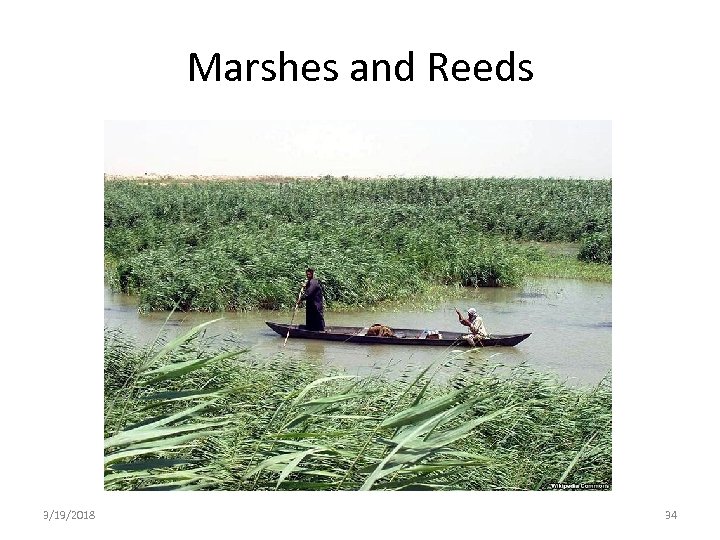
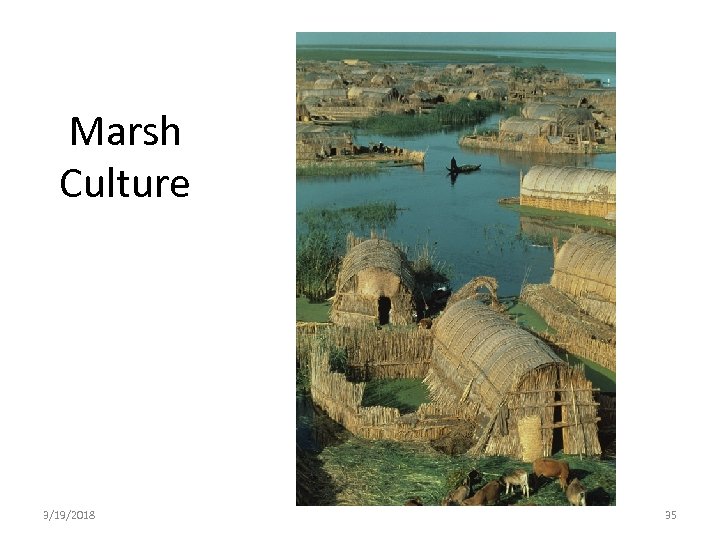
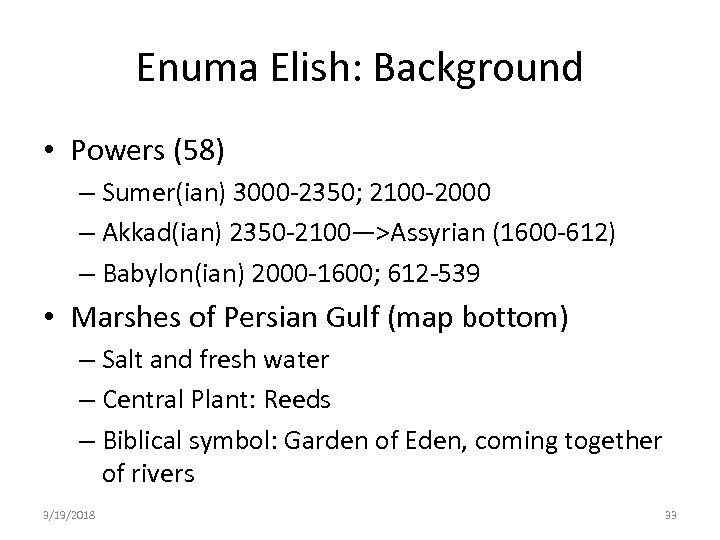 Enuma Elish: Background • Powers (58) – Sumer(ian) 3000 -2350; 2100 -2000 – Akkad(ian) 2350 -2100—>Assyrian (1600 -612) – Babylon(ian) 2000 -1600; 612 -539 • Marshes of Persian Gulf (map bottom) – Salt and fresh water – Central Plant: Reeds – Biblical symbol: Garden of Eden, coming together of rivers 3/19/2018 33
 Marshes and Reeds 3/19/2018 34
 Marsh Culture 3/19/2018 35
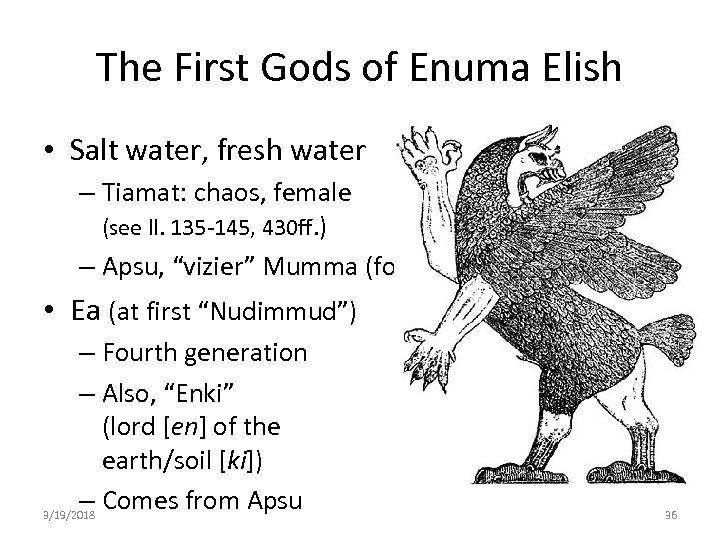 The First Gods of Enuma Elish • Salt water, fresh water – Tiamat: chaos, female (see ll. 135 -145, 430 ff. ) – Apsu, “vizier” Mumma (fog) • Ea (at first “Nudimmud”) – Fourth generation – Also, “Enki” (lord [en] of the earth/soil [ki]) – Comes from Apsu 3/19/2018 36
 Noisy Gods and Ea’s conquest of Apsu • Gods of Ea’s generation disturb the “old” gods – Tolerated by Tiamat – Confronted by Apsu and Mummu – “How can we destroy what we created? ” – Apsu and Mummu plot • Ea seizes control – “stilled the waters” (ll. 63, 68) – Kills Apsu, ties up Mummu – “set dwelling…on top of Apsu” 3/19/2018 37
 Marduk created to defeat Tiamat • “superior in every way” (l. 92, see 104) – Given authority by Anu: sky/heaven • Marduk’s “grandfather, ” removed from immediate authority • Winds stir up Tiamat (ll. 110, 119, see 229) – Creates monsters as weapons – Qingu commander of army: “cast a spell” (l. 151) – Initial defeat of Anu and (father) Anshar (Ll. 173 -4) • Summoning of Marduk – “what kind of man? , ” “Tiamat, of womankind” (ll. 194, 195) – Asks for council; power of unchanging decrees 3/19/2018 38
 Marduk’s War against Tiamat • Gods authorize worship of Marduk (ll. 260 -270) – Power of creation and destruction – “path of peace and obedience” (l. 292, see l. 471) – Winds as weapons (Tiamat has her monsters) • Battle of spells (ll. 319, 329) – Tiamat seems to praise Marduk (331); he rejects – Who has rejected compassion (l. 338; see 45)? • Given power to whom it does not belong • Threatened Ashar and Anu – Marduk sends winds, Tiamat tries to swallow, Marduk shoots inside 3/19/2018 39
 Division of Tiamat: primal sea controlled • Ties up enemies; takes Tablet of Destinies • Tiamat’s body makes sky and earth – Takes over worship of older gods (ll. 400 ff. ; 458 ff. ) – Ribs becomes gate-posts – Constellations, time, moon, sun (Shamash) – Poison = fog; head & udder = mountains; eyes—> 2 rivers; tail and thigh fixes cosmos • Reads tablets and establishes worship (l. 474) – Establishes Babylon 3/19/2018 40
 Creation of man and Kingship of Marduk • To serve the gods – Need a victim: Qingu incited the war • Assigns gods to sky and earth (300 each) – Need to rest, ask for a shrine (l. 544 -5; see 488) – The banquet of the gods – Anu names Marduk’s bow – Confirm Marduk’s “kingship” and “mastery” • Fifty names of Marduk – = Elil (syncretism) 3/19/2018 41
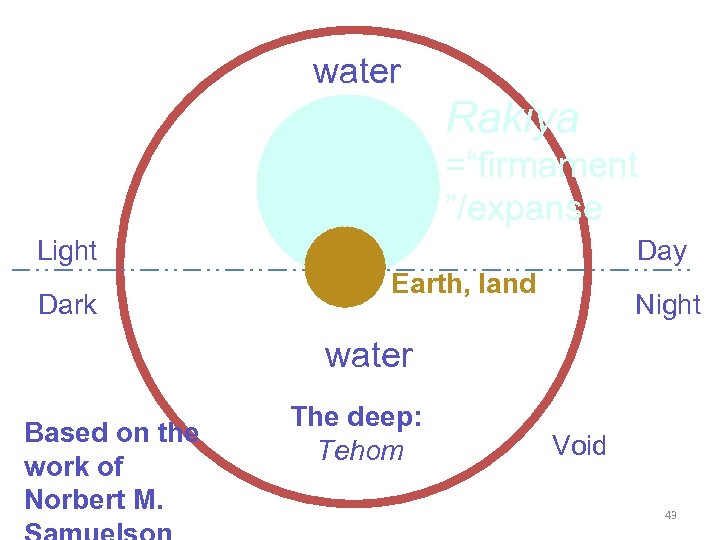
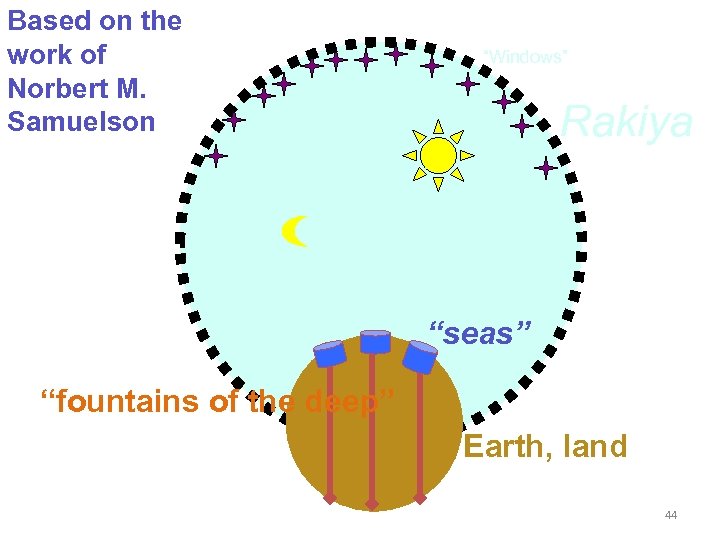
![Creation in Genesis (the Hebrew Bible) • “in the beginning…[of? ]” – Tohu va-bohu](https://present5.com/presentation/73d5326a4558f5f9aa00db1aa6a146cf/image-42.jpg "Creation in Genesis (the Hebrew Bible) • “in the beginning…[of? ]” – Tohu va-bohu") Creation in Genesis (the Hebrew Bible) • “in the beginning…[of? ]” – Tohu va-bohu – The Deep = Tehom = ? Tiamat – “Spirit of God was moving over the face of the waters” • “And God said…” 3/19/2018 • Light: Night and day • Firmament=expanse • Sea and dry land, vegetation • Sun, moon, stars • animals in sea & air • Land animals, man • “very good”: God rests 42
Creation in Genesis (the Hebrew Bible) • “in the beginning…[of? ]” – Tohu va-bohu – The Deep = Tehom = ? Tiamat – “Spirit of God was moving over the face of the waters” • “And God said…” 3/19/2018 • Light: Night and day • Firmament=expanse • Sea and dry land, vegetation • Sun, moon, stars • animals in sea & air • Land animals, man • “very good”: God rests 42
 water Rakiya =“firmament ”/expanse Light Dark Day Earth, land Night water Based on the work of Norbert M. The deep: Tehom Void 43
 Based on the work of Norbert M. Samuelson “Windows” Rakiya “seas” “fountains of the deep” Earth, land 44
 The Garden of Eden, Man and Woman • Heaven and earth already; no rain, only mist • Man formed from dust; “the breath of life” • God plants the garden “in the east” – Tree of life and tree of the knowledge of good and evil – Man to till the garden: don’t eat of the tree of knowledge of good and evil • A Companion for man – Naming of the animals; but none are appropriate (“fit”) – Woman created from rib – Both are naked but unashamed 3/19/2018 45
 The Loss of Paradise • Serpent: how does the woman change the command? • You will be like elohim. – Elohim (“God”) and Yhwh (“the LORD”) – Was the serpent right? • Knowledge: nakedness – “hear the sound of the LORD God” – Ashamed • Curses • Clothing; cast out of the garden 3/19/2018 46
 Prose Edda: Historical Background • Celts (middle Europe) – France > British Isles > Wales, Scotland, Ireland • Germans (Nibelungenlied), Anglo-Saxon (Beowulf) • “Norse” peoples – “Vikings, ” became Swedes, Danes, and Norwegians – Iceland became Christian in 1000 CE – Swedes were sacrificing to Odin as late as 1070 • Snorri wants to preserve ancient traditions 3/19/2018 47
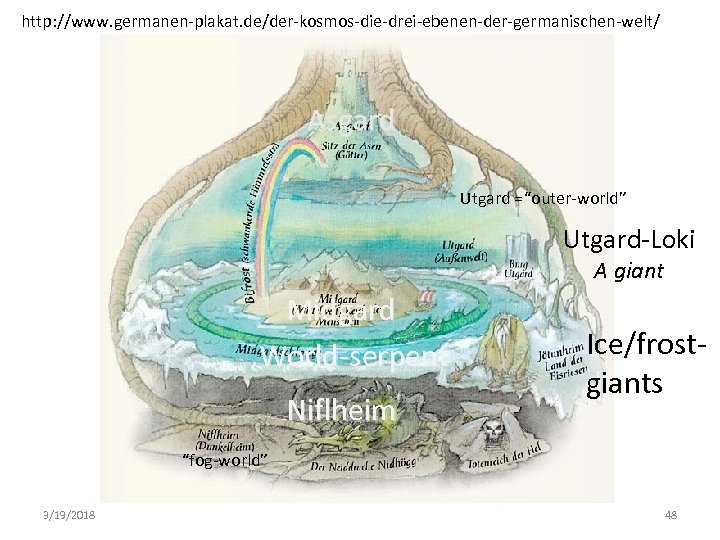 http: //www. germanen-plakat. de/der-kosmos-die-drei-ebenen-der-germanischen-welt/ Asgard Utgard =“outer-world” Utgard-Loki A giant Midgard World-serpent Niflheim Ice/frostgiants “fog-world” 3/19/2018 48
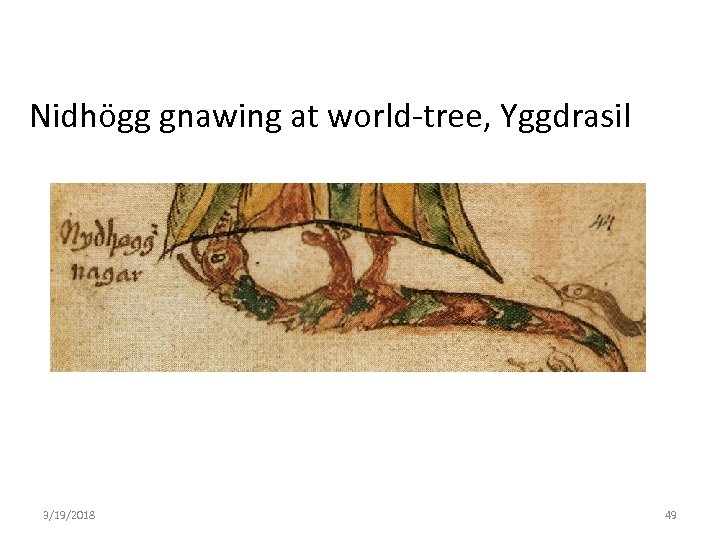 Nidhögg gnawing at world-tree, Yggdrasil 3/19/2018 49
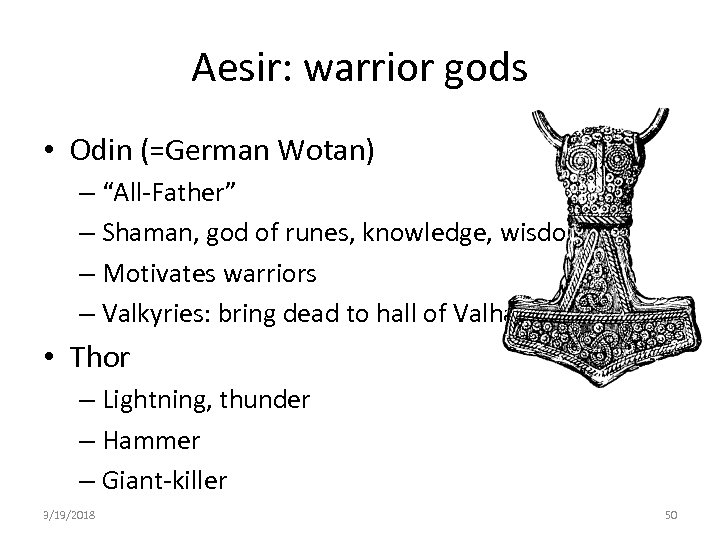 Aesir: warrior gods • Odin (=German Wotan) – “All-Father” – Shaman, god of runes, knowledge, wisdom – Motivates warriors – Valkyries: bring dead to hall of Valhalla • Thor – Lightning, thunder – Hammer – Giant-killer 3/19/2018 50
 Vanir: fertility gods • Njörd: lives by sea, fishing, wealth – In some stories, fathers children with sister • Son Frey: sun, rain, fertility of land > prosperity • Daughter Freya (or, Freyja) – Object of lust of giants – Some sources say she’s a whore – I. e. , excites sexual desire – Snorri: “She enjoys erotic poetry. It is good to call on her for love. ” 3/19/2018 51
 The reconciliation of the gods • War between the Aesir & Vanir • Exchange hostages – Njörd and Frey go to Aesir – The Aesir send Hoenir and Mímir – Hoenir reputed to have qualities of chieftain, but he won’t do anything without the counsel of Mímir. – The Vanir believe themselves to be cheated, cut off Mímir’s head, and send it back to the Aesir – Mímir’s head source of wisdom for Odin 3/19/2018 52
 Key characteristics of Snorri’s retelling • Historicizing: retelling myths as if they are history • Euhemerism – myths are fanciful or exaggerated versions of historical personages or events – Subtype of “rationalization” – Foundational figures or events of a community • Syncretism: combining or synthesizing different religious beliefs or cultural customs 3/19/2018 53
 Prologue • What stories does Snorri incorporate into the prologue? – 79 bottom; 80 top; 81 middle • “In the end they lost the very name of God” – Who is “they”? – What is Snorri trying to explain, pp. 80 -81? • How does Snorri include the gods in his tale? – What is he doing? 81 middle-82 – How does he “euhemerize” the Aesir (82 middle)? – Why are these ____ assimilated to the Aesir? 3/19/2018 54
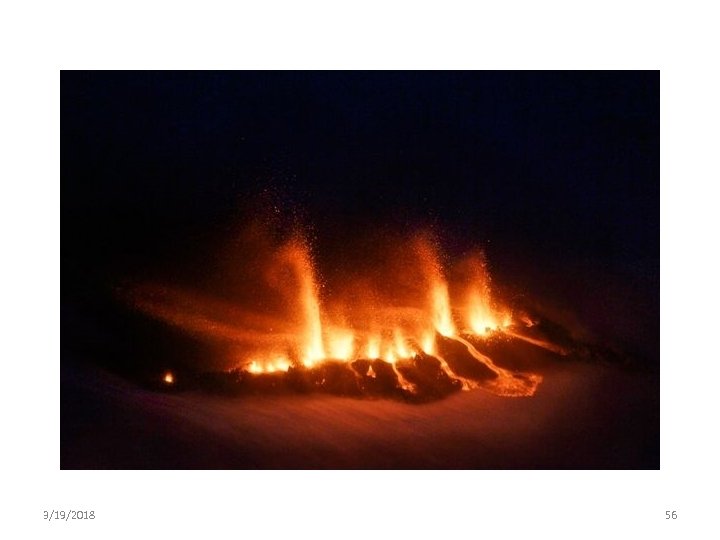
 “The Deluding of Gylfi” • How does Snorri incorporate the old tales? – Look at the structure. • Goes the Aesir for answers • Ginnungagap – Niflheim, Hel; and Muspel (Surt) – Rivers of Niflheim: yeasty venom > rime – Ymir, first frost-ogre from melting rime – How do we explain alternative name, “Aurgelmir”? (also, “Bergelmir” [86 bot. ]) 3/19/2018 55
 3/19/2018 56
 Humans and Their World • Ymir’s sweat; legs copulate • Ymir’s cow licks “the whole man” from a block of ice: Buri (Notice: no wife for Buri) • Identified with Aesir: – Originally, was this “really” a story about the gods, or humans? – “it is my belief…We think…you believe they are the gods” • Buri has son “Bor” = “Bur” = “son” • Bor’s sons kill Ymir > Bergelmir escapes flood • Ymir’s blood, flesh, bones = water, earth, rocks 3/19/2018 57
 Sky and Midgard • Put in place by “sons of Bor” (gods? ) – Völuspa: creator gods are Odin, Hœnir, and Lódur • Skull = sky – Four directions • “burning embers” of Muspell= heavenly lights – Given place – Ordering of time • Ymir’s eyebrows = Midgard – Brains = clouds • Final version of creation of men: trees (“pieces of wood”) > “Ask” [“ash tree”] and Embla 3/19/2018 58
 Aesir, Asgard, Troy • • • Euhemerizes origins of Norse gods Identifies Asgard with Troy What is significant about the choice of Troy? Explanation of “All-Father” Christianization? 3/19/2018 59
 Southwestern Amerind: (Pre)history • From Asia via Bering Strait (> 15, 000 BP ? ) • Shamanism (Siberia) and animism – Contacts spirit world for benefit of people • Zuni: indigenous to region • Navaho: “Diné”: “the people” – from Canada/Alaska (“Athapaskans”) c. 1300 -1400 – “apachu” = “strangers” > some settled into agriculture = “apachus of the cultivated fields [Sp. Nabahu]” – Tonal language (like east Asian languages) 3/19/2018 60
 Southwestern Amerind Creation Stories • Literary versions of earlier oral stories • Emergence Myths: Come out from under the ground as pre-human beings • Zuni origins – pregnant Mother Earth must push Father Sky away – Spits in water > clouds; fertilized by Father Sky > rain – Earth like bowl: land surrounded by water; mtns. = rim of bowl • Navaho: small, dark world, water on 4 sides 3/19/2018 61
 Zuni Emergence Myth: The Sun • • Dark Disorderly: human chaos “four days, ” i. e. , a general period of time No differentiation Beautiful world The Sun needs “prayersticks” Rays of sun 3/19/2018 62
 Two Sons lead people out of 4 th world • Separation – “look for beautiful places” – “old enough to work” • Go to the southwest; down into the 4 th world – The 2 sons are both sons of the people, and their fathers – People want to see Sun • Led by priests of the four directions – Pine, spruce, silver spruce, aspen – Makes prayer sticks: “went up the prayerstick” 3/19/2018 63
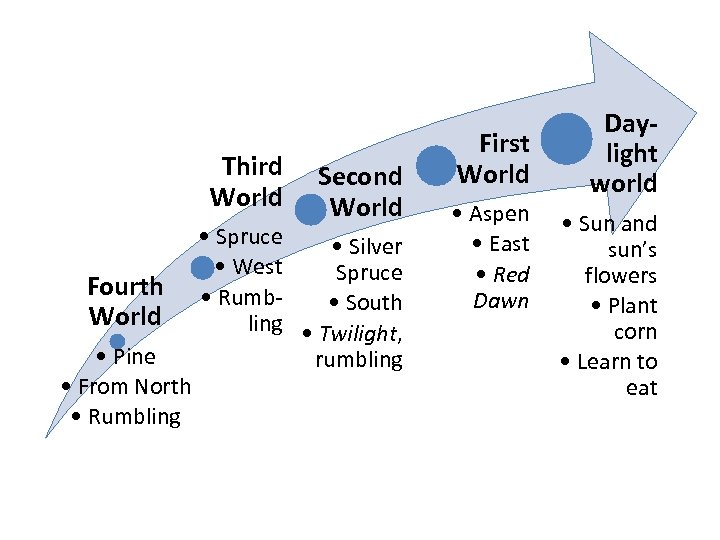 Third World Fourth World • Pine • From North • Rumbling Second World • Spruce • Silver • West Spruce • Rumb • South ling • Twilight, rumbling First World • Aspen • East • Red Dawn Daylight world • Sun and sun’s flowers • Plant corn • Learn to eat
 Emergence into the 1 st world • • • bow priests (2 sons) carriers of medicine bundles Tears make flowers Growth of corn by itsumawe Take on human characteristics – In second world, are slimy beings with webbed extremities, tails, and horns – Must be removed in 1 st world 3/19/2018 65
 First night • Cut mouth (red from the whetstone) Second night • Cut anus (black from the soot whetstone) Third night • Cut webs from hands and feet • No longer notice the risen sun Fourth night • Cut tails and horns
 “Humanization” • “when the sun rose they did not mind any more” • Separation of the community • Etiology of climate • Finding the middle – not quite where the community lives 3/19/2018 67
 Navajo Creation Story: “Air-Spirit People” • fighting and adultery – Expelled from every direction – “insurmountable wall of water” • Fly to escape – find a sipapuni to east (and other directions) – “place of emergence”: spiritual emergence • “Insect” people look in each direction – Nothing but bare land – “we could have told you” 3/19/2018 68
 Third and Fourth Worlds • Join swallows – After 24 days, a locust is “too free” with a swallow’s wife – Not enough food to go around – Fly up until they find another sipapuni ( > 3 rd) • Join grasshoppers, problems repeat – Sipapuni is a tendril of vine > 4 th world – 4 grasshoppers join with (4 colors, like today) – Sky primarily black and blue (no sun, moon, stars) – 4 peaks, one in each direction – Meet race with houses and agriculture 3/19/2018 69
 Gods make humans • • Exiles and race with agriculture intermarry Insect people want human beings Preparation: bathing Ritual magic: 2 ears of corn between 2 buckskins – Care and balance • Wind blows: man and woman (margin) • First family • Masks: kachinas to symbolize beneficent spirits 3/19/2018 70