


 Скачать презентацию World Meteorological Organization Working together in weather climate
623e65dfd450e1494760fc768b4e46da.ppt
- Количество слайдов: 50
 World Meteorological Organization Working together in weather, climate and water WMO First Technical Workshop on Standards for Hazard Monitoring, Data, Metadata and Hazard Analysis to Support Risk Assessment and Analysis http: //www. wmo. int/pages/prog/drr/projects/Thematic/Hazard. Risk/2013 -04 Tech. Wks/index_en. html Maryam Golnaraghi, Ph. D. Chief of Disaster Risk Reduction programme 10 -14 June 2013 WMO HQ, Geneva www. wmo. int © World Meteorological Organization
 Content • Impacts of weather-, water-, and climate-related hazards in a changing Climate • Background • Role of WMO for Development of Guidelines and International Standards • About the Workshop – – Objectives Participants List of documents Outputs • Next Steps © World Meteorological Organization
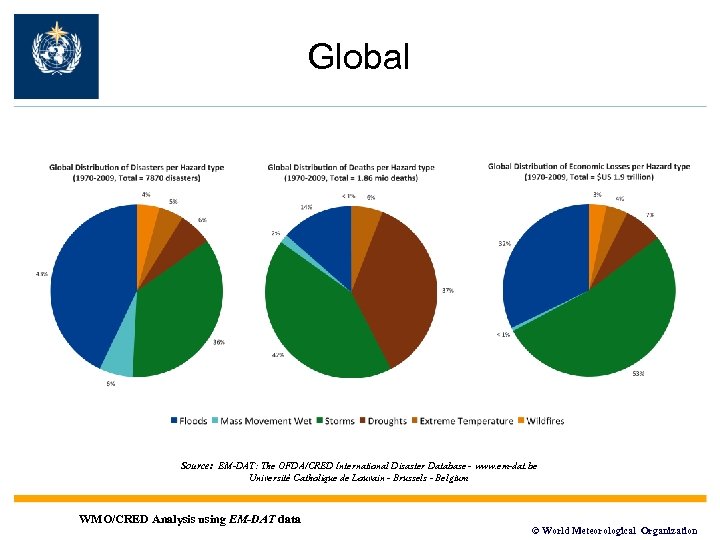 Global Source: EM-DAT: The OFDA/CRED International Disaster Database - www. em-dat. be Université Catholique de Louvain - Brussels - Belgium WMO/CRED Analysis using EM-DAT data © World Meteorological Organization
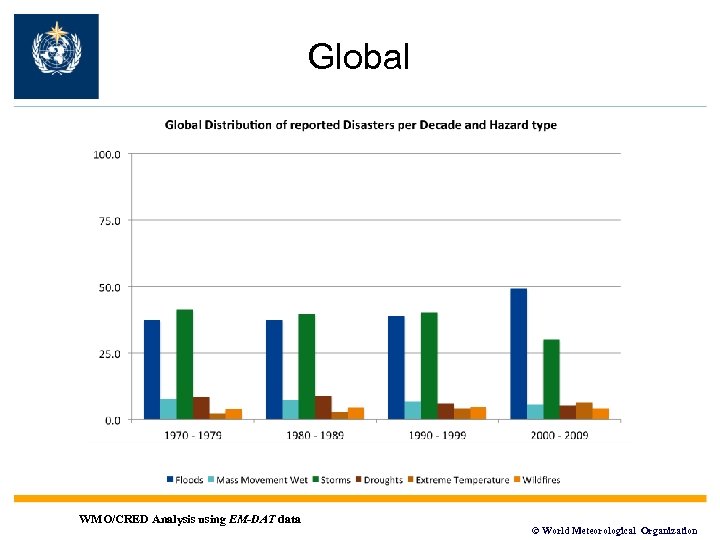 Global WMO/CRED Analysis using EM-DAT data © World Meteorological Organization
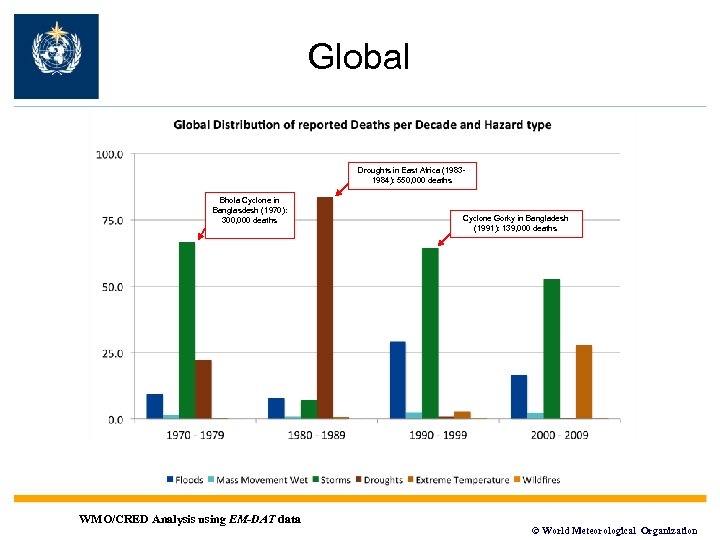 Global Droughts in East Africa (19831984): 550, 000 deaths Bhola Cyclone in Banglasdesh (1970): 300, 000 deaths Cyclone Gorky in Bangladesh (1991): 139, 000 deaths WMO/CRED Analysis using EM-DAT data © World Meteorological Organization
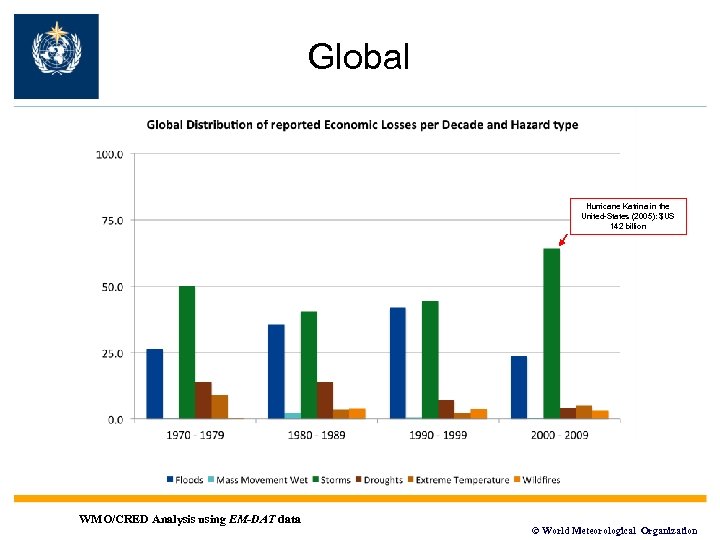 Global Hurricane Katrina in the United-States (2005): $US 142 billion WMO/CRED Analysis using EM-DAT data © World Meteorological Organization
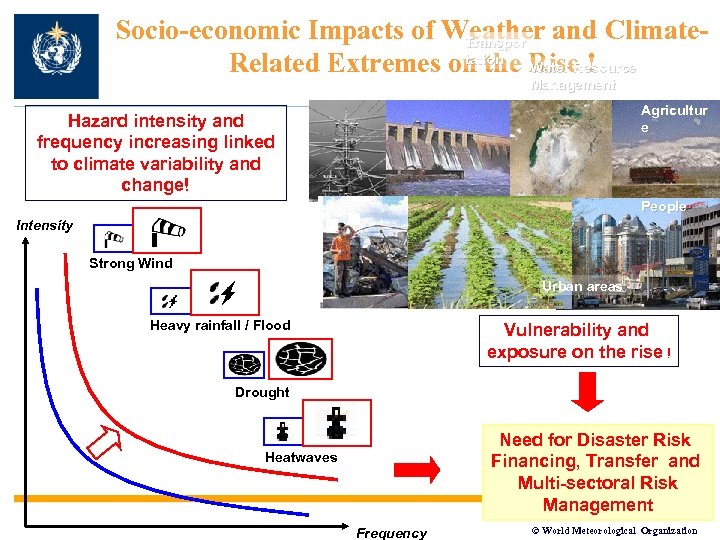 Socio-economic Impacts of Weather and Climate. Transpor Energy tation Water Resource Related Extremes on the Rise ! Management Agricultur e Hazard intensity and frequency increasing linked to climate variability and change! People Intensity Strong Wind Urban areas Heavy rainfall / Flood Vulnerability and exposure on the rise ! Drought Need for Disaster Risk Financing, Transfer and Multi-sectoral Risk Management Heatwaves Frequency © World Meteorological Organization
 Content • Impacts of weather-, water-, and climate-related hazards in a changing Climate • Background • Role of WMO for Development of Guidelines and International Standards • About the Workshop – Objectives – Participants – List of documents – Outputs • Next Steps © World Meteorological Organization
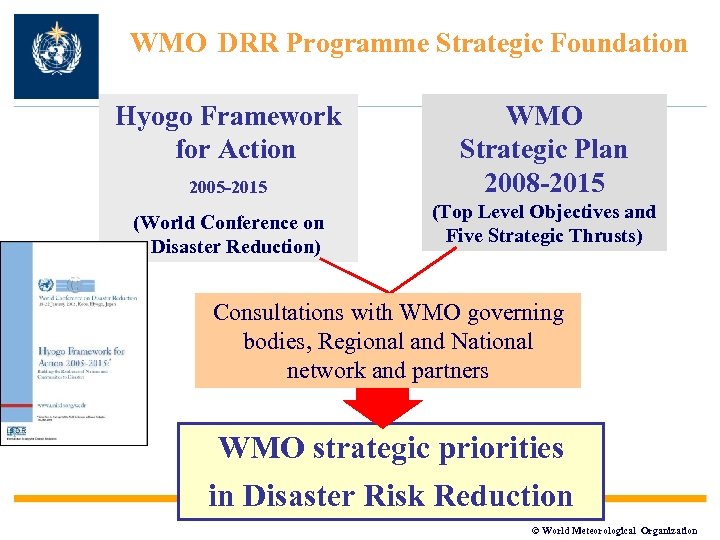 WMO DRR Programme Strategic Foundation Hyogo Framework for Action 2005 -2015 (World Conference on Disaster Reduction) WMO Strategic Plan 2008 -2015 (Top Level Objectives and Five Strategic Thrusts) Consultations with WMO governing bodies, Regional and National network and partners WMO strategic priorities in Disaster Risk Reduction © World Meteorological Organization
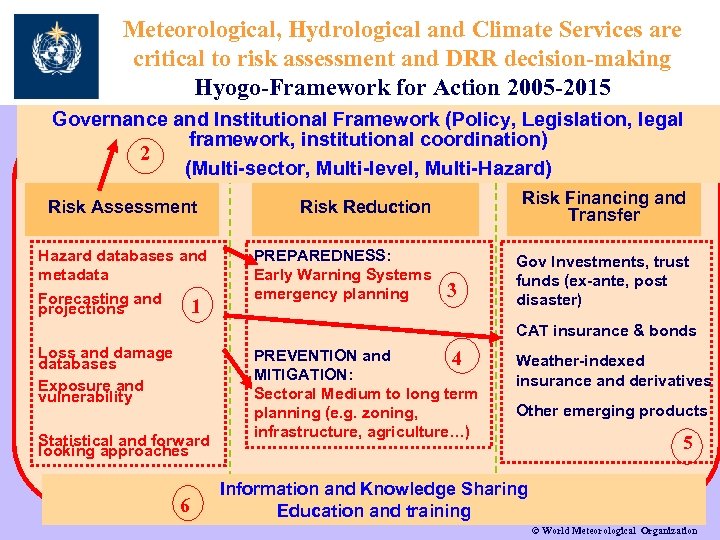 Meteorological, Hydrological and Climate Services are critical to risk assessment and DRR decision-making Hyogo-Framework for Action 2005 -2015 Governance and Institutional Framework (Policy, Legislation, legal framework, institutional coordination) 2 (Multi-sector, Multi-level, Multi-Hazard) Risk Assessment Hazard databases and metadata Forecasting and 1 projections Risk Reduction Risk Financing and Transfer PREPAREDNESS: Early Warning Systems emergency planning Gov Investments, trust funds (ex-ante, post disaster) 3 CAT insurance & bonds Loss and damage databases Exposure and vulnerability Statistical and forward looking approaches 6 PREVENTION and 4 MITIGATION: Sectoral Medium to long term planning (e. g. zoning, infrastructure, agriculture…) Weather-indexed insurance and derivatives Other emerging products 5 Information and Knowledge Sharing Education and training © World Meteorological Organization
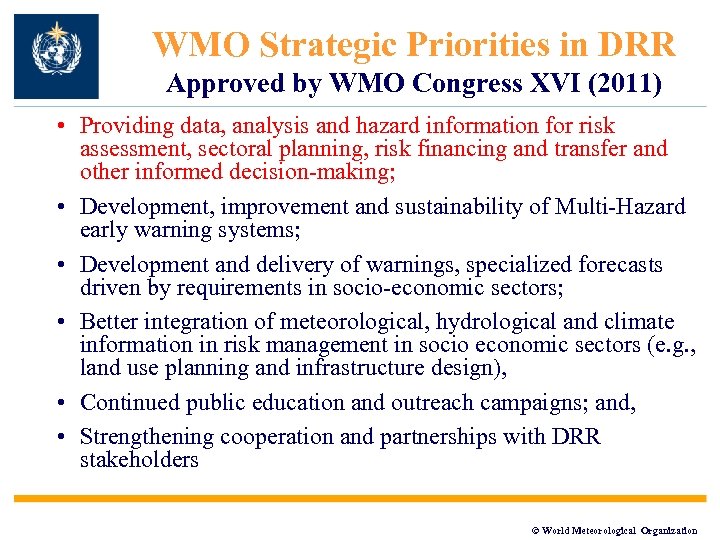 WMO Strategic Priorities in DRR Approved by WMO Congress XVI (2011) • Providing data, analysis and hazard information for risk assessment, sectoral planning, risk financing and transfer and other informed decision-making; • Development, improvement and sustainability of Multi-Hazard early warning systems; • Development and delivery of warnings, specialized forecasts driven by requirements in socio-economic sectors; • Better integration of meteorological, hydrological and climate information in risk management in socio economic sectors (e. g. , land use planning and infrastructure design), • Continued public education and outreach campaigns; and, • Strengthening cooperation and partnerships with DRR stakeholders © World Meteorological Organization
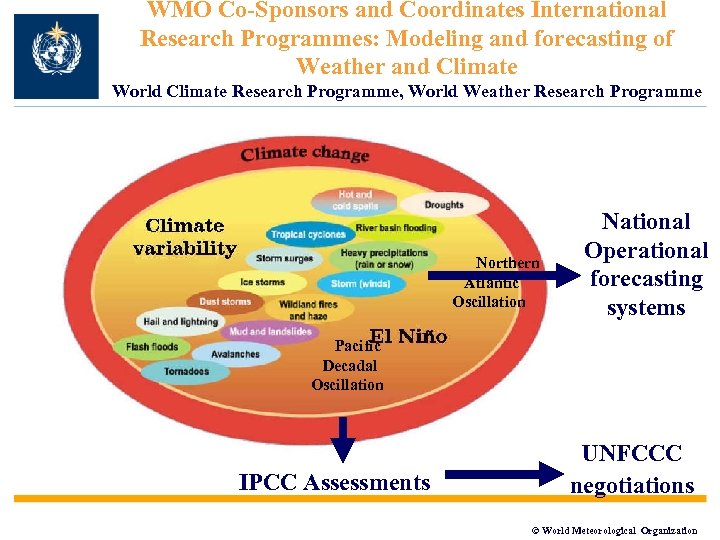 WMO Co-Sponsors and Coordinates International Research Programmes: Modeling and forecasting of Weather and Climate World Climate Research Programme, World Weather Research Programme Northern Atlantic Oscillation National Operational forecasting systems Pacific Decadal Oscillation IPCC Assessments UNFCCC negotiations © World Meteorological Organization
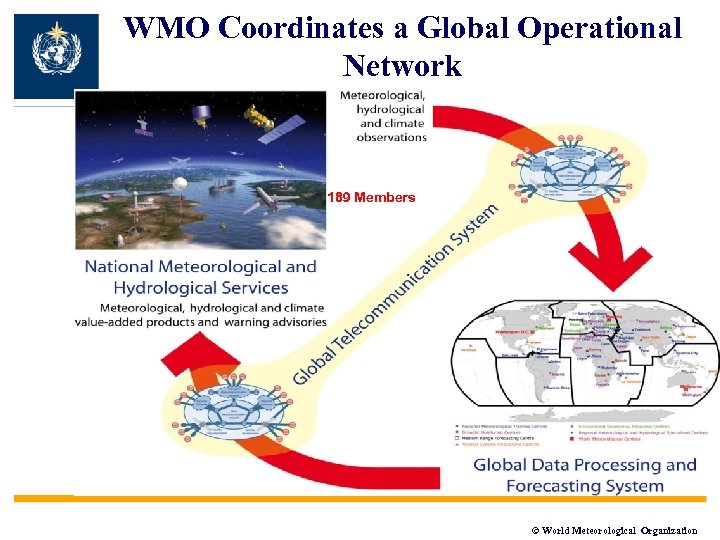 WMO Coordinates a Global Operational Network 189 Members © World Meteorological Organization
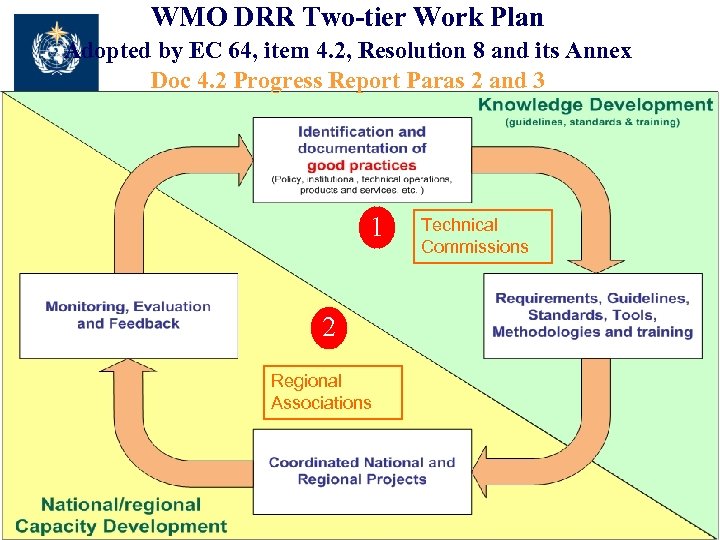 WMO DRR Two-tier Work Plan Adopted by EC 64, item 4. 2, Resolution 8 and its Annex Doc 4. 2 Progress Report Paras 2 and 3 1 Technical Commissions 2 Regional Associations © World Meteorological Organization
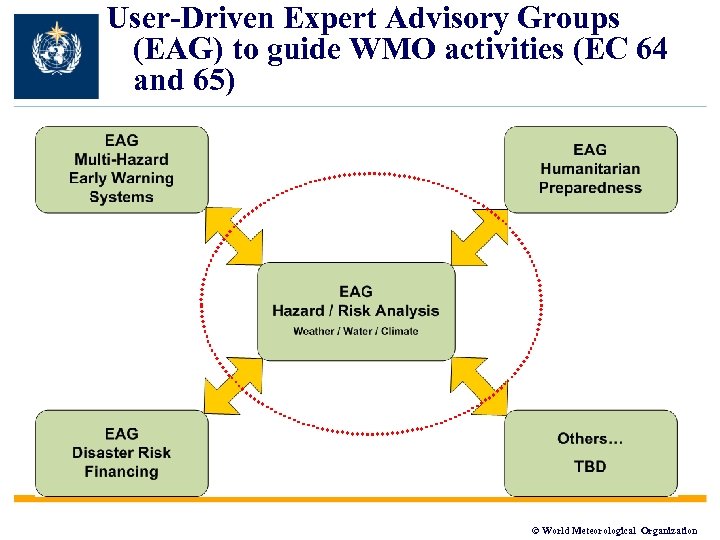 User-Driven Expert Advisory Groups (EAG) to guide WMO activities (EC 64 and 65) © World Meteorological Organization
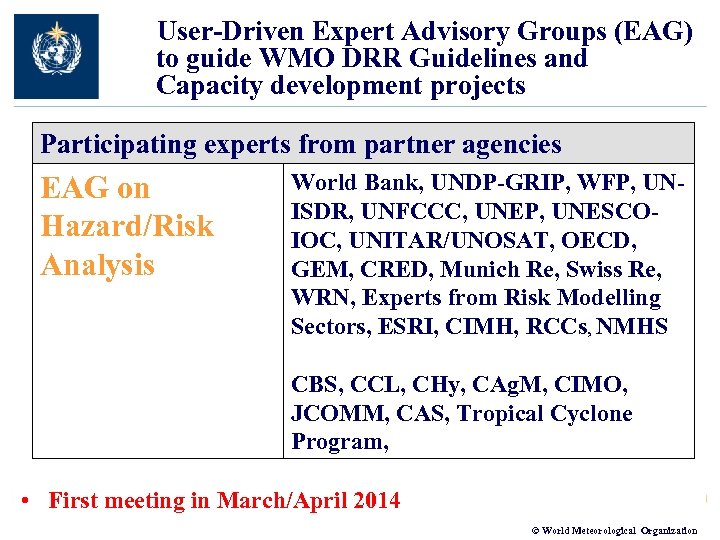 User-Driven Expert Advisory Groups (EAG) to guide WMO DRR Guidelines and Capacity development projects Participating experts from partner agencies EAG on Hazard/Risk Analysis World Bank, UNDP-GRIP, WFP, UNISDR, UNFCCC, UNEP, UNESCOIOC, UNITAR/UNOSAT, OECD, GEM, CRED, Munich Re, Swiss Re, WRN, Experts from Risk Modelling Sectors, ESRI, CIMH, RCCs, NMHS CBS, CCL, CHy, CAg. M, CIMO, JCOMM, CAS, Tropical Cyclone Program, • First meeting in March/April 2014 © World Meteorological Organization
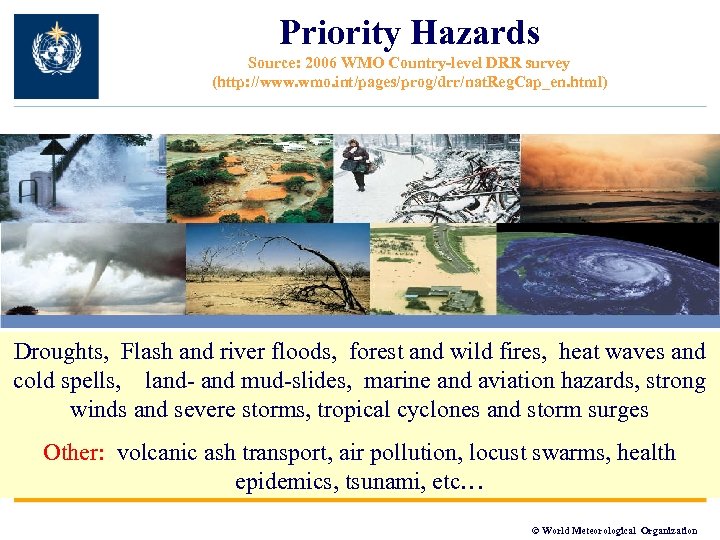 Priority Hazards Source: 2006 WMO Country-level DRR survey (http: //www. wmo. int/pages/prog/drr/nat. Reg. Cap_en. html) Droughts, Flash and river floods, forest and wild fires, heat waves and cold spells, land- and mud-slides, marine and aviation hazards, strong winds and severe storms, tropical cyclones and storm surges Other: volcanic ash transport, air pollution, locust swarms, health epidemics, tsunami, etc… © World Meteorological Organization
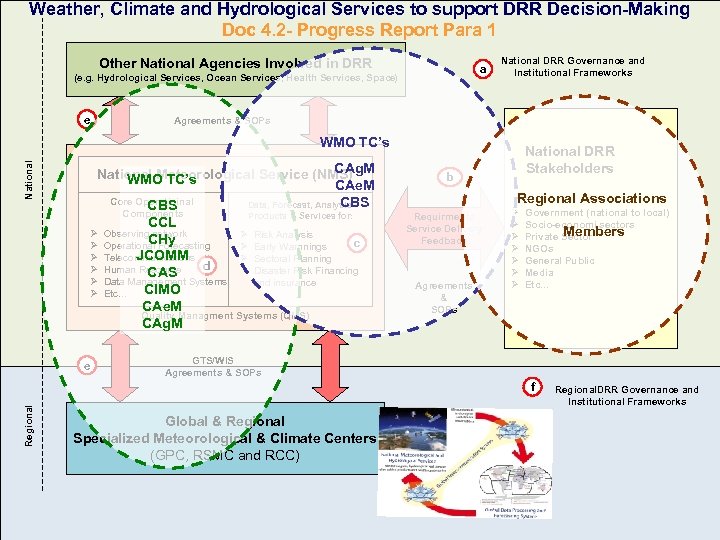 Weather, Climate and Hydrological Services to support DRR Decision-Making Doc 4. 2 - Progress Report Para 1 Other National Agencies Involved in DRR a (e. g. Hydrological Services, Ocean Services, Health Services, Space) e National DRR Governance and Institutional Frameworks Agreements & SOPs WMO TC’s National CAg. M National Meteorological Service (NMS) WMO TC’s CAe. M Core Operatioinal CBS Components Ø Ø Ø e CBS Data, Forecast, Analysis Products & Services for: CCL Observing network Ø Risk Analysis CHy c Operational Forecasting Ø Early Warnnings JCOMM Telecommunications Ø Sectoral Planning d Human Resource Disaster Risk Financing CAS Data Management Systems and insurance CIMO Etc. . . CAe. M Quality Managment Systems (QMS) CAg. M National DRR Stakeholders b Regional Associations Requirments Service Delivery Feedback Agreements & SOPs Ø Ø Ø Ø Government (national to local) Socio-economi sectors Members Private Sector NGOs General Public Media Etc. . . GTS/WIS Agreements & SOPs Regional f Regional. DRR Governance and Institutional Frameworks Global & Regional Specialized Meteorological & Climate Centers (GPC, RSMC and RCC) © World Meteorological Organization
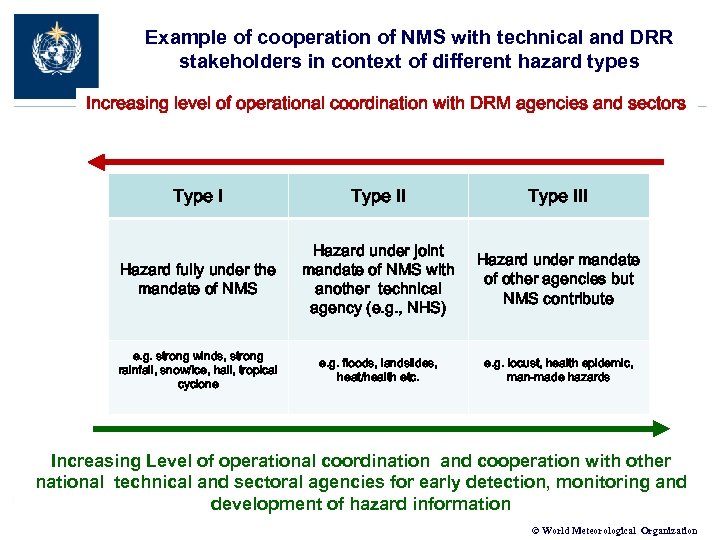 Example of cooperation of NMS with technical and DRR stakeholders in context of different hazard types Increasing level of operational coordination with DRM agencies and sectors Type III Hazard fully under the mandate of NMS Hazard under joint mandate of NMS with another technical agency (e. g. , NHS) Hazard under mandate of other agencies but NMS contribute e. g. strong winds, strong rainfall, snow/ice, hail, tropical cyclone e. g. floods, landslides, heat/health etc. e. g. locust, health epidemic, man-made hazards Increasing Level of operational coordination and cooperation with other national technical and sectoral agencies for early detection, monitoring and development of hazard information © World Meteorological Organization
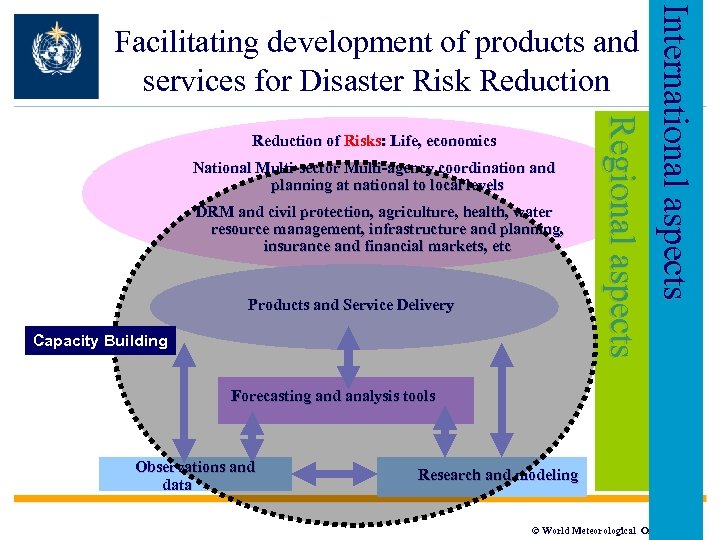 International aspects Regional aspects Facilitating development of products and services for Disaster Risk Reduction of Risks: Life, economics National Multi-sector Multi-agency coordination and planning at national to local levels DRM and civil protection, agriculture, health, water resource management, infrastructure and planning, insurance and financial markets, etc Products and Service Delivery Capacity Building Forecasting and analysis tools Observations and data Research and modeling © World Meteorological Organization
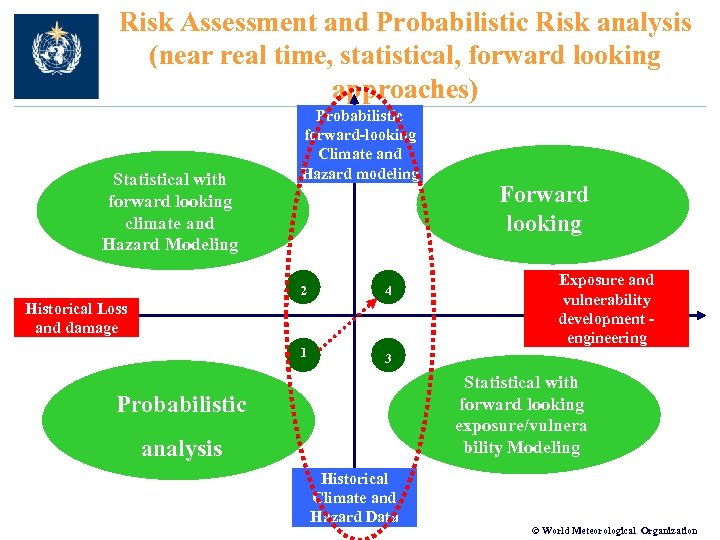 Risk Assessment and Probabilistic Risk analysis (near real time, statistical, forward looking approaches) Statistical with forward looking climate and Hazard Modeling Probabilistic forward-looking Climate and Hazard modeling 2 4 1 Forward looking Exposure and vulnerability development engineering 3 Historical Loss and damage Statistical with forward looking exposure/vulnera bility Modeling Probabilistic analysis Historical Climate and Hazard Data © World Meteorological Organization
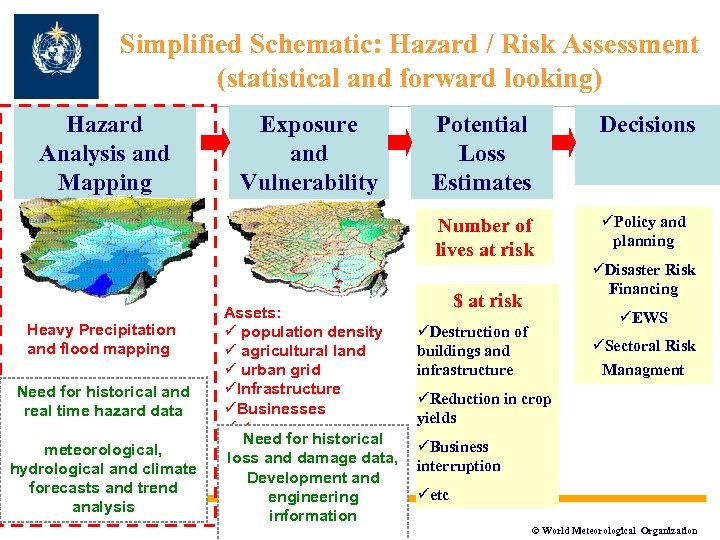 Simplified Schematic: Hazard / Risk Assessment (statistical and forward looking) Hazard Analysis and Mapping Need for historical and real time hazard data meteorological, hydrological and climate forecasts and trend analysis Assets: ü population density ü agricultural land ü urban grid üInfrastructure üBusinesses üetc Need for historical loss and damage data, Development and engineering information Potential Loss Estimates Decisions Number of lives at risk Heavy Precipitation and flood mapping Exposure and Vulnerability üPolicy and planning $ at risk üDisaster Risk Financing üEWS üDestruction of buildings and infrastructure üSectoral Risk Managment üReduction in crop yields üBusiness interruption üetc © World Meteorological Organization
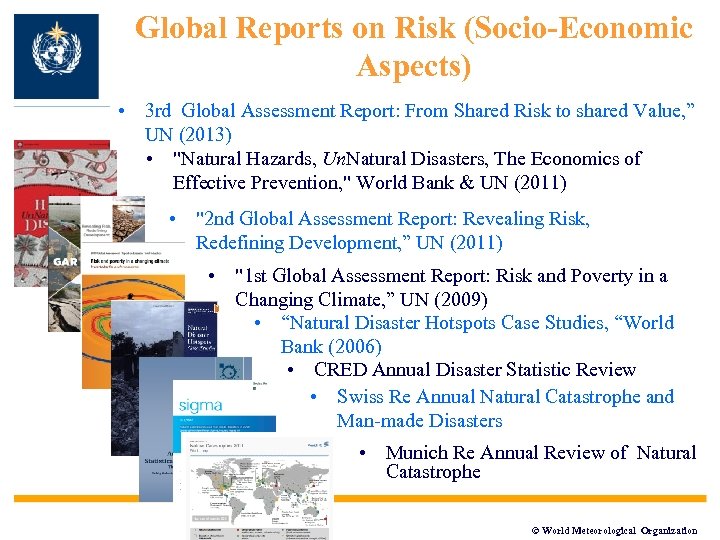 Global Reports on Risk (Socio-Economic Aspects) • 3 rd Global Assessment Report: From Shared Risk to shared Value, ” UN (2013) • "Natural Hazards, Un. Natural Disasters, The Economics of Effective Prevention, " World Bank & UN (2011) • "2 nd Global Assessment Report: Revealing Risk, Redefining Development, ” UN (2011) • "1 st Global Assessment Report: Risk and Poverty in a Changing Climate, ” UN (2009) • “Natural Disaster Hotspots Case Studies, “World Bank (2006) • CRED Annual Disaster Statistic Review • Swiss Re Annual Natural Catastrophe and Man-made Disasters • Munich Re Annual Review of Natural Catastrophe © World Meteorological Organization
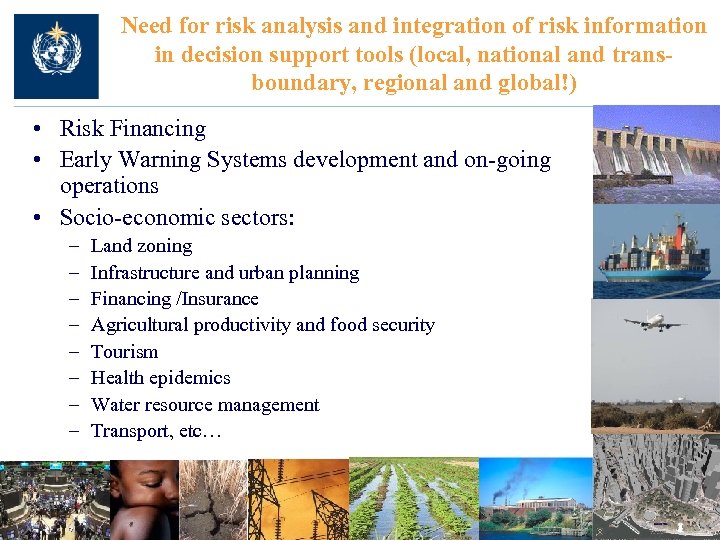 Need for risk analysis and integration of risk information in decision support tools (local, national and transboundary, regional and global!) • Risk Financing • Early Warning Systems development and on-going operations • Socio-economic sectors: – – – – Land zoning Infrastructure and urban planning Financing /Insurance Agricultural productivity and food security Tourism Health epidemics Water resource management Transport, etc… © World Meteorological Organization
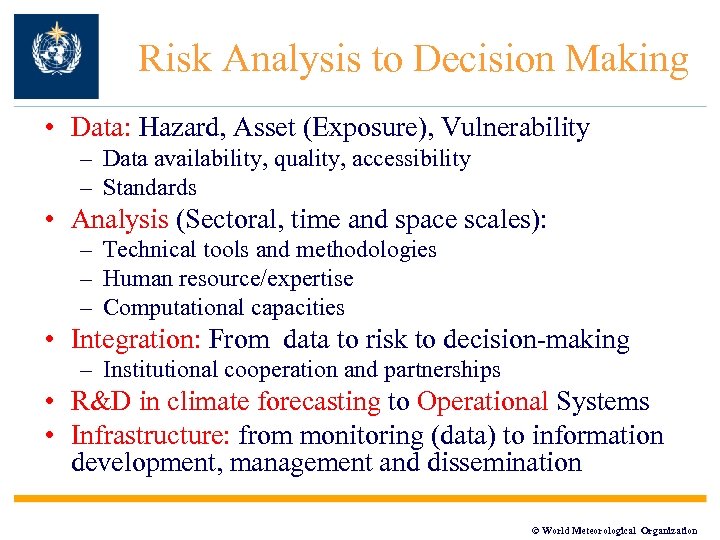 Risk Analysis to Decision Making • Data: Hazard, Asset (Exposure), Vulnerability – Data availability, quality, accessibility – Standards • Analysis (Sectoral, time and space scales): – Technical tools and methodologies – Human resource/expertise – Computational capacities • Integration: From data to risk to decision-making – Institutional cooperation and partnerships • R&D in climate forecasting to Operational Systems • Infrastructure: from monitoring (data) to information development, management and dissemination © World Meteorological Organization
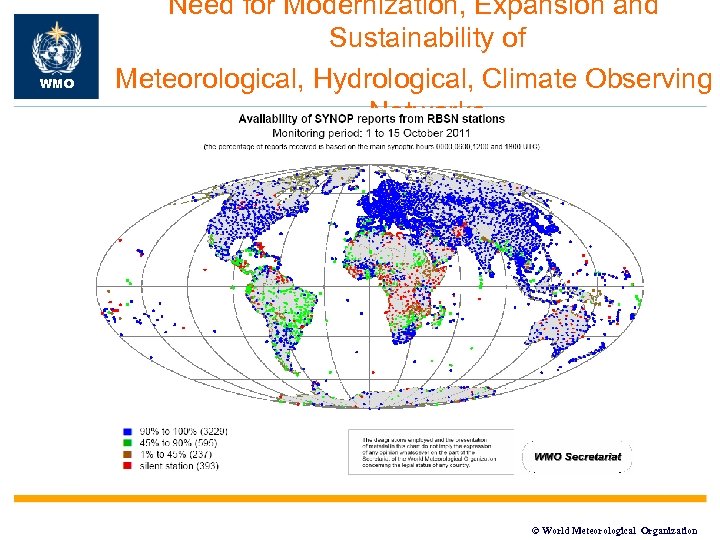 WMO Need for Modernization, Expansion and Sustainability of Meteorological, Hydrological, Climate Observing Networks © World Meteorological Organization
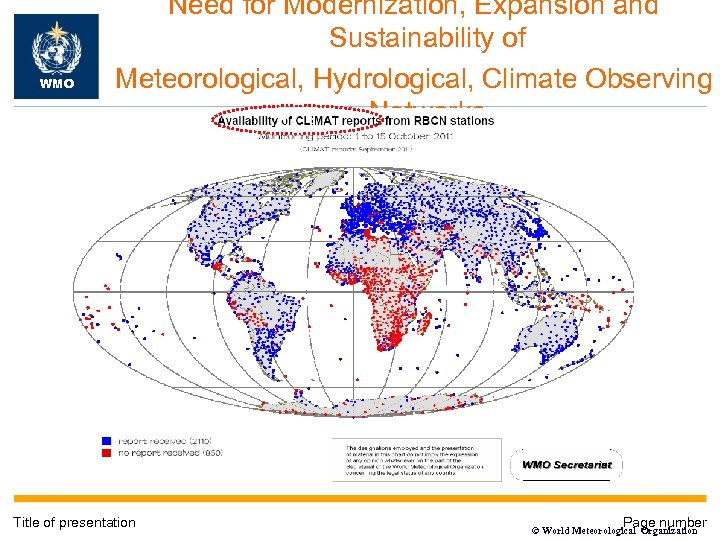 WMO Need for Modernization, Expansion and Sustainability of Meteorological, Hydrological, Climate Observing Networks • c Title of presentation Page number © World Meteorological Organization
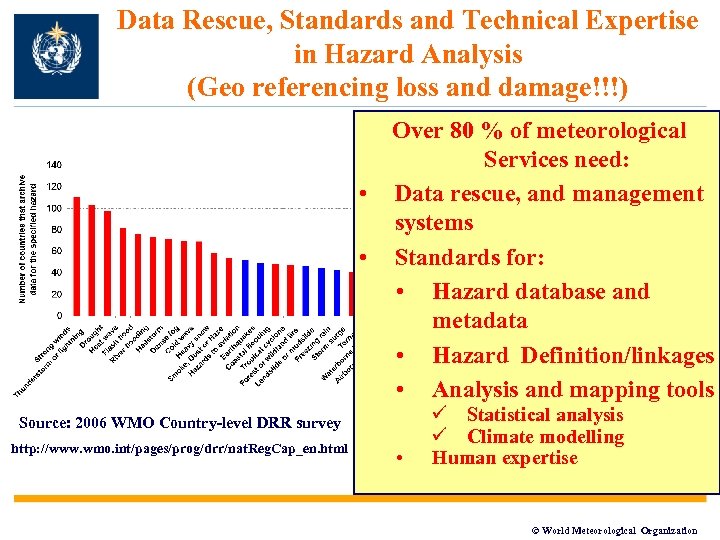 Data Rescue, Standards and Technical Expertise in Hazard Analysis (Geo referencing loss and damage!!!) • • Over 80 % of meteorological Services need: Data rescue, and management systems Standards for: • Hazard database and metadata • Hazard Definition/linkages • Analysis and mapping tools Source: 2006 WMO Country-level DRR survey http: //www. wmo. int/pages/prog/drr/nat. Reg. Cap_en. html • ü Statistical analysis ü Climate modelling Human expertise © World Meteorological Organization
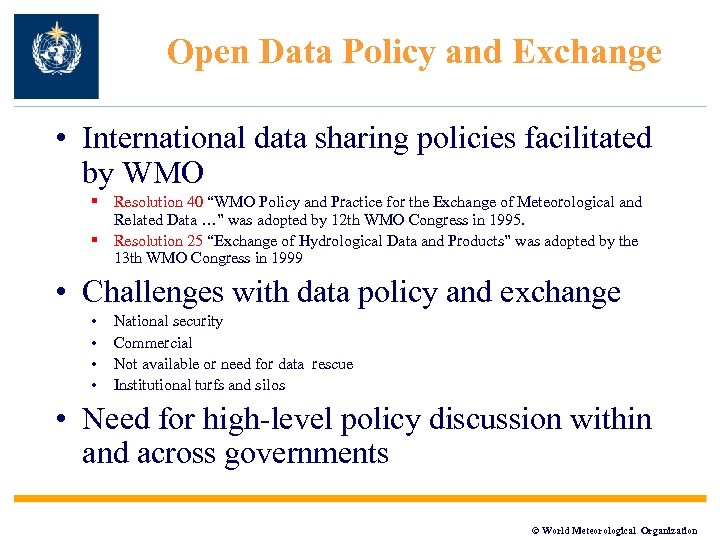 Open Data Policy and Exchange • International data sharing policies facilitated by WMO § Resolution 40 “WMO Policy and Practice for the Exchange of Meteorological and Related Data …” was adopted by 12 th WMO Congress in 1995. § Resolution 25 “Exchange of Hydrological Data and Products” was adopted by the 13 th WMO Congress in 1999 • Challenges with data policy and exchange • • National security Commercial Not available or need for data rescue Institutional turfs and silos • Need for high-level policy discussion within and across governments © World Meteorological Organization
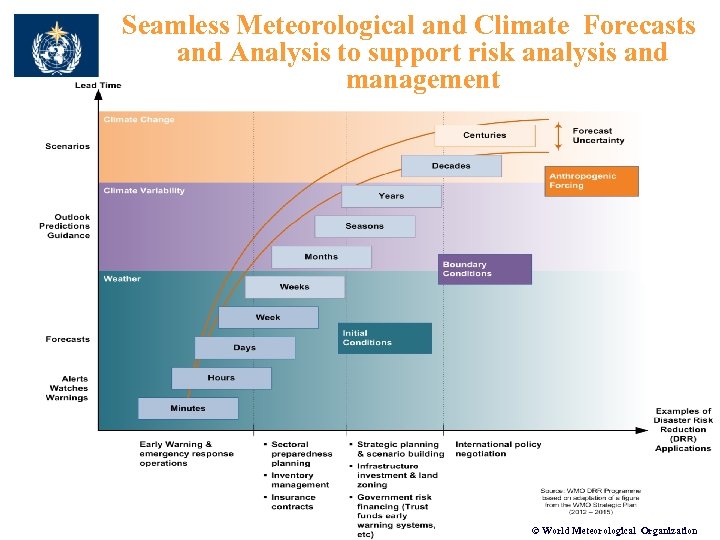 Seamless Meteorological and Climate Forecasts and Analysis to support risk analysis and management © World Meteorological Organization
 Content • Impacts of weather-, water-, and climate-related hazards in a changing Climate • Background • Role of WMO for Development of Guidelines and International Standards • About the Workshop – – Objectives Participants List of documents Outputs • Next Steps © World Meteorological Organization
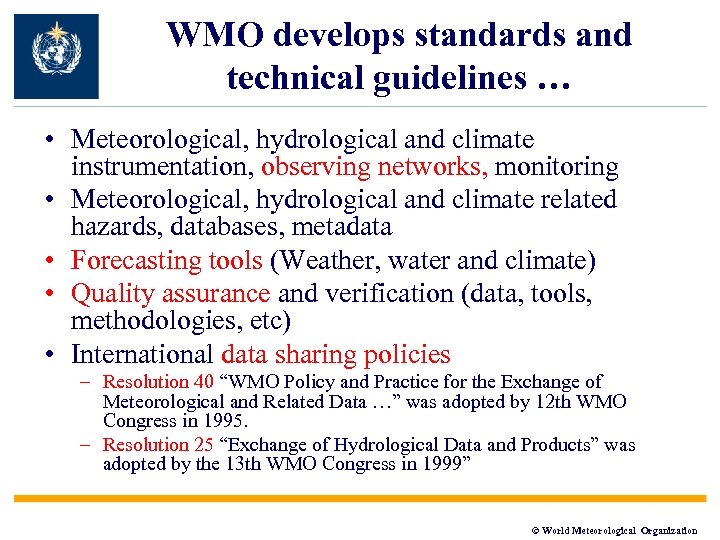 WMO develops standards and technical guidelines … • Meteorological, hydrological and climate instrumentation, observing networks, monitoring • Meteorological, hydrological and climate related hazards, databases, metadata • Forecasting tools (Weather, water and climate) • Quality assurance and verification (data, tools, methodologies, etc) • International data sharing policies – Resolution 40 “WMO Policy and Practice for the Exchange of Meteorological and Related Data …” was adopted by 12 th WMO Congress in 1995. – Resolution 25 “Exchange of Hydrological Data and Products” was adopted by the 13 th WMO Congress in 1999” © World Meteorological Organization
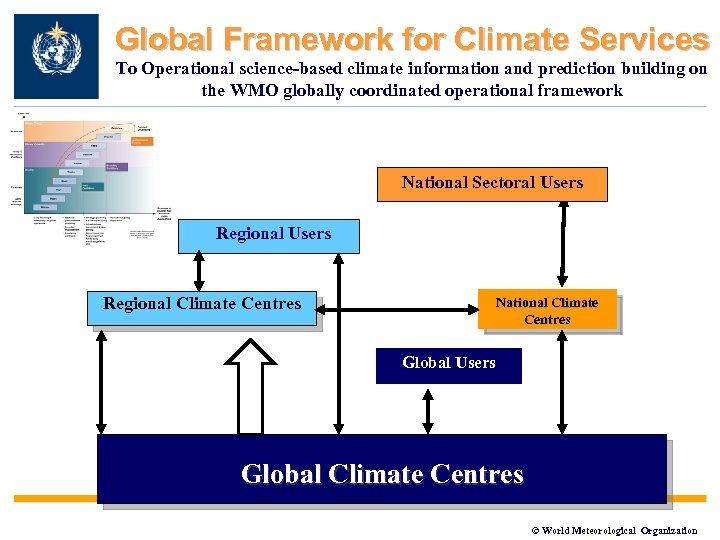 Global Framework for Climate Services To Operational science-based climate information and prediction building on the WMO globally coordinated operational framework National Sectoral Users Regional Climate Centres National Climate Centres Global Users Global Climate Centres © World Meteorological Organization
 Content • Impacts of weather-, water-, and climate-related hazards in a changing Climate • Background • Role of WMO for Development of Guidelines and International Standards • About the Workshop – – Objectives Participants List of documents Outputs • Next Steps © World Meteorological Organization
 First Technical Workshop on Standards for Hazard Monitoring, Data, Metadata and Hazard Analysis to Support Risk Assessment and Analysis 10 -14 June 2013 WMO HQ, Geneva http: //www. wmo. int/pages/prog/drr/projects/Thematic/Ha zard. Risk/2013 -04 -Tech. Wks/index_en. html © World Meteorological Organization
 About the Workshop Objectives (Scoping) • Explore considerations and needs for hazard information to conduct risk assessment and analysis – • Cascading hazards and geo-referencing of damage and loss data; Document definitions and approaches of the participating Members, similarities and differences among their approaches; Review the mandate and related activities of the relevant WMO Technical Commissions • – • related to the standardization of definitions, monitoring, detecting, as well as mapping and forecasting tools for different hazards; Explore challenges and opportunities for developing international guidelines, manual and standards in this area, and; Develop recommendations and priorities of action • – for consideration of the Management Groups of the WMO Technical Commissions for integration in their work planning and the first meeting of the EAG-HRA, © World Meteorological Organization
 About the Workshop Participants • Several countries, which systematically monitor, maintain databases and analyze hazards, – • Australia, Canada, China, France, Germany, Japan, Netherlands, Russian Federation, Switzerland, United States of America, and the United Kingdom of Great Britain and Northern Ireland; WMO Technical Commissions and Programmes responsible for the development of technical standards and guidelines – • CBS, CCL, CHy, JCOMM, CIMO, Ag. M, TCP Organizations with extensive experience in risk assessment and collection of damage and loss data – Munich Re, CRED, UNISDR, UNDP © World Meteorological Organization
 About the Workshop Documents • Doc. 1: Draft Agenda of the Workshop • Doc. 2: Concept Note – Annex I to Doc. 2: Guidelines for Preparation of Country Documents for the First Technical Workshop on Standards for Hazard Monitoring, Databases, Metadata and Analysis Techniques to Support Risk Assessment – Annex II to Doc. 2: Guidelines for Preparation of Technical Commission Documents for the First Technical Workshop on Standards for Hazard Monitoring, Databases, Metadata and Analysis Techniques to Support Risk Assessment • Doc. 3: List of Participants. • Inf. 1: Logistical Information Note for Participants. © World Meteorological Organization
 About the Workshop Outputs A comprehensive WMO Technical Report including: (1) All documents, presentations prepared and presented in the workshop as the foundation knowledge underpinning the recommendations – Revised and updated documents to be submitted to WMO by 9 September 2013 for inclusion in the publication (2) A set of recommendations and priorities for action for 2013, 2015, 2017, 2019 timeframes – What specific guidelines and standards for hazard definitions, , monitoring and detection, databases and metadata and hazard analysis and forecasting tools, for weather-, climate- and hydrological hazards © World Meteorological Organization
 About the Workshop Next Steps • Presenting and discussing the report and recommendations to the Presidents and Management Groups of TCs • Discussion of the priorities of actions and mechanisms at the Joint President’s of TC Meetings (Jan 2014) • First Meeting of Expert Advisory Group on Hazard/Risk (Spring 2014) • Work planning and implementation of priorities and deliverables through intra- and inter-commission mechanisms with Risk experts © World Meteorological Organization
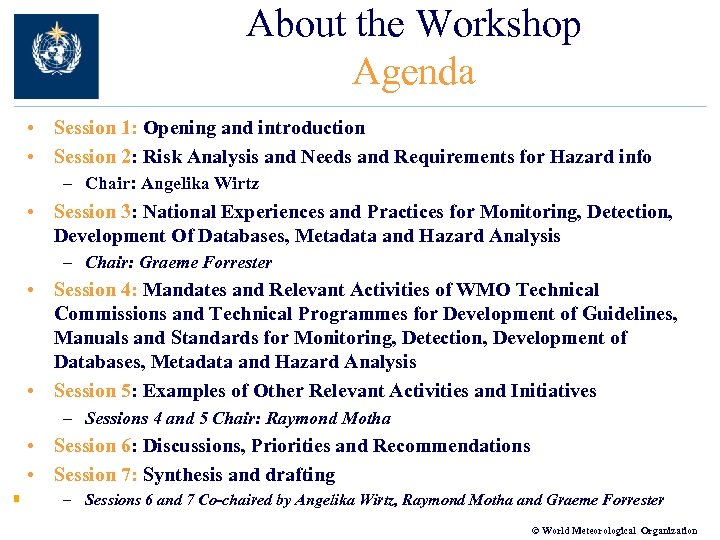 About the Workshop Agenda • Session 1: Opening and introduction • Session 2: Risk Analysis and Needs and Requirements for Hazard info – Chair: Angelika Wirtz • Session 3: National Experiences and Practices for Monitoring, Detection, Development Of Databases, Metadata and Hazard Analysis – Chair: Graeme Forrester • Session 4: Mandates and Relevant Activities of WMO Technical Commissions and Technical Programmes for Development of Guidelines, Manuals and Standards for Monitoring, Detection, Development of Databases, Metadata and Hazard Analysis • Session 5: Examples of Other Relevant Activities and Initiatives – Sessions 4 and 5 Chair: Raymond Motha • Session 6: Discussions, Priorities and Recommendations • Session 7: Synthesis and drafting – Sessions 6 and 7 Co-chaired by Angelika Wirtz, Raymond Motha and Graeme Forrester © World Meteorological Organization
 Drafting Team • Co-chairs: Angelika Wirtz, Raymond Motha and Graeme Forrester • Participants (experts from Members, TCs and organizations) • WMO Secretariat support © World Meteorological Organization
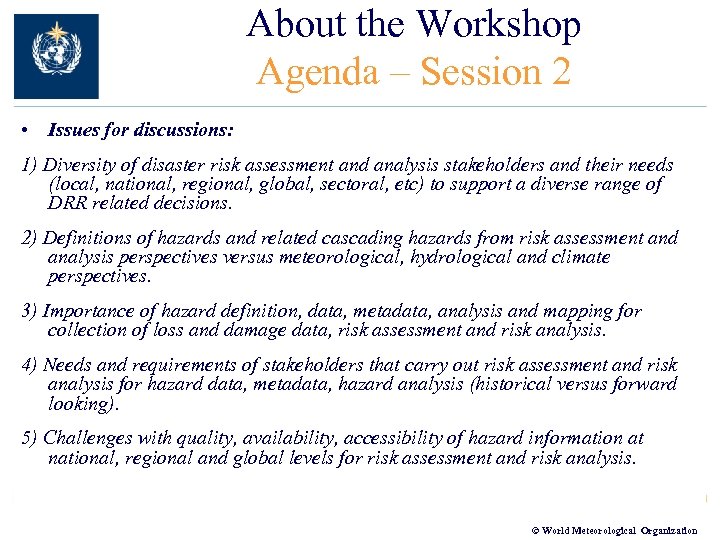 About the Workshop Agenda – Session 2 • Issues for discussions: 1) Diversity of disaster risk assessment and analysis stakeholders and their needs (local, national, regional, global, sectoral, etc) to support a diverse range of DRR related decisions. 2) Definitions of hazards and related cascading hazards from risk assessment and analysis perspectives versus meteorological, hydrological and climate perspectives. 3) Importance of hazard definition, data, metadata, analysis and mapping for collection of loss and damage data, risk assessment and risk analysis. 4) Needs and requirements of stakeholders that carry out risk assessment and risk analysis for hazard data, metadata, hazard analysis (historical versus forward looking). 5) Challenges with quality, availability, accessibility of hazard information at national, regional and global levels for risk assessment and risk analysis. © World Meteorological Organization
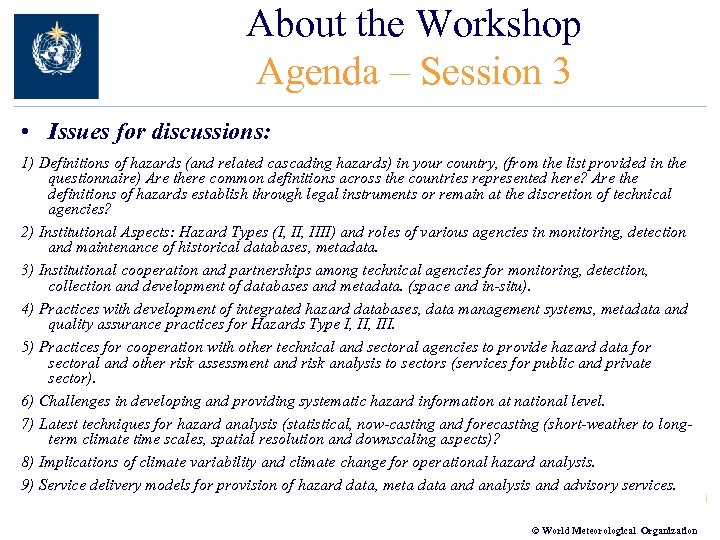 About the Workshop Agenda – Session 3 • Issues for discussions: 1) Definitions of hazards (and related cascading hazards) in your country, (from the list provided in the questionnaire) Are there common definitions across the countries represented here? Are the definitions of hazards establish through legal instruments or remain at the discretion of technical agencies? 2) Institutional Aspects: Hazard Types (I, IIII) and roles of various agencies in monitoring, detection and maintenance of historical databases, metadata. 3) Institutional cooperation and partnerships among technical agencies for monitoring, detection, collection and development of databases and metadata. (space and in-situ). 4) Practices with development of integrated hazard databases, data management systems, metadata and quality assurance practices for Hazards Type I, III. 5) Practices for cooperation with other technical and sectoral agencies to provide hazard data for sectoral and other risk assessment and risk analysis to sectors (services for public and private sector). 6) Challenges in developing and providing systematic hazard information at national level. 7) Latest techniques for hazard analysis (statistical, now-casting and forecasting (short-weather to longterm climate time scales, spatial resolution and downscaling aspects)? 8) Implications of climate variability and climate change for operational hazard analysis. 9) Service delivery models for provision of hazard data, meta data and analysis and advisory services. © World Meteorological Organization
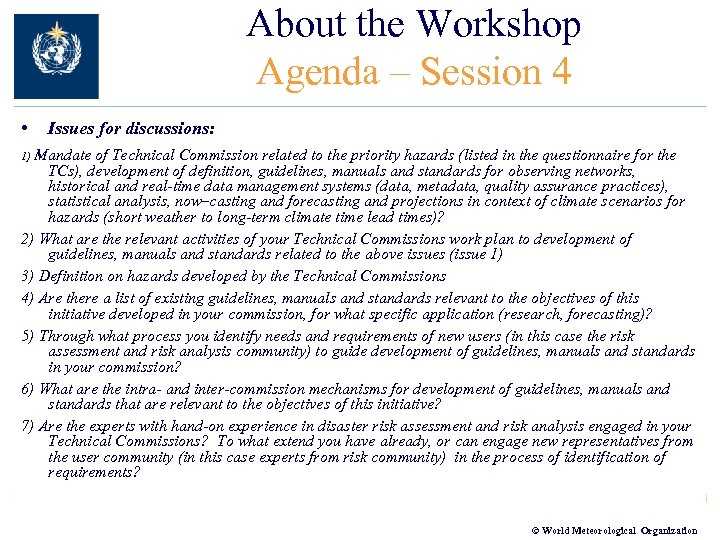 About the Workshop Agenda – Session 4 • Issues for discussions: 1) Mandate of Technical Commission related to the priority hazards (listed in the questionnaire for the TCs), development of definition, guidelines, manuals and standards for observing networks, historical and real-time data management systems (data, metadata, quality assurance practices), statistical analysis, now–casting and forecasting and projections in context of climate scenarios for hazards (short weather to long-term climate time lead times)? 2) What are the relevant activities of your Technical Commissions work plan to development of guidelines, manuals and standards related to the above issues (issue 1) 3) Definition on hazards developed by the Technical Commissions 4) Are there a list of existing guidelines, manuals and standards relevant to the objectives of this initiative developed in your commission, for what specific application (research, forecasting)? 5) Through what process you identify needs and requirements of new users (in this case the risk assessment and risk analysis community) to guide development of guidelines, manuals and standards in your commission? 6) What are the intra- and inter-commission mechanisms for development of guidelines, manuals and standards that are relevant to the objectives of this initiative? 7) Are the experts with hand-on experience in disaster risk assessment and risk analysis engaged in your Technical Commissions? To what extend you have already, or can engage new representatives from the user community (in this case experts from risk community) in the process of identification of requirements? © World Meteorological Organization
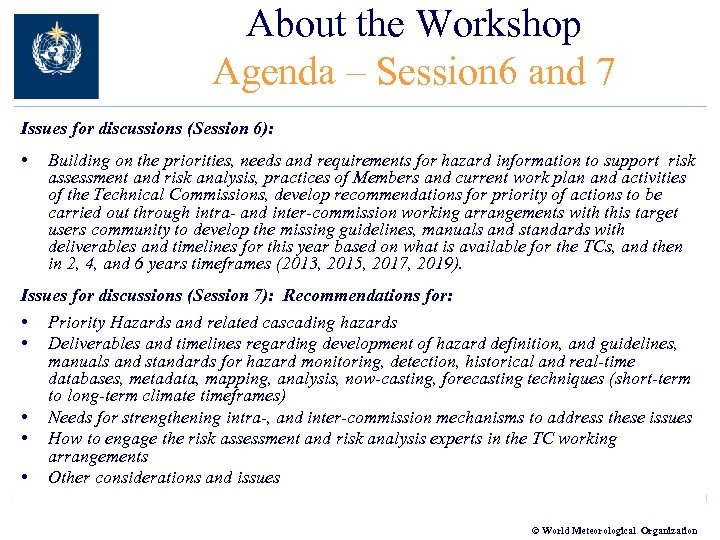 About the Workshop Agenda – Session 6 and 7 Issues for discussions (Session 6): • Building on the priorities, needs and requirements for hazard information to support risk assessment and risk analysis, practices of Members and current work plan and activities of the Technical Commissions, develop recommendations for priority of actions to be carried out through intra- and inter-commission working arrangements with this target users community to develop the missing guidelines, manuals and standards with deliverables and timelines for this year based on what is available for the TCs, and then in 2, 4, and 6 years timeframes (2013, 2015, 2017, 2019). Issues for discussions (Session 7): Recommendations for: • • • Priority Hazards and related cascading hazards Deliverables and timelines regarding development of hazard definition, and guidelines, manuals and standards for hazard monitoring, detection, historical and real-time databases, metadata, mapping, analysis, now-casting, forecasting techniques (short-term to long-term climate timeframes) Needs for strengthening intra-, and inter-commission mechanisms to address these issues How to engage the risk assessment and risk analysis experts in the TC working arrangements Other considerations and issues © World Meteorological Organization
 Thank You For more information please contact: Maryam Golnaraghi, Ph. D. Chief Disaster Risk Reduction Programme World Meteorological Organization Tel. +41. 22. 730. 8006 Email. MGolnaraghi@wmo. int http: //www. wmo. int/disasters © World Meteorological Organization
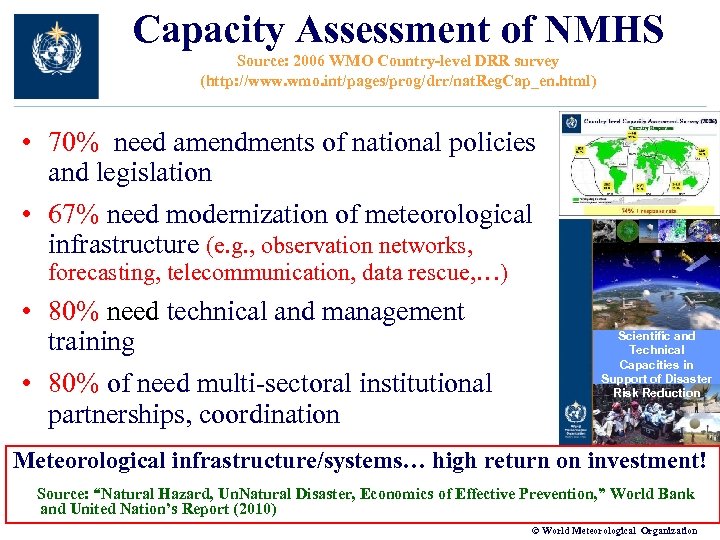 Capacity Assessment of NMHS Source: 2006 WMO Country-level DRR survey (http: //www. wmo. int/pages/prog/drr/nat. Reg. Cap_en. html) • 70% need amendments of national policies and legislation • 67% need modernization of meteorological infrastructure (e. g. , observation networks, forecasting, telecommunication, data rescue, …) • 80% need technical and management training • 80% of need multi-sectoral institutional partnerships, coordination Global Survey of Scientific and Technical Capacities in Support of Disaster Risk Reduction Meteorological infrastructure/systems… high return on investment! Source: “Natural Hazard, Un. Natural Disaster, Economics of Effective Prevention, ” World Bank and United Nation’s Report (2010) © World Meteorological Organization
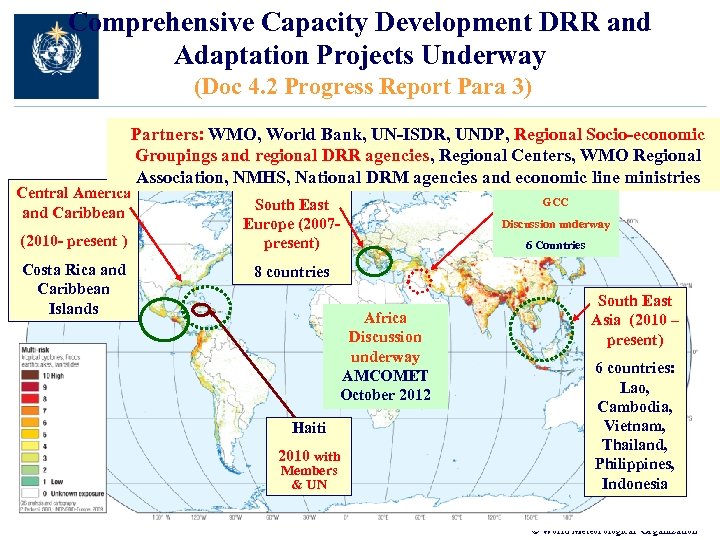 Comprehensive Capacity Development DRR and Adaptation Projects Underway (Doc 4. 2 Progress Report Para 3) Partners: WMO, World Bank, UN-ISDR, UNDP, Regional Socio-economic Groupings and regional DRR agencies, Regional Centers, WMO Regional Association, NMHS, National DRM agencies and economic line ministries Central America and Caribbean (2010 - present ) Costa Rica and Caribbean Islands South East Europe (2007 present) GCC Discussion underway 6 Countries 8 countries Africa Discussion underway AMCOMET October 2012 Haiti 2010 with Members & UN South East Asia (2010 – present) 6 countries: Lao, Cambodia, Vietnam, Thailand, Philippines, Indonesia © World Meteorological Organization
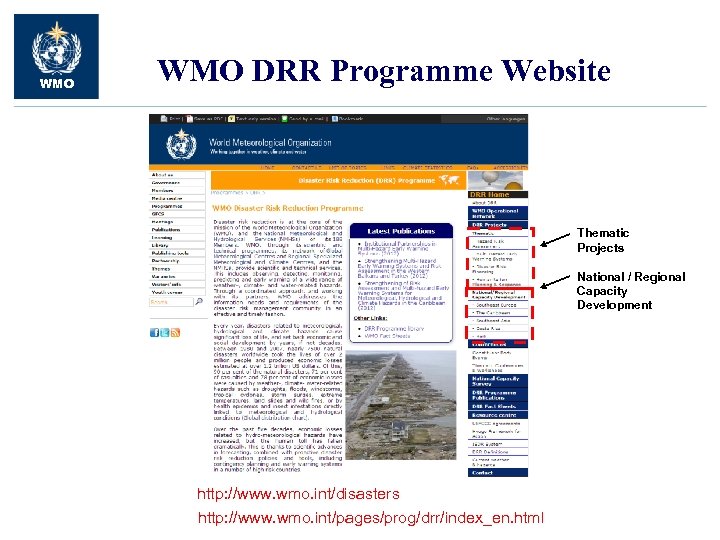 WMO DRR Programme Website Thematic Projects National / Regional Capacity Development http: //www. wmo. int/disasters http: //www. wmo. int/pages/prog/drr/index_en. html © World Meteorological Organization