


 Скачать презентацию World Meteorological Organization Working together in weather climate
ecb046ed85de7b1b893e2a517761b6ed.ppt
- Количество слайдов: 34
 World Meteorological Organization Working together in weather, climate and water WMO The WMO Education and Training Programme www. wmo. int
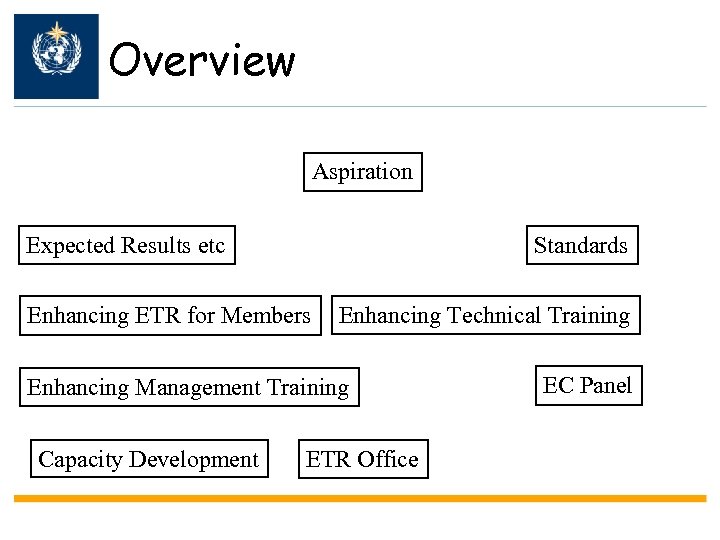 Overview Aspiration Expected Results etc Standards Enhancing ETR for Members Enhancing Technical Training Enhancing Management Training Capacity Development ETR Office EC Panel
 What is the ETRP doing? Setting education and training Standards Pro-actively assisting the TCs in development of job competencies Working with training institutes to provide more training opportunities and resources Encouraging the use of Distance Learning Increasing HR development activities
 ETRP in 2016 Fellowships – More with alternative funding Training – Standards implemented – Additional training partners – Other WMO programmes utilising RTC facilities and supporting development of new resources – E-learning a normal part of training delivery
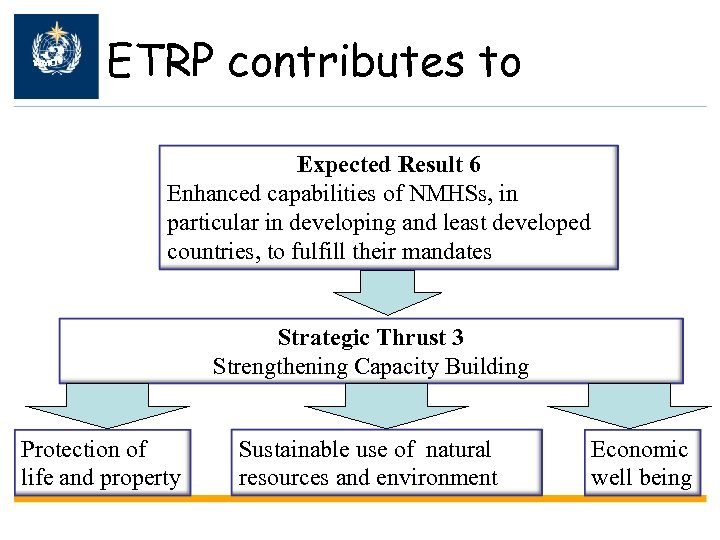 WMO ETRP contributes to Expected Result 6 Enhanced capabilities of NMHSs, in particular in developing and least developed countries, to fulfill their mandates Strategic Thrust 3 Strengthening Capacity Building Protection of life and property Sustainable use of natural resources and environment Economic well being
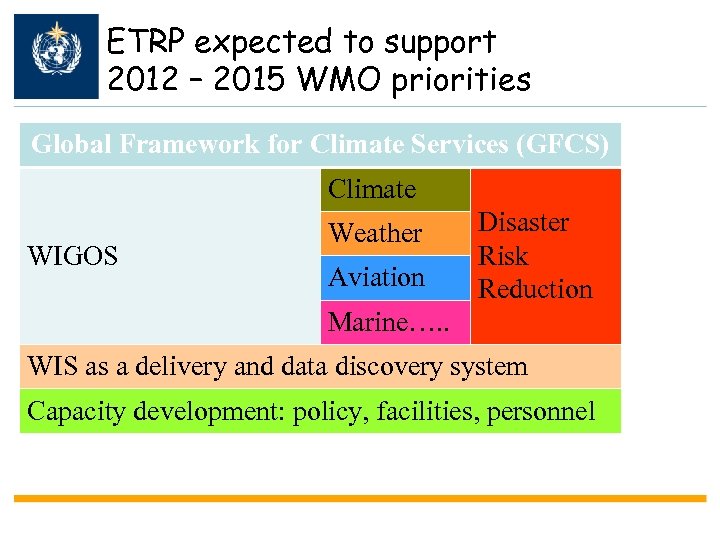 ETRP expected to support 2012 – 2015 WMO priorities Global Framework for Climate Services (GFCS) Climate WIGOS Weather Aviation Disaster Risk Reduction Marine…. . WIS as a delivery and data discovery system Capacity development: policy, facilities, personnel
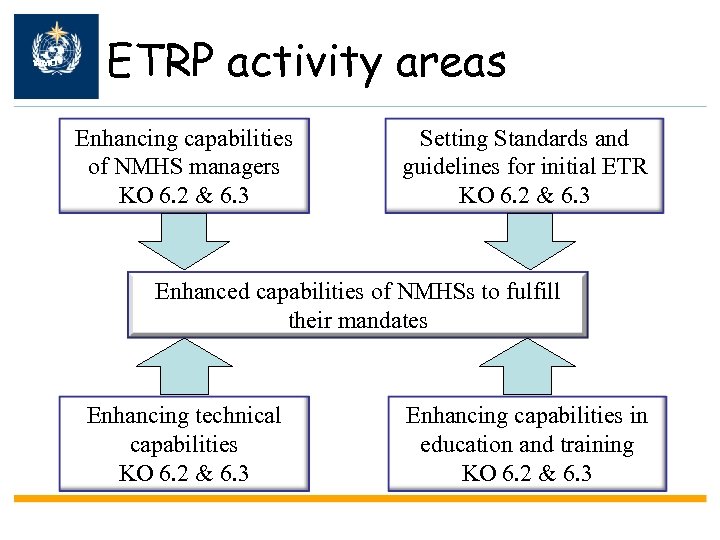 WMO ETRP activity areas Enhancing capabilities of NMHS managers KO 6. 2 & 6. 3 Setting Standards and guidelines for initial ETR KO 6. 2 & 6. 3 Enhanced capabilities of NMHSs to fulfill their mandates Enhancing technical capabilities KO 6. 2 & 6. 3 Enhancing capabilities in education and training KO 6. 2 & 6. 3
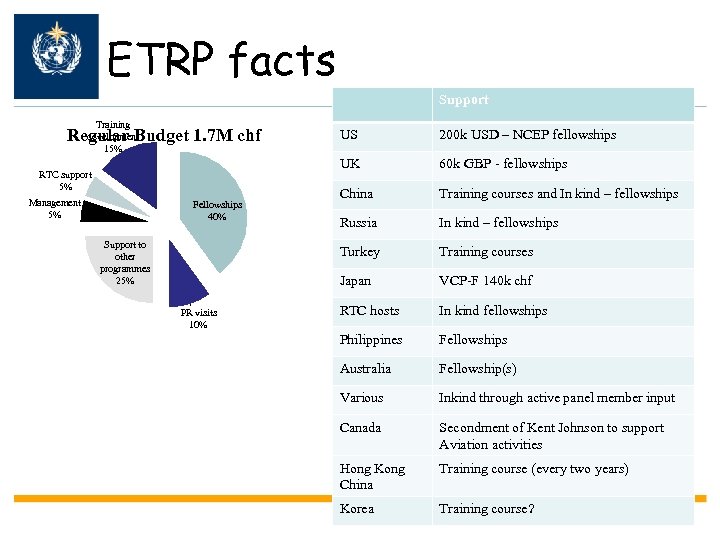 ETRP facts Support Training development 15% Regular Budget 1. 7 M chf Management 5% PR visits 10% China Training courses and In kind – fellowships Russia In kind – fellowships Training courses Japan Support to other programmes 25% 60 k GBP - fellowships Turkey Fellowships 40% 200 k USD – NCEP fellowships UK RTC support 5% US VCP-F 140 k chf RTC hosts In kind fellowships Philippines Fellowships Australia Fellowship(s) Various Inkind through active panel member input Canada Secondment of Kent Johnson to support Aviation activities Hong Kong China Training course (every two years) Korea Training course?
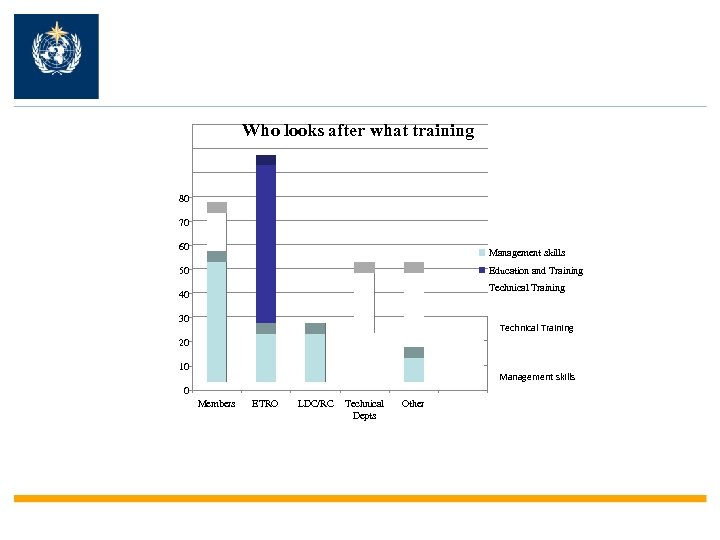 Who looks after what training 80 70 60 Management skills 50 Education and Training Technical Training 40 30 Technical Training 20 10 Management skills 0 Members ETRO LDC/RC Technical Depts Other
 Setting Standards
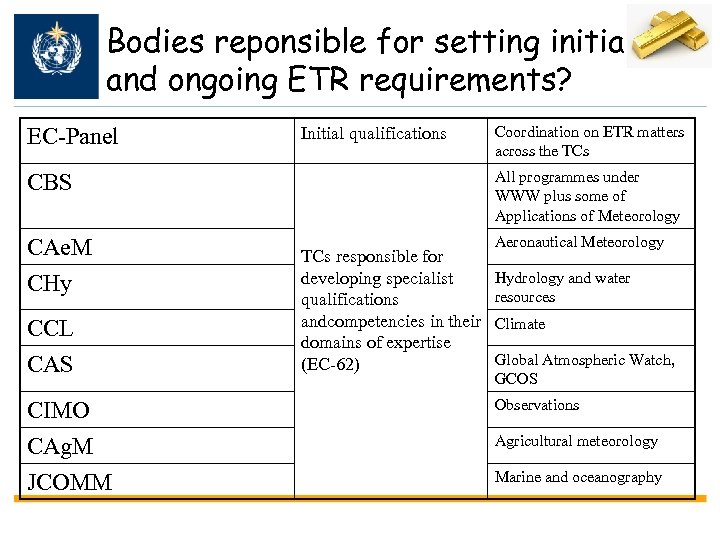 Bodies reponsible for setting initial and ongoing ETR requirements? EC-Panel Initial qualifications Coordination on ETR matters across the TCs CBS All programmes under WWW plus some of Applications of Meteorology CAe. M CHy Aeronautical Meteorology CCL CAS TCs responsible for developing specialist qualifications andcompetencies in their domains of expertise (EC-62) Hydrology and water resources Climate Global Atmospheric Watch, GCOS CIMO Observations CAg. M JCOMM Agricultural meteorology Marine and oceanography
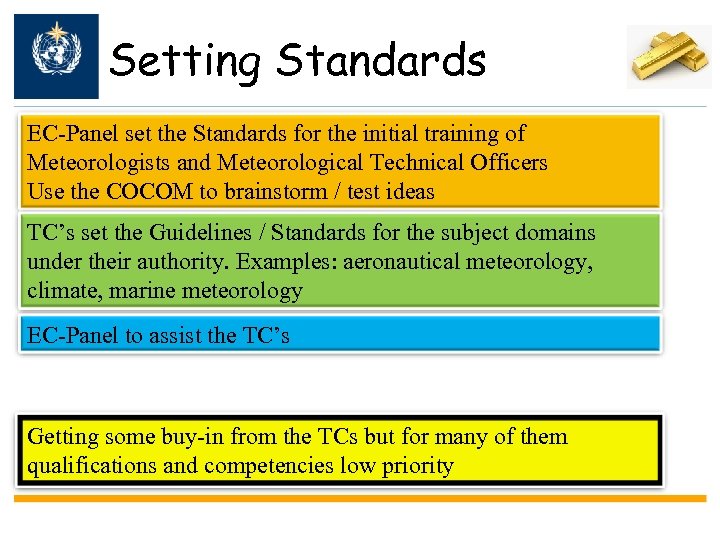 Setting Standards EC-Panel set the Standards for the initial training of Meteorologists and Meteorological Technical Officers Use the COCOM to brainstorm / test ideas TC’s set the Guidelines / Standards for the subject domains under their authority. Examples: aeronautical meteorology, climate, marine meteorology EC-Panel to assist the TC’s Getting some buy-in from the TCs but for many of them qualifications and competencies low priority
 Enhancing Member ETR capabilities
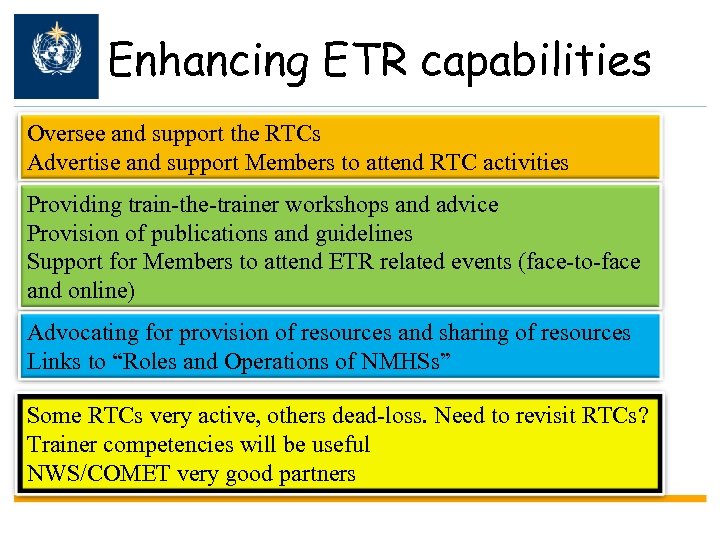 Enhancing ETR capabilities Oversee and support the RTCs Advertise and support Members to attend RTC activities Providing train-the-trainer workshops and advice Provision of publications and guidelines Support for Members to attend ETR related events (face-to-face and online) Advocating for provision of resources and sharing of resources Links to “Roles and Operations of NMHSs” Some RTCs very active, others dead-loss. Need to revisit RTCs? Trainer competencies will be useful NWS/COMET very good partners
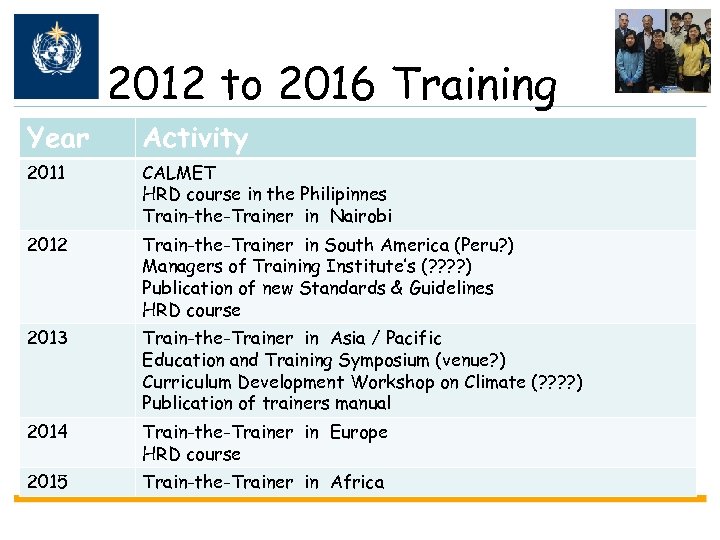 2012 to 2016 Training Year Activity 2011 CALMET HRD course in the Philipinnes Train-the-Trainer in Nairobi 2012 Train-the-Trainer in South America (Peru? ) Managers of Training Institute’s (? ? ) Publication of new Standards & Guidelines HRD course 2013 Train-the-Trainer in Asia / Pacific Education and Training Symposium (venue? ) Curriculum Development Workshop on Climate (? ? ) Publication of trainers manual 2014 Train-the-Trainer in Europe HRD course 2015 Train-the-Trainer in Africa
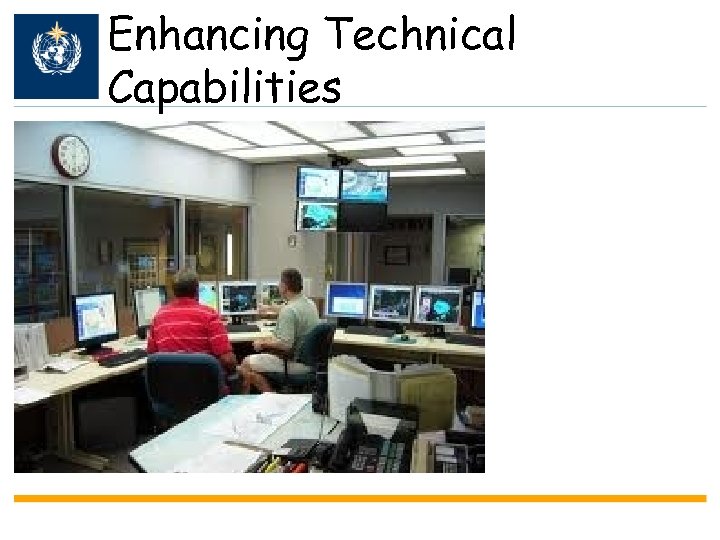 Enhancing Technical Capabilities
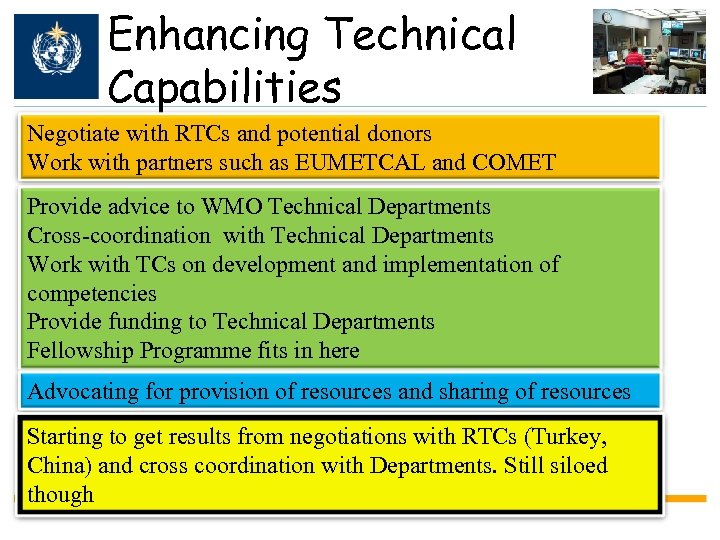 Enhancing Technical Capabilities Negotiate with RTCs and potential donors Work with partners such as EUMETCAL and COMET Provide advice to WMO Technical Departments Cross-coordination with Technical Departments Work with TCs on development and implementation of competencies Provide funding to Technical Departments Fellowship Programme fits in here Advocating for provision of resources and sharing of resources Starting to get results from negotiations with RTCs (Turkey, China) and cross coordination with Departments. Still siloed though
 Enhancing Management Capabilities
 Enhancing Management Capabilities Working with the LDCR and Regional Programme to deliver workshops that support strategic planning …. . Linking to the “Roles and Operations of NMHSs” and anticipating Panel looking at a Capability Framework at next session. Coordinating with UK, Spain and France on their management courses PR Familiarisation visits come under this Capability framework will give this much more focus. Links with LDCR and Regional Programmes tentative but firming
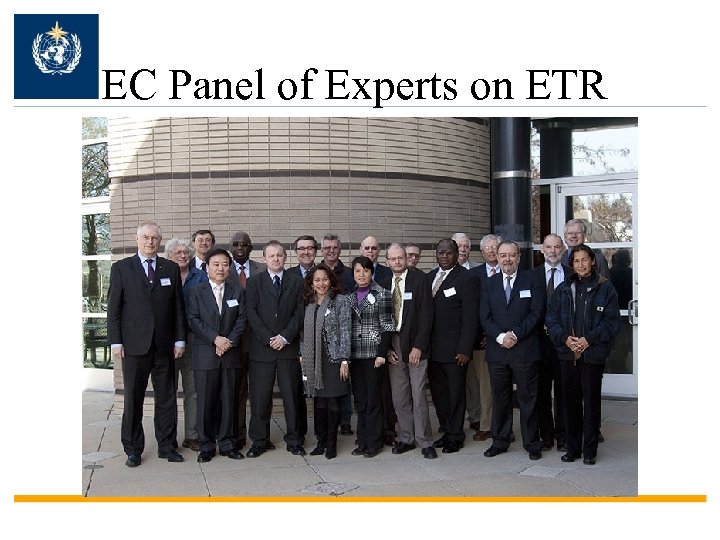 EC Panel of Experts on ETR
 Congress Decisions Revised definition of Meteorologist and Meteorological Technician Agreed on new BIP-M and BIP-MT Standards Agreed on new guidelines to support the implementation of the Standards Continued the EC Panel of Experts on Education and Training
 Implications for ETRP of Congress decisions Severed the link between jobs and classifications. Now up to each Member who does what tasks WMO 258 is being phased out by 1 Dec 2013. ETR Standards in Section B 4 of WMO Technical Regulations Vol 1, publication 49
 Expectations of ETRP due to Congress decisions Expected to support the implementation of the GFCS through education and training in climate services Expected to increase provision of management training Expected to assist implementation of WIS / WIGOS through training in meta-data, network management, quality control, QMS ….
 EC Panel possible topics March 2012 – New Zealand /Geneva / New Delhi? – Climate services - Human Resource Development – Use of ISO standard for accrediting non university training institutions – Trainer competencies document – Symposium in 2013 – HRD capability framework – RTC reviews – Task Team on Distance Learning – WMO Cloud Atlas and Global Satellite Manual – Clarifying the WMO ETR cycle and who is responsible for which components and how to bring it all together
 Opportunities and Challenges for the ETRP / Panel Reform proposals for the EC WG on Capacity Development and how this could support / impact upon the work of the Panel Member interest in the Panel Making the most of available resources (staff and funds)
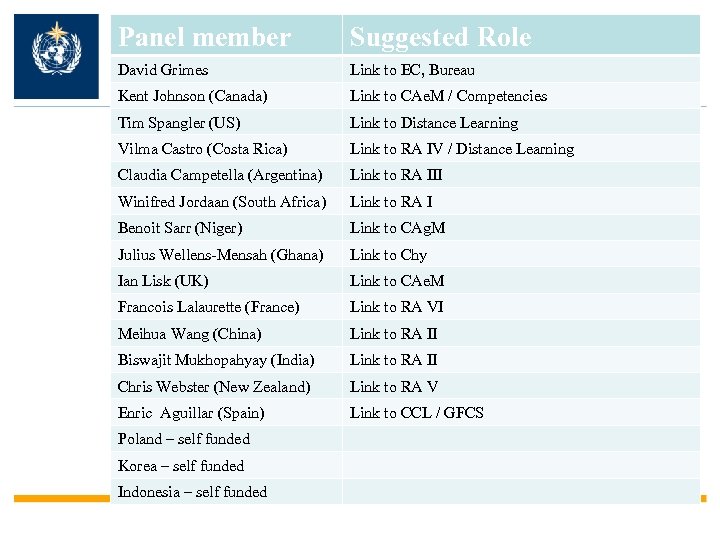 Panel member Suggested Role David Grimes Link to EC, Bureau Kent Johnson (Canada) Link to CAe. M / Competencies Tim Spangler (US) Link to Distance Learning Vilma Castro (Costa Rica) Link to RA IV / Distance Learning Claudia Campetella (Argentina) Link to RA III Winifred Jordaan (South Africa) Link to RA I Benoit Sarr (Niger) Link to CAg. M Julius Wellens-Mensah (Ghana) Link to Chy Ian Lisk (UK) Link to CAe. M Francois Lalaurette (France) Link to RA VI Meihua Wang (China) Link to RA II Biswajit Mukhopahyay (India) Link to RA II Chris Webster (New Zealand) Link to RA V Enric Aguillar (Spain) Link to CCL / GFCS Poland – self funded Korea – self funded Indonesia – self funded
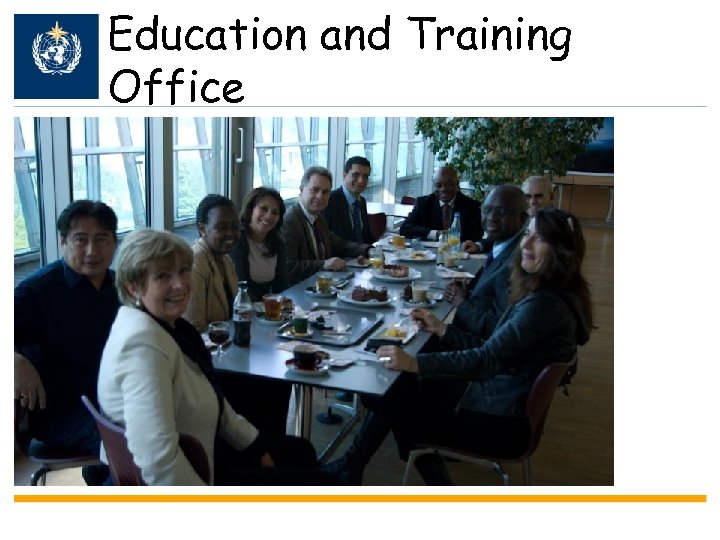 Education and Training Office
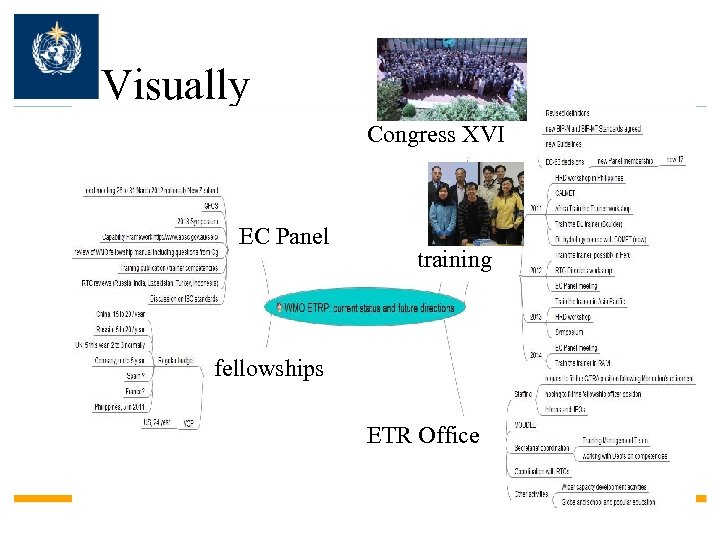 Visually Congress XVI EC Panel training fellowships ETR Office
 ETR Office Staffing: – Chief of the Training Division (advertised) – Fellowship Officer (early 2012) Using interns and JPOs Extending the use of MOODLE
 Extending the GFCS model in terms of capacity development
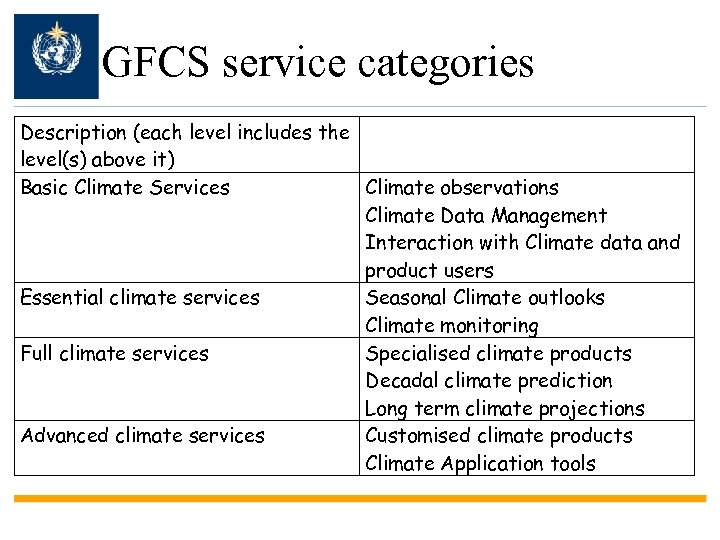 GFCS service categories Description (each level includes the level(s) above it) Basic Climate Services Climate observations Climate Data Management Interaction with Climate data and product users Essential climate services Seasonal Climate outlooks Climate monitoring Full climate services Specialised climate products Decadal climate prediction Long term climate projections Advanced climate services Customised climate products Climate Application tools
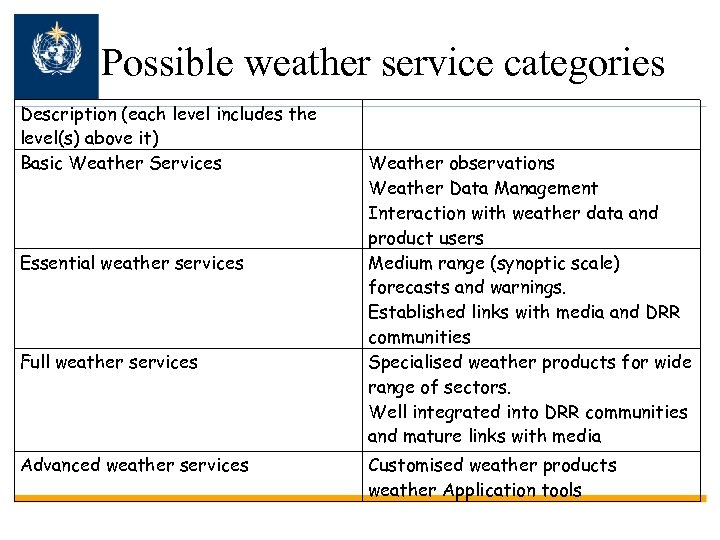 Possible weather service categories Description (each level includes the level(s) above it) Basic Weather Services Essential weather services Full weather services Advanced weather services Weather observations Weather Data Management Interaction with weather data and product users Medium range (synoptic scale) forecasts and warnings. Established links with media and DRR communities Specialised weather products for wide range of sectors. Well integrated into DRR communities and mature links with media Customised weather products weather Application tools
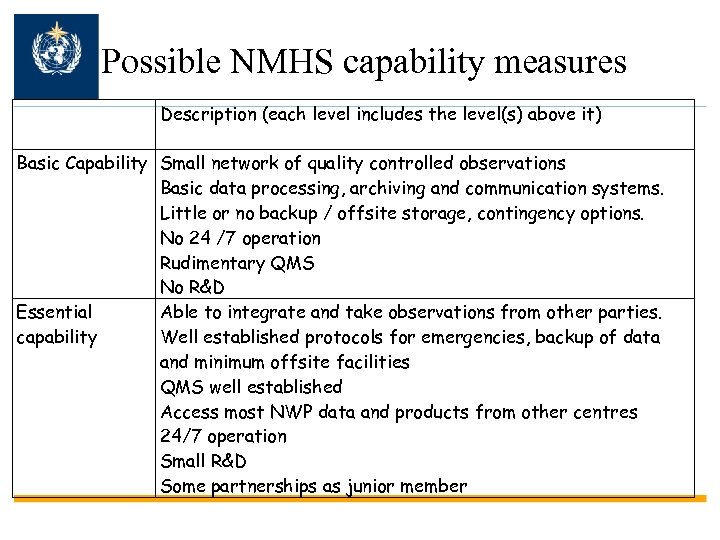 Possible NMHS capability measures Description (each level includes the level(s) above it) Basic Capability Small network of quality controlled observations Basic data processing, archiving and communication systems. Little or no backup / offsite storage, contingency options. No 24 /7 operation Rudimentary QMS No R&D Essential Able to integrate and take observations from other parties. capability Well established protocols for emergencies, backup of data and minimum offsite facilities QMS well established Access most NWP data and products from other centres 24/7 operation Small R&D Some partnerships as junior member
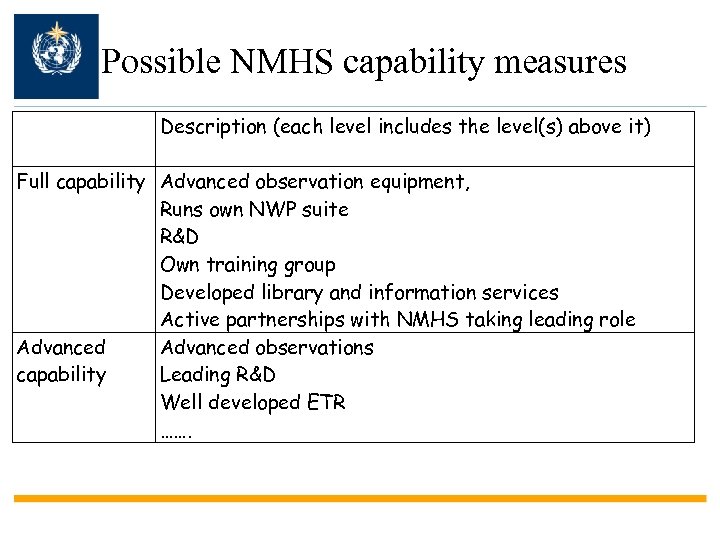 Possible NMHS capability measures Description (each level includes the level(s) above it) Full capability Advanced observation equipment, Runs own NWP suite R&D Own training group Developed library and information services Active partnerships with NMHS taking leading role Advanced observations capability Leading R&D Well developed ETR …….