


 Скачать презентацию WORLD METEOROLOGICAL ORGANIZATION Weather Climate — Water
4735a918a6b7af80585d97906c0e7705.ppt
- Количество слайдов: 16
 WORLD METEOROLOGICAL ORGANIZATION Weather – Climate - Water WMO Information System (WIS) Managing & Moving Weather, Water and Climate Information in the 21 st Century Report to ICT-ISS – Fourth Session 10 -12 November 2008 Presented by David Thomas (PM-WIS) World Meteorological 1
 ICT-ISS – Fourth Session • Two presentations complementing ET-WISC report 1. An overview of WIS (Dave) 2. Technical presentation on Compliance Specs of WIS (Eliot) • • • What is WIS and why is WMO going this way? What is happening to the GTS & MTN? How does WIS relate to ET & WGs? Will WIS lead to changes in the ET & WGs plans and priorities? What is the time frame of WIS? Input for CBS planning ETs, TOR and priorities World Meteorological 2
 WMO Objectives • To produce more accurate, timely and reliable forecasts and warnings of weather, climate, water and related environmental elements; • To improve the delivery of weather, climate, water and related environmental information and services to the public, governments and other users; • To provide scientific and technical expertise and advice in support of policy- and decision-making and implementation of the agreed international development goals and multilateral agreements. World Meteorological 3
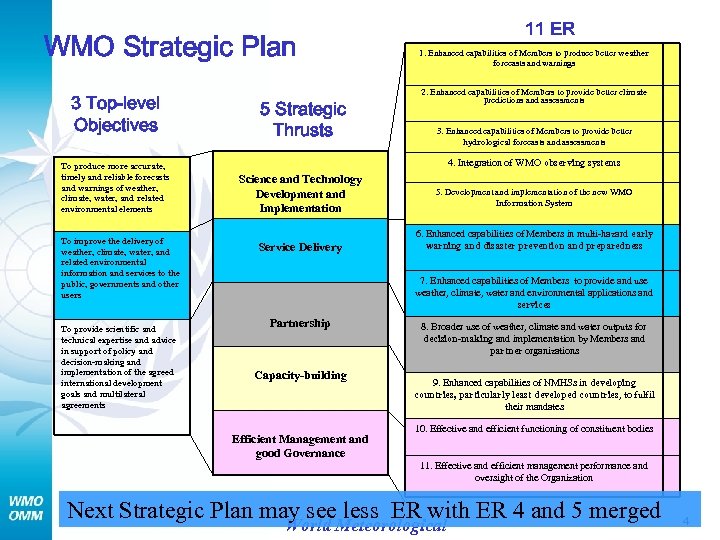 WMO Strategic Plan 3 Top-level Objectives To produce more accurate, timely and reliable forecasts and warnings of weather, climate, water, and related environmental elements To improve the delivery of weather, climate, water, and related environmental information and services to the public, governments and other users To provide scientific and technical expertise and advice in support of policy and decision-making and implementation of the agreed international development goals and multilateral agreements 5 Strategic Thrusts 11 ER 1. Enhanced capabilities of Members to produce better weather forecasts and warnings 2. Enhanced capabilities of Members to provide better climate predictions and assessments 3. Enhanced capabilities of Members to provide better hydrological forecasts and assessments 4. Integration of WMO observing systems Science and Technology Development and Implementation Service Delivery 5. Development and implementation of the new WMO Information System 6. Enhanced capabilities of Members in multi-hazard early warning and disaster prevention and preparedness 7. Enhanced capabilities of Members to provide and use weather, climate, water and environmental applications and services Partnership Capacity-building Efficient Management and good Governance 8. Broader use of weather, climate and water outputs for decision-making and implementation by Members and partner organizations 9. Enhanced capabilities of NMHSs in developing countries, particularly least developed countries, to fulfil their mandates 10. Effective and efficient functioning of constituent bodies 11. Effective and efficient management performance and oversight of the Organization Next Strategic Plan may see less ER with ER 4 and 5 merged World Meteorological 4
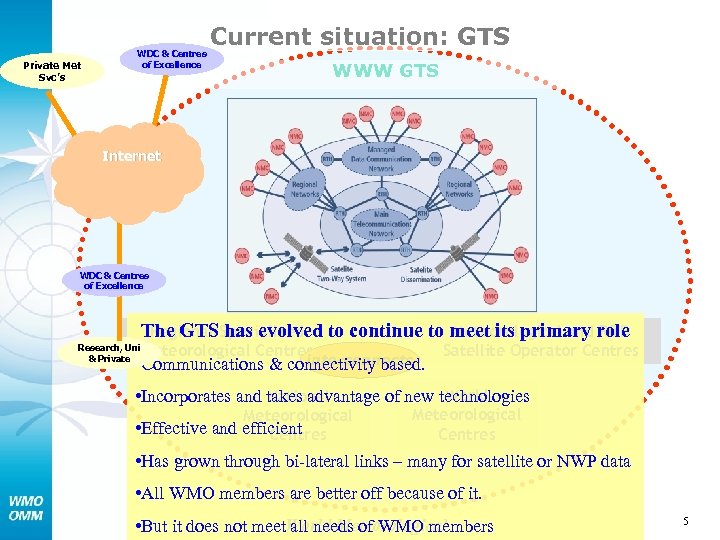 Private Met Svc’s WDC & Centres of Excellence Current situation: GTS WWW GTS Internet WDC & Centres of Excellence The GTS has evolved to continue to meet its primary role Regional/Specialized Meteorological and R&D Research, Uni & Private Meteorological Centres interconnects • Communications & connectivity based. Satellite Operator Centres World • Incorporates and takes advantage of new technologies National Meteorological • Effective and efficient Centres Meteorological Centres • Has grown through bi-lateral links – many for satellite or NWP data • All WMO members are better off because of it. • But it does not meet. World Meteorological all needs of WMO members 5
 Goals of WIS • GTS needs to be open to all WMO activities to provide time critical information exchange • Internet should be a part of WIS to allow support of less critical requirements • The continuous improvement and adaptation of new technologies in the GTS should be maintained. • The WIS should be open to more than just WMO programs allowing partners to participate • Need seamless discovery, access and retrieval (DAR) across all WMO systems, including collaborators and partners. World Meteorological 6
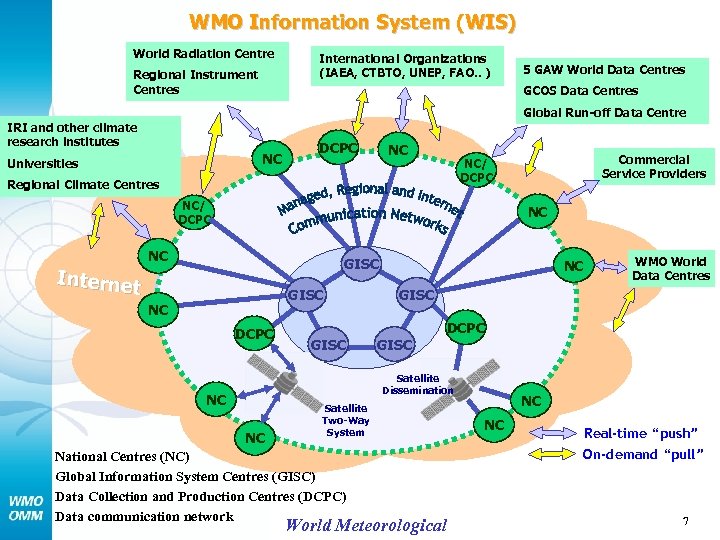 WMO Information System (WIS) World Radiation Centre Regional Instrument Centres International Organizations (IAEA, CTBTO, UNEP, FAO. . ) 5 GAW World Data Centres GCOS Data Centres Global Run-off Data Centre IRI and other climate research institutes NC Universities DCPC NC Commercial Service Providers NC/ DCPC Regional Climate Centres NC/ DCPC NC NC GISC I nt e r ne t GISC NC DCPC GISC NC GISC DCPC Satellite Dissemination NC NC Satellite Two-Way System National Centres (NC) Global Information System Centres (GISC) Data Collection and Production Centres (DCPC) Data communication network WMO World Data Centres World Meteorological NC NC Real-time “push” On-demand “pull” 7
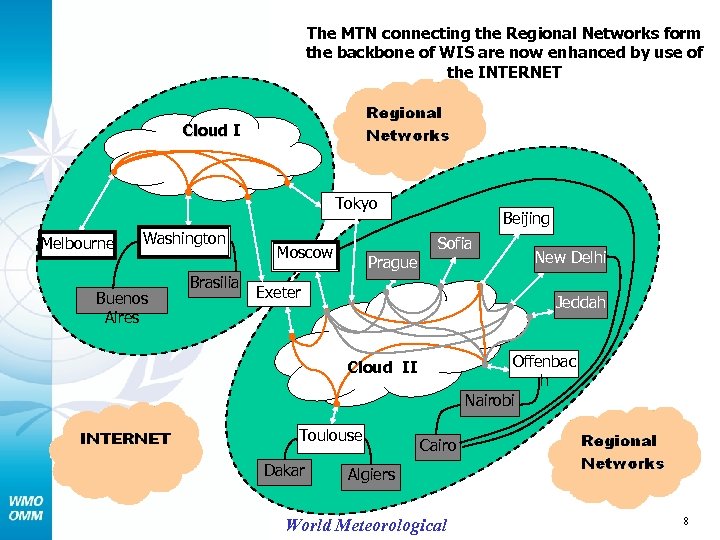 The MTN connecting the Regional Networks form the backbone of WIS are now enhanced by use of the INTERNET Cloud I Tokyo Melbourne Washington Buenos Aires Brasilia Beijing Sofia Moscow Prague Exeter Jeddah Offenbac h Nairobi Cloud II Toulouse Dakar New Delhi Cairo Algiers World Meteorological 8
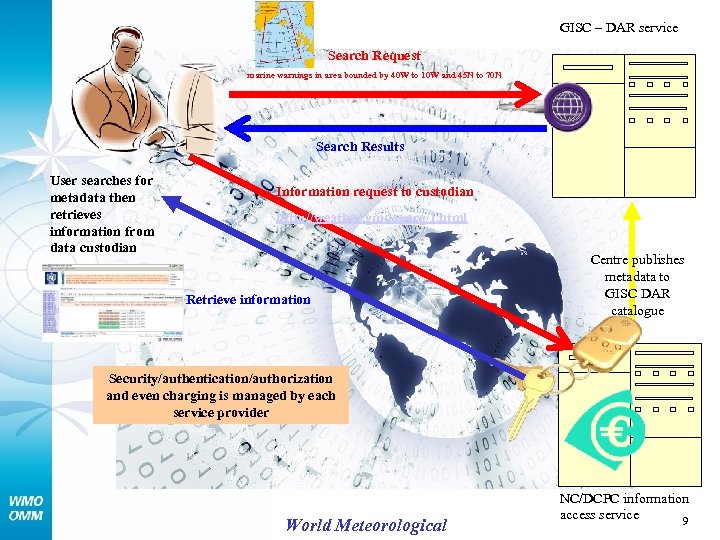 GISC – DAR service Search Request marine warnings in area bounded by 40 W to 10 W and 45 N to 70 N Search Results User searches for metadata then retrieves information from data custodian Information request to custodian http: //weather. gmdss. org/I. html Retrieve information Centre publishes metadata to GISC DAR catalogue Security/authentication/authorization and even charging is managed by each service provider World Meteorological NC/DCPC information access service 9
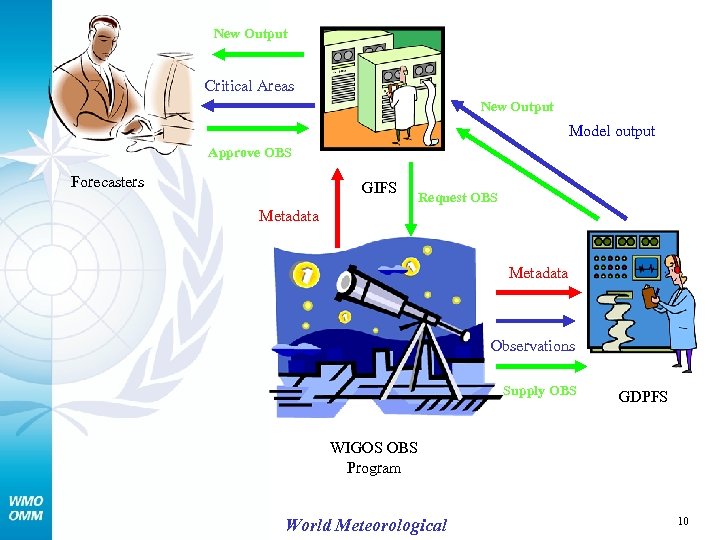 New Output Critical Areas New Output Model output Approve OBS Forecasters GIFS Request OBS Metadata Observations Supply OBS GDPFS WIGOS OBS Program World Meteorological 10
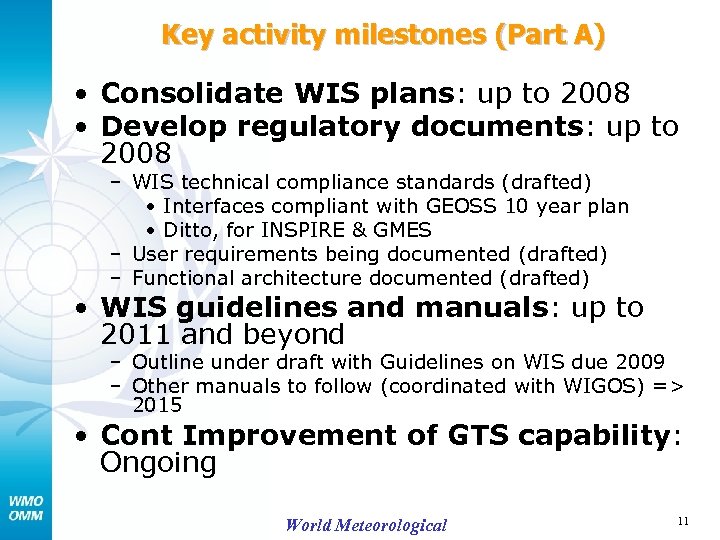 Key activity milestones (Part A) • Consolidate WIS plans: up to 2008 • Develop regulatory documents: up to 2008 – WIS technical compliance standards (drafted) • Interfaces compliant with GEOSS 10 year plan • Ditto, for INSPIRE & GMES – User requirements being documented (drafted) – Functional architecture documented (drafted) • WIS guidelines and manuals: up to 2011 and beyond – Outline under draft with Guidelines on WIS due 2009 – Other manuals to follow (coordinated with WIGOS) => 2015 • Cont Improvement of GTS capability: Ongoing World Meteorological 11
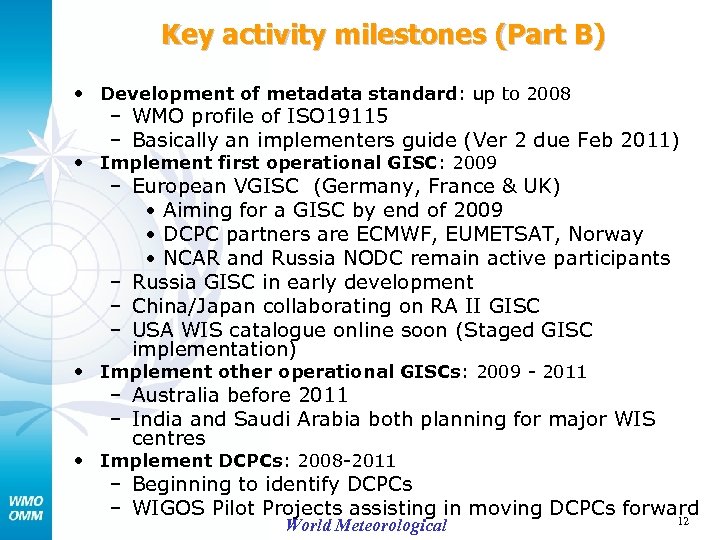 Key activity milestones (Part B) • Development of metadata standard: up to 2008 – WMO profile of ISO 19115 – Basically an implementers guide (Ver 2 due Feb 2011) • Implement first operational GISC: 2009 – European VGISC (Germany, France & UK) • Aiming for a GISC by end of 2009 • DCPC partners are ECMWF, EUMETSAT, Norway • NCAR and Russia NODC remain active participants – Russia GISC in early development – China/Japan collaborating on RA II GISC – USA WIS catalogue online soon (Staged GISC implementation) • Implement other operational GISCs: 2009 - 2011 – Australia before 2011 – India and Saudi Arabia both planning for major WIS centres • Implement DCPCs: 2008 -2011 – Beginning to identify DCPCs – WIGOS Pilot Projects assisting in moving DCPCs forward World Meteorological 12
 Essential Reading • WIS Project & Implementation Plan (WPIP) • WIS Functional Architecture • WIS Compliance specifications for GISC, DCPC & NC Under development • WIS Rolling Review of requirements (WPIP) • Guidelines on WIS • New WIS web page http: //www. wmo. int/pages/prog/www/test. WIS-Webtest/index_en. html World Meteorological 13
 ICT-ISS – Fourth Session • What is WIS and why is WMO going this way? – WIS is necessary to ensure all WMO information is available to all WMO users and to ensure long term sustainability of all WMO information systems. • What is happening to the GTS? – The GTS remains as an integral part of WIS and will continue to be improved as well as being made available to all WMO programs for the sharing of operational and time critical information. • How does WIS relate to ICT-ISS? – Implementation of WIS is the responsibility CBS – CBS needs your understanding and endorsement of ET-WISC docs. – An immediate priority is the identification of WIS centres and the assessment process. – ICG-WIS has formed an ET to forward this, and recommended CBS-MG set up and assessment team. Need to support this activity. World Meteorological 14
 ICT-ISS – Fourth Session (cont) • Will WIS lead to changes in the ICT-ISS plans and priorities? – Change focus from “development” to “implementation” – Update CBS long term and strategic plans targeted to meeting the timelines required from Congress. – Need to review ISS’s ET & WG, their TOR and priorities to incorporate implementing WIS – Need to liaise with OPAG IOS to ensure WIS meets WIGOS requirements – Also liaise with PWS and GDPFS OPAGs • What is the time frame? – WIS is now in its implementation stage and we expect the first GISC online next year. Once a WIS catalogue is up and running, Members can start to register products and services. Most time critical operations and many countries should be fully WIS compliant by 2011. Remaining countries and less critical components by 2015. World Meteorological 15
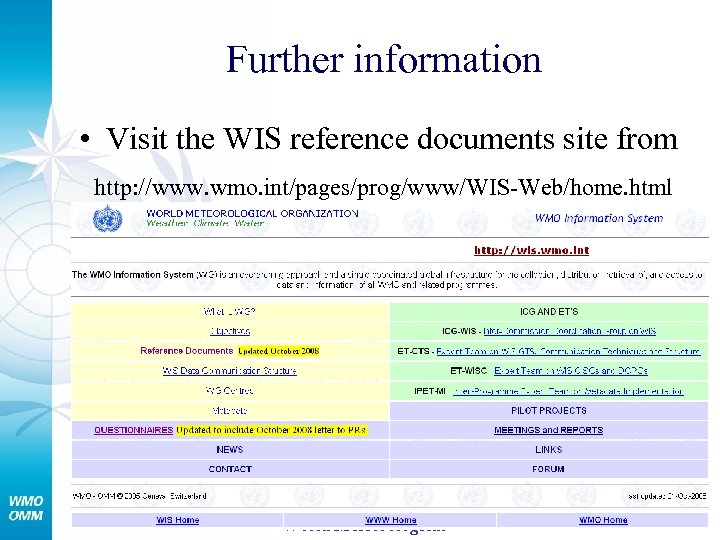 Further information • Visit the WIS reference documents site from http: //www. wmo. int/pages/prog/www/WIS-Web/home. html World Meteorological 16