


 Скачать презентацию WORLD METEOROLOGICAL ORGANIZATION RA VI Training Workshop on
1d34ec3ad4aa89ffe8f457d6dc98f5ff.ppt
- Количество слайдов: 20
 WORLD METEOROLOGICAL ORGANIZATION RA VI Training Workshop on BUFR and Migration to Table-Driven Code Forms Langen, Germany, 17 -20 April 2007 Often asked questions Eva Červená CZECH HYDROMETEOROLOGICAL INSTITUTE 1
 Q: Are the common sequence descriptors mandatory? This leads to inclusion of too many missing values. Usage of common sequence descriptors is highly recommended: - It is suitable for data processing (filtering, etc. ). - It prevents introduction of rather serious mistakes caused by not quite qualified modifications of the existing templates. - The data description section is expressed in a concise way. 2
 Q: Why the version of BUFR master table has to be indicated in the Section 1 although all descriptors are kept in the tables, including the entries that should not to be used anymore? The version number of BUFR master table allows to create different tables. The deprecated entries do not have to be necessarily included in the next version of the tables. Thus, the archived data could not be properly processed without the indication of version number of the tables. Moreover, the time may come when some of the tables will be filled to their capacity and the deprecated entries might be needed for the newly introduced elements. 3
 Q: The number of cloud layers or masses should be positive in a NIL report. Why not 0? This question applies to the number of cloud layers (0 31 001), but the same question could be asked referring to the number of levels in the upper-air data (0 31 002). Or to a sequence, where 0 31 000 is used. In a NIL report, all parameters shall be set to “missing”, with the exception of the station identification and delayed replication factors. To oblige this definition, the delayed replication factors 0 31 000, 0 31 001 and 0 31 002 shall be set to 1, so that the entries (to be replicated) could be set to missing. Moreover, if the report is included in a BUFR multi-subset message to be compressed, 0 31 000, 0 31 001 or 0 31 002 shall be set to 1, 2, 3, … (number of replications has to be identical in all subsets). Generally expressed, delayed 4 replication factors have to be positive in a NIL report.
 Q: The number of cloud layers or masses shall never be missing. Why? If the observation is not made, the number of cloud layers is not known. Delayed descriptor replication factors, e. g. 0 31 001, must never be set to missing (number of replications has to be known to allow the encoding/decoding procedure). If the observation is not made, e. g. at an automatic station without ceilometer, then 0 31 001 preceding 3 02 005 shall be set to 1 and all the parameter within 3 02 005 shall be set to a missing value. 5
 Q: How should be a missing value of a CCITT IA 5 element encoded? By all bits set to 0 or all bits set to 1? A missing value is expressed by all bits set to 1 within the data width of the element. This applies to all elements, including those with the “Unit” defined as CCITT IA 5. 6
 Q: In BUFR flag tables, bits are numbered from 1 to x. Bit No. 1 is the rightmost one or the leftmost one? Bit No. 1 in all BUFR flag tables is the leftmost one, i. e. the bit No. 1 is the most significant within the data width. The rightmost bit (x) is the least significant and is set to 1 only if all bits are set to 1 to express “missing”. 7
 Q: Total precipitation past 24 hours is included in 3 02 035 (Basic synoptic “instantaneous” data). Why is it so, if it refers to the previous 24 hours? “Instantaneous” parameter is a parameter that is not coupled to a time period descriptor. Total precipitation past 24 hours (013023) expresses the required meaning by itself, and therefore does not need to be preceded by 0 04 024 (Time period in hours). It was introduced to represent R 24 R 24 (SYNOP, section 3, group 7). The amount of precipitation in groups 6 RRRt. R is reported from different periods, and therefore they are represented by Total precipitation (0 13 011 ) being preceded by 0 04 024. 8
 Q: The order of entries in the template TM 307080 does not correspond with the order of the elements in a SYNOP message. Why? In a SYNOP message, elements of “period” character are followed by “instantaneous” elements. In a BUFR message, all “instantaneous” elements have to be reported first and only then the elements of “period” character may follow. Once a period descriptor is introduced, it applies to all following elements until it is redefined by another period descriptor. TDCF allow more precise data representation, consequently their flexibility being somewhat limited. 9
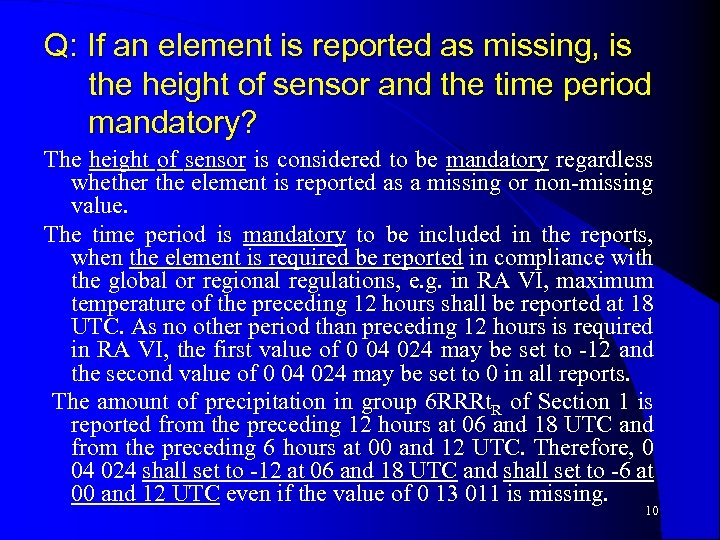 Q: If an element is reported as missing, is the height of sensor and the time period mandatory? The height of sensor is considered to be mandatory regardless whether the element is reported as a missing or non-missing value. The time period is mandatory to be included in the reports, when the element is required be reported in compliance with the global or regional regulations, e. g. in RA VI, maximum temperature of the preceding 12 hours shall be reported at 18 UTC. As no other period than preceding 12 hours is required in RA VI, the first value of 0 04 024 may be set to -12 and the second value of 0 04 024 may be set to 0 in all reports. The amount of precipitation in group 6 RRRt. R of Section 1 is reported from the preceding 12 hours at 06 and 18 UTC and from the preceding 6 hours at 00 and 12 UTC. Therefore, 0 04 024 shall set to -12 at 06 and 18 UTC and shall set to -6 at 00 and 12 UTC even if the value of 0 13 011 is missing. 10
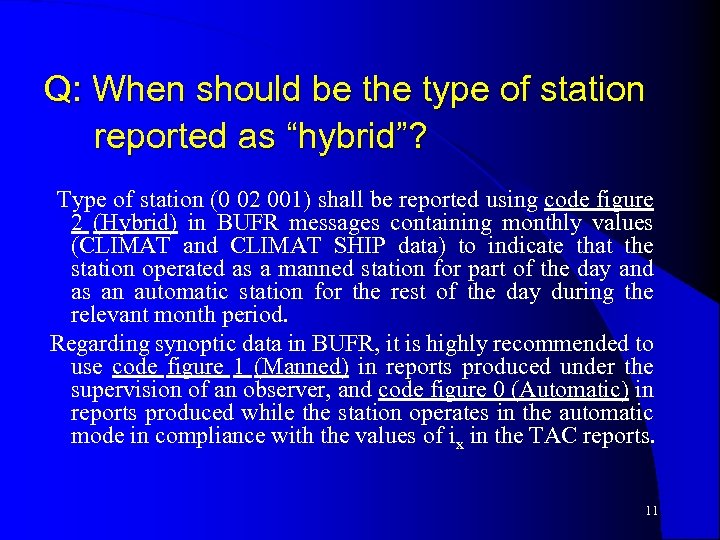 Q: When should be the type of station reported as “hybrid”? Type of station (0 02 001) shall be reported using code figure 2 (Hybrid) in BUFR messages containing monthly values (CLIMAT and CLIMAT SHIP data) to indicate that the station operated as a manned station for part of the day and as an automatic station for the rest of the day during the relevant month period. Regarding synoptic data in BUFR, it is highly recommended to use code figure 1 (Manned) in reports produced under the supervision of an observer, and code figure 0 (Automatic) in reports produced while the station operates in the automatic mode in compliance with the values of ix in the TAC reports. 11
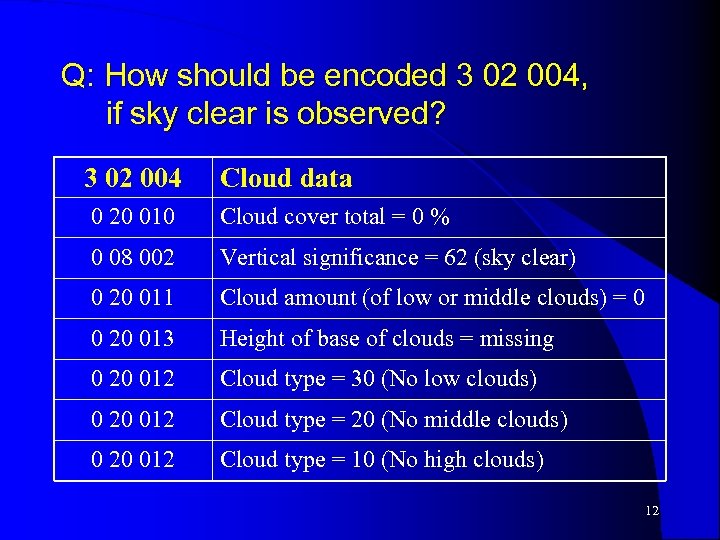 Q: How should be encoded 3 02 004, if sky clear is observed? 3 02 004 Cloud data 0 20 010 Cloud cover total = 0 % 0 08 002 Vertical significance = 62 (sky clear) 0 20 011 Cloud amount (of low or middle clouds) = 0 0 20 013 Height of base of clouds = missing 0 20 012 Cloud type = 30 (No low clouds) 0 20 012 Cloud type = 20 (No middle clouds) 0 20 012 Cloud type = 10 (No high clouds) 12
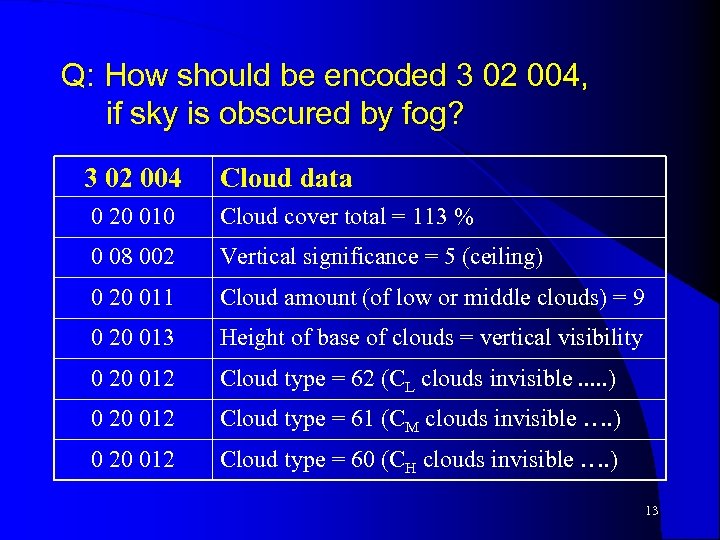 Q: How should be encoded 3 02 004, if sky is obscured by fog? 3 02 004 Cloud data 0 20 010 Cloud cover total = 113 % 0 08 002 Vertical significance = 5 (ceiling) 0 20 011 Cloud amount (of low or middle clouds) = 9 0 20 013 Height of base of clouds = vertical visibility 0 20 012 Cloud type = 62 (CL clouds invisible. . . ) 0 20 012 Cloud type = 61 (CM clouds invisible …. ) 0 20 012 Cloud type = 60 (CH clouds invisible …. ) 13
 Q: If only high clouds CH are observed, vertical significance in 3 02 004 should be set to 0. Why not to 9 (High cloud)? Vertical significance 0 08 002 is used to specify two following elements, i. e. cloud amount 0 20 011 and height of cloud base 0 20 013. E. g. if CL clouds are observed, 0 08 002 = 7 expresses that both following elements refer to low clouds. If only high clouds CH are observed, however, the cloud amount refers to CL and CM (0 20 011 = 0), whereas the height of cloud base refers to CH. Therefore 0 08 002 has to be set to 0 (Observing rules of FM 12 SYNOP and FM 13 SHIP apply). It is the only case, when 0 08 002 is to be set to 0. 14
 Q: How should be encoded 0 08 002 (vertical significance) in 3 02 005 if four cloud layers are reported, a Cb in the second layer? If sky is not obscured by fog or other meteorological phenomena, vertical significance 0 08 002 within 3 02 005 is encoded using code figures 1, 2, 3 and 4, where 4 = Cumulonimbus layer. Four cloud layers: 1/8 St 250 m, 2/8 Cb 300 m, 3/8 Sc 600 m and 5/8 Ac 3000 m (81708 82910 83620 85360 in SYNOP). In this case, 0 08 002 shall be set to 1, 4, 2 and 3 in the first, second, third and fourth replication of 3 02 005, respectively. 15
 Q: How should be encoded 0 08 002 (vertical significance) in 3 02 005 if four cloud layers are reported from a ceilometer of an AWS? An automatic station equipped with a ceilometer may be able to report cloud amount and height of the base of the individual cloud layers, but the type of clouds is not available. If four cloud layers are reported from an AWS, e. g. 81/11 83/14 85/24 88/56 in SYNOP, vertical significance 0 08 002 shall be set to 1, 2, 3 and missing in the first, second, third and fourth replication of 3 02 005, respectively. 16
 Q: Is reporting of normal monthly values mandatory? Normal monthly values are mandatory in BUFR messages containing monthly values (CLIMAT and CLIMAT SHIP data). It is recommended to include the normal values to ease the maintenance of the database of these values (to avoid potential problems caused by the normals or their changes being available for very limited period in the TAC data). 17
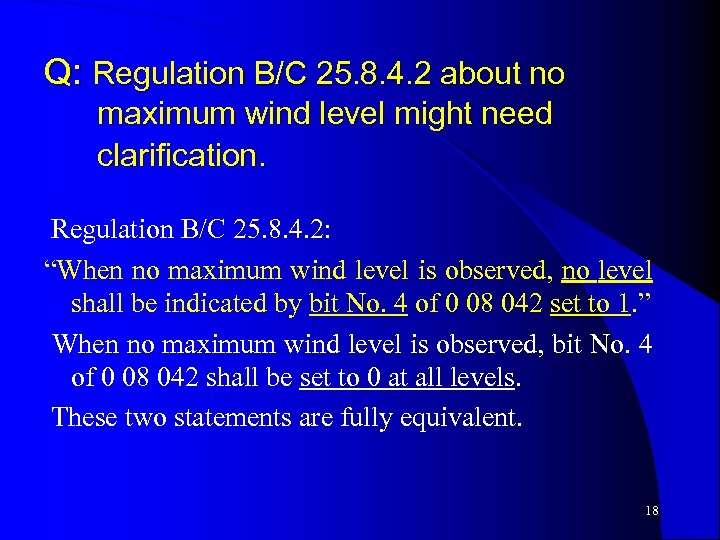 Q: Regulation B/C 25. 8. 4. 2 about no maximum wind level might need clarification. Regulation B/C 25. 8. 4. 2: “When no maximum wind level is observed, no level shall be indicated by bit No. 4 of 0 08 042 set to 1. ” When no maximum wind level is observed, bit No. 4 of 0 08 042 shall be set to 0 at all levels. These two statements are fully equivalent. 18
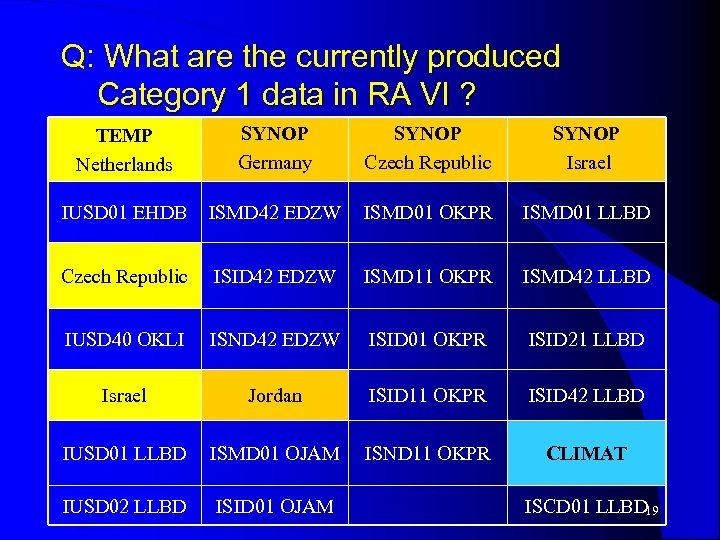 Q: What are the currently produced Category 1 data in RA VI ? TEMP Netherlands SYNOP Germany SYNOP Czech Republic SYNOP Israel IUSD 01 EHDB ISMD 42 EDZW ISMD 01 OKPR ISMD 01 LLBD Czech Republic ISID 42 EDZW ISMD 11 OKPR ISMD 42 LLBD IUSD 40 OKLI ISND 42 EDZW ISID 01 OKPR ISID 21 LLBD Israel Jordan ISID 11 OKPR ISID 42 LLBD IUSD 01 LLBD ISMD 01 OJAM ISND 11 OKPR CLIMAT IUSD 02 LLBD ISID 01 OJAM ISCD 01 LLBD 19
 Other questions? 20