

WORLD INVESTMENT REPORT 2012 Kalman Kalotay UNCTAD Division

 Скачать презентацию WORLD INVESTMENT REPORT 2012 Kalman Kalotay UNCTAD Division
15288-wir12_transition.ppt
- Количество слайдов: 24
WORLD INVESTMENT REPORT 2012 Kalman Kalotay UNCTAD Division on Investment and Enterprise Geneva, 18 February 2013 Towards a New Generation of Investment Policies
Outline Global investment trends Regional trends in FDI Recent policy trends Investment policy framework for sustainable development
GLOBAL INVESTMENT TRENDS
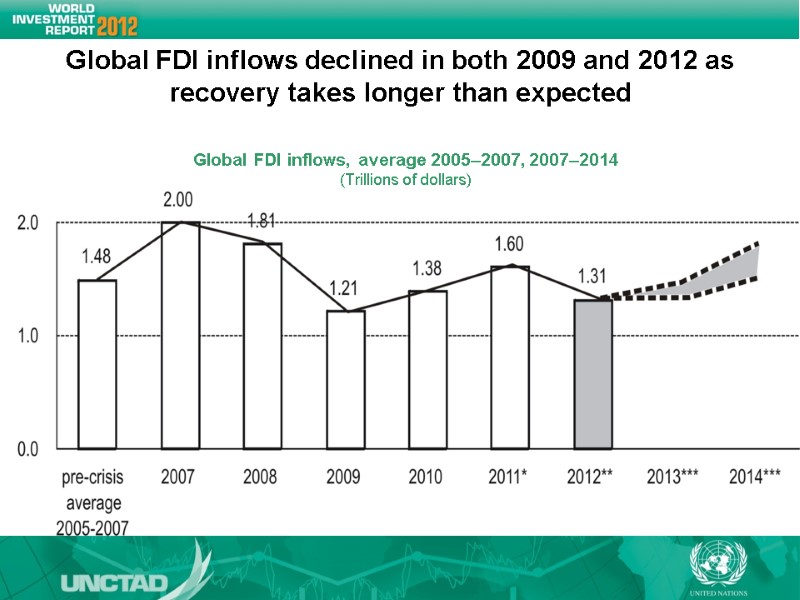
Global FDI inflows, average 2005–2007, 2007–2014 (Trillions of dollars) Global FDI inflows declined in both 2009 and 2012 as recovery takes longer than expected
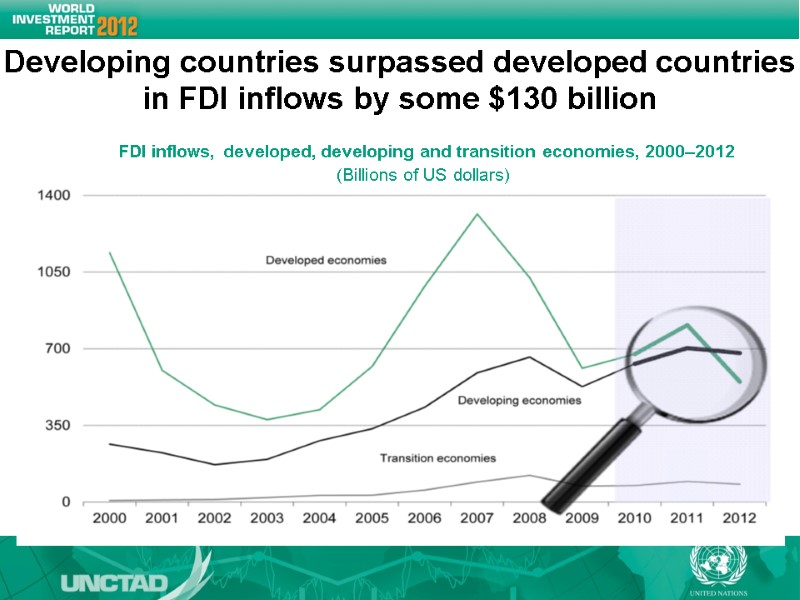
Developing countries surpassed developed countries in FDI inflows by some $130 billion FDI inflows, developed, developing and transition economies, 2000–2012 (Billions of US dollars)
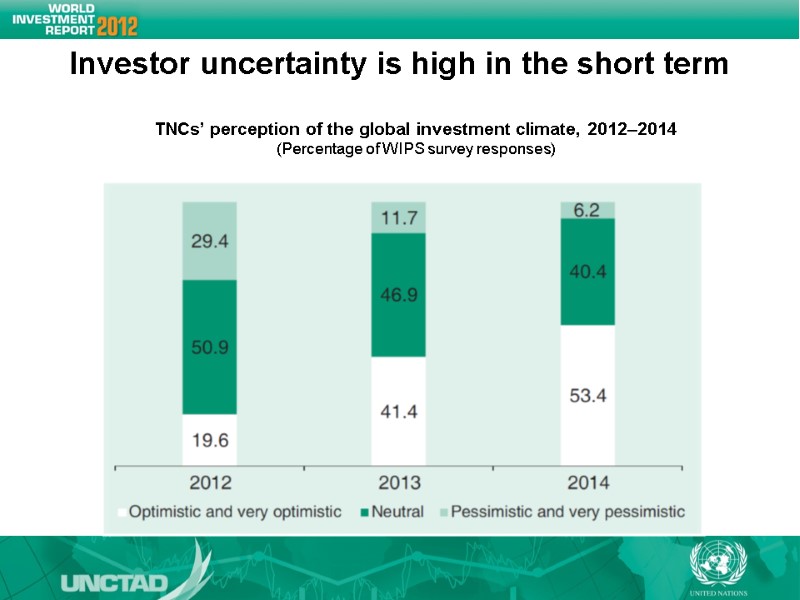
Investor uncertainty is high in the short term TNCs’ perception of the global investment climate, 2012–2014 (Percentage of WIPS survey responses)
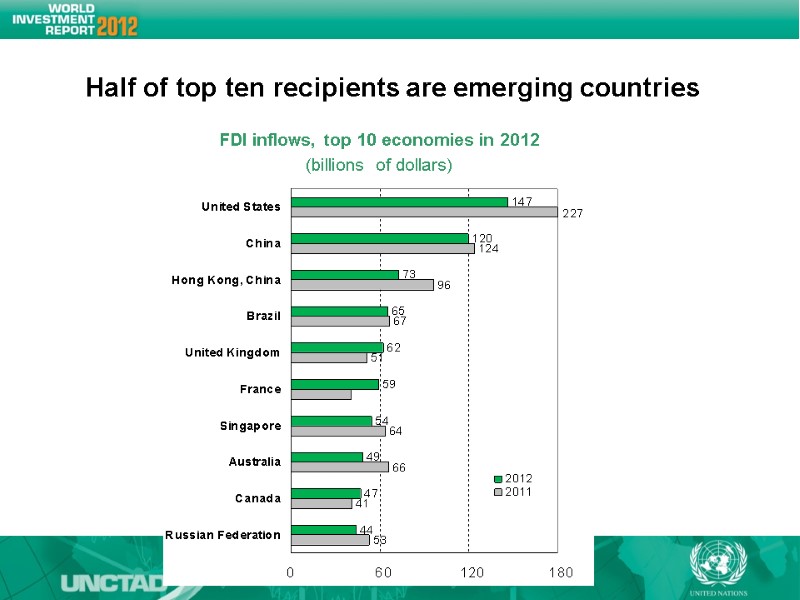
Half of top ten recipients are emerging countries FDI inflows, top 10 economies in 2012 (billions of dollars)
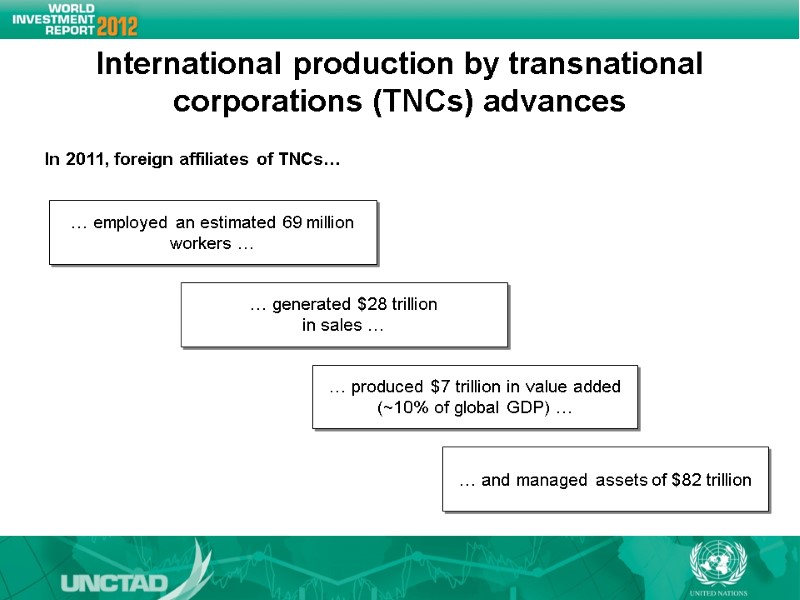
International production by transnational corporations (TNCs) advances … employed an estimated 69 million workers … … generated $28 trillion in sales … … produced $7 trillion in value added (~10% of global GDP) … In 2011, foreign affiliates of TNCs… … and managed assets of $82 trillion
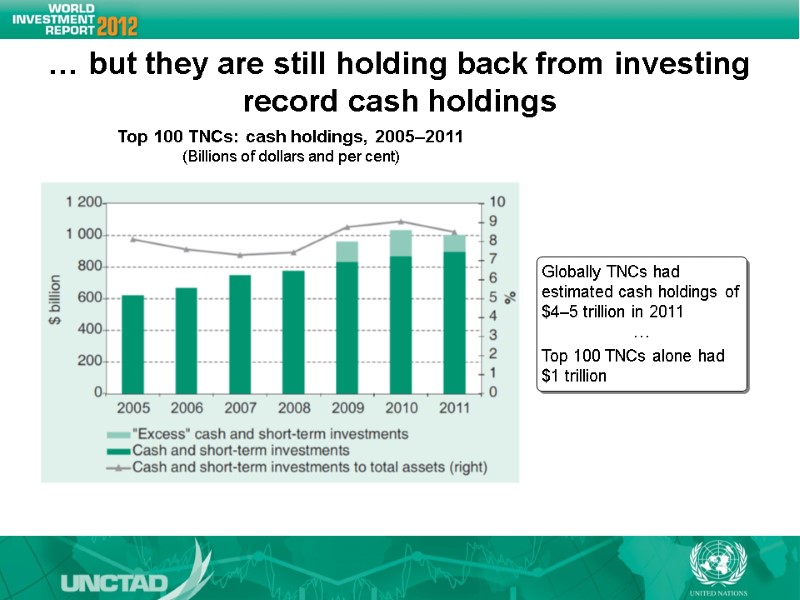
… but they are still holding back from investing record cash holdings Top 100 TNCs: cash holdings, 2005–2011 (Billions of dollars and per cent) Globally TNCs had estimated cash holdings of $4–5 trillion in 2011 … Top 100 TNCs alone had $1 trillion
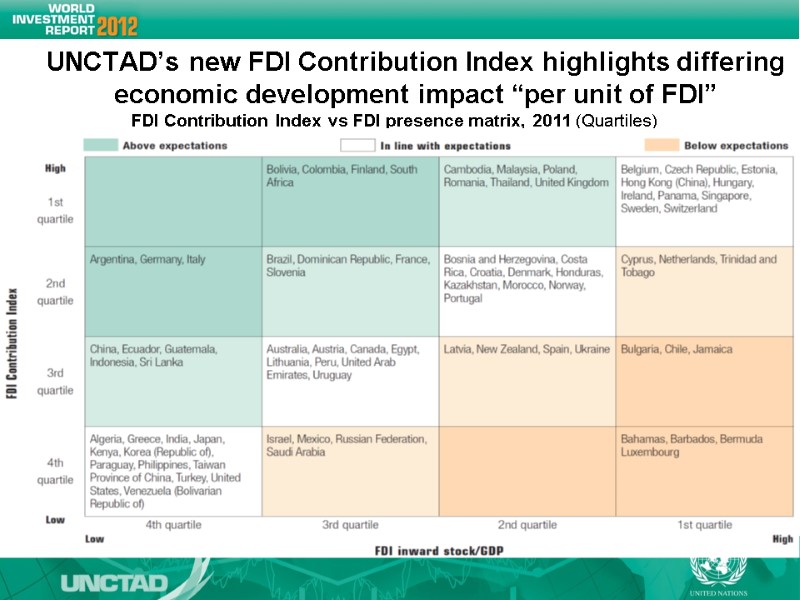
UNCTAD’s new FDI Contribution Index highlights differing economic development impact “per unit of FDI” FDI Contribution Index vs FDI presence matrix, 2011 (Quartiles)
REGIONAL TRENDS IN FDI
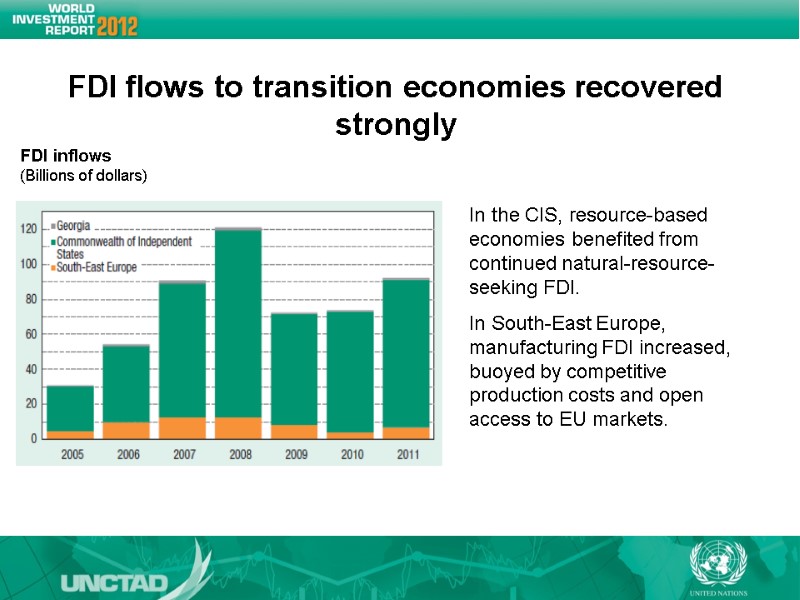
FDI flows to transition economies recovered strongly FDI inflows (Billions of dollars) In the CIS, resource-based economies benefited from continued natural-resource-seeking FDI. In South-East Europe, manufacturing FDI increased, buoyed by competitive production costs and open access to EU markets.
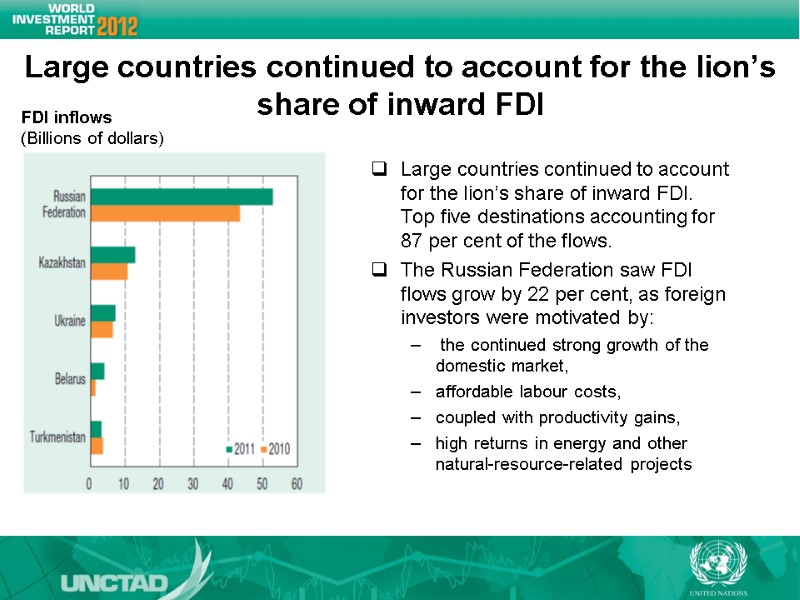
Large countries continued to account for the lion’s share of inward FDI Large countries continued to account for the lion’s share of inward FDI. Top five destinations accounting for 87 per cent of the flows. The Russian Federation saw FDI flows grow by 22 per cent, as foreign investors were motivated by: the continued strong growth of the domestic market, affordable labour costs, coupled with productivity gains, high returns in energy and other natural-resource-related projects FDI inflows (Billions of dollars)
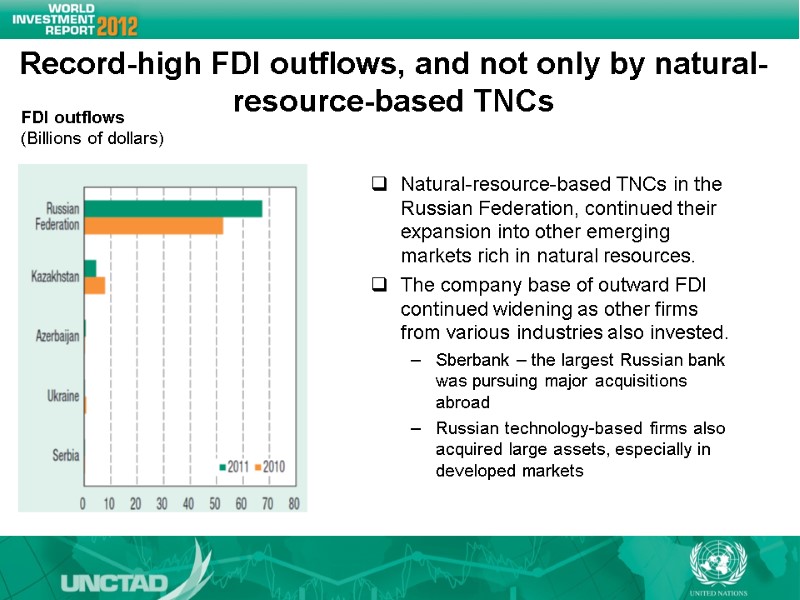
Record-high FDI outflows, and not only by natural-resource-based TNCs Natural-resource-based TNCs in the Russian Federation, continued their expansion into other emerging markets rich in natural resources. The company base of outward FDI continued widening as other firms from various industries also invested. Sberbank – the largest Russian bank was pursuing major acquisitions abroad Russian technology-based firms also acquired large assets, especially in developed markets FDI outflows (Billions of dollars)
FDI projects rose in all three sectors FDI projects rose in all three sectors of production. Compared with the pre-crisis level (2005–2007), the value of FDI in the primary sector increased almost four-fold, FDI in manufacturing rose by 33 per cent while FDI in services remained lower. WTO accession of the Russian Federation is expected to further integrate the country into the global economic system: The Russian Federation has undertaken special obligations in 11 services sectors and 116 subsectors, including: banking, insurance, trade, business services, telecommunications
Both inflows and outflows are expected to rise further FDI flows to transition economies are expected to continue to grow in the medium term reflecting: a more investor-friendly environment, WTO accession by the Russian Federation, new privatization programmes. The rise of investments from other developing countries
RECENT POLICY DEVELOPMENTS
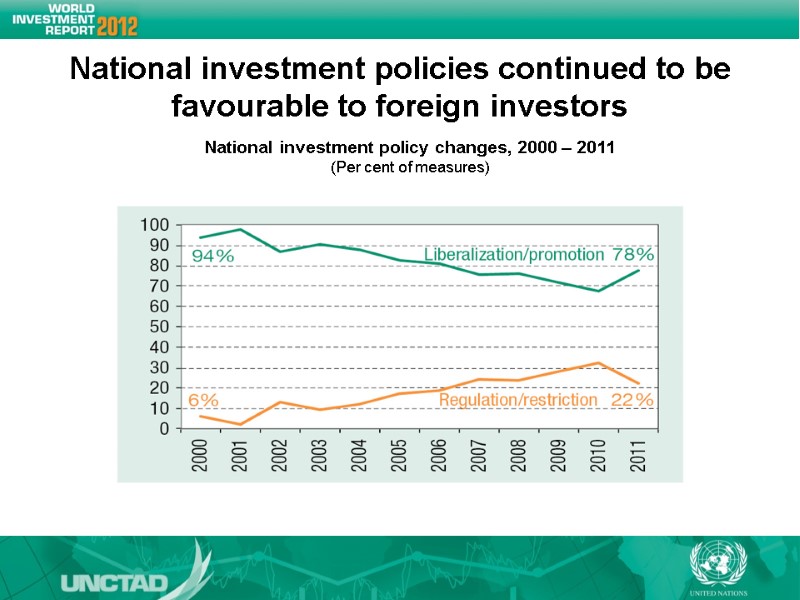
National investment policies continued to be favourable to foreign investors National investment policy changes, 2000 – 2011 (Per cent of measures)
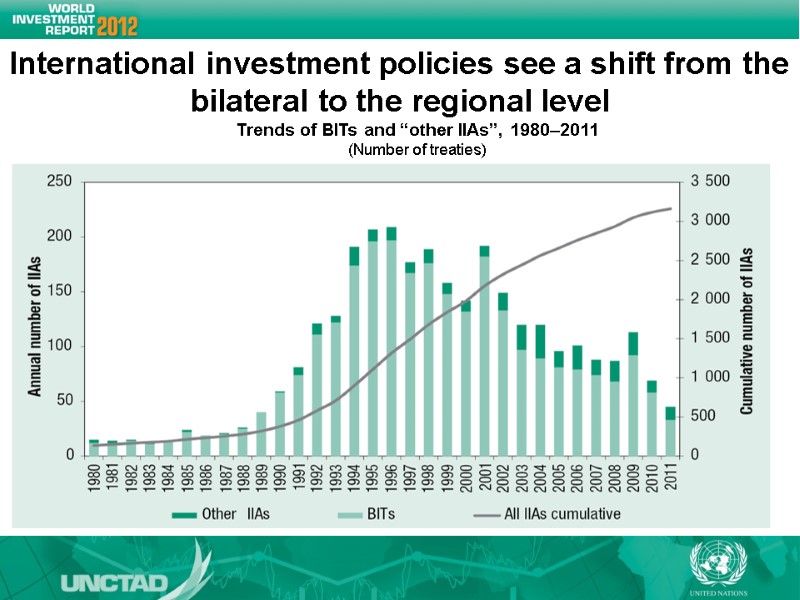
International investment policies see a shift from the bilateral to the regional level Trends of BITs and “other IIAs”, 1980–2011 (Number of treaties)
INVESTMENT POLICY FRAMEWORK FOR SUSTAINABLE DEVELOPMENT
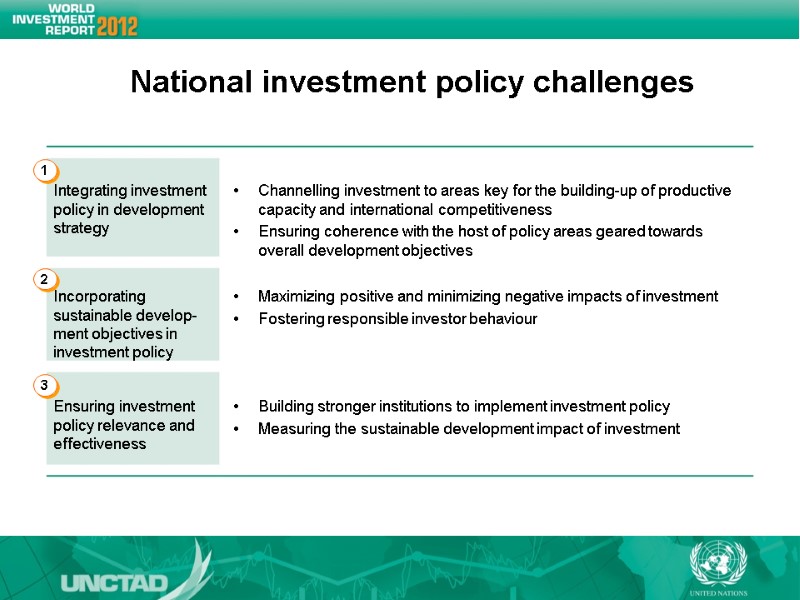
National investment policy challenges Integrating investment policy in development strategy Incorporating sustainable develop-ment objectives in investment policy Ensuring investment policy relevance and effectiveness Channelling investment to areas key for the building-up of productive capacity and international competitiveness Ensuring coherence with the host of policy areas geared towards overall development objectives Maximizing positive and minimizing negative impacts of investment Fostering responsible investor behaviour Building stronger institutions to implement investment policy Measuring the sustainable development impact of investment 1 2 3
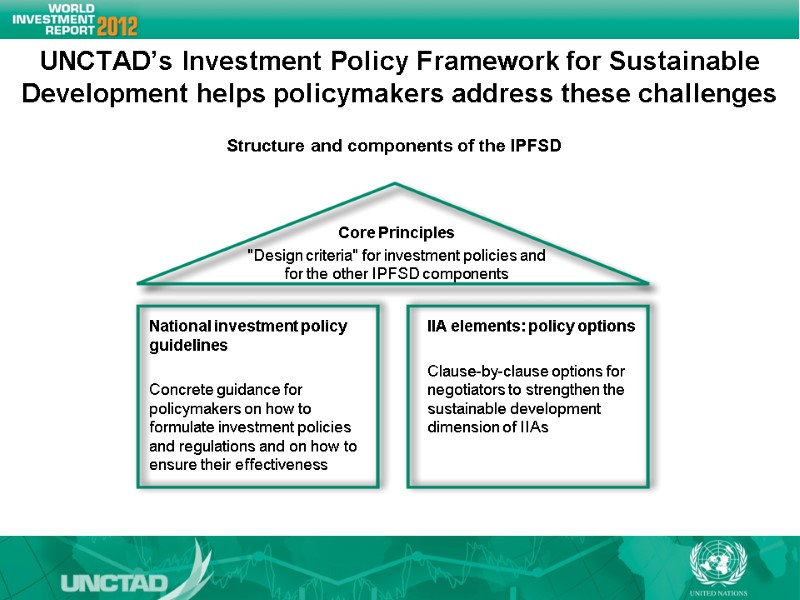
UNCTAD’s Investment Policy Framework for Sustainable Development helps policymakers address these challenges Core Principles "Design criteria" for investment policies and for the other IPFSD components National investment policy guidelines Concrete guidance for policymakers on how to formulate investment policies and regulations and on how to ensure their effectiveness IIA elements: policy options Clause-by-clause options for negotiators to strengthen the sustainable development dimension of IIAs Structure and components of the IPFSD
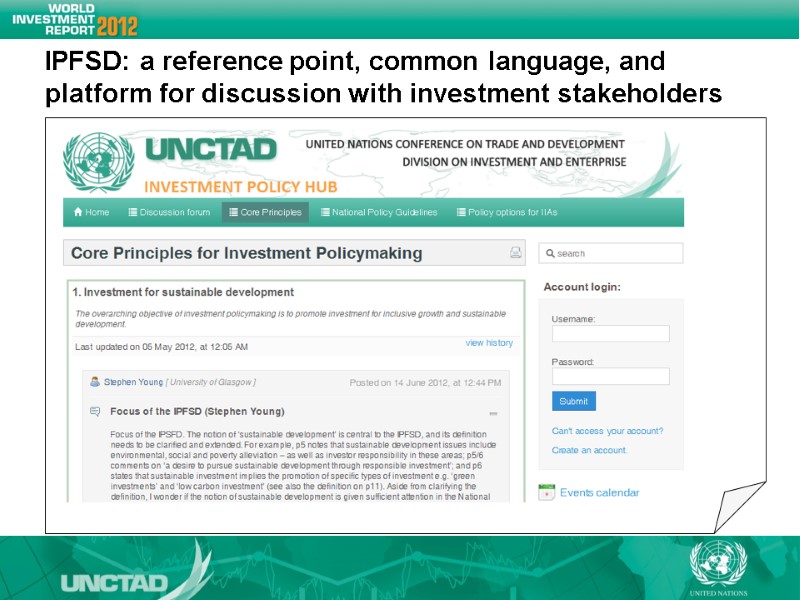
IPFSD: a reference point, common language, and platform for discussion with investment stakeholders
Visit UNCTAD’s websites: www.unctad.org/diae and www.unctad.org/wir www.unctad.org/fdistatistics www.unctad.org/ipfsd Thank you!