


 Скачать презентацию World History Final Exam STUDY GUIDE REVIEW FIVE
6ebc88ce06a334d6267014c2c99526f1.ppt
- Количество слайдов: 62
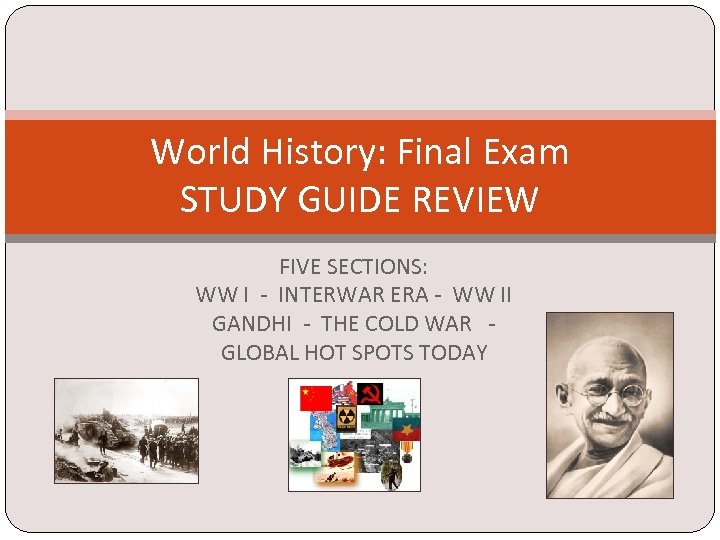 World History: Final Exam STUDY GUIDE REVIEW FIVE SECTIONS: WW I - INTERWAR ERA - WW II GANDHI - THE COLD WAR GLOBAL HOT SPOTS TODAY
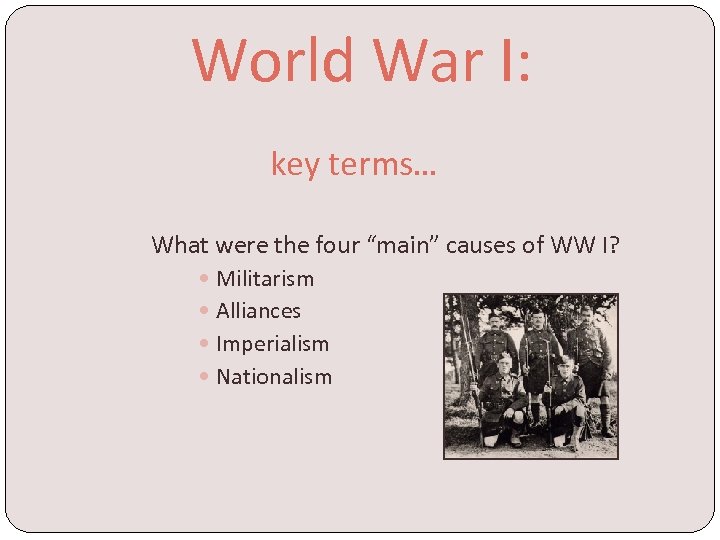 World War I: key terms… What were the four “main” causes of WW I? Militarism Alliances Imperialism Nationalism
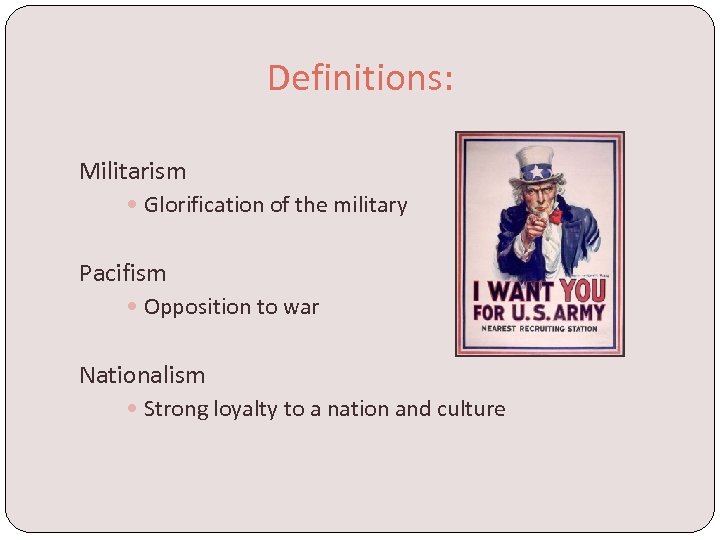 Definitions: Militarism Glorification of the military Pacifism Opposition to war Nationalism Strong loyalty to a nation and culture
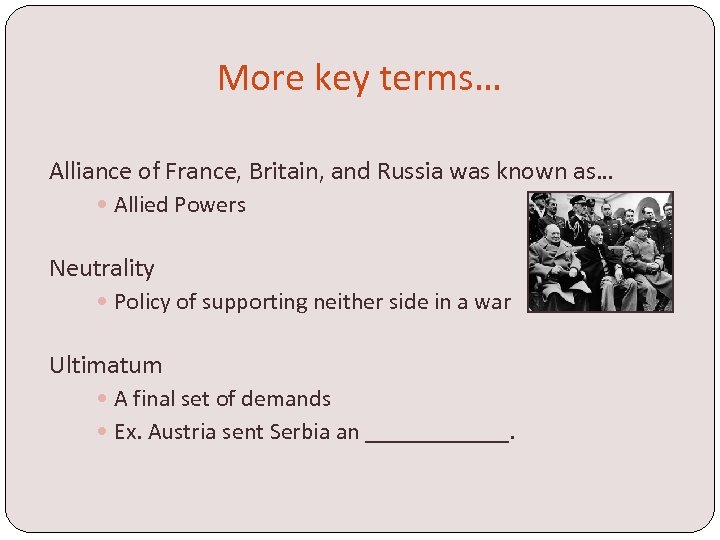 More key terms… Alliance of France, Britain, and Russia was known as… Allied Powers Neutrality Policy of supporting neither side in a war Ultimatum A final set of demands Ex. Austria sent Serbia an ______.
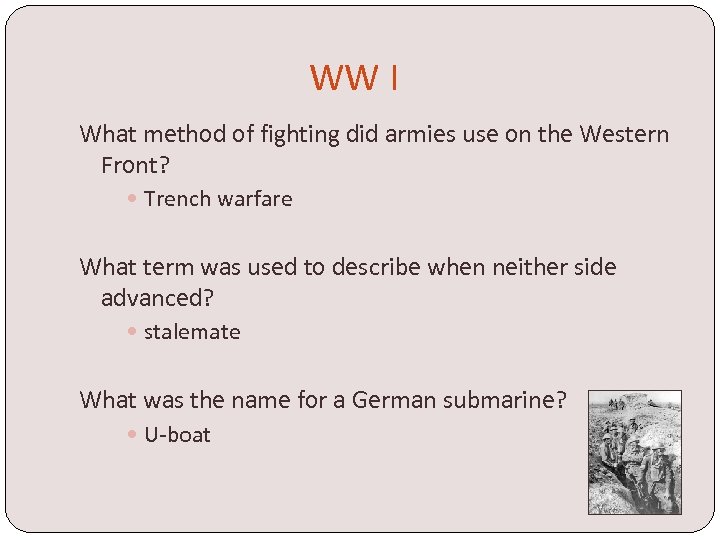 WW I What method of fighting did armies use on the Western Front? Trench warfare What term was used to describe when neither side advanced? stalemate What was the name for a German submarine? U-boat
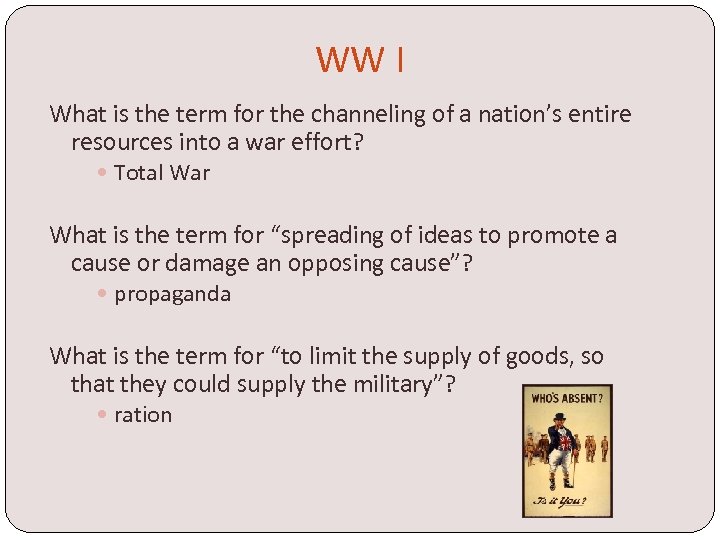 WW I What is the term for the channeling of a nation’s entire resources into a war effort? Total War What is the term for “spreading of ideas to promote a cause or damage an opposing cause”? propaganda What is the term for “to limit the supply of goods, so that they could supply the military”? ration
 WW I: Fill-in-the-blank Germany paid $30 billion as payment for war damages, or ______. Reparations Wilson’s plan of the ______ was a group of over 40 countries which hoped to settle problems without war. League of Nations By June 1919, the Paris Peace Conference drew up the ______, which blamed Germany for the war. Treaty of Versailles.
 Which of the following helped to start WW I? A. a good economy. B. the United States. C. an environmental disaster. D. an assassination ANSWER: D.
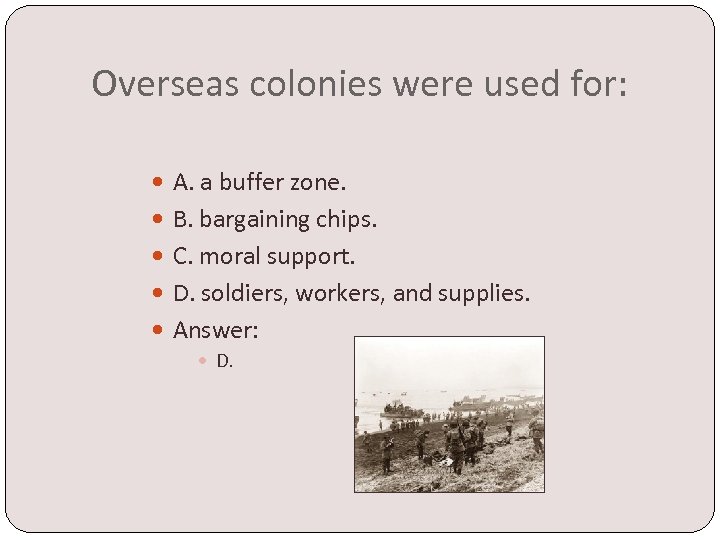 Overseas colonies were used for: A. a buffer zone. B. bargaining chips. C. moral support. D. soldiers, workers, and supplies. Answer: D.
 What famous novel describes WW I? A. April Morning. B. All Quiet on the Western Front. C. Red Badge of Courage. D. Saving Private Ryan. ANSWER: B. All Quiet on the Western Front
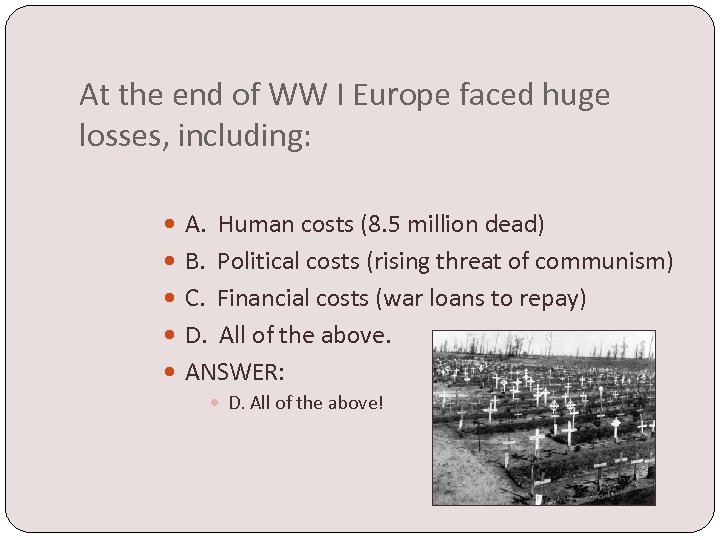 At the end of WW I Europe faced huge losses, including: A. Human costs (8. 5 million dead) B. Political costs (rising threat of communism) C. Financial costs (war loans to repay) D. All of the above. ANSWER: D. All of the above!
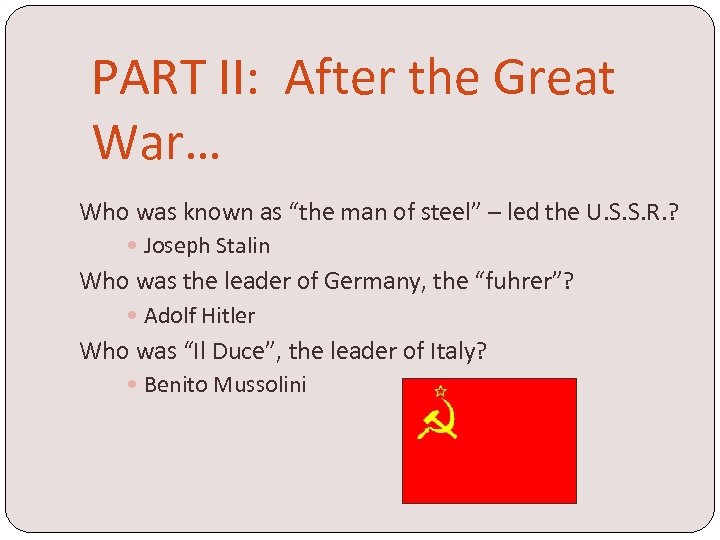 PART II: After the Great War… Who was known as “the man of steel” – led the U. S. S. R. ? Joseph Stalin Who was the leader of Germany, the “fuhrer”? Adolf Hitler Who was “Il Duce”, the leader of Italy? Benito Mussolini
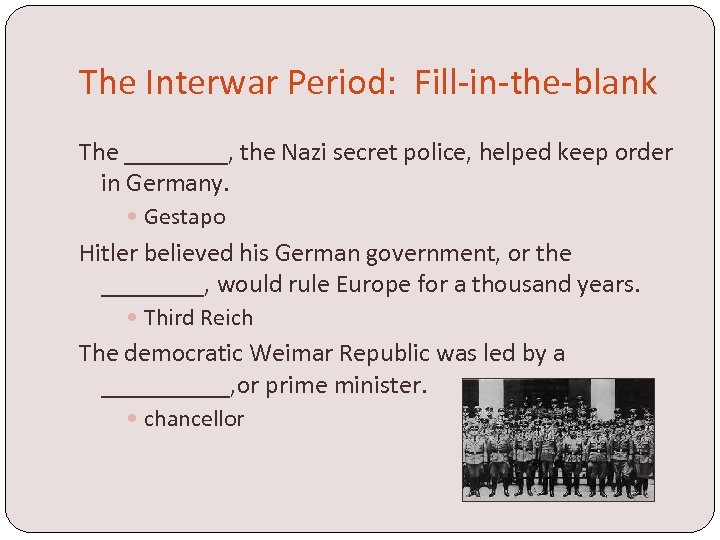 The Interwar Period: Fill-in-the-blank The ____, the Nazi secret police, helped keep order in Germany. Gestapo Hitler believed his German government, or the ____, would rule Europe for a thousand years. Third Reich The democratic Weimar Republic was led by a _____, or prime minister. chancellor
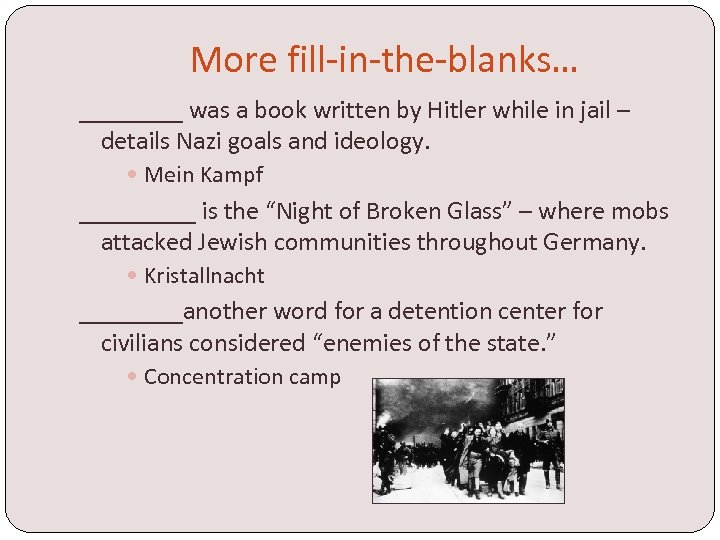 More fill-in-the-blanks… ____ was a book written by Hitler while in jail – details Nazi goals and ideology. Mein Kampf _____ is the “Night of Broken Glass” – where mobs attacked Jewish communities throughout Germany. Kristallnacht ____another word for a detention center for civilians considered “enemies of the state. ” Concentration camp
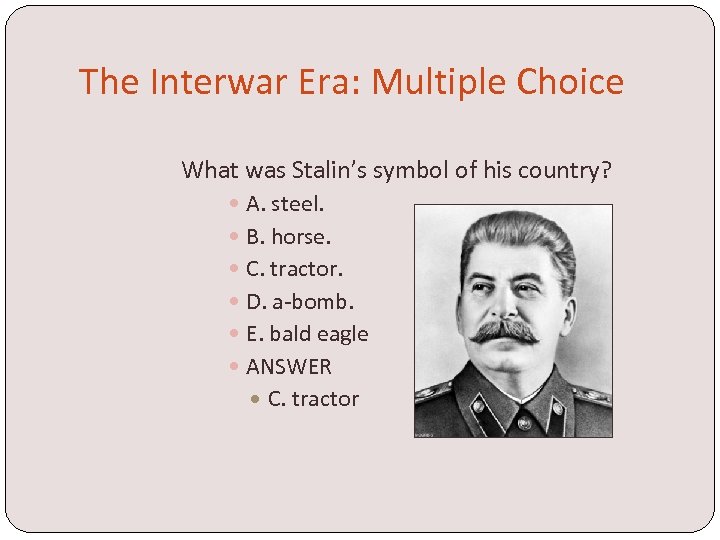 The Interwar Era: Multiple Choice What was Stalin’s symbol of his country? A. steel. B. horse. C. tractor. D. a-bomb. E. bald eagle ANSWER C. tractor
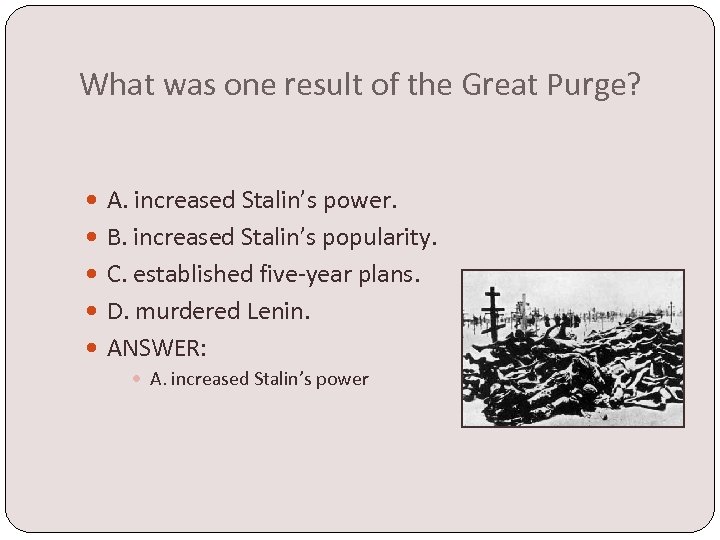 What was one result of the Great Purge? A. increased Stalin’s power. B. increased Stalin’s popularity. C. established five-year plans. D. murdered Lenin. ANSWER: A. increased Stalin’s power
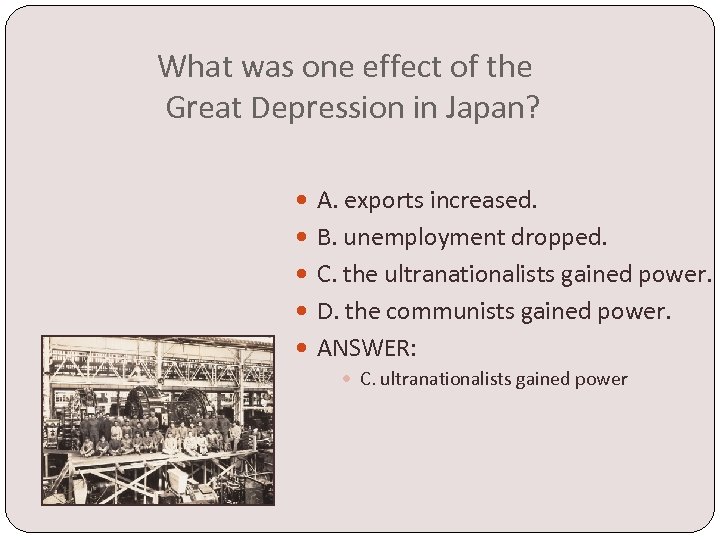 What was one effect of the Great Depression in Japan? A. exports increased. B. unemployment dropped. C. the ultranationalists gained power. D. the communists gained power. ANSWER: C. ultranationalists gained power
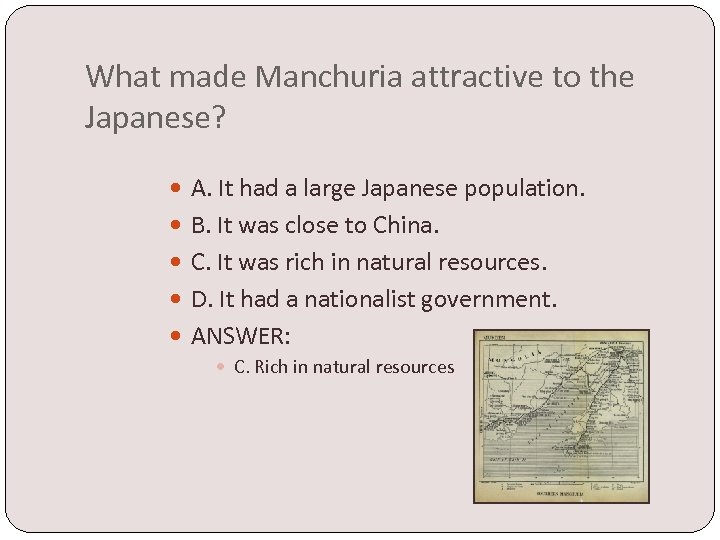 What made Manchuria attractive to the Japanese? A. It had a large Japanese population. B. It was close to China. C. It was rich in natural resources. D. It had a nationalist government. ANSWER: C. Rich in natural resources
 With which countries did Japan ally itself in 1936? China and India. Germany and France. The U. S. and Germany. Italy and Germany ANSWER: Italy and Germany
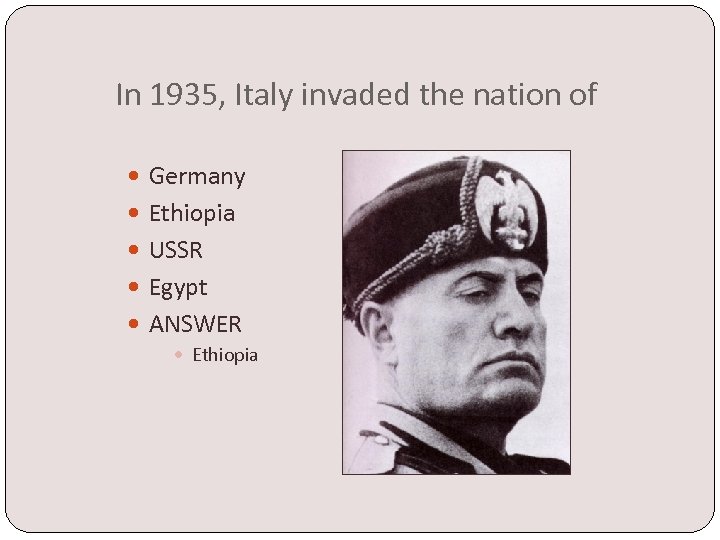 In 1935, Italy invaded the nation of Germany Ethiopia USSR Egypt ANSWER Ethiopia
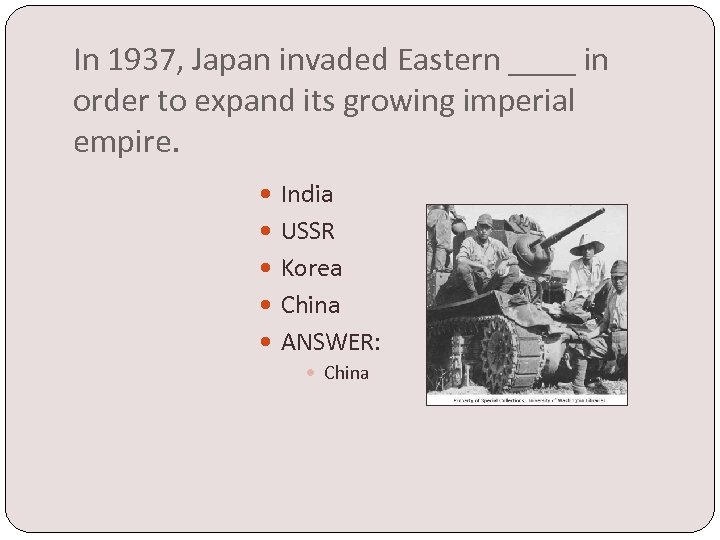 In 1937, Japan invaded Eastern ____ in order to expand its growing imperial empire. India USSR Korea China ANSWER: China
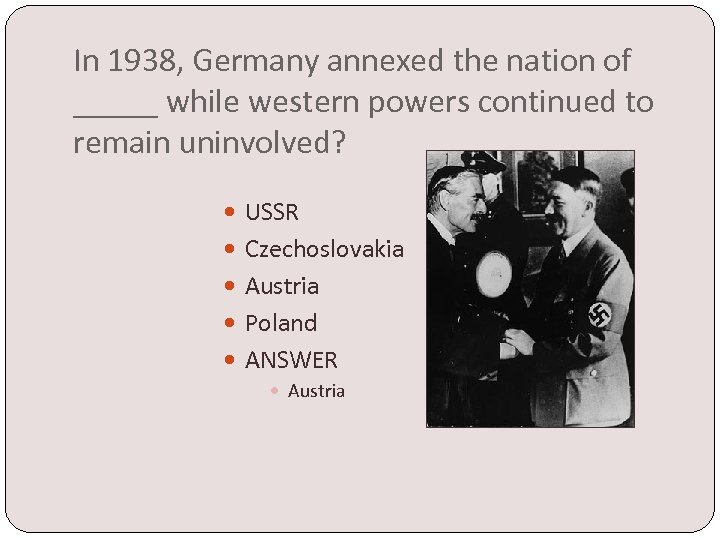 In 1938, Germany annexed the nation of _____ while western powers continued to remain uninvolved? USSR Czechoslovakia Austria Poland ANSWER Austria
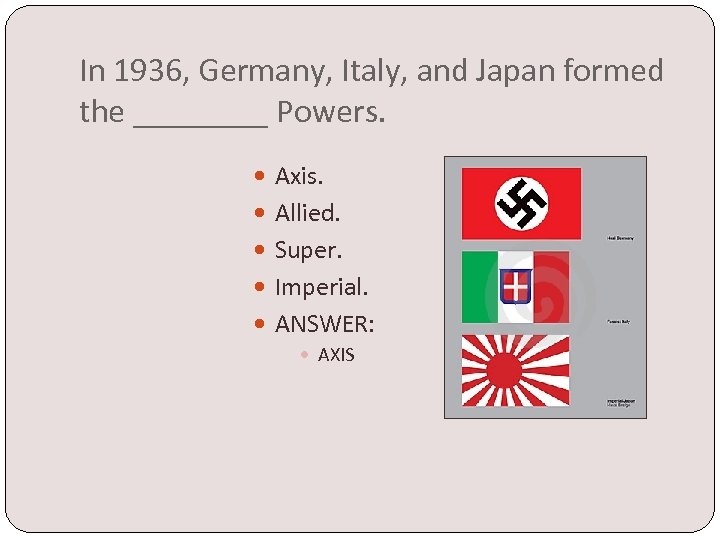 In 1936, Germany, Italy, and Japan formed the ____ Powers. Axis. Allied. Super. Imperial. ANSWER: AXIS
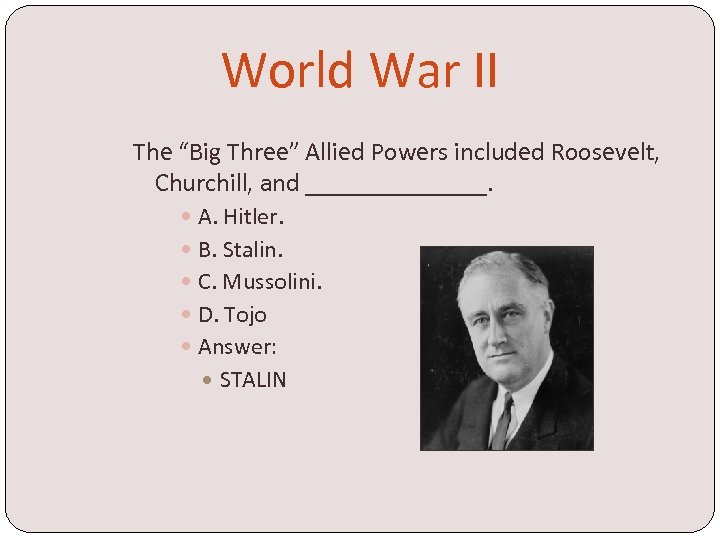 World War II The “Big Three” Allied Powers included Roosevelt, Churchill, and _______. A. Hitler. B. Stalin. C. Mussolini. D. Tojo Answer: STALIN
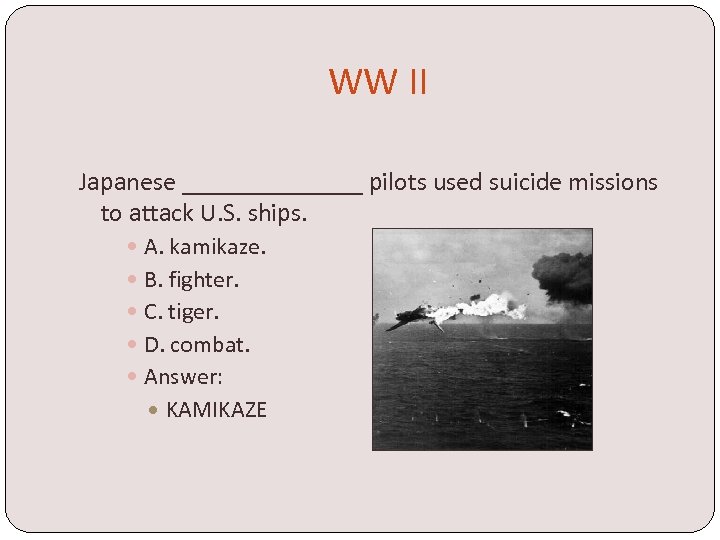 WW II Japanese _______ pilots used suicide missions to attack U. S. ships. A. kamikaze. B. fighter. C. tiger. D. combat. Answer: KAMIKAZE
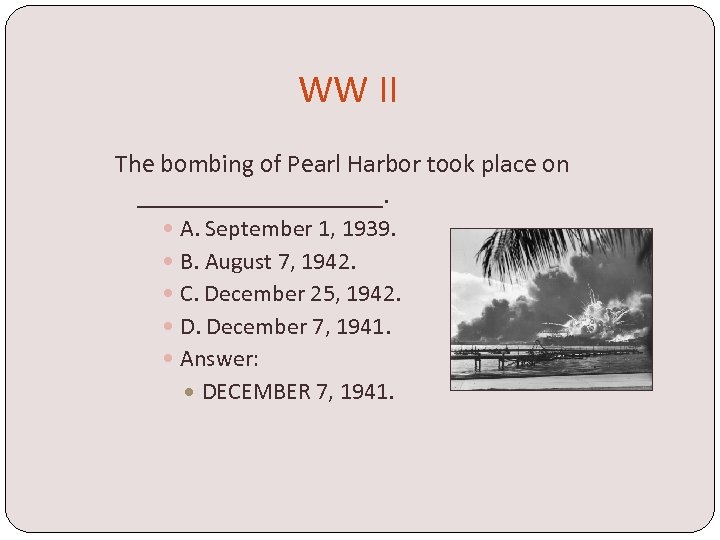 WW II The bombing of Pearl Harbor took place on __________. A. September 1, 1939. B. August 7, 1942. C. December 25, 1942. D. December 7, 1941. Answer: DECEMBER 7, 1941.
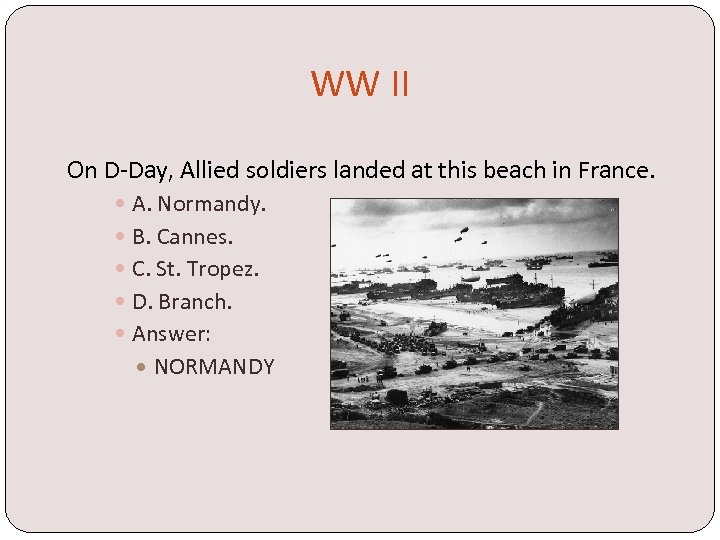 WW II On D-Day, Allied soldiers landed at this beach in France. A. Normandy. B. Cannes. C. St. Tropez. D. Branch. Answer: NORMANDY
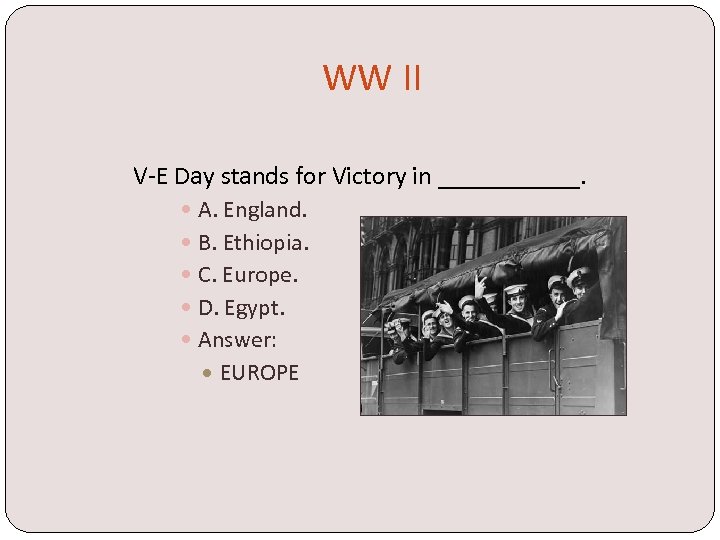 WW II V-E Day stands for Victory in ______. A. England. B. Ethiopia. C. Europe. D. Egypt. Answer: EUROPE
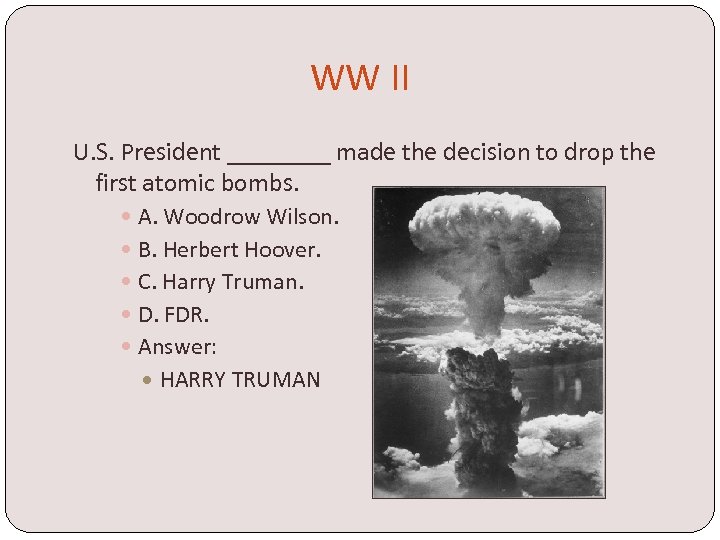 WW II U. S. President ____ made the decision to drop the first atomic bombs. A. Woodrow Wilson. B. Herbert Hoover. C. Harry Truman. D. FDR. Answer: HARRY TRUMAN
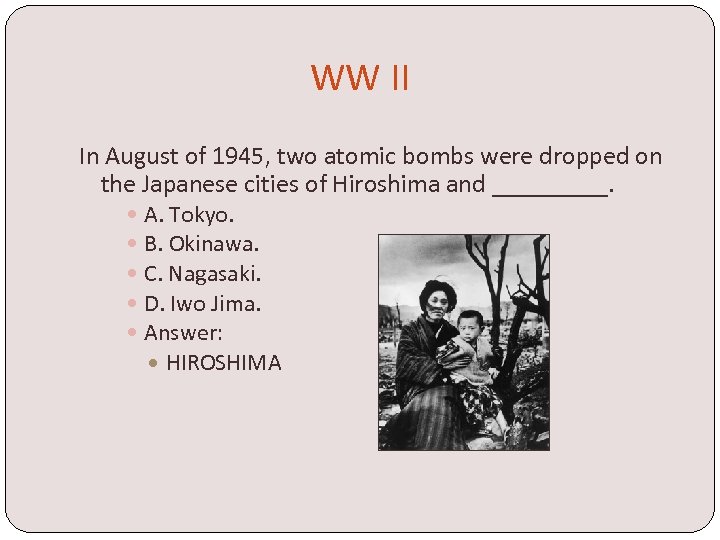 WW II In August of 1945, two atomic bombs were dropped on the Japanese cities of Hiroshima and _____. A. Tokyo. B. Okinawa. C. Nagasaki. D. Iwo Jima. Answer: HIROSHIMA
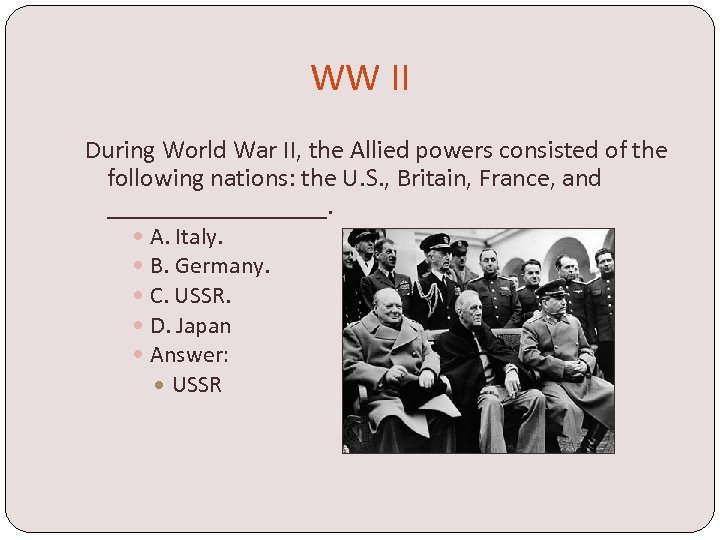 WW II During World War II, the Allied powers consisted of the following nations: the U. S. , Britain, France, and _________. A. Italy. B. Germany. C. USSR. D. Japan Answer: USSR
 Creation of the UN… The five nations which are permanent members of the UN include the U. S. , Russia (former USSR), Britain, France and ______. A. Italy. B. Japan. C. Germany. D. China. Answer: CHINA
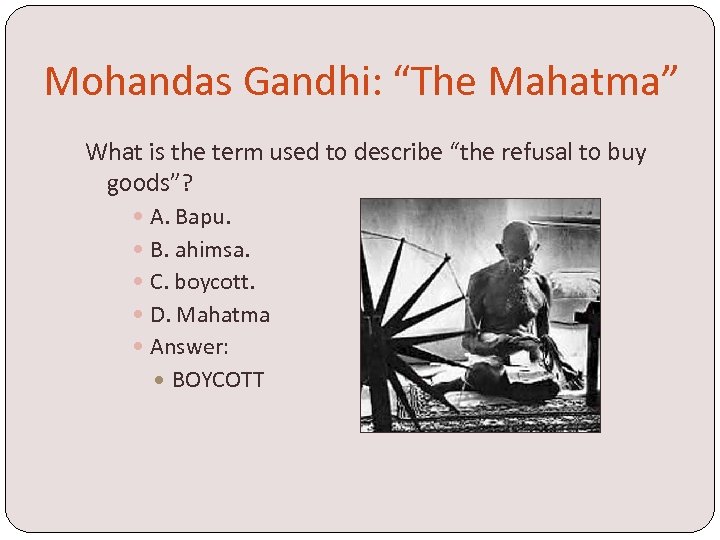 Mohandas Gandhi: “The Mahatma” What is the term used to describe “the refusal to buy goods”? A. Bapu. B. ahimsa. C. boycott. D. Mahatma Answer: BOYCOTT
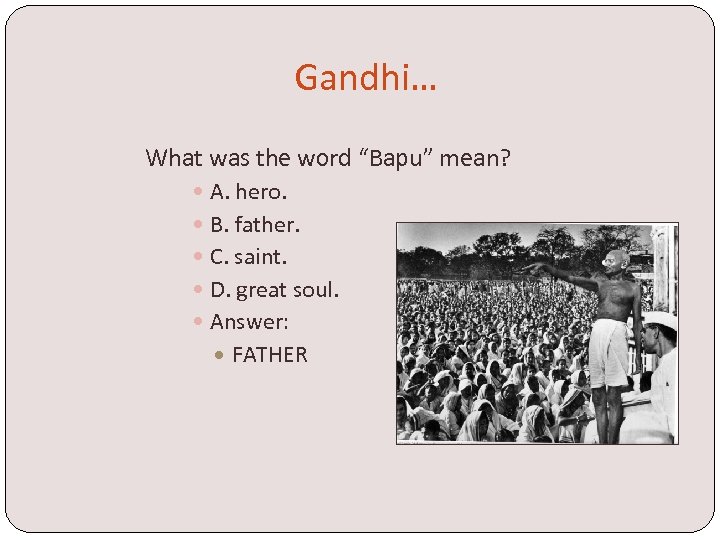 Gandhi… What was the word “Bapu” mean? A. hero. B. father. C. saint. D. great soul. Answer: FATHER
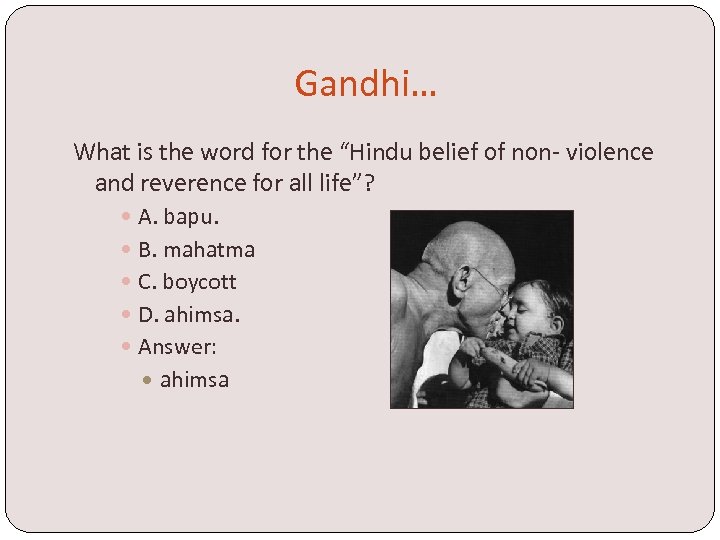 Gandhi… What is the word for the “Hindu belief of non- violence and reverence for all life”? A. bapu. B. mahatma C. boycott D. ahimsa. Answer: ahimsa
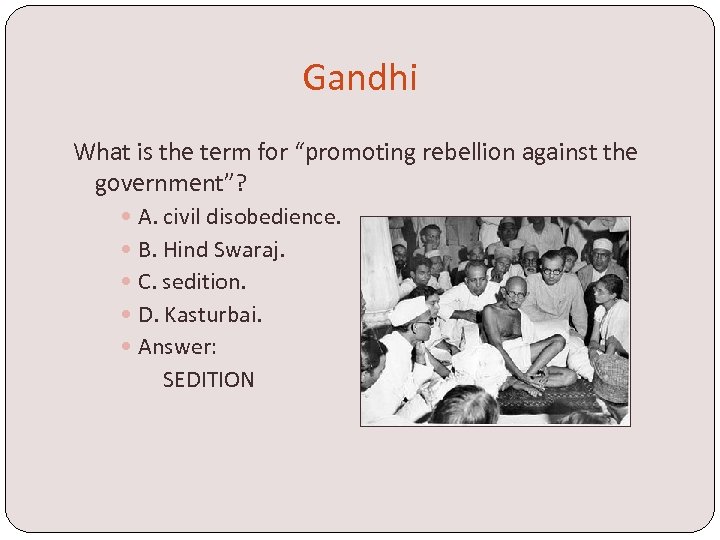 Gandhi What is the term for “promoting rebellion against the government”? A. civil disobedience. B. Hind Swaraj. C. sedition. D. Kasturbai. Answer: SEDITION
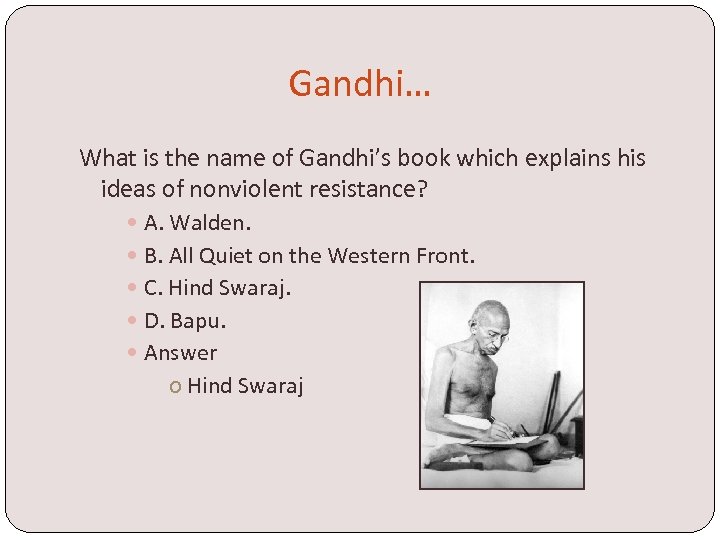 Gandhi… What is the name of Gandhi’s book which explains his ideas of nonviolent resistance? A. Walden. B. All Quiet on the Western Front. C. Hind Swaraj. D. Bapu. Answer o Hind Swaraj
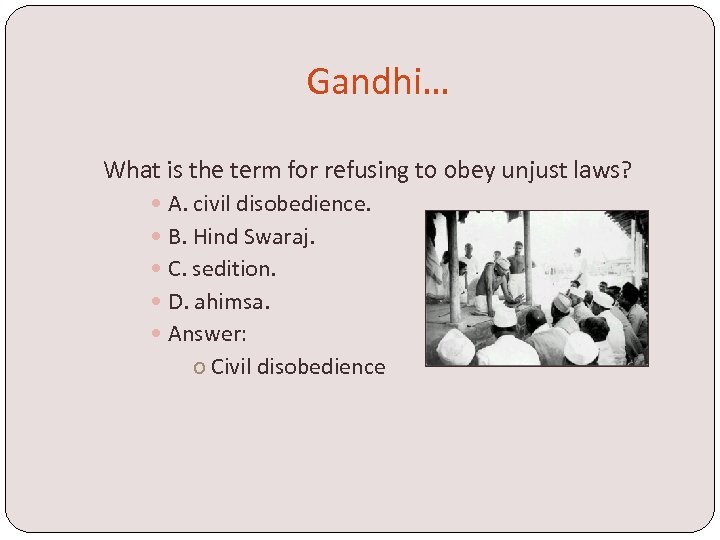 Gandhi… What is the term for refusing to obey unjust laws? A. civil disobedience. B. Hind Swaraj. C. sedition. D. ahimsa. Answer: o Civil disobedience
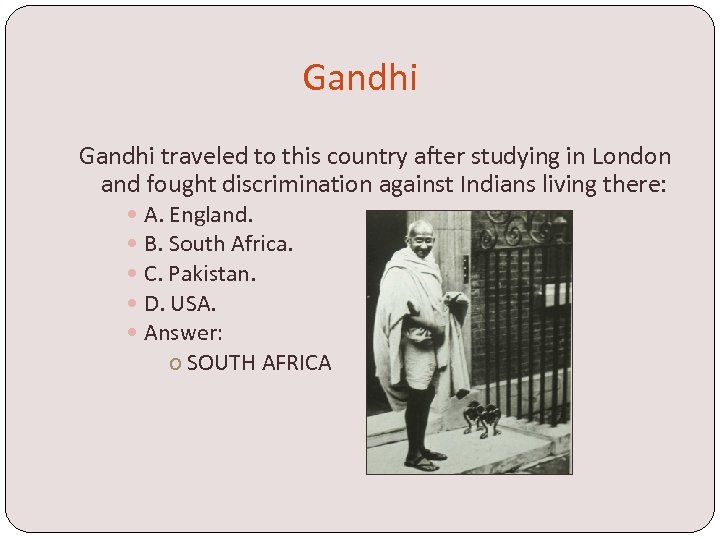 Gandhi traveled to this country after studying in London and fought discrimination against Indians living there: A. England. B. South Africa. C. Pakistan. D. USA. Answer: o SOUTH AFRICA
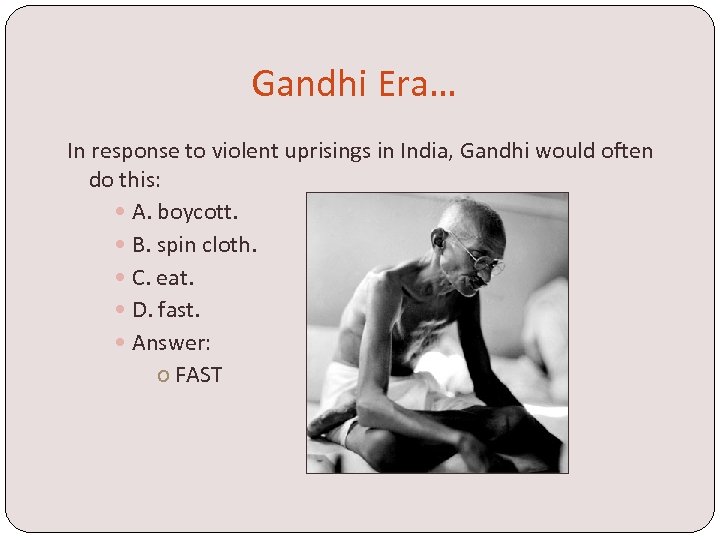 Gandhi Era… In response to violent uprisings in India, Gandhi would often do this: A. boycott. B. spin cloth. C. eat. D. fast. Answer: o FAST
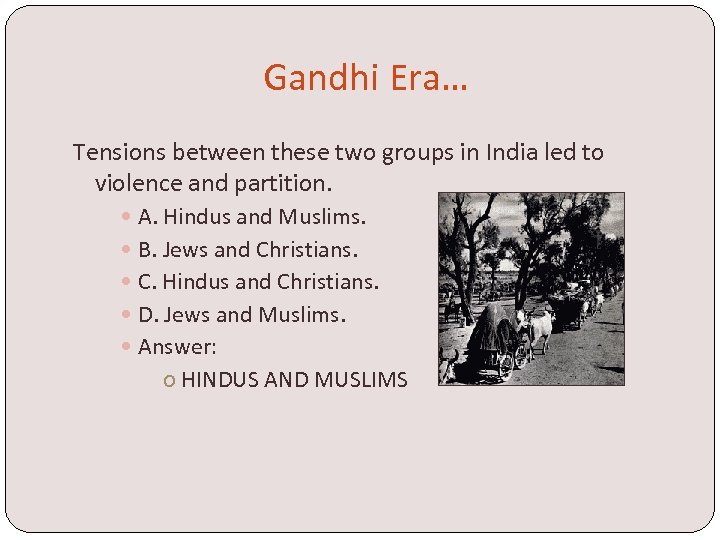 Gandhi Era… Tensions between these two groups in India led to violence and partition. A. Hindus and Muslims. B. Jews and Christians. C. Hindus and Christians. D. Jews and Muslims. Answer: o HINDUS AND MUSLIMS
 The Cold War: Definitions Define: NATO Answer: o The military alliance led by the United States. o Stands for the North American Treaty Organization. Define: Warsaw Pact. Answer: o The (Cold War) military alliance led by the former Soviet Union.
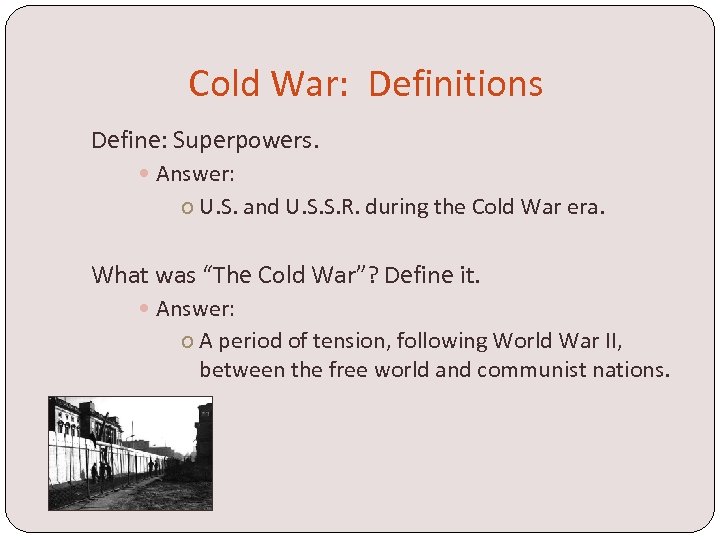 Cold War: Definitions Define: Superpowers. Answer: o U. S. and U. S. S. R. during the Cold War era. What was “The Cold War”? Define it. Answer: o A period of tension, following World War II, between the free world and communist nations.
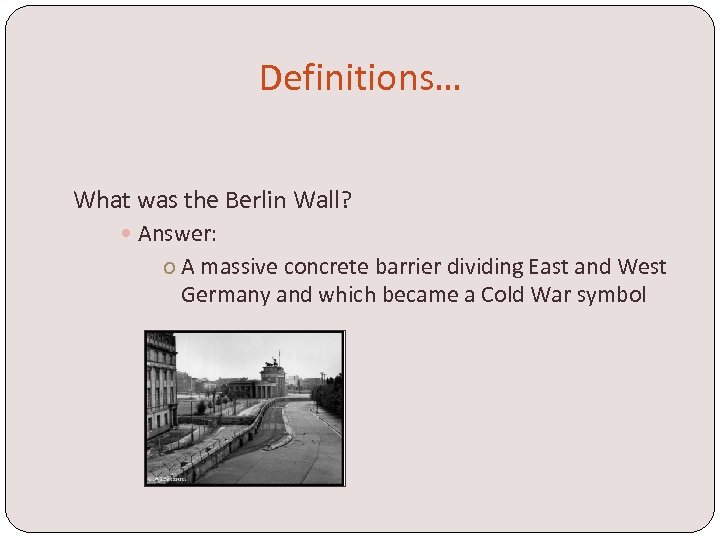 Definitions… What was the Berlin Wall? Answer: o A massive concrete barrier dividing East and West Germany and which became a Cold War symbol
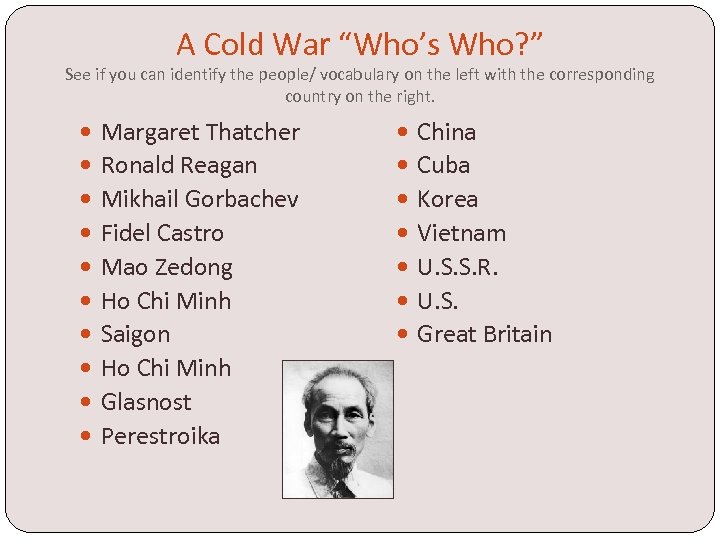 A Cold War “Who’s Who? ” See if you can identify the people/ vocabulary on the left with the corresponding country on the right. Margaret Thatcher Ronald Reagan Mikhail Gorbachev Fidel Castro Mao Zedong Ho Chi Minh Saigon Ho Chi Minh Glasnost Perestroika China Cuba Korea Vietnam U. S. S. R. U. S. Great Britain
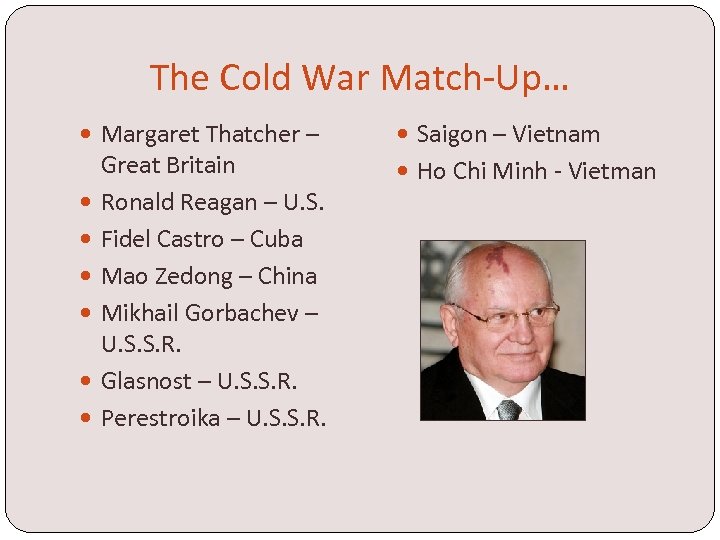 The Cold War Match-Up… Margaret Thatcher – Great Britain Ronald Reagan – U. S. Fidel Castro – Cuba Mao Zedong – China Mikhail Gorbachev – U. S. S. R. Glasnost – U. S. S. R. Perestroika – U. S. S. R. Saigon – Vietnam Ho Chi Minh - Vietman
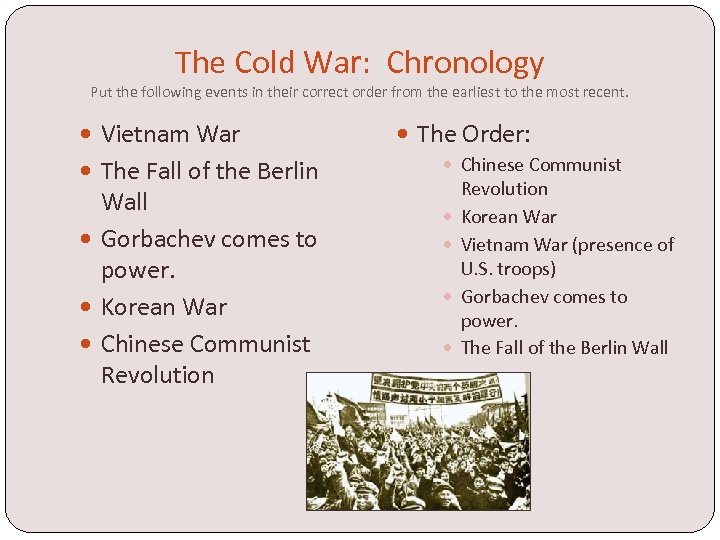 The Cold War: Chronology Put the following events in their correct order from the earliest to the most recent. Vietnam War The Fall of the Berlin Wall Gorbachev comes to power. Korean War Chinese Communist Revolution The Order: Chinese Communist Revolution Korean War Vietnam War (presence of U. S. troops) Gorbachev comes to power. The Fall of the Berlin Wall
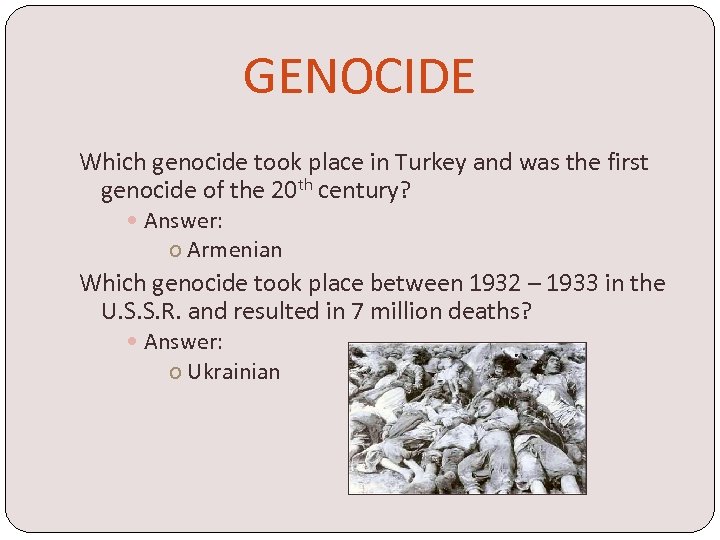 GENOCIDE Which genocide took place in Turkey and was the first genocide of the 20 th century? Answer: o Armenian Which genocide took place between 1932 – 1933 in the U. S. S. R. and resulted in 7 million deaths? Answer: o Ukrainian
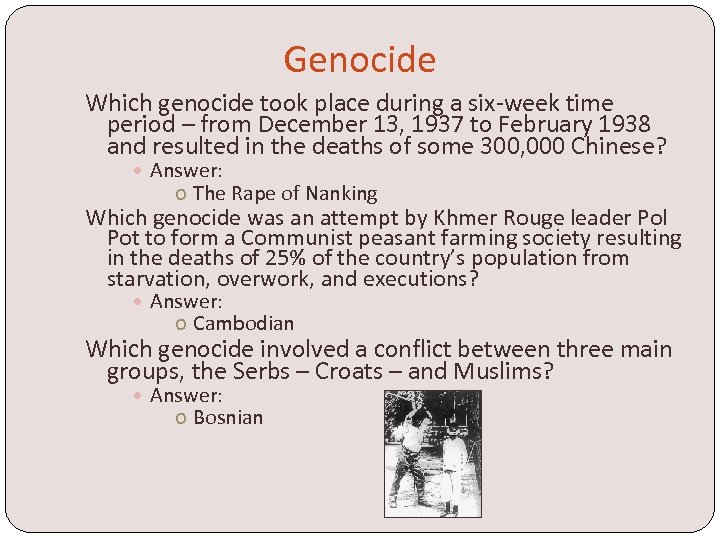 Genocide Which genocide took place during a six-week time period – from December 13, 1937 to February 1938 and resulted in the deaths of some 300, 000 Chinese? Answer: o The Rape of Nanking Which genocide was an attempt by Khmer Rouge leader Pol Pot to form a Communist peasant farming society resulting in the deaths of 25% of the country’s population from starvation, overwork, and executions? Answer: o Cambodian Which genocide involved a conflict between three main groups, the Serbs – Croats – and Muslims? Answer: o Bosnian
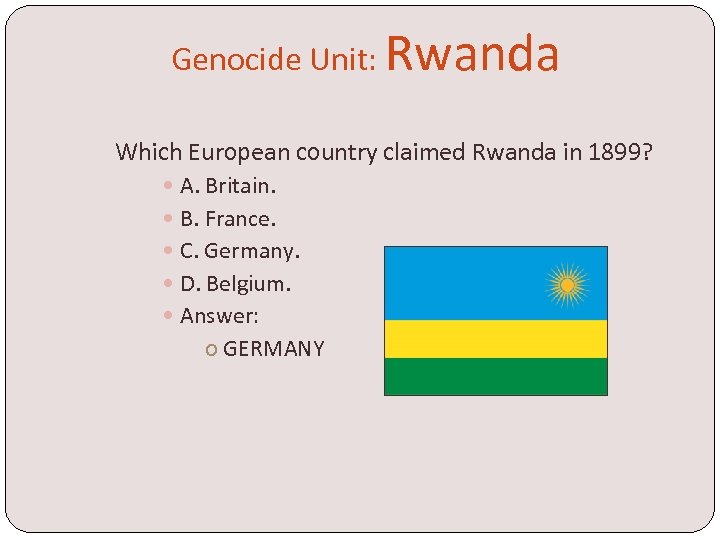 Genocide Unit: Rwanda Which European country claimed Rwanda in 1899? A. Britain. B. France. C. Germany. D. Belgium. Answer: o GERMANY
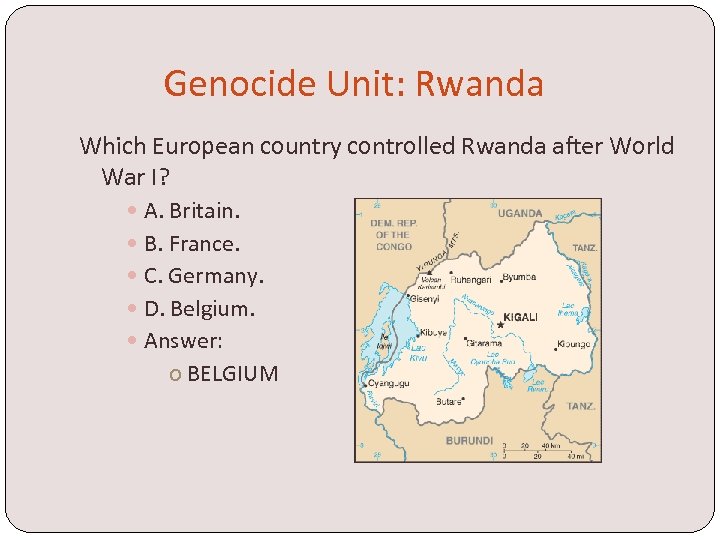 Genocide Unit: Rwanda Which European country controlled Rwanda after World War I? A. Britain. B. France. C. Germany. D. Belgium. Answer: o BELGIUM
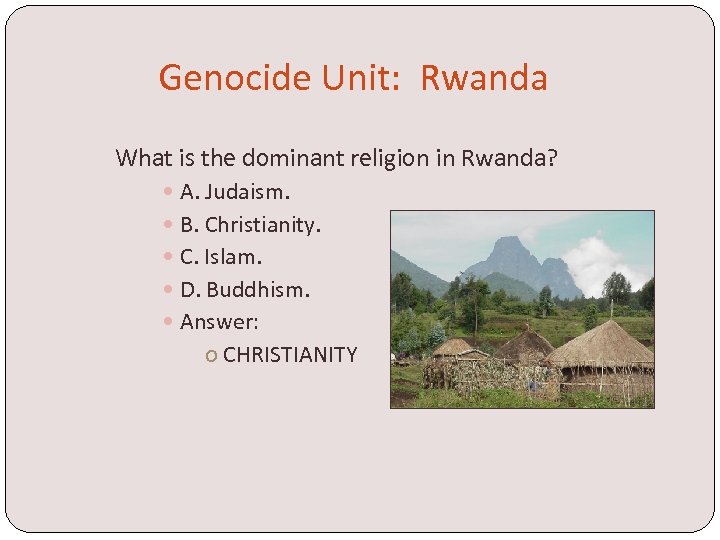 Genocide Unit: Rwanda What is the dominant religion in Rwanda? A. Judaism. B. Christianity. C. Islam. D. Buddhism. Answer: o CHRISTIANITY
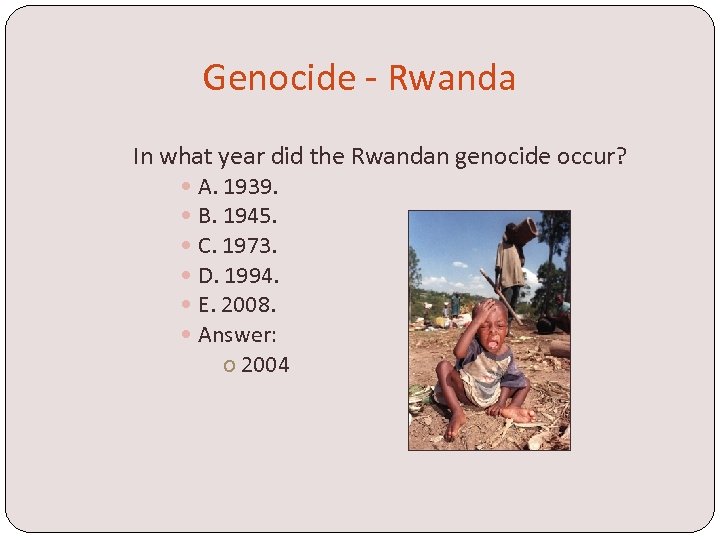 Genocide - Rwanda In what year did the Rwandan genocide occur? A. 1939. B. 1945. C. 1973. D. 1994. E. 2008. Answer: o 2004
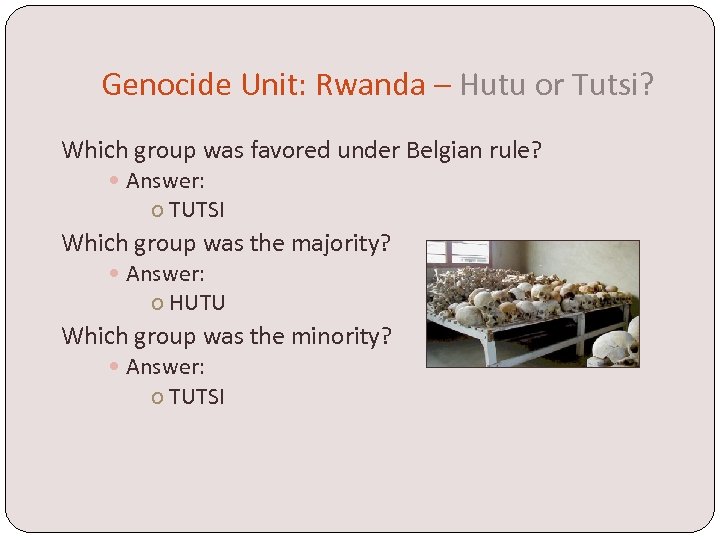 Genocide Unit: Rwanda – Hutu or Tutsi? Which group was favored under Belgian rule? Answer: o TUTSI Which group was the majority? Answer: o HUTU Which group was the minority? Answer: o TUTSI
 Hutu or Tutsi – continued… Paul Rusesabagina HUTU Tatiana Rusesabagina TUTSI Interhamwe Militia (George Rutagunda) HUTU Rwandan Patriotic Front (RPF) TUTSI
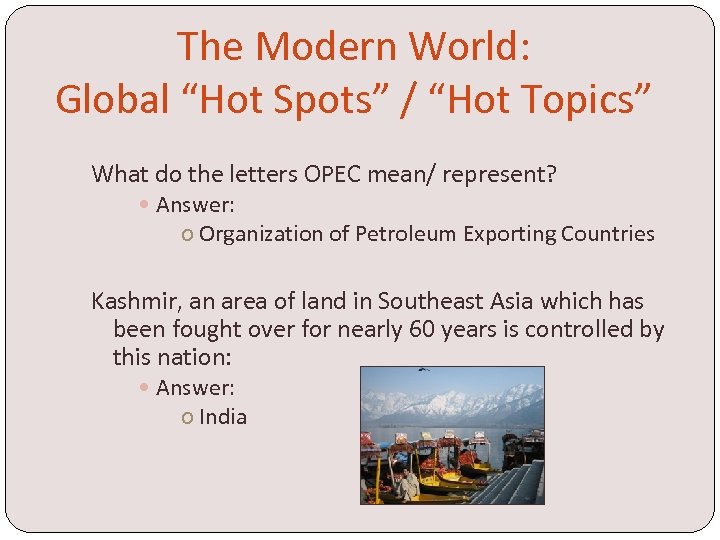 The Modern World: Global “Hot Spots” / “Hot Topics” What do the letters OPEC mean/ represent? Answer: o Organization of Petroleum Exporting Countries Kashmir, an area of land in Southeast Asia which has been fought over for nearly 60 years is controlled by this nation: Answer: o India
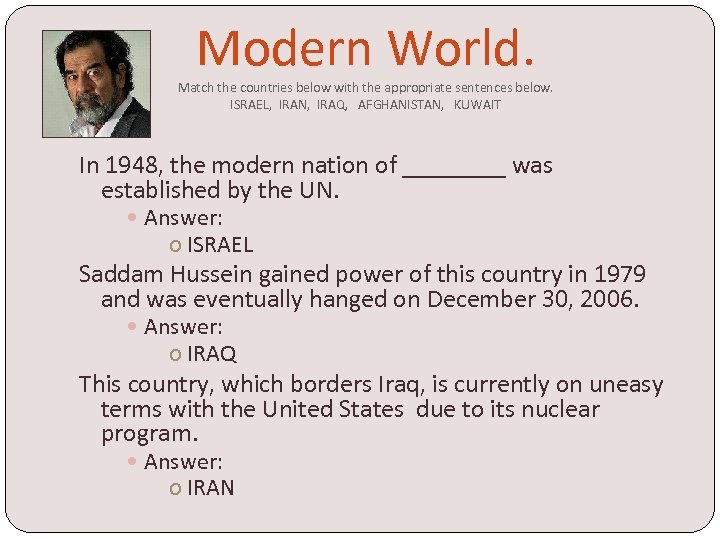 Modern World. Match the countries below with the appropriate sentences below. ISRAEL, IRAN, IRAQ, AFGHANISTAN, KUWAIT In 1948, the modern nation of ____ was established by the UN. Answer: o ISRAEL Saddam Hussein gained power of this country in 1979 and was eventually hanged on December 30, 2006. Answer: o IRAQ This country, which borders Iraq, is currently on uneasy terms with the United States due to its nuclear program. Answer: o IRAN
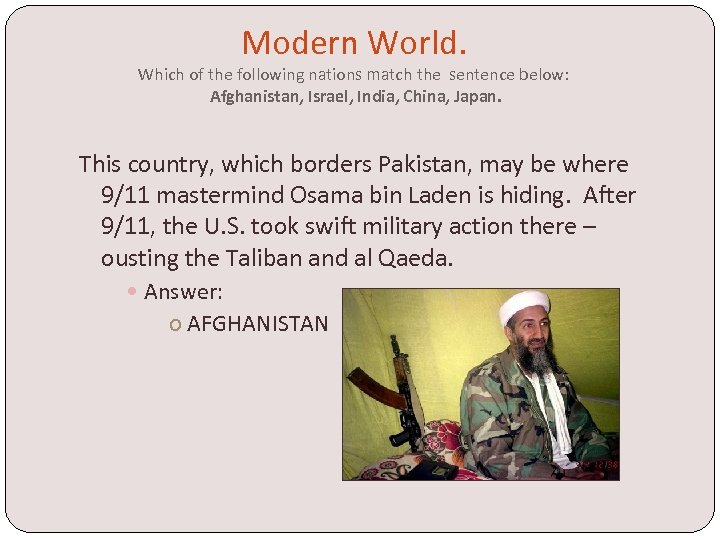 Modern World. Which of the following nations match the sentence below: Afghanistan, Israel, India, China, Japan. This country, which borders Pakistan, may be where 9/11 mastermind Osama bin Laden is hiding. After 9/11, the U. S. took swift military action there – ousting the Taliban and al Qaeda. Answer: o AFGHANISTAN
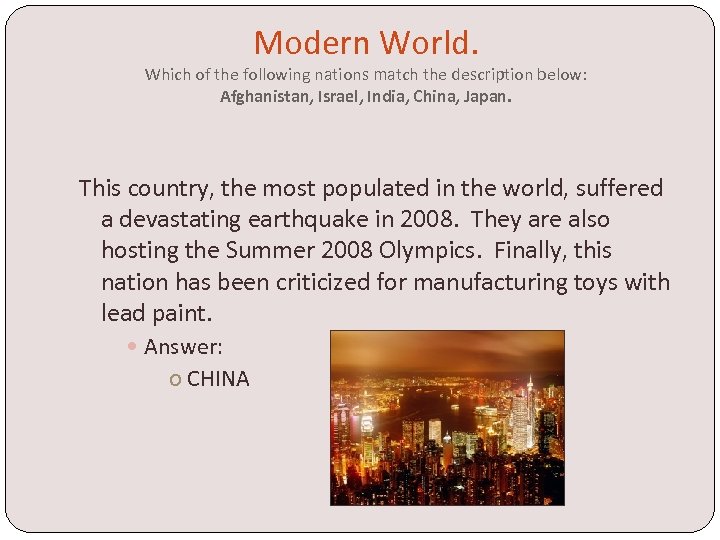 Modern World. Which of the following nations match the description below: Afghanistan, Israel, India, China, Japan. This country, the most populated in the world, suffered a devastating earthquake in 2008. They are also hosting the Summer 2008 Olympics. Finally, this nation has been criticized for manufacturing toys with lead paint. Answer: o CHINA
 Modern World. Which of the following nations match the description below: Afghanistan, Israel, Pakistan, India, China, Japan. This nation, the second most populated in the world, is experiencing tremendous economic growth due to outsourcing – especially by U. S. companies. Answer: o INDIA
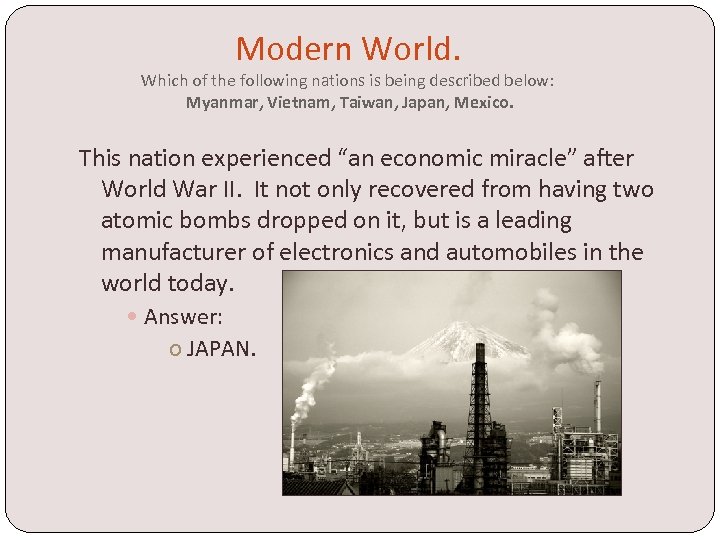 Modern World. Which of the following nations is being described below: Myanmar, Vietnam, Taiwan, Japan, Mexico. This nation experienced “an economic miracle” after World War II. It not only recovered from having two atomic bombs dropped on it, but is a leading manufacturer of electronics and automobiles in the world today. Answer: o JAPAN.
 A few more things… Good luck on your exam! Thanks for a wonderful year!!!!! Have a safe and happy summer!!!!! Keep in touch! This concludes the power point review.