 Скачать презентацию World Climate Negotiating a Global Climate Agreement using
d11ba584151865e24c133e29500e7980.ppt
- Количество слайдов: 17



World Climate: Negotiating a Global Climate Agreement using the C-ROADS Climate Policy Simulation
Agenda 1. 2. 3. 4. Introduction and schedule Roles The Negotiation Debrief
We Will Test Pledges in C-ROADS, a Scientifically-Reviewed Simulator External Review found that C-ROADS: • “reproduces the response properties of state-ofthe-art three dimensional climate models very well” • “Given the models capabilities and its close alignment with a range of scenarios published in the Fourth Assessment Report of the IPCC we support its widespread use among a broad range of users and recommend that it be considered as an official United Nations tool. ” Full report: http: //climateinteractive. org/simulations/C-ROADS/technical/scientific-review/C-ROADS%20 Scientific%20 Review%20 Summary-1. pdf
3 -Region Negotiation Parties • Developed Nations Led by US, EU, Japan, but also Russia/FSUs/ Eastern Europe, South Korea, Australia/NZ, Canada • Developing A Led by China, India, Brazil, but also South Africa, Mexico, Indonesia, Phillipines, Thailand, Taiwan, Hong Kong, Malaysia, Pakistan, Singapore • Developing B Small Island Nations and “LDCs”, representing Other Small Asia, Central/South America, Middle East, Bangladesh
Process • Introduce yourselves to members of your delegation • Review Briefing Memo for your or bloc • Begin to formulate your negotiating strategy – What are your vital interests? What is politically feasible in your bloc? – What do you need from the other blocs? What can you offer them?
Welcome Delegates UN Climate Summit
Your Goals • Achieve emissions reduction commitments to stabilize GHG levels by 2100 at a level that limits global warming to no more than 2 °C above preindustrial levels. • Agree on a deal to share costs of mitigation and adaptation fund to aid less developed nations.
Task 1: Emissions • Each delegation will set its own fossil fuel emissions targets. You will set: – In what year will GHG emissions in your bloc stop growing (if any)? – In what year (if desired), will your GHG emissions begin to fall? – If emissions will fall, at what rate (% per year)? • REDD policies: – Deforestation: 0 – 1 scale. 1 continues BAU deforestation path, 0 gradually eliminates deforestation over coming decades. – Afforestation: 0 – 1 scale. 0 = no new area set aside for afforestation; 1 = maximum feasible afforestation area.
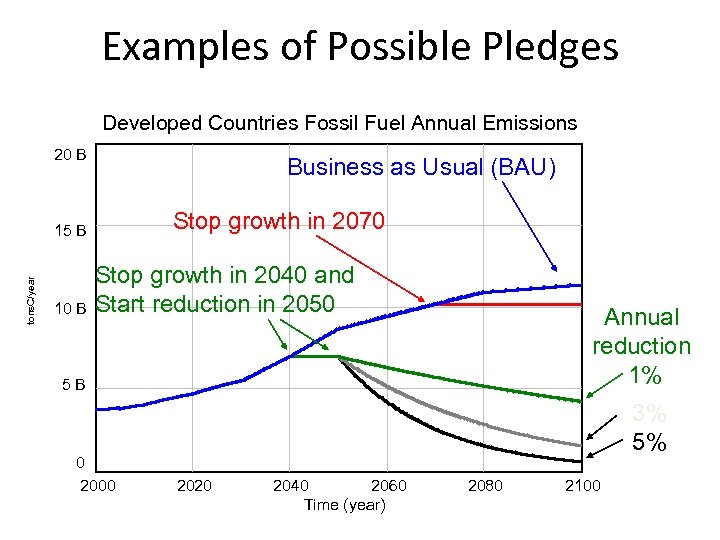
Examples of Possible Pledges Developed Countries Fossil Fuel Annual Emissions 20 B Business as Usual (BAU) Stop growth in 2070 tons. C/year 15 B 10 B Stop growth in 2040 and Start reduction in 2050 Annual reduction 1% 5 B 0 2000 3% 5% 2020 2040 2060 Time (year) 2080 2100
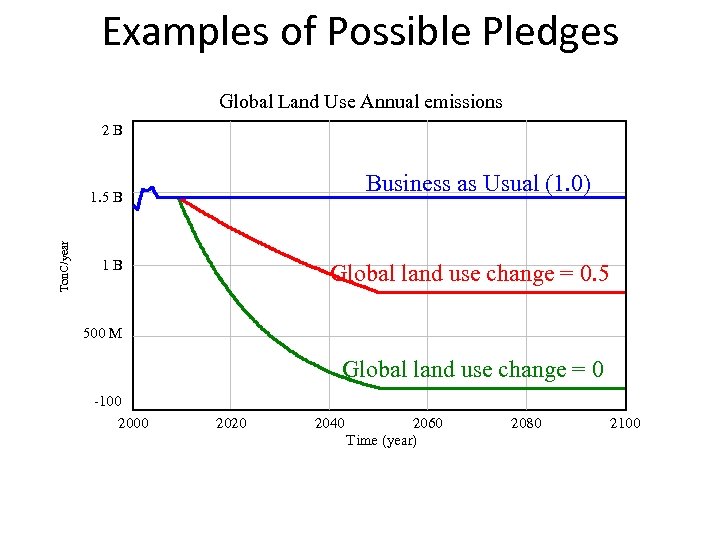
Examples of Possible Pledges Global Land Use Annual emissions 2 B Business as Usual (1. 0) Ton. C/year 1. 5 B 1 B Global land use change = 0. 5 500 M Global land use change = 0 -100 2020 2040 2060 Time (year) 2080 2100
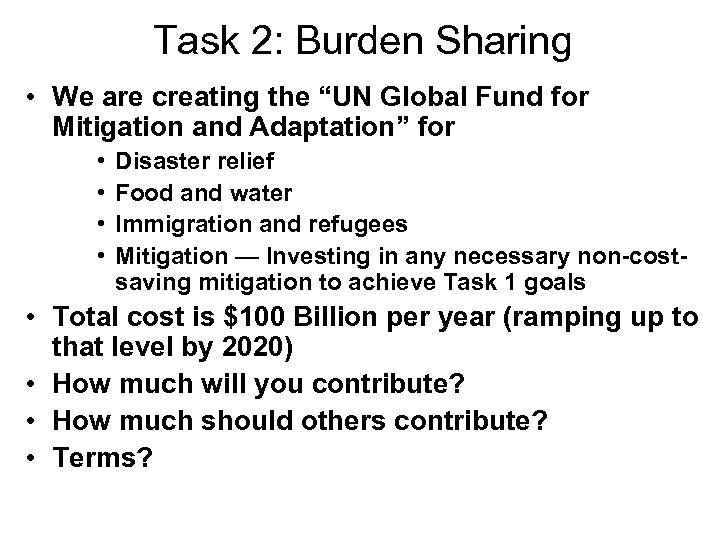
Task 2: Burden Sharing • We are creating the “UN Global Fund for Mitigation and Adaptation” for • • Disaster relief Food and water Immigration and refugees Mitigation — Investing in any necessary non-costsaving mitigation to achieve Task 1 goals • Total cost is $100 Billion per year (ramping up to that level by 2020) • How much will you contribute? • How much should others contribute? • Terms?
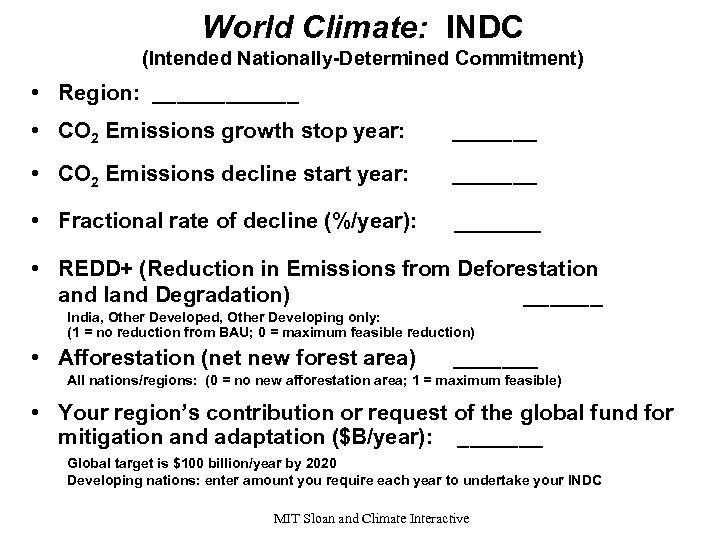
World Climate: INDC (Intended Nationally-Determined Commitment) • Region: ______ • CO 2 Emissions growth stop year: _______ • CO 2 Emissions decline start year: _______ • Fractional rate of decline (%/year): ______ • REDD+ (Reduction in Emissions from Deforestation and land Degradation) ______ India, Other Developed, Other Developing only: (1 = no reduction from BAU; 0 = maximum feasible reduction) • Afforestation (net new forest area) _______ All nations/regions: (0 = no new afforestation area; 1 = maximum feasible) • Your region’s contribution or request of the global fund for mitigation and adaptation ($B/year): _______ Global target is $100 billion/year by 2020 Developing nations: enter amount you require each year to undertake your INDC MIT Sloan and Climate Interactive
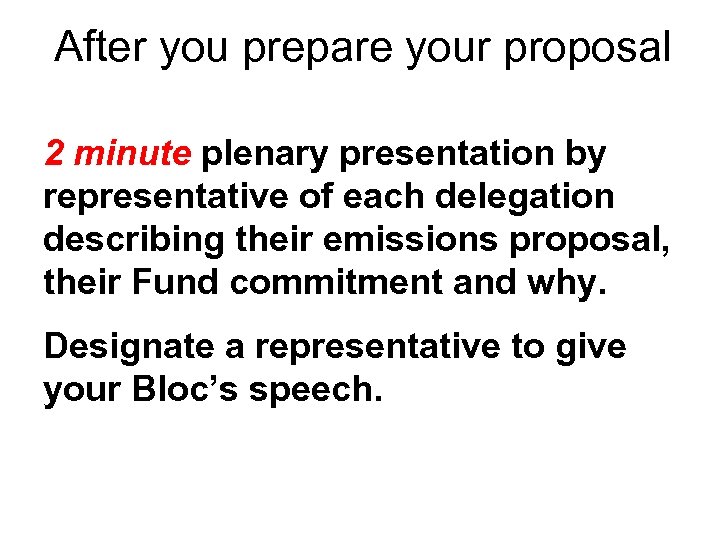
After you prepare your proposal 2 minute plenary presentation by representative of each delegation describing their emissions proposal, their Fund commitment and why. Designate a representative to give your Bloc’s speech.
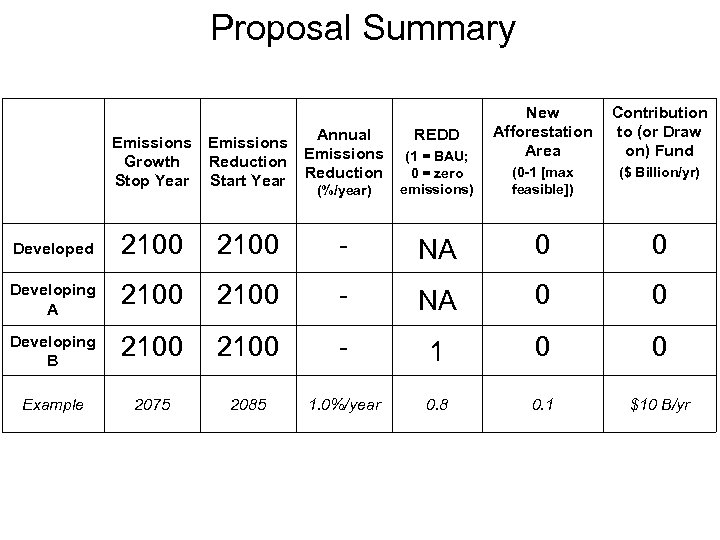
Proposal Summary Emissions Growth Stop Year Emissions Reduction Start Year Developed 2100 Developing A Annual Emissions Reduction REDD New Afforestation Area Contribution to (or Draw on) Fund (0 -1 [max feasible]) ($ Billion/yr) (%/year) (1 = BAU; 0 = zero emissions) 2100 - NA 0 0 Developing B 2100 - 1 0 0 Example 2075 2085 1. 0%/year 0. 8 0. 1 $10 B/yr
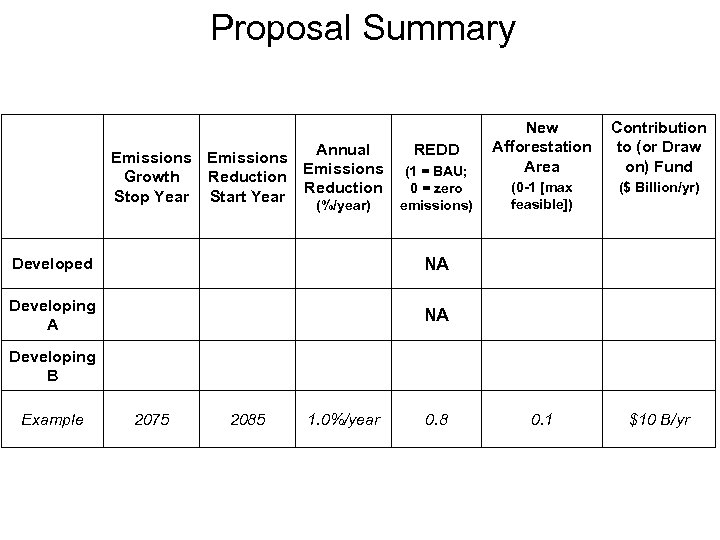
Proposal Summary Emissions Growth Stop Year Emissions Reduction Start Year Annual Emissions Reduction (%/year) REDD (1 = BAU; 0 = zero emissions) Developed Contribution to (or Draw on) Fund (0 -1 [max feasible]) ($ Billion/yr) 0. 1 $10 B/yr NA Developing A New Afforestation Area NA Developing B Example 2075 2085 1. 0%/year 0. 8
For more information or to lead the exercise yourself, contact: climateinteractive. org
Скачать презентацию World Climate Negotiating a Global Climate Agreement using
d11ba584151865e24c133e29500e7980.ppt