 Скачать презентацию World Breastfeeding Trends Initiative WBTi Assessment of the
b2fa05fc64fd1cc199458004562d4c83.ppt
- Количество слайдов: 19



World Breastfeeding Trends Initiative (WBTi) Assessment of the Status of Global Strategy for Infant and Young Child Feeding at National Level—Achievements and Gaps Afghanistan
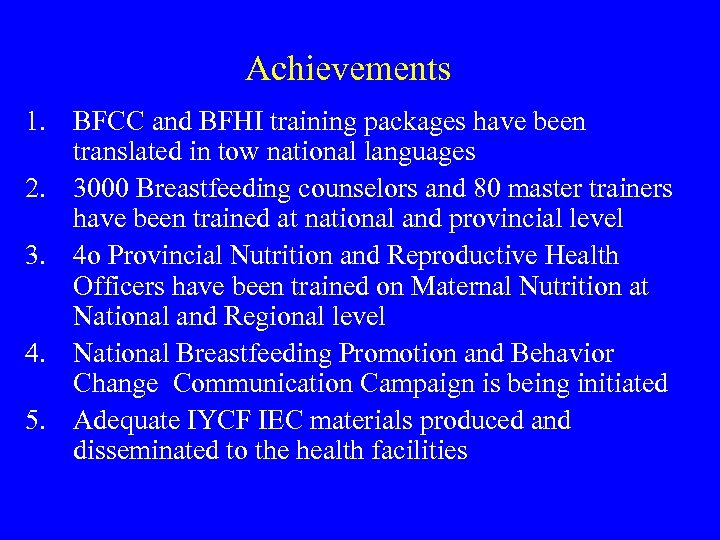
Achievements 1. BFCC and BFHI training packages have been translated in tow national languages 2. 3000 Breastfeeding counselors and 80 master trainers have been trained at national and provincial level 3. 4 o Provincial Nutrition and Reproductive Health Officers have been trained on Maternal Nutrition at National and Regional level 4. National Breastfeeding Promotion and Behavior Change Communication Campaign is being initiated 5. Adequate IYCF IEC materials produced and disseminated to the health facilities
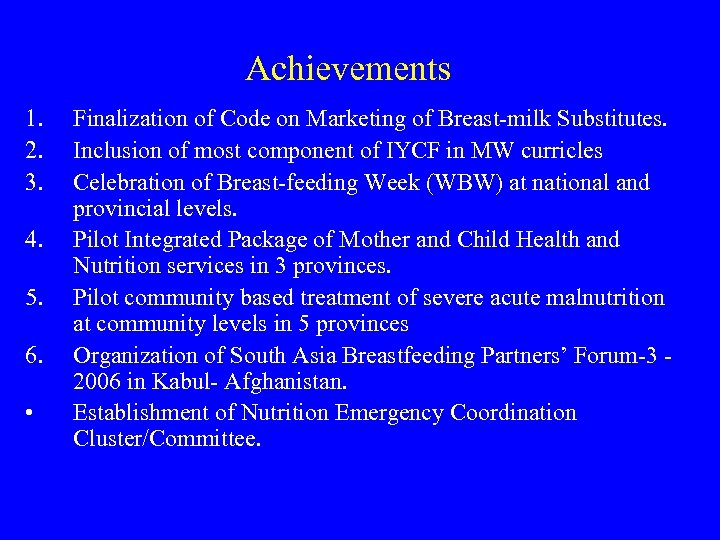
Achievements 1. 2. 3. 4. 5. 6. • Finalization of Code on Marketing of Breast-milk Substitutes. Inclusion of most component of IYCF in MW curricles Celebration of Breast-feeding Week (WBW) at national and provincial levels. Pilot Integrated Package of Mother and Child Health and Nutrition services in 3 provinces. Pilot community based treatment of severe acute malnutrition at community levels in 5 provinces Organization of South Asia Breastfeeding Partners’ Forum-3 2006 in Kabul- Afghanistan. Establishment of Nutrition Emergency Coordination Cluster/Committee.
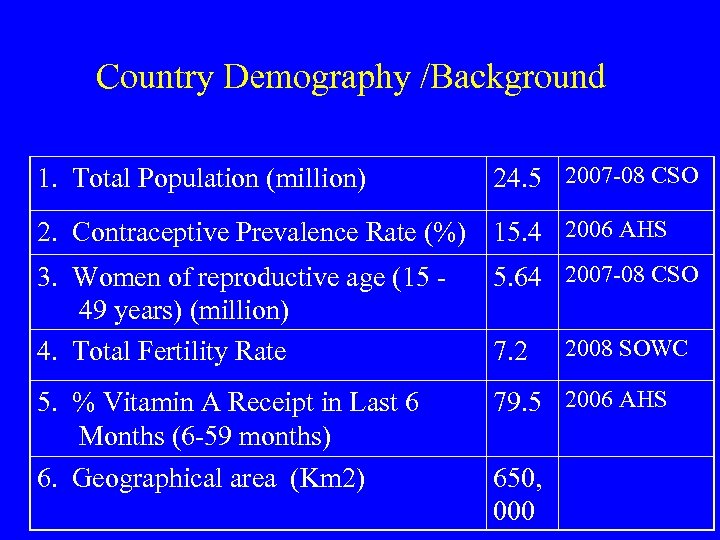
Country Demography /Background 1. Total Population (million) 24. 5 2007 -08 CSO 2. Contraceptive Prevalence Rate (%) 15. 4 2006 AHS 3. Women of reproductive age (15 49 years) (million) 4. Total Fertility Rate 5. 64 2007 -08 CSO 5. % Vitamin A Receipt in Last 6 Months (6 -59 months) 79. 5 2006 AHS 6. Geographical area (Km 2) 650, 000 7. 2 2008 SOWC
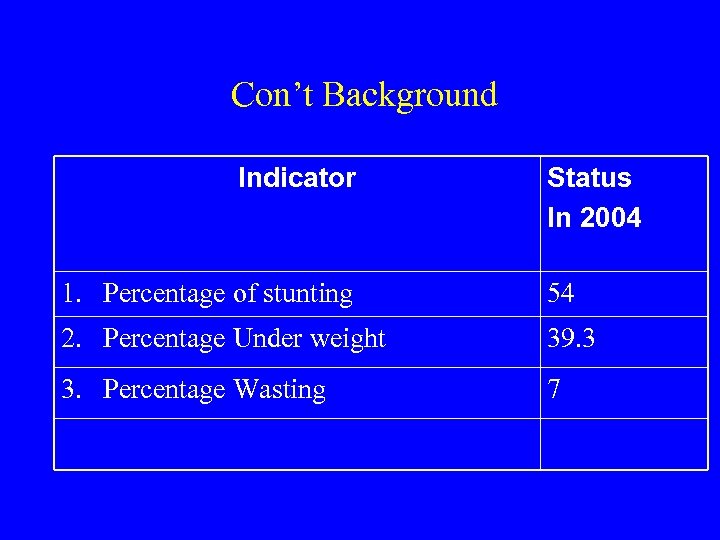
Con’t Background Indicator Status In 2004 1. Percentage of stunting 54 2. Percentage Under weight 39. 3 3. Percentage Wasting 7
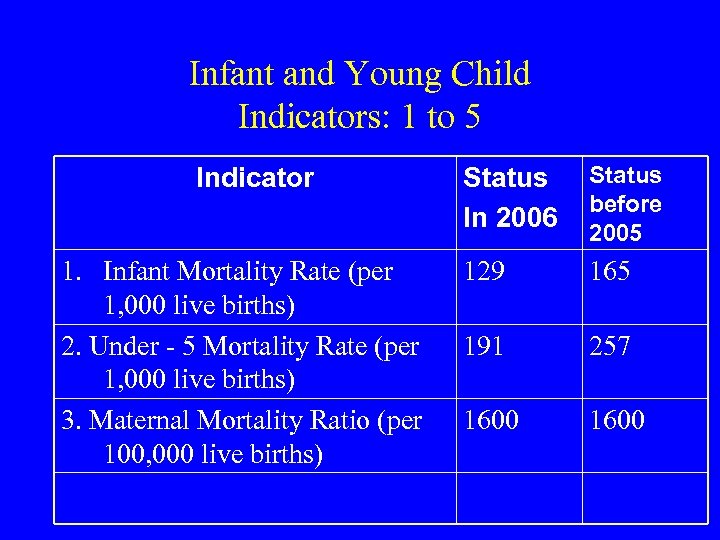
Infant and Young Child Indicators: 1 to 5 Indicator 1. Infant Mortality Rate (per 1, 000 live births) 2. Under - 5 Mortality Rate (per 1, 000 live births) 3. Maternal Mortality Ratio (per 100, 000 live births) Status In 2006 Status before 2005 129 165 191 257 1600
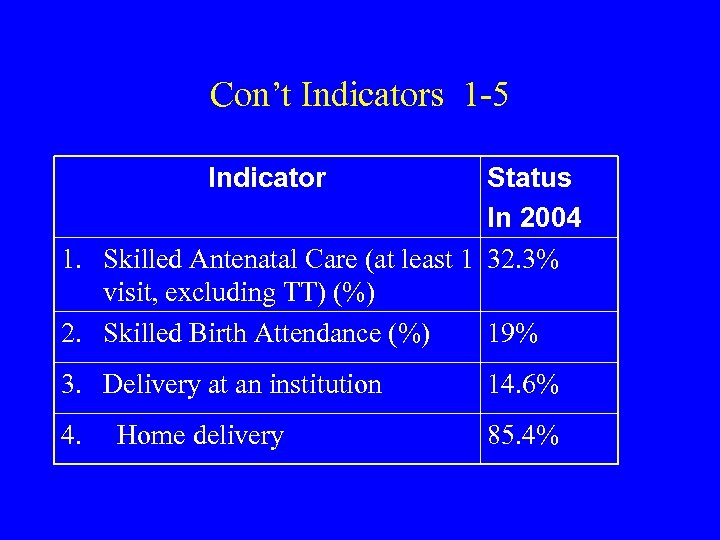
Con’t Indicators 1 -5 Indicator Status In 2004 1. Skilled Antenatal Care (at least 1 32. 3% visit, excluding TT) (%) 2. Skilled Birth Attendance (%) 19% 3. Delivery at an institution 14. 6% 4. 85. 4% Home delivery
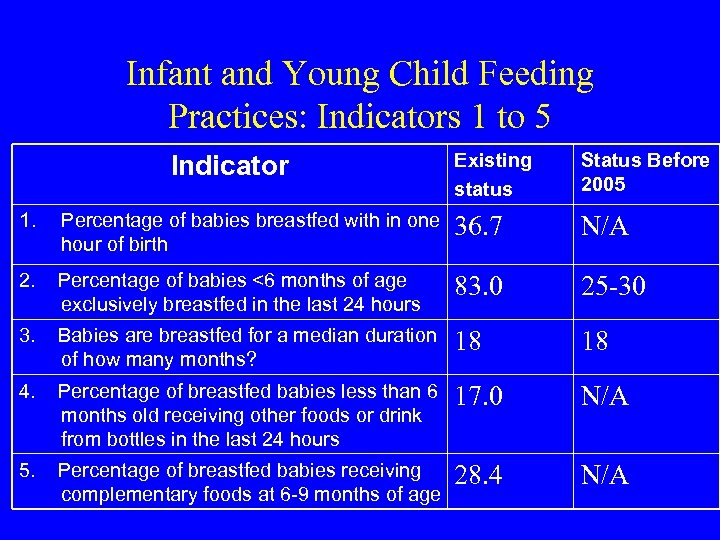
Infant and Young Child Feeding Practices: Indicators 1 to 5 Indicator Existing status Status Before 2005 1. Percentage of babies breastfed with in one hour of birth 36. 7 N/A 2. Percentage of babies <6 months of age exclusively breastfed in the last 24 hours 83. 0 25 -30 3. Babies are breastfed for a median duration of how many months? 18 18 4. Percentage of breastfed babies less than 6 months old receiving other foods or drink from bottles in the last 24 hours 17. 0 N/A 5. Percentage of breastfed babies receiving complementary foods at 6 -9 months of age 28. 4 N/A
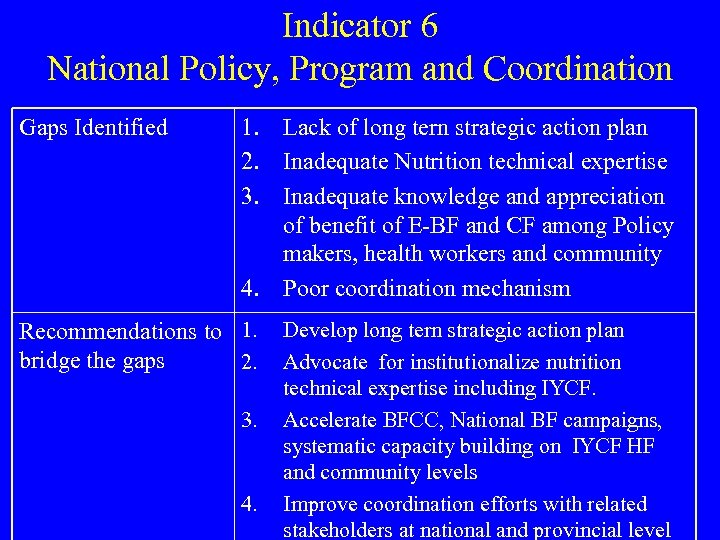
Indicator 6 National Policy, Program and Coordination Gaps Identified 1. Lack of long tern strategic action plan 2. Inadequate Nutrition technical expertise 3. Inadequate knowledge and appreciation of benefit of E-BF and CF among Policy makers, health workers and community 4. Poor coordination mechanism Recommendations to 1. bridge the gaps 2. 3. 4. Develop long tern strategic action plan Advocate for institutionalize nutrition technical expertise including IYCF. Accelerate BFCC, National BF campaigns, systematic capacity building on IYCF HF and community levels Improve coordination efforts with related stakeholders at national and provincial level
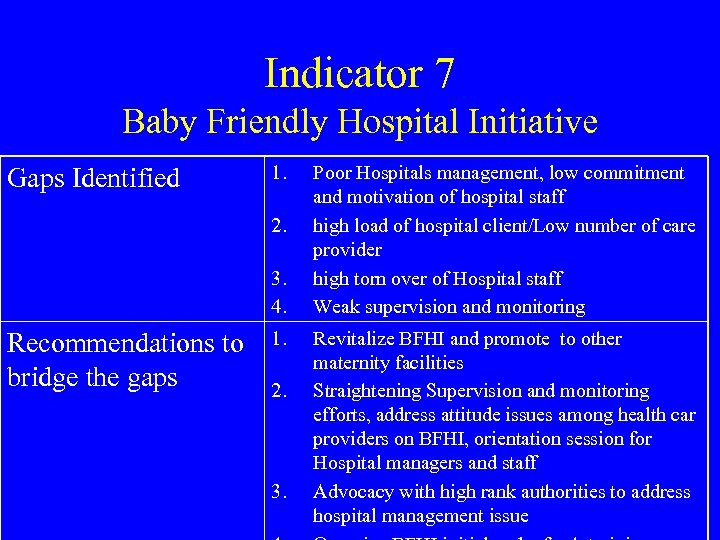
Indicator 7 Baby Friendly Hospital Initiative Gaps Identified 1. 2. 3. 4. Recommendations to bridge the gaps 1. 2. 3. Poor Hospitals management, low commitment and motivation of hospital staff high load of hospital client/Low number of care provider high torn over of Hospital staff Weak supervision and monitoring Revitalize BFHI and promote to other maternity facilities Straightening Supervision and monitoring efforts, address attitude issues among health car providers on BFHI, orientation session for Hospital managers and staff Advocacy with high rank authorities to address hospital management issue
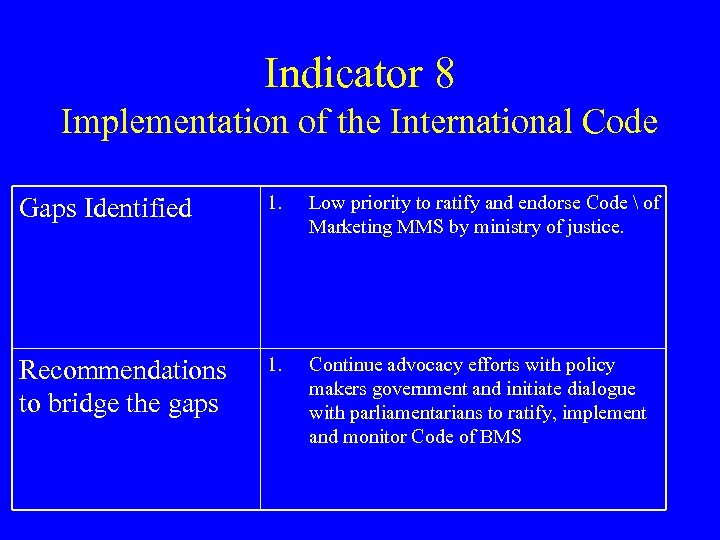
Indicator 8 Implementation of the International Code Gaps Identified 1. Low priority to ratify and endorse Code of Marketing MMS by ministry of justice. Recommendations to bridge the gaps 1. Continue advocacy efforts with policy makers government and initiate dialogue with parliamentarians to ratify, implement and monitor Code of BMS
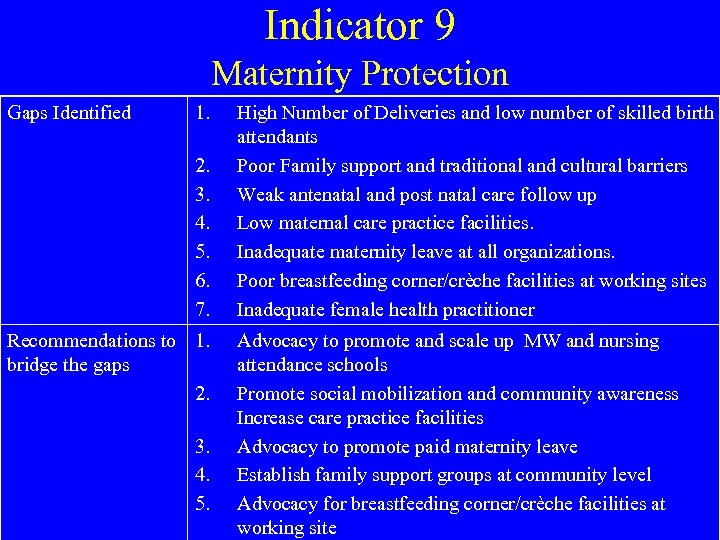
Indicator 9 Maternity Protection Gaps Identified 1. 2. 3. 4. 5. 6. 7. Recommendations to 1. bridge the gaps 2. 3. 4. 5. High Number of Deliveries and low number of skilled birth attendants Poor Family support and traditional and cultural barriers Weak antenatal and post natal care follow up Low maternal care practice facilities. Inadequate maternity leave at all organizations. Poor breastfeeding corner/crèche facilities at working sites Inadequate female health practitioner Advocacy to promote and scale up MW and nursing attendance schools Promote social mobilization and community awareness Increase care practice facilities Advocacy to promote paid maternity leave Establish family support groups at community level Advocacy for breastfeeding corner/crèche facilities at working site
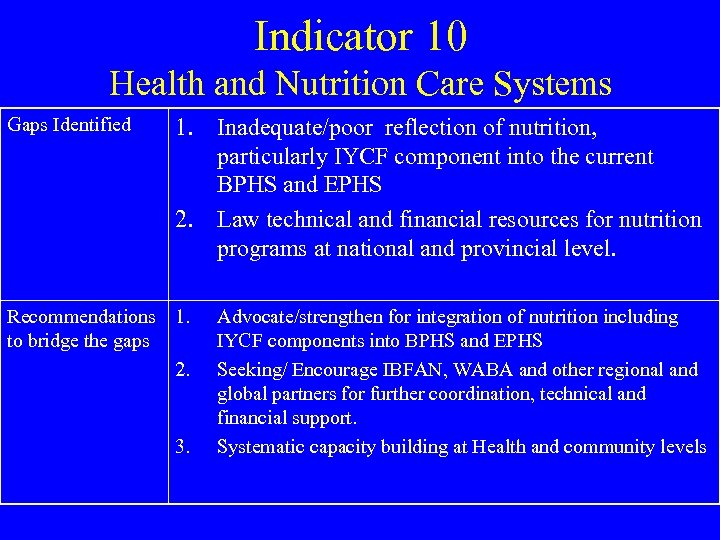
Indicator 10 Health and Nutrition Care Systems Gaps Identified 1. Inadequate/poor reflection of nutrition, particularly IYCF component into the current BPHS and EPHS 2. Law technical and financial resources for nutrition programs at national and provincial level. Recommendations 1. to bridge the gaps 2. 3. Advocate/strengthen for integration of nutrition including IYCF components into BPHS and EPHS Seeking/ Encourage IBFAN, WABA and other regional and global partners for further coordination, technical and financial support. Systematic capacity building at Health and community levels
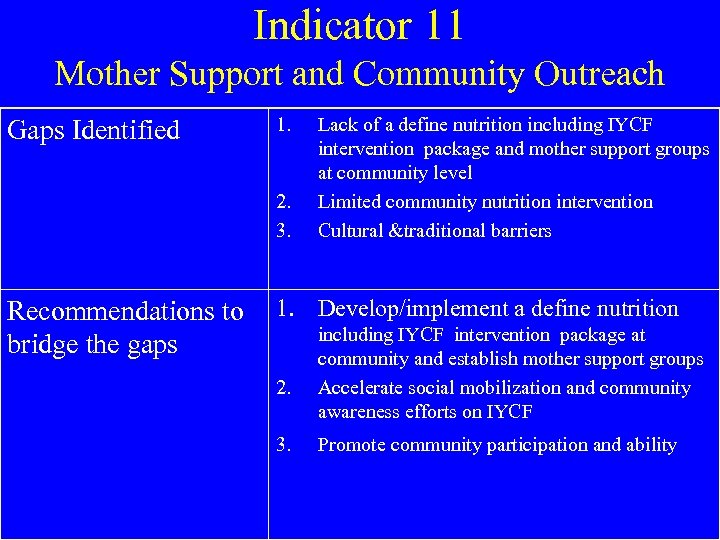
Indicator 11 Mother Support and Community Outreach Gaps Identified 1. 2. 3. Recommendations to bridge the gaps Lack of a define nutrition including IYCF intervention package and mother support groups at community level Limited community nutrition intervention Cultural &traditional barriers 1. Develop/implement a define nutrition 2. 3. including IYCF intervention package at community and establish mother support groups Accelerate social mobilization and community awareness efforts on IYCF Promote community participation and ability
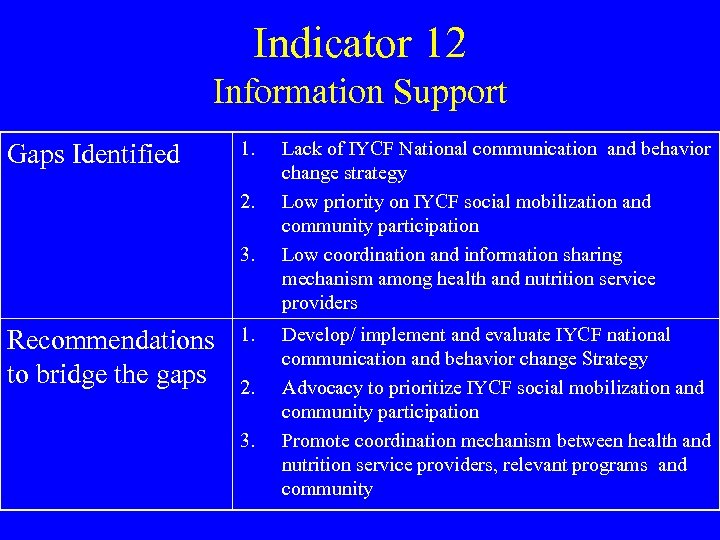
Indicator 12 Information Support Gaps Identified 1. 2. 3. Recommendations to bridge the gaps 1. 2. 3. Lack of IYCF National communication and behavior change strategy Low priority on IYCF social mobilization and community participation Low coordination and information sharing mechanism among health and nutrition service providers Develop/ implement and evaluate IYCF national communication and behavior change Strategy Advocacy to prioritize IYCF social mobilization and community participation Promote coordination mechanism between health and nutrition service providers, relevant programs and community
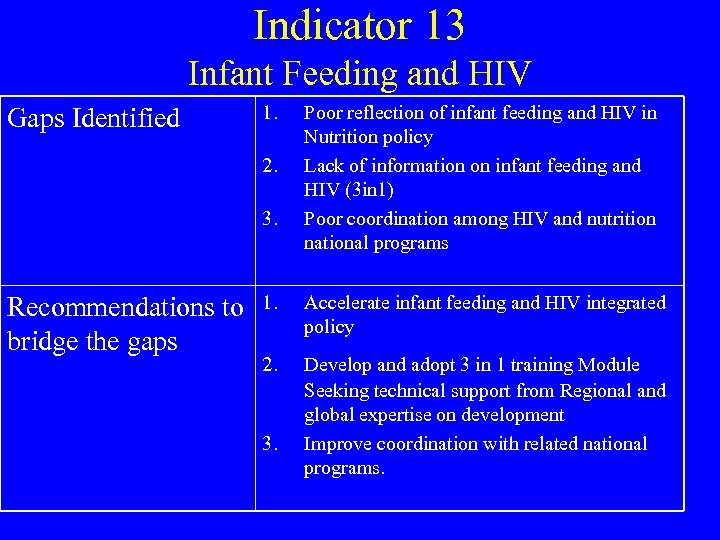
Indicator 13 Infant Feeding and HIV Gaps Identified 1. 2. 3. Recommendations to bridge the gaps Poor reflection of infant feeding and HIV in Nutrition policy Lack of information on infant feeding and HIV (3 in 1) Poor coordination among HIV and nutrition national programs 1. Accelerate infant feeding and HIV integrated policy 2. Develop and adopt 3 in 1 training Module Seeking technical support from Regional and global expertise on development Improve coordination with related national programs. 3.
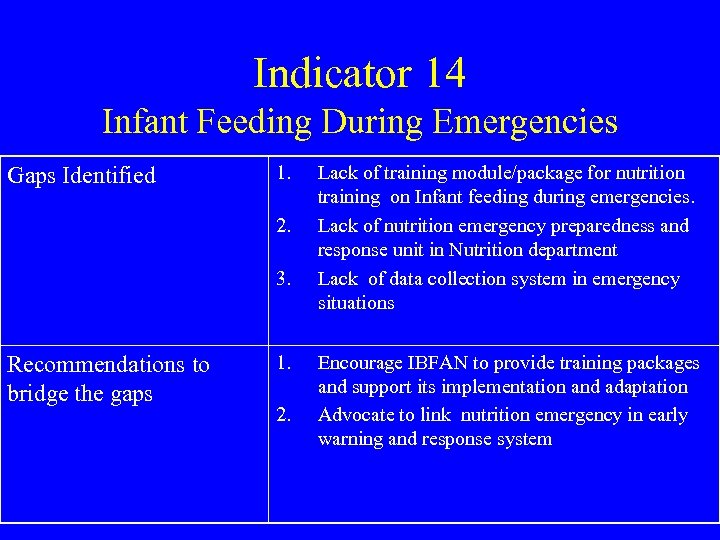
Indicator 14 Infant Feeding During Emergencies Gaps Identified 1. 2. 3. Recommendations to bridge the gaps 1. 2. Lack of training module/package for nutrition training on Infant feeding during emergencies. Lack of nutrition emergency preparedness and response unit in Nutrition department Lack of data collection system in emergency situations Encourage IBFAN to provide training packages and support its implementation and adaptation Advocate to link nutrition emergency in early warning and response system
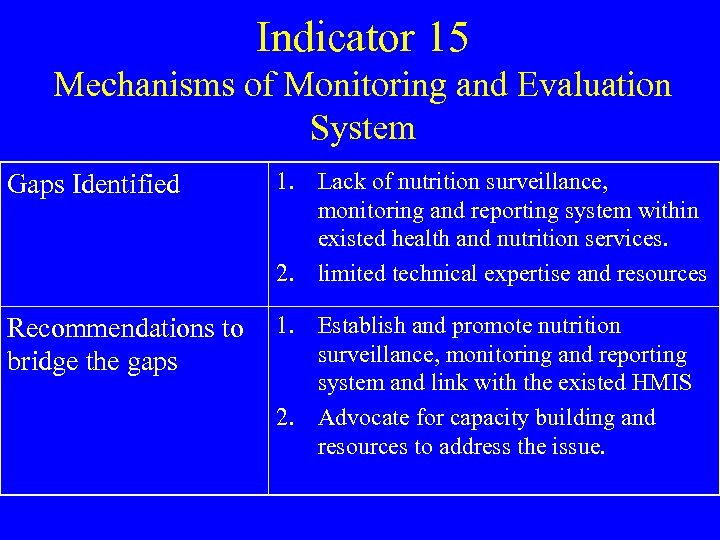
Indicator 15 Mechanisms of Monitoring and Evaluation System Gaps Identified 1. Lack of nutrition surveillance, monitoring and reporting system within existed health and nutrition services. 2. limited technical expertise and resources Recommendations to bridge the gaps 1. Establish and promote nutrition surveillance, monitoring and reporting system and link with the existed HMIS 2. Advocate for capacity building and resources to address the issue.

Thank You
Скачать презентацию World Breastfeeding Trends Initiative WBTi Assessment of the
b2fa05fc64fd1cc199458004562d4c83.ppt