 Скачать презентацию WORLD BIOENERGY CONGRESS AND EXPO 13 th -14
aae2cb2137c3e907da2047247950bdd4.ppt
- Количество слайдов: 21




WORLD BIOENERGY CONGRESS AND EXPO 13 th -14 th June 2016 Bio-Energy Potential for Power Generation: Performance and Emission of Improvised Biodiesel in Microgasturbine Assoc. Prof. Ir. Dr. Kumaran Palanisamy Centre for Renewable Energy Universiti Tenaga Nasional (UNITEN)
Table of Content q. Introduction q. Literature Review q. Research Methodology q. Results and Discussion q. Conclusion q. References q. Q & A
Introduction q Biodiesel or referred as “First Generation Biodiesel” (FGB) that meets ASTM D 6751 or EN 14214 fuel standard is a renewable energy to substitute diesel engine without engine modification. q Biodiesel produced from vegetable oils and animal fats through chemical process known as “Transesterification” and its utilization in diesel engine is well established and has shown comparable performance and emission. q Biodiesel is also can be considered as an alternative fuel for gas turbine application in power generation industry. q However, properties of biodiesel such as viscosity, surface tension and density has been impeding factor for gas turbine application. q Direct switching from fossil diesel to biodiesel in impractical for gas turbine application. q Further improvement is needed on biodiesel properties to meet gas turbine fuel standard requirement in accordance to ASTM D 2880.
What's Stopping Biodiesel for Gas Turbine Ejim , 2006 q Physical properties of biodiesel such as viscosity, surface tension and density higher than fossil diesel q All these properties plays an important role in atomization process which is initial stage in combustion process q High viscosity, surface tension and density will lead to poor atomization and eventually leads to incomplete combustion Allen, 1999 q Sauter Mean Diameter (SMD) of biodiesel varies from 5 to 40% than fossil diesel due to higher viscosity Yung, 2010 q Larger droplets (SMD) will require longer evaporation time and caused inadequate air fuel mixing in combustion chamber eventually effects gas turbine performance and emissions
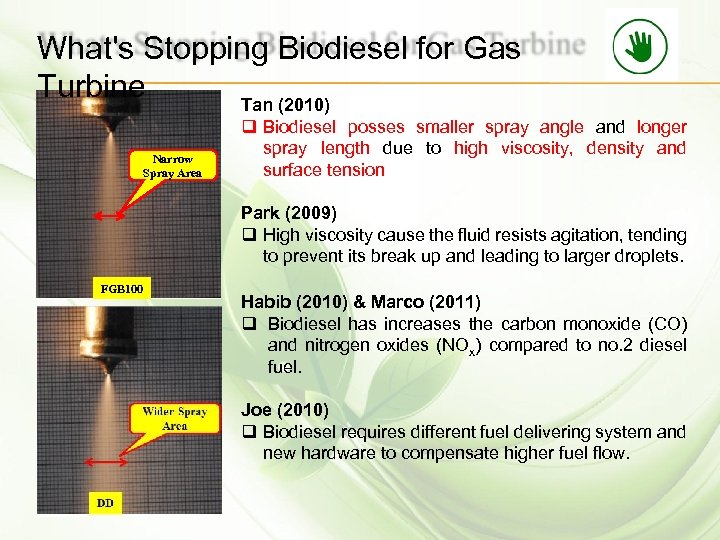
What's Stopping Biodiesel for Gas Turbine Tan (2010) Narrow Spray Area q Biodiesel posses smaller spray angle and longer spray length due to high viscosity, density and surface tension Park (2009) q High viscosity cause the fluid resists agitation, tending to prevent its break up and leading to larger droplets. FGB 100 Habib (2010) & Marco (2011) q Biodiesel has increases the carbon monoxide (CO) and nitrogen oxides (NOx) compared to no. 2 diesel fuel. Joe (2010) q Biodiesel requires different fuel delivering system and new hardware to compensate higher fuel flow.
Proposed Solution for Biodiesel…………… q Instead of modifying the existing hardware or system, the properties of biodiesel have been improved through post treatment process. q The properties of biodiesel are purely influenced by the properties origin source including its fatty acid composition. q Selectively separating the mono alkyl ester according to its fatty acid carbon chain the properties of the biodiesel can be controlled and consistent quality can be obtained. q The properties of improvised biodiesel fuel or called Second Generation Biodiesel (SGB) have been evaluated accordance to ASTM D 2800 gas turbine specification

Objective q The objective of this research is to evaluate the performance and emission of the second generation biodiesel in 30 k. W Capstone micro gas turbine.
Research Methodology Step 1 : Production of FGB q Malaysian waste cooking oils (MWCO) that collected from local restaurants and hotels has been used as raw material to produce FGB. q 5 litre biodiesel processor that available in University Tenaga Nasional at Biodiesel Laboratory has been used to produce FGB. Step 2 : Production of SGB q Production of SGB using post treatment scheme and later sample fuel sent for property evaluation in accordance to ASTM D 2880. Step 3 : Fuel Preparation q Five various blends of fuels prepared according to volumetric ratio FGB 10, FGB 20, SGB 10, SGB 20 and DD. q Upon mixing the blends were heated up 60 °C and stirred vigorously in hot plate stirrer to ensure homogenous mixing.
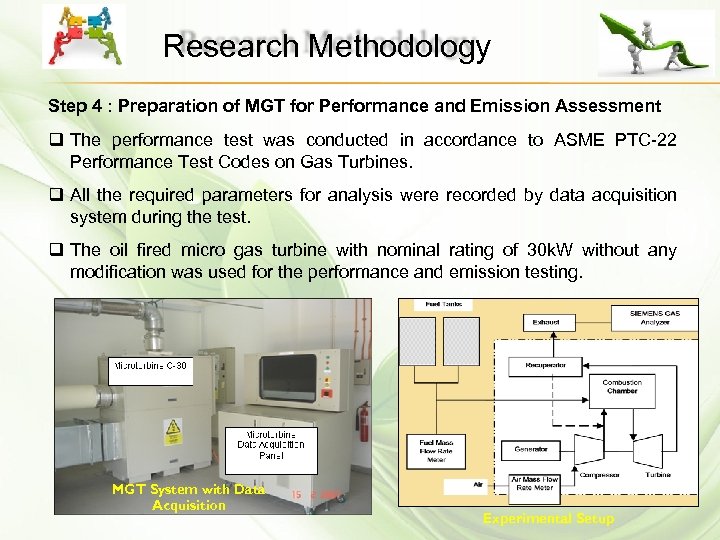
Research Methodology Step 4 : Preparation of MGT for Performance and Emission Assessment q The performance test was conducted in accordance to ASME PTC-22 Performance Test Codes on Gas Turbines. q All the required parameters for analysis were recorded by data acquisition system during the test. q The oil fired micro gas turbine with nominal rating of 30 k. W without any modification was used for the performance and emission testing. MGT System with Data Acquisition Experimental Setup
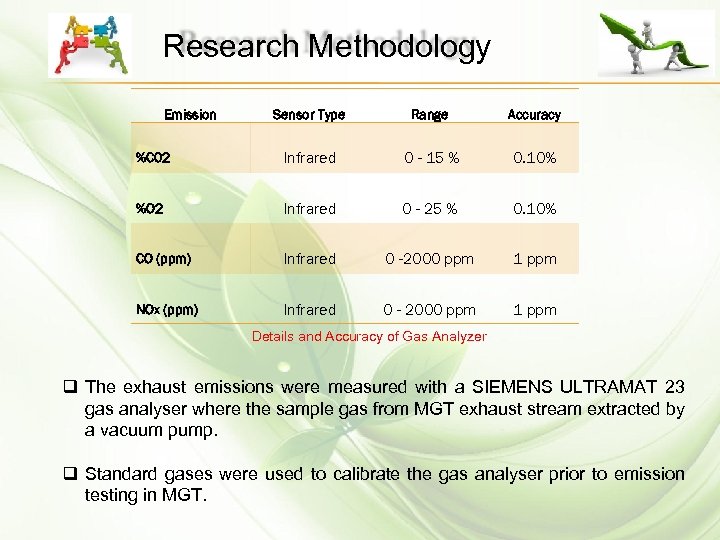
Research Methodology Emission Sensor Type Range Accuracy %C 02 Infrared 0 - 15 % 0. 10% %O 2 Infrared 0 - 25 % 0. 10% CO (ppm) Infrared 0 -2000 ppm 1 ppm NOx (ppm) Infrared 0 - 2000 ppm 1 ppm Details and Accuracy of Gas Analyzer q The exhaust emissions were measured with a SIEMENS ULTRAMAT 23 gas analyser where the sample gas from MGT exhaust stream extracted by a vacuum pump. q Standard gases were used to calibrate the gas analyser prior to emission testing in MGT.
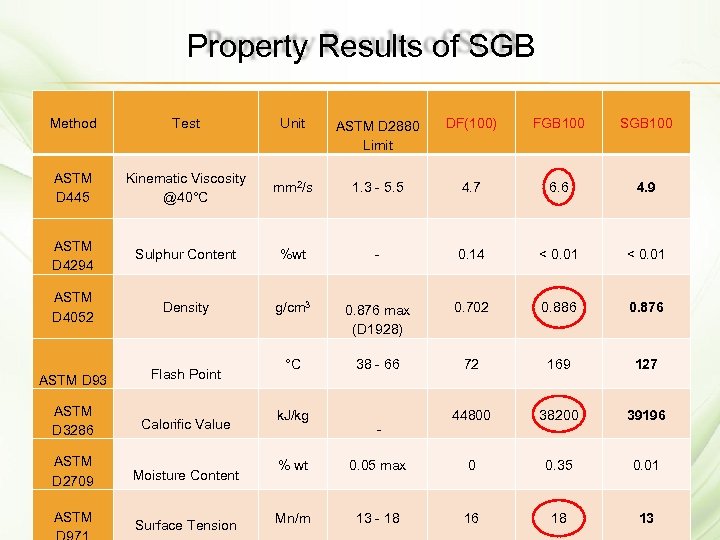
Property Results of SGB Method Test Unit ASTM D 2880 Limit DF(100) FGB 100 SGB 100 ASTM D 445 Kinematic Viscosity @40°C mm 2/s 1. 3 - 5. 5 4. 7 6. 6 4. 9 ASTM D 4294 Sulphur Content %wt - 0. 14 < 0. 01 ASTM D 4052 Density g/cm 3 0. 876 max (D 1928) 0. 702 0. 886 0. 876 ASTM D 93 Flash Point °C 38 - 66 72 169 127 ASTM D 3286 Calorific Value 44800 38200 39196 ASTM D 2709 Moisture Content ASTM Surface Tension k. J/kg - % wt 0. 05 max 0 0. 35 0. 01 Mn/m 13 - 18 16 18 13
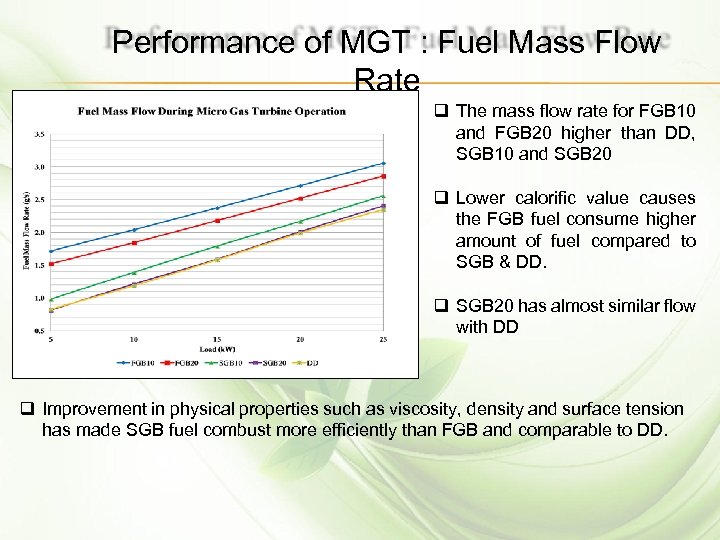
Performance of MGT : Fuel Mass Flow Rate q The mass flow rate for FGB 10 and FGB 20 higher than DD, SGB 10 and SGB 20 q Lower calorific value causes the FGB fuel consume higher amount of fuel compared to SGB & DD. q SGB 20 has almost similar flow with DD q Improvement in physical properties such as viscosity, density and surface tension has made SGB fuel combust more efficiently than FGB and comparable to DD.
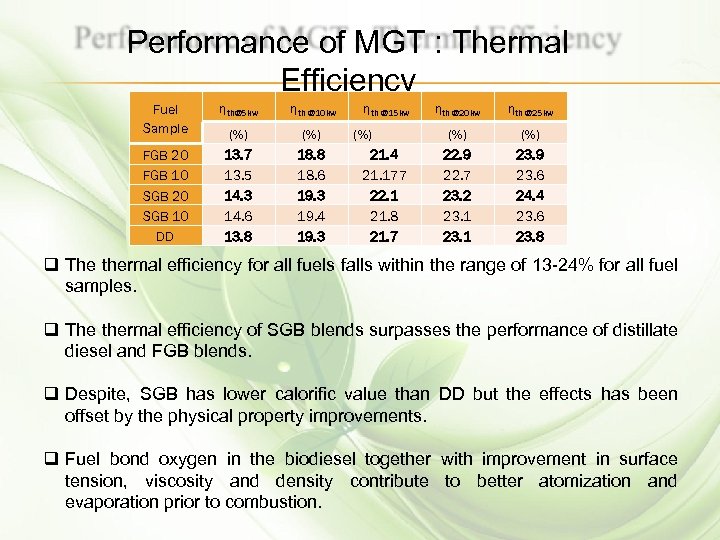
Performance of MGT : Thermal Efficiency Fuel Sample ηth@5 kw ηth @10 kw (%) FGB 20 FGB 10 SGB 20 SGB 10 DD 13. 7 13. 5 14. 3 14. 6 13. 8 18. 6 19. 3 19. 4 19. 3 ηth @15 kw (%) 21. 4 21. 177 22. 1 21. 8 21. 7 ηth @20 kw ηth @25 kw (%) 22. 9 22. 7 23. 2 23. 1 23. 9 23. 6 24. 4 23. 6 23. 8 q The thermal efficiency for all fuels falls within the range of 13 -24% for all fuel samples. q The thermal efficiency of SGB blends surpasses the performance of distillate diesel and FGB blends. q Despite, SGB has lower calorific value than DD but the effects has been offset by the physical property improvements. q Fuel bond oxygen in the biodiesel together with improvement in surface tension, viscosity and density contribute to better atomization and evaporation prior to combustion.
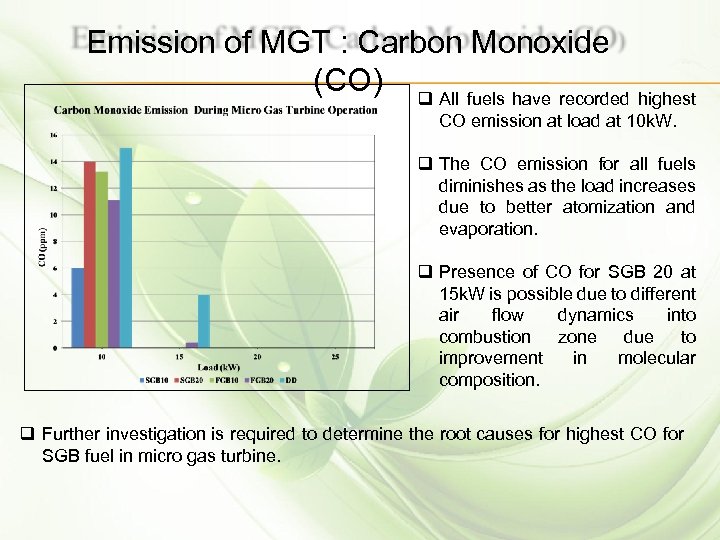
Emission of MGT : Carbon Monoxide (CO) q All fuels have recorded highest CO emission at load at 10 k. W. q The CO emission for all fuels diminishes as the load increases due to better atomization and evaporation. q Presence of CO for SGB 20 at 15 k. W is possible due to different air flow dynamics into combustion zone due to improvement in molecular composition. q Further investigation is required to determine the root causes for highest CO for SGB fuel in micro gas turbine.
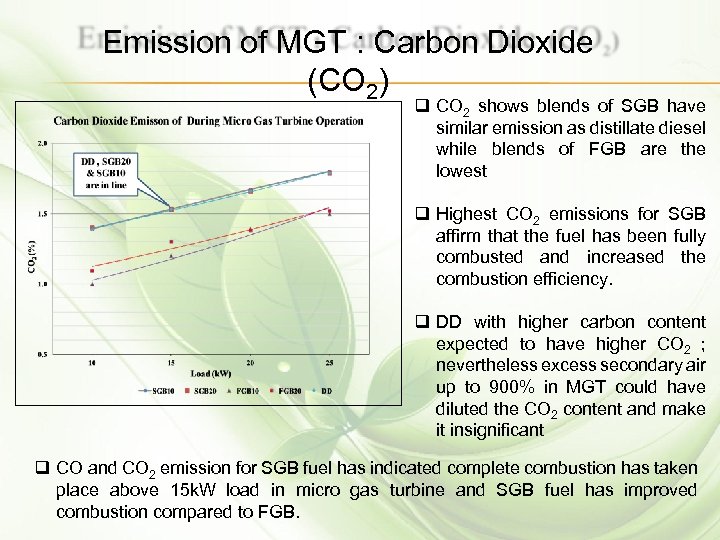
Emission of MGT : Carbon Dioxide (CO 2) q CO 2 shows blends of SGB have similar emission as distillate diesel while blends of FGB are the lowest q Highest CO 2 emissions for SGB affirm that the fuel has been fully combusted and increased the combustion efficiency. q DD with higher carbon content expected to have higher CO 2 ; nevertheless excess secondary air up to 900% in MGT could have diluted the CO 2 content and make it insignificant q CO and CO 2 emission for SGB fuel has indicated complete combustion has taken place above 15 k. W load in micro gas turbine and SGB fuel has improved combustion compared to FGB.
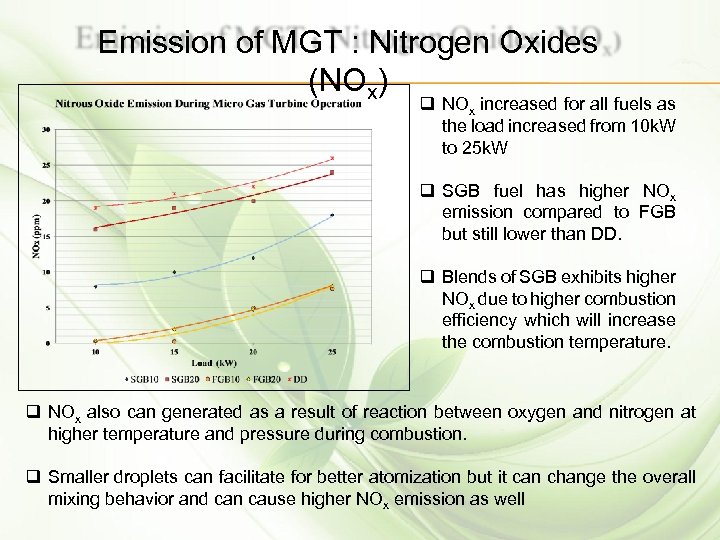
Emission of MGT : Nitrogen Oxides (NOx) q NOx increased for all fuels as the load increased from 10 k. W to 25 k. W q SGB fuel has higher NOx emission compared to FGB but still lower than DD. q Blends of SGB exhibits higher NOx due to higher combustion efficiency which will increase the combustion temperature. q NOx also can generated as a result of reaction between oxygen and nitrogen at higher temperature and pressure during combustion. q Smaller droplets can facilitate for better atomization but it can change the overall mixing behavior and can cause higher NOx emission as well
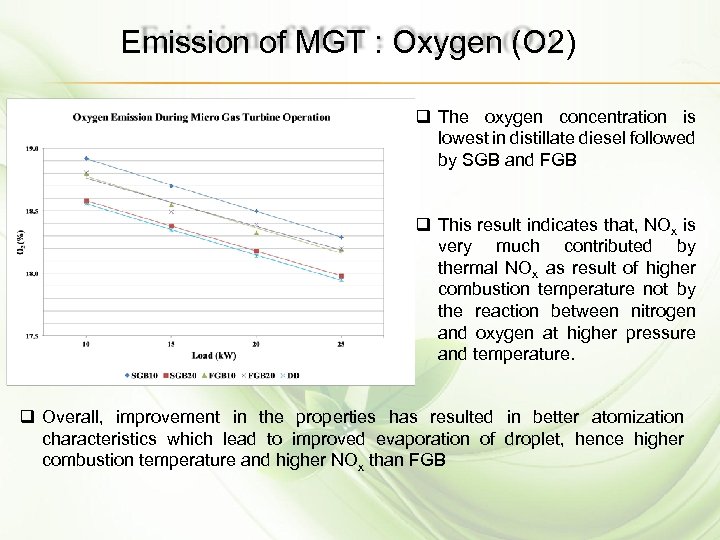
Emission of MGT : Oxygen (O 2) q The oxygen concentration is lowest in distillate diesel followed by SGB and FGB q This result indicates that, NOx is very much contributed by thermal NOx as result of higher combustion temperature not by the reaction between nitrogen and oxygen at higher pressure and temperature. q Overall, improvement in the properties has resulted in better atomization characteristics which lead to improved evaporation of droplet, hence higher combustion temperature and higher NOx than FGB
Conclusion q SGB has reduced fuel consumption compared to FGB during operation in micro gas turbine but still higher than distillate diesel. q SGB fuel has better thermal efficiency compared to FGB and it blends and DD due to better atomization and evaporation characteristic as a result of improved viscosity and surface tension by alteration of carbon chain composition q By increasing the shorter saturated carbon chain composition and decrease in unsaturated compounds have resulted in better thermal conductivity, latent heat of evaporation and lower molecular weight which eventually resulted better thermal efficiency. q The emission of SGB has improved in terms of NOX and CO compared distillate fuel ; however higher than FGB and it blends. q SGB 20 presence as promising blends in micro gas turbine by providing higher thermal efficiency and emissions compared to DD.
References § Bolszo, C. D. , Mc Donell, V. G. , (2009). “Emission Optimization of a Biodiesel Fired Gas Turbine”, Proceeding of the Combustion Institute, vol. 32, pp. 2949 -2956. § Ejim, C. E. , Fleck, B. A. , Amir fazli, A. , (2007). “Analytical study for atomization of biodiesel and their blends in a typical injector Surface Tension and viscosity effects”, Fuel, vol. 86, pp. 1534 -44. § Gopinathan, M. , “ Development of a post treatment scheme to produce improved biodiesel fuel for gas turbine application”, Postgraduate Research Thesis, Submitted to College of Graduate Studies, pp. 116 – 132, University Tenaga Nasional, UNITEN 2014. § Gupta, K. K. , Rehman, A. , Saviya, R. M. , (2010). “Bio-Fuels for the Gas Turbine: A Review”, Renewable and Sustainable Energy Reviews, vol. 14, pp. 2946 -2955. § Habib, Z. , Parthasarathy, R. , Gollahalli, S. , (2010). “Performance and Emission Characteristics of Biofuel in a Small Scale Gas Turbine Engine”, Applied Energy, vol. 87, pp. 1701 -1709. § Joe, F. S. , Rachel, T. F. , and James, K. D. (2010). “Liquid biofuels in the aeroderivative gas turbine. Texas USA”. § Krishna. C. R, 2007. Brookhaven National Laboratory, Upton. NY “Performance of the Capstone C 30 microturbine on biodiesel blends”. BNL-77927 -2007 -IR. § Kumaran, P. , Gopinathan, M. and Kantharrajan, S. (2014). “Combustion Characteristics of Improved Biodiesel in Diffusion Burner”. Int. J. Automot. Mech. Eng. , 10, pp. 2112 -2121. § Nacimento, M. A. R. D. & Santos, E. C. D. , (2011). “Biofuel and Gas Turbine Engines”, Federal University of Itajuba- Brazil, Available: www. intechopen. com”. § Rehman, A. , Phalke, D. R. , Pandey, R. , (2011), “Alternative Fuel for Gas Turbine: Esterified Jatropha Oilediesel Blend”. Renewable Energy, 36, 2635 -2640.
References § Tan, E. S, (2008). “Performance and emission study of waste cooking oil biodiesel and distillate blends in microturbine application”, Postgraduate Research Thesis, Submitted to College of Graduate Studies, pp. 94 -145, University Tenaga Nasional, UNITEN 2008. § Zabihian F. , Fung, A. S. , Chiang H. D. , (2010), “Performance Analysis of Micro Gas Turbine Fueled by Blends of Biodiesel and Petroleum-Based Diesel” ASME Early Career Technical Journal 2010, ASME Early Career Technical Conference, ASME ECTC, October 1 – 2, Atlanta, Georgia USA

Thank You Q&A A vote of thanks to TNB and TNB Research, for funding this research and Participation of undergraduate students of University Tenaga Nasional
Скачать презентацию WORLD BIOENERGY CONGRESS AND EXPO 13 th -14
aae2cb2137c3e907da2047247950bdd4.ppt