 Скачать презентацию World Bank Training Program on HIV AIDS Drugs Training
a9ab6bab5c5d385a0f5822ae955c5c32.ppt
- Количество слайдов: 82



World Bank Training Program on HIV/AIDS Drugs Training Module 4 Quality Assurance Ben K Botwe April 2005 1
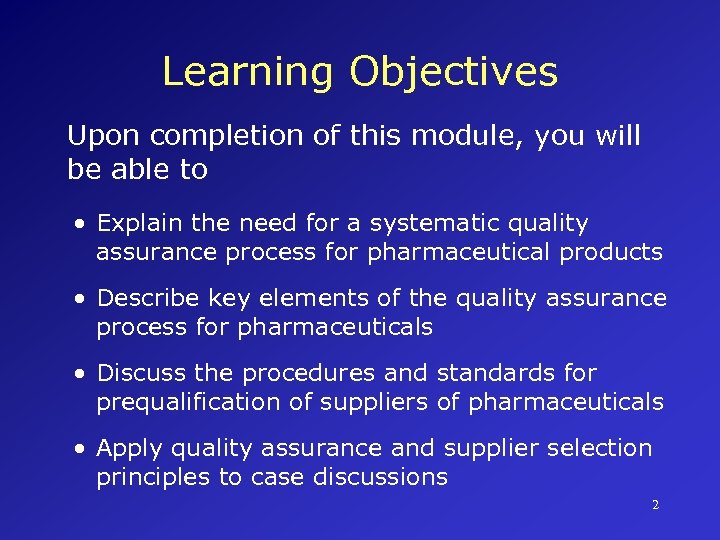
Learning Objectives Upon completion of this module, you will be able to • Explain the need for a systematic quality assurance process for pharmaceutical products • Describe key elements of the quality assurance process for pharmaceuticals • Discuss the procedures and standards for prequalification of suppliers of pharmaceuticals • Apply quality assurance and supplier selection principles to case discussions 2
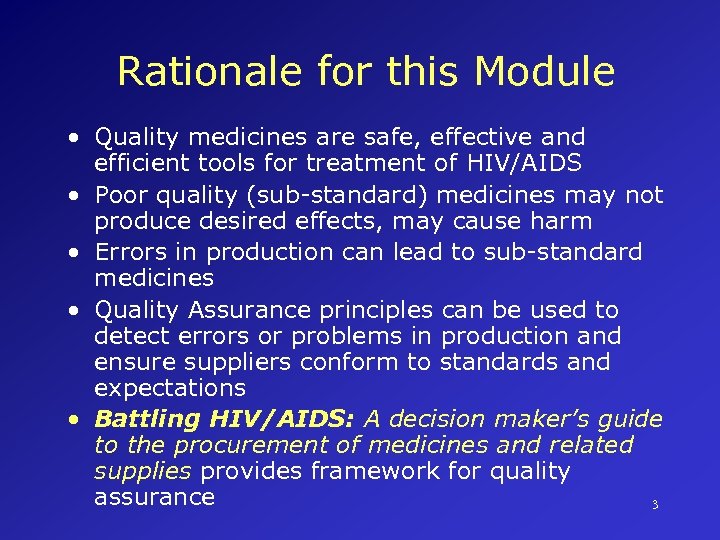
Rationale for this Module • Quality medicines are safe, effective and efficient tools for treatment of HIV/AIDS • Poor quality (sub-standard) medicines may not produce desired effects, may cause harm • Errors in production can lead to sub-standard medicines • Quality Assurance principles can be used to detect errors or problems in production and ensure suppliers conform to standards and expectations • Battling HIV/AIDS: A decision maker’s guide to the procurement of medicines and related supplies provides framework for quality assurance 3
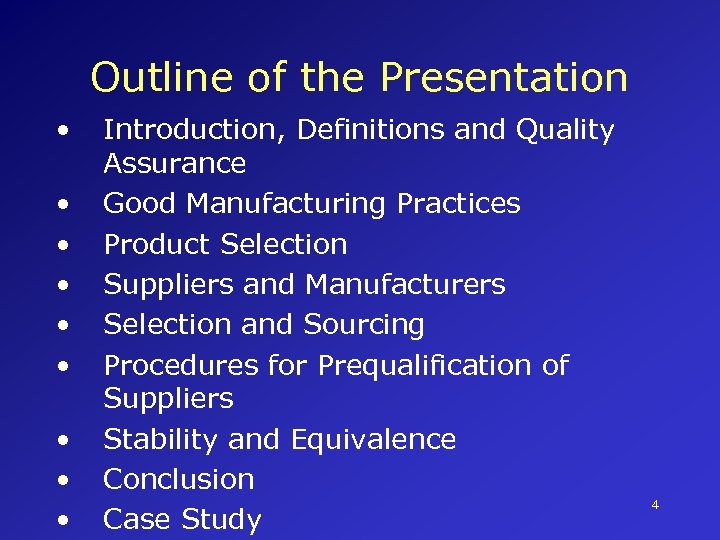
Outline of the Presentation • • • Introduction, Definitions and Quality Assurance Good Manufacturing Practices Product Selection Suppliers and Manufacturers Selection and Sourcing Procedures for Prequalification of Suppliers Stability and Equivalence Conclusion Case Study 4
Quality Assurance • A process, not an end-point • Must be independent of financial pressures • Must ensure that quality policies are followed • Must have final authority in product acceptance, rejection and release to public • Integral to production, not an add-on • Responsible for day-to-day operations and for longer term goal settings • Quantitative discipline with specified parameters 5
DEFINITIONS • QUALITY • The totality of features and characteristics of a medicinal product and its ability to satisfy stated and/or implied needs • QUALITY ASSURANCE • The sum total of the organized arrangements made with the object of ensuring that medicinal products are of the quality required for their intended 6 use.
DEFINITIONS • GOOD MANUFACTURING PRACTICE (GMP) • That part of QA which ensures that products are consistently produced and controlled to the quality standards appropriate to their intended use. • QUALITY CONTROL • That part of GMP which is concerned with sampling, specifications and testing. 7
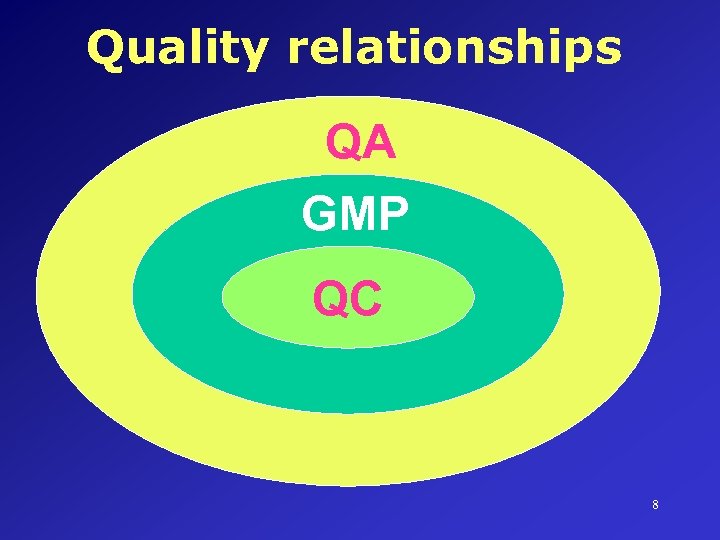
Quality relationships QA GMP QC 8
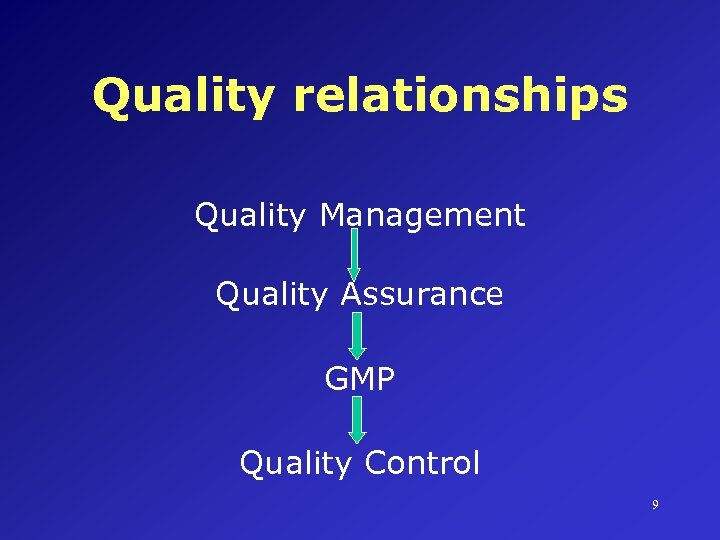
Quality relationships Quality Management Quality Assurance GMP Quality Control 9
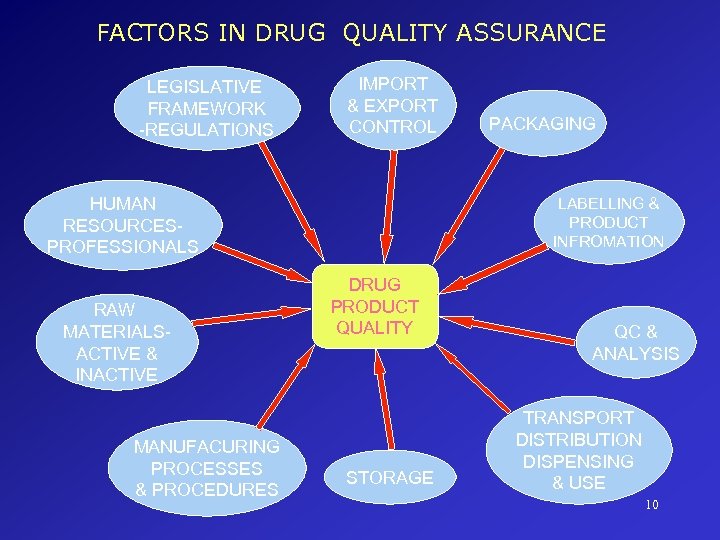
FACTORS IN DRUG QUALITY ASSURANCE LEGISLATIVE FRAMEWORK -REGULATIONS IMPORT & EXPORT CONTROL HUMAN RESOURCESPROFESSIONALS RAW MATERIALSACTIVE & INACTIVE MANUFACURING PROCESSES & PROCEDURES PACKAGING LABELLING & PRODUCT INFROMATION DRUG PRODUCT QUALITY STORAGE QC & ANALYSIS TRANSPORT DISTRIBUTION DISPENSING & USE 10
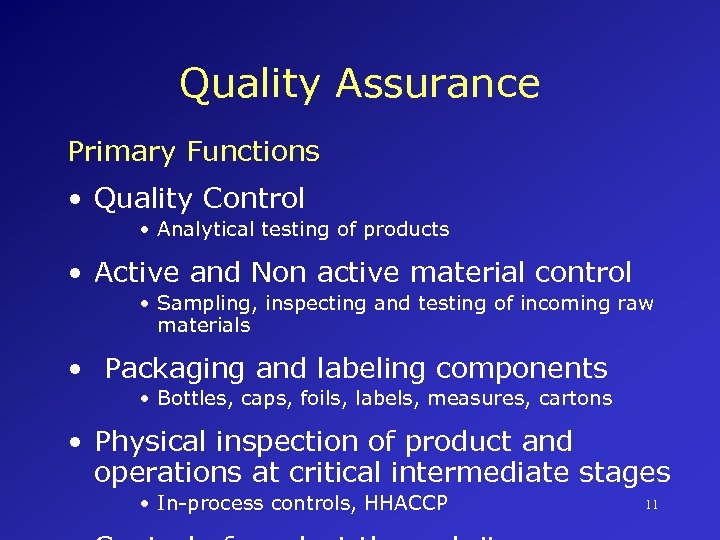
Quality Assurance Primary Functions • Quality Control • Analytical testing of products • Active and Non active material control • Sampling, inspecting and testing of incoming raw materials • Packaging and labeling components • Bottles, caps, foils, labels, measures, cartons • Physical inspection of product and operations at critical intermediate stages • In-process controls, HHACCP 11
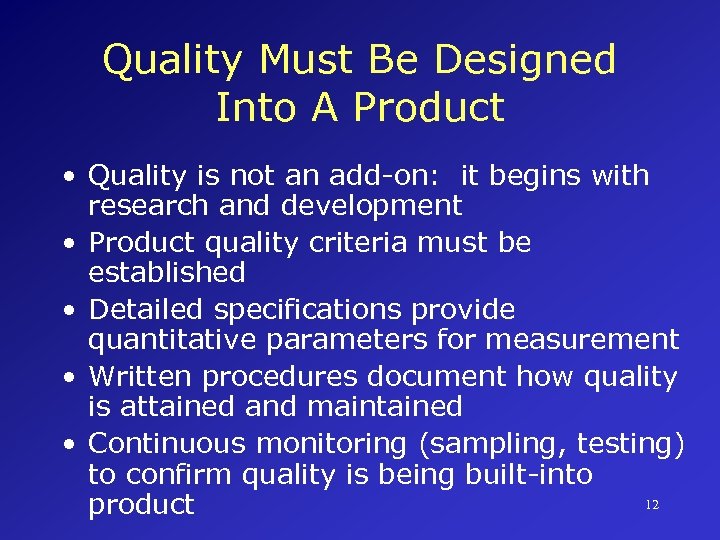
Quality Must Be Designed Into A Product • Quality is not an add-on: it begins with research and development • Product quality criteria must be established • Detailed specifications provide quantitative parameters for measurement • Written procedures document how quality is attained and maintained • Continuous monitoring (sampling, testing) to confirm quality is being built-into 12 product
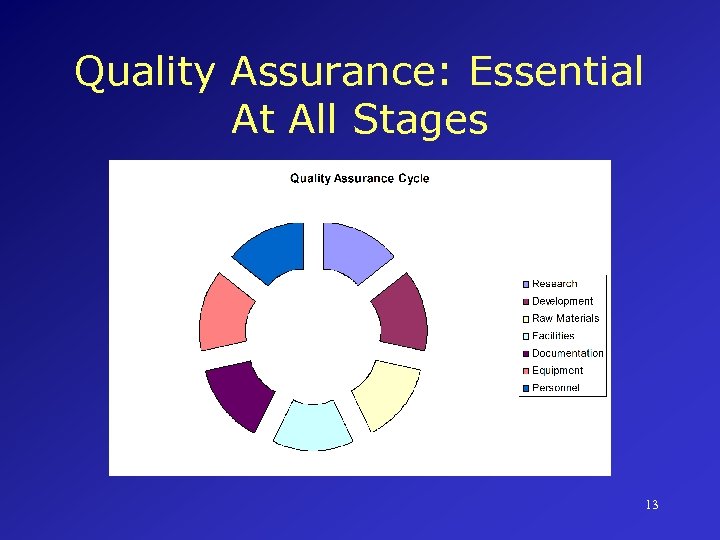
Quality Assurance: Essential At All Stages 13
Elements of the Quality Assurance Cycle in Pharmaceutical Manufacturing • • • Research Development Prototyping Documentation Raw Materials Facilities Equipment Personnel and Supervision Monitoring, Feedback, Follow-up 14
Analytical Control Laboratory Heart of Quality Management in Pharmaceuticals • Academically trained and certified staff • Experienced supervision/management • Capable of performing complex analyses • Able to report honestly and in a timely manner • Equipment and instrumentation must be suitable for performing testing • Access to reliable power, water and other stable infrastructure 15
Quality Control & Analysis • Qualification • Design, Installation, Process and Operational • Calibration • Daily and periodic • Validation • Equipment, Method and process • SOPs • Authorized, used and updated • Documentation • Systematic and well kept • Quality Manual • Quality manager, staff trained and motivated to comply. • Safety measures 16
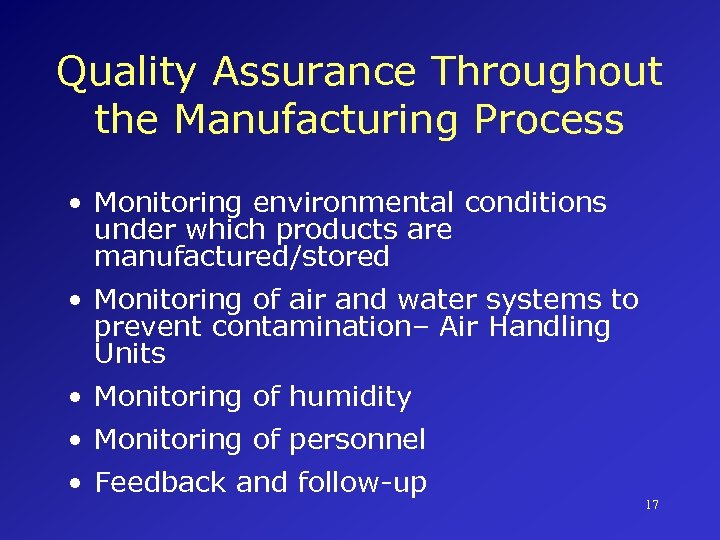
Quality Assurance Throughout the Manufacturing Process • Monitoring environmental conditions under which products are manufactured/stored • Monitoring of air and water systems to prevent contamination– Air Handling Units • Monitoring of humidity • Monitoring of personnel • Feedback and follow-up 17
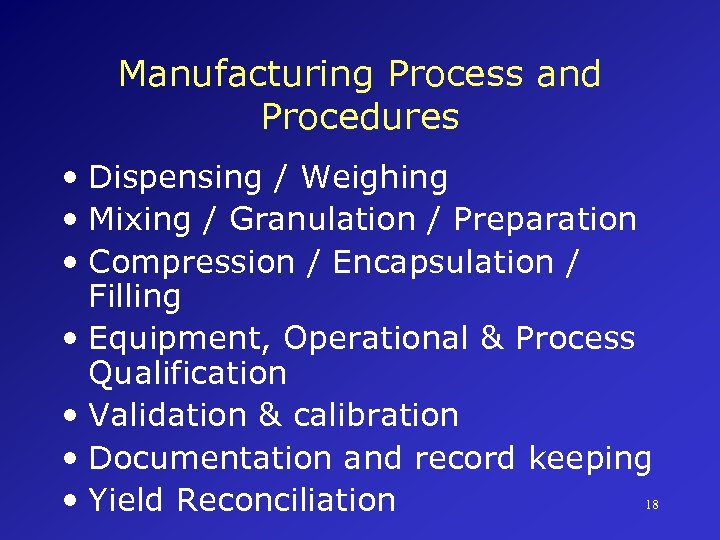
Manufacturing Process and Procedures • Dispensing / Weighing • Mixing / Granulation / Preparation • Compression / Encapsulation / Filling • Equipment, Operational & Process Qualification • Validation & calibration • Documentation and record keeping 18 • Yield Reconciliation
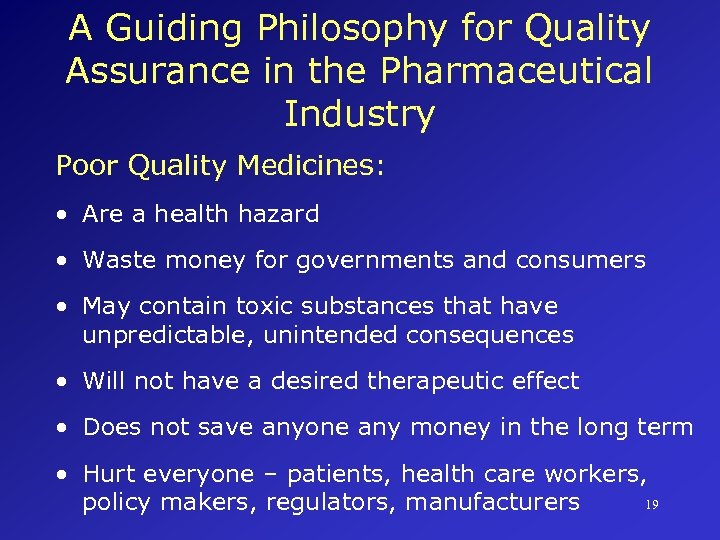
A Guiding Philosophy for Quality Assurance in the Pharmaceutical Industry Poor Quality Medicines: • Are a health hazard • Waste money for governments and consumers • May contain toxic substances that have unpredictable, unintended consequences • Will not have a desired therapeutic effect • Does not save anyone any money in the long term • Hurt everyone – patients, health care workers, 19 policy makers, regulators, manufacturers
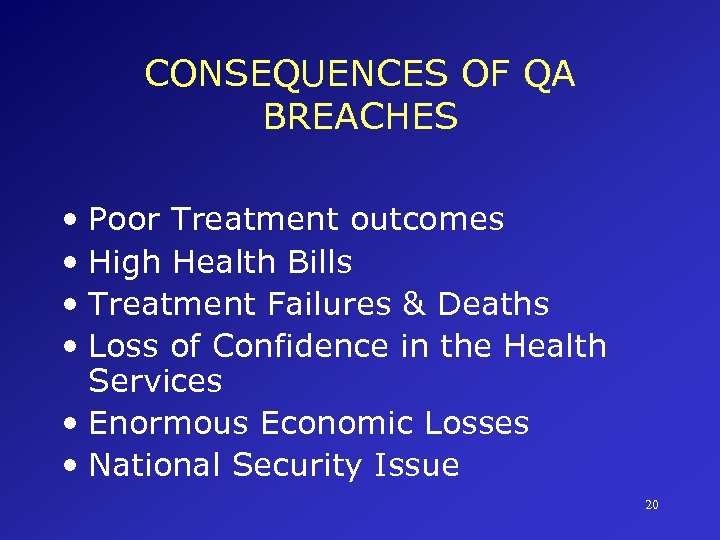
CONSEQUENCES OF QA BREACHES • Poor Treatment outcomes • High Health Bills • Treatment Failures & Deaths • Loss of Confidence in the Health Services • Enormous Economic Losses • National Security Issue 20
What is GMP? (WHO) • Comprehensive system for ensuring products are consistently produced and controlled according to quality standards • Designed to minimize risks involved in any pharmaceutical production that cannot be eliminated through testing of final product alone • Cross-contamination 21
Major Risks in Pharmaceutical Production • Contamination of products (microbial, particulate or other) • Incorrect labels on containers • Insufficient active ingredient • Excess active ingredient • Poor quality raw materials • Poor formulation practices 22
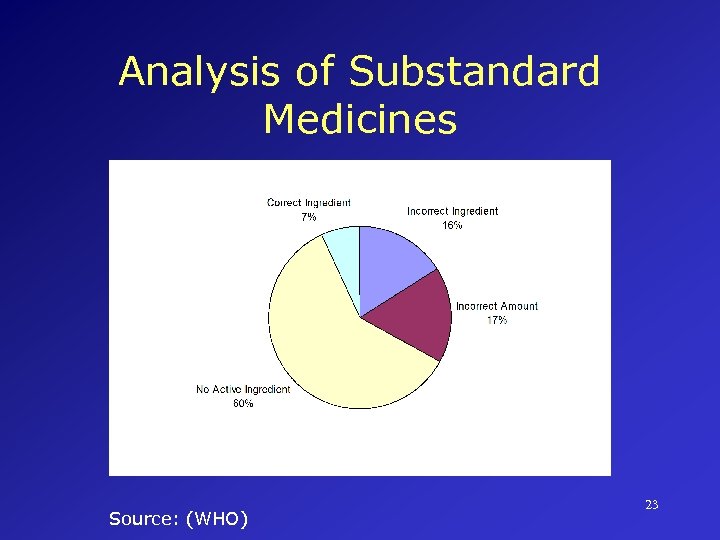
Analysis of Substandard Medicines Source: (WHO) 23
The Breadth of GMP Covers all aspects of production including • Raw or starting materials • Finished products • Premises and environment • Equipment • personnel • Training • Hygiene 24
GMP Principles • Must be built into manufacturing process • Prevents errors that cannot be eliminated through quality control of finished product • Ensures all units of a medicine are of the same (within specified parameters) quality • Poor medicines leads to loss of credibility for everyone: manufacturers, health care workers and governments • WHO Guidelines for GMP 25
WHO Technical Guide to GMP • First prepared in 1967 • Updated and revised regularly • “Quality Management in the Drug Industry” outlines general concepts and principle components of GMP • “Good practices in production and quality control” describes implementation 26
WHO Technical Guide to GMP General Consideration “Licensed pharmaceutical products should be manufactured only by licensed manufacturers whose activities are regularly inspected by competent national authorities” 27
WHO Technical Guide to GMP Key Concepts • Validation Action of proving (in accordance with principles of GMP) that any procedure, process, equipment, material, activity, or system actually leads to expected results 28
WHO Technical Guide to GMP Key Concepts • Qualification Action of proving that any premises, system, and items of equipment work correctly and actually lead to expected results 29
Associated Concepts • • • Good Laboratory Practice (GLP) Good Clinical Practice (GCP) Clear language use Effective record keeping Design, installation, operational and process qualification (DQ, IQ, OQ and PQ) • Self-inspection and self-regulation • Good Distribution Practice (GDP) 30
Key Elements of GMP (WHO Technical Guide) • Sanitation and hygiene • Qualification and validation • Complaints • Product recalls • Contract Production and Analysis • Self-Inspection and Quality Audits 31
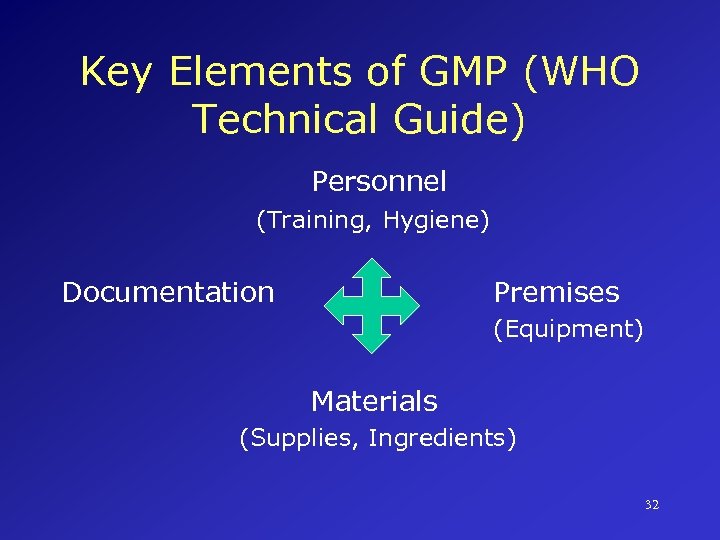
Key Elements of GMP (WHO Technical Guide) Personnel (Training, Hygiene) Documentation Premises (Equipment) Materials (Supplies, Ingredients) 32
Product Selection Issues • Unique nature of medicines heightens need for effective quality assurance • All medicines used must be safe, effective, and of consistent quality • Failure to select proper products will lead to treatment failure, drug resistance, wasted resources and human suffering 33
Product Selection Issues (Cont. ) Selection of product and goal of treatment may vary depending upon patient group • Infected adults • Infected women (who may be/may become pregnant) • Infected children (blood-borne or sexual transmission) • Emergency workers • Victims of sexual assault 34
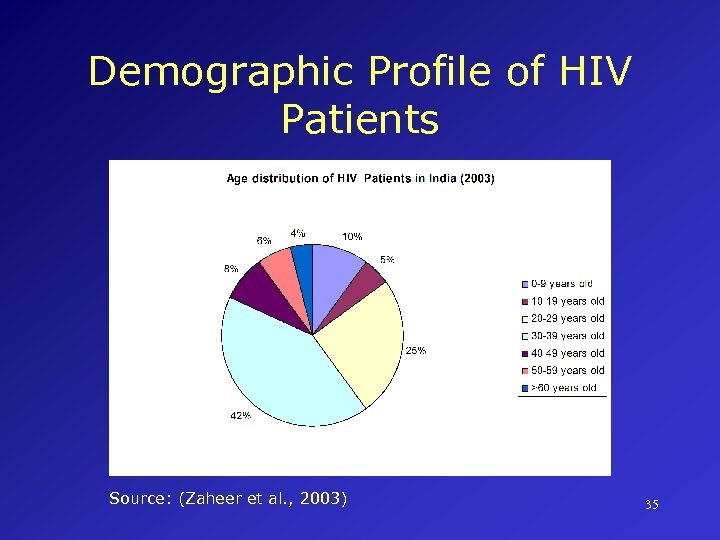
Demographic Profile of HIV Patients Source: (Zaheer et al. , 2003) 35
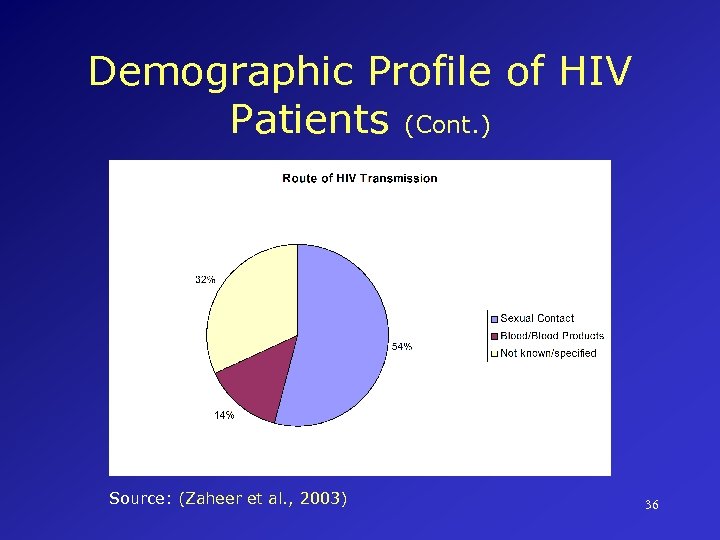
Demographic Profile of HIV Patients (Cont. ) Source: (Zaheer et al. , 2003) 36
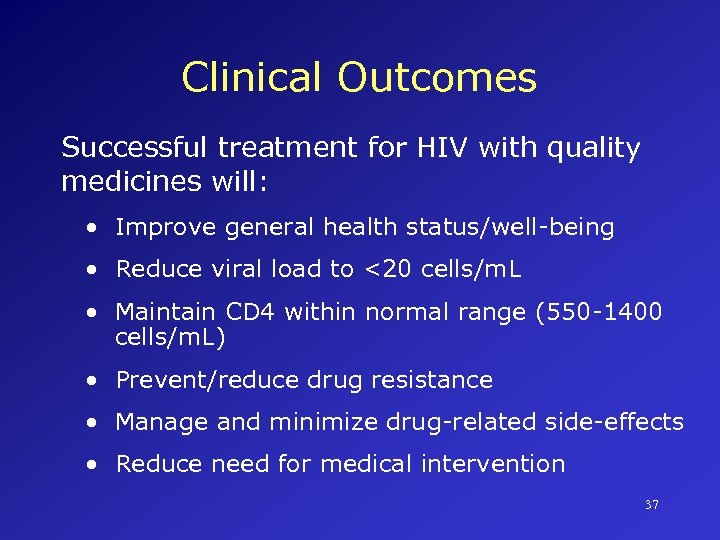
Clinical Outcomes Successful treatment for HIV with quality medicines will: • Improve general health status/well-being • Reduce viral load to <20 cells/m. L • Maintain CD 4 within normal range (550 -1400 cells/m. L) • Prevent/reduce drug resistance • Manage and minimize drug-related side-effects • Reduce need for medical intervention 37
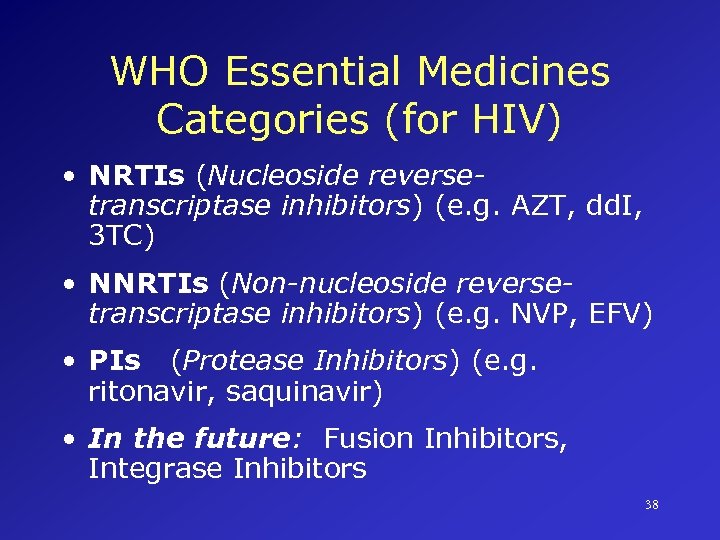
WHO Essential Medicines Categories (for HIV) • NRTIs (Nucleoside reversetranscriptase inhibitors) (e. g. AZT, dd. I, 3 TC) • NNRTIs (Non-nucleoside reversetranscriptase inhibitors) (e. g. NVP, EFV) • PIs (Protease Inhibitors) (e. g. ritonavir, saquinavir) • In the future: Fusion Inhibitors, Integrase Inhibitors 38
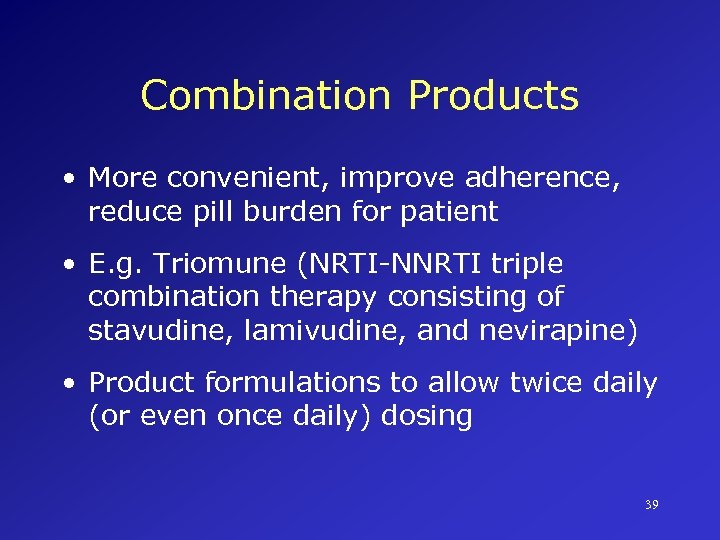
Combination Products • More convenient, improve adherence, reduce pill burden for patient • E. g. Triomune (NRTI-NNRTI triple combination therapy consisting of stavudine, lamivudine, and nevirapine) • Product formulations to allow twice daily (or even once daily) dosing 39
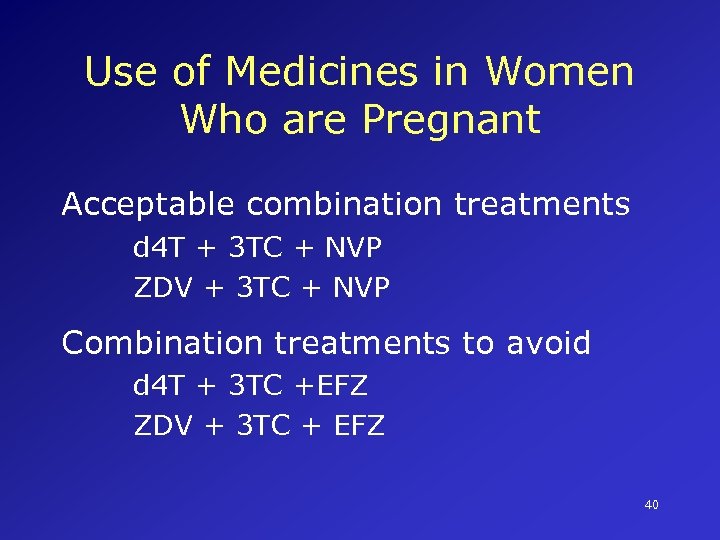
Use of Medicines in Women Who are Pregnant Acceptable combination treatments d 4 T + 3 TC + NVP ZDV + 3 TC + NVP Combination treatments to avoid d 4 T + 3 TC +EFZ ZDV + 3 TC + EFZ 40
Suppliers/Manufacturers “Many reliable manufacturers, both innovator and generic companies, can offer quality products…the aim…is sustained, consistent and acceptable quality rather than high or better quality, terms that are impossible to quantify” Battling HIV/AIDS, World Bank 2004 41
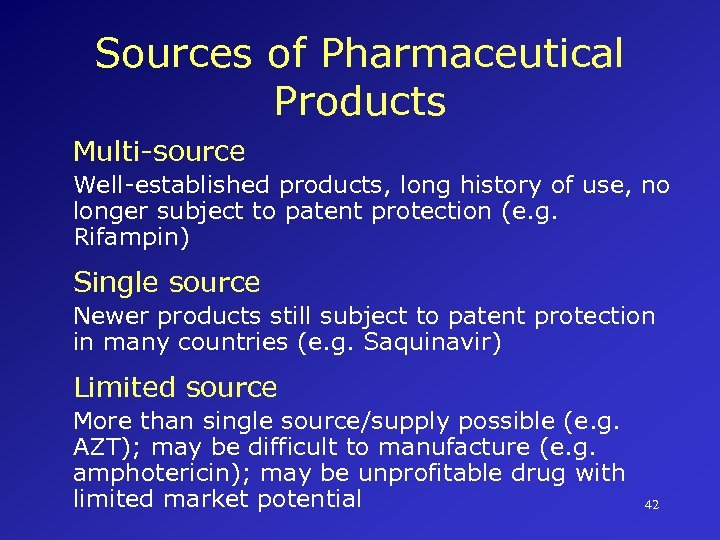
Sources of Pharmaceutical Products Multi-source Well-established products, long history of use, no longer subject to patent protection (e. g. Rifampin) Single source Newer products still subject to patent protection in many countries (e. g. Saquinavir) Limited source More than single source/supply possible (e. g. AZT); may be difficult to manufacture (e. g. amphotericin); may be unprofitable drug with limited market potential 42
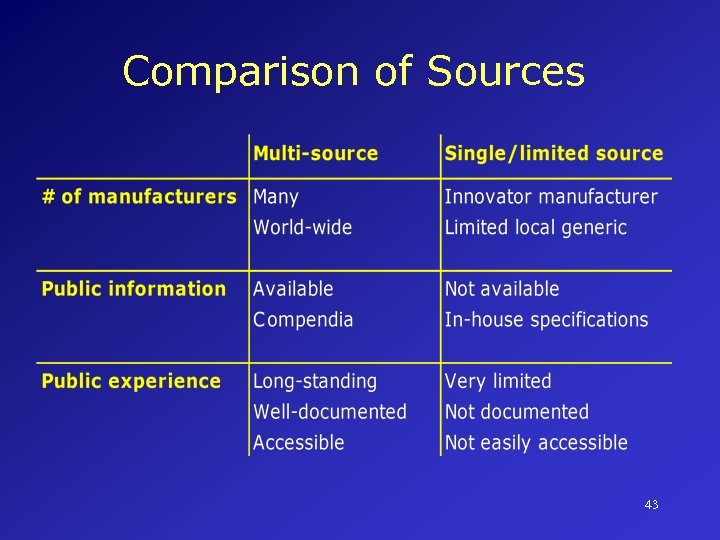
Comparison of Sources 43
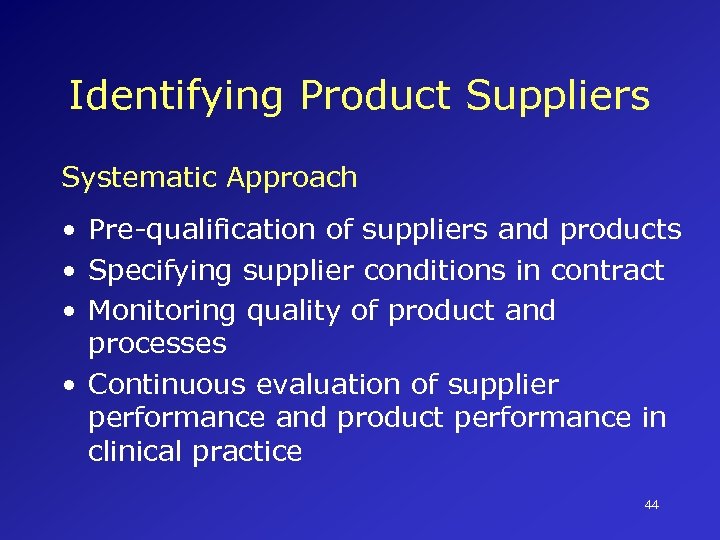
Identifying Product Suppliers Systematic Approach • Pre-qualification of suppliers and products • Specifying supplier conditions in contract • Monitoring quality of product and processes • Continuous evaluation of supplier performance and product performance in clinical practice 44
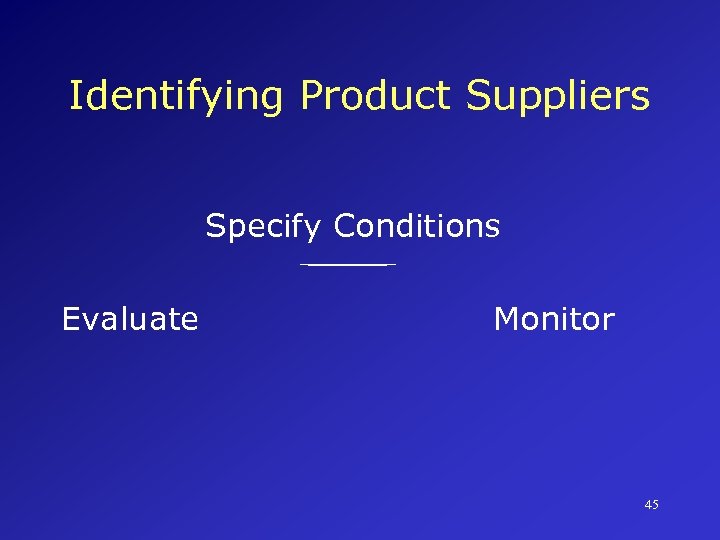
Identifying Product Suppliers Specify Conditions Evaluate Monitor 45
Selecting and Sourcing Multi. Source Products • Innovator vs. generic issues • Prequalification systems • Specific issues related to interchangeability of products stability, bioavailability, bioequivalence, etc. 46
Selecting and Sourcing Multi. Source Products • Innovator vs. generic issues • Prequalification systems • Specific issues related to interchangeability of products stability, bioavailability, bioequivalence, etc. 47
Procedures for Prequalification of Suppliers Rationale More meaningful, effective, efficient and less expensive to eliminate sub-standard manufacturers and products at the opening of bidding/tendering than during the process Purpose To ensure that products are manufactured in compliance with GMP and products meet established quality standards 48
Procedures for Prequalification of Manufacturers • Local Procurement Committee comprising managerial, technical, and professional staff • Manufacturers submit dossiers for review; must be reviewed/re-inspected every 3 -5 years to ensure adherence to policies • Review/re-inspection also performed if product changes occur that may impact on safety, efficacy, quality, manufacturing method, or location of manufacturing 49
Procedures for Prequalification of Manufacturers (Cont. ) • Evaluation of Product Dossier • Random testing of samples • Verification of compliance with GMP • Verification of compliance with good distribution practices • Role of national drug regulatory organizations (in compliance with WHO standards) 50
Prequalification: Evaluation of Product Dossier • • - Specifications in WHO guidelines Must include details regarding: Regulatory status Pharmaceutically active ingredient(s) Manufacturing processes Finished product specifications (stability, bioavailability, interchangeability etc. ) - Packaging/labeling/storage details - Product/patient information 51
Prequalification: Evaluation of Product Dossier- Multi-source Products • For products manufactured and registered in countries with a stringent regulatory authority, the product dossier presented may be the same as that presented to the regulatory authority • Appropriate documentation/certification provided if product differs in any way from product registered in original country (e. g. packaging, formulation, 52 strength, manufacturing site, etc. )
Prequalification: Evaluation of Product Dossier- Single/Limited Source Products • Include specifications of in-house quality-control and quality management practices in sufficient detail to allow replication by another laboratory • Validation of in-house methods must be provided by manufacturer • Quality assessment of products to be undertaken by external laboratory 53
Prequalification: Random Testing of Samples • Undertaken to verify compliance with standards and references provided in dossier • Test samples should be from supplies, not from pre-supply batches • On-going random sampling and quality control analysis post-supply 54
Prequalification Verifications Compliance with GMP • Inspections and certification of facilities or reliance on national regulatory authorities Compliance with good distribution practices • Quality assurance methods for selection of raw material suppliers, storage of products, transportation delivery of final product, etc. 55
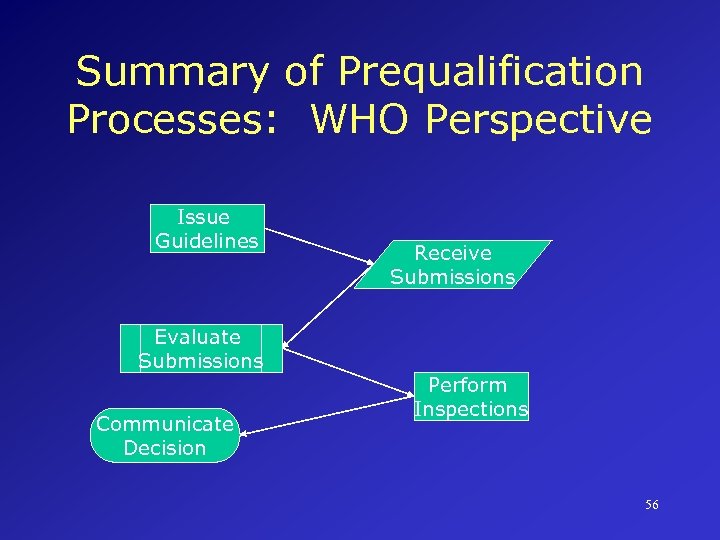
Summary of Prequalification Processes: WHO Perspective Issue Guidelines Evaluate Submissions Communicate Decision Receive Submissions Perform Inspections 56
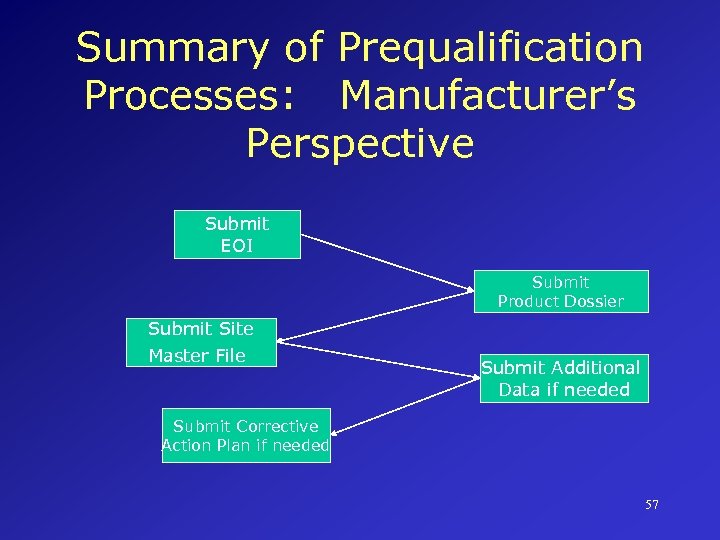
Summary of Prequalification Processes: Manufacturer’s Perspective Submit EOI Submit Product Dossier Submit Site Master File Submit Additional Data if needed Submit Corrective Action Plan if needed 57
Options for Prequalification WHO Prequalification Regional Prequalification International Low-cost Suppliers Development of international consolidated prequalification system 58
Pharmaceutical Stability • GMP state there must be a written testing program designed to assess stability characteristics of drugs. Results of stability testing are used to determine appropriate storage conditions and expiration dating 59
Stability Definitions (1) • Capability of a particular formulation of a pharmaceutical in a specified container/closure system to remain within specified physical, chemical, microbiological, therapeutic and toxicological specifications 60
Stability Definitions (2) • The time from the date of manufacture and packaging of the formulation until its chemical or biological activity is not less than a predetermined level (generally, 90%) of labeled potency and its physical characteristics have not changed appreciably 61
Stability Issues Time-related harmful events include a) Deterioration of therapeutic activity below specified threshold b) Potentiation of therapeutic activity above specified threshold c) Appearance of toxic substance forming as a degradation by-product 62
Factors Affecting Stability of a Pharmaceutical Product • Stability of active ingredient • Interaction between active/inactive ingredients • Manufacturing process • Dosage formulation • Container/Liner/Closure System • Environment during storage, handling • Length of time between manufacturing and usage 63
Evaluation of Therapeutic Equivalence of Generic Products Basic Assumption Drug quality is a function of consistent and optimal release, dissolution, and absorption of active ingredient from a dosage form: this impacts upon chemical equivalence, lot-to-lot uniformity in manufacturing, stability, etc. 64
Bioavailability Measurement of both the rate of drug absorption and total amount (extent) of drug that reaches the general systemic circulation from an administered dosage form 65
Equivalence More general, relative term indicating a comparison of one drug with another along a set of established standards/criteria • Bio-equivalence • Clinical equivalence • Therapeutic equivalence • Pharmaceutical equivalence 66
Therapeutic Equivalence Two different brands of a drug product are expected to yield the same clinical result For therapeutic equivalence • Pharmaceutical, chemical and bioequivalence must be demonstrated • Product must be appropriately labeled • Product must be manufactured in compliance with GMP 67
Factors Affecting Equivalences • Properties of the Drug • Properties of the Dosage Form • Properties of Inactive Ingredients (e. g. binders, fillers, disintegrants, lubricants) 68
Bio-Equivalence • Indicates that a drug in two or more similar dosage forms reaches the general circulation at the same relative rate and the same relative extent • Does not necessarily demonstrate clinical or therapeutic equivalence (but does not necessarily rule it out either!) 69
Evaluation of Equivalence • Products frequently tested in small samples, not whole populations • Individual variations may emerge • Must adhere to GMP • Appropriate and accurate labeling (e. g. generic or brand-name product) 70
Conclusions GMP as a quality management system • Ensure appropriate infrastructure encompassing organizational structure, procedures, processes, and resources • Ensure systematic actions necessary to provide adequate confidence that product will meet quality standards and expectations 71
Conclusions Good Manufacturing Practices are • Pivotal to quality assurance • Everyone’s responsibility (manufacturers, purchasers, distributors, consumers) • Clear, transparent, documented, readily observable • On-going, consistent, reproducible 72
Conclusions • GMP are aimed at reducing risks inherent in pharmaceutical production • Qualification and validation provides confidence in manufacturers’ processes • Prequalification provides greatest assurance regarding quality of pharmaceutical products, based on GMP and product dossier 73
Case Study In your small groups, review the case study which you have already read. As a group, identify critical issues raised by this case study. Use the guided discovery questions to prompt discussion. 74

Case Discussion Question How should the government of Fatakia prioritize elements of Good Manufacturing Practices, given the unique situation it faces in procurement, storage, and distribution of antiretrovirals? What if Fatakia does not have the capacity to pre-qualify suppliers? 75
Case Discussion Question Given the unique factors of the drug distribution system in Fatakia, what particular issues related to stability must be considered? How can the drug distribution be modified to optimize pharmaceutical stability? 76
Case Discussion Question In evaluating claims and documents made by different manufacturers of the same drug, what principles must be weighed to ensure optimal health outcomes? How would you advise the government of Fatakia to develop an evaluation scheme for multiple, competing providers of the same medicine? 77
Case Study Summary Key Issues • Health System Infrastructure (e. g. laboratory testing facilities, medics, etc. ) • Drug Distribution System (e. g. transport/storage logistics, deterioration in quality of products, drug diversion issues) • Financial Pressures (e. g. use of generic products) 78
Case Study Summary Prequalification of suppliers In accordance with GMP • Provision of dossier • Random testing of samples (not presupply) • Changes/variances must be qualified/validated • Demonstrated on-going commitment to standards • Options in case there is insufficient 79 capacity to pre-qualify suppliers
Case Study Summary WHO Certification Scheme on the Quality of Pharmaceutical Products Moving In International Commerce • Manufacturing authorizations • Marketing authorizations 80
Case Study Summary Equivalency Decisions • Linked directly to GMP • Additional burden of proof based on pharmacopeial/compendial standards • Differentiate bio-equivalence, therapeutic equivalence, and clinical equivalence 81
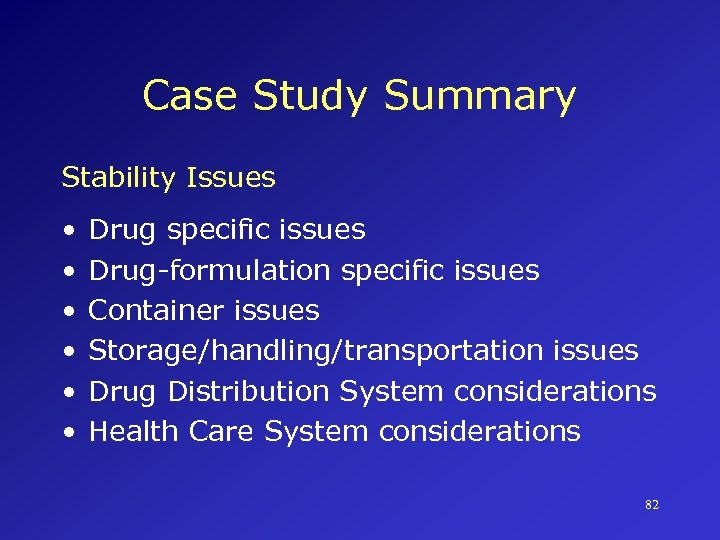
Case Study Summary Stability Issues • • • Drug specific issues Drug-formulation specific issues Container issues Storage/handling/transportation issues Drug Distribution System considerations Health Care System considerations 82
Скачать презентацию World Bank Training Program on HIV AIDS Drugs Training
a9ab6bab5c5d385a0f5822ae955c5c32.ppt