 Скачать презентацию World Bank Procurement Training 1 International Agreements
5a9a0e7b4503ef8f12b132842db987d5.ppt
- Количество слайдов: 56



World Bank Procurement Training 1

International Agreements Institutions LEGAL Background ECONOMY HISTORY Political situation Procurement Legal Framework World Bank Procurement Training 2
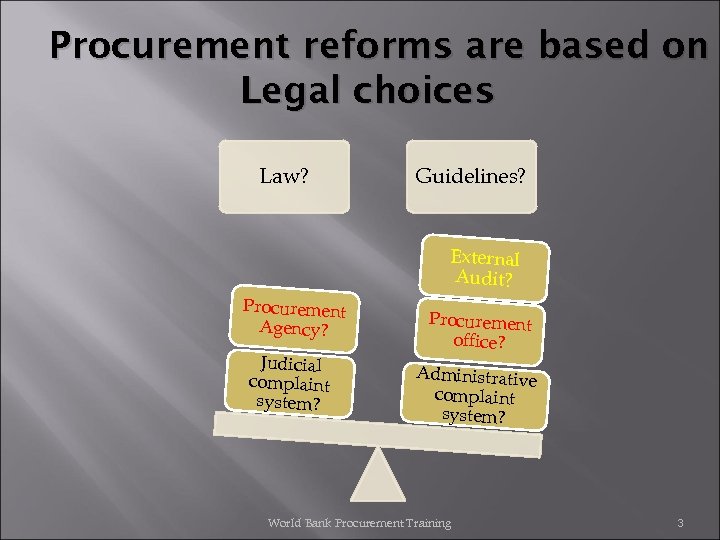
Procurement reforms are based on Legal choices Law? Guidelines? External Audit? Procurement Agency? Judicial complaint system? Procurement office? Administrative complaint system? World Bank Procurement Training 3
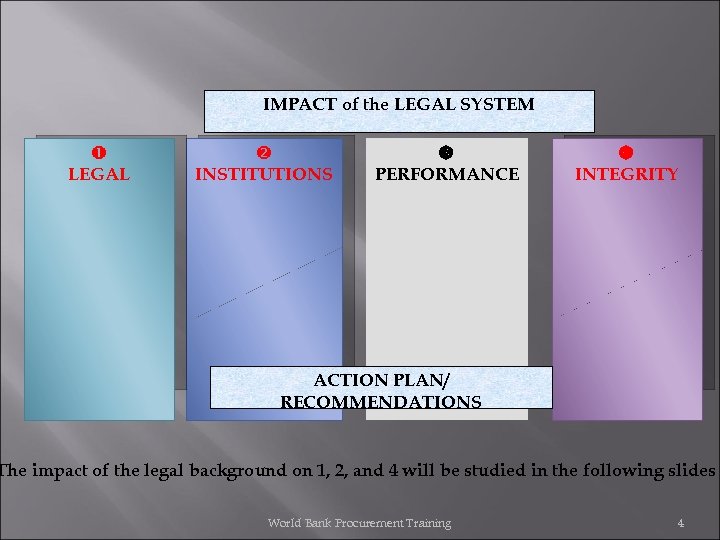
IMPACT of the LEGAL SYSTEM LEGAL INSTITUTIONS PERFORMANCE INTEGRITY ACTION PLAN/ RECOMMENDATIONS The impact of the legal background on 1, 2, and 4 will be studied in the following slides World Bank Procurement Training 4
warning This presentation aims at clarifying the legal context of the countries for a pedagogical purpose. It does not and it can not reflect all the variations and particularities that are the product of each country’s history. For simplicity, the expression “civil law” system will be used in the following slides even if it is not actually endorsed by many countries which prefer to call it the “romano-germanic” system. World Bank Procurement Training 5
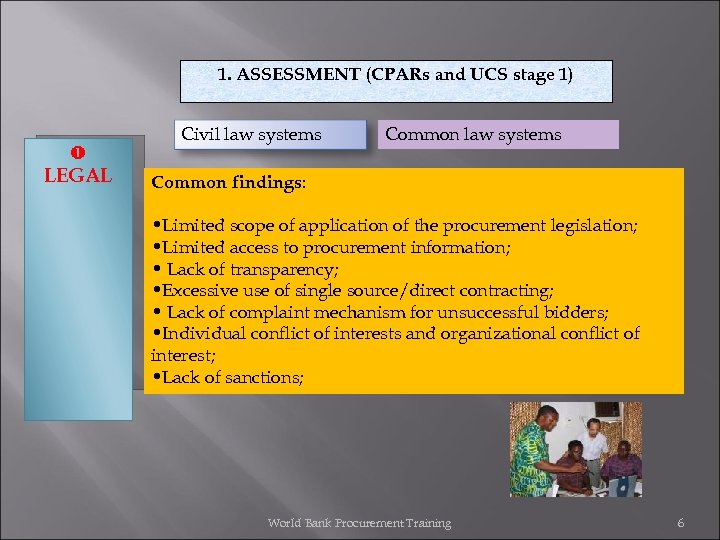
1. ASSESSMENT (CPARs and UCS stage 1) LEGAL Civil law systems Common findings: • Limited scope of application of the procurement legislation; • Limited access to procurement information; • Lack of transparency; • Excessive use of single source/direct contracting; • Lack of complaint mechanism for unsuccessful bidders; • Individual conflict of interests and organizational conflict of interest; • Lack of sanctions; World Bank Procurement Training 6
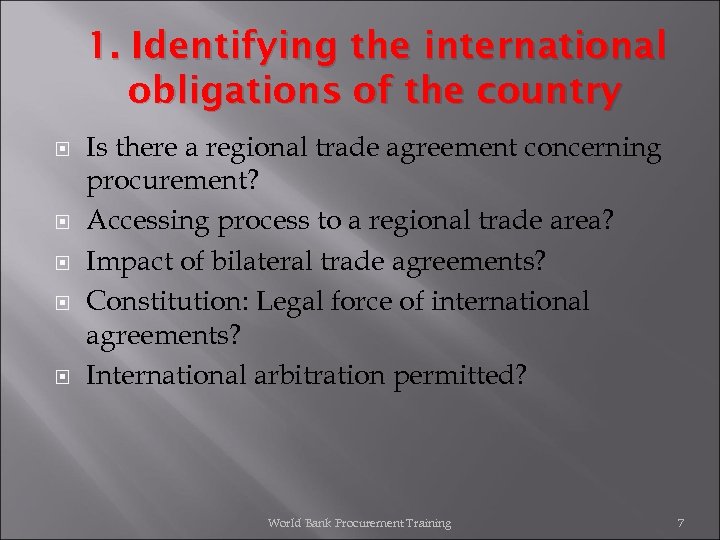
1. Identifying the international obligations of the country Is there a regional trade agreement concerning procurement? Accessing process to a regional trade area? Impact of bilateral trade agreements? Constitution: Legal force of international agreements? International arbitration permitted? World Bank Procurement Training 7
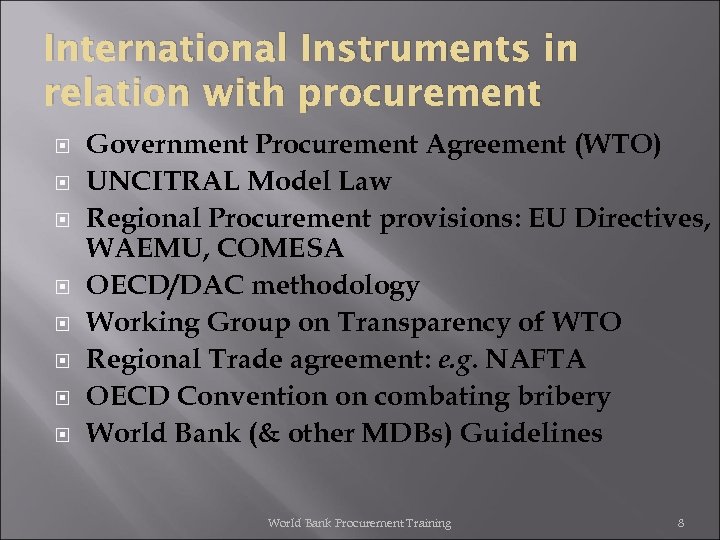
International Instruments in relation with procurement Government Procurement Agreement (WTO) UNCITRAL Model Law Regional Procurement provisions: EU Directives, WAEMU, COMESA OECD/DAC methodology Working Group on Transparency of WTO Regional Trade agreement: e. g. NAFTA OECD Convention on combating bribery World Bank (& other MDBs) Guidelines World Bank Procurement Training 8
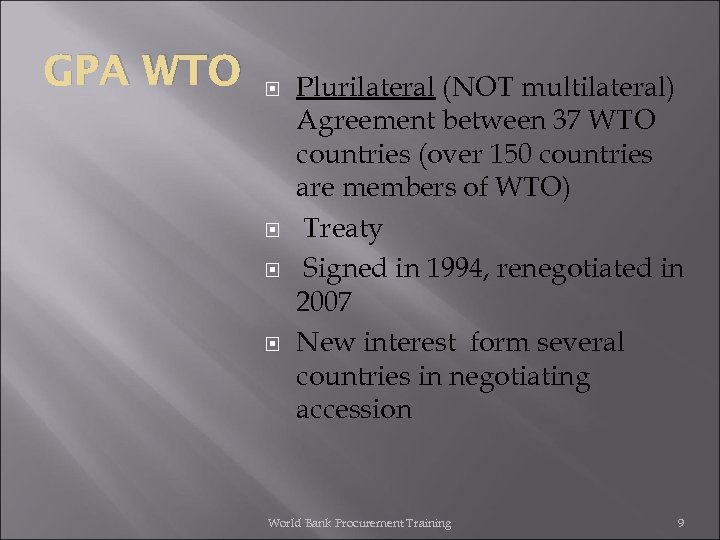
GPA WTO Plurilateral (NOT multilateral) Agreement between 37 WTO countries (over 150 countries are members of WTO) Treaty Signed in 1994, renegotiated in 2007 New interest form several countries in negotiating accession World Bank Procurement Training 9
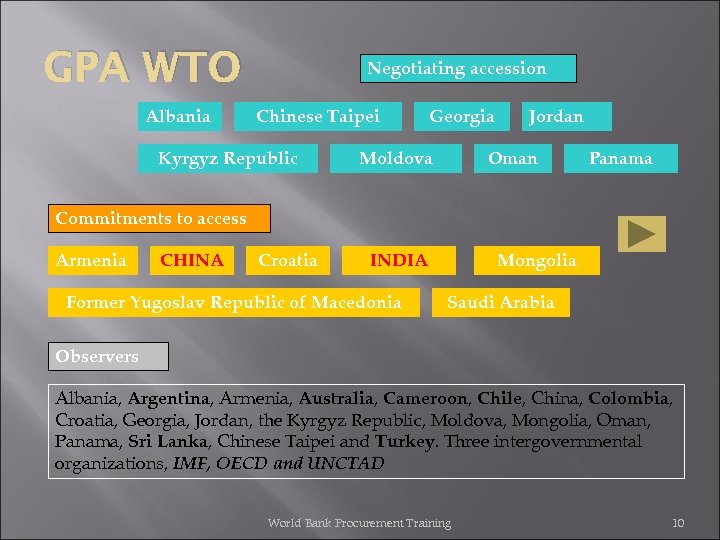
GPA WTO Albania Negotiating accession Chinese Taipei Kyrgyz Republic Georgia Moldova Jordan Oman Panama Commitments to access Armenia CHINA Croatia INDIA Former Yugoslav Republic of Macedonia Mongolia Saudi Arabia Observers Albania, Argentina, Armenia, Australia, Cameroon, Chile, China, Colombia, Croatia, Georgia, Jordan, the Kyrgyz Republic, Moldova, Mongolia, Oman, Panama, Sri Lanka, Chinese Taipei and Turkey. Three intergovernmental organizations, IMF, OECD and UNCTAD World Bank Procurement Training 10
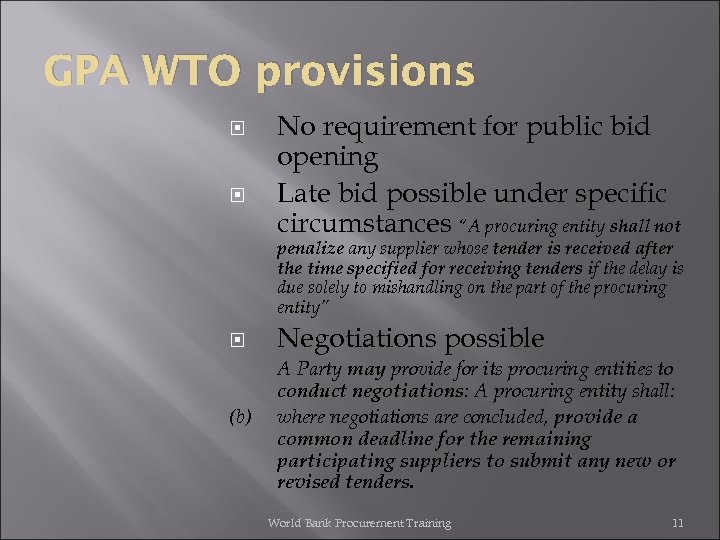
GPA WTO provisions No requirement for public bid opening Late bid possible under specific circumstances “A procuring entity shall not penalize any supplier whose tender is received after the time specified for receiving tenders if the delay is due solely to mishandling on the part of the procuring entity” Negotiations possible (b) A Party may provide for its procuring entities to conduct negotiations: A procuring entity shall: where negotiations are concluded, provide a common deadline for the remaining participating suppliers to submit any new or revised tenders. World Bank Procurement Training 11
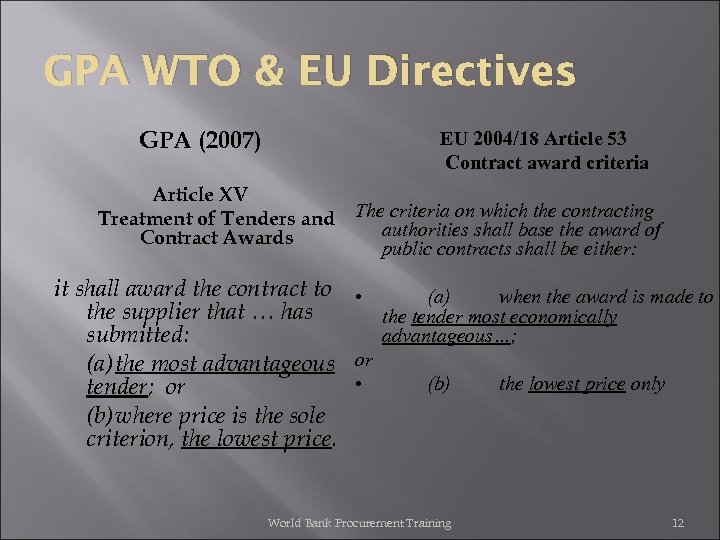
GPA WTO & EU Directives GPA (2007) EU 2004/18 Article 53 Contract award criteria Article XV Treatment of Tenders and Contract Awards The criteria on which the contracting authorities shall base the award of public contracts shall be either: it shall award the contract to • (a) when the award is made to the supplier that … has the tender most economically advantageous…; submitted: (a)the most advantageous or • (b) the lowest price only tender; or (b)where price is the sole criterion, the lowest price. World Bank Procurement Training 12
Architecture of the 2. Identifying the Legal legal framework country environment of the What is the current system? • What is the Legal framework? World Bank Procurement Training 13
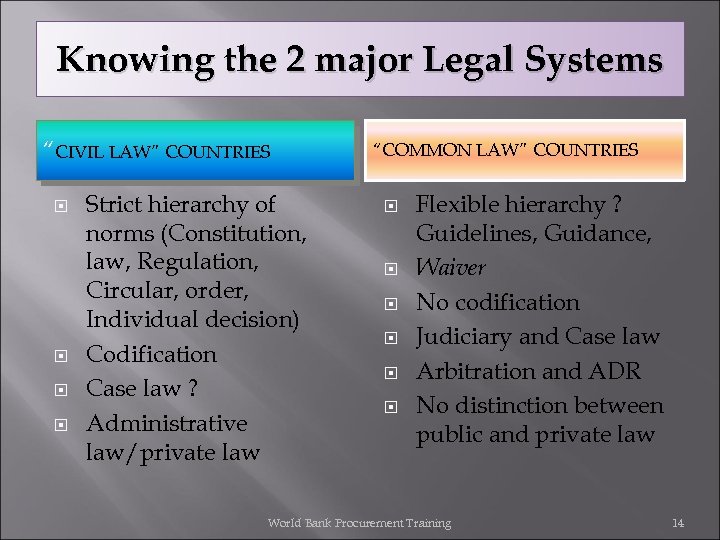
Knowing the 2 major Legal Systems “CIVIL LAW” COUNTRIES Strict hierarchy of norms (Constitution, law, Regulation, Circular, order, Individual decision) Codification Case law ? Administrative law/private law “COMMON LAW” COUNTRIES Flexible hierarchy ? Guidelines, Guidance, Waiver No codification Judiciary and Case law Arbitration and ADR No distinction between public and private law World Bank Procurement Training 14
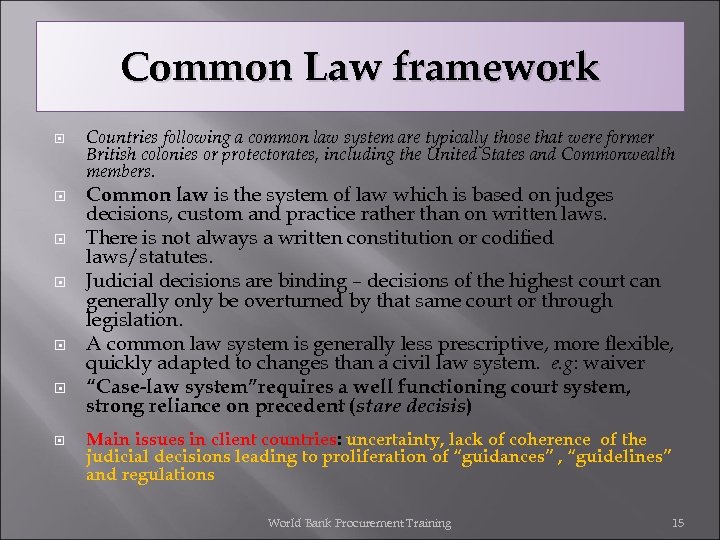
Common Law framework Countries following a common law system are typically those that were former British colonies or protectorates, including the United States and Commonwealth members. Common law is the system of law which is based on judges decisions, custom and practice rather than on written laws. There is not always a written constitution or codified laws/statutes. Judicial decisions are binding – decisions of the highest court can generally only be overturned by that same court or through legislation. A common law system is generally less prescriptive, more flexible, quickly adapted to changes than a civil law system. e. g: waiver “Case-law system”requires a well functioning court system, strong reliance on precedent (stare decisis) Main issues in client countries: uncertainty, lack of coherence of the judicial decisions leading to proliferation of “guidances” , “guidelines” and regulations World Bank Procurement Training 15
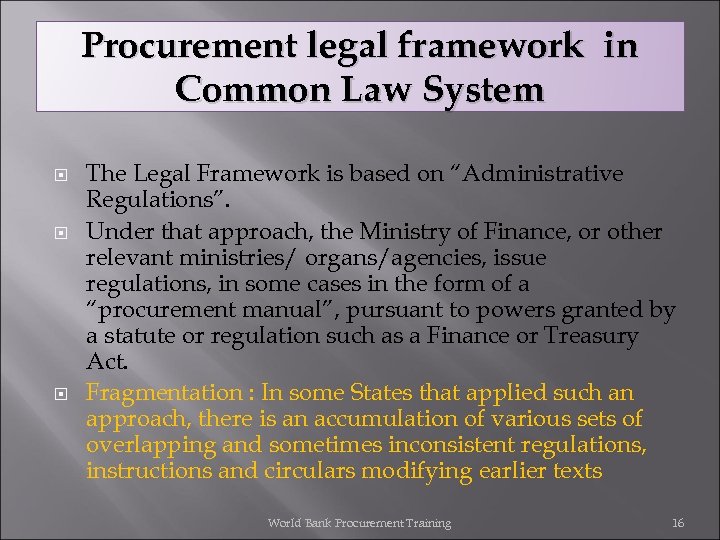
Procurement legal framework in Common Law System The Legal Framework is based on “Administrative Regulations”. Under that approach, the Ministry of Finance, or other relevant ministries/ organs/agencies, issue regulations, in some cases in the form of a “procurement manual”, pursuant to powers granted by a statute or regulation such as a Finance or Treasury Act. Fragmentation : In some States that applied such an approach, there is an accumulation of various sets of overlapping and sometimes inconsistent regulations, instructions and circulars modifying earlier texts World Bank Procurement Training 16
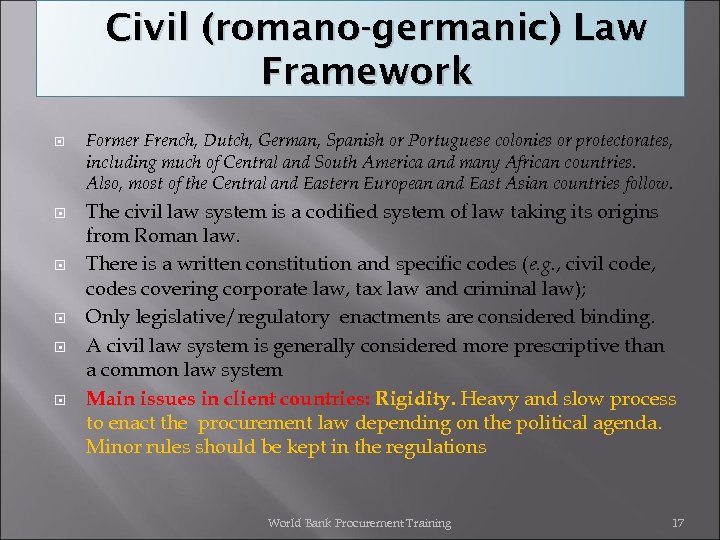
Civil (romano-germanic) Law Framework Former French, Dutch, German, Spanish or Portuguese colonies or protectorates, including much of Central and South America and many African countries. Also, most of the Central and Eastern European and East Asian countries follow. The civil law system is a codified system of law taking its origins from Roman law. There is a written constitution and specific codes (e. g. , civil code, codes covering corporate law, tax law and criminal law); Only legislative/regulatory enactments are considered binding. A civil law system is generally considered more prescriptive than a common law system Main issues in client countries: Rigidity. Heavy and slow process to enact the procurement law depending on the political agenda. Minor rules should be kept in the regulations World Bank Procurement Training 17
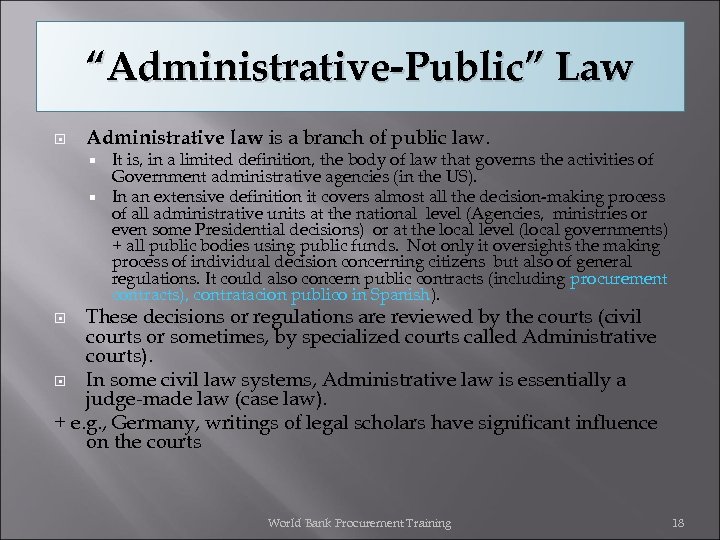
“Administrative-Public” Law Administrative law is a branch of public law. It is, in a limited definition, the body of law that governs the activities of Government administrative agencies (in the US). In an extensive definition it covers almost all the decision-making process of all administrative units at the national level (Agencies, ministries or even some Presidential decisions) or at the local level (local governments) + all public bodies using public funds. Not only it oversights the making process of individual decision concerning citizens but also of general regulations. It could also concern public contracts (including procurement contracts), contratacion publico in Spanish). These decisions or regulations are reviewed by the courts (civil courts or sometimes, by specialized courts called Administrative courts). In some civil law systems, Administrative law is essentially a judge-made law (case law). + e. g. , Germany, writings of legal scholars have significant influence on the courts World Bank Procurement Training 18
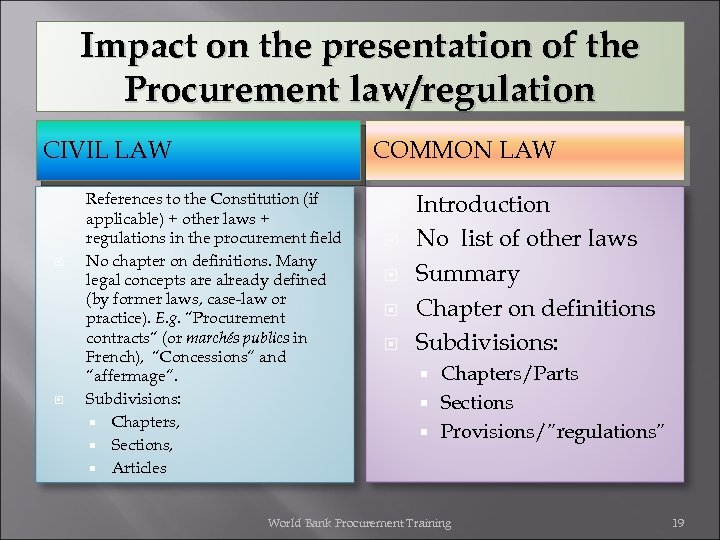
Impact on the presentation of the Procurement law/regulation CIVIL LAW COMMON LAW References to the Constitution (if applicable) + other laws + regulations in the procurement field No chapter on definitions. Many legal concepts are already defined (by former laws, case-law or practice). E. g. “Procurement contracts“ (or marchés publics in French), “Concessions” and “affermage”. Subdivisions: Chapters, Sections, Articles Introduction No list of other laws Summary Chapter on definitions Subdivisions: Chapters/Parts Sections Provisions/”regulations” World Bank Procurement Training 19
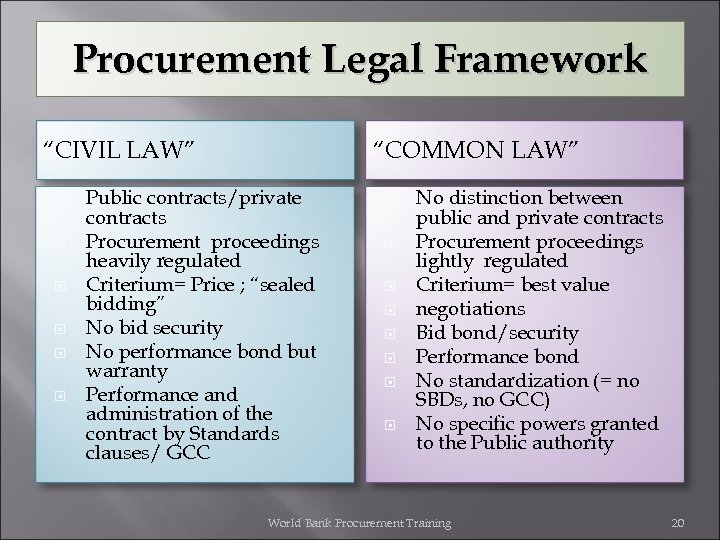
Procurement Legal Framework “CIVIL LAW” “COMMON LAW” Public contracts/private contracts Procurement proceedings heavily regulated Criterium= Price ; “sealed bidding” No bid security No performance bond but warranty Performance and administration of the contract by Standards clauses/ GCC No distinction between public and private contracts Procurement proceedings lightly regulated Criterium= best value negotiations Bid bond/security Performance bond No standardization (= no SBDs, no GCC) No specific powers granted to the Public authority World Bank Procurement Training 20
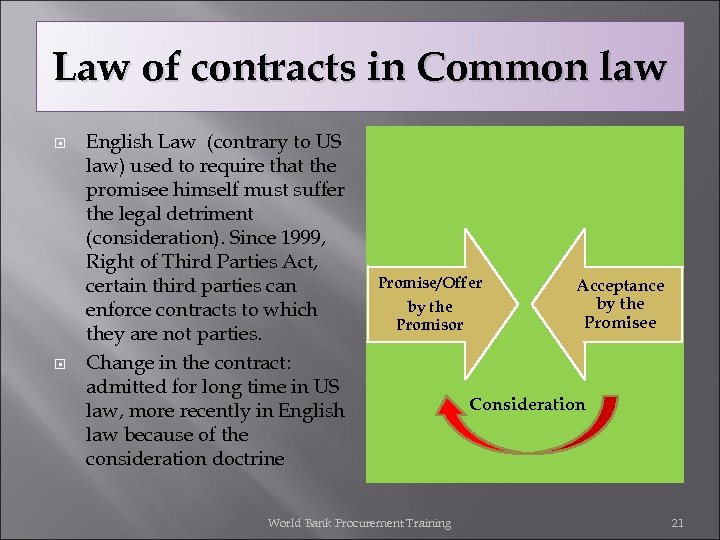
Law of contracts in Common law English Law (contrary to US law) used to require that the promisee himself must suffer the legal detriment (consideration). Since 1999, Right of Third Parties Act, certain third parties can enforce contracts to which they are not parties. Change in the contract: admitted for long time in US law, more recently in English law because of the consideration doctrine Promise/Offer by the Promisor World Bank Procurement Training Acceptance by the Promisee Consideration 21
Common law and procurement principles (I) The call for bids = invitation to make an offer The bidder is the “offeror” Limited power of revocation of the offer = the bid security is an “option” ( a separate consideration/contract) No contract exists until the public entity (the “offeree”) accepts one bid. The acceptance of the offer creates the contract ; but there is no formalization of the acceptance World Bank Procurement Training 22
Common law and procurement principles (II) “Mailbox rule” (British case 1818 Adams v. Lindsell) = an offer is effective when it is received by the offeree while an acceptance is effective on dispatch. The US-English law does not impose an obligation on a party to volunteer information to the other contracting party, with exception World Bank Procurement Training 23
Transfer of the property In English law, intention of the parties: property in goods is transferred when the parties (essentially the seller) to the contract intend it to be transferred. In French law, the transfer of property is an immediate result of the agreement between the parties and the intention of the parties is irrelevant after that moment, even though the goods are not delivered nor the price paid (Civil Code article 1583). Signature and formalization are required. In German law, two conditions: the agreement of the parties (legal basis) and the delivery of the goods (article 929 of the Civil Code). World Bank Procurement Training 24
Regime of procurement contracts Modification/change clause Differently from the courts in most civil law countries, under the common law the courts have not the power to adjust or adapt the contract to changing circumstances. Incidents, contractual events Termination World Bank Procurement Training 25
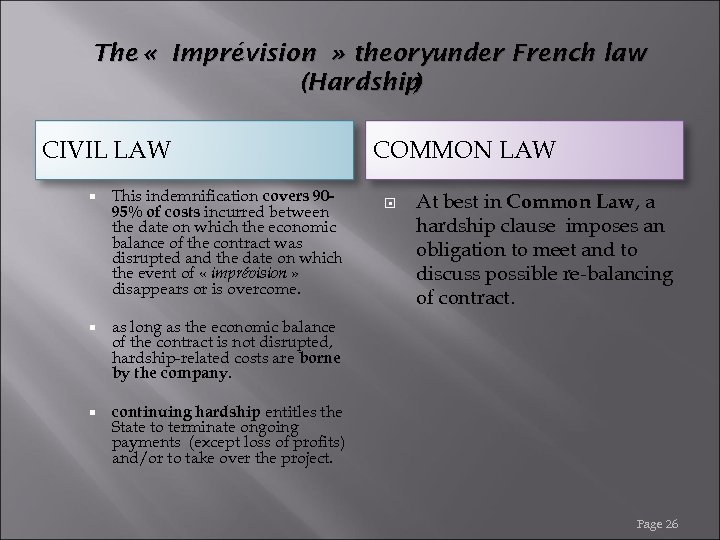
The « Imprévision » theoryunder French law (Hardship ) CIVIL LAW This indemnification covers 9095% of costs incurred between the date on which the economic balance of the contract was disrupted and the date on which the event of « imprévision » disappears or is overcome. as long as the economic balance of the contract is not disrupted, hardship-related costs are borne by the company. COMMON LAW continuing hardship entitles the State to terminate ongoing payments (except loss of profits) and/or to take over the project. At best in Common Law, a hardship clause imposes an obligation to meet and to discuss possible re-balancing of contract. Page 26
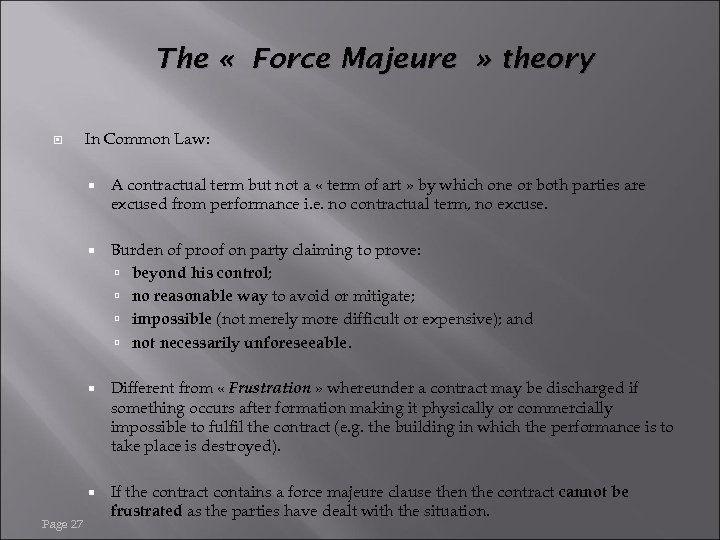
The « Force Majeure » theory In Common Law: Burden of proof on party claiming to prove: beyond his control; no reasonable way to avoid or mitigate; impossible (not merely more difficult or expensive); and not necessarily unforeseeable. Different from « Frustration » whereunder a contract may be discharged if something occurs after formation making it physically or commercially impossible to fulfil the contract (e. g. the building in which the performance is to take place is destroyed). Page 27 A contractual term but not a « term of art » by which one or both parties are excused from performance i. e. no contractual term, no excuse. If the contract contains a force majeure clause then the contract cannot be frustrated as the parties have dealt with the situation.
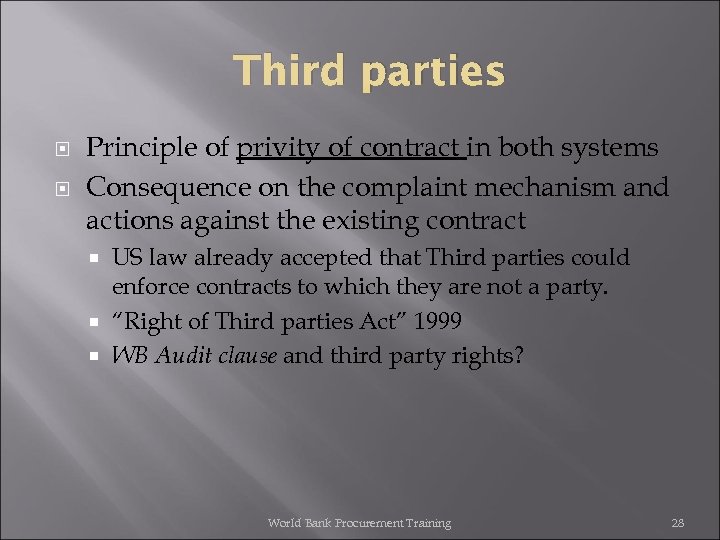
Third parties Principle of privity of contract in both systems Consequence on the complaint mechanism and actions against the existing contract US law already accepted that Third parties could enforce contracts to which they are not a party. “Right of Third parties Act” 1999 WB Audit clause and third party rights? World Bank Procurement Training 28
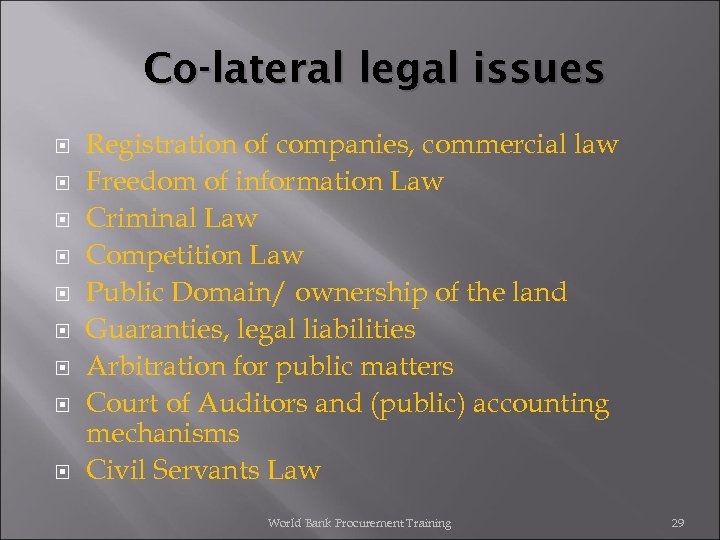
Co-lateral legal issues Registration of companies, commercial law Freedom of information Law Criminal Law Competition Law Public Domain/ ownership of the land Guaranties, legal liabilities Arbitration for public matters Court of Auditors and (public) accounting mechanisms Civil Servants Law World Bank Procurement Training 29
Collateral legal fields (1) Consistency between the procurement system and the Constitutional framework, hierarchy of norms Organization of the country: federalist, decentralized, centralized with deconcentration Legal background: civil law (emphasis on norms) or common law (emphasis on institutions)
Collateral legal fields (2) Judicial system: Civil courts Commercial courts? Administrative courts? Proceedings? Powers? Efficiency? Staffing? Status of the court of Auditors: established by the Constitution? Independence? Efficiency? What implication in the procurement review system? / Audit system?
Collateral legal fields (3) Anti-trust policy/competition law? Anti-trust Body? Sanction of collusive practices? Sectors regulations? Civil service law: does it permit to create a specific position for procurement staff? Requirements for hiring? Specific incentives? “Revolving door” provision? Code of ethics? Prevention of conflict of interest?
Collateral legal fields (4) PPP law? Specific or covered by procurement framework? Institutions in charge, methods of procurement, complaint system, oversight of the performance Arbitration? Availability of arbitration for public contracts? Appropriation/ budgetary proceedings Environmental issues
ASSESSMENT (CPARs and UCS Stage 1) INSTITUTIONS Common issues: Civil law systems Common findings: • Unclear involvement of several institutions, overlaps • Political interferences; political appointments • Hegemony of certain ministries; • Central Tender Boards responsible of reviewing most of the procurement proceedings; • Conflict of interest between traditional Central Tender Board functions and the review of bidder complaints; • Lack of an independent Review Body; • Lack of material and legal resources for Court of Auditors; World Bank Procurement Training 34
INSTITUTIONS involved in Procurement Institutional organization Justice organization The institutional model is linked to the Legal system World Bank Procurement Training 35
Common law institutions Emphasis on the Institutions ‘The Commission shall have a distinct corporate identity with perpetual succession and a common seal and may sue and be sued in its corporate name. ’ Government agencies, decentralized bodies What approvals during the tender process are required and from whom? World Bank Procurement Training 36
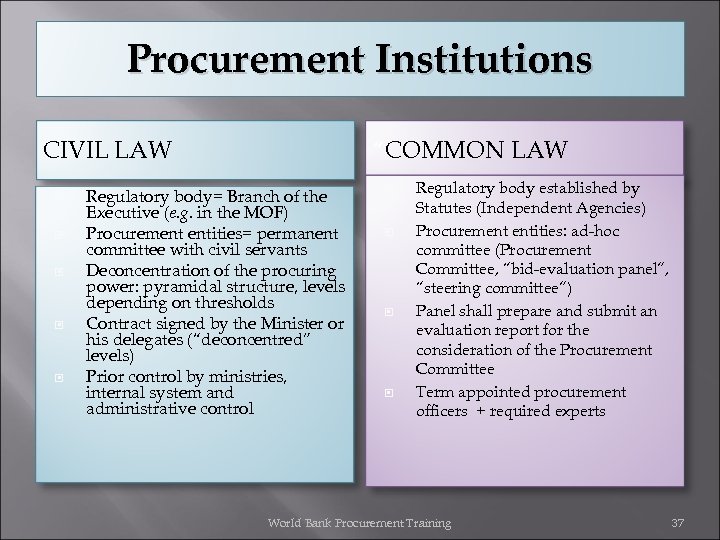
Procurement Institutions CIVIL LAW “COMMON LAW Regulatory body= Branch of the Executive (e. g. in the MOF) Procurement entities= permanent committee with civil servants Deconcentration of the procuring power: pyramidal structure, levels depending on thresholds Contract signed by the Minister or his delegates (“deconcentred” levels) Prior control by ministries, internal system and administrative control Regulatory body established by Statutes (Independent Agencies) Procurement entities: ad-hoc committee (Procurement Committee, “bid-evaluation panel”, “steering committee”) Panel shall prepare and submit an evaluation report for the consideration of the Procurement Committee Term appointed procurement officers + required experts World Bank Procurement Training 37
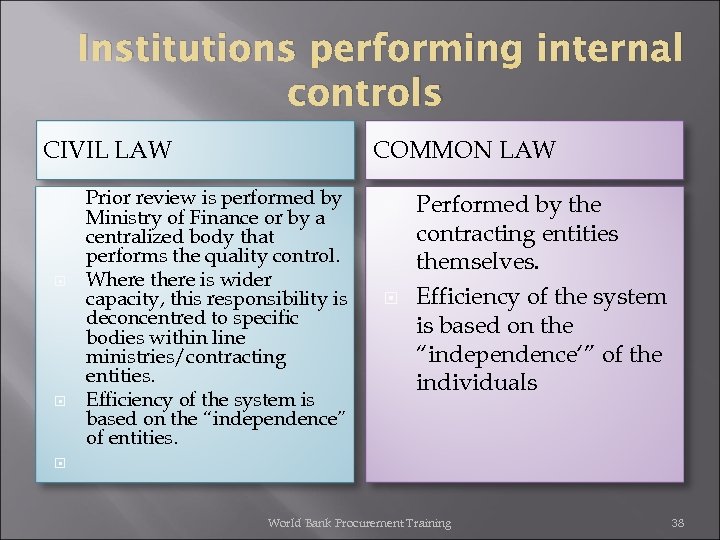
Institutions performing internal controls CIVIL LAW COMMON LAW Prior review is performed by Ministry of Finance or by a centralized body that performs the quality control. Where there is wider capacity, this responsibility is deconcentred to specific bodies within line ministries/contracting entities. Efficiency of the system is based on the “independence” of entities. Performed by the contracting entities themselves. Efficiency of the system is based on the “independence‘” of the individuals World Bank Procurement Training 38
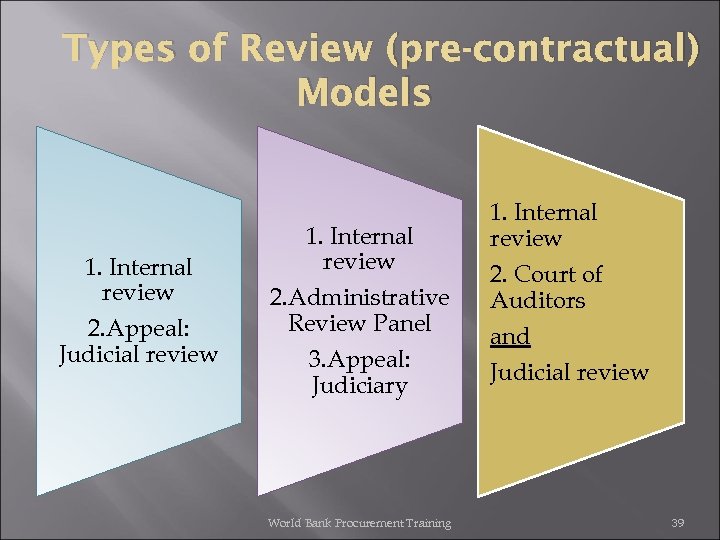
Types of Review (pre-contractual) Models 1. Internal review 2. Appeal: Judicial review 1. Internal review 2. Administrative Review Panel 3. Appeal: Judiciary World Bank Procurement Training 1. Internal review 2. Court of Auditors and Judicial review 39
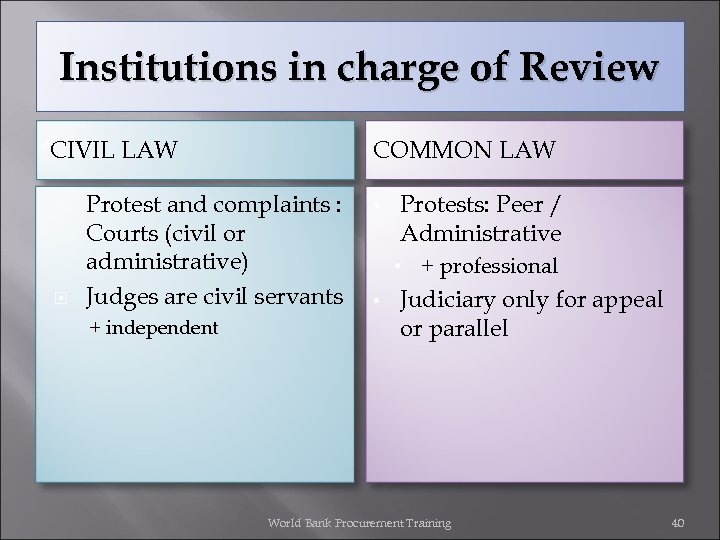
Institutions in charge of Review ‘CIVIL LAW COMMON LAW Protest and complaints : Courts (civil or administrative) Judges are civil servants + independent • Protests: Peer / Administrative • + professional • Judiciary only for appeal or parallel World Bank Procurement Training 40
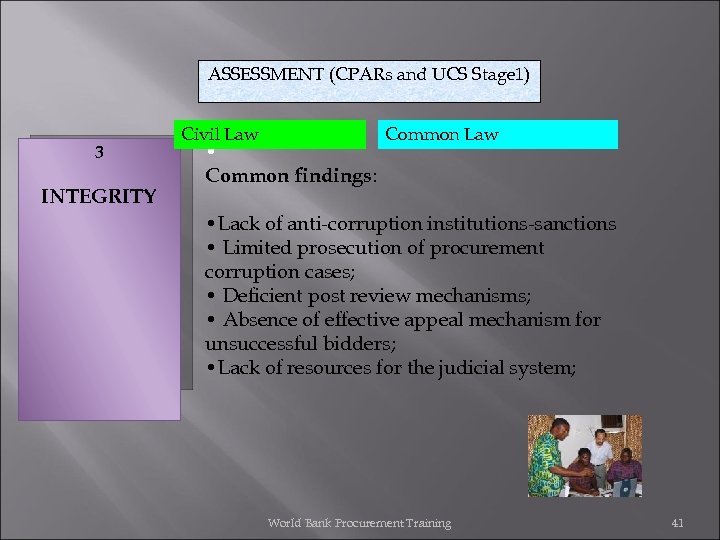
ASSESSMENT (CPARs and UCS Stage 1) 3 INTEGRITY Civil Law • Common Law Common findings: • Lack of anti-corruption institutions-sanctions • Limited prosecution of procurement corruption cases; • Deficient post review mechanisms; • Absence of effective appeal mechanism for unsuccessful bidders; • Lack of resources for the judicial system; World Bank Procurement Training 41
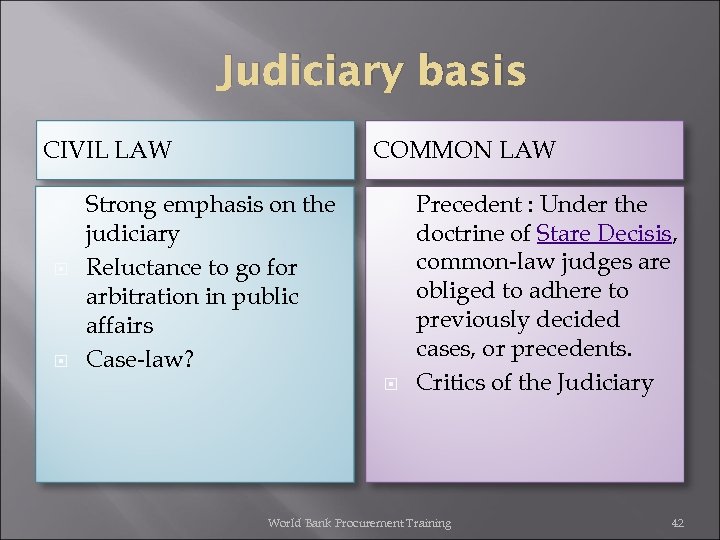
Judiciary basis CIVIL LAW COMMON LAW Strong emphasis on the judiciary Reluctance to go for arbitration in public affairs Case-law? Precedent : Under the doctrine of Stare Decisis, common-law judges are obliged to adhere to previously decided cases, or precedents. Critics of the Judiciary World Bank Procurement Training 42
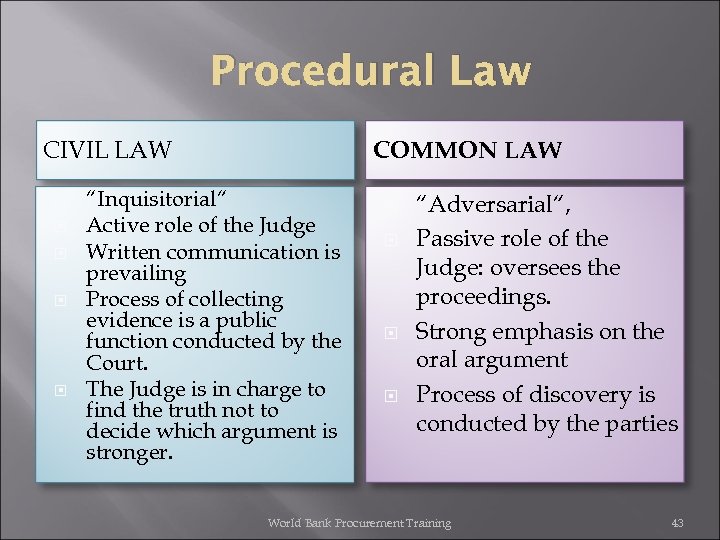
Procedural Law CIVIL LAW COMMON LAW “Inquisitorial“ Active role of the Judge Written communication is prevailing Process of collecting evidence is a public function conducted by the Court. The Judge is in charge to find the truth not to decide which argument is stronger. “Adversarial“, Passive role of the Judge: oversees the proceedings. Strong emphasis on the oral argument Process of discovery is conducted by the parties World Bank Procurement Training 43
Review of administrative decisions Sovereign Act doctrine for the Government decisions. Exception in specific areas. Judicial review is different from an administrative appeal. In Judicial review the Court will only look at the method and the proceedings of the decision. An administrative appeal is performed by a higher body in the agency to assess also the correctness of the decision. World Bank Procurement Training 44

2. ACTION PLAN Recommendations RECOMMENDATIONS World Bank Procurement Training 45
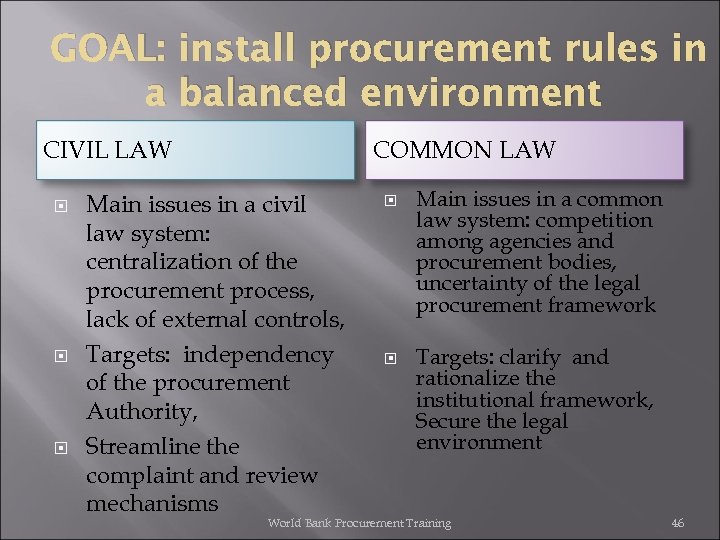
GOAL: install procurement rules in a balanced environment CIVIL LAW COMMON LAW Main issues in a civil law system: centralization of the procurement process, lack of external controls, Targets: independency of the procurement Authority, Streamline the complaint and review mechanisms Main issues in a common law system: competition among agencies and procurement bodies, uncertainty of the legal procurement framework Targets: clarify and rationalize the institutional framework, Secure the legal environment World Bank Procurement Training 46
e. g. Use of other institutions/mechanisms to improve procurement oversight Court of Auditors Competition/Antitrust Agency or Sector Agencies Procurement regulatory body should be involved in negotiations of international trade agreement dealing with procurement World Bank Procurement Training 47
Improving the Complaint mechanism Create a specific delay before contract signature (“Standstill period”) Screening Non-automatic suspension of the contract proceedings Access of Third parties? Impact in the existing contract? World Bank Procurement Training 48
Progress made in (private) Contract Law Adoption of international treaties, conventions and uniform rules containing elements of both the civil law and the common law. 1980 Vienna Sales Convention. The UNIDROIT Principles for International Commercial Contracts They are aimed to serve as a model to national legislators and to provide guidance to courts and arbitrators when interpreting existing uniform law and deciding disputes relating to international commercial contracts. The 2000 INCOTERMS regulate the transfer of risk and costs in contracts of sale. Soft law: Commission on European Contract Law (the Lando Commission) has prepared the Principles of European Contract Law There are similar examples in other fields of law, like international carriage of goods, international payments, international commercial arbitration. World Bank Procurement Training 49
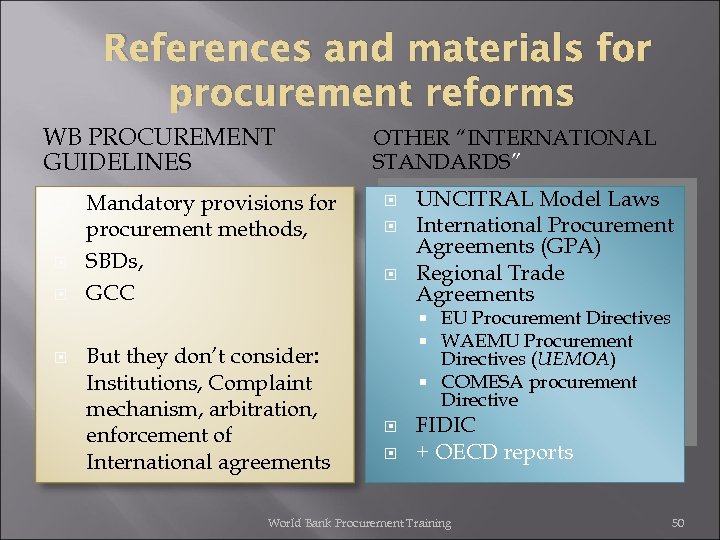
References and materials for procurement reforms WB PROCUREMENT GUIDELINES Mandatory provisions for procurement methods, SBDs, GCC But they don’t consider: Institutions, Complaint mechanism, arbitration, enforcement of International agreements OTHER “INTERNATIONAL STANDARDS” UNCITRAL Model Laws International Procurement Agreements (GPA) Regional Trade Agreements EU Procurement Directives WAEMU Procurement Directives (UEMOA) COMESA procurement Directive FIDIC + OECD reports World Bank Procurement Training 50
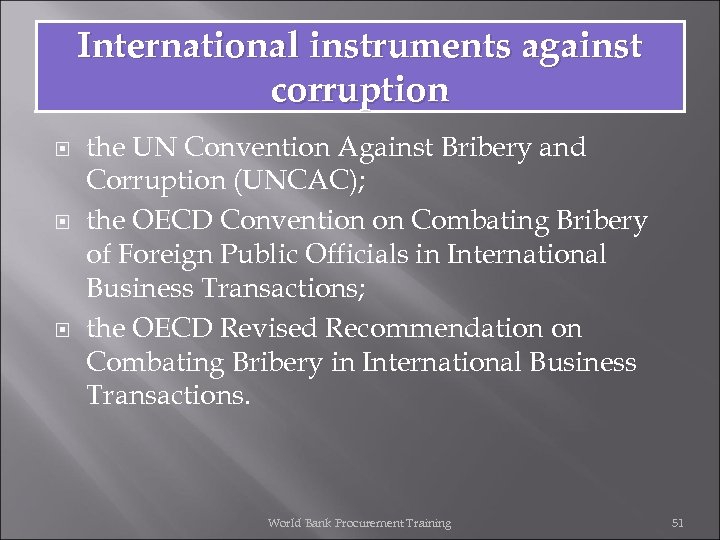
International instruments against corruption the UN Convention Against Bribery and Corruption (UNCAC); the OECD Convention on Combating Bribery of Foreign Public Officials in International Business Transactions; the OECD Revised Recommendation on Combating Bribery in International Business Transactions. World Bank Procurement Training 51
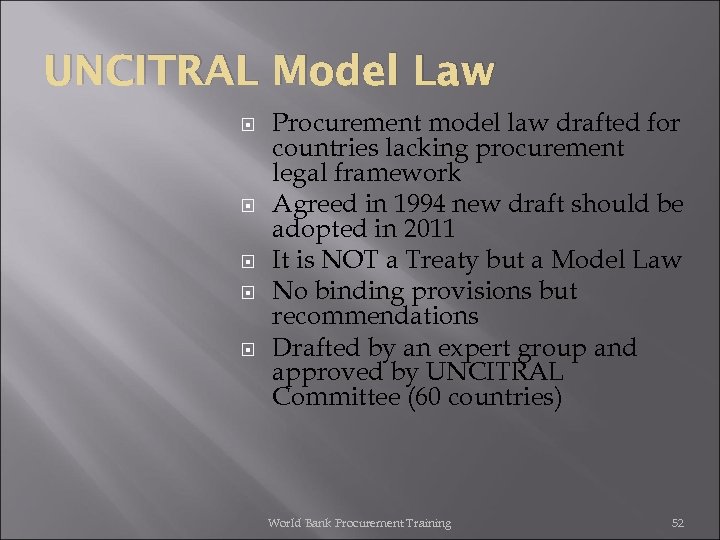
UNCITRAL Model Law Procurement model law drafted for countries lacking procurement legal framework Agreed in 1994 new draft should be adopted in 2011 It is NOT a Treaty but a Model Law No binding provisions but recommendations Drafted by an expert group and approved by UNCITRAL Committee (60 countries) World Bank Procurement Training 52
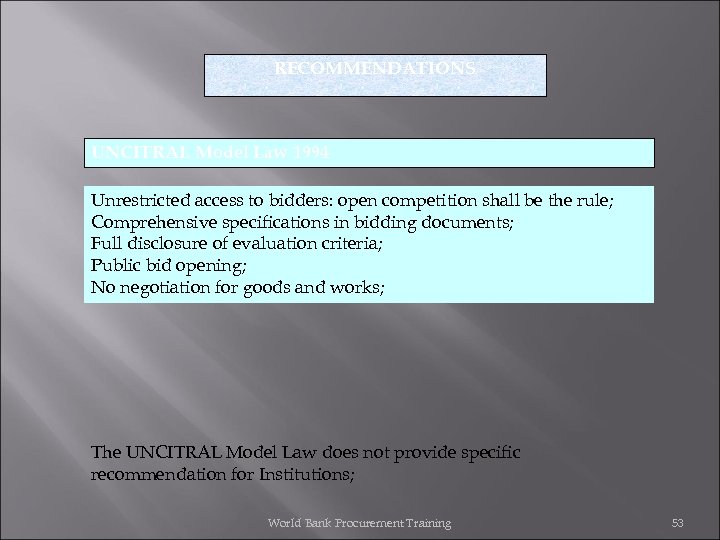
RECOMMENDATIONS UNCITRAL Model Law 1994 Unrestricted access to bidders: open competition shall be the rule; Comprehensive specifications in bidding documents; Full disclosure of evaluation criteria; Public bid opening; No negotiation for goods and works; The UNCITRAL Model Law does not provide specific recommendation for Institutions; World Bank Procurement Training 53
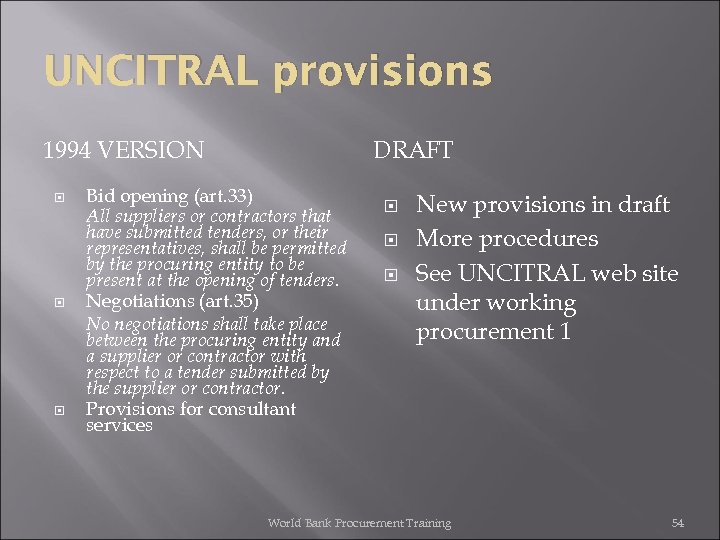
UNCITRAL provisions 1994 VERSION DRAFT Bid opening (art. 33) All suppliers or contractors that have submitted tenders, or their representatives, shall be permitted by the procuring entity to be present at the opening of tenders. Negotiations (art. 35) No negotiations shall take place between the procuring entity and a supplier or contractor with respect to a tender submitted by the supplier or contractor. Provisions for consultant services New provisions in draft More procedures See UNCITRAL web site under working procurement 1 World Bank Procurement Training 54
UNCITRAL (coming) provisions FRAMEWORK AGREEMENTS E-PROCUREMENT World Bank Procurement Training 55
Conclusion: Beyond the legal framework Operation & Efficiency World Bank Procurement Training 56
Скачать презентацию World Bank Procurement Training 1 International Agreements
5a9a0e7b4503ef8f12b132842db987d5.ppt