 Скачать презентацию World Bank Group E-LEARNING STRATEGIES Samia Melhem Learntec
411be3931f3b019efa65832180100d8c.ppt
- Количество слайдов: 57



World Bank Group E-LEARNING STRATEGIES Samia Melhem, Learntec 2002, Karlsruhe Germany, Feb 8, 2002
Our Vision … to become a Knowledge Bank that spurs the knowledge revolution in developing countries and acts as a catalyst for creating, sharing, and applying cutting edge knowledge necessary for poverty reduction and economic development
Why focus on Knowledge? The knowledge revolution offers an opportunity to redraw the global economy by: enhancing competitiveness offering new opportunities for economic growth and jobs better access to basic services increasing returns on investments in education and health: Focus on e. Learning and e. Health empowerment of local communities and poor people
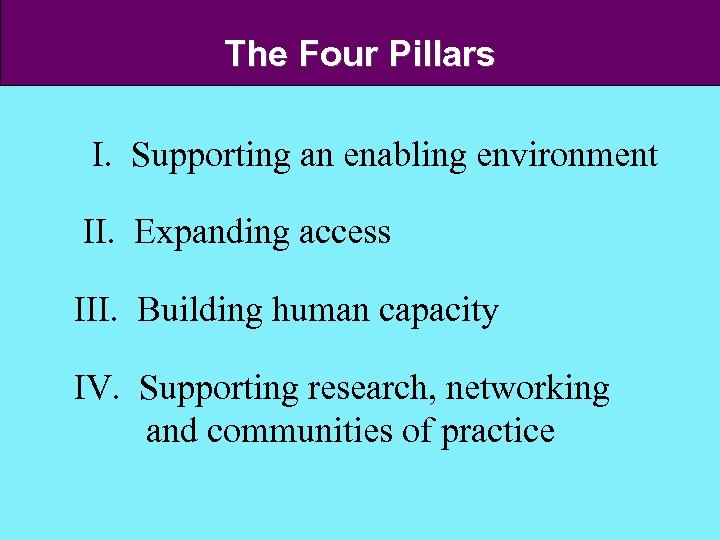
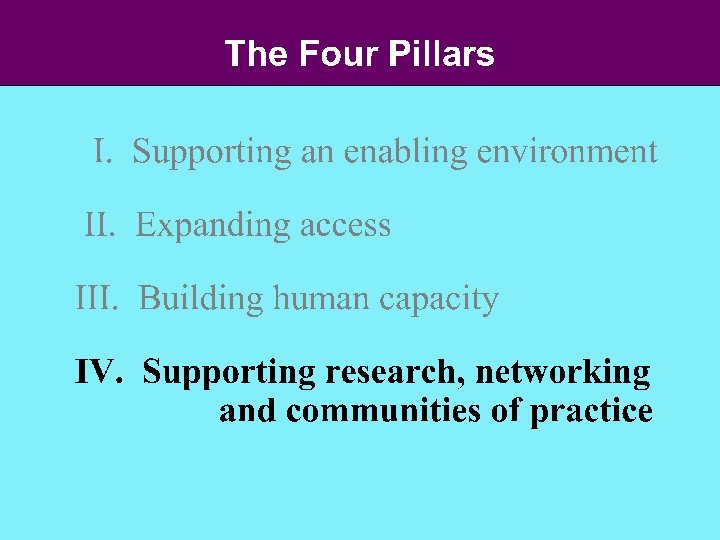
The Four Pillars I. Supporting an enabling environment II. Expanding access III. Building human capacity IV. Supporting research, networking and communities of practice
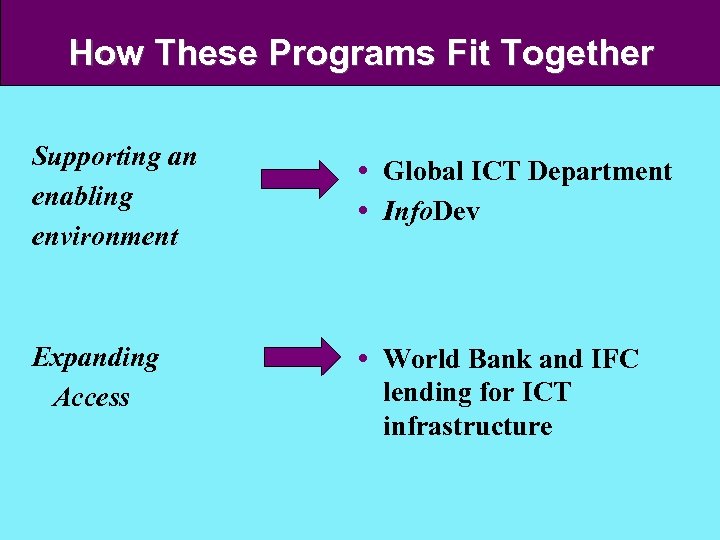
How These Programs Fit Together Supporting an enabling environment Expanding Access Global ICT Department Info. Dev World Bank and IFC lending for ICT infrastructure
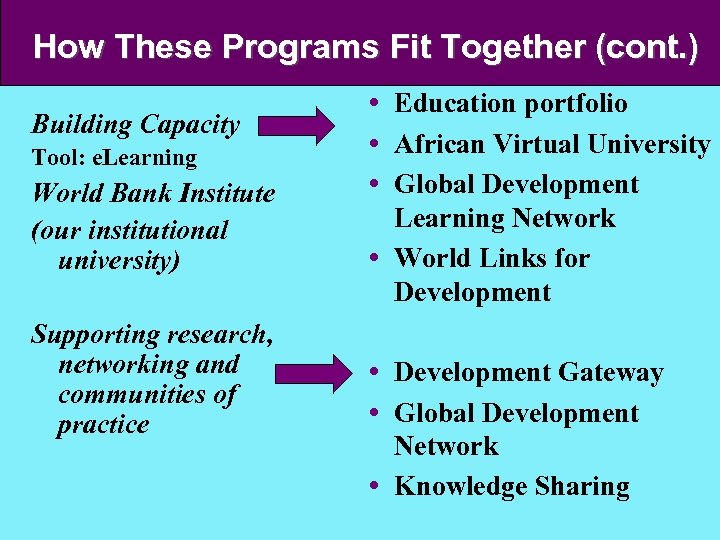
How These Programs Fit Together (cont. ) Building Capacity Tool: e. Learning World Bank Institute (our institutional university) Supporting research, networking and communities of practice Education portfolio African Virtual University Global Development Learning Network World Links for Development Gateway Global Development Network Knowledge Sharing
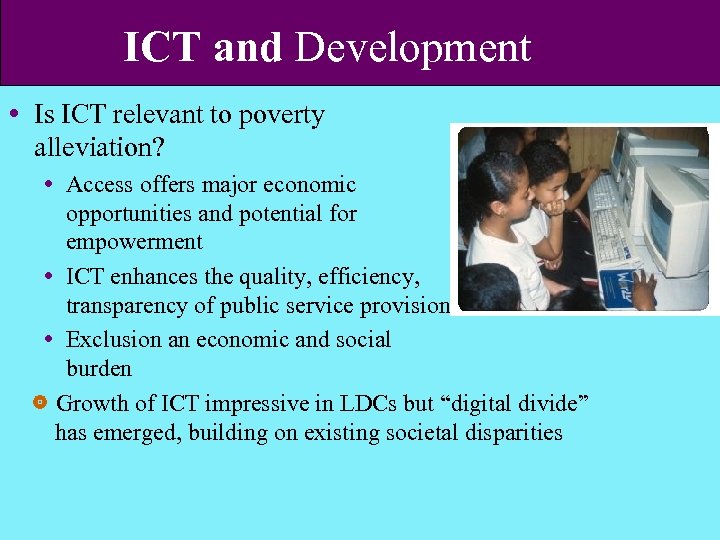
ICT and Development Is ICT relevant to poverty alleviation? Access offers major economic opportunities and potential for empowerment ICT enhances the quality, efficiency, transparency of public service provision Exclusion an economic and social burden Growth of ICT impressive in LDCs but “digital divide” has emerged, building on existing societal disparities
ICT and Development Is there a role for the Public Sector? Privatization, strong regulation, competitive markets could double No. lines in poorer markets in Africa Reforms require passing (and enforcing) enabling legislation, and innovating in business landscape Regulatory agencies need competence and credibility The market, unassisted, will not provide a sufficient level of access today.
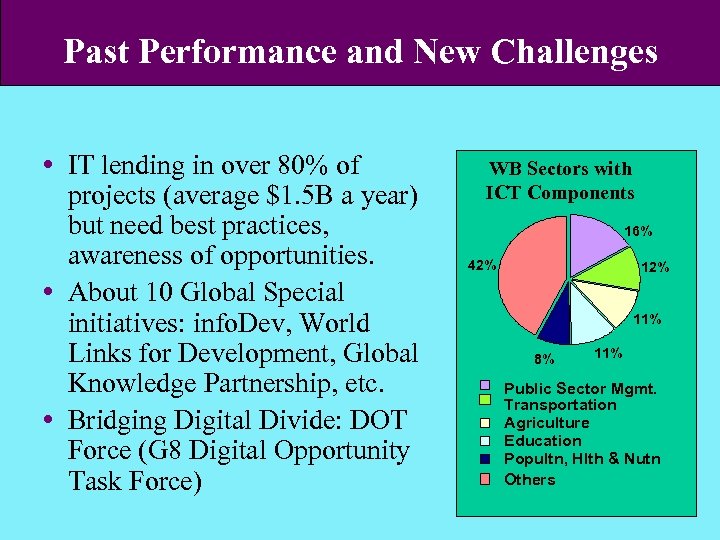
Past Performance and New Challenges IT lending in over 80% of projects (average $1. 5 B a year) but need best practices, awareness of opportunities. About 10 Global Special initiatives: info. Dev, World Links for Development, Global Knowledge Partnership, etc. Bridging Digital Divide: DOT Force (G 8 Digital Opportunity Task Force) WB Sectors with ICT Components 16% 42% 11% 8% 11% Public Sector Mgmt. Transportation Agriculture Education Popultn, Hlth & Nutn Others
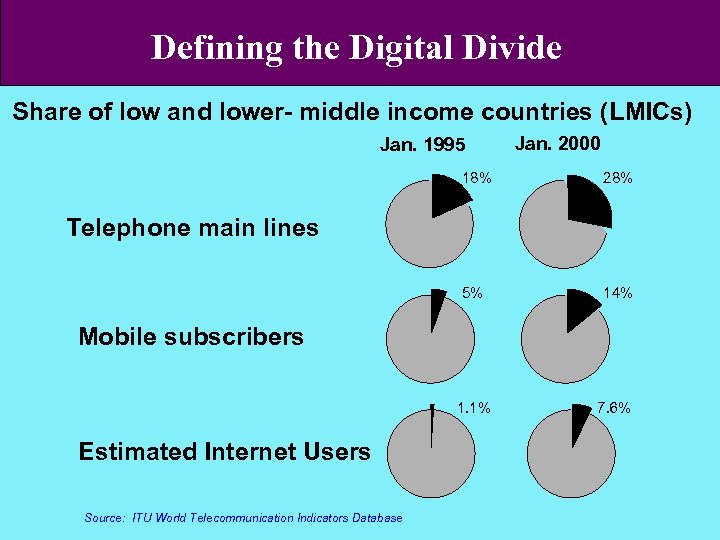
Defining the Digital Divide Share of low and lower- middle income countries (LMICs) Jan. 1995 Jan. 2000 18% 28% 5% 14% 1. 1% 7. 6% Telephone main lines Mobile subscribers Estimated Internet Users Source: ITU World Telecommunication Indicators Database
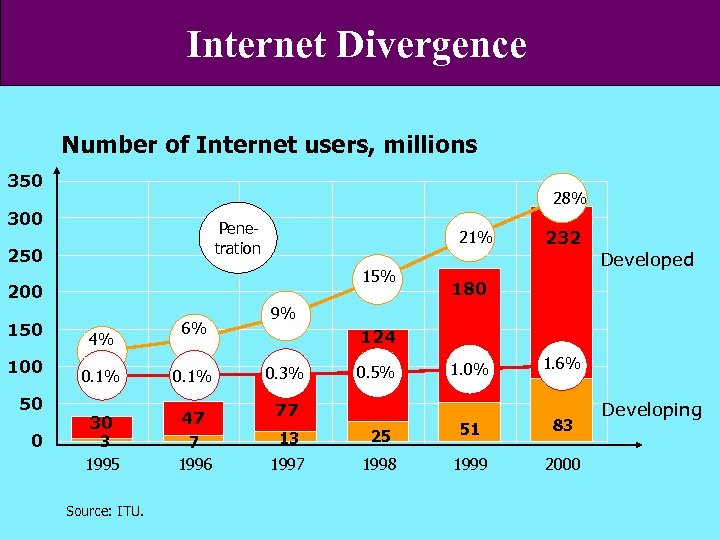
Internet Divergence Number of Internet users, millions 350 28% 300 Penetration 250 21% 15% 200 150 100 50 0 4% 6% 180 124 0. 1% 0. 3% 30 47 7 1996 13 1997 1. 0% 1. 6% 25 51 83 1998 1999 2000 0. 5% 77 Source: ITU. Developed 9% 0. 1% 3 1995 232 Developing
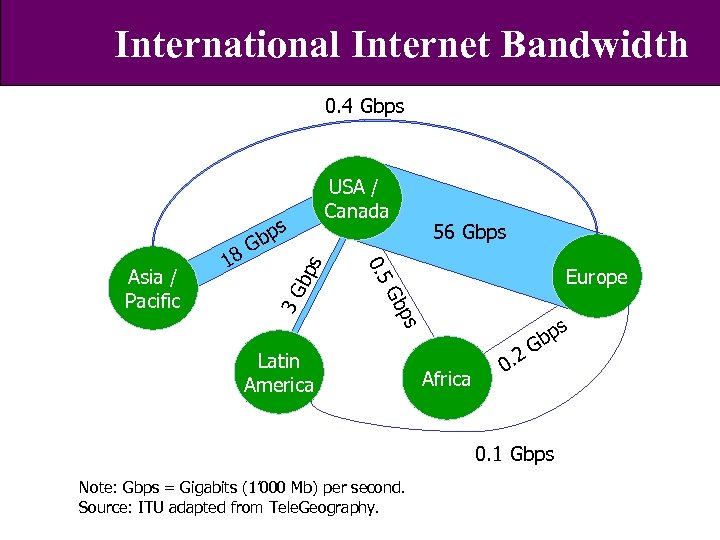
International Internet Bandwidth 0. 4 Gbps 56 Gbps Europe ps Gb 3 G bp s s bp G 0. 5 Asia / Pacific 18 USA / Canada Latin America Africa s p Gb 2 0. 1 Gbps Note: Gbps = Gigabits (1’ 000 Mb) per second. Source: ITU adapted from Tele. Geography.
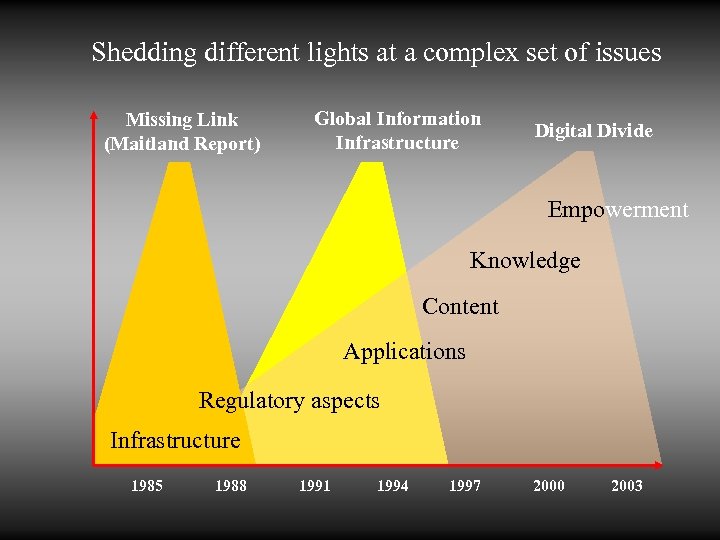
Shedding different lights at a complex set of issues Missing Link (Maitland Report) Global Information Infrastructure Digital Divide Empowerment Knowledge Content Applications Regulatory aspects Infrastructure 1985 1988 1991 1994 1997 2000 2003
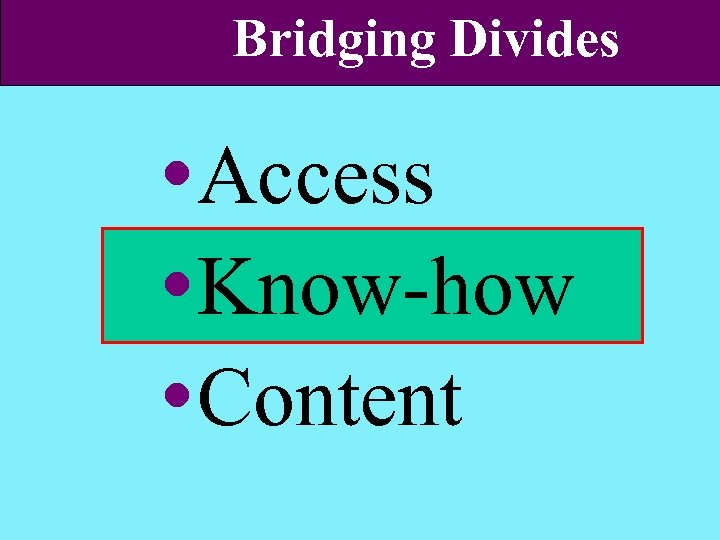
Bridging Divides Access Know-how Content
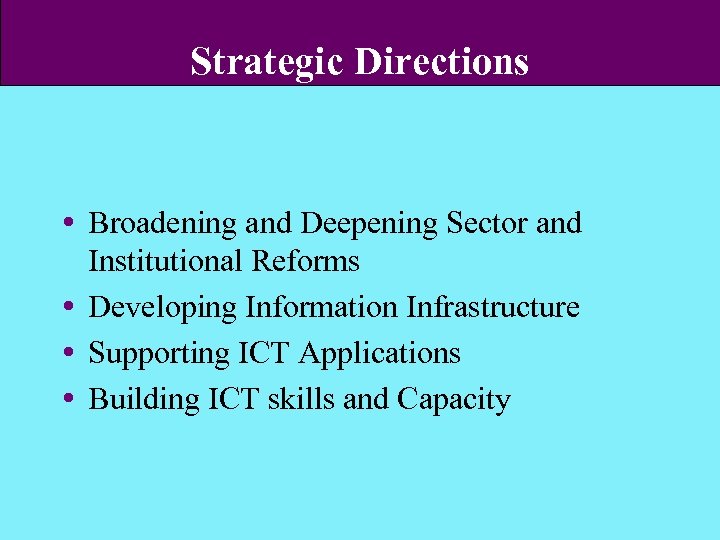
Strategic Directions Broadening and Deepening Sector and Institutional Reforms Developing Information Infrastructure Supporting ICT Applications Building ICT skills and Capacity
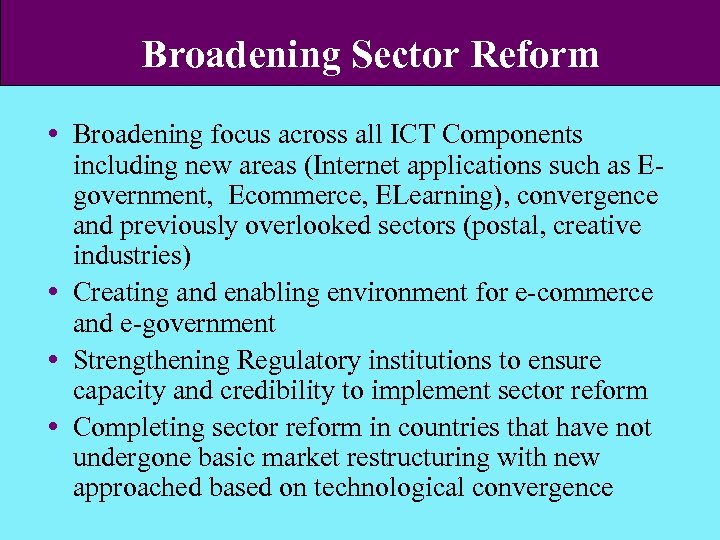
Broadening Sector Reform Broadening focus across all ICT Components including new areas (Internet applications such as Egovernment, Ecommerce, ELearning), convergence and previously overlooked sectors (postal, creative industries) Creating and enabling environment for e-commerce and e-government Strengthening Regulatory institutions to ensure capacity and credibility to implement sector reform Completing sector reform in countries that have not undergone basic market restructuring with new approached based on technological convergence
Developing Information Infrastructure Extending Access beyond the market with WB support for innovative solutions such as public/private co-financing, universal access Funds; community centered development (Telecenters); innovative solutions Exploiting synergies with other rural infrastructure projects across sectors. Investment branch (IFC) will focus on new entrants rather than incumbent operators and will increase investments in content and applications, including Internet info. Dev “e-readiness” assessments of 40 countries
Supporting ICT Applications Sectoral applications of ICT in areas such as e. Learning, health, education, public sector management and social services Strategic info. systems for finance, tax, education, health with a move towards use of the Internet WB lending projects have, on average an ICT component of $8 Millions. Focus on Change management, training and retooling client’s counterparts.
Building ICT skills and Capacity New trend triggered by global shortage of technicians and IT specialists Identifying needs for building ICT human capacity Advising governments and entrepreneurs on developing new information industries such as software exports, Application development and hosting, remote network management, call centers. Lending to Education in ICT in higher education projects: DL, e. Learning, Infrastructure & Content Investing in private ICT training institutes from developing nations: Content and Tools Supporting public-private partnerships for technical skills education and skills transfer
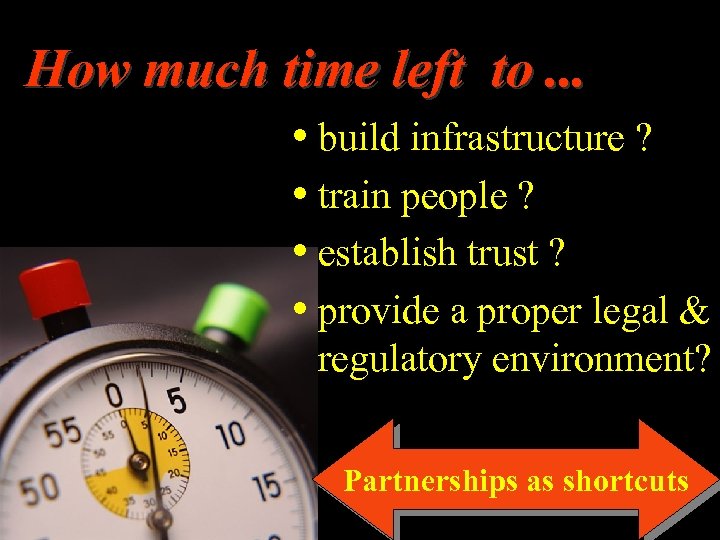
How much time left to. . . build infrastructure ? train people ? establish trust ? provide a proper legal & regulatory environment? Partnerships as shortcuts
Framework Building Capacity through the Education Portfolio: Building the Knowledge Economy Higher Education in the New Economy Continuous and Lifelong Learning
Potential Benefits of Incorporating ICTs in Education · Increased access to learning opportunities · Improved quality of education · Strengthened education management systems · Shared knowledge
Skilled Labor Force that can Create and Use Knowledge · Knowledge creates increasing returns, economic growth · Technological revolution puts a premium on skilled workers · Continuous learning becoming a necessity
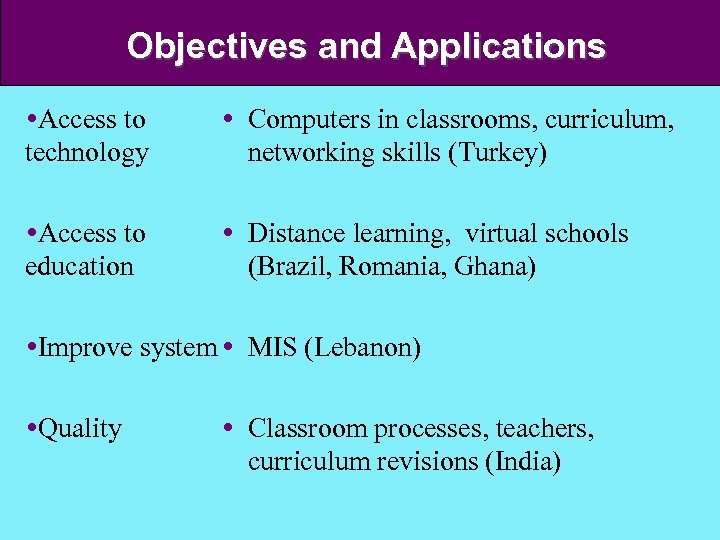
Objectives and Applications Access to technology Computers in classrooms, curriculum, networking skills (Turkey) Access to education Distance learning, virtual schools (Brazil, Romania, Ghana) Improve system MIS (Lebanon) Quality Classroom processes, teachers, curriculum revisions (India)
Remaining Challenge Technology to transform education
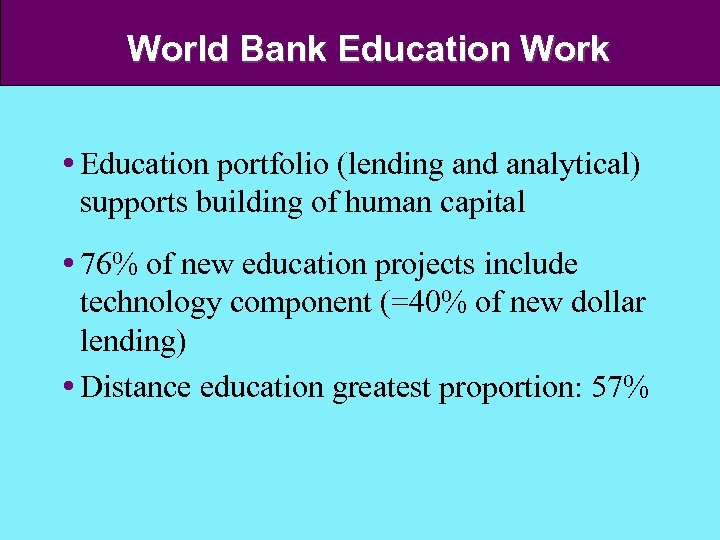
World Bank Education Work Education portfolio (lending and analytical) supports building of human capital 76% of new education projects include technology component (=40% of new dollar lending) Distance education greatest proportion: 57%
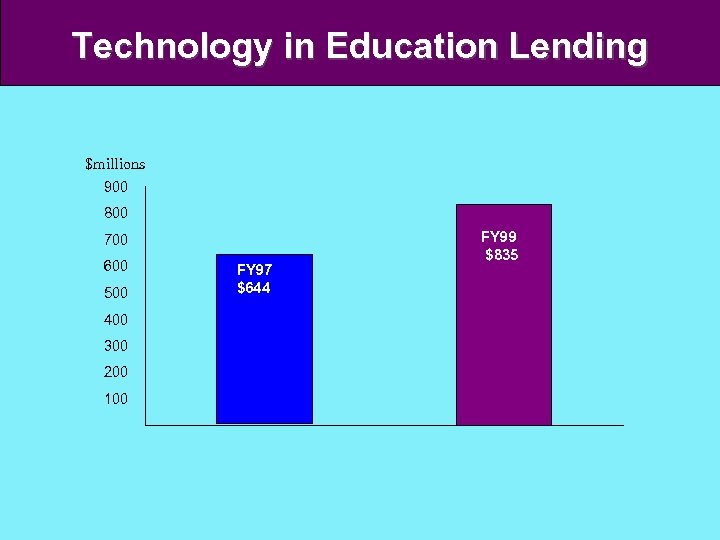
Technology in Education Lending $millions 900 800 700 600 500 400 300 200 100 FY 97 $644 FY 99 $835
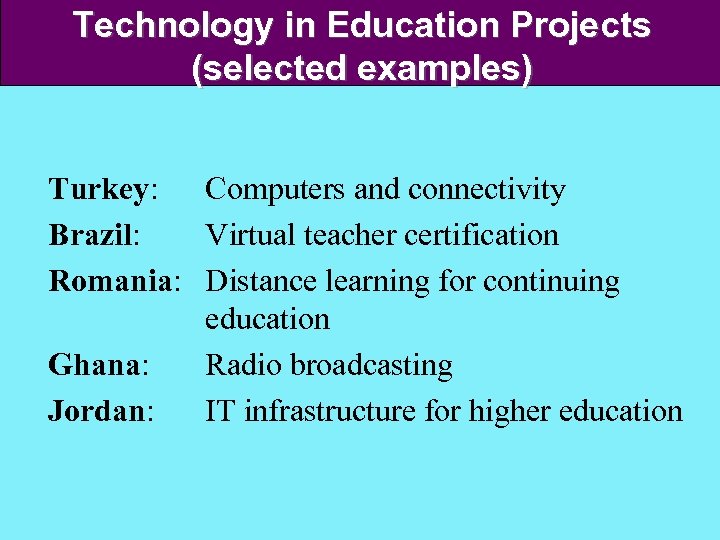
Technology in Education Projects (selected examples) Turkey: Computers and connectivity Brazil: Virtual teacher certification Romania: Distance learning for continuing education Ghana: Radio broadcasting Jordan: IT infrastructure for higher education
IFC Invests in On-line Education egurucool. com Escola@24 horas. com
Messages Knowledge Economy Distance Education Partnership Next… Enabling the Environment with Special Initiatives
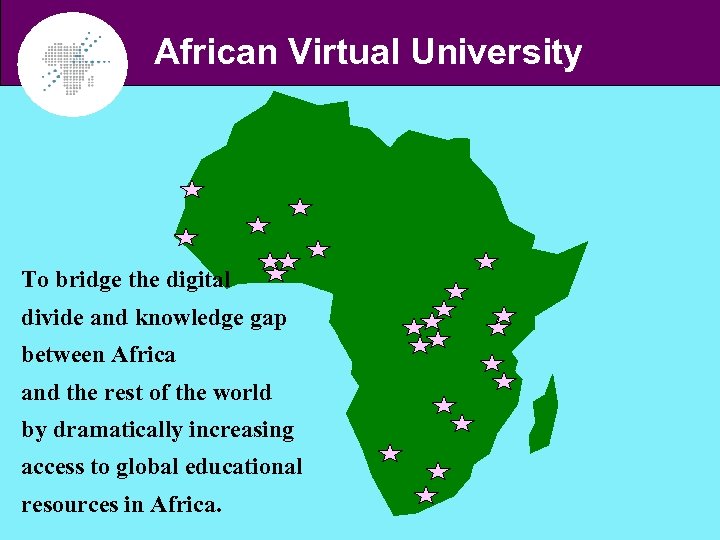
African Virtual University To bridge the digital divide and knowledge gap between Africa and the rest of the world by dramatically increasing access to global educational resources in Africa.
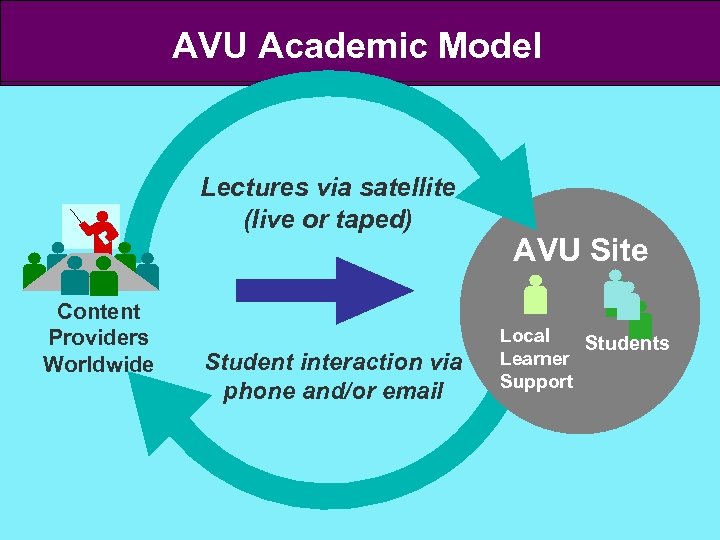
AVU Academic Model Lectures via satellite (live or taped) Content Providers Worldwide Student interaction via phone and/or email AVU Site Local Students Learner Support
AVU Capacity Building Activities Encourage research and use of ICT in African institutions Strengthen university libraries through AVU’s digital library Foster shared use by students of AVU web-based resources Facilitate communication and linkages among academics and students in various parts of Africa and globally
Results of the Pilot Phase: 1997 -1999 Over 14, 000 students have taken full semester courses in the sciences 3, 500 seminar participants Web site now receives over 80, 000 hits a day 10, 000 AVU e-mail accounts are active Digital library with 1, 100 journals
AVU Transition AVU legally established in Nairobi with elected Board Financial backing from Dfid (U. K. ), CIDA (Canada), Carnegie Foundation, World Bank
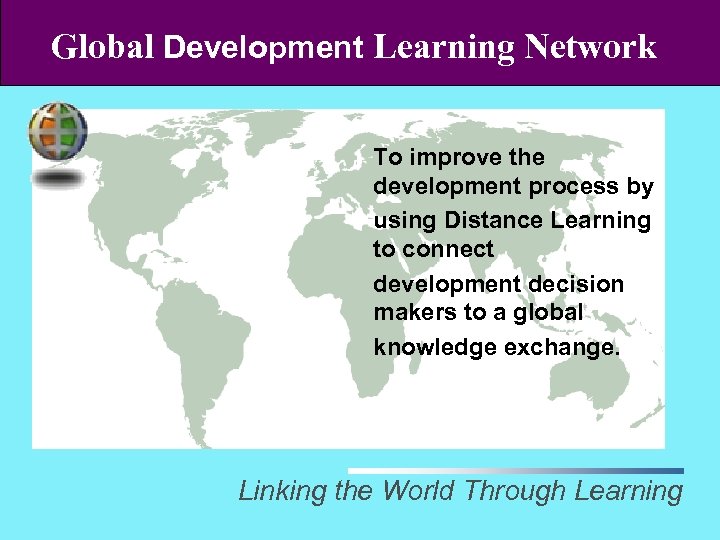
Global Development Learning Network To improve the development process by using Distance Learning to connect development decision makers to a global knowledge exchange. Linking the World Through Learning
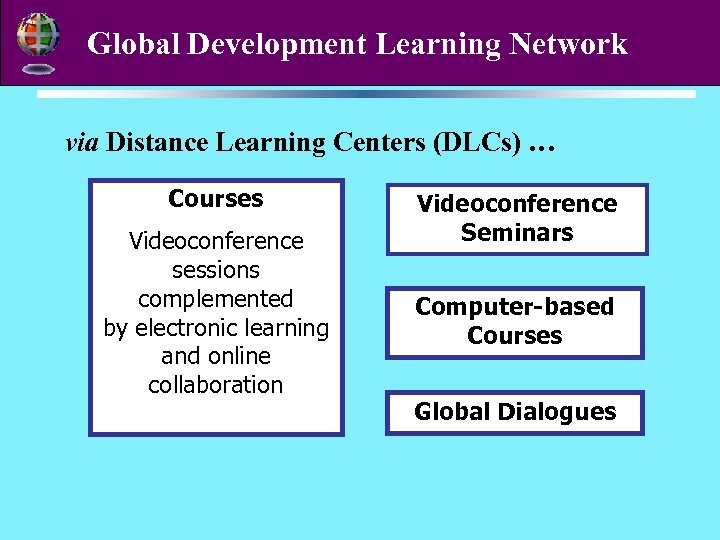
Global Development Learning Network via Distance Learning Centers (DLCs) … Courses Videoconference sessions complemented by electronic learning and online collaboration Videoconference Seminars Computer-based Courses Global Dialogues
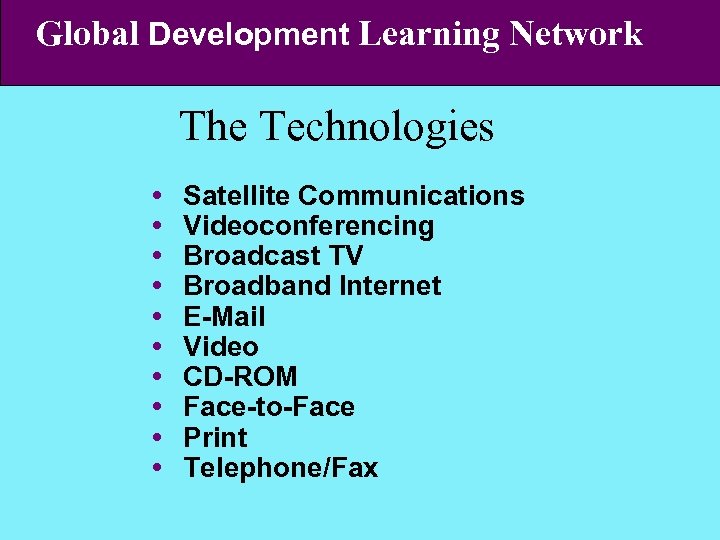
Global Development Learning Network The Technologies Satellite Communications Videoconferencing Broadcast TV Broadband Internet E-Mail Video CD-ROM Face-to-Face Print Telephone/Fax
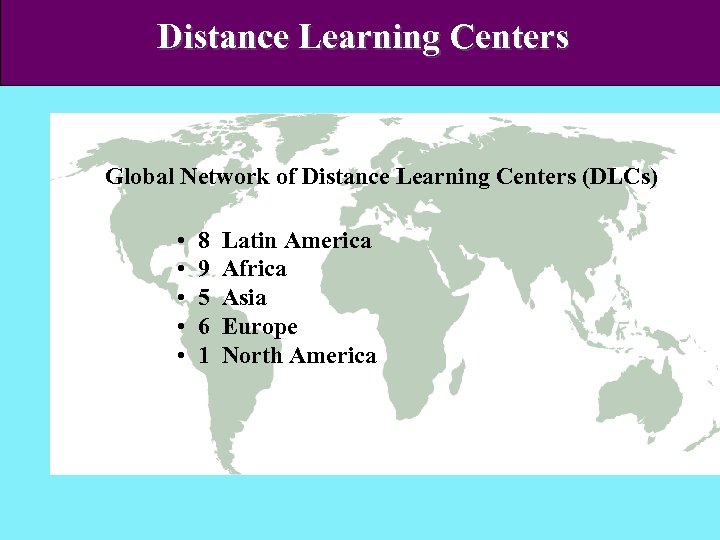
Distance Learning Centers Global Network of Distance Learning Centers (DLCs) • • • 8 9 5 6 1 Latin America Africa Asia Europe North America
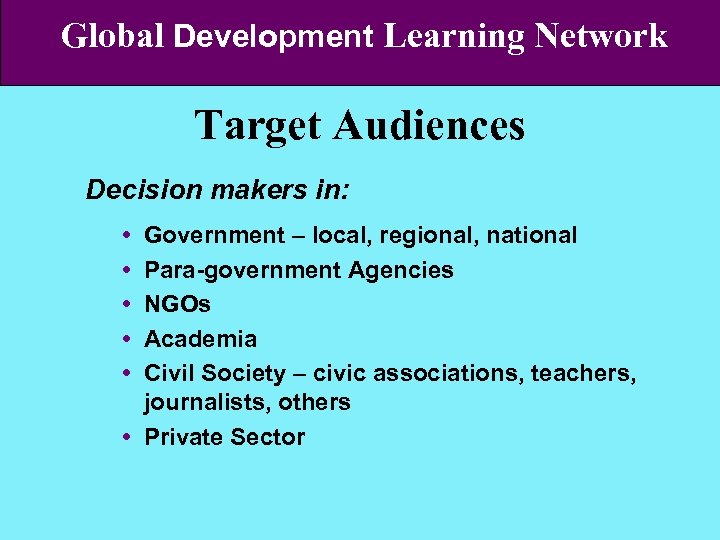
Global Development Learning Network Target Audiences Decision makers in: Government – local, regional, national Para-government Agencies NGOs Academia Civil Society – civic associations, teachers, journalists, others Private Sector
GDLN Strategic Approach • Reach wider audiences • Offer content from a wide range of sources • Reach a critical mass of participants to effect change • Extend the reach of existing knowledge and learning institutions • Network of networks
GDLN Today Distance Learning Centers 32 + today 50 + by mid 2003 Program Partners -- 60 + Project Partners – expanding the network Learners -- from 40, 000 to 150, 000 by mid 2002 (330, 000 participant days) All connected via telecommunications networks
Global Development Learning Network GDLN Impacts So Far Increased knowledge sharing and improved decision-making through interactive learning (HIV/AIDS, education, ICT training…) Enhanced country-to-country exchanges among experts, peers, and practitioners More cost-effective course delivery But we have a lot to learn about distance learning for development professionals.
Global Development Learning Network Opportunities for Partnership • Provide programs that draw on development knowledge and experience • Support DLCs in their own program development • Set up distance learning centers • Support GDLN Central Operations Network of networks = tremendous outreach potential
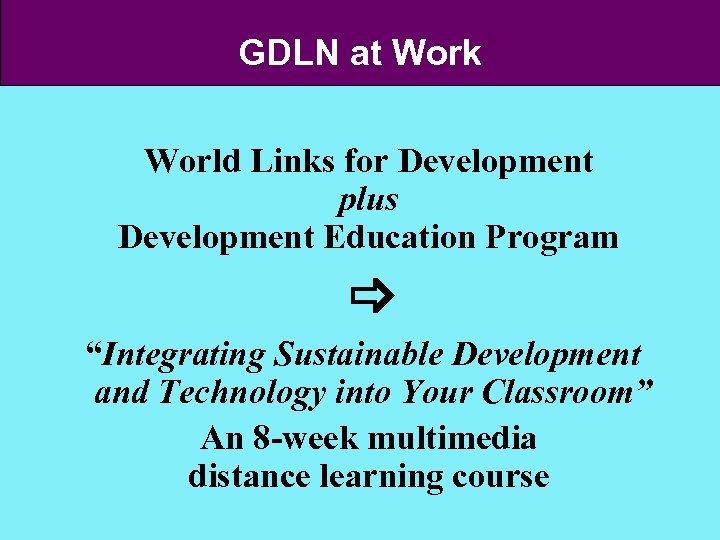
GDLN at Work World Links for Development plus Development Education Program “Integrating Sustainable Development and Technology into Your Classroom” An 8 -week multimedia distance learning course
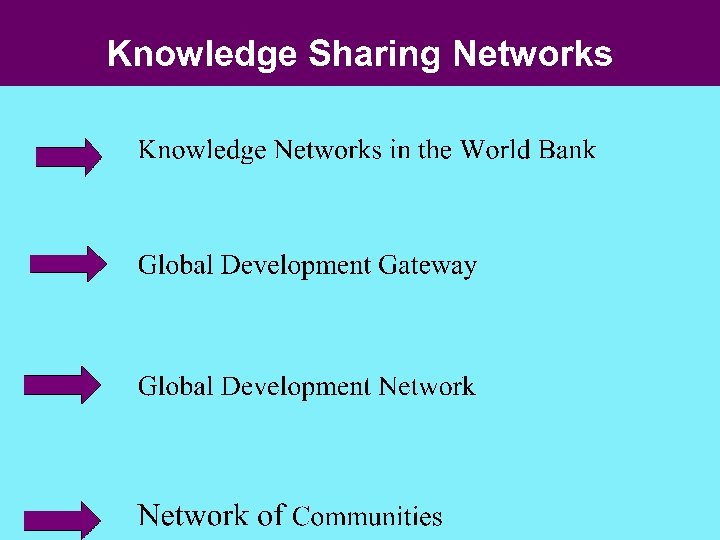
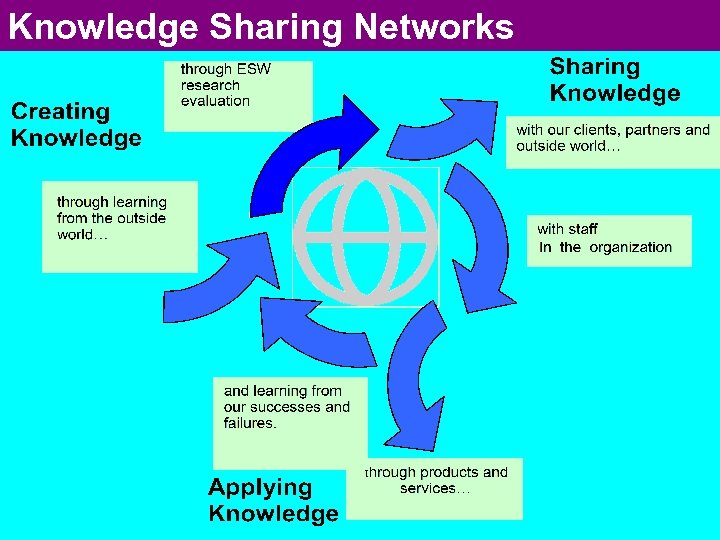
Knowledge Sharing Networks
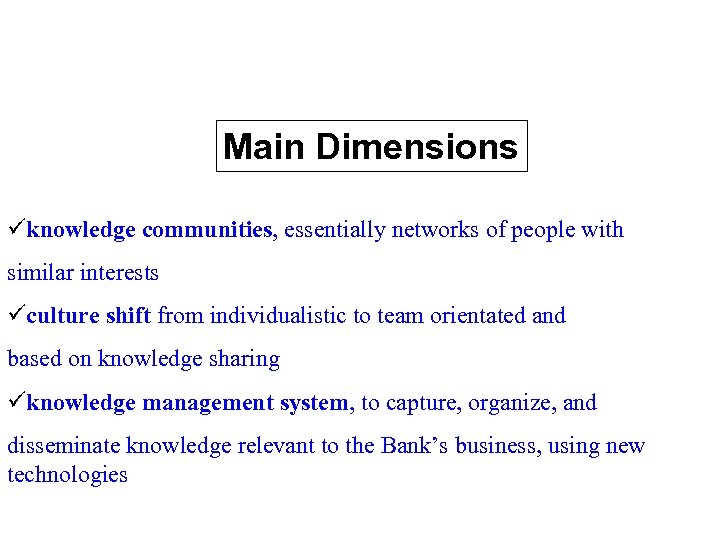
Main Dimensions üknowledge communities, essentially networks of people with similar interests üculture shift from individualistic to team orientated and based on knowledge sharing üknowledge management system, to capture, organize, and disseminate knowledge relevant to the Bank’s business, using new technologies
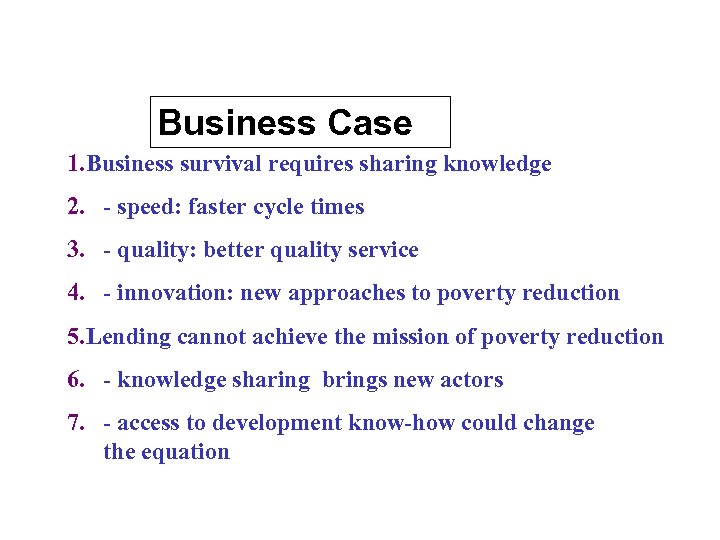
Business Case 1. Business survival requires sharing knowledge 2. - speed: faster cycle times 3. - quality: better quality service 4. - innovation: new approaches to poverty reduction 5. Lending cannot achieve the mission of poverty reduction 6. - knowledge sharing brings new actors 7. - access to development know-how could change the equation
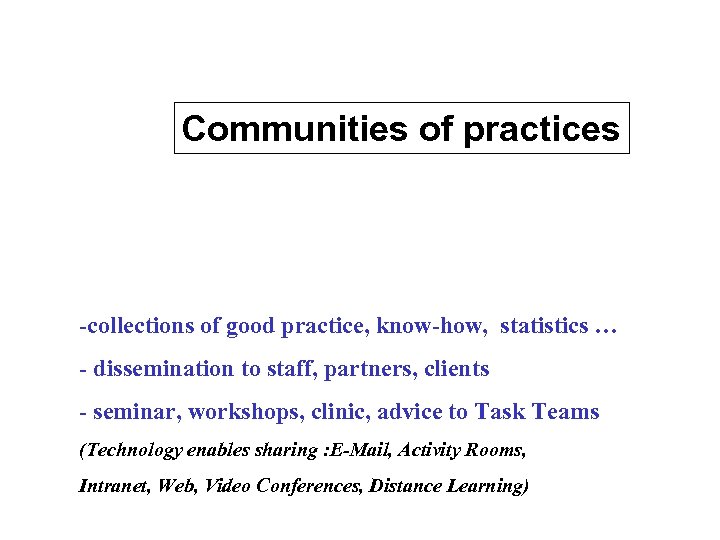
Communities of practices -collections of good practice, know-how, statistics … - dissemination to staff, partners, clients - seminar, workshops, clinic, advice to Task Teams (Technology enables sharing : E-Mail, Activity Rooms, Intranet, Web, Video Conferences, Distance Learning)
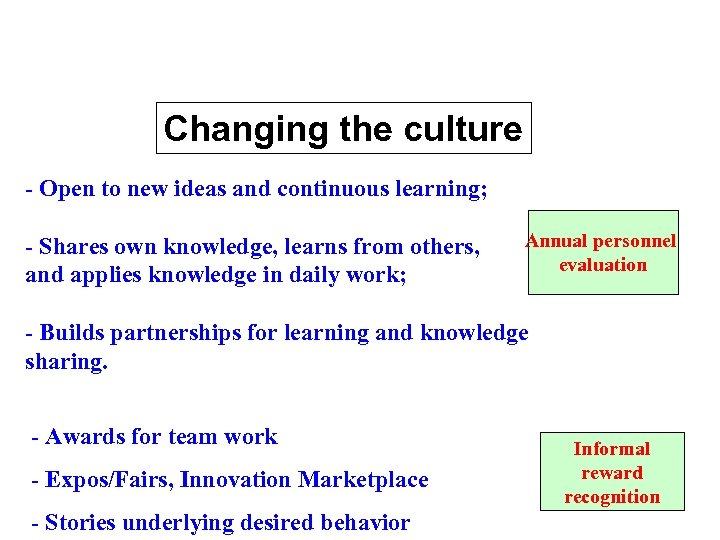
Changing the culture - Open to new ideas and continuous learning; - Shares own knowledge, learns from others, and applies knowledge in daily work; Annual personnel evaluation - Builds partnerships for learning and knowledge sharing. - Awards for team work - Expos/Fairs, Innovation Marketplace - Stories underlying desired behavior Informal reward recognition
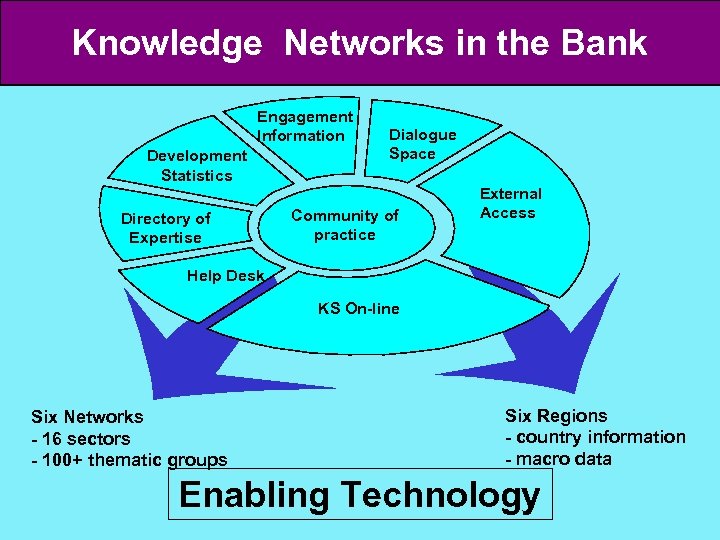
Knowledge Networks in the Bank Engagement Information Development Statistics Directory of Expertise Dialogue Space Community of practice External Access Help Desk KS On-line Six Networks - 16 sectors - 100+ thematic groups Six Regions - country information - macro data Enabling Technology
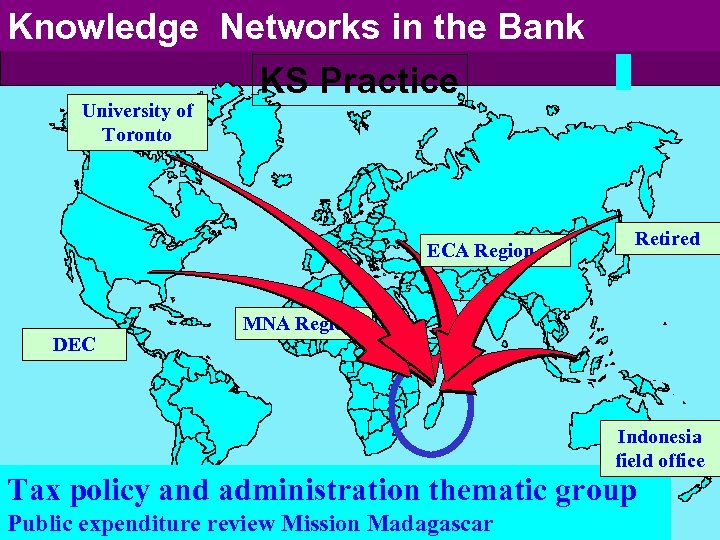
Knowledge Networks in the Bank KS Practice University of Toronto ECA Region DEC Retired MNA Region Indonesia field office Tax policy and administration thematic group Public expenditure review Mission Madagascar
- Solve development problems by sharing high-quality information from local, national and global sources, tailored to users’ needs by topic and community, quickly and easily. - A platform to facilitate the establishment of common standards for the exchange of information among the development community - Expanded opportunities for building and sharing knowledge and experience in and among developing countries
Partnerships - core of the Gateway business model - public and private sector organizations, and civil society collaborators - partner organizations are a key element in content development and quality assurance - partners provide technology support (SAP) Financial support

Thank You!
Скачать презентацию World Bank Group E-LEARNING STRATEGIES Samia Melhem Learntec
411be3931f3b019efa65832180100d8c.ppt