 Скачать презентацию Workshop on Veterinary border control AGR 31220 PODGORICA
175b7cfaeeb1850d96c4df8ebae7e6ed.ppt
- Количество слайдов: 21



Workshop on Veterinary border control AGR 31220 PODGORICA, ME 24 – 25 February 2009 PRACTICAL CASES Georgi Agov, BIP Varna 1
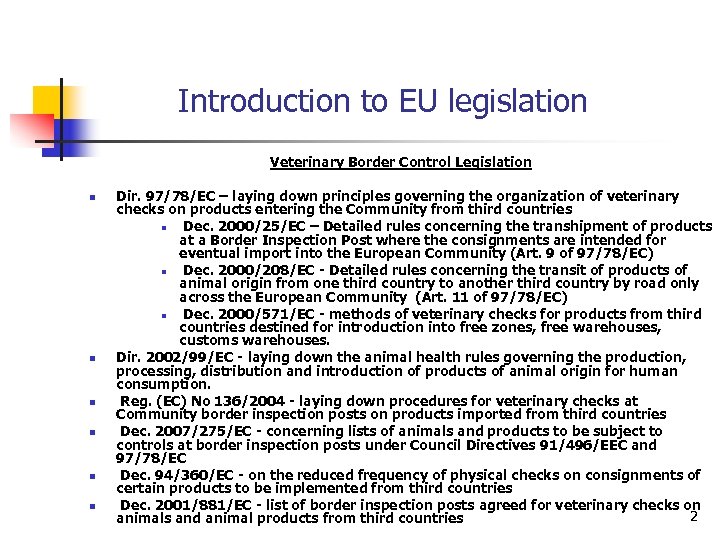
Introduction to EU legislation Veterinary Border Control Legislation n n n Dir. 97/78/EC – laying down principles governing the organization of veterinary checks on products entering the Community from third countries n Dec. 2000/25/EC – Detailed rules concerning the transhipment of products at a Border Inspection Post where the consignments are intended for eventual import into the European Community (Art. 9 of 97/78/EC) n Dec. 2000/208/EC - Detailed rules concerning the transit of products of animal origin from one third country to another third country by road only across the European Community (Art. 11 of 97/78/EC) n Dec. 2000/571/EC - methods of veterinary checks for products from third countries destined for introduction into free zones, free warehouses, customs warehouses. Dir. 2002/99/EC - laying down the animal health rules governing the production, processing, distribution and introduction of products of animal origin for human consumption. Reg. (EC) No 136/2004 - laying down procedures for veterinary checks at Community border inspection posts on products imported from third countries Dec. 2007/275/EC - concerning lists of animals and products to be subject to controls at border inspection posts under Council Directives 91/496/EEC and 97/78/EC Dec. 94/360/EC - on the reduced frequency of physical checks on consignments of certain products to be implemented from third countries Dec. 2001/881/EC - list of border inspection posts agreed for veterinary checks on 2 animals and animal products from third countries
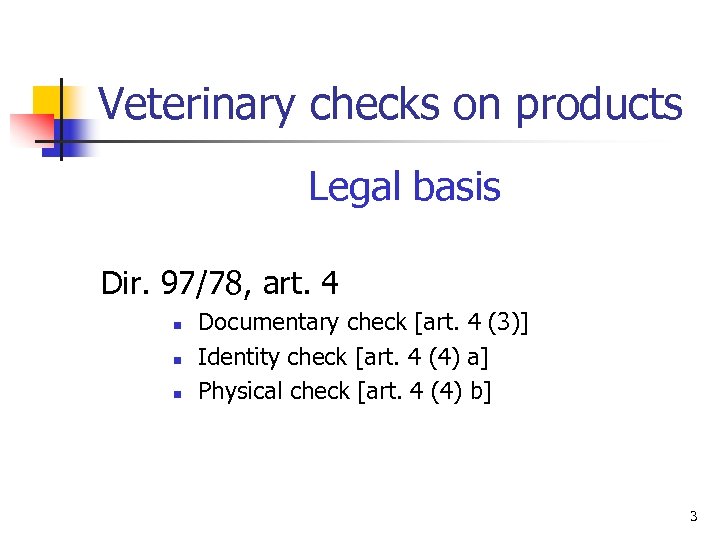
Veterinary checks on products Legal basis Dir. 97/78, art. 4 n n n Documentary check [art. 4 (3)] Identity check [art. 4 (4) a] Physical check [art. 4 (4) b] 3
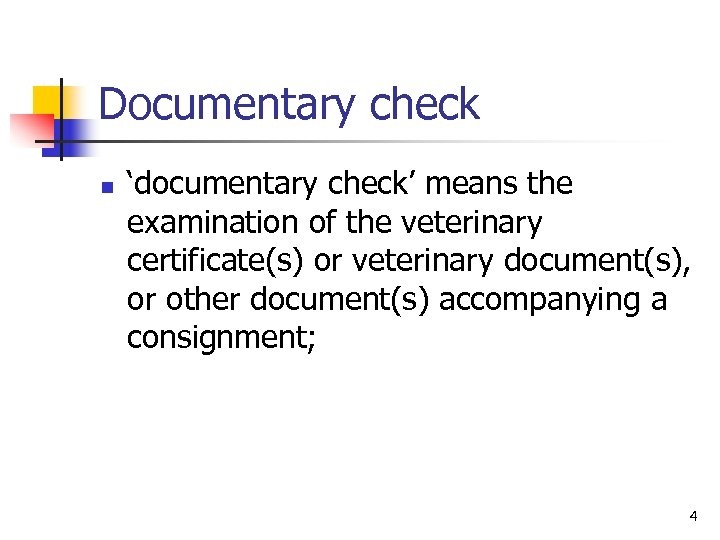
Documentary check n ‘documentary check’ means the examination of the veterinary certificate(s) or veterinary document(s), or other document(s) accompanying a consignment; 4
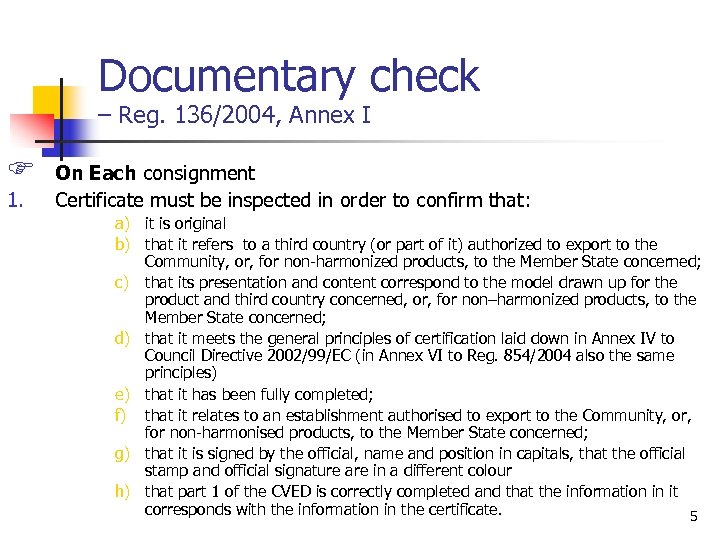
Documentary check – Reg. 136/2004, Annex I F 1. On Each consignment Certificate must be inspected in order to confirm that: a) it is original b) that it refers to a third country (or part of it) authorized to export to the Community, or, for non-harmonized products, to the Member State concerned; c) that its presentation and content correspond to the model drawn up for the product and third country concerned, or, for non–harmonized products, to the Member State concerned; d) that it meets the general principles of certification laid down in Annex IV to Council Directive 2002/99/EC (in Annex VI to Reg. 854/2004 also the same principles) e) that it has been fully completed; f) that it relates to an establishment authorised to export to the Community, or, for non-harmonised products, to the Member State concerned; g) that it is signed by the official, name and position in capitals, that the official stamp and official signature are in a different colour h) that part 1 of the CVED is correctly completed and that the information in it corresponds with the information in the certificate. 5
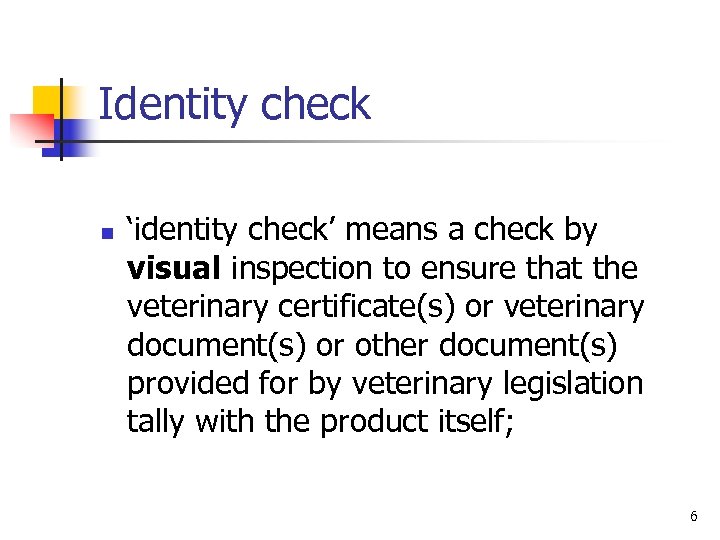
Identity check n ‘identity check’ means a check by visual inspection to ensure that the veterinary certificate(s) or veterinary document(s) or other document(s) provided for by veterinary legislation tally with the product itself; 6
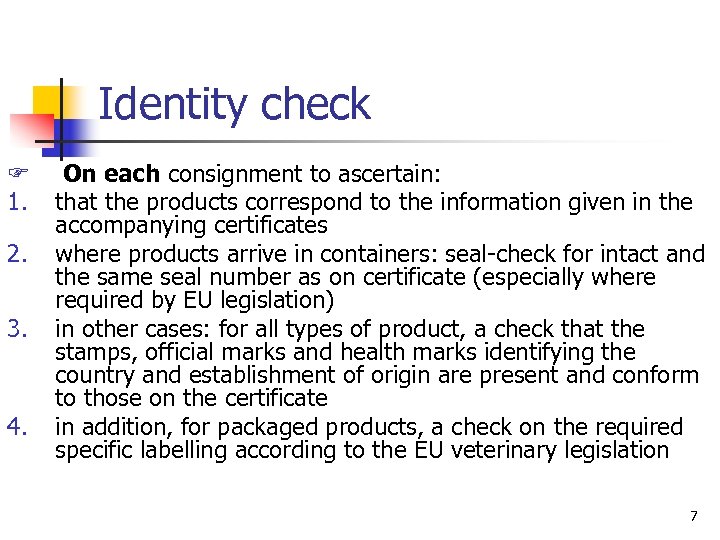
Identity check F 1. 2. 3. 4. On each consignment to ascertain: that the products correspond to the information given in the accompanying certificates where products arrive in containers: seal-check for intact and the same seal number as on certificate (especially where required by EU legislation) in other cases: for all types of product, a check that the stamps, official marks and health marks identifying the country and establishment of origin are present and conform to those on the certificate in addition, for packaged products, a check on the required specific labelling according to the EU veterinary legislation 7
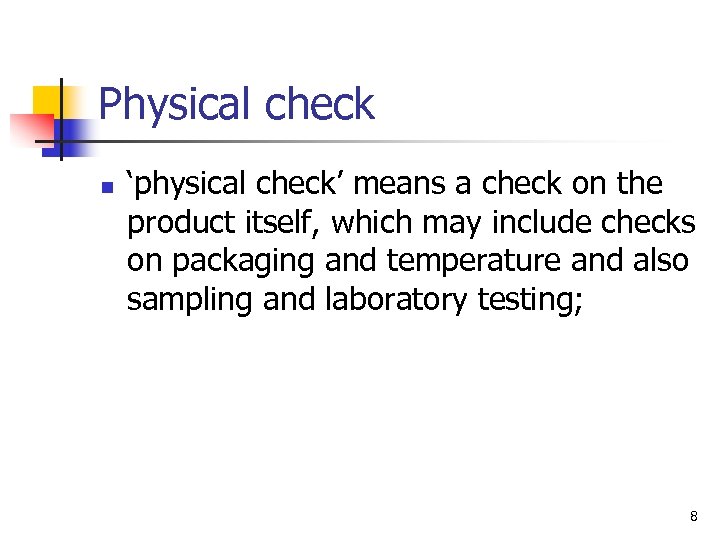
Physical check n ‘physical check’ means a check on the product itself, which may include checks on packaging and temperature and also sampling and laboratory testing; 8
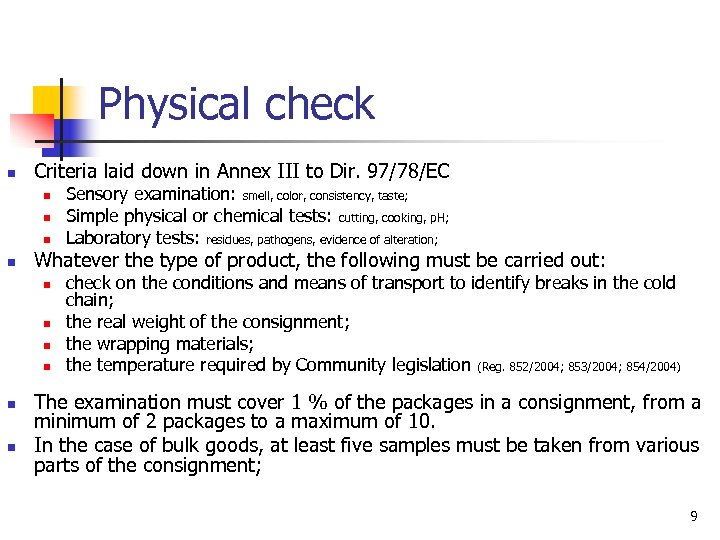
Physical check n Criteria laid down in Annex III to Dir. 97/78/EC n n Whatever the type of product, the following must be carried out: n n n Sensory examination: smell, color, consistency, taste; Simple physical or chemical tests: cutting, cooking, p. H; Laboratory tests: residues, pathogens, evidence of alteration; check on the conditions and means of transport to identify breaks in the cold chain; the real weight of the consignment; the wrapping materials; the temperature required by Community legislation (Reg. 852/2004; 853/2004; 854/2004) The examination must cover 1 % of the packages in a consignment, from a minimum of 2 packages to a maximum of 10. In the case of bulk goods, at least five samples must be taken from various parts of the consignment; 9
Physical check n Physical check can be: n Random or n Based on Suspicion 10
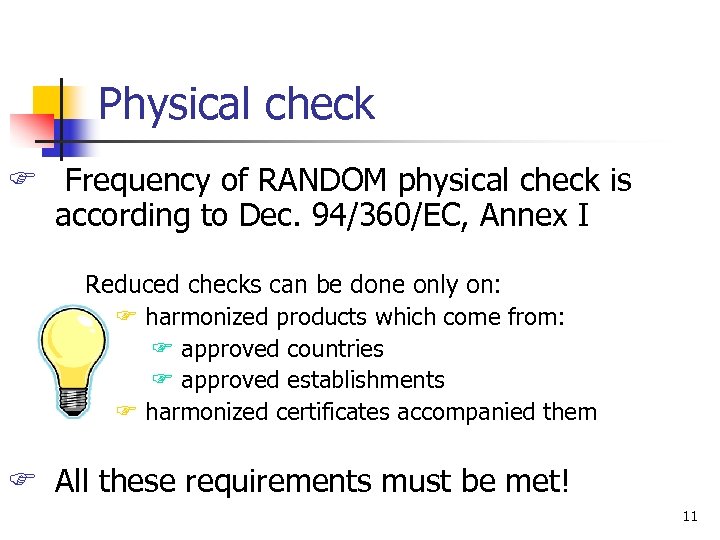
Physical check F Frequency of RANDOM physical check is according to Dec. 94/360/EC, Annex I Reduced checks can be done only on: F harmonized products which come from: F approved countries F approved establishments F harmonized certificates accompanied them F All these requirements must be met! 11
Physical check Ø Ø Suspicion physical checks are on the basis of irregularity, a previous RASFF notification or safeguard measures and usually they include taking samples. Any physical checks done in the context of suspicion are NOT random, so they do not take effect on the level of physical checks according to Dec. 94/360/EC in the framework of the usual physical checks! 12
Check procedure § § n n After checks – official seal on resealing containers (seal number on CVED) After veterinary checks are done: part 2 of the CVED have to be completed under the responsibility of the official veterinarian. Results of the checks will be filled in CVED The CVED for consignments to which veterinary clearance has been given shall consist of parts 1 and 2 together, properly 13 completed and signed by official veterinarian.
Practical cases 14
1. Import n Frozen chicken livers from Brazil n n Veterinary Certificate Pictures 15
2. Rejected consignment – Dir 97/78, art. 17) n Where the checks show that the consignment does not fulfill the import requirements, the official veterinarian, in consultation with person responsible for the load shall decide: n to redispatch the product outside the EU n n n redispatch must be from the same BIP, using the same means of transport, within a maximum time limit of 60 days, to destroy the products in the facilities provided for that purpose nearest to the BIP to make RASFF notification if it is needed 16
Rejected consignment n Frozen fish with double labeling from Morocco n n Veterinary Certificate CVED RASFF-notification Pictures 17
3. TRACES TRAINING n How to log in TRACES - TRAINING n n USER NAMES PASSWORDS 18
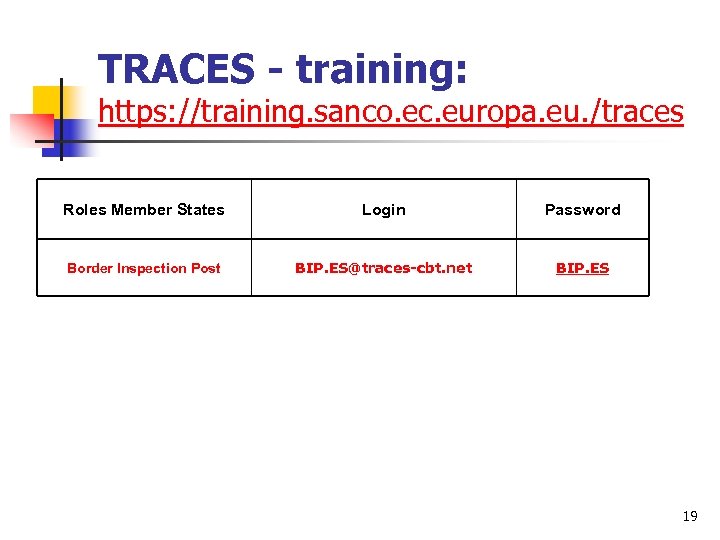
TRACES - training: https: //training. sanco. ec. europa. eu. /traces Roles Member States Login Password Border Inspection Post BIP. ES@traces-cbt. net BIP. ES 19
A few useful websites EUR-Lex – Access to European Union Law http: //eur-lex. europa. eu/en/index. htm TAIEX – Vet. Lex http: //vetlex. taiex. be/intros/main. htm TRACES - HELP http: //www. traces-cbt. net/en/toc. html European Commission - Food and Feed Safety http: //ec. europa. eu/food/index_en. htm DEFRA – Import requirements http: //www. defra. gov. uk/animalh/int-trde/imports/iins/index. htm GUIDANCE DOCUMENT http: //ec. europa. eu/food/controls/foodfeed/sampling_testing. 20 pdf

THANK YOU FOR YOUR ATTENTION ! 21
Скачать презентацию Workshop on Veterinary border control AGR 31220 PODGORICA
175b7cfaeeb1850d96c4df8ebae7e6ed.ppt