


 Скачать презентацию Workshop on the role of International Standards
00ccd1a412be7e4cdee4eccfc72e8a3e.ppt
- Количество слайдов: 30
 Workshop on the role of International Standards in Economic Development Use of Standards in the Textile Sector and the Challenges for the SMEs Presentation by The Pakistan Permanent Mission to the WTO
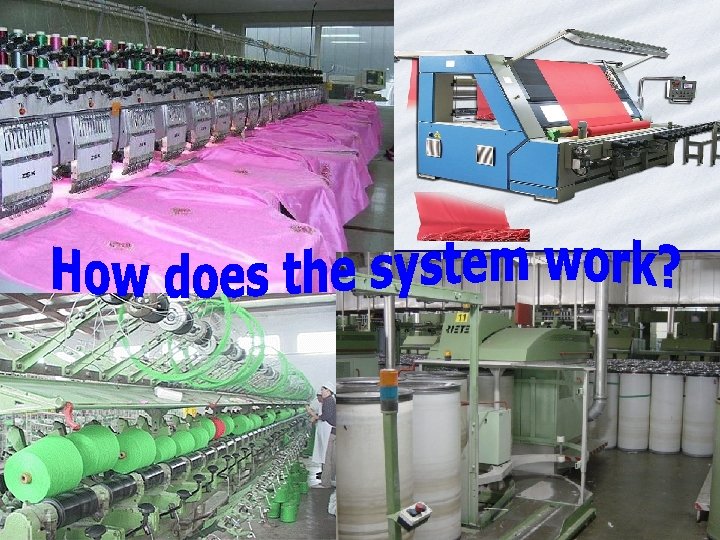
 HOW DOES THE SYSTEM WORK? HOW THE SYSTEM WORKS?
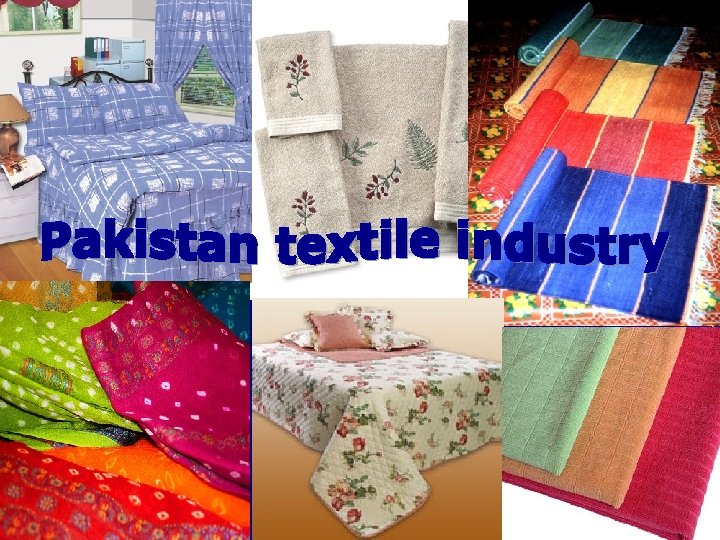
 Pakistan textile industry Textiles is the premier industry of Pakistan. Ø Major Agrarian industrial sector. Ø Generates about 60 % of exports Ø Constitutes 46 % of Manufacturing Industry Ø Employs 38 % of country’s work force Ø Contributes 8. 5% to the total GDP Ø Major products are cotton yarn, fabrics, bed wear, towels, woven & knit garments. Ø Drives Banking, Shipping , Transport , Insurance, Machinery, Dyes/Chemicals , Printing/Packaging & allied sectors.
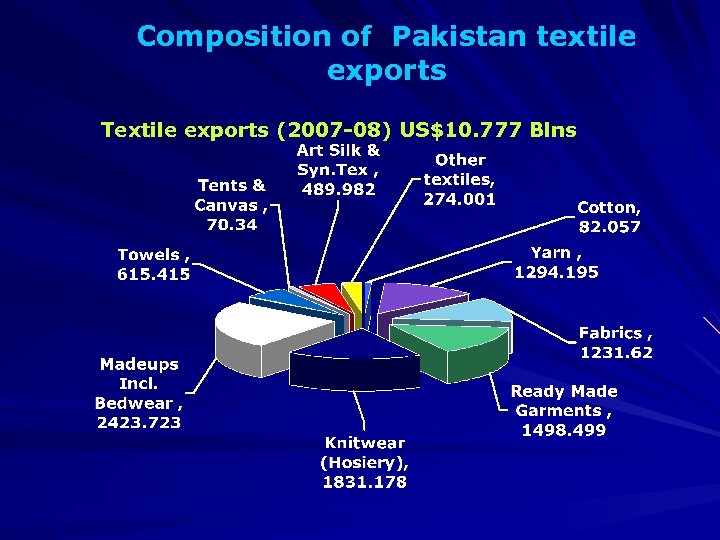 Composition of Pakistan textile exports Textile exports (2007 -08) US$10. 777 Blns
 SMEs the backbone of economy Role in the Textile Industry: v SMEs are involved at various stages of value chain i. e, gining, spining, weaving, processing, stitching, packing etc. v Labour intensive work therefore trained manpower and quality control mechanisms are extremely important v Case study of a Company and two clusters of SMEs
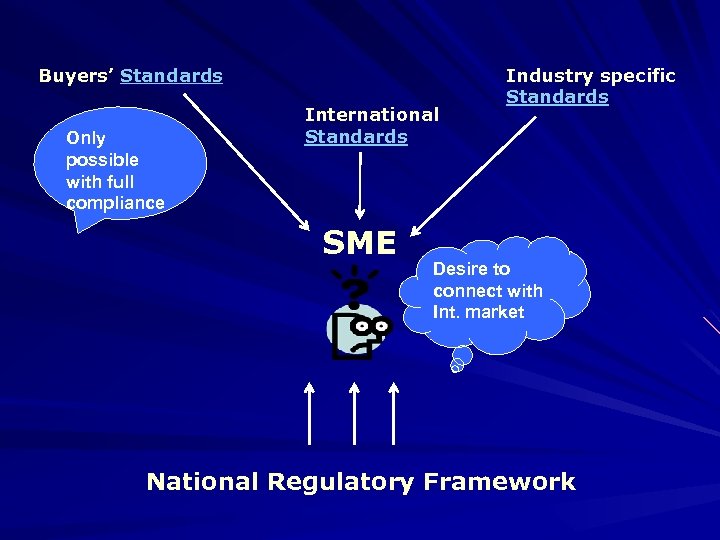 Buyers’ Standards Only possible with full compliance International Standards SME Industry specific Standards Desire to connect with Int. market National Regulatory Framework
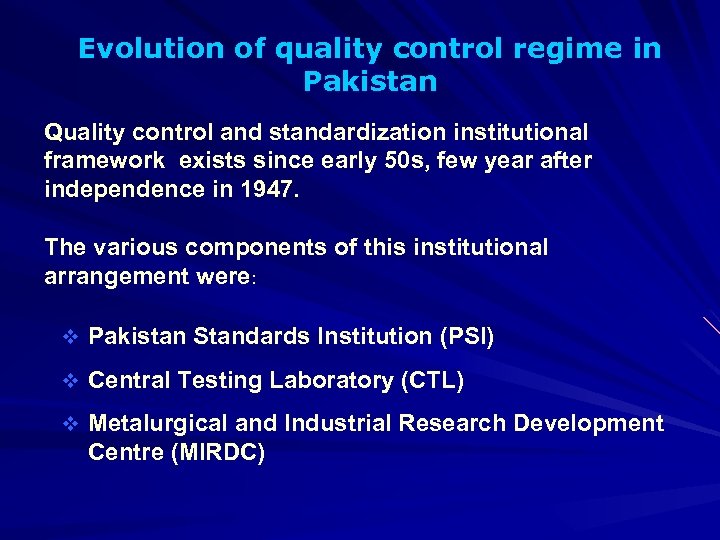 Evolution of quality control regime in Pakistan Quality control and standardization institutional framework exists since early 50 s, few year after independence in 1947. The various components of this institutional arrangement were: v Pakistan Standards Institution (PSI) v Central Testing Laboratory (CTL) v Metalurgical and Industrial Research Development Centre (MIRDC)
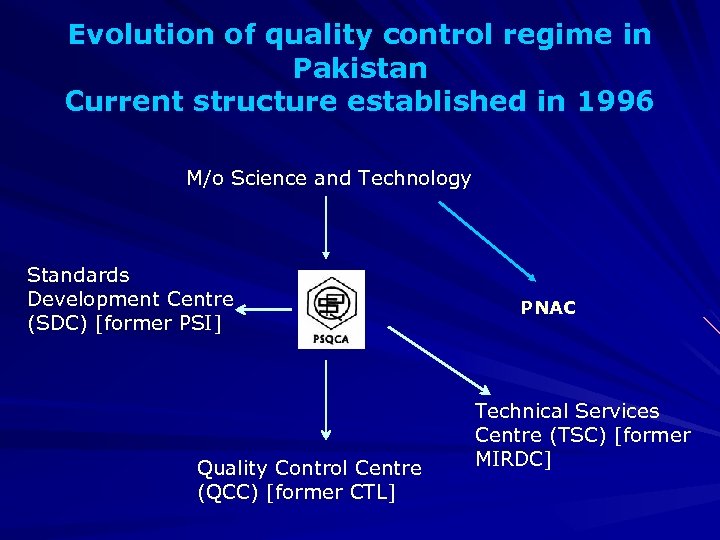 Evolution of quality control regime in Pakistan Current structure established in 1996 M/o Science and Technology Standards Development Centre (SDC) [former PSI] Quality Control Centre (QCC) [former CTL] PNAC Technical Services Centre (TSC) [former MIRDC]
 Pakistan’s global affiliation Signatory of MOU’s & MRA’s in the fields of Science & Technology, Standardization, Quality Assurance/Management, Product Certification and exchange of technical information, human resource development and capacity building to achieve the objectives of TBT Agreement: A) Between governments Pakistan and the sovereign Governments of Saudi Arabia, Morocco, Algeria, Sri Lanka B) PSQCA and another standardization bodies: Ø PSQCA and Turkish Standards Institution (TSE). Ø PSQCA and Yemen Authority for Specification, Standardization and Quality Control (YASSC). Ø MRA signed with SASO, ASTM International USA, DIN Germany, ANSI
 Pakistan’s global affiliation (Continued) C) Affiliation in progress between : Ø Pakistan and the sovereign Governments of Asia Cooperation Dialogue (ACD) Countries, Brunei Darussalam, Sultanate of Oman, Republic of South Africa, Kingdom of Jordan, India, Malaysia, Russian Federation, Norway, Peoples Republic of China Ø PSQCA and SIRIM QAS International, Malaysia. Ø PSQCA and Bangladesh Standards Testing Institution (BSTI).
 Institutional and regulatory support by the Government to protect environment v National Conservation Strategy (NCS) adopted in 1992 v The Environmental Protection Ordinance of 1983 was replaced by a new Act of Parliament in 1997 i. e. Pakistan Environmental Protection Act 1997 v The federal government offered incentives of reduction in customs duties on import of anti pollution equipment
 Pakistan National Accreditation Council Mission Statement PNAC strives for improvement, competence and integrity of conformity assessment bodies by providing them an internationally recognized accreditation service and also promote quality culture, which ultimately benefit the consumers, producers, regulators and other stakeholders. International Linkages PNAC represents Pakistan in the following regional and international forum: International Laboratory Accreditation Cooperation (ILAC) ► International Accreditation Forum (IAF) ► Asia Pacific Laboratory Accreditation Cooperation (APLAC) ► ► Pacific Accreditation Cooperation (PAC)
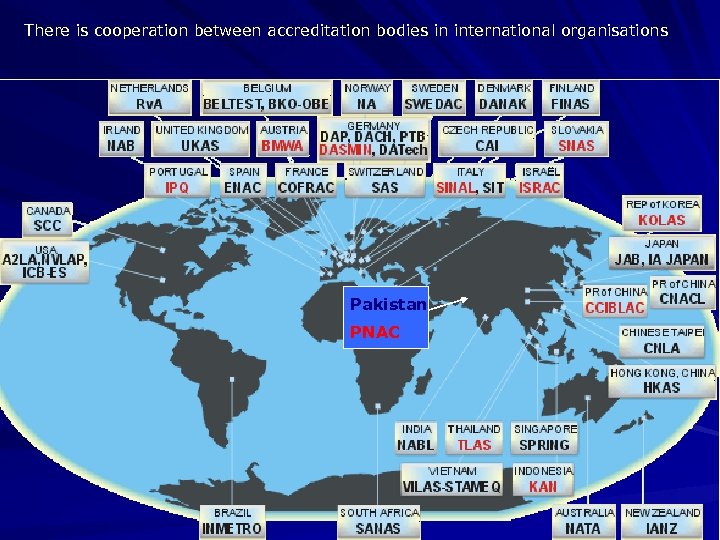 There is cooperation between accreditation bodies in international organisations Pakistan PNAC
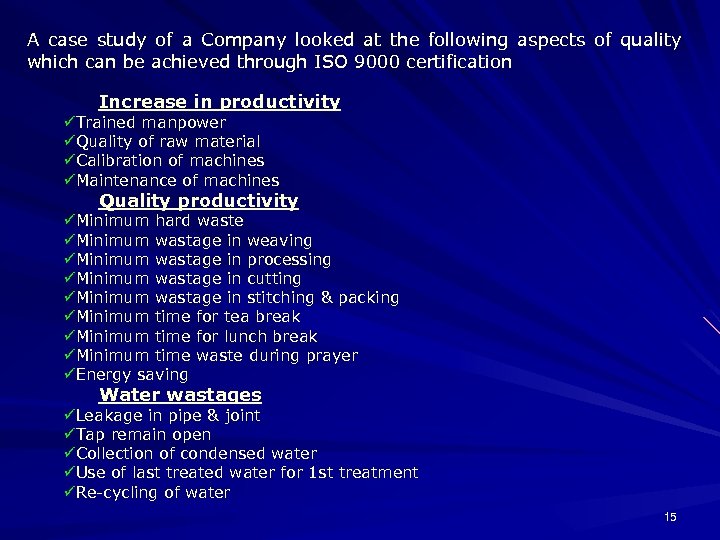 A case study of a Company looked at the following aspects of quality which can be achieved through ISO 9000 certification Increase in productivity üTrained manpower üQuality of raw material üCalibration of machines üMaintenance of machines Quality productivity üMinimum hard waste üMinimum wastage in weaving üMinimum wastage in processing üMinimum wastage in cutting üMinimum wastage in stitching & packing üMinimum time for tea break üMinimum time for lunch break üMinimum time waste during prayer üEnergy saving Water wastages üLeakage in pipe & joint üTap remain open üCollection of condensed water üUse of last treated water for 1 st treatment üRe-cycling of water 15
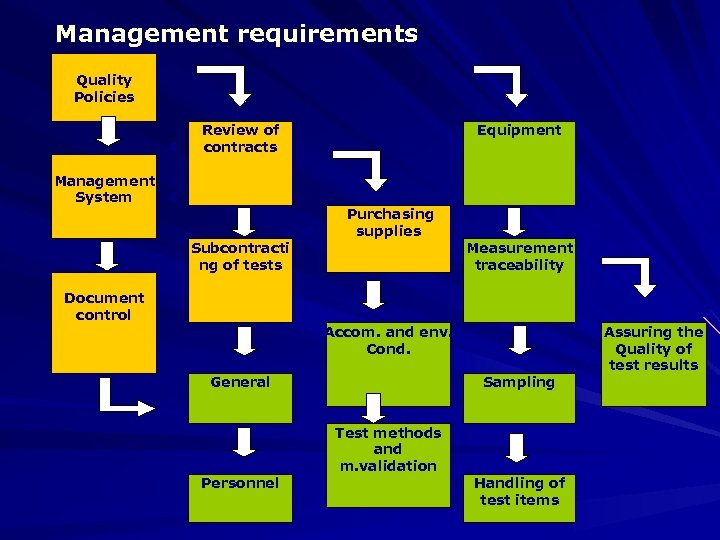 Management requirements Quality Policies 4 Management System 4 Document control Review of contracts Subcontracti 5 ng of tests 6 7 General 1 1 8 9 Personnel 10 Equipment Purchasing supplies 1 Measurement 2 traceability Accom. and env. Cond. 1 3 Sampling Test methods and m. validation 1 Handling of 4 test items Assuring the Quality of 15 test results
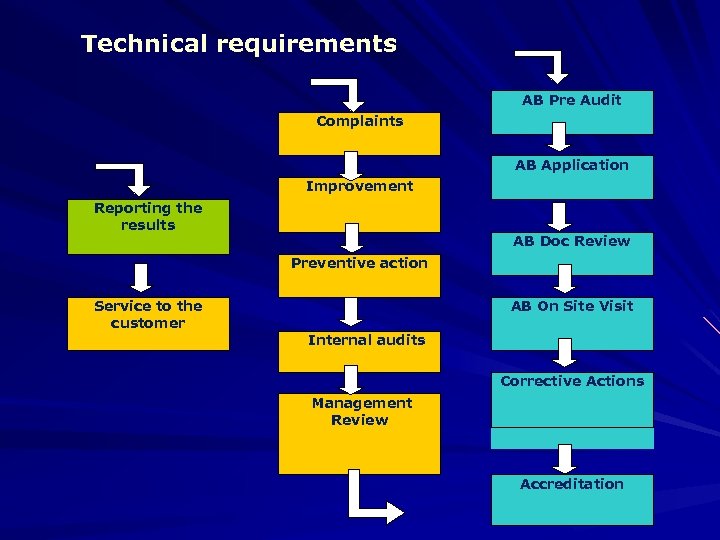 Technical requirements AB Pre Audit Complaints AB Application Improvement Reporting the results AB Doc Review Preventive action Service to the customer AB On Site Visit Internal audits Corrective Actions Management Review Accreditation
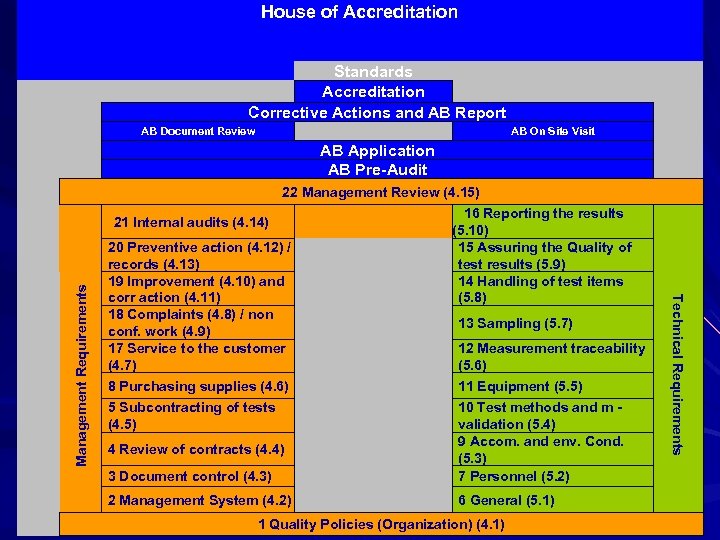 House of Accreditation Standards Accreditation Corrective Actions and AB Report AB Document Review AB On Site Visit AB Application AB Pre-Audit 21 Internal audits (4. 14) 20 Preventive action (4. 12) / records (4. 13) 19 Improvement (4. 10) and corr action (4. 11) 18 Complaints (4. 8) / non conf. work (4. 9) 17 Service to the customer (4. 7) 16 Reporting the results (5. 10) 15 Assuring the Quality of test results (5. 9) 14 Handling of test items (5. 8) 13 Sampling (5. 7) 12 Measurement traceability (5. 6) 8 Purchasing supplies (4. 6) 11 Equipment (5. 5) 5 Subcontracting of tests (4. 5) 10 Test methods and m validation (5. 4) 9 Accom. and env. Cond. (5. 3) 7 Personnel (5. 2) 4 Review of contracts (4. 4) 3 Document control (4. 3) 2 Management System (4. 2) 6 General (5. 1) 1 Quality Policies (Organization) (4. 1) Technical Requirements Management Requirements 22 Management Review (4. 15)
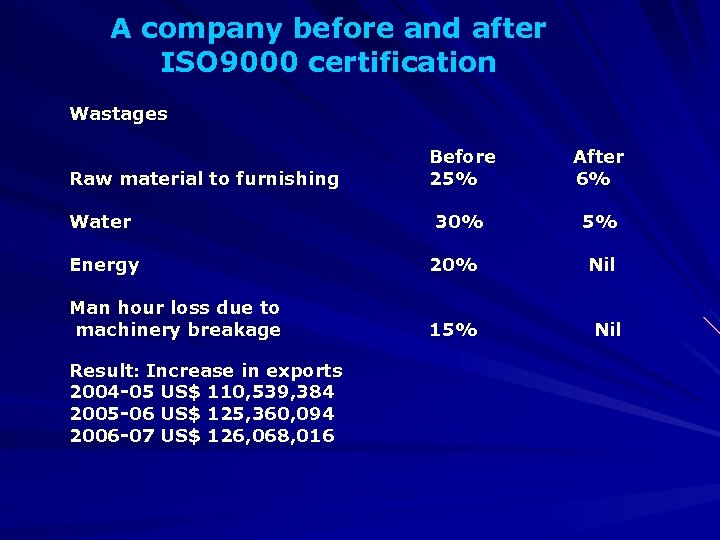 A company before and after ISO 9000 certification Wastages Raw material to furnishing Before After 25% 6% Water 30% 5% Energy 20% Nil Man hour loss due to machinery breakage 15% Nil Result: Increase in exports 2004 -05 US$ 110, 539, 384 2005 -06 US$ 125, 360, 094 2006 -07 US$ 126, 068, 016
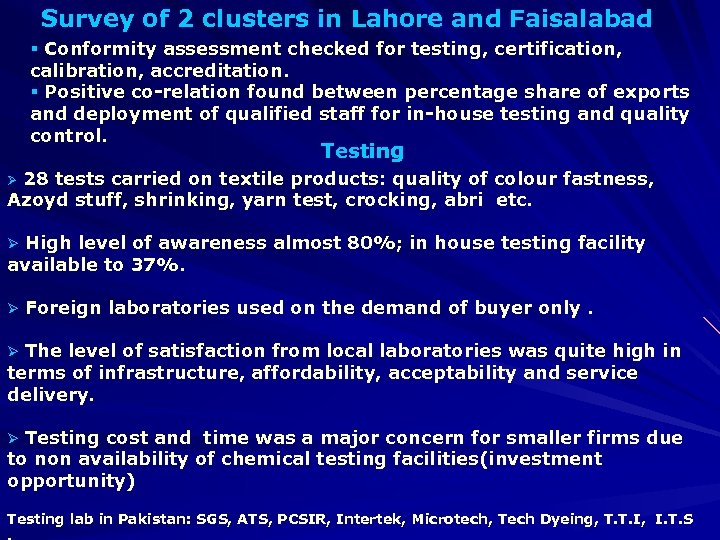 Survey of 2 clusters in Lahore and Faisalabad § Conformity assessment checked for testing, certification, calibration, accreditation. § Positive co-relation found between percentage share of exports and deployment of qualified staff for in-house testing and quality control. Testing Ø 28 tests carried on textile products: quality of colour fastness, Azoyd stuff, shrinking, yarn test, crocking, abri etc. Ø High level of awareness almost 80%; in house testing facility available to 37%. Ø Foreign laboratories used on the demand of buyer only. Ø The level of satisfaction from local laboratories was quite high in terms of infrastructure, affordability, acceptability and service delivery. Ø Testing cost and time was a major concern for smaller firms due to non availability of chemical testing facilities(investment opportunity) Testing lab in Pakistan: SGS, ATS, PCSIR, Intertek, Microtech, Tech Dyeing, T. T. I, I. T. S
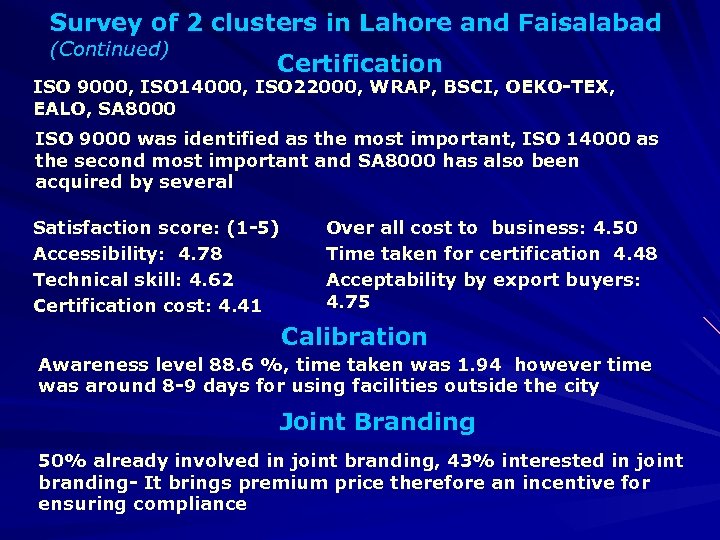 Survey of 2 clusters in Lahore and Faisalabad (Continued) Certification ISO 9000, ISO 14000, ISO 22000, WRAP, BSCI, OEKO-TEX, EALO, SA 8000 ISO 9000 was identified as the most important, ISO 14000 as the second most important and SA 8000 has also been acquired by several Satisfaction score: (1 -5) Accessibility: 4. 78 Technical skill: 4. 62 Certification cost: 4. 41 Over all cost to business: 4. 50 Time taken for certification 4. 48 Acceptability by export buyers: 4. 75 Calibration Awareness level 88. 6 %, time taken was 1. 94 however time was around 8 -9 days for using facilities outside the city Joint Branding 50% already involved in joint branding, 43% interested in joint branding- It brings premium price therefore an incentive for ensuring compliance
 Fields of determinations requested A. Care Label Instructions: Many countries have mandatory or voluntary standards for care label instructions that apply to either apparel or soft home furnishing products. Ø Colourfastness to bleaching Ø Dimensional stability Ø Appearance retention Ø Ironing (EU & US joint proposal on textile labelling in NAMA negotiation is supported by Pakistan)
 Fields of determinations requested (continued) B. Performance Testing: To meet specific performance standards that affect end use consumer of textile products, a variety of tests are required. Some of these tests includes: Ø Dimensional Stability to Washing and/or Dry- cleaning ØColourfastness to Light, Crocking (Rubbing), Washing, Bleaching, etc ØPhysical tests – Strength, Abrasion, Pilling Resistance, etc ØChemical Tests – Finish Analysis, p. H, etc
 Fields of determinations requested (continued) C. Eco – Textile Testing The trend of green consumerism has been extended to textile and apparel products. Major European and USA textile product buyers have responded to this public awareness by viewing their textile products from an ecological viewpoint and are establishing relevant requirements. Chemical analysis for Eco. Testing includes: Ø Banned Azo Colorants Ø Formaldehyde Content Ø Heavy Metal Residues Ø Dye testing to carcinogenic compounds Ø Pesticide Residue
 Fields of determinations requested (continued) D. FLAMMABILITY TESTING For apparel, it is especially important that the material used are in compliance with the flammability regulations. In particular, adult apparel and children’s sleeper.
 Importance of SMEs in Pakistan Ø About 3. 2 million business establishments exist in Pakistan. Ø Out of which 99% are SMEs. Ø They contribute 30% to GDP and 25% to export. 26
 Recommendations 1. Harmonization of all private standards 2. Harmonization of private standards with international standards where ever possible 3. Cluster development of SMEs through 3 C approach Competitive cluster conformity connectivity with the market 4. Incentives from the national governments to promote compliance, i. e. duty free import of equipment, tax breaks, exemption from sales tax, national reward system and SME of the year etc. 5. Institutional support-SMEDA in Pakistan
 Recommendations (Continued) 5. Best use of Aid for Trade(skill development, mobile vans with training equipment, strengthening of testing labs-chemical) 6. Effective participation of SME sector in the standard setting process 7. Effective implementation of special and differential treatment provisions (article 12 of TBT) for developing countries 8. See things in a context, ban on trade is not a solution. Country specific solution is another option(TA under Article 11 of TBT) 9. Promote public-private investment for establishing testing laboratories
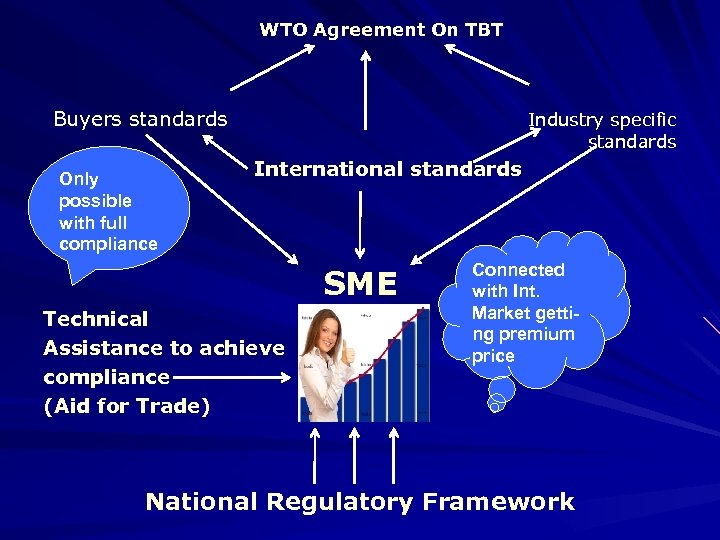 WTO Agreement On TBT Buyers standards Only possible with full compliance Industry specific standards International standards SME Technical Assistance to achieve compliance (Aid for Trade) Connected with Int. Market getting premium price National Regulatory Framework
 THANK YOU