


 Скачать презентацию Workshop on the implementation of the Construction Products
744f8ca390ae7533ecb14dc069fe2c6e.ppt
- Количество слайдов: 67
 Workshop on the implementation of the Construction Products Regulation Declaration of Performance and CE marking Amilcar da Costa 2014 -04 -28
 European Standardization Organizations (ESOs) CEN. . . . (European Committee for Standardization) CENELEC. . . (European Committee for Electrotechnical Standardization) ETSI. . . . (European Telecommunications Standards Institute)
 Sectors Electricity – Electrotechnical Chemistry Material Food Energy European Committee for Electrotechnical Standardization Electronic Communications Services Transport Mechanical engineering HVAC Space Metrology Healthcare Construction Environment European Telecommunications Standards Institute Information society Security and defence European Committee for Standardization
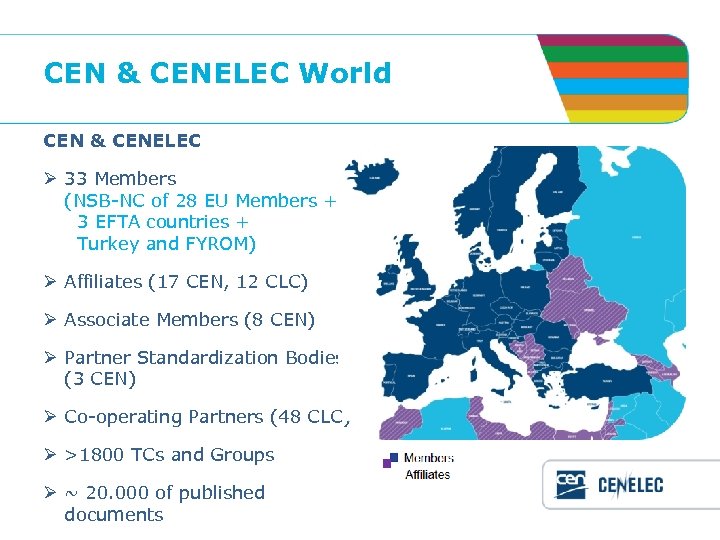 CEN & CENELEC World CEN & CENELEC Ø 33 Members (NSB-NC of 28 EU Members + 3 EFTA countries + Turkey and FYROM) Ø Affiliates (17 CEN, 12 CLC) Ø Associate Members (8 CEN) Ø Partner Standardization Bodies (3 CEN) Ø Co-operating Partners (48 CLC) Ø >1800 TCs and Groups Ø ~ 20. 000 of published documents
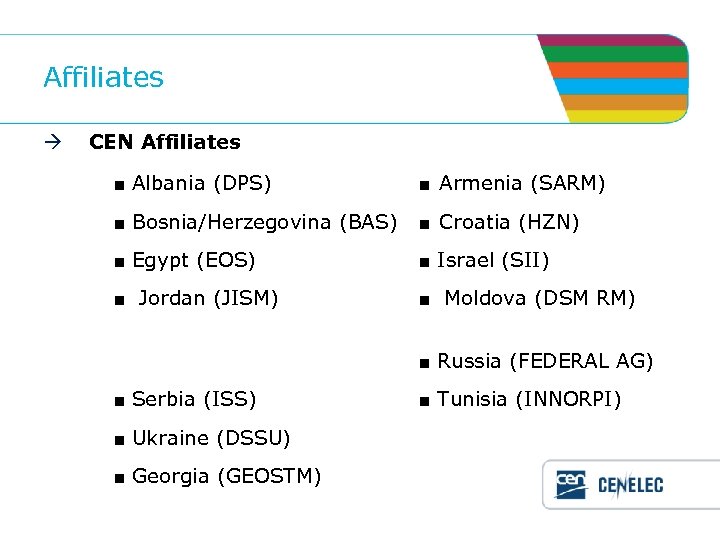 Affiliates CEN Affiliates ■ Albania (DPS) ■ Armenia (SARM) ■ Bosnia/Herzegovina (BAS) ■ Croatia (HZN) ■ Egypt (EOS) ■ Israel (SII) ■ Jordan (JISM) ■ Moldova (DSM RM) ■ Russia (FEDERAL AG) ■ Serbia (ISS) ■ Ukraine (DSSU) ■ Georgia (GEOSTM) ■ Tunisia (INNORPI)
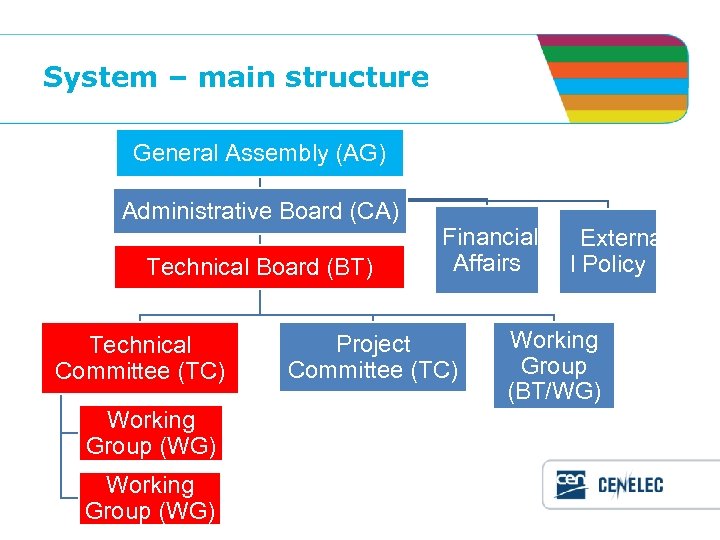 System – main structure General Assembly (AG) Administrative Board (CA) Technical Board (BT) Technical Committee (TC) Working Group (WG) Financial Affairs Project Committee (TC) Externa l Policy Working Group (BT/WG)
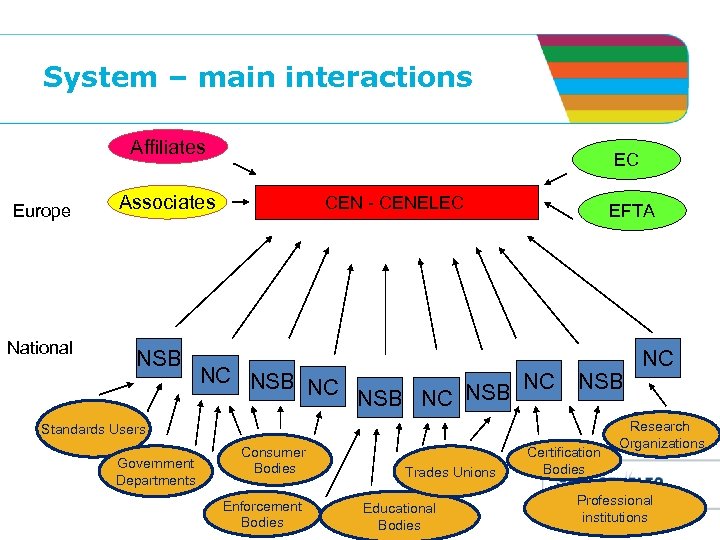 System – main interactions Affiliates Europe National EC Associates NSB CEN - CENELEC NC NSB EFTA NC NSB Standards Users Government Departments Consumer Bodies Enforcement Bodies Trades Unions Educational Bodies Certification Bodies NC Research Organizations Professional institutions
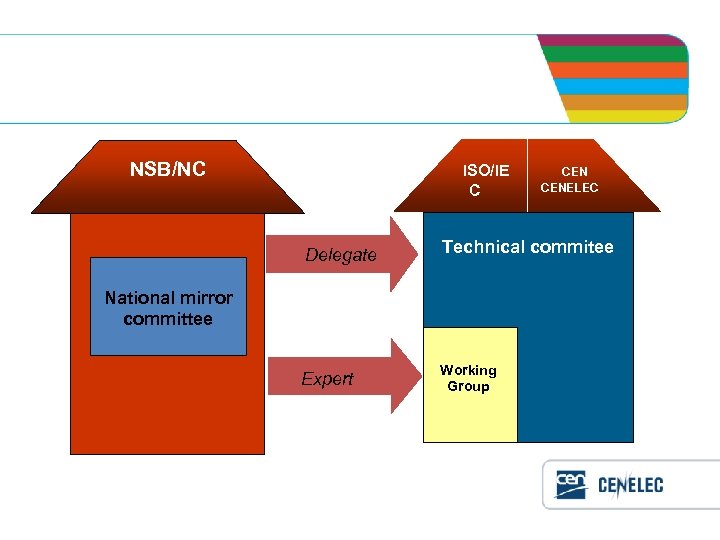 ISO/IE NSB/NC C Delegate CENELEC Technical commitee National mirror committee Expert CEN Working Group
 CEN & CENELEC All National Members are members of all TCs • Official languages are English, French and German • Development through discussion leading to consensus • Final decisions reached by weighted vote • Standards shall be adopted as National Standards even if the country has voted against the draft standard
 CEN/CENELEC Deliverables Standards • European Standard – EN Pre-Standards • Technical Specification - TS Informative • Technical Report - TR • CEN/CENELEC Guide Workshop Agreement • CEN/CENELEC Workshop Agreement (CWA)
 Main principles of European standardization Voluntary: Standards are voluntary in application Openness and transparency: Open to participation of all interested parties and broad consultation Consensus: European consensus among all stakeholders National commitment: To implement European standards as identical national standards and withdraw conflicting national standards Market relevance: Reflect market needs Integration with international work: Cooperation with ISO (Vienna agreement); Cooperation with CENELEC (Dresden Agreement) 11
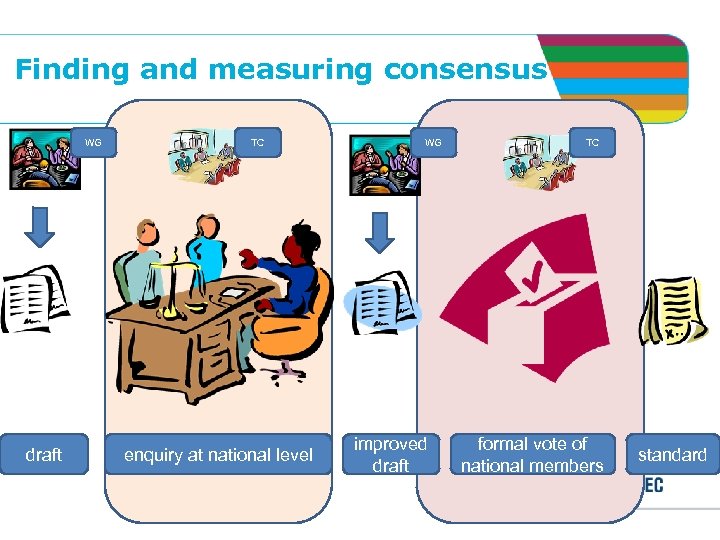 Finding and measuring consensus WG draft TC enquiry at national level WG improved draft TC formal vote of national members standard
 European standards are voluntary in that there is no obligation to apply them or comply with them, except in those few cases where their application is directly demanded by regulatory instruments. European standards are created in response to a demand with the active involvement of a wide range of stakeholders: whether purchasers, vendors, consumenrs, producers, academics and indeed regulators.
 Why is a European Standard so valuable? Strength and recognition because • Shaped by those who contribute • Open and transparent process • Market driven • Representation of all interested parties • Reached through agreement • One European Standard = 33 national standards = access to a market of over 600 million people
 Importance of ENs • To build the Single European Market • To help competitiveness and innovation Transfer of European research results • To strengthen regional influence in a global economy Export European knowhow • To enable access to the Single European Market Accession of new Members to the EU
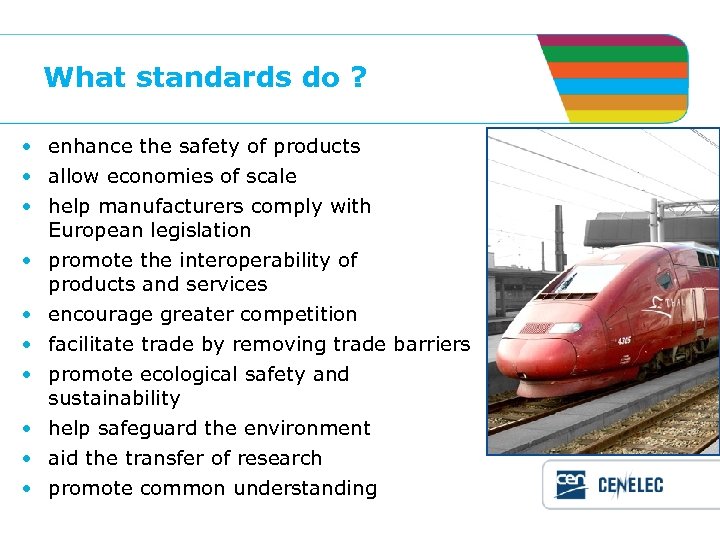 What standards do ? • enhance the safety of products • allow economies of scale • help manufacturers comply with European legislation • promote the interoperability of products and services • encourage greater competition • facilitate trade by removing trade barriers • promote ecological safety and sustainability • help safeguard the environment • aid the transfer of research • promote common understanding
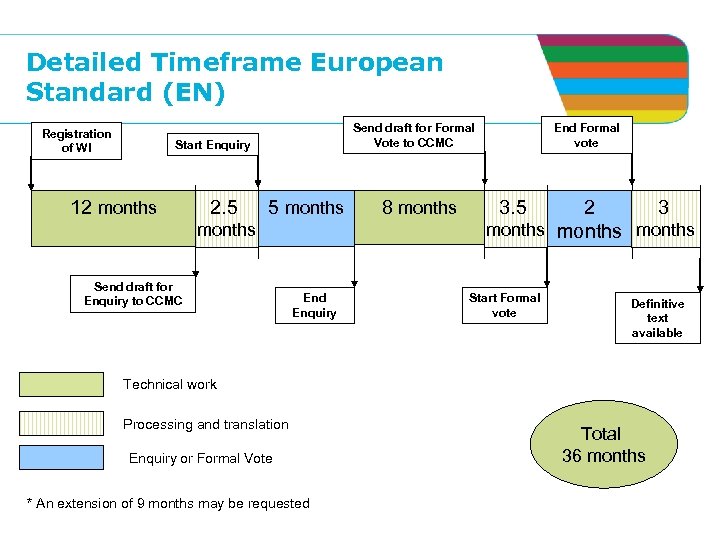 Detailed Timeframe European Standard (EN) Registration of WI Send draft for Formal Vote to CCMC Start Enquiry 12 months 2. 5 5 months Send draft for Enquiry to CCMC End Enquiry 8 months End Formal vote 2 3 months 3. 5 Start Formal vote Definitive text available Technical work Processing and translation Enquiry or Formal Vote * An extension of 9 months may be requested Total 36 months
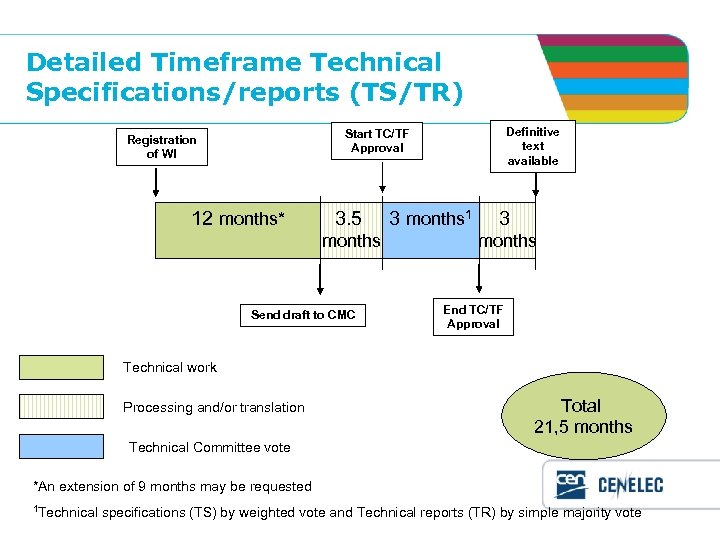 Detailed Timeframe Technical Specifications/reports (TS/TR) Definitive text available Start TC/TF Approval Registration of WI 12 months* 3. 5 months Send draft to CMC 3 months 1 3 months End TC/TF Approval Technical work Processing and/or translation Total 21, 5 months Technical Committee vote *An extension of 9 months may be requested 1 Technical specifications (TS) by weighted vote and Technical reports (TR) by simple majority vote
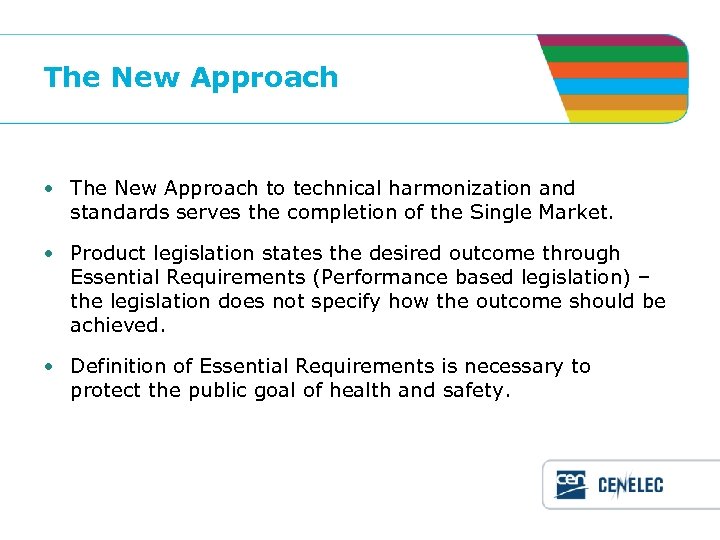 The New Approach • The New Approach to technical harmonization and standards serves the completion of the Single Market. • Product legislation states the desired outcome through Essential Requirements (Performance based legislation) – the legislation does not specify how the outcome should be achieved. • Definition of Essential Requirements is necessary to protect the public goal of health and safety.
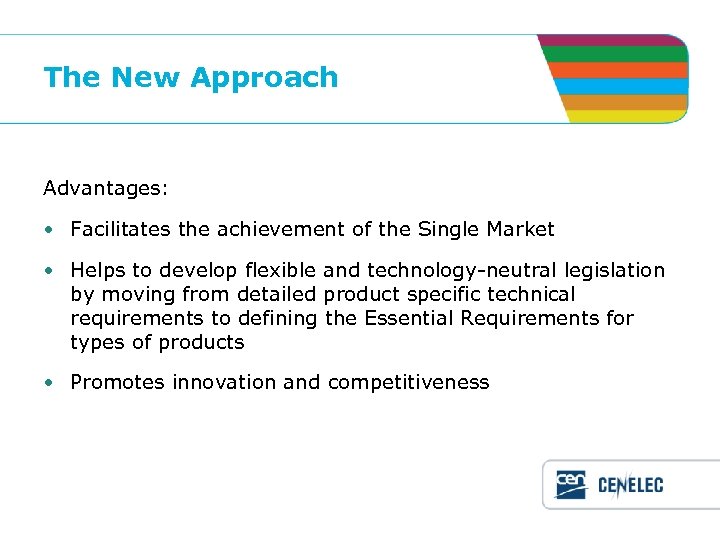 The New Approach Advantages: • Facilitates the achievement of the Single Market • Helps to develop flexible and technology-neutral legislation by moving from detailed product specific technical requirements to defining the Essential Requirements for types of products • Promotes innovation and competitiveness
 European standards and laws • European standardization supports policies and legislation such as environmental protection, trade and the Single Market • European Standards specify how to meet Essential Requirements set by laws • Products made according to (harmonized) European Standards (Ens) are presumed to comply with the Essential Requirements
 CE marking • Products made according to harmonized European Standards carry the CE marking • Such products have access to the European Union market • The CE marking affixing falls under the responsibility of of the relevant manufacturers
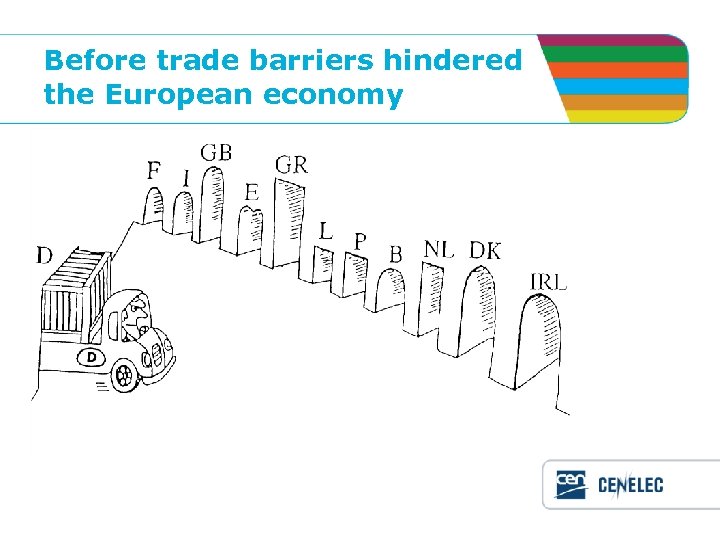 Before trade barriers hindered the European economy
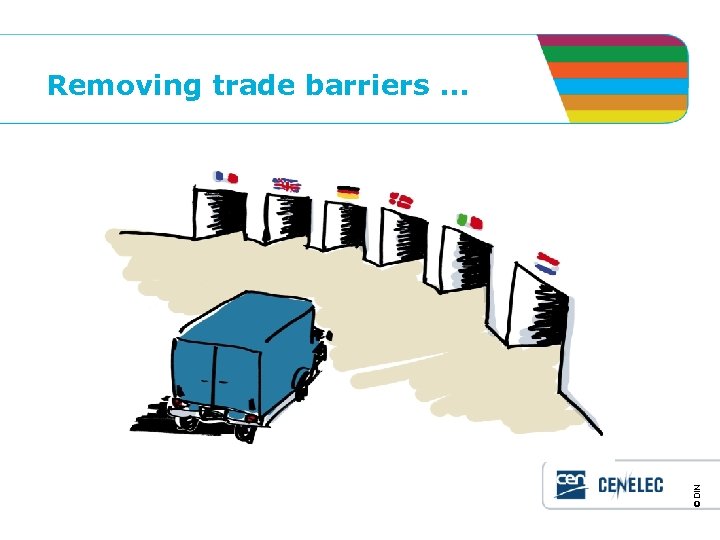 © DIN Removing trade barriers. . .
 Support to Union’s policies Through providing standards supporting: Directives, Regulations, e. g. New Approach, Public procurement, General Product Safety. Policies, e. g. efficient market (services, communications), safety (electrical apparatus and others), sustainable development, energy, new technologies, …
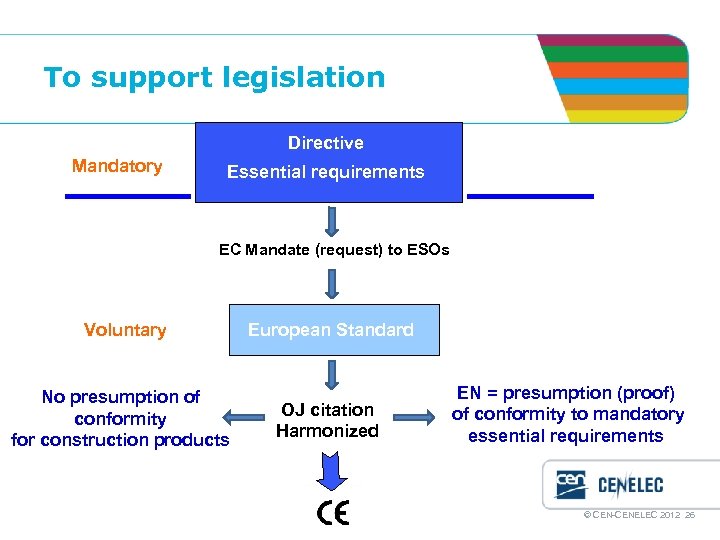 To support legislation Directive Mandatory Essential requirements EC Mandate (request) to ESOs Voluntary No presumption of conformity for construction products European Standard OJ citation Harmonized EN = presumption (proof) of conformity to mandatory essential requirements © CEN-CENELEC 2012 26
 Harmonisation under the CPD/CPR European standardization under the Construction Products Directive (89/106/EEC) European standardization under the Construction Products Regulation (305/2011)
 Importance of construction industry The construction industry is hugely significant to the European economy. It is generally accepted that it accounts for some 6 -7 % of total European Gross Domestic Product and employs about +/-15 million people. Analysis reported by the European Commission in impact assessment has identified the total annual value of the European construction market as over 1, 800 €Bi with design services making up 75 €Billion
 CPD-CPR ü The CPD allowed for interpretation at national level and consequently failed to a certain extent in the expected harmonization. ü The CPR as a regulation highlights more clearly than the Directive the main differences with the “New Approach”: • Basic Requirements of Works (instead of Essential Requirements) • Essential Product Characteristics (new concept)
 CPR ü The CPR covers more than 300 different products and systems (from sophisticated electronic devices for domotics to sand or aggregates) ü These products, grouped in 45 families, are covered by 35 mandates for standards. New mandates cover extensions of earlier mandates
 CPR harmonises the methods of assessment and test, the means of declaration of product performance and the system of conformity assessment of construction products, but not national building regulations. The choice of required values for the particular intended use is left to the regulators and public/private sector procurers at the national level. However, such required values must be expressed in a consistent manner as used in the harmonised technical specifications.
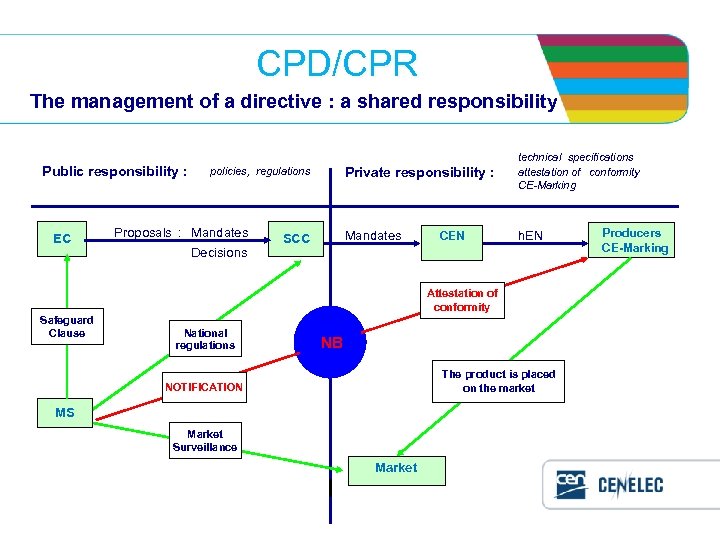 CPD/CPR The management of a directive : a shared responsibility Public responsibility : EC Private responsibility : Proposals : Mandates Decisions SCC technical specifications attestation of conformity CE-Marking Mandates policies, regulations h. EN CEN Attestation of conformity Safeguard Clause National regulations NB The product is placed on the market NOTIFICATION MS Market Surveillance Market Producers CE-Marking
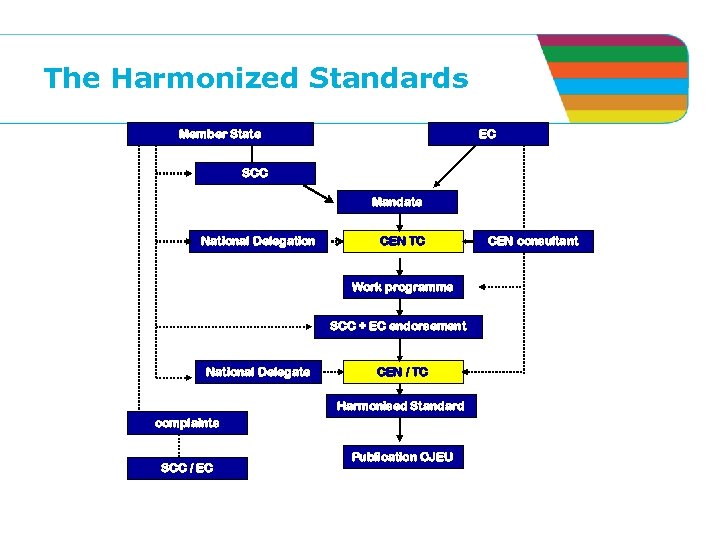 The Harmonized Standards Member State EC SCC Mandate National Delegation CEN TC Work programme SCC + EC endorsement National Delegate CEN / TC Harmonised Standard complaints SCC / EC Publication OJEU CEN consultant
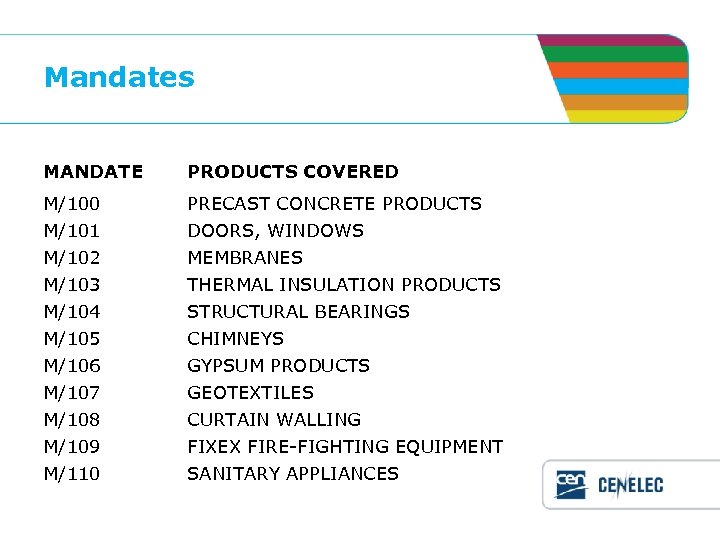 Mandates MANDATE PRODUCTS COVERED M/100 M/101 PRECAST CONCRETE PRODUCTS DOORS, WINDOWS M/102 M/103 M/104 M/105 M/106 M/107 M/108 M/109 M/110 MEMBRANES THERMAL INSULATION PRODUCTS STRUCTURAL BEARINGS CHIMNEYS GYPSUM PRODUCTS GEOTEXTILES CURTAIN WALLING FIXEX FIRE-FIGHTING EQUIPMENT SANITARY APPLIANCES
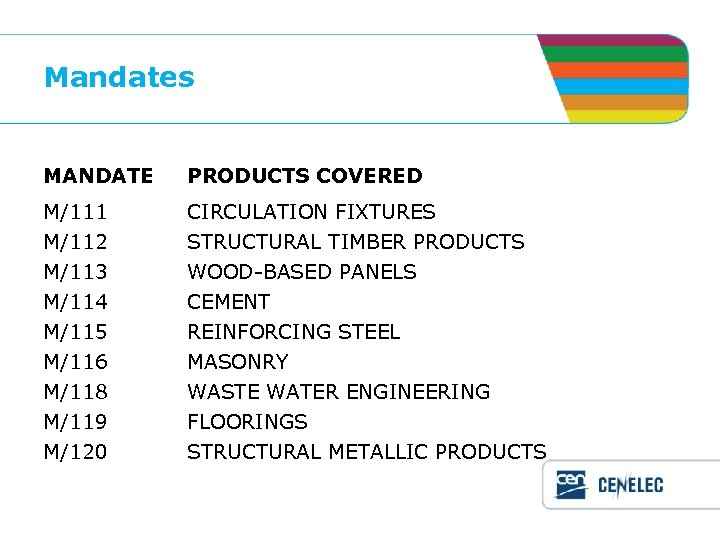 Mandates MANDATE PRODUCTS COVERED M/111 M/112 CIRCULATION FIXTURES STRUCTURAL TIMBER PRODUCTS M/113 M/114 M/115 M/116 M/118 M/119 M/120 WOOD-BASED PANELS CEMENT REINFORCING STEEL MASONRY WASTE WATER ENGINEERING FLOORINGS STRUCTURAL METALLIC PRODUCTS
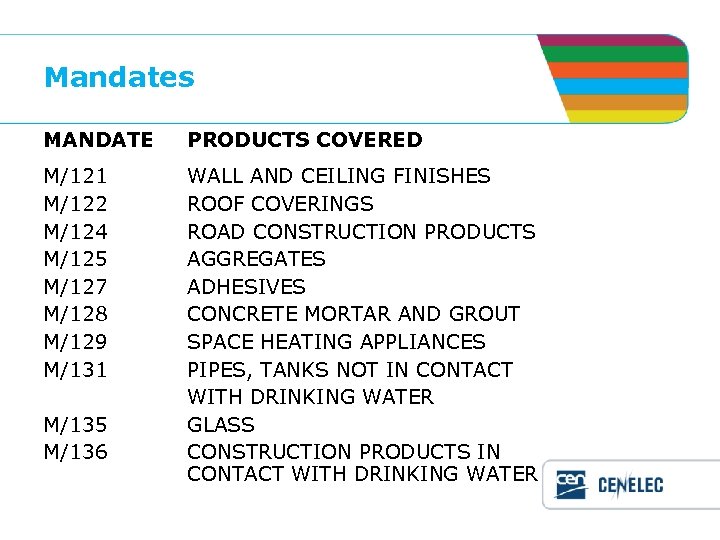 Mandates MANDATE PRODUCTS COVERED M/121 M/122 M/124 M/125 M/127 M/128 M/129 M/131 WALL AND CEILING FINISHES ROOF COVERINGS ROAD CONSTRUCTION PRODUCTS AGGREGATES ADHESIVES CONCRETE MORTAR AND GROUT SPACE HEATING APPLIANCES PIPES, TANKS NOT IN CONTACT WITH DRINKING WATER GLASS CONSTRUCTION PRODUCTS IN CONTACT WITH DRINKING WATER M/135 M/136
 Harmonised standards SNAPSHOT ftp: //ftp. cen. eu/CEN/Sectors/List/Construction/Sna pshot. pdf Approved ENs Available stds cited in the OJEU Available stds not yet cited in the OJEU 413 7
 Harmonised standards Structure of h. ENs: Normative + Informative Parts The Annex ZA, although it is an informative annex, contains information on those parts of the standard which relate to regulatory requirements and has effects for CE marking. The Annex ZA is the part of the standard which, without prejudice to the simplified measures envisaged by the CPR, needs to be applied for CE marking purposes and transforms all or part of a European product standard into a harmonised European product standard.
 Annex ZA Only (candidate) harmonised product standards include Annex ZA, Supporting standards do not. The Annex ZA identifies those clauses of the standard which cover the essential characteristics included in the mandate.
 Annex ZA Moreover, it reproduces the system(s) for Assessment and Verification of Constancy of Performance (AVCP) of product(s) established by EC Decisions, to which the concerned product needs to be submitted before the manufacturer is entitled to draw up the Do. P and to affix the CE marking.
 Annex ZA Clause ZA. 1 - Scope and relevant characteristics Clause ZA. 2 – Procedure(s) for the Assessment and Verification of Constancy of Performance (AVCP) Clause ZA. 2. 2 – Declaration of Performance Clause ZA. 3 – CE marking and labelling
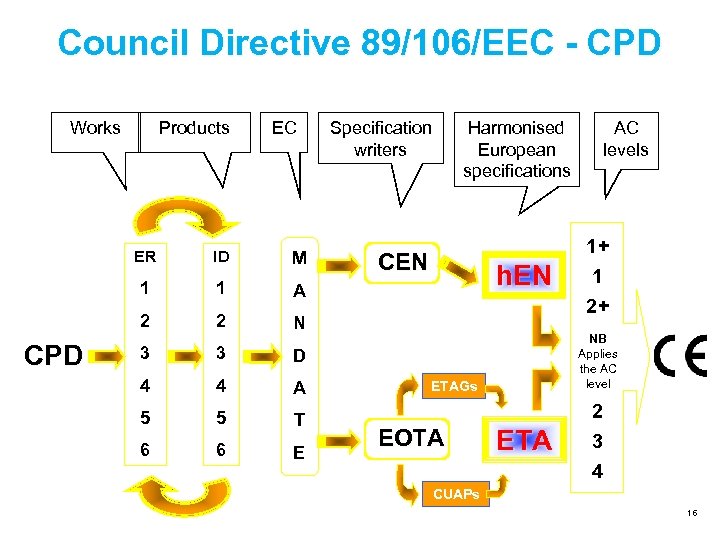 Council Directive 89/106/EEC - CPD Works Products EC ER M 1 1 2 Harmonised European specifications A 2 CPD ID Specification writers N 3 3 4 A 5 5 T 6 6 E h. EN 1+ 1 2+ NB Applies the AC level D 4 CEN AC levels ETAGs EOTA ETA 2 3 4 CUAPs 16
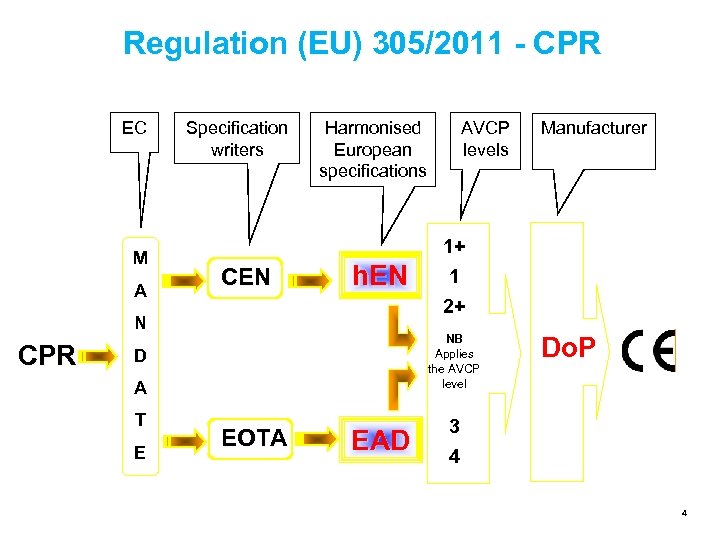 Regulation (EU) 305/2011 - CPR EC M A Specification writers CEN Harmonised European specifications h. EN A E 1+ 1 NB Applies the AVCP level D T Manufacturer 2+ N CPR AVCP levels EOTA EAD Do. P 3 4 4
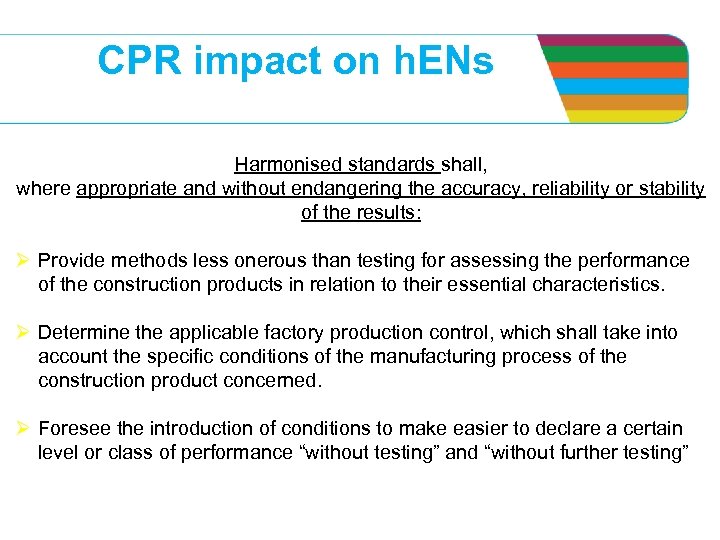 CPR impact on h. ENs Harmonised standards shall, where appropriate and without endangering the accuracy, reliability or stability of the results: Ø Provide methods less onerous than testing for assessing the performance of the construction products in relation to their essential characteristics. Ø Determine the applicable factory production control, which shall take into account the specific conditions of the manufacturing process of the construction product concerned. Ø Foresee the introduction of conditions to make easier to declare a certain level or class of performance “without testing” and “without further testing” 5
 CPR impact on h. ENs Ø Terminology changed compared to the CPD: - AVCP instead of Evaluation of Conformity (Eo. C) - Certificate of constancy of performance instead of Certificate of Conformity - Product-type instead of Initial Type Testing (ITT) - Declaration of Performance (Do. P) instead of Declaration of Conformity Ø AVCP systems: Ao. C System 2 deleted Ø Model of Do. P and filling-in instructions 6
 CPR impact on h. ENs Ø Modified provisions for the CE marking: (on product or label or packaging or accompanying documents) Ø Information following the marking two last digits of the year in which it was first affixed - name and the registered address of the manufacturer or identifying mark - identification code of the product-type - reference number of Do. P - level or class of the performance declared - reference to the harmonised technical specification applied - identification number of the notified body, if applicable, - intended use of the product 7
 Harmonized standards Provide methods and criteria for assessing the performance of construction products in relation to their essential characteristics; Refer to an intended use of products covered, when provided for in the relevant mandates. Where appropriate and without endangering accuracy, reliability or stability of the results: • Provide methods less onerous than testing for assessing the performance of the construction products in relation to their essential characteristics. • Determine the applicable FPC which shall take into account the specific conditions of the manufacturing process of the construction product.
 Harmonized standards The list of harmonized standards is published in OJEU by the Commission. For each harmonized standard the list shall include: - The reference of superseded harmonized technical specifications, if any; - The date of the beginning of the coexistence period; - The date of the end of the coexistence period.
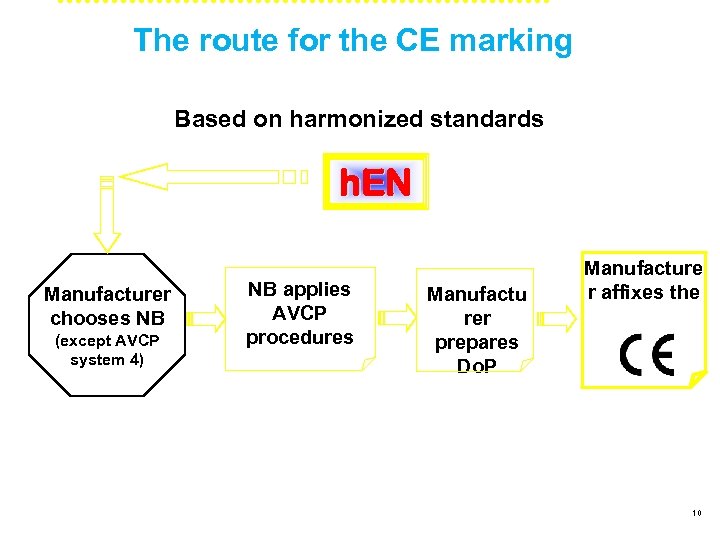 The route for the CE marking Based on harmonized standards h. EN Manufacturer chooses NB (except AVCP system 4) NB applies AVCP procedures Manufactu rer prepares Do. P Manufacture r affixes the 10
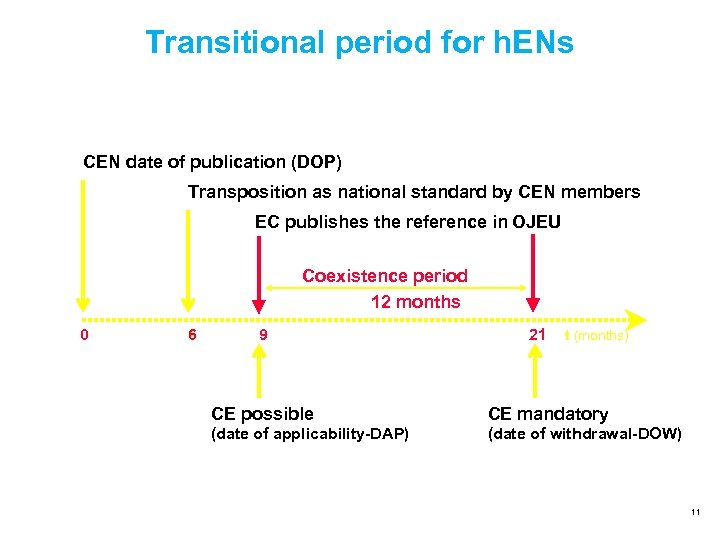 Transitional period for h. ENs CEN date of publication (DOP) Transposition as national standard by CEN members EC publishes the reference in OJEU Coexistence period 12 months 0 6 9 21 t (months) CE possible CE mandatory (date of applicability-DAP) (date of withdrawal-DOW) 11
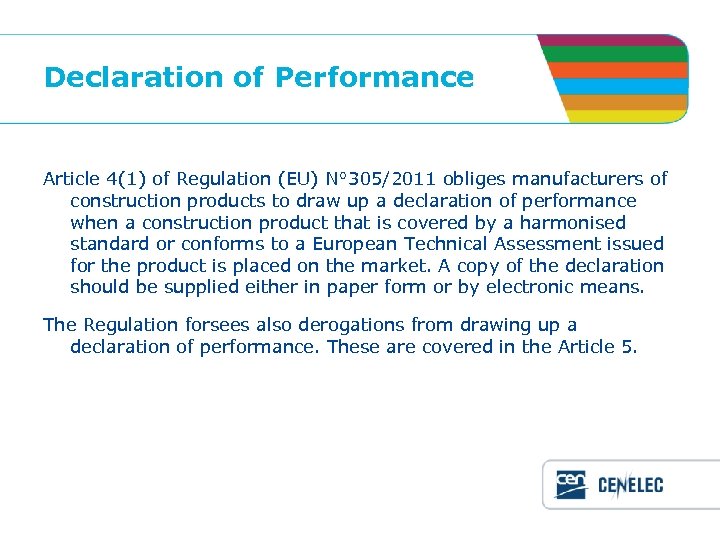 Declaration of Performance Article 4(1) of Regulation (EU) N° 305/2011 obliges manufacturers of construction products to draw up a declaration of performance when a construction product that is covered by a harmonised standard or conforms to a European Technical Assessment issued for the product is placed on the market. A copy of the declaration should be supplied either in paper form or by electronic means. The Regulation forsees also derogations from drawing up a declaration of performance. These are covered in the Article 5.
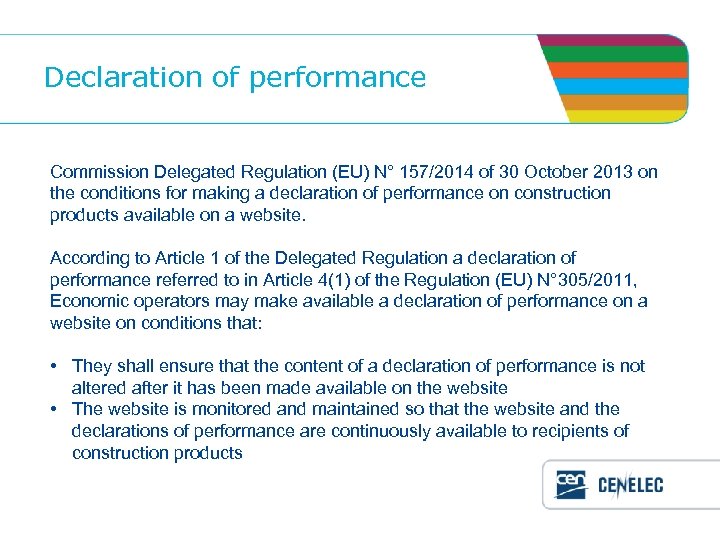 Declaration of performance Commission Delegated Regulation (EU) N° 157/2014 of 30 October 2013 on the conditions for making a declaration of performance on construction products available on a website. According to Article 1 of the Delegated Regulation a declaration of performance referred to in Article 4(1) of the Regulation (EU) N° 305/2011, Economic operators may make available a declaration of performance on a website on conditions that: • They shall ensure that the content of a declaration of performance is not altered after it has been made available on the website • The website is monitored and maintained so that the website and the declarations of performance are continuously available to recipients of construction products
 Declaration of performance • The declaration of performance may be accessed by the recipients of construction products free of charge • The recipients shall be provided with instructions on how to access the website Manufacturers shall ensure that every single product, or batch of the same product, they are placing on the market is linked to a given declaration of performance by means of the unique identification code of the product type.
 Declaration of performance A Delegated Regulation amending Annex III of the CPR was adopted on the 21 st of February and submitted to the EP and the European Council for their right of objection until the 21 st of May 2014. Annex III of the CPR deals with the model for the declaration of performance.
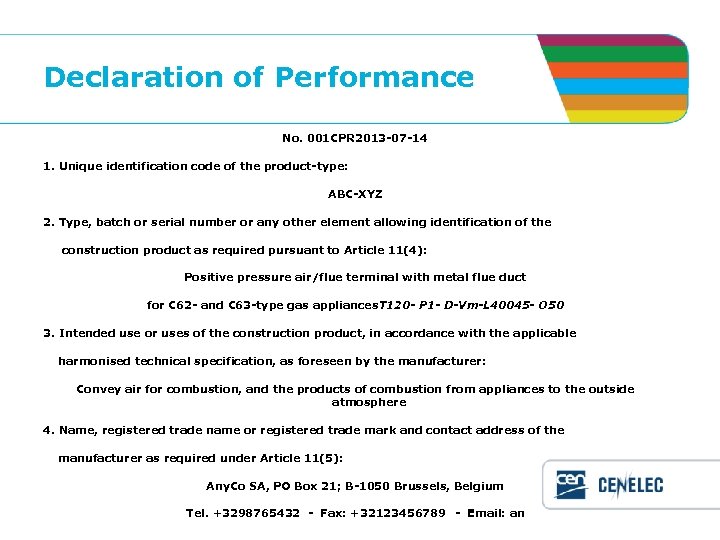 Declaration of Performance No. 001 CPR 2013 -07 -14 1. Unique identification code of the product-type: ABC-XYZ 2. Type, batch or serial number or any other element allowing identification of the construction product as required pursuant to Article 11(4): Positive pressure air/flue terminal with metal flue duct for C 62 - and C 63 -type gas appliances. T 120 - P 1 - D-Vm-L 40045 - O 50 3. Intended use or uses of the construction product, in accordance with the applicable harmonised technical specification, as foreseen by the manufacturer: Convey air for combustion, and the products of combustion from appliances to the outside atmosphere 4. Name, registered trade name or registered trade mark and contact address of the manufacturer as required under Article 11(5): Any. Co SA, PO Box 21; B-1050 Brussels, Belgium Tel. +3298765432 - Fax: +32123456789 - Email: an
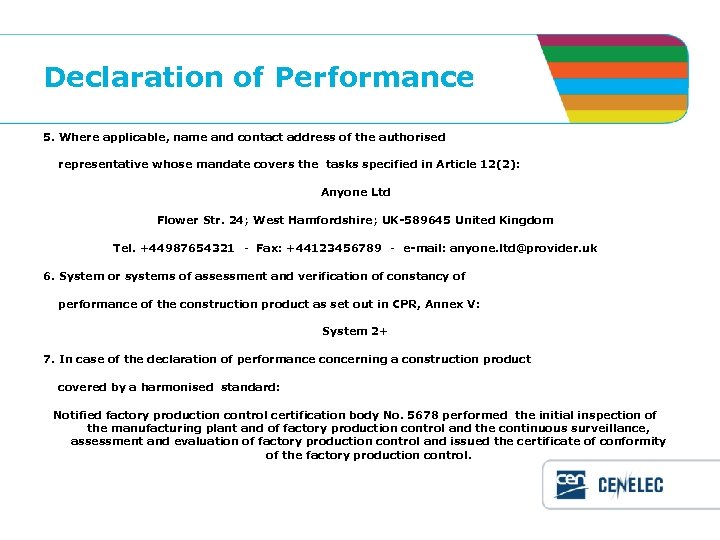 Declaration of Performance 5. Where applicable, name and contact address of the authorised representative whose mandate covers the tasks specified in Article 12(2): Anyone Ltd Flower Str. 24; West Hamfordshire; UK-589645 United Kingdom Tel. +44987654321 - Fax: +44123456789 - e-mail: anyone. ltd@provider. uk 6. System or systems of assessment and verification of constancy of performance of the construction product as set out in CPR, Annex V: System 2+ 7. In case of the declaration of performance concerning a construction product covered by a harmonised standard: Notified factory production control certification body No. 5678 performed the initial inspection of the manufacturing plant and of factory production control and the continuous surveillance, assessment and evaluation of factory production control and issued the certificate of conformity of the factory production control.
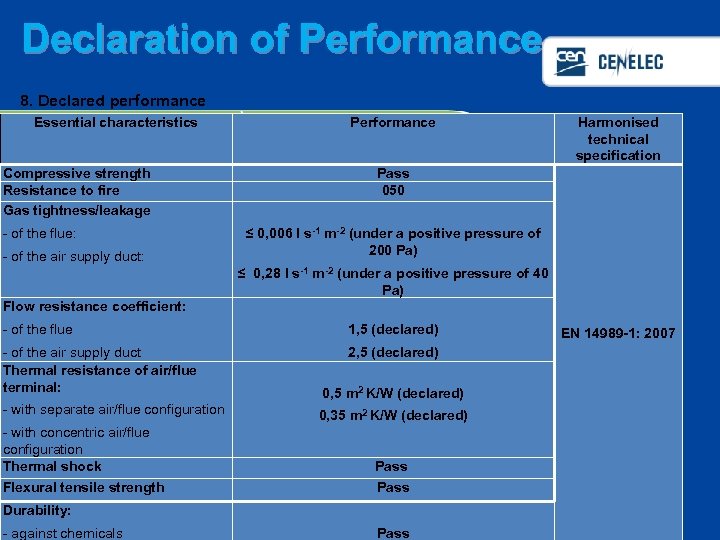 Declaration of Performance 8. Declared performance Essential characteristics Performance Compressive strength Resistance to fire Gas tightness/leakage Pass 050 - of the flue: - of the air supply duct: Flow resistance coefficient: - of the flue - of the air supply duct Thermal resistance of air/flue terminal: - with separate air/flue configuration ≤ 0, 006 l s-1 m-2 (under a positive pressure of 200 Pa) 2, 5 (declared) 0, 5 m 2 K/W (declared) 0, 35 m 2 K/W (declared) Pass Flexural tensile strength Pass - against chemicals ≤ 0, 28 l s-1 m-2 (under a positive pressure of 40 Pa) 1, 5 (declared) EN 14989 -1: 2007 - with concentric air/flue configuration Thermal shock Durability: Harmonised technical specification Pass
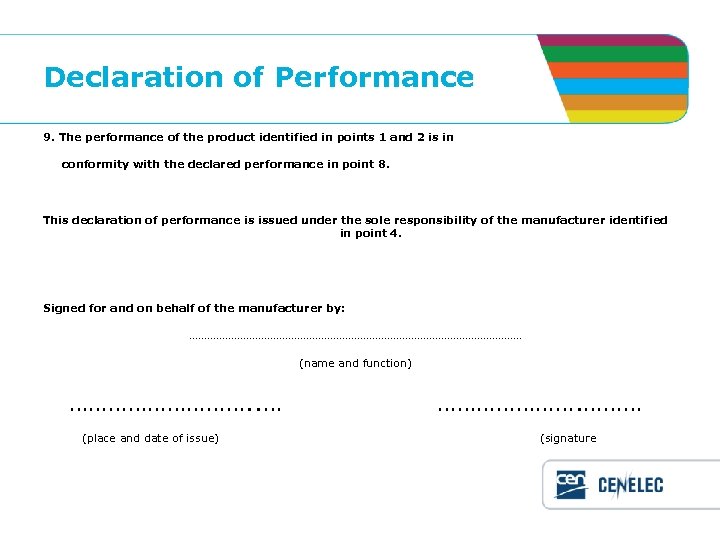 Declaration of Performance 9. The performance of the product identified in points 1 and 2 is in conformity with the declared performance in point 8. This declaration of performance is issued under the sole responsibility of the manufacturer identified in point 4. Signed for and on behalf of the manufacturer by: ………………………………………………… (name and function) ……………. . … (place and date of issue) …………………. ……… (signature
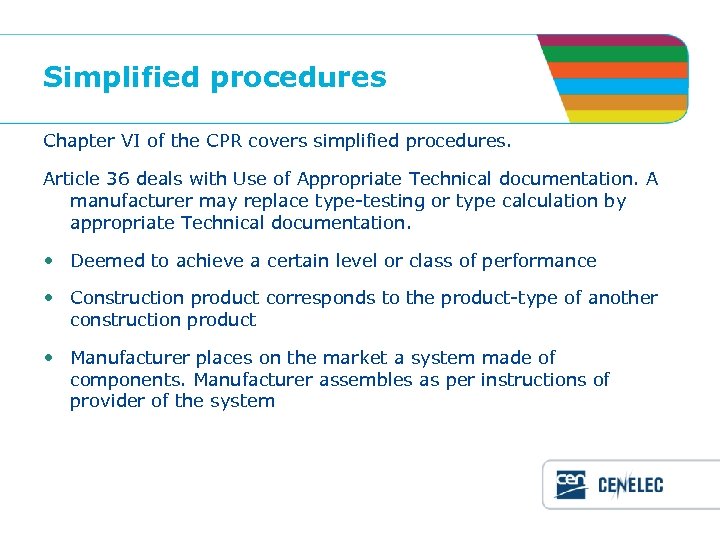 Simplified procedures Chapter VI of the CPR covers simplified procedures. Article 36 deals with Use of Appropriate Technical documentation. A manufacturer may replace type-testing or type calculation by appropriate Technical documentation. • Deemed to achieve a certain level or class of performance • Construction product corresponds to the product-type of another construction product • Manufacturer places on the market a system made of components. Manufacturer assembles as per instructions of provider of the system
 Simplified procedures Article 37 deals with the use of simplified procedures by microenterprises and Article 38 covers other simplified procedures
 Eurocodes What are they? • They are European Standards (ENs) for the design (structural) of buildings and other civil engineering structures (construction works) • Since March 2010, they are the only design standards in the EU and EFTA countries (>600 million citizens)
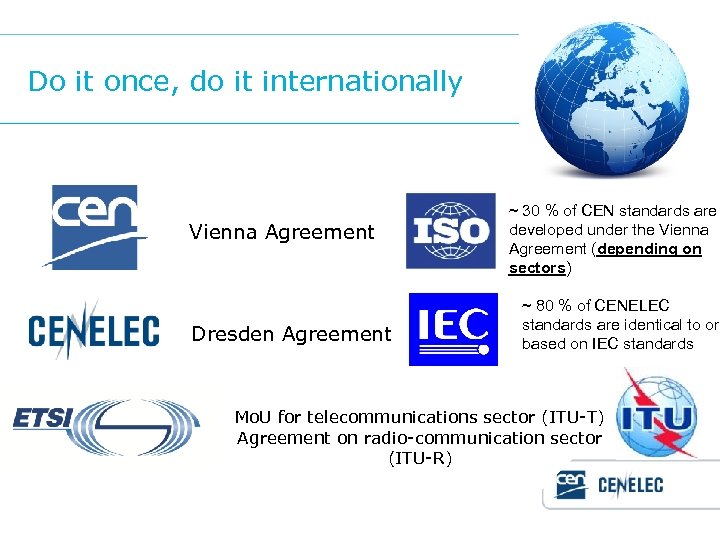 Do it once, do it internationally Vienna Agreement Dresden Agreement ~ 30 % of CEN standards are developed under the Vienna Agreement (depending on sectors) ~ 80 % of CENELEC standards are identical to or based on IEC standards Mo. U for telecommunications sector (ITU-T) Agreement on radio-communication sector (ITU-R)
 International cooperation CHINA: Seconded European Standardization Expert (Beijing) INDIA: Seconded European Standardization Expert (New Delhi) – (project under discussion) JAPAN: CEN-JISC agreement signed in June 2008 Technical Assistance (EU programmes managed by CEN) ■ TA programmes involve at present 27 countries (Balkan, Mediterranean and South-East Asian countries) Cooperation with international organisations (ISO, ANSI)
 International cooperation Cooperation Agreements with third country NSBs (Rosstandart, JISC) Memoranda of Understanding with Regional standardization organisations (ARSO, AMN) Licence agreements for specific standards or series of standards Visibility Projects improving the awareness of the European Standardization System in specific countries (SESEI)
 Sources of information I CEN website, CENELEC website and CEN-CENELEC website Websites of the National Members of CEN and of CENELEC CEN/BOSS Internal Regulations
 Sources of information II Latest publications in CEN and in CENELEC Search Standards in CEN and in CENELEC CEN-CENELEC Newsletter “Connect” Technical Committees of CEN and of CENELEC CEN-CENELEC Guides
 Thank you very much for your attention