


 Скачать презентацию Workshop on Statistical Organisation and Management for SADC
6f73c08387ff65341792d44ad1f738f7.ppt
- Количество слайдов: 35
 Workshop on “Statistical Organisation and Management for SADC Member States” Luanda, 2 – 6 December 2006 ----Strategy based Human Resources Management by Awa Thiongane Senior Regional Adviser ECA
 Outline n n n n HR Management : Issue Planning Recruitment Development Audit Performance appraisal Reward systems Separation
 Authoritative Quotation “The organization’s greatest strength – and the key to our success - is the quality of our staff and managers. ” Koffi Anan in « Building the Future »
 HR and Management Theory n n A definition of Management • “Management is working with and through other people to accomplish the objectives of both the organization and those of its members” This implies that: • • • n Human capital is central in organizations' assets There a is need to stress results rather than activities Employees’ expectations are as important as organizations’ objectives In other words: • Involvement of people (quality management – principle 3) • Managing for results (new development agenda) • Empowerment – responsibility - accountability
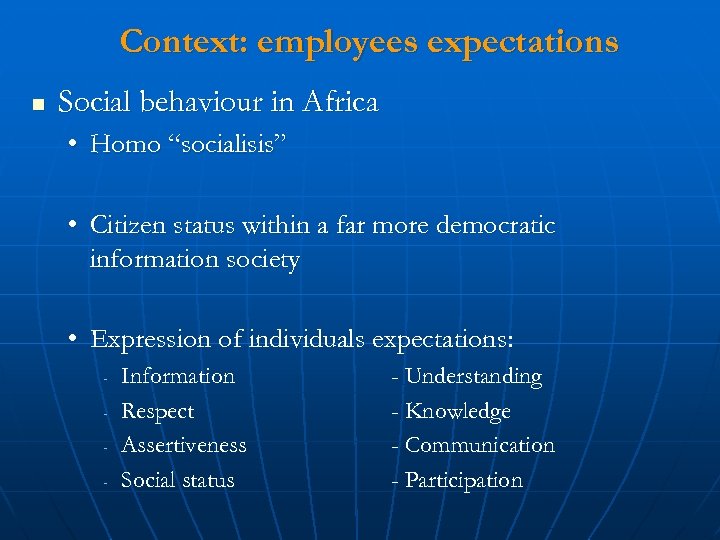 Context: employees expectations n Social behaviour in Africa • Homo “socialisis” • Citizen status within a far more democratic information society • Expression of individuals expectations: - Information Respect Assertiveness Social status - Understanding - Knowledge - Communication - Participation
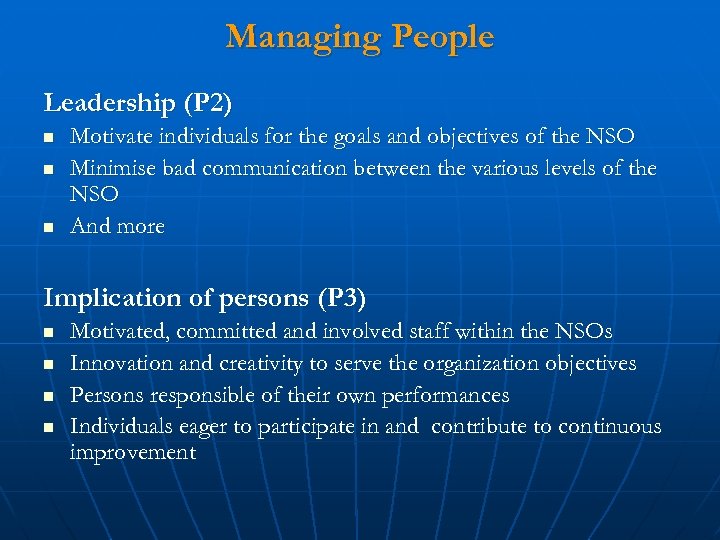 Managing People Leadership (P 2) n n n Motivate individuals for the goals and objectives of the NSO Minimise bad communication between the various levels of the NSO And more Implication of persons (P 3) n n Motivated, committed and involved staff within the NSOs Innovation and creativity to serve the organization objectives Persons responsible of their own performances Individuals eager to participate in and contribute to continuous improvement
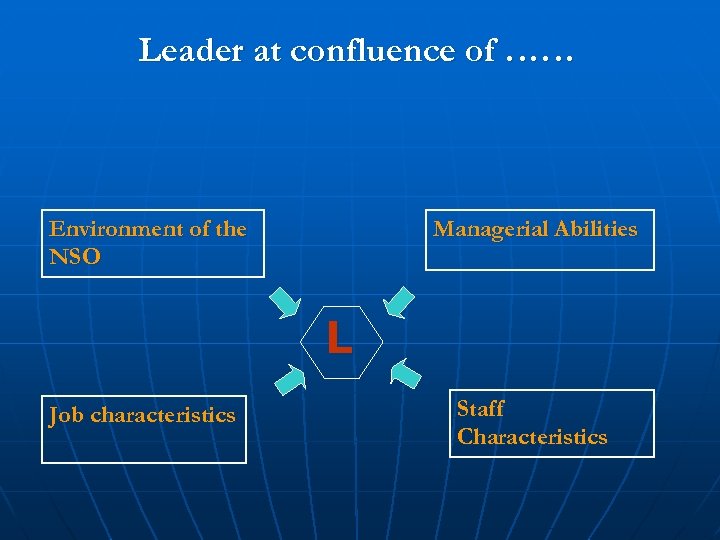 Leader at confluence of …… Environment of the NSO Managerial Abilities L Job characteristics Staff Characteristics
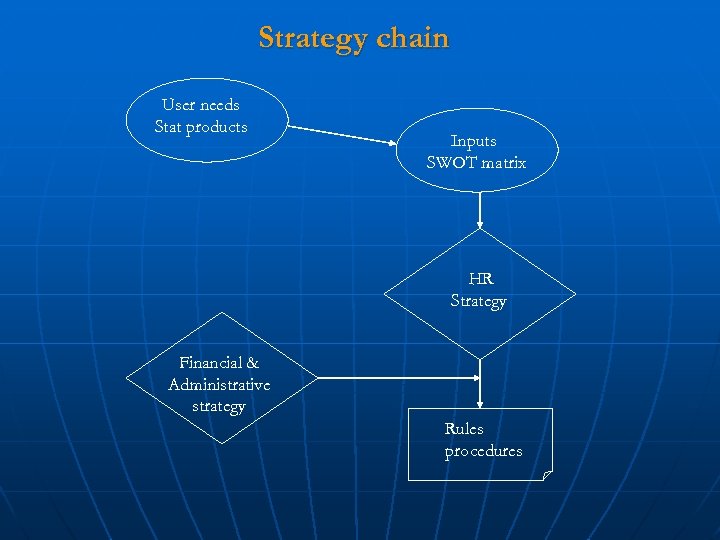 Strategy chain User needs Stat products Inputs SWOT matrix HR Strategy Financial & Administrative strategy Rules procedures
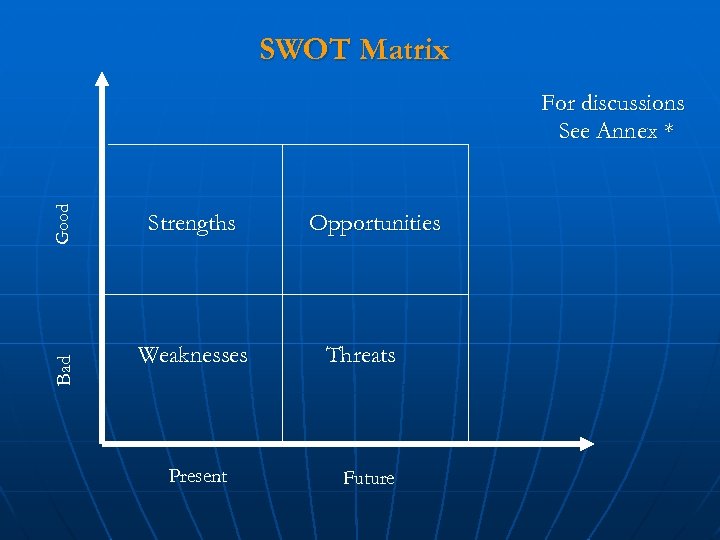 SWOT Matrix Bad Good For discussions See Annex * Strengths Weaknesses Present Opportunities Threats Future
 Career path n Very different patterns • Before: Vertical career path (civil service – life appointment in Japanese companies – quasipredictability ) • Nowadays: Horizontal career path or combined with vertical arrangements (mobility is key today*) • (for discussions: advantages and disadvantages for the NSO) * “Where do you think you will be in 5 years? ”
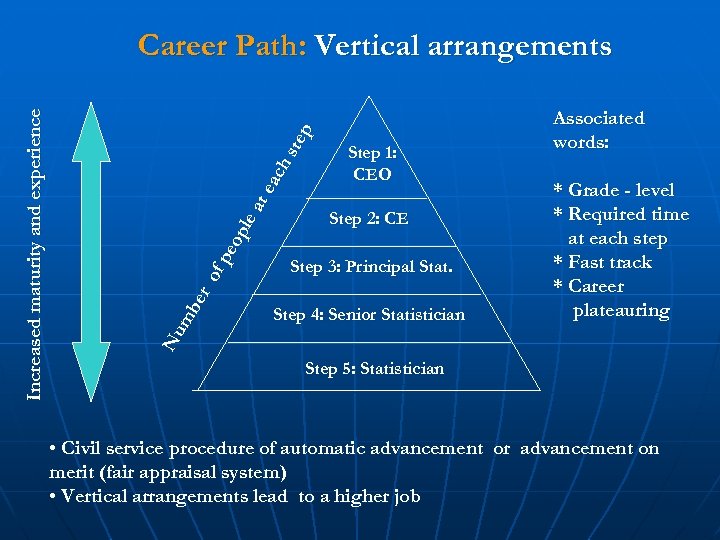 of pe op le at ea ch ste p Step 1: CEO Step 2: CE Step 3: Principal Stat. Nu mb er Increased maturity and experience Career Path: Vertical arrangements Step 4: Senior Statistician Associated words: * Grade - level * Required time at each step * Fast track * Career plateauring Step 5: Statistician • Civil service procedure of automatic advancement or advancement on merit (fair appraisal system) • Vertical arrangements lead to a higher job
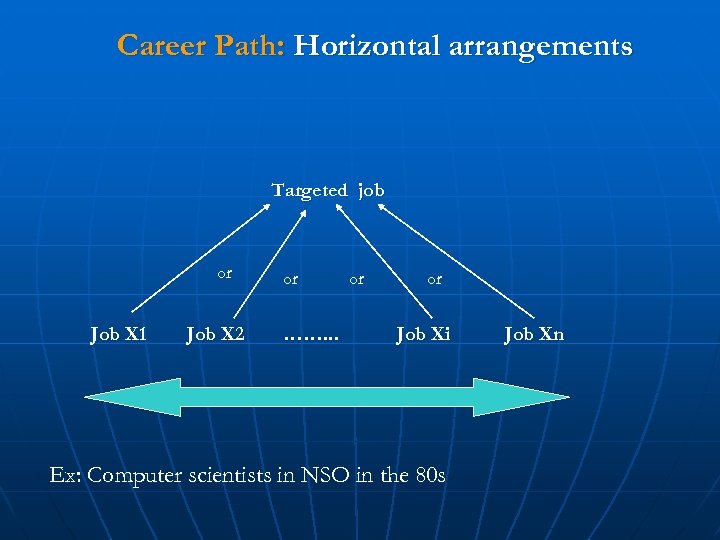 Career Path: Horizontal arrangements Targeted job or Job X 1 Job X 2 or ……. . . or or Job Xi Ex: Computer scientists in NSO in the 80 s Job Xn
 Career path n Career plateauring • • n Organizations cannot promote everyone Skill-mix is needed at various levels Organizational structure are generally hierarchal Career path is set up for the organization goals Solutions • • • Remain in the same job Transfer to a different career path Quit the organization
 Recruitment n Generally by the civil service • NSO Request – employees are posted • Risk factors: Long procedure beyond the control of the NSO n NSO has often no say on the candidates n Difficulties in retention of skilled staff (low wages – sometimes low profile of the NSO, etc. ) n n The NSO is autonomous • • Recruitment plan to be designed Selection procedures as part of the recruitment
 Selection n What is required for the job? Pre-selection through résumé (minimum requirements) Interviews • Face-to-face interview (short list) n To assess the candidate motivation to perform the job and remain on the job (cost-effectiveness); whether he/she has the qualifications required; he/her attitude vis-à-vis the organization culture n Face-to-face interview appraisal based on verbal messages and body language • Formal (predetermined questions - various types ) • Informal (group meal) n Fairness requires to avoid not job-related factors; n Etc.
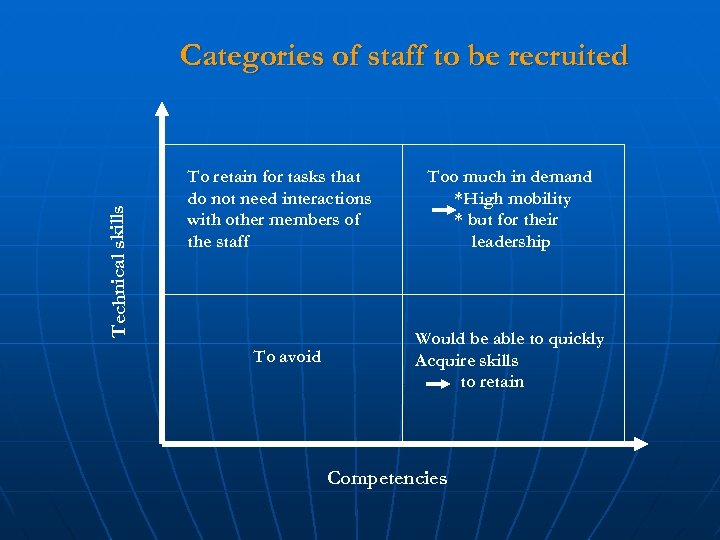 Technical skills Categories of staff to be recruited To retain for tasks that do not need interactions with other members of the staff To avoid Too much in demand *High mobility * but for their leadership Would be able to quickly Acquire skills to retain Competencies
 Training – A lifetime Activity n On-the-job training • Orientation for new employees (formal or informal for quick integration of new employees) • Internship • On-the-job rotation (managerial and other levels) • Coaching • Divisional meetings • Specialized training (Task rotation to maximized specialized human capital based on versatility) • Ad hoc training sessions to improve personal skills and to share the organization culture (on team building, team work, communication, negotiations, planning and organizing, management, time management, etc. )
 Training n Off- the –job Training • Seminars/workshops : n Training workshop n Peer learning – expert groups n Reward for performance • Refresher courses • Courses leading to degrees (tuition fees) • Etc.
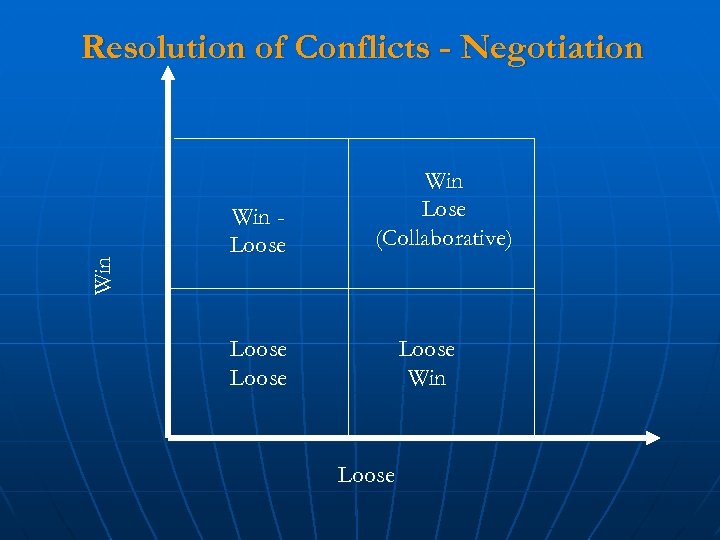 Win Resolution of Conflicts - Negotiation Win Loose Win Lose (Collaborative) Loose Win Loose
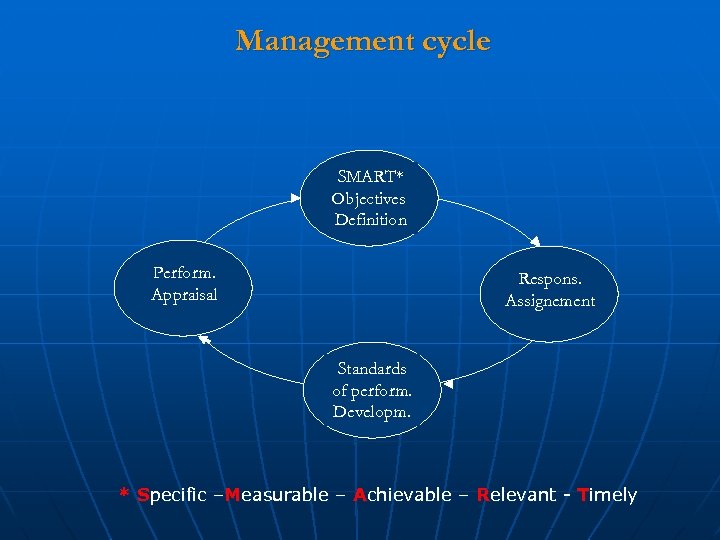 Management cycle SMART* Objectives Definition Perform. Appraisal Respons. Assignement Standards of perform. Developm. * Specific –Measurable – Achievable – Relevant - Timely
 Reward Systems n Non-monetary - n Participation in the staff social events Certificate Letter of appreciation Empowerment Training (on-the-job and out-of-the job) Study tours, etc. Compensation • In projects • Surveys, censuses • Etc.
 Separation n n Current situation - Retirement - End of contract - Resignation - Discharge, …. Other situations • Consequences of budgetary constraints (SAP) n Downsizing • Change of status, etc. n New organizational structure n New job descriptions n New recruitment rules
 Audit n Objective: • Measure of effectiveness of HR management => Analysis • • n Turnovers Absenteeism Lateness Etc. Based on existing files or surveys results Recommendations for improvement
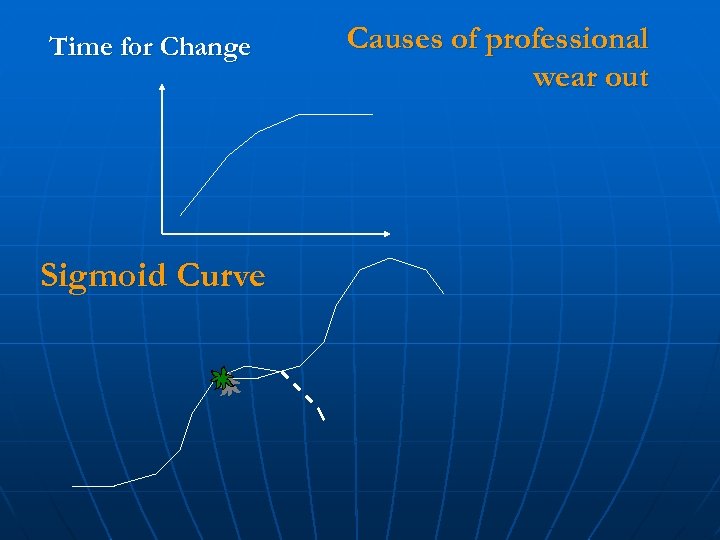 Time for Change Sigmoid Curve Causes of professional wear out
 Challenges Staff Retention: A major challenge for the NSO n Ex: Central banks in competition with the NSOs • Training • Change of status • Professionalism • Contractual relationships with new members** • Periods for consultancy services for senior staff • Mentoring • Special Programmes • Social events
 For discussions n n n n Indicators for monitoring purposes? Career plans? Training programmes? Incentive scheme? Staff retention? Performance appraisal programme? Jobe description? Trade union or association?
 Annexes
 Annex 1: Quality Management Principles P 1 P 2 P 3 P 4 P 5 P 6 P 7 P 8 - Customer focus Leadership Involvement of people Process approach System approach to management Continual improvement Factual approach to decision-making Mutually beneficial suppliers relationships Source: iso. org
 Annex 2: SWOT Analysis n Weaknesses: • Poor staffing • High mobility of specialized staff • No adequate skill-mix • Low wages • Not enough incentives • Etc.
 Annex 2: SWOT Analysis n Strengths: • Highly skilled staff • Change of status • Brand name of the NSO • Partnerships _ New opportunities in training, funding additional activities • Etc.
 Annex 2: SWOT Analysis n Threats: • Skilled staff highly in demand (threat for NSOs not for NSSs)
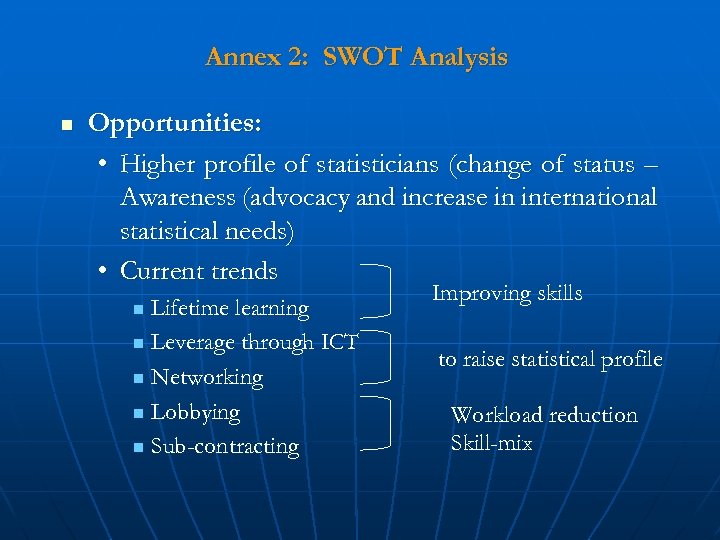 Annex 2: SWOT Analysis n Opportunities: • Higher profile of statisticians (change of status – Awareness (advocacy and increase in international statistical needs) • Current trends Lifetime learning n Leverage through ICT n Networking n Lobbying n Sub-contracting n Improving skills to raise statistical profile Workload reduction Skill-mix
 Annex 3: SWOT Analysis n Opportunities: • Higher profile of statisticians (change of status – Awareness (advocacy and international needs) • Current trends Lifetime learning n Leverage through ICT n Networking n Lobbying n Sub-contracting n Improving skills to raise statistical profile Workload reduction Skill-mix
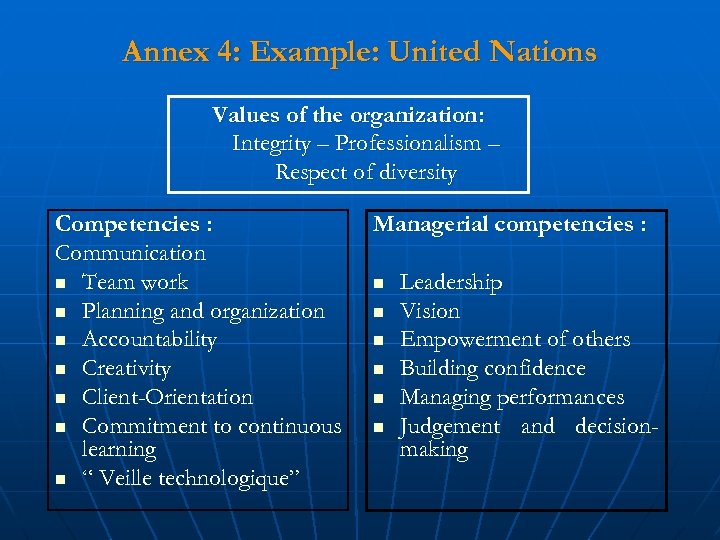 Annex 4: Example: United Nations Values of the organization: Integrity – Professionalism – Respect of diversity Competencies : Communication n Team work n Planning and organization n Accountability n Creativity n Client-Orientation n Commitment to continuous learning n “ Veille technologique” Managerial competencies : n n n Leadership Vision Empowerment of others Building confidence Managing performances Judgement and decisionmaking
 Thank you