


 Скачать презентацию Workshop on Low Emittance Rings 2010 CERN 12
5aa9b5477983e8a3c530ff6e7f2bfab0.ppt
- Количество слайдов: 40
 Workshop on Low Emittance Rings 2010 CERN, 12 -15 January 2010 EXPERIENCE WITH THE SOLEIL 352 MHZ RF SYSTEMS P. Marchand
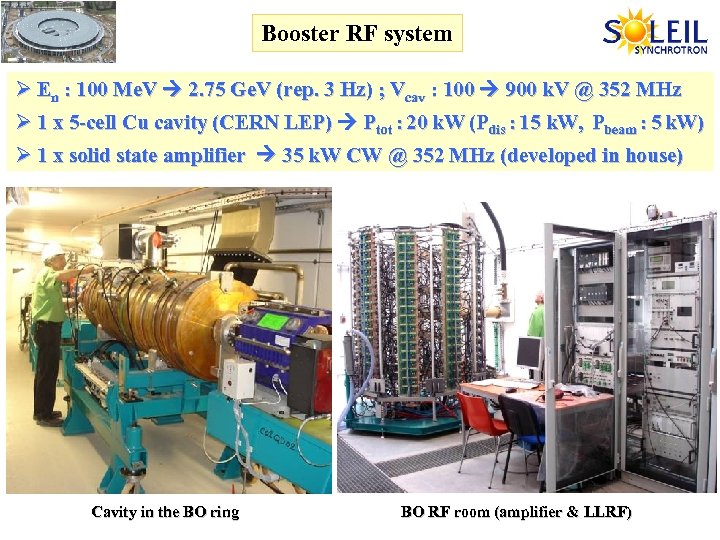 Booster RF system Ø En : 100 Me. V 2. 75 Ge. V (rep. 3 Hz) ; Vcav : 100 900 k. V @ 352 MHz Ø 1 x 5 -cell Cu cavity (CERN LEP) Ptot : 20 k. W (Pdis : 15 k. W, Pbeam : 5 k. W) Ø 1 x solid state amplifier 35 k. W CW @ 352 MHz (developed in house) Cavity in the BO ring BO RF room (amplifier & LLRF)
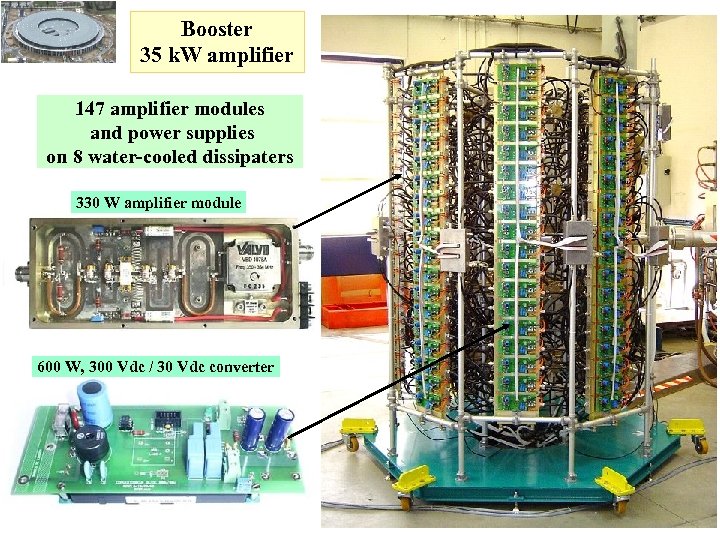 Booster 35 k. W amplifier 147 amplifier modules and power supplies on 8 water-cooled dissipaters 330 W amplifier module 600 W, 300 Vdc / 30 Vdc converter
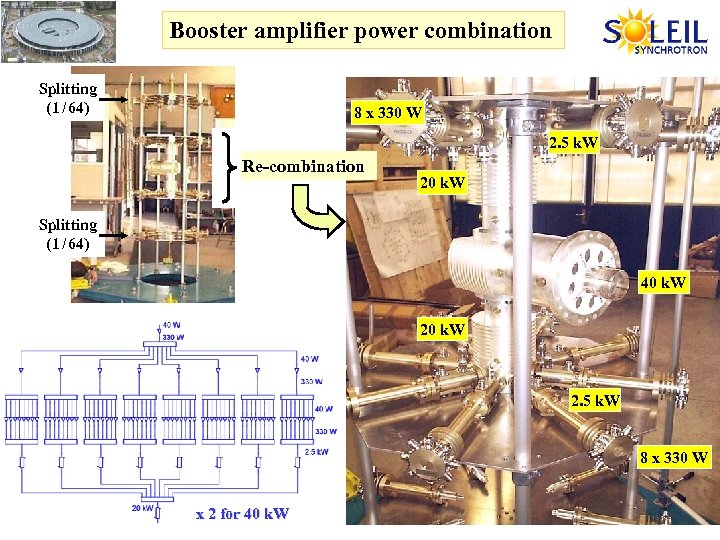 Booster amplifier power combination Splitting (1 / 64) 8 x 330 W 2. 5 k. W Re-combination 20 k. W Splitting (1 / 64) 40 k. W 2. 5 k. W Monitoring power couplers x 2 for 40 k. W 8 x 330 W
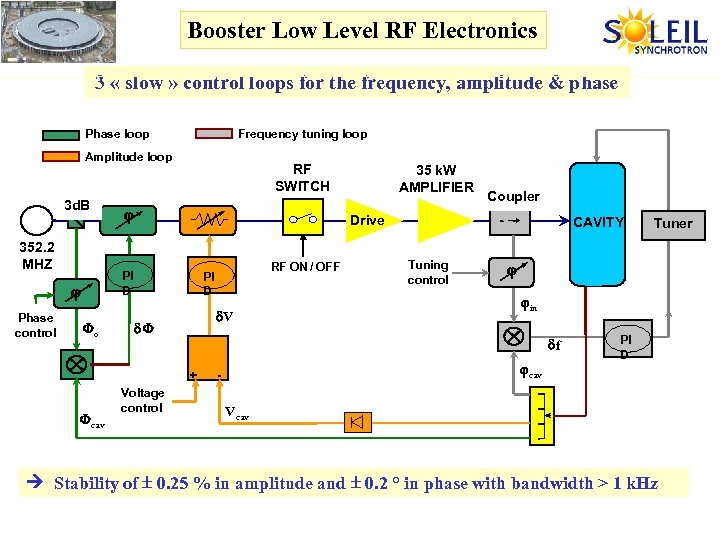 Booster Low Level RF Electronics 3 « slow » control loops for the frequency, amplitude & phase Phase loop Frequency tuning loop Amplitude loop 3 d. B 352. 2 MHZ Fo RF ON / OFF PI D d. V d. F Coupler Voltage control CAVITY Tuning control in cav - Tuner df + Fcav 35 k. W AMPLIFIER Drive PI D Phase control RF SWITCH PI D Vcav Stability of 0. 25 % in amplitude and 0. 2 ° in phase with bandwidth > 1 k. Hz
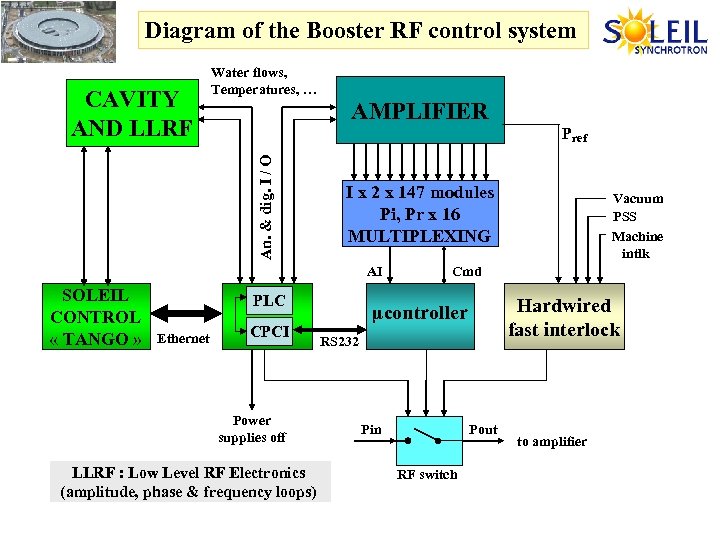 Diagram of the Booster RF control system AMPLIFIER Pref An. & dig. I / O CAVITY AND LLRF Water flows, Temperatures, … I x 2 x 147 modules Pi, Pr x 16 MULTIPLEXING AI SOLEIL CONTROL « TANGO » PLC Ethernet CPCI Cmd Hardwired fast interlock µcontroller RS 232 Power supplies off LLRF : Low Level RF Electronics (amplitude, phase & frequency loops) Vacuum PSS Machine intlk Pin Pout RF switch to amplifier
 Operational experience with the Booster RF system The Booster RF plant is in operation since mid 2005. Up to date, after ~ 20 000 running hours, only a single trip in operation, due to a human mistake (2006) Never play with the equipment during the operation ! The 35 k. W solid state amplifier has proved to be very reliable. Only 5 (out of 150) modules had minor problems which did not affect at all the operating conditions, and could be quickly repaired during scheduled machine shutdowns. Advantage of the high modularity and redundancy
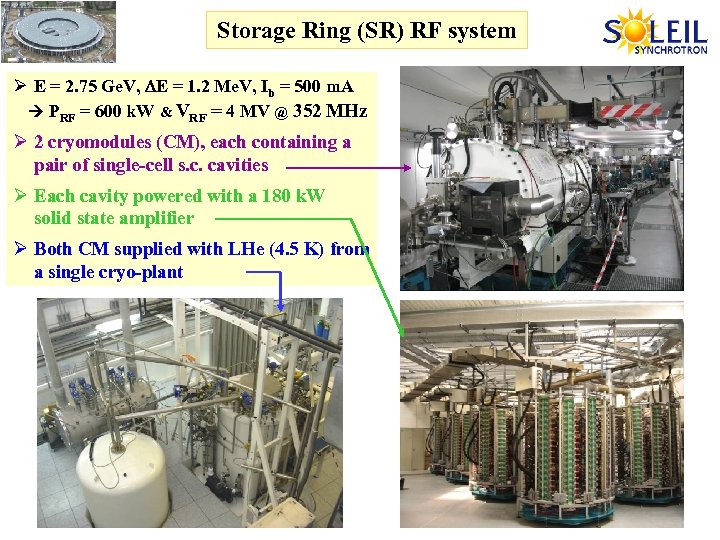 Storage Ring (SR) RF system Ø E = 2. 75 Ge. V, DE = 1. 2 Me. V, Ib = 500 m. A PRF = 600 k. W & VRF = 4 MV @ 352 MHz Ø 2 cryomodules (CM), each containing a pair of single-cell s. c. cavities Ø Each cavity powered with a 180 k. W solid state amplifier Ø Both CM supplied with LHe (4. 5 K) from a single cryo-plant
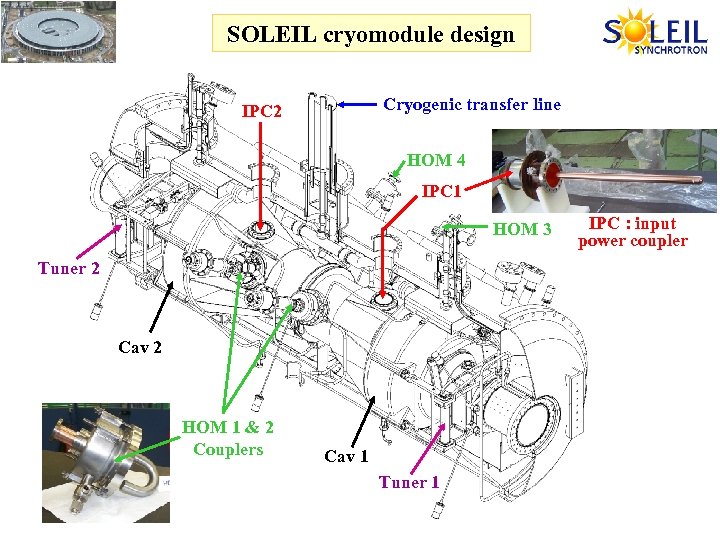 SOLEIL cryomodule design SOLEIL cryomodule Cryogenic transfer line IPC 2 HOM 4 IPC 1 HOM 3 Tuner 2 Cav 2 HOM 1 & 2 Couplers Cav 1 Tuner 1 IPC : input power coupler
 Cryomodule (CM) history Ø SOLEIL studies (1996) launch the development of a CM prototype (1996) realized in the frame work of a CEA/CERN collaboration Ø After a campaign of tests on the ESRF SR (2001 - 2002), the CM prototype ), was fully disassembled, significantly modified and then re-assembled and tested at CERN, in order to be used as the 1 st CM of SOLEIL (CM 1)
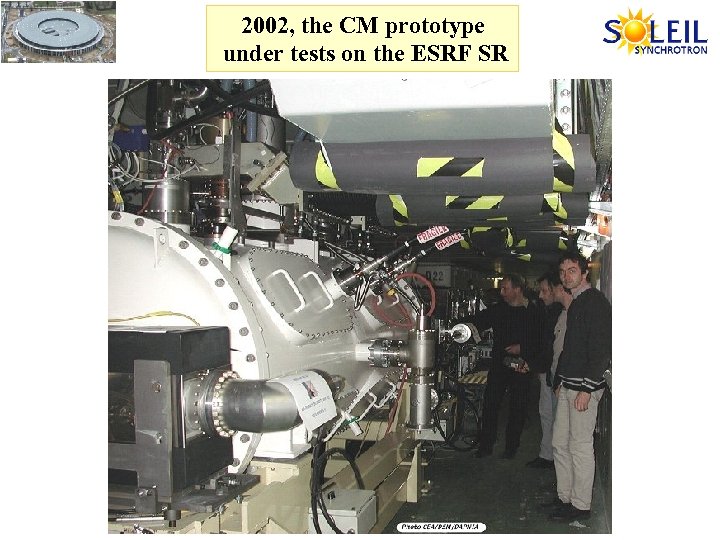 2002, the CM prototype under tests on the ESRF SR
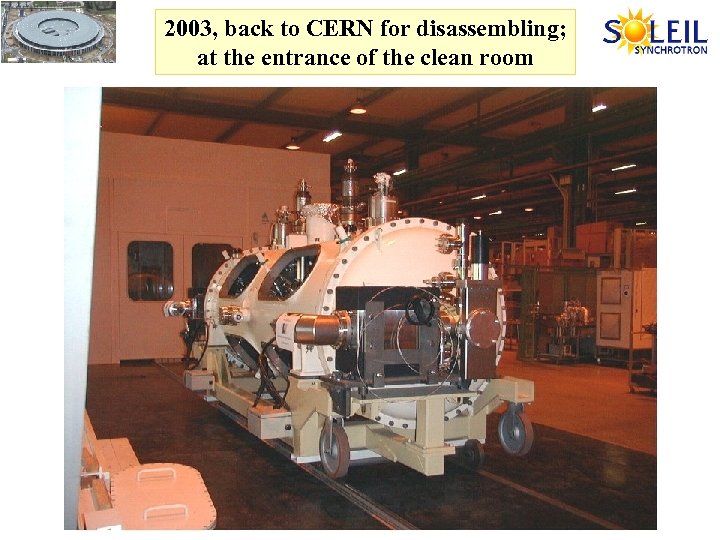 2003, back to CERN for disassembling; at the entrance of the clean room
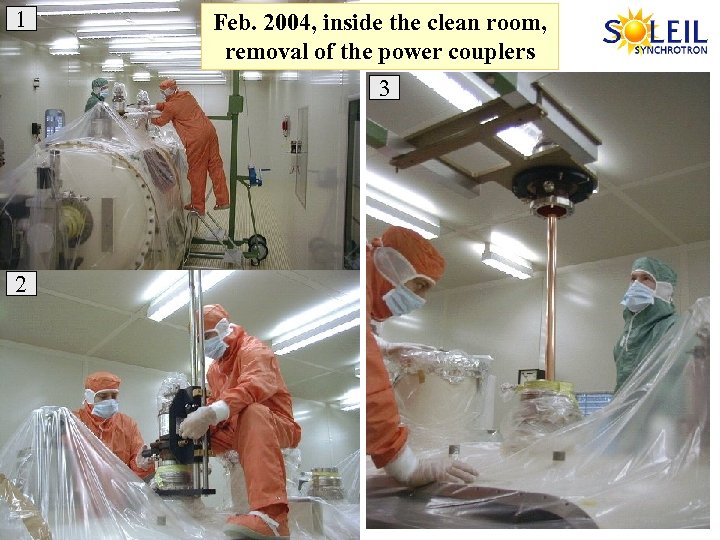 1 Feb. 2004, inside the clean room, removal of the power couplers 3 2
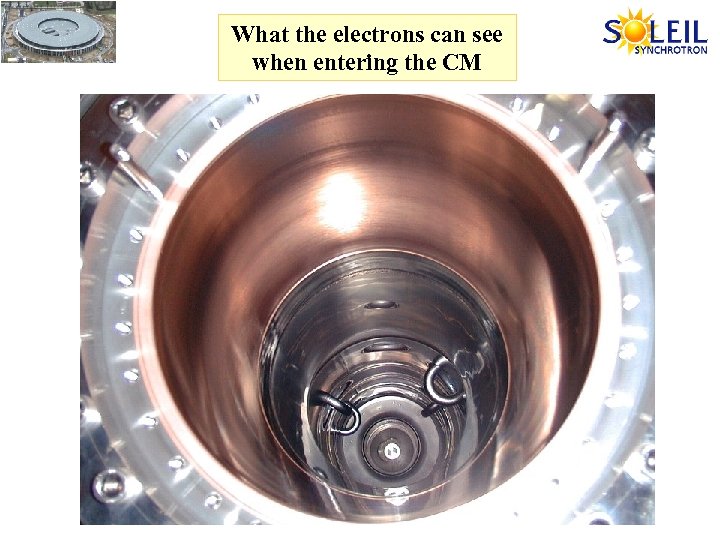 What the electrons can see when entering the CM
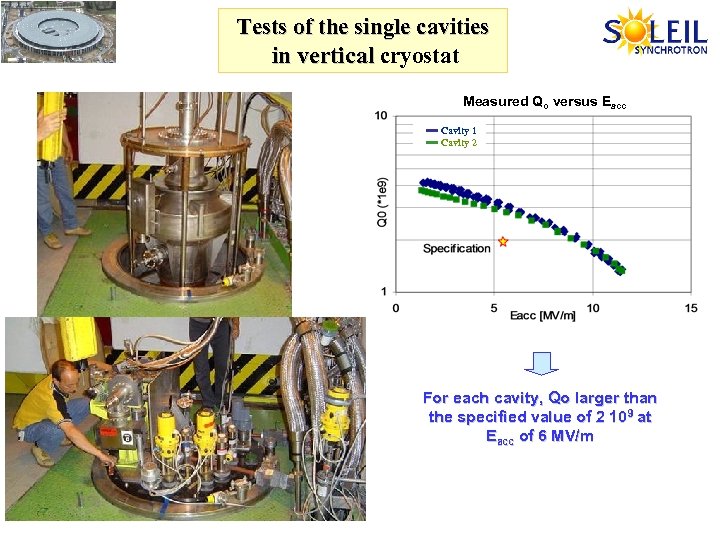 Tests of the single cavities in vertical cryostat Measured Qo versus Eacc Cavity 1 Cavity 2 For each cavity, Qo larger than the specified value of 2 109 at Eacc of 6 MV/m
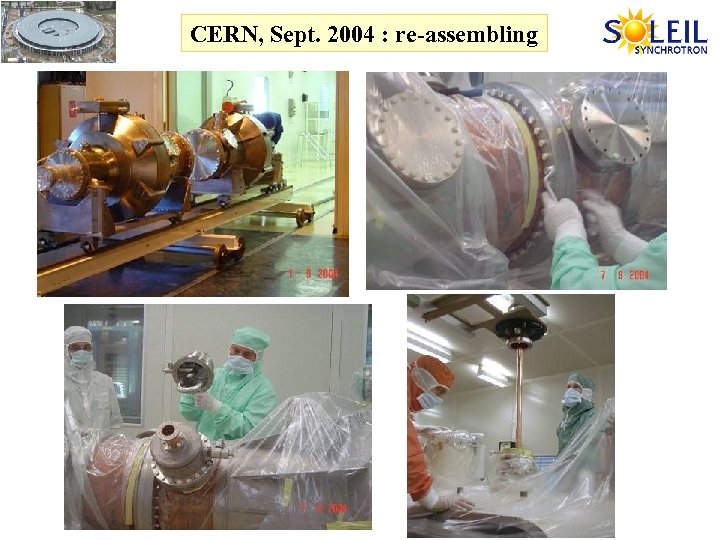 CERN, Sept. 2004 : re-assembling
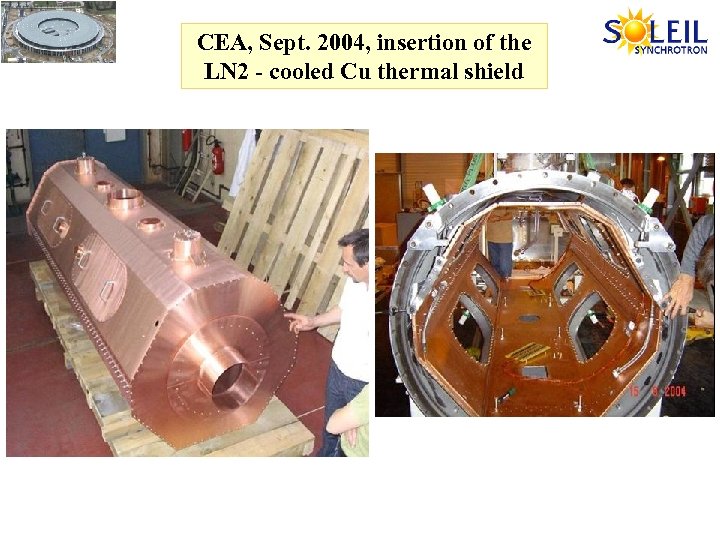 CEA, Sept. 2004, insertion of the LN 2 - cooled Cu thermal shield
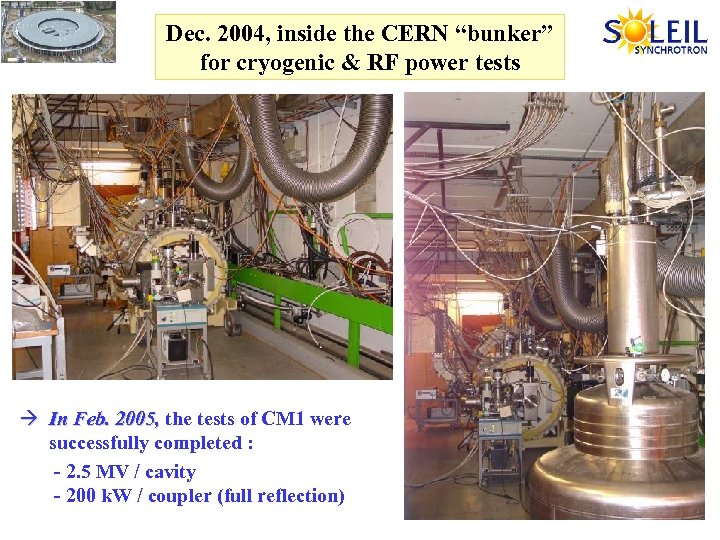 Dec. 2004, inside the CERN “bunker” for cryogenic & RF power tests In Feb. 2005, the tests of CM 1 were 2005, successfully completed : - 2. 5 MV / cavity - 200 k. W / coupler (full reflection)
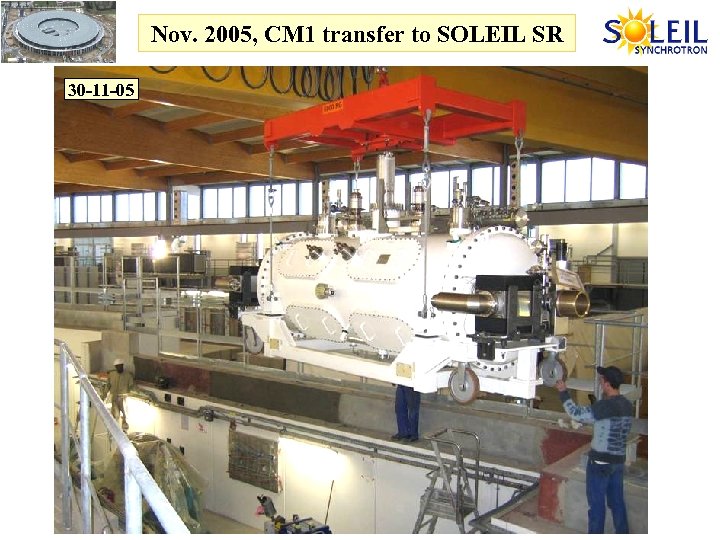 Nov. 2005, CM 1 transfer to SOLEIL SR 30 -11 -05
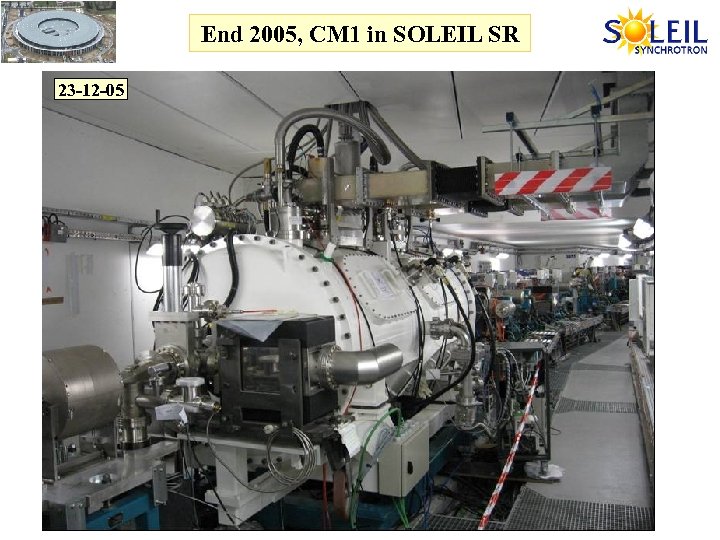 End 2005, CM 1 in SOLEIL SR 23 -12 -05
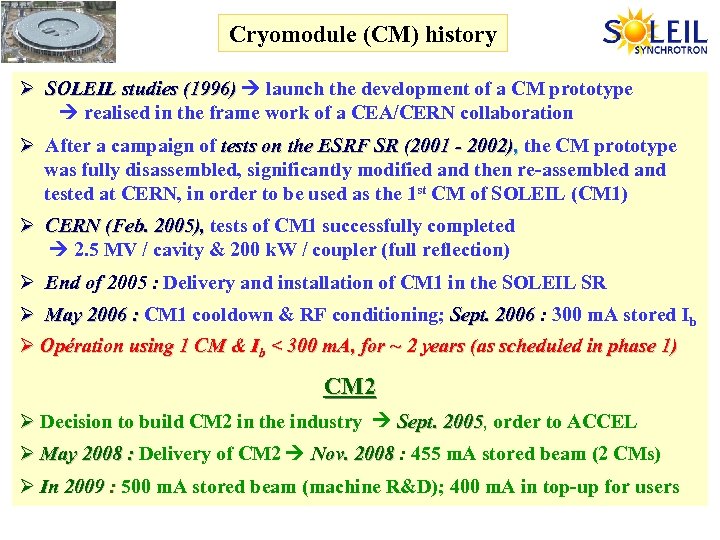 Cryomodule (CM) history Ø SOLEIL studies (1996) launch the development of a CM prototype (1996) realised in the frame work of a CEA/CERN collaboration Ø After a campaign of tests on the ESRF SR (2001 - 2002), the CM prototype was fully disassembled, significantly modified and then re-assembled and tested at CERN, in order to be used as the 1 st CM of SOLEIL (CM 1) Ø CERN (Feb. 2005), tests of CM 1 successfully completed 2. 5 MV / cavity & 200 k. W / coupler (full reflection) Ø End of 2005 : Delivery and installation of CM 1 in the SOLEIL SR : Ø May 2006 : CM 1 cooldown & RF conditioning; Sept. 2006 : 300 m. A stored Ib : 2006 Ø Opération using 1 CM & Ib < 300 m. A, for ~ 2 years (as scheduled in phase 1) CM 2 Ø Decision to build CM 2 in the industry Sept. 2005, order to ACCEL Ø May 2008 : Delivery of CM 2 Nov. 2008 : 455 m. A stored beam (2 CMs) : Ø In 2009 : 500 m. A stored beam (machine R&D); 400 m. A in top-up for users
 RF cryogenic system Both CM are supplied with LHe (4. 5 K) from a single cryo-plant, a HELIAL-2000 device from AIR LIQUIDE, operated in mixed refrigerator/liquefier mode; it can provide up to 400 W of refrigeration and 60 l / h of liquefaction, simultaneously.
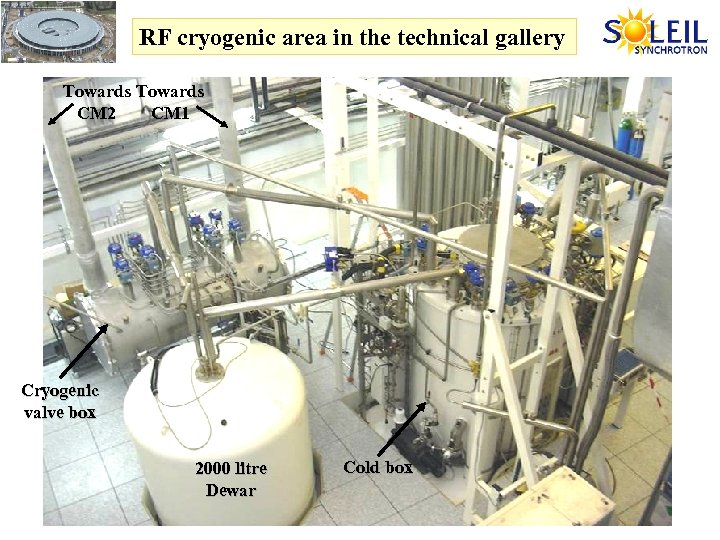 RF cryogenic area in the technical gallery Towards CM 2 CM 1 Cryogenic valve box 2000 litre Dewar Cold box
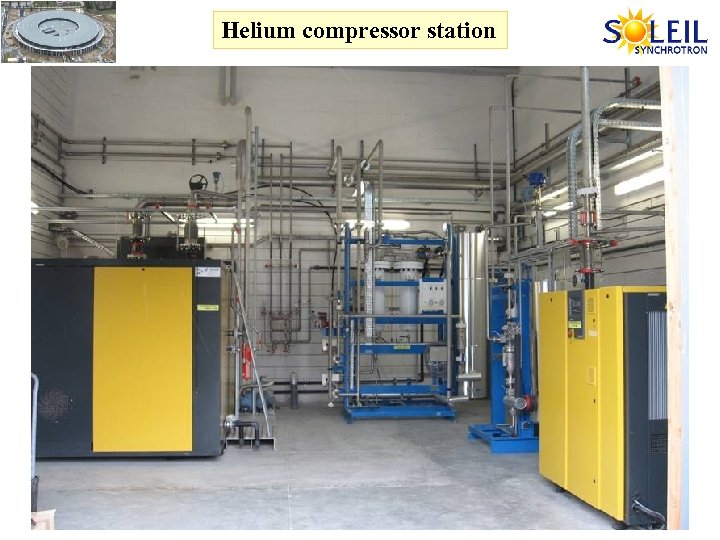 Helium compressor station
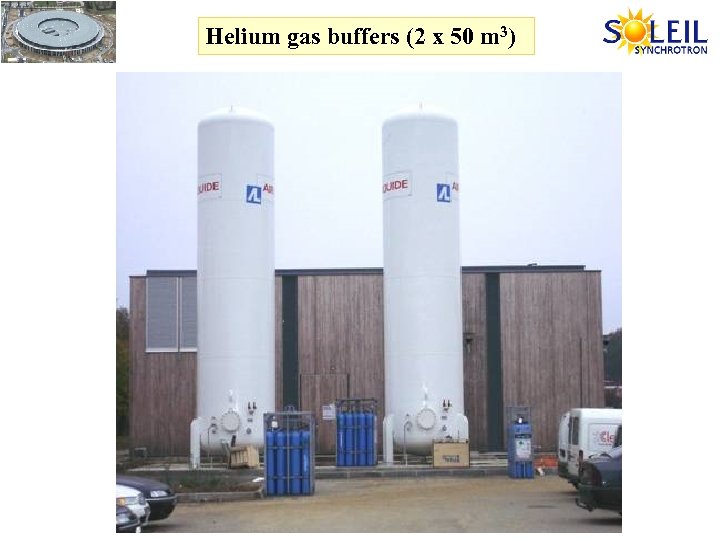 Helium gas buffers (2 x 50 m 3)
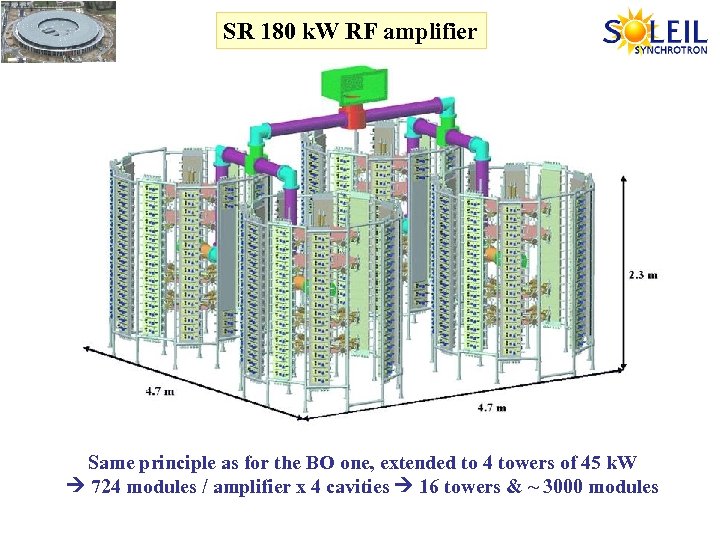 SR 180 k. W RF amplifier Same principle as for the BO one, extended to 4 towers of 45 k. W 724 modules / amplifier x 4 cavities 16 towers & ~ 3000 modules
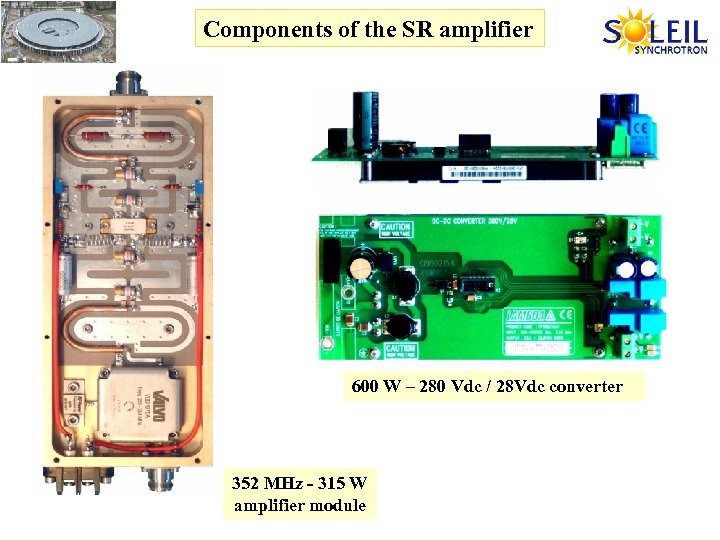 Components of the SR amplifier 600 W – 280 Vdc / 28 Vdc converter 352 MHz - 315 W amplifier module
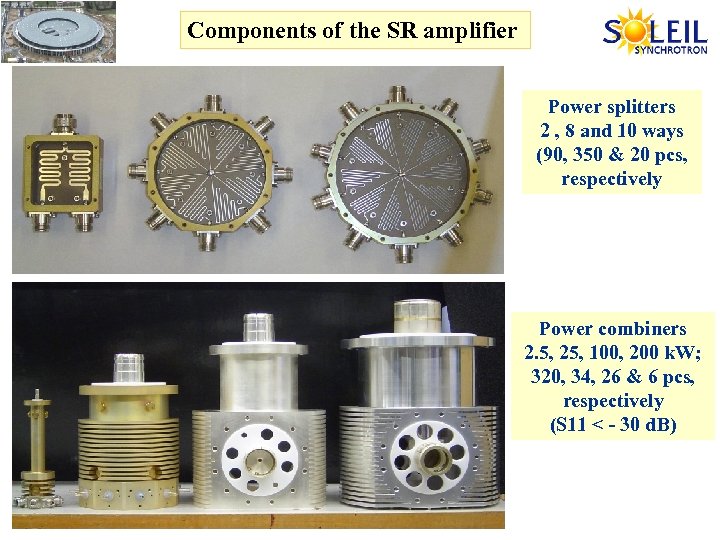 Components of the SR amplifier Power splitters 2 , 8 and 10 ways (90, 350 & 20 pcs, respectively Power combiners 2. 5, 25, 100, 200 k. W; 320, 34, 26 & 6 pcs, respectively (S 11 < - 30 d. B)
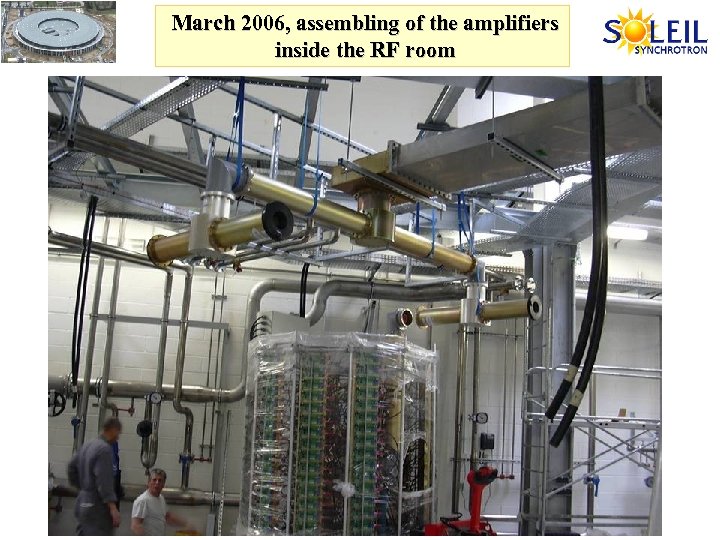 March 2006, assembling of the amplifiers inside the RF room
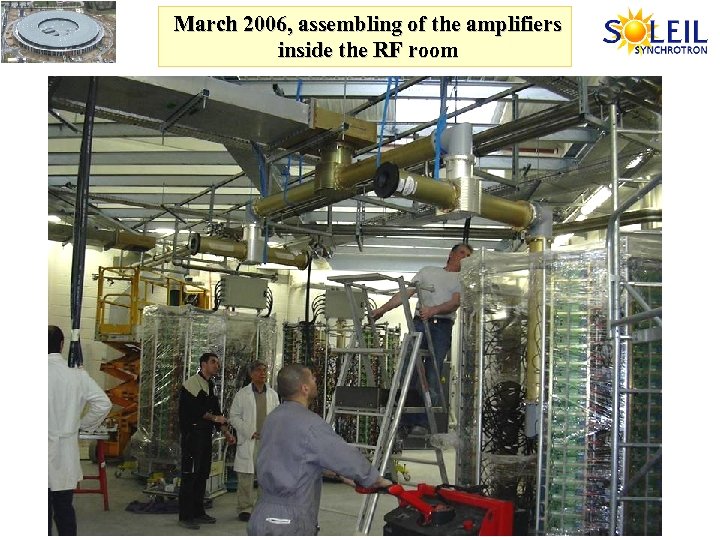 March 2006, assembling of the amplifiers inside the RF room
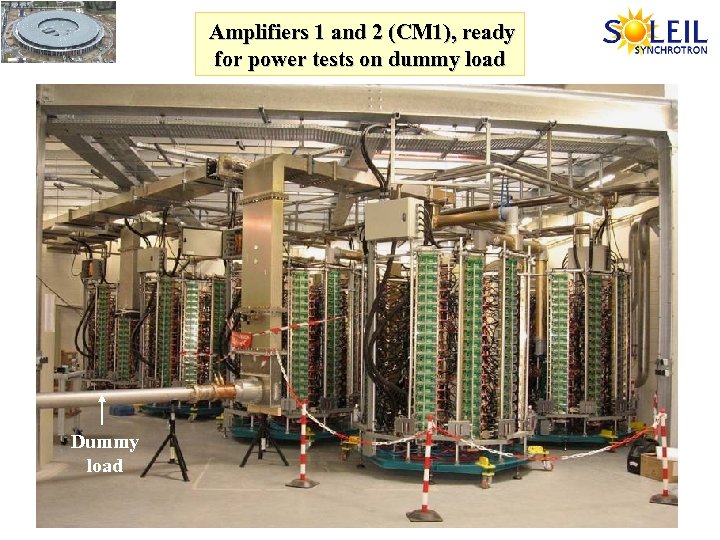 Amplifiers 1 and 2 (CM 1), ready for power tests on dummy load Dummy load
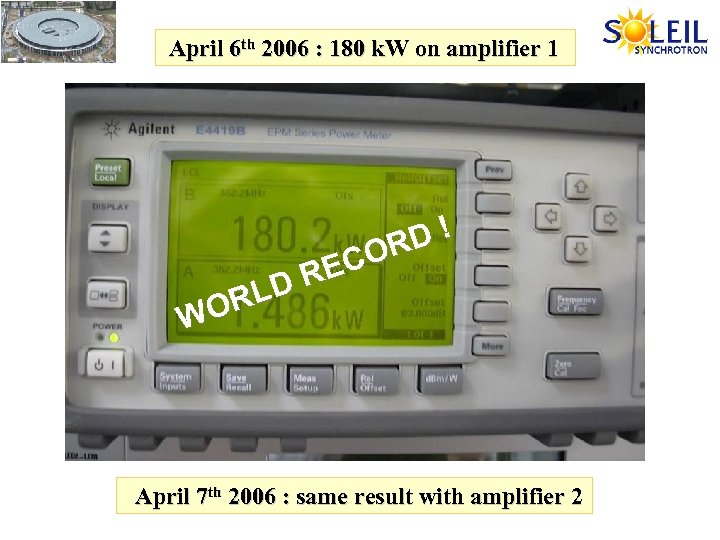 April 6 th 2006 : 180 k. W on amplifier 1 RLD WO D! OR REC April 7 th 2006 : same result with amplifier 2
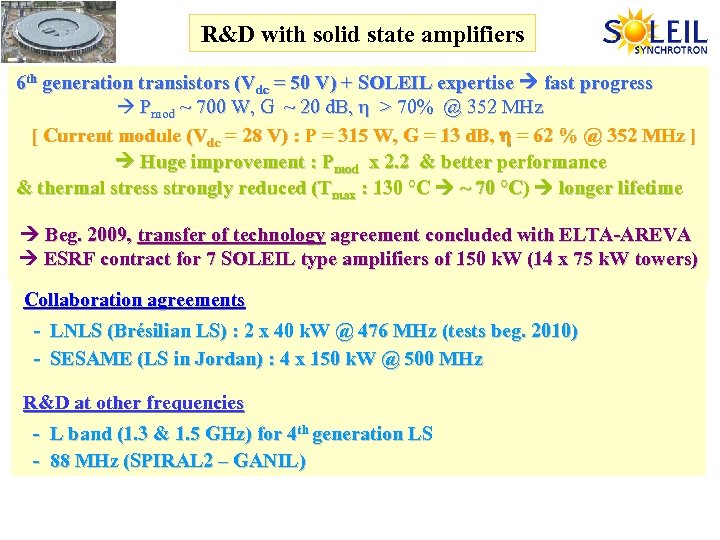 R&D with solid state amplifiers 6 th generation transistors (Vdc = 50 V) + SOLEIL expertise fast progress Pmod ~ 700 W, G ~ 20 d. B, > 70% @ 352 MHz [ Current module (Vdc = 28 V) : P = 315 W, G = 13 d. B, = 62 % @ 352 MHz ] Huge improvement : Pmod x 2. 2 & better performance & thermal stress strongly reduced (Tmax : 130 °C ~ 70 °C) longer lifetime Beg. 2009, transfer of technology agreement concluded with ELTA-AREVA ESRF contract for 7 SOLEIL type amplifiers of 150 k. W (14 x 75 k. W towers) Collaboration agreements - LNLS (Brésilian LS) : 2 x 40 k. W @ 476 MHz (tests beg. 2010) - SESAME (LS in Jordan) : 4 x 150 k. W @ 500 MHz R&D at other frequencies - L band (1. 3 & 1. 5 GHz) for 4 th generation LS - 88 MHz (SPIRAL 2 – GANIL)
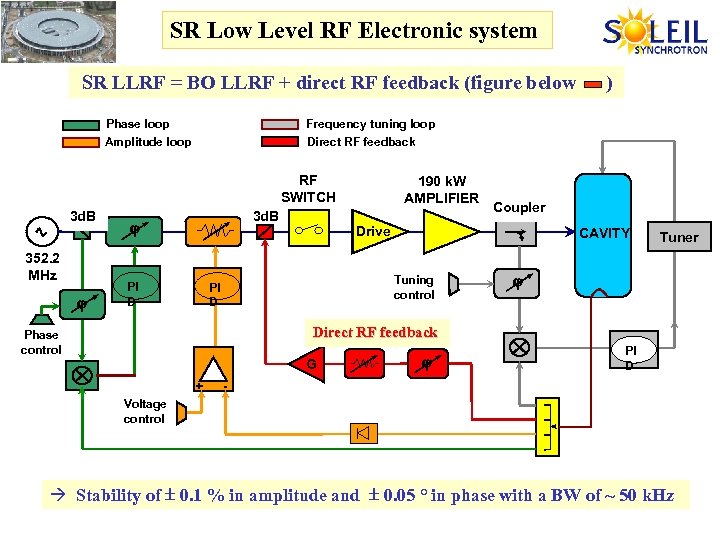 SR Low Level RF Electronic system SR LLRF = BO LLRF + direct RF feedback (figure below ) Frequency tuning loop Direct RF feedback Phase loop Amplitude loop RF SWITCH 3 d. B 352. 2 MHz 3 d. B PI D 190 k. W AMPLIFIER Coupler Drive CAVITY Tuning control PI D Tuner Direct RF feedback Phase control G + PI D - Voltage control Stability of 0. 1 % in amplitude and 0. 05 ° in phase with a BW of ~ 50 k. Hz
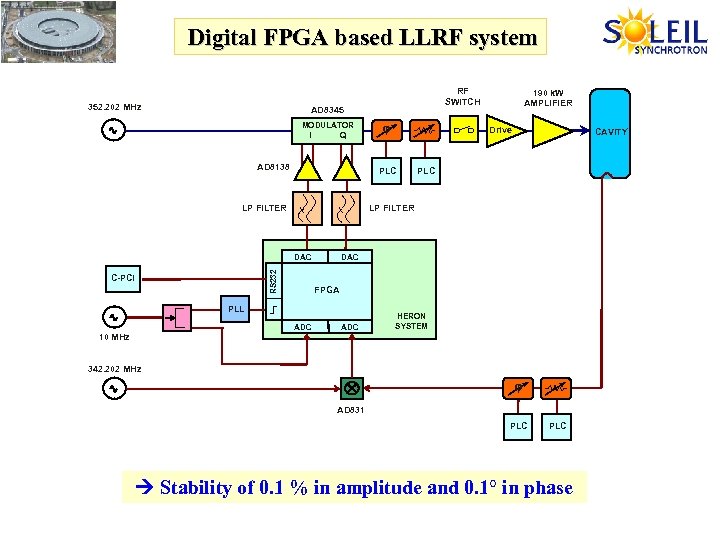 Digital FPGA based LLRF system 352. 202 MHz AD 8345 MODULATOR I Q AD 8138 190 k. W AMPLIFIER Drive CAVITY PLC LP FILTER RS 232 DAC C-PCI PLC LP FILTER DAC FPGA PLL ADC 10 MHz RF SWITCH ADC HERON SYSTEM 342. 202 MHz AD 831 PLC Stability of 0. 1 % in amplitude and 0. 1° in phase
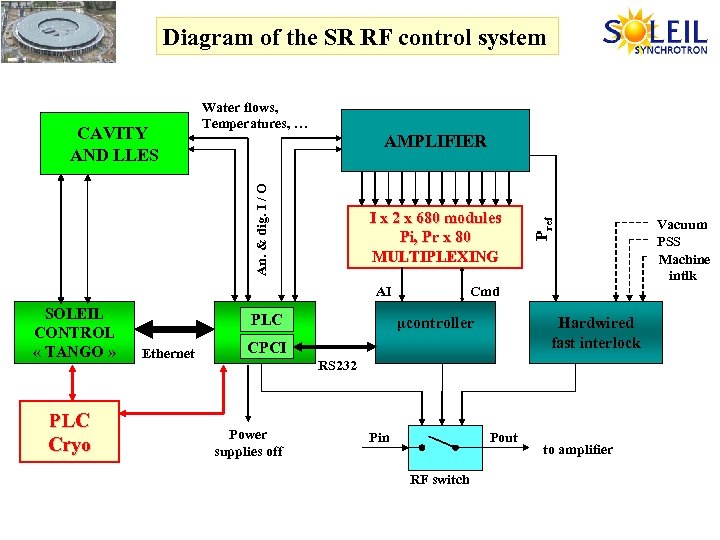 Diagram of the SR RF control system I x 2 x 680 modules Pi, Pr x 80 MULTIPLEXING AI SOLEIL CONTROL « TANGO » PLC Cryo PLC Ethernet Pref AMPLIFIER An. & dig. I / O CAVITY AND LLES Water flows, Temperatures, … Cmd µcontroller Hardwired fast interlock CPCI RS 232 Power supplies off Pin Pout RF switch to amplifier Vacuum PSS Machine intlk
 SR operational experience Repetitive pbs with the CM frequency tuning mechanism - Complete tuner assembly (step-motor, gear-box, driving screw, lever system) inside the CM, under vacuum and cryogenic environment - Pbs on SUP 3 HC cavity at ELETTRA with a similar design Ø Sparing use back-up mode at fixed tuning (Ibmax) Vcav (Ib) & f (Vcav) Ø Development of a new design - March 2009, prototype successfully tested on a test bench @ cold in Cry. Holab at CEA + 20 years of SOLEIL operation - New version implemented in Aug. 2009 on CM 2 & Jan. 2010, on CM 1 In spite of repetitive pbs with the tuners, the impact on the operation was relatively weak, thanks to our back-up mode at fixed tuning Trips « Excess of Pref » , which occurred @ 250 m. A with 1 CM Erratic events at a mean rate of ~ 1 / week, which disappeared after operating with 2 CM (< 400 m. A) Discharges on coupler window (500 m. A with 2 CM) ? New coupler design (P > 300 k. W), developed in collab. CERN/ESRF/SOLEIL 500 m. A with 1 CM (redundancy)
 SR operational experience Cryogenic system - ~ 100 % operational availability, but for a while, difficulties in maintaining the CM LHe level transfer line too deeply pushed into the Dewar ! - Losses of utilities (electr. , water) long restarts (few hours) Spare He compressor station with separate utilities (install. , beg. 2010) Redundancy in operation and easier maintenance RF power amplifiers - Proved to be very reliable : after ~ 18 000 running hours, over + 3 years, only 3 short beam dead times ~ 100 % operational availability - Module failure rate of ~ 3. 5 % per year ~ no impact on the operation Matter of maintenance : 1 hour @ each shutdown for ~ 10 mod. repair Significant improvement expected from the new generation modules with more robust transistors and less thermal stress
 Summary & conclusions After ~ 3. 5 years of operation, result globally satisfying : - For the BO RF, no pb at all - In SR, for the first 2 years, using a single CM, only 5 % of dead time due to RF - The third year, with the commissioning of CM 2, it has nearly tripled - Last 8 months 4 % - Significant improvements expected from the corrective actions : Upgrade of the CM frequency tuners Installation of a spare He compressor station - Longer term Upgrade of the power couplers (collab. with CERN & ESRF) Replace the actual amplifier modules by the 700 W generation R&D with solid state amplifiers : - ESRF contract with ELTA 352 MHz - Collaborations (LNLS, SESAME) ~ 500 MHz - L and VHF bands
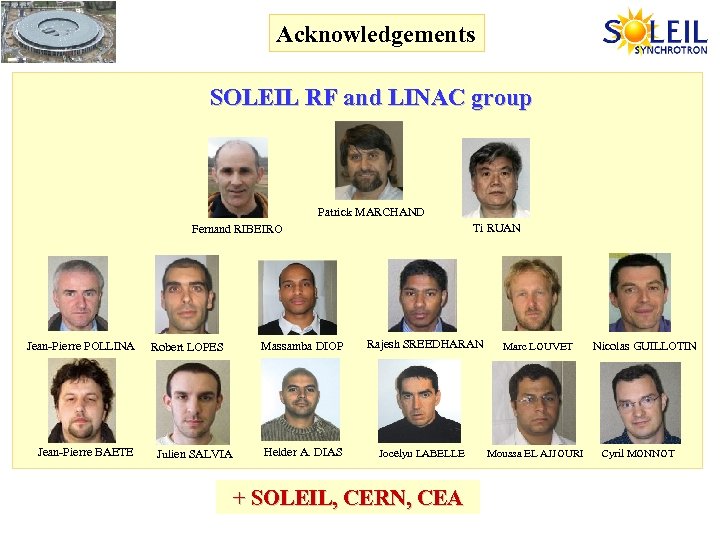 Acknowledgements SOLEIL RF and LINAC group Patrick MARCHAND Ti RUAN Fernand RIBEIRO Jean-Pierre POLLINA Jean-Pierre BAETE Massamba DIOP Robert LOPES Julien SALVIA Helder A. DIAS Rajesh SREEDHARAN Jocelyn LABELLE + SOLEIL, CERN, CEA Marc LOUVET Moussa EL AJJOURI Catherine Nicolas GUILLOTIN THOMAS-MADEC Cyril MONNOT