Скачать презентацию Workshop on Improving Education Deliverance and Attainment Standards
5bfb733f8a87eca09e52aa398a21df62.ppt
- Количество слайдов: 75
 Workshop on Improving Education Deliverance and Attainment Standards Through Transforming Academic Institutions Towards OBE System Megat Johari Megat Mohd Noor Professor, Malaysia Japan International Institute of Technology & Assoc Director (International Affairs), Engineering Accreditation Department Karachi & Peshawar, Pakistan 27 - 30 October 2015
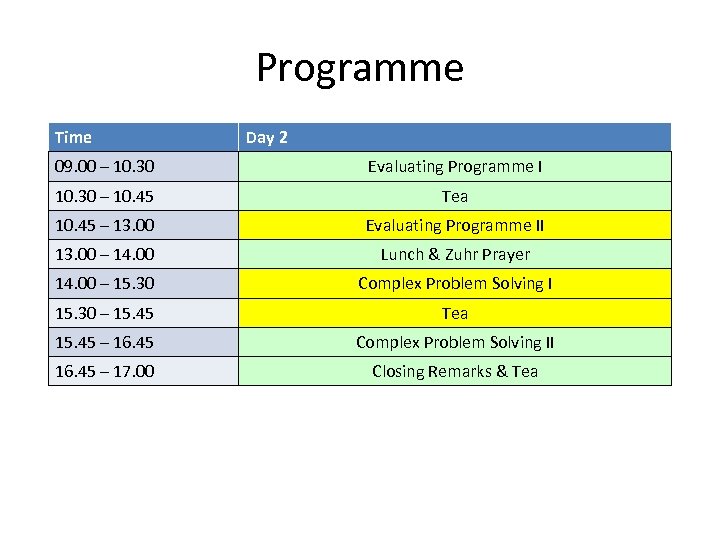 Programme Time Day 2 09. 00 – 10. 30 Evaluating Programme I 10. 30 – 10. 45 Tea 10. 45 – 13. 00 Evaluating Programme II 13. 00 – 14. 00 Lunch & Zuhr Prayer 14. 00 – 15. 30 Complex Problem Solving I 15. 30 – 15. 45 Tea 15. 45 – 16. 45 Complex Problem Solving II 16. 45 – 17. 00 Closing Remarks & Tea
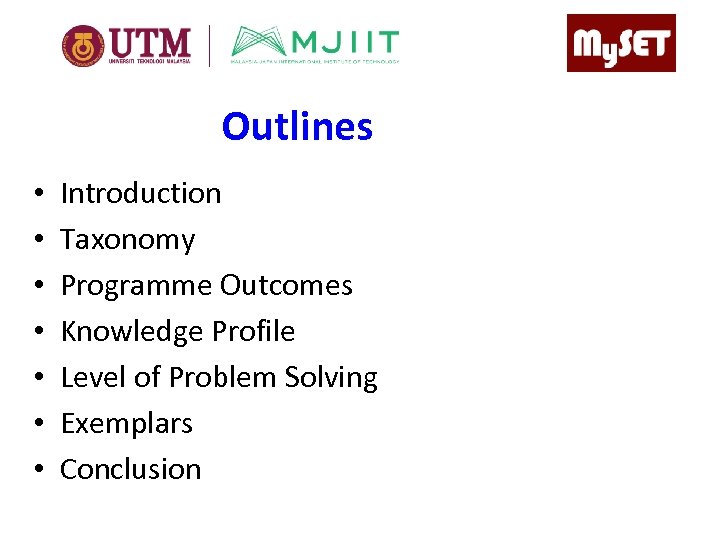 Outlines • • Introduction Taxonomy Programme Outcomes Knowledge Profile Level of Problem Solving Exemplars Conclusion
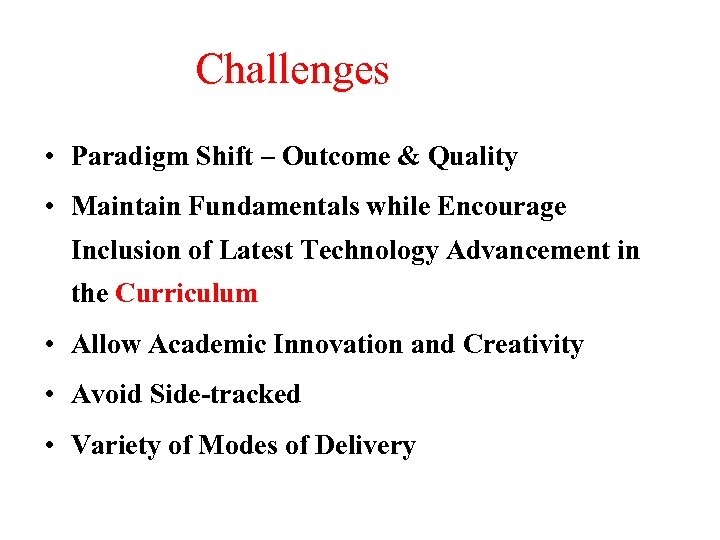 Challenges • Paradigm Shift – Outcome & Quality • Maintain Fundamentals while Encourage Inclusion of Latest Technology Advancement in the Curriculum • Allow Academic Innovation and Creativity • Avoid Side-tracked • Variety of Modes of Delivery
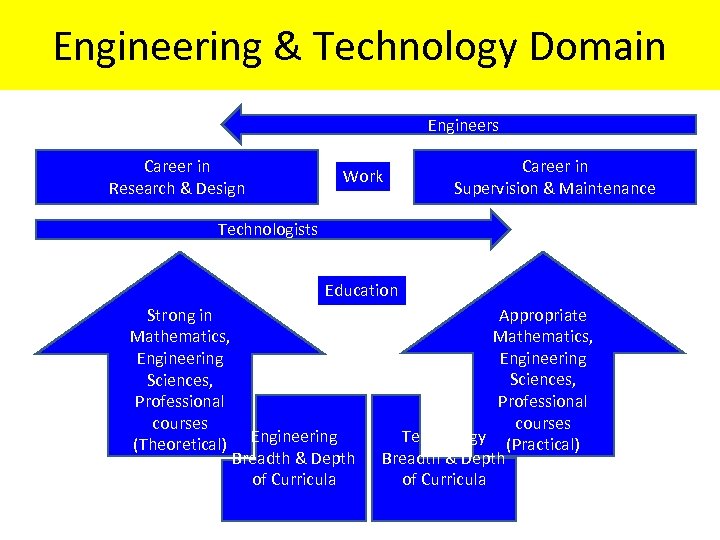 Engineering & Technology Domain Engineers Career in Research & Design Work Career in Supervision & Maintenance Technologists Education Strong in Mathematics, Engineering Sciences, Professional courses (Theoretical) Engineering Breadth & Depth of Curricula Appropriate Mathematics, Engineering Sciences, Professional courses Technology (Practical) Breadth & Depth of Curricula
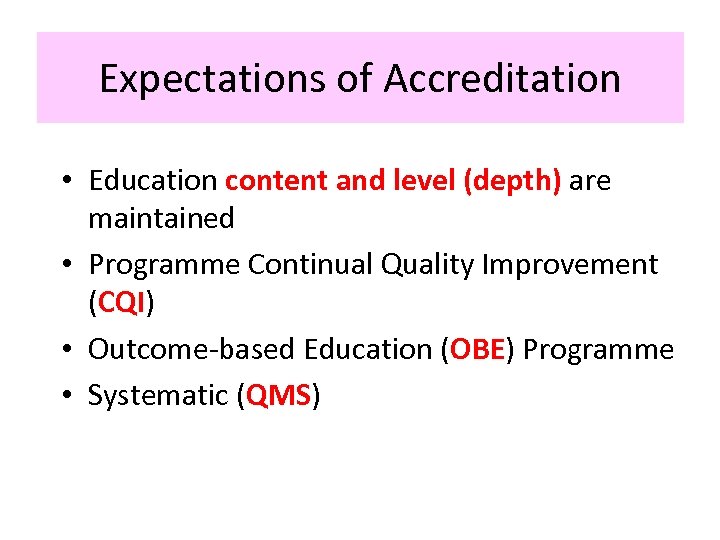 Expectations of Accreditation • Education content and level (depth) are maintained • Programme Continual Quality Improvement (CQI) • Outcome-based Education (OBE) Programme • Systematic (QMS)
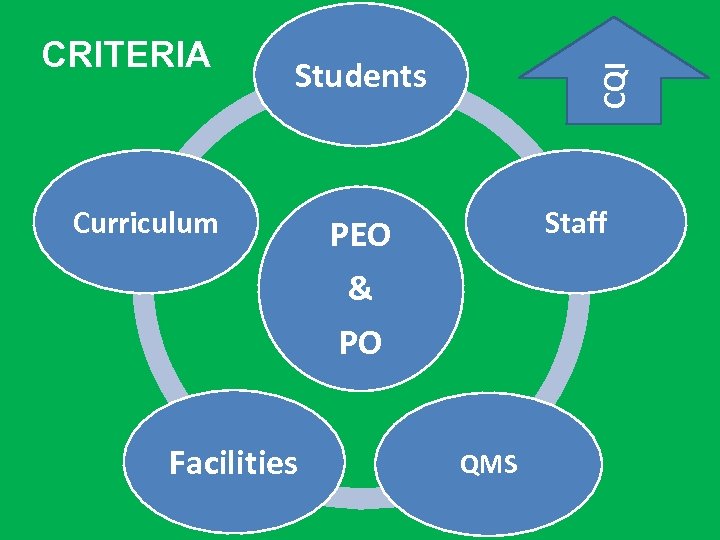 Students Curriculum CQI CRITERIA Staff PEO & PO Facilities QMS
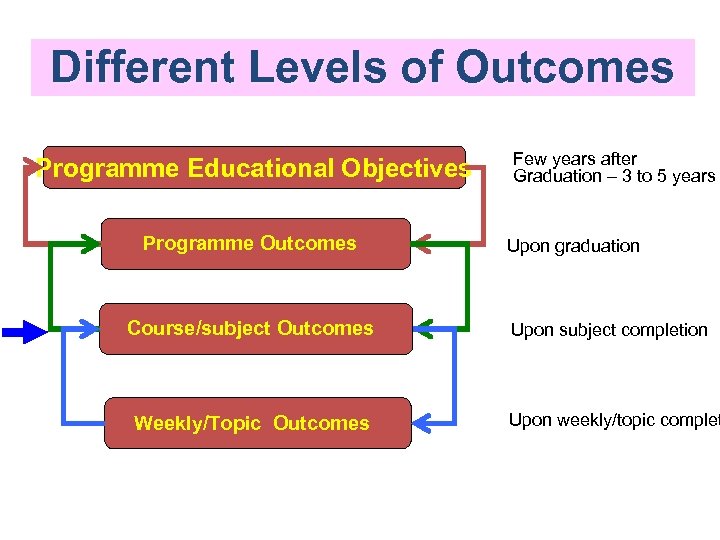 Different Levels of Outcomes Programme Educational Objectives Programme Outcomes Course/subject Outcomes Weekly/Topic Outcomes Few years after Graduation – 3 to 5 years Upon graduation Upon subject completion Upon weekly/topic complet
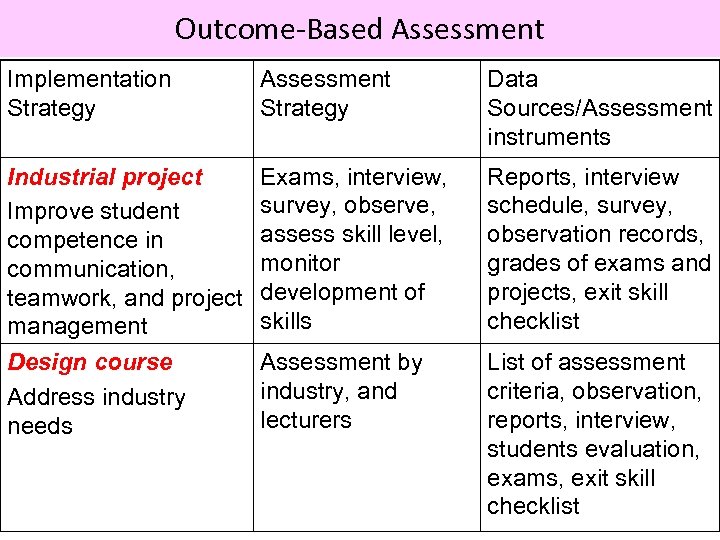 Outcome-Based Assessment Implementation Strategy Assessment Strategy Data Sources/Assessment instruments Industrial project Improve student competence in communication, teamwork, and project management Design course Address industry needs Exams, interview, survey, observe, assess skill level, monitor development of skills Reports, interview schedule, survey, observation records, grades of exams and projects, exit skill checklist Assessment by industry, and lecturers List of assessment criteria, observation, reports, interview, students evaluation, exams, exit skill checklist
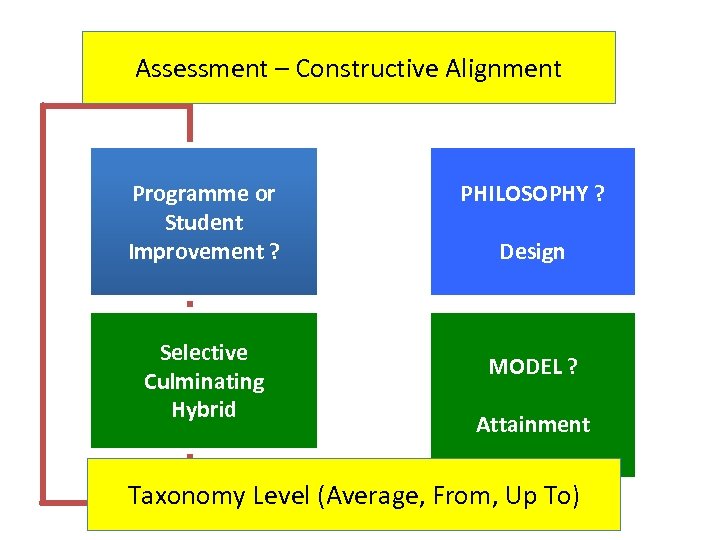 Assessment – Constructive Alignment Big Picture Programme or Student Improvement ? Selective Culminating Hybrid PHILOSOPHY ? Design MODEL ? Attainment Taxonomy Level (Average, From, Up To)
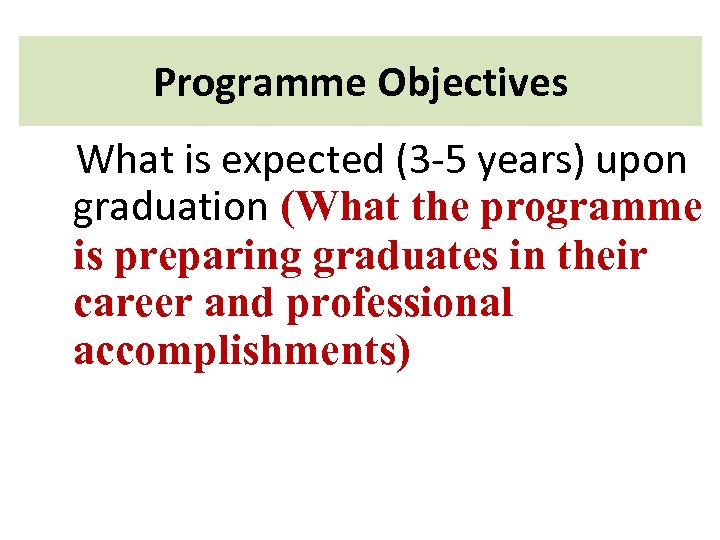 Programme Objectives What is expected (3 -5 years) upon graduation (What the programme is preparing graduates in their career and professional accomplishments)
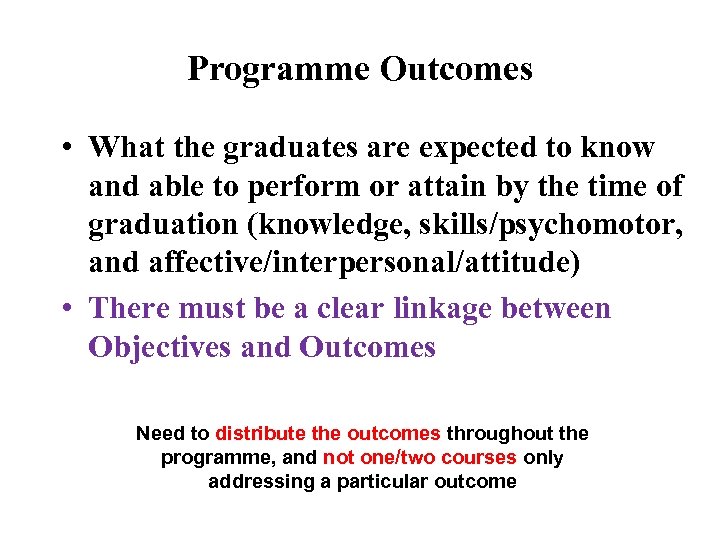 Programme Outcomes • What the graduates are expected to know and able to perform or attain by the time of graduation (knowledge, skills/psychomotor, and affective/interpersonal/attitude) • There must be a clear linkage between Objectives and Outcomes Need to distribute the outcomes throughout the programme, and not one/two courses only addressing a particular outcome
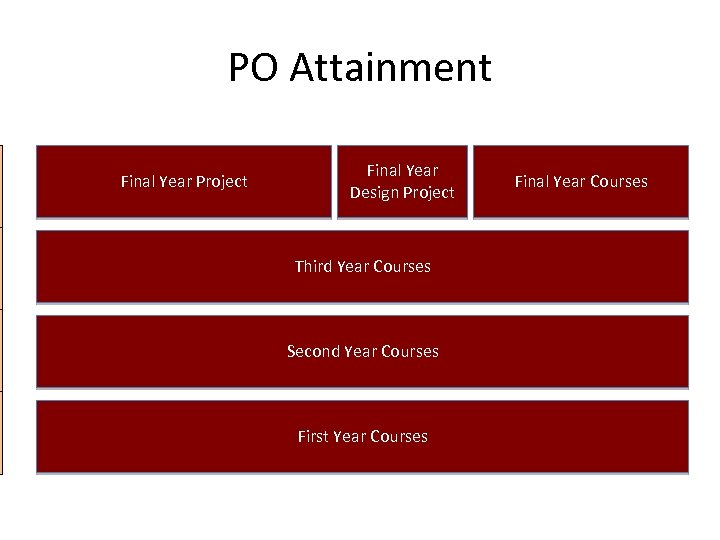 PO Attainment Final Year Project Final Year Design Project Third Year Courses Second Year Courses First Year Courses Final Year Courses
 Compliance to Washington Accord 2017 - 2019 • Knowledge Profile • Level of Problem Solving • Graduate Attributes (Programme Outcomes)
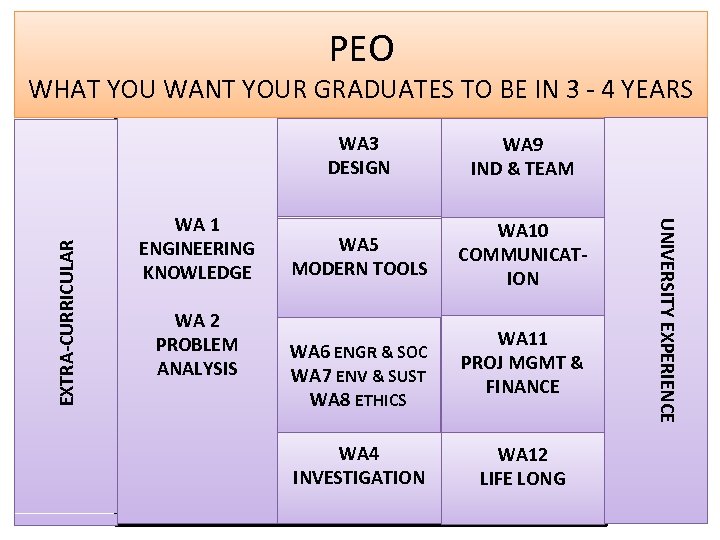 PEO WHAT YOU WANT YOUR GRADUATES TO BE IN 3 - 4 YEARS EXTRA-CURRICULAR WA 1 ENGINEERING KNOWLEDGE WA 2 PROBLEM ANALYSIS WA 9 IND & TEAM WA 5 MODERN TOOLS WA 10 COMMUNICATION 4 YEARS WA 6 ENGR & SOC WA 7 ENV & SUST WA 8 ETHICS WA 4 INVESTIGATION WA 11 PROJ MGMT & FINANCE WA 12 LIFE LONG UNIVERSITY EXPERIENCE WA 3 DESIGN
 Course Outcomes • Statement … explain, calculate, derive, design, critique. • Statement … learn, know, understand, appreciate – not learning objectives but may qualify as outcomes (non-observable). • Understanding cannot be directly observed, student must do something observable to demonstrate his/her understanding.
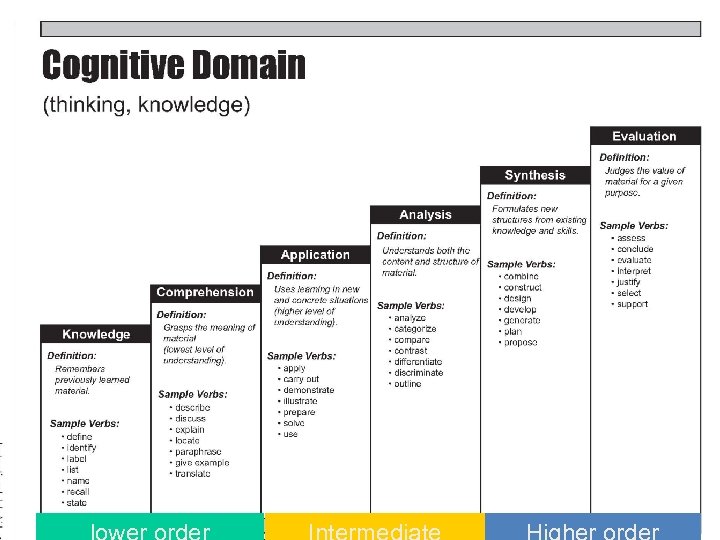
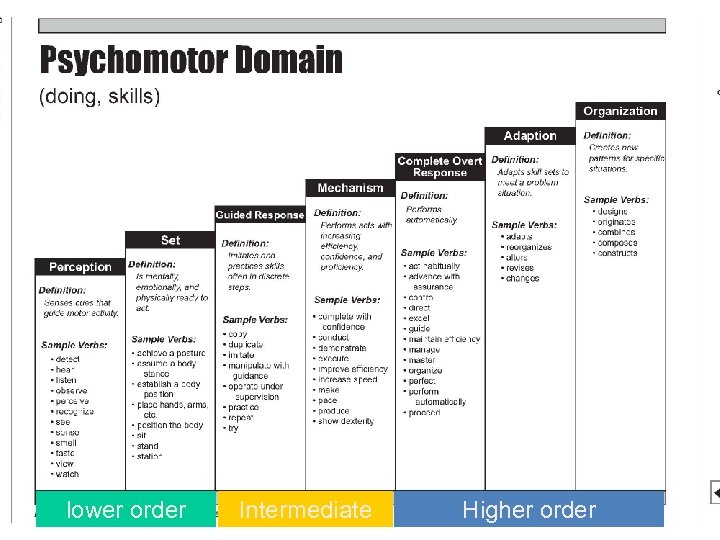 lower order Intermediate Higher order
 lower order Intermediate Higher
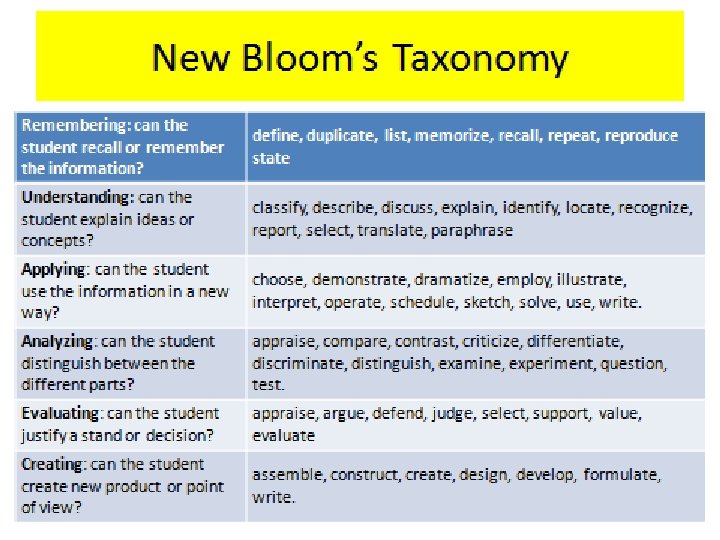
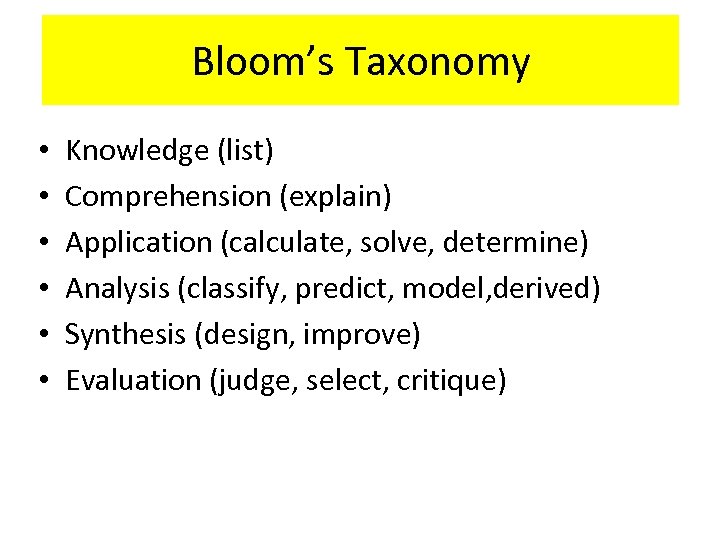 Bloom’s Taxonomy • • • Knowledge (list) Comprehension (explain) Application (calculate, solve, determine) Analysis (classify, predict, model, derived) Synthesis (design, improve) Evaluation (judge, select, critique)
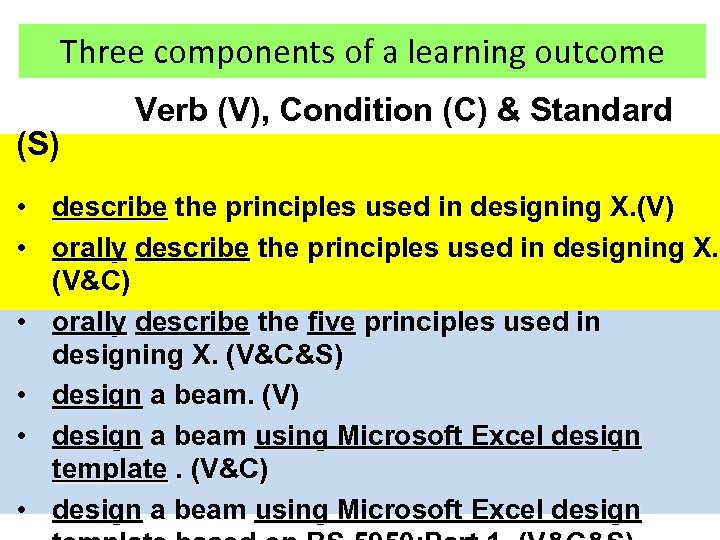 Three components of a learning outcome (S) Verb (V), Condition (C) & Standard • describe the principles used in designing X. (V) • orally describe the principles used in designing X. (V&C) • orally describe the five principles used in designing X. (V&C&S) • design a beam. (V) • design a beam using Microsoft Excel design template. (V&C) • design a beam using Microsoft Excel design
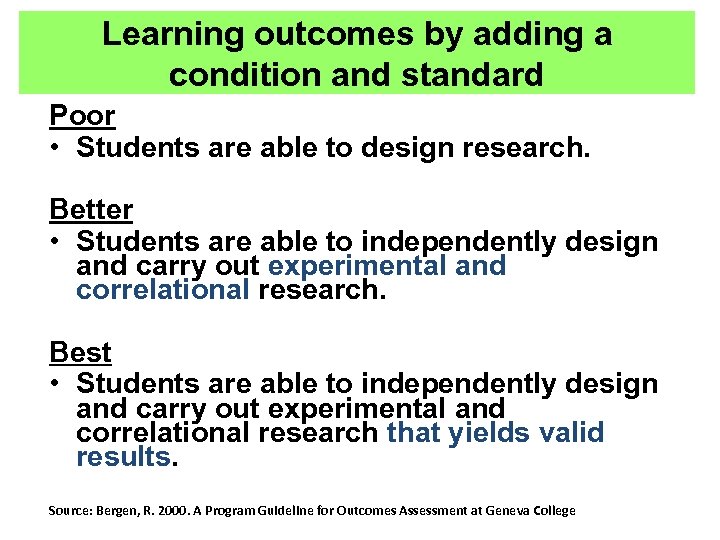 Learning outcomes by adding a condition and standard Poor • Students are able to design research. Better • Students are able to independently design and carry out experimental and correlational research. Best • Students are able to independently design and carry out experimental and correlational research that yields valid results. Source: Bergen, R. 2000. A Program Guideline for Outcomes Assessment at Geneva College
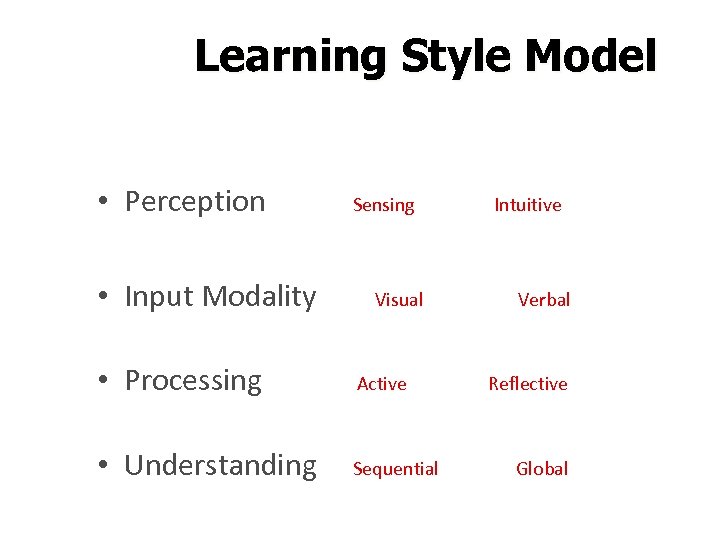 Learning Style Model • Perception • Input Modality Sensing Visual • Processing Active • Understanding Sequential Intuitive Verbal Reflective Global
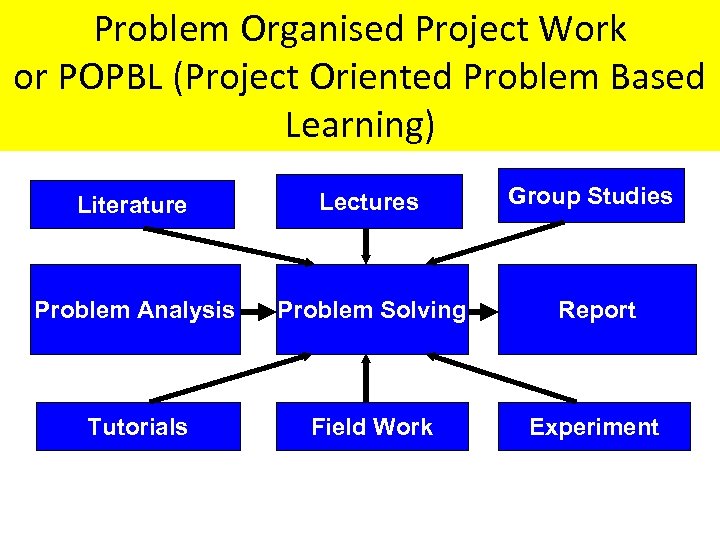 Problem Organised Project Work or POPBL (Project Oriented Problem Based Learning) Literature Lectures Group Studies Problem Analysis Problem Solving Report Tutorials Field Work Experiment
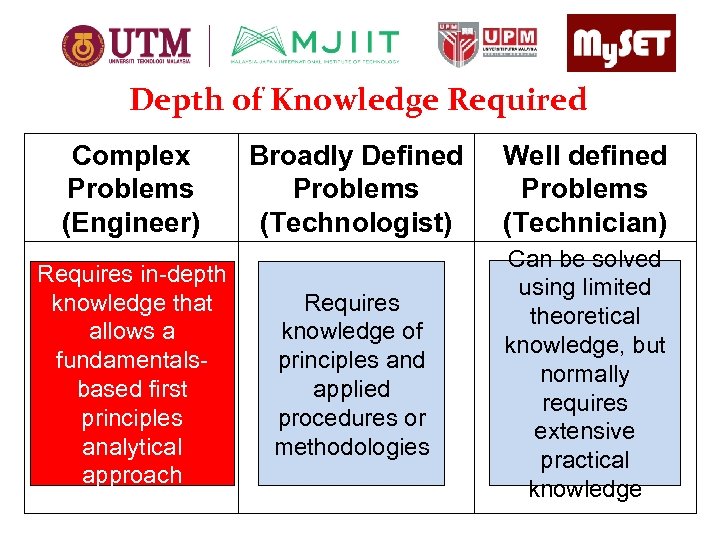 Depth of Knowledge Required Complex Problems (Engineer) Requires in-depth knowledge that allows a fundamentalsbased first principles analytical approach Broadly Defined Problems (Technologist) Well defined Problems (Technician) Requires knowledge of principles and applied procedures or methodologies Can be solved using limited theoretical knowledge, but normally requires extensive practical knowledge
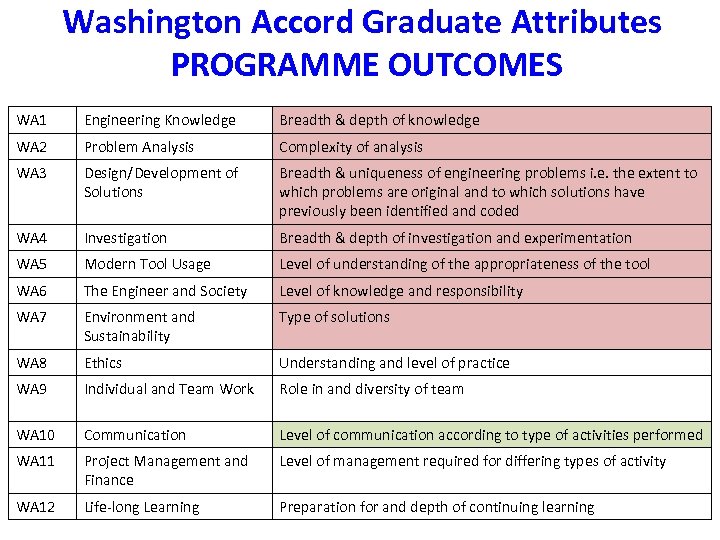 Washington Accord Graduate Attributes PROGRAMME OUTCOMES WA 1 Engineering Knowledge Breadth & depth of knowledge WA 2 Problem Analysis Complexity of analysis WA 3 Design/Development of Solutions Breadth & uniqueness of engineering problems i. e. the extent to which problems are original and to which solutions have previously been identified and coded WA 4 Investigation Breadth & depth of investigation and experimentation WA 5 Modern Tool Usage Level of understanding of the appropriateness of the tool WA 6 The Engineer and Society Level of knowledge and responsibility WA 7 Environment and Sustainability Type of solutions WA 8 Ethics Understanding and level of practice WA 9 Individual and Team Work Role in and diversity of team WA 10 Communication Level of communication according to type of activities performed WA 11 Project Management and Finance Level of management required for differing types of activity WA 12 Life-long Learning Preparation for and depth of continuing learning
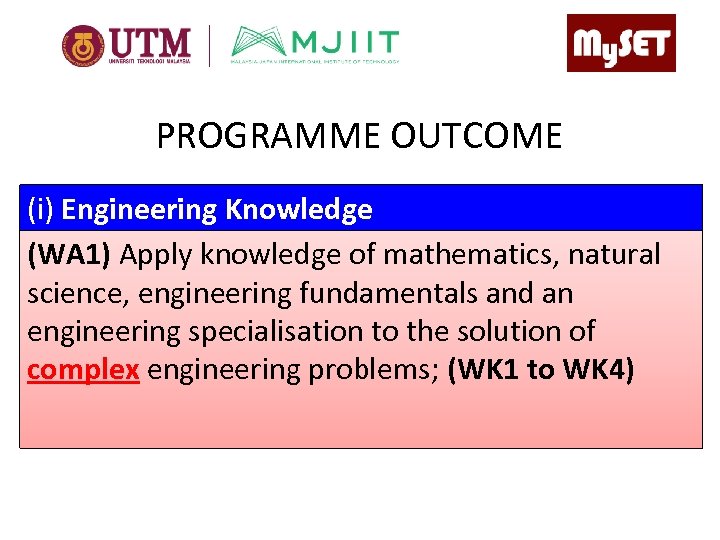 PROGRAMME OUTCOME (i) Engineering Knowledge (WA 1) Apply knowledge of mathematics, natural science, engineering fundamentals and an engineering specialisation to the solution of complex engineering problems; (WK 1 to WK 4)
 PROGRAMME OUTCOME (ii) Problem Analysis - Complexity of analysis (WA 2) Identify, formulate, research literature and analyse complex engineering problems reaching substantiated conclusions using first principles of mathematics, natural sciences and engineering sciences (WK 1 – WK 4)
 PROGRAMME OUTCOME (iii) Design/Development of Solutions – Breadth and uniqueness of engineering problems i. e. the extent to which problems are original and to which solutions have previously been identified or codified (WA 3) Design solutions for complex engineering problems and design systems, components or processes that meet specified needs with appropriate consideration for public health and safety, cultural, societal, and environmental considerations (WK 5)
 PROGRAMME OUTCOME (iv) Investigation - Breadth & Depth of Investigation & Experimentation (WA 4) Conduct investigation of complex problems using research based knowledge (WK 8) and research methods including design of experiments, analysis and interpretation of data, and synthesis of information to provide valid conclusions
 PROGRAMME OUTCOME (v) Modern Tool Usage - Level of understanding of the appropriateness of the tool (WA 5) Create, select and apply appropriate techniques, resources, and modern engineering and IT tools, including prediction and modelling, to complex engineering problems, with an understanding of the limitations. (WK 6)
 PROGRAMME OUTCOME (vi) The Engineer and Society - Level of knowledge and responsibility (WA 6) Apply reasoning informed by contextual knowledge to assess societal, health, safety, legal and cultural issues and the consequent responsibilities relevant to professional engineering practice and solutions to complex engineering problems. (WK 7)
 PROGRAMME OUTCOME (vii) Environment and Sustainability - Type of solutions (WA 7) Understand evaluate the sustainabilty and impact of professional engineering work in the solutions of complex engineering problems in societal and environmental contexts (demonstrate knowledge of and need for sustainable development) (WK 7)
 PROGRAMME OUTCOME (viii) Ethics - Understanding and level of practice (WA 8) Apply ethical principles and commit to professional ethics and responsibilities and norms of engineering practice. (WK 7)
 PROGRAMME OUTCOME (x) Individual and Team Work – Role in and diversity of team (WA 9) Function effectively as an individual, and as a member or leader in diverse teams and in multidisciplinary settings
 PROGRAMME OUTCOME (ix) Communication – Level of communication according to type of activities performed (WA 10) Communicate effectively on complex engineering activities with the engineering community and with society at large, such as being able to comprehend and write effective reports and design documentation, make effective presentations, and give and receive clear instructions
 PROGRAMME OUTCOME (xi) Project Management and Finance – Level of management required for differing types of activity (WA 11) Demonstrate knowledge and understanding of engineering and management principles and economic decision-making and apply these to one’s own work, as a member and leader in a team, to manage projects and in multidisciplinary environments
 PROGRAMME OUTCOME (xii) Life-long Learning – Preparation for and depth of continuing learning (WA 12) Recognise the need for, and have the preparation and ability to engage in independent and life-long learning in the broadest context of technological change
 Knowledge Profile (Curriculum) Theory-based natural sciences Conceptually-based mathematics, numerical analysis, statistics and formal aspects of computer and information science to support analysis and modelling Theory-based engineering fundamentals Engineering specialist knowledge that provides theoretical frameworks and bodies of knowledge for the practice areas; much is forefront WK 1 WK 2 WK 3 WK 4
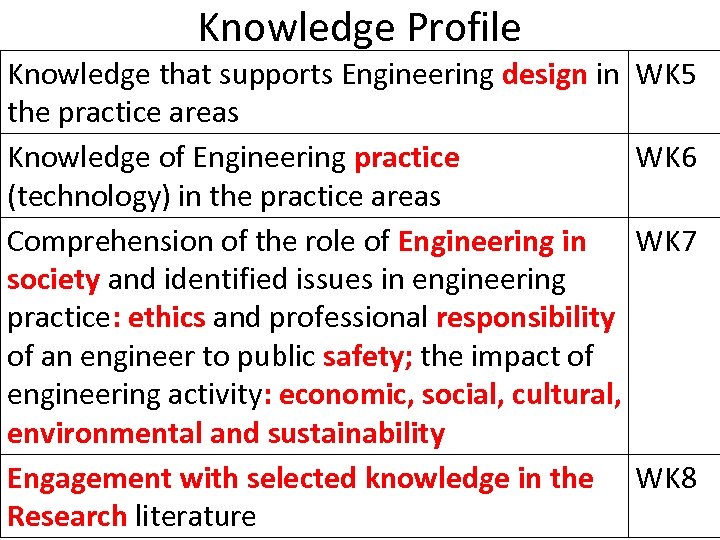 Knowledge Profile Knowledge that supports Engineering design in the practice areas Knowledge of Engineering practice (technology) in the practice areas Comprehension of the role of Engineering in society and identified issues in engineering practice: ethics and professional responsibility of an engineer to public safety; the impact of engineering activity: economic, social, cultural, environmental and sustainability Engagement with selected knowledge in the Research literature WK 5 WK 6 WK 7 WK 8
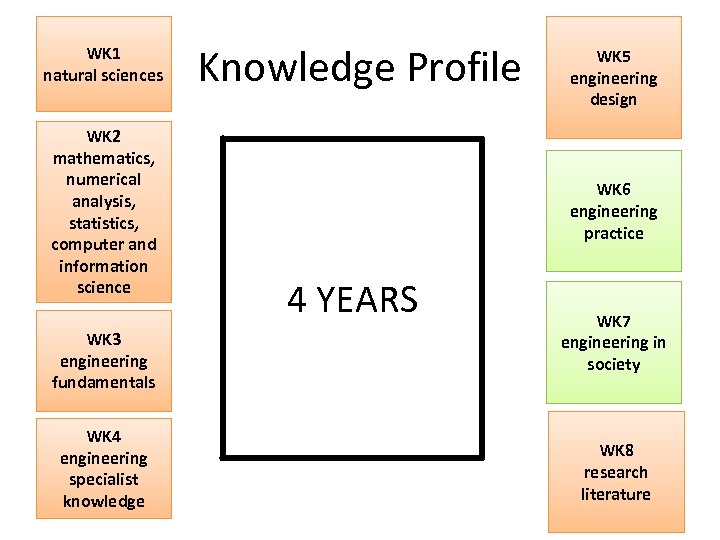 WK 1 natural sciences WK 2 mathematics, numerical analysis, statistics, computer and information science WK 3 engineering fundamentals WK 4 engineering specialist knowledge Knowledge Profile WK 5 engineering design WK 6 engineering practice 4 YEARS WK 7 engineering in society WK 8 research literature
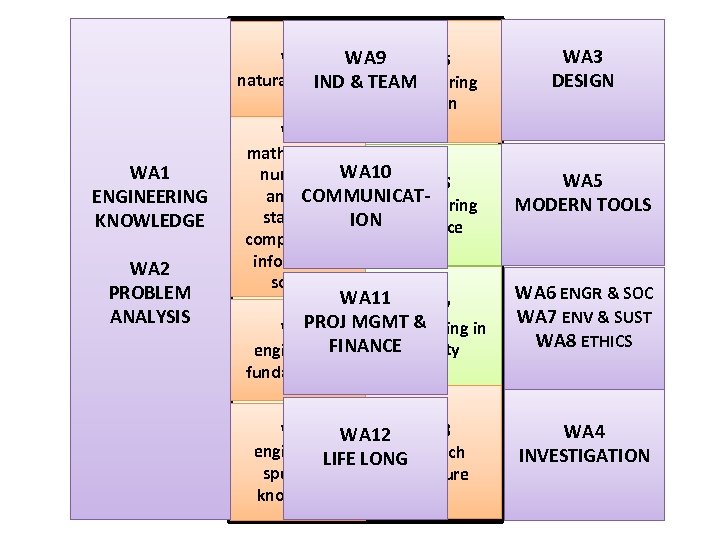 WK 1 WA 9 WK 5 natural sciences TEAM IND & engineering design WA 1 ENGINEERING KNOWLEDGE WA 2 PROBLEM ANALYSIS WK 2 mathematics, numerical WA 10 WK 6 analysis, COMMUNICATengineering statistics, ION practice computer and information science WA 11 WK 7 PROJ MGMT & engineering in WK 3 FINANCE society engineering fundamentals 4 YEARS WK 4 WA 12 WK 8 engineering LONG research LIFE specialist literature knowledge WA 3 DESIGN WA 5 MODERN TOOLS WA 6 ENGR & SOC WA 7 ENV & SUST WA 8 ETHICS WA 4 INVESTIGATION
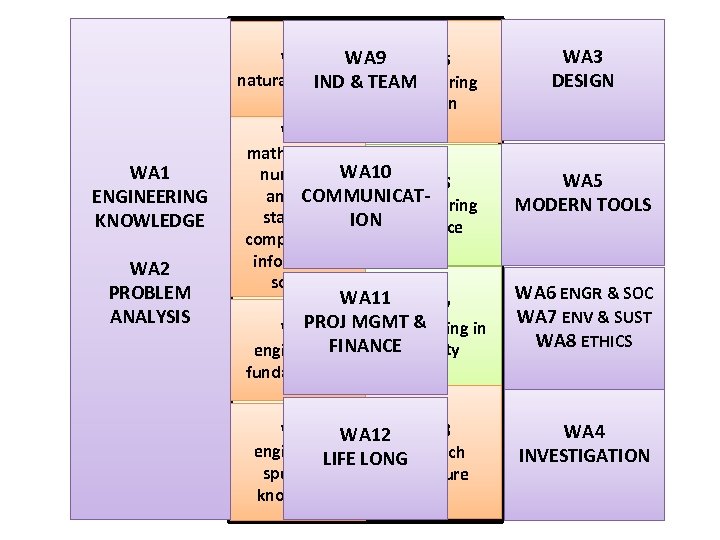 WK 1 WA 9 WK 5 natural sciences TEAM IND & engineering design WA 1 ENGINEERING KNOWLEDGE WA 2 PROBLEM ANALYSIS WK 2 mathematics, numerical WA 10 WK 6 analysis, COMMUNICATengineering statistics, ION practice computer and information science WA 11 WK 7 PROJ MGMT & engineering in WK 3 FINANCE society engineering fundamentals 4 YEARS WK 4 WA 12 WK 8 engineering LONG research LIFE specialist literature knowledge WA 3 DESIGN WA 5 MODERN TOOLS WA 6 ENGR & SOC WA 7 ENV & SUST WA 8 ETHICS WA 4 INVESTIGATION
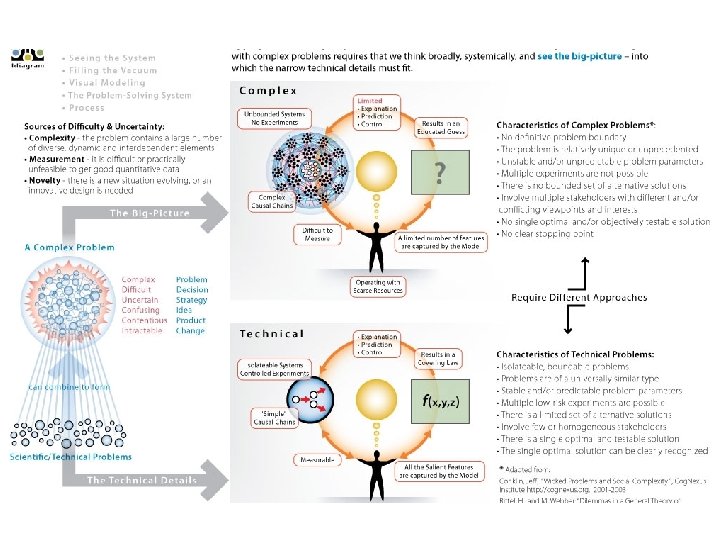
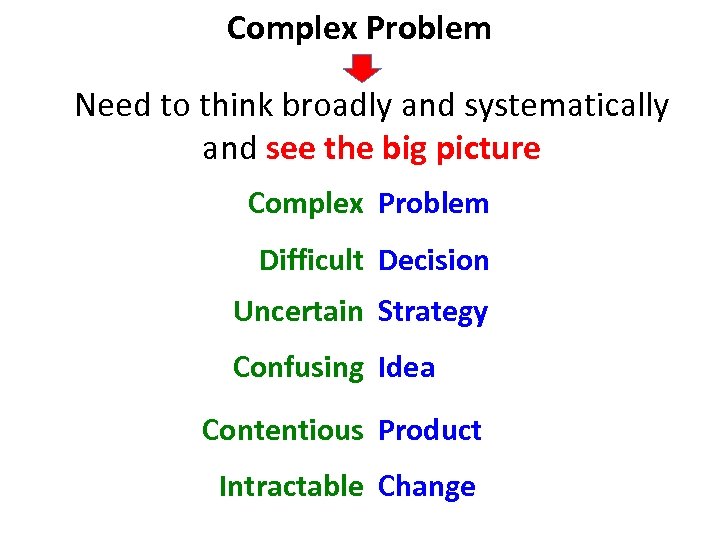 Complex Problem Need to think broadly and systematically and see the big picture Complex Problem Difficult Decision Uncertain Strategy Confusing Idea Contentious Product Intractable Change
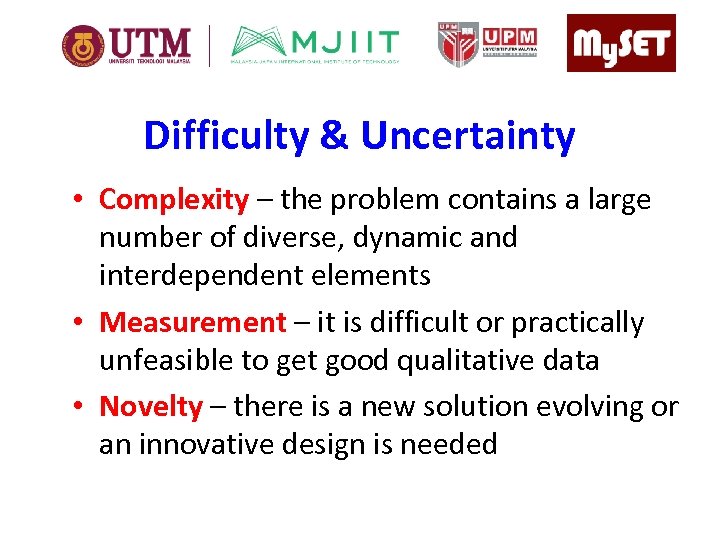 Difficulty & Uncertainty • Complexity – the problem contains a large number of diverse, dynamic and interdependent elements • Measurement – it is difficult or practically unfeasible to get good qualitative data • Novelty – there is a new solution evolving or an innovative design is needed
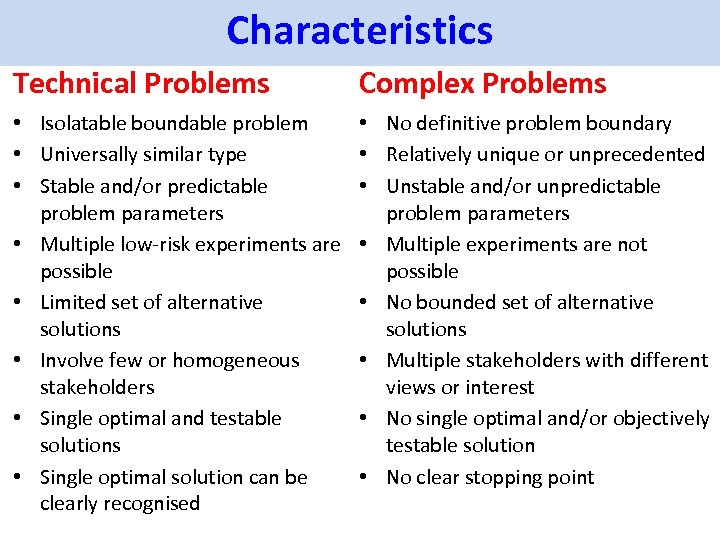 Characteristics Technical Problems Complex Problems • Isolatable boundable problem • Universally similar type • Stable and/or predictable problem parameters • Multiple low-risk experiments are possible • Limited set of alternative solutions • Involve few or homogeneous stakeholders • Single optimal and testable solutions • Single optimal solution can be clearly recognised • No definitive problem boundary • Relatively unique or unprecedented • Unstable and/or unpredictable problem parameters • Multiple experiments are not possible • No bounded set of alternative solutions • Multiple stakeholders with different views or interest • No single optimal and/or objectively testable solution • No clear stopping point
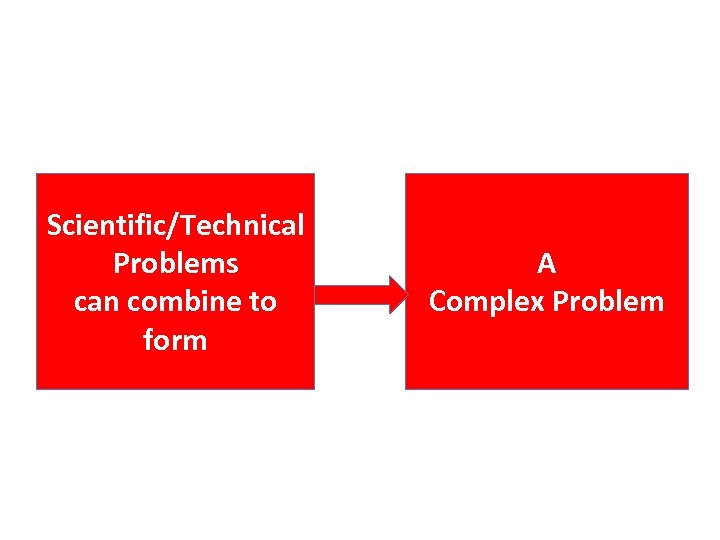 Scientific/Technical Problems can combine to form A Complex Problem
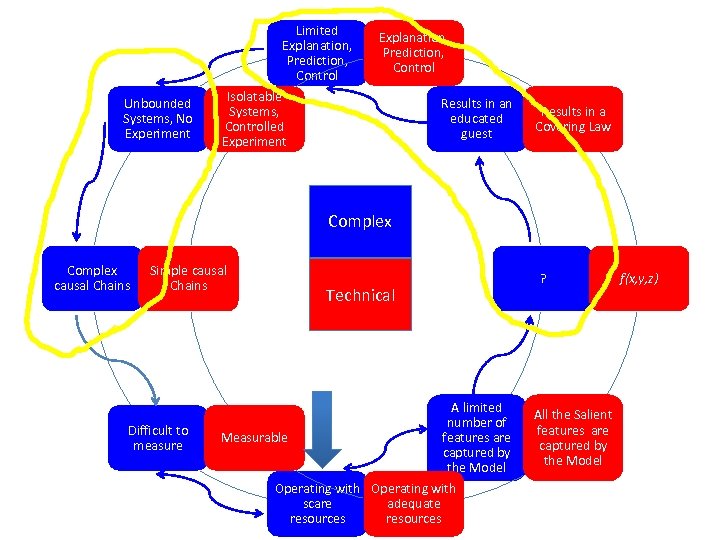 Limited Explanation, Prediction, Control Unbounded Systems, No Experiment Explanation, Prediction, Control Isolatable Systems, Controlled Experiment Results in an educated guest Results in a Covering Law Complex causal Chains Simple causal Chains Difficult to measure Technical A limited number of Measurable features are captured by the Model Operating with scare adequate resources ? All the Salient features are captured by the Model f(x, y, z)
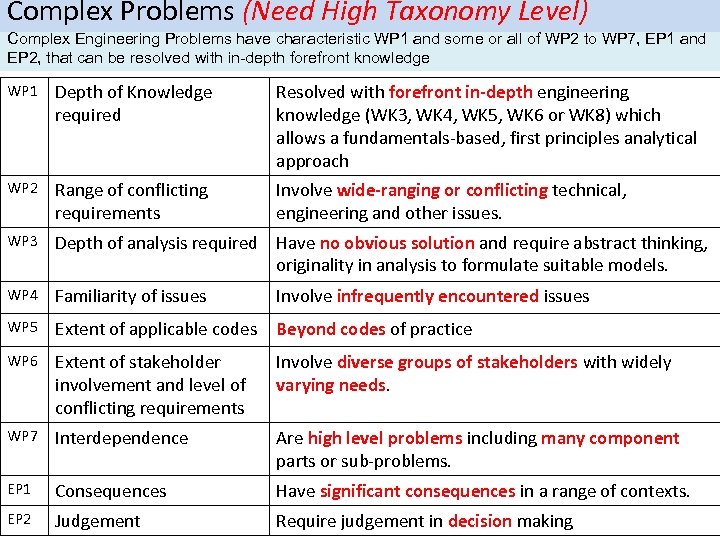 Complex Problems (Need High Taxonomy Level) Complex Engineering Problems have characteristic WP 1 and some or all of WP 2 to WP 7, EP 1 and EP 2, that can be resolved with in-depth forefront knowledge WP 1 Depth of Knowledge required Resolved with forefront in-depth engineering knowledge (WK 3, WK 4, WK 5, WK 6 or WK 8) which allows a fundamentals-based, first principles analytical approach WP 2 Range of conflicting requirements Involve wide-ranging or conflicting technical, engineering and other issues. WP 3 Depth of analysis required Have no obvious solution and require abstract thinking, originality in analysis to formulate suitable models. WP 4 Familiarity of issues Involve infrequently encountered issues WP 5 Extent of applicable codes Beyond codes of practice WP 6 Extent of stakeholder involvement and level of conflicting requirements Involve diverse groups of stakeholders with widely varying needs. WP 7 Interdependence Are high level problems including many component parts or sub-problems. EP 1 Consequences Have significant consequences in a range of contexts. EP 2 Judgement Require judgement in decision making
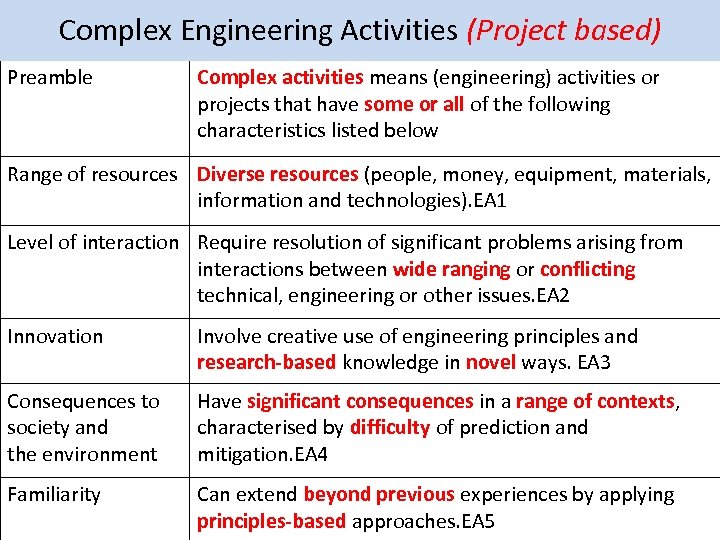 Complex Engineering Activities (Project based) Preamble Complex activities means (engineering) activities or projects that have some or all of the following characteristics listed below Range of resources Diverse resources (people, money, equipment, materials, information and technologies). EA 1 Level of interaction Require resolution of significant problems arising from interactions between wide ranging or conflicting technical, engineering or other issues. EA 2 Innovation Involve creative use of engineering principles and research-based knowledge in novel ways. EA 3 Consequences to society and the environment Have significant consequences in a range of contexts, characterised by difficulty of prediction and mitigation. EA 4 Familiarity Can extend beyond previous experiences by applying principles-based approaches. EA 5
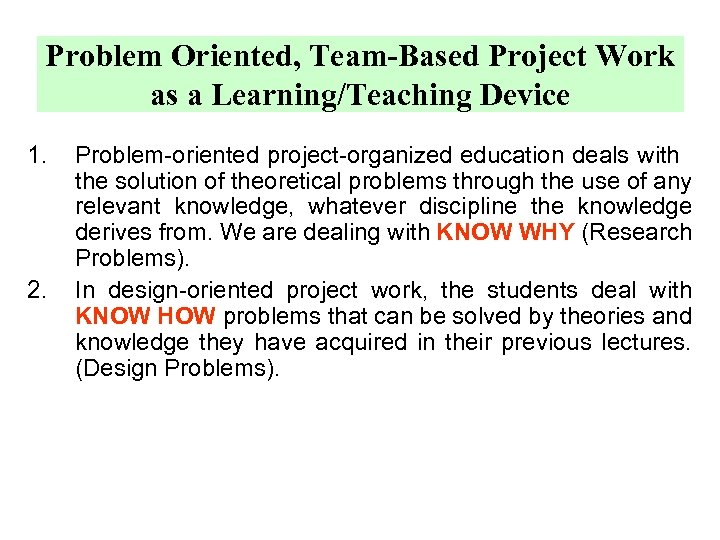 Problem Oriented, Team-Based Project Work as a Learning/Teaching Device 1. 2. Problem-oriented project-organized education deals with the solution of theoretical problems through the use of any relevant knowledge, whatever discipline the knowledge derives from. We are dealing with KNOW WHY (Research Problems). In design-oriented project work, the students deal with KNOW HOW problems that can be solved by theories and knowledge they have acquired in their previous lectures. (Design Problems).
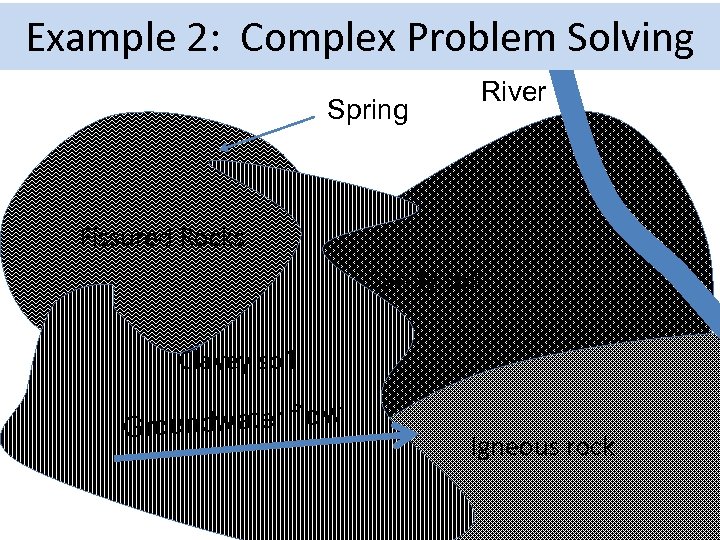
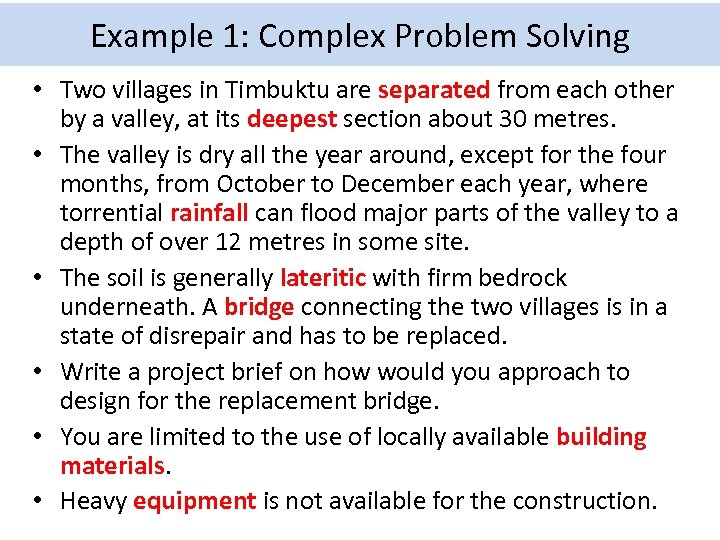 Example 1: Complex Problem Solving • Two villages in Timbuktu are separated from each other by a valley, at its deepest section about 30 metres. • The valley is dry all the year around, except for the four months, from October to December each year, where torrential rainfall can flood major parts of the valley to a depth of over 12 metres in some site. • The soil is generally lateritic with firm bedrock underneath. A bridge connecting the two villages is in a state of disrepair and has to be replaced. • Write a project brief on how would you approach to design for the replacement bridge. • You are limited to the use of locally available building materials. • Heavy equipment is not available for the construction.
 Aspects • • Economics Social Environment Ethics Management Technology Analysis Evaluation
 Thinking • • Site condition Weather Available technology Building materials Design Costing Scheduling
 Solutions? • • Problem solving skills Formulate the problem Literature Experiment?
 Assessment • Report – style and content (flow) • Display – attractive ? • Viva / Articulation • Teamwork • Management – scheduling
 Example 2: Complex Problem Solving Spring River Fissured Rocks Sandy soil Clayey soil roundwater flow G Igneous rock
 How does complexity relates to curriculum? • General Subjects • Industrial Placement • Core & Specialist (Engineering) Subjects – Complex Problem Solving • Elective Subjects – Complex Problem Solving • Design Project – Complex Problem Solving & Complex Engineering Activities • Final Year Project – Complex Problem Solving
 ACCULTURALISATION • • Knowledge Behaviour Attitude DNA QUALITY EDUCATION Establish, Maintain & Improve System Resources Management Commitment
 Conclusion • Adequate knowledge profile • Right taxonomy • Demonstrate outcomes (solving complex problem)
 Appendix
 Complex Problem Solving (CPS) • Dynamic, because early actions determine the environment in which subsequent decision must be made, and features of the task environment may change independently of the solver’s actions; • Time- dependent, because decisions must be made at the correct moment in relation to environmental demands; • Complex, in the sense that most variables are not related to each other in a one-to-one manner
 Microworld CPS Model • The problem requires not one decision, but a long series, in which early decisions condition later ones. • For a task that is changing continuously, the same action can be definitive at moment t 1 and useless at moment t 2. • Include novel solutions to an old dilemma in general science (external validity vs. experimental control)
 Expert-novice CPS Model • Expert-novice approach most of the time produces conclusions that are crystal-clear. • It almost guarantees statistically significant results, because the groups compared (expert and novices) are very different and tend to perform very differently when confronted with similar experimental situations (Sternberg 1995).
 Naturalistic decision making (NDM) • Naturalistic decision making (NDM) (e. g. , Zsambok and Klein 1997, Salas and Klein 2001) • ‘real-world’ task • Example interviewing firefighters after putting out a fire or a surgeon after she has decided in real time what to do with a patient.
 Dynamic decision making DDM • Dynamic decision making (DDM) (Brehmer 1992, Sterman 1994). • Discrete dynamic decision tasks that change only when the participant introduces a new set of inputs. • Variables like time pressure have been successfully integrated in models like Busemeyer and Townsend’s (1993) decision field theory
 Implicit learning in system control • This tradition has used tasks like the sugar factory (Berry and Broadbent 1984) or the transportation task (Broadbent et al. 1986), that are governed by comparatively simple equations. • The theorization and computational modeling in this branch of CPS are extremely rich. Models are based on exemplar learning, rule learning, and both (e. g. , Dienes and Fahey 1995, Gibson et al. 1997, Lebiere et al. 1998).
 European complex problem solving (CPS) • Initiated by Do rner (Do rner and Scholkopf 1991, Do rner and Wearing 1995) • A large number of tasks that have been considered complex problem solving are nowadays affordable for theory development and computer modeling (e. g. Putz-Osterloh 1993, Vollmeyer et al. 1996, Burns and Vollmeyer 2002, Schoppek 2002) • Transport real-life complexity to the lab in a way that can be partly controlled
 Time related • Time variant – time invariant (dynamic vs. static systems) • Continuous time – discrete time. • Degree of time pressure – decision has to be made quickly
 Variable related • Number and type (discrete/continuous) of variables • Number and pattern of relationships between variables • Non-Linear - Linear
 System behaviour related • Opaque - transparent. • Stochastic - deterministic • Delayed feedback - immediate feedback.
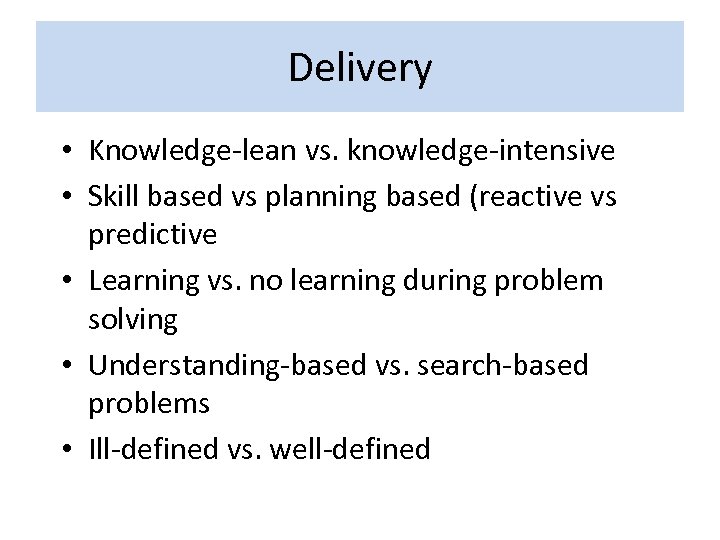 Delivery • Knowledge-lean vs. knowledge-intensive • Skill based vs planning based (reactive vs predictive • Learning vs. no learning during problem solving • Understanding-based vs. search-based problems • Ill-defined vs. well-defined
 Conclusion • Problem solving has been traditionally a task -centered field. Van. Lehn (1989) think that ‘task’ and ‘problem’ are virtually synonymous.