


 Скачать презентацию Workshop on Curriculum Development http www marineresearchnetwork org activities
ff5306d8fa6f32a25720305d695f3161.ppt
- Количество слайдов: 14
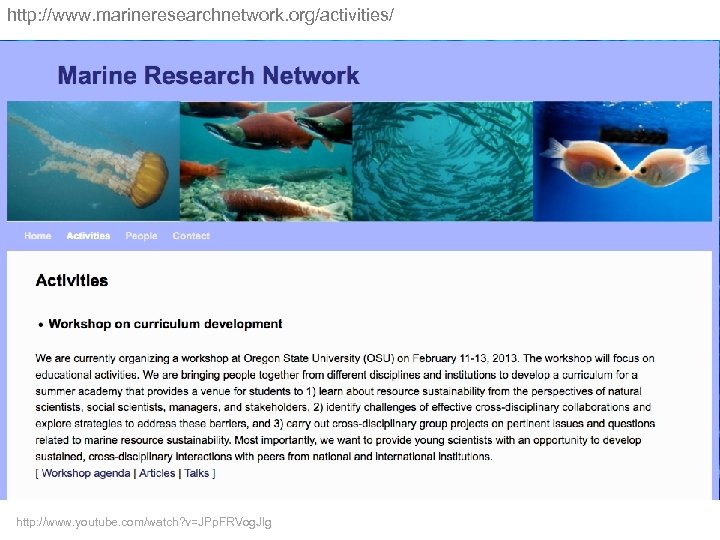
 Workshop on Curriculum Development http: //www. marineresearchnetwork. org/activities/ February 11 -13, 2013 Corvallis, OR • Some context • Goals of the workshop • Opportunities and challenges • Workshop activities
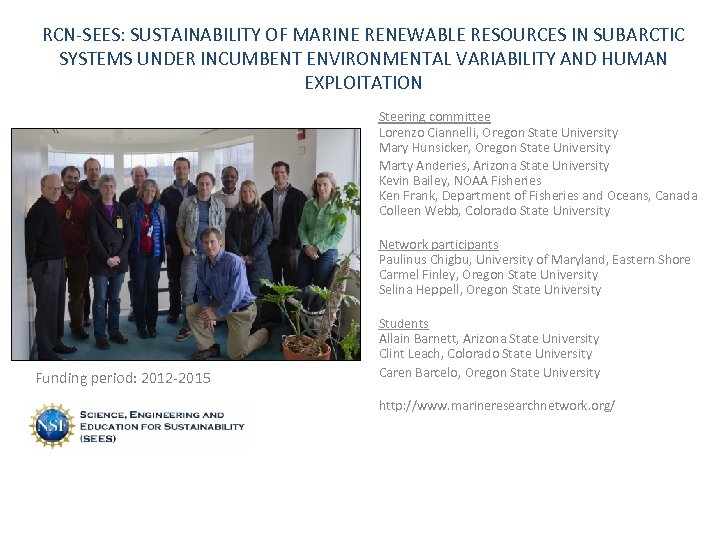 RCN-SEES: SUSTAINABILITY OF MARINE RENEWABLE RESOURCES IN SUBARCTIC SYSTEMS UNDER INCUMBENT ENVIRONMENTAL VARIABILITY AND HUMAN EXPLOITATION Steering committee Lorenzo Ciannelli, Oregon State University Mary Hunsicker, Oregon State University Marty Anderies, Arizona State University Kevin Bailey, NOAA Fisheries Ken Frank, Department of Fisheries and Oceans, Canada Colleen Webb, Colorado State University Network participants Paulinus Chigbu, University of Maryland, Eastern Shore Carmel Finley, Oregon State University Selina Heppell, Oregon State University Funding period: 2012 -2015 Students Allain Barnett, Arizona State University Clint Leach, Colorado State University Caren Barcelo, Oregon State University http: //www. marineresearchnetwork. org/
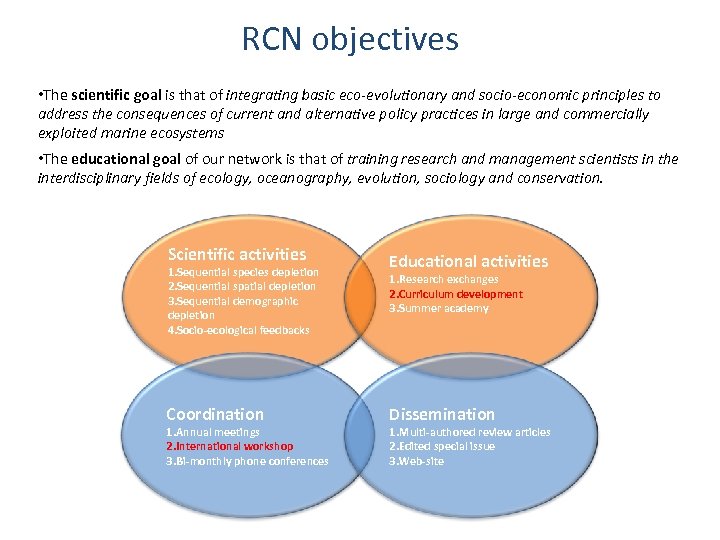 RCN objectives • The scientific goal is that of integrating basic eco-evolutionary and socio-economic principles to address the consequences of current and alternative policy practices in large and commercially exploited marine ecosystems • The educational goal of our network is that of training research and management scientists in the interdisciplinary fields of ecology, oceanography, evolution, sociology and conservation. Scientific activities 1. Sequential species depletion 2. Sequential spatial depletion 3. Sequential demographic depletion 4. Socio-ecological feedbacks Coordination 1. Annual meetings 2. International workshop 3. Bi-monthly phone conferences Educational activities 1. Research exchanges 2. Curriculum development 3. Summer academy Dissemination 1. Multi-authored review articles 2. Edited special issue 3. Web-site
 Workshop on curriculum development Goals • Develop curriculum for a graduate level summer course on how to integrate socio-ecological principles in management and conservation practices • Generate ideas for course implementation • Develop outline for a multi-authored educational forum article Benefit of participating • Stimulate ideas and links for your own research and educational activities • Be a co-author on an Educational Forum article • Get involved with course delivery
 Opportunities • In coming together we are breaking new grounds on curriculum development
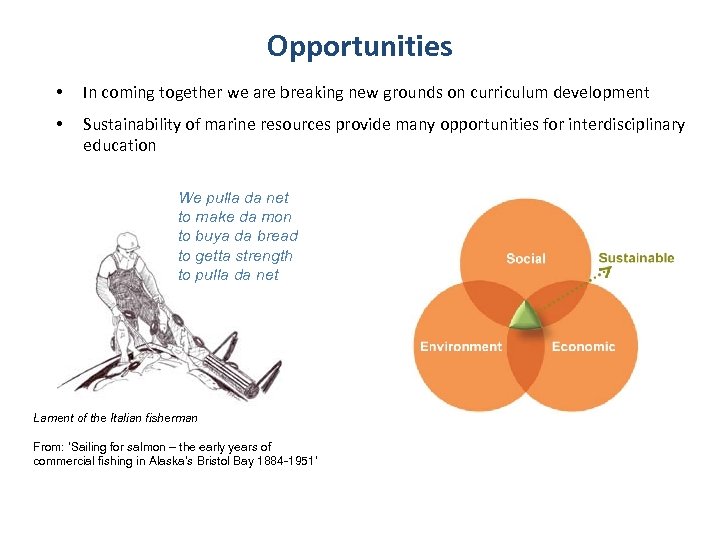 Opportunities • In coming together we are breaking new grounds on curriculum development • Sustainability of marine resources provide many opportunities for interdisciplinary education We pulla da net to make da mon to buya da bread to getta strength to pulla da net Lament of the Italian fisherman From: ‘Sailing for salmon – the early years of commercial fishing in Alaska’s Bristol Bay 1884 -1951’
 Challenges in interdisciplinary education Haapasari et al (2012) conclude that: ‘interdisciplinarity is a learning process that takes place at three levels: between individuals, between disciplines and between types of knowledge’ • Knowledge: Breadth vs depth • Skills: Developing a common language and set of tools • Attitudes: Means and opportunities for long-lasting collaborations
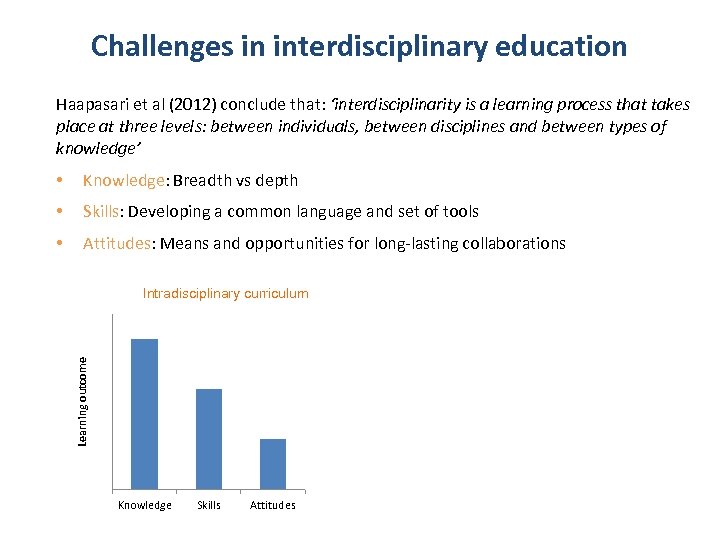 Challenges in interdisciplinary education Haapasari et al (2012) conclude that: ‘interdisciplinarity is a learning process that takes place at three levels: between individuals, between disciplines and between types of knowledge’ • Knowledge: Breadth vs depth • Skills: Developing a common language and set of tools • Attitudes: Means and opportunities for long-lasting collaborations Intradisciplinary curriculum 35 Learning outcome 30 25 20 15 10 5 0 Knowledge Skills Attitudes
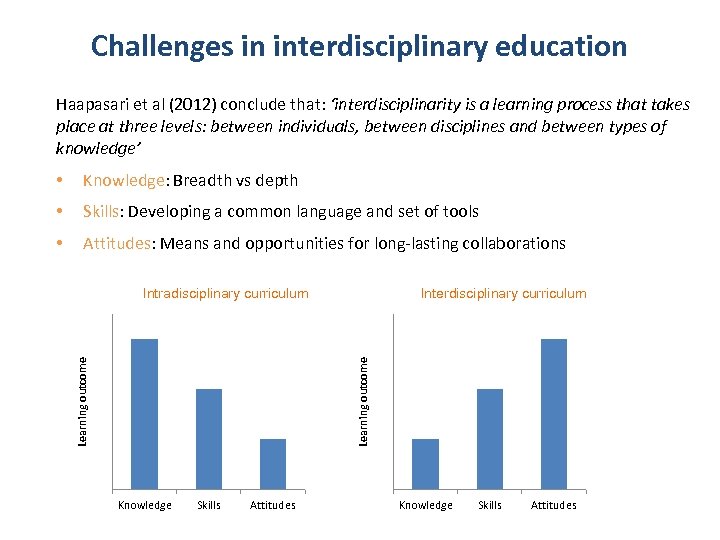 Challenges in interdisciplinary education Haapasari et al (2012) conclude that: ‘interdisciplinarity is a learning process that takes place at three levels: between individuals, between disciplines and between types of knowledge’ • Knowledge: Breadth vs depth • Skills: Developing a common language and set of tools • Attitudes: Means and opportunities for long-lasting collaborations Intradisciplinary curriculum Interdisciplinary curriculum 30 25 25 Learning outcome 35 30 Learning outcome 35 20 15 10 5 5 0 0 Knowledge Skills Attitudes
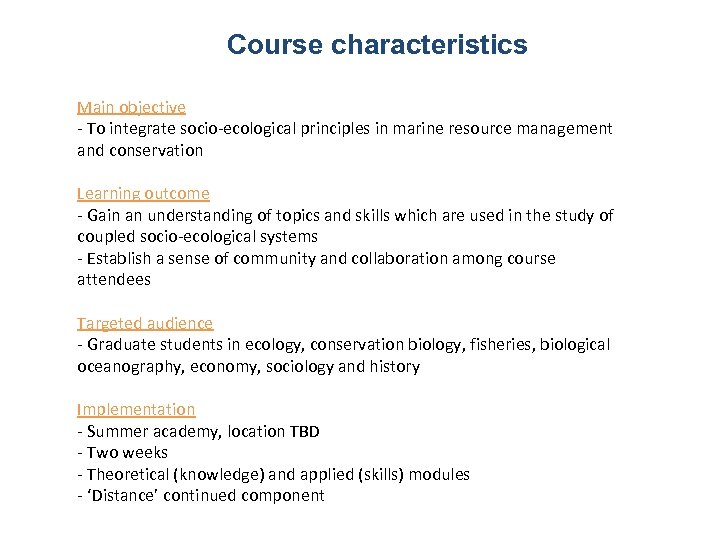 Course characteristics Main objective - To integrate socio-ecological principles in marine resource management and conservation Learning outcome - Gain an understanding of topics and skills which are used in the study of coupled socio-ecological systems - Establish a sense of community and collaboration among course attendees Targeted audience - Graduate students in ecology, conservation biology, fisheries, biological oceanography, economy, sociology and history Implementation - Summer academy, location TBD - Two weeks - Theoretical (knowledge) and applied (skills) modules - ‘Distance’ continued component
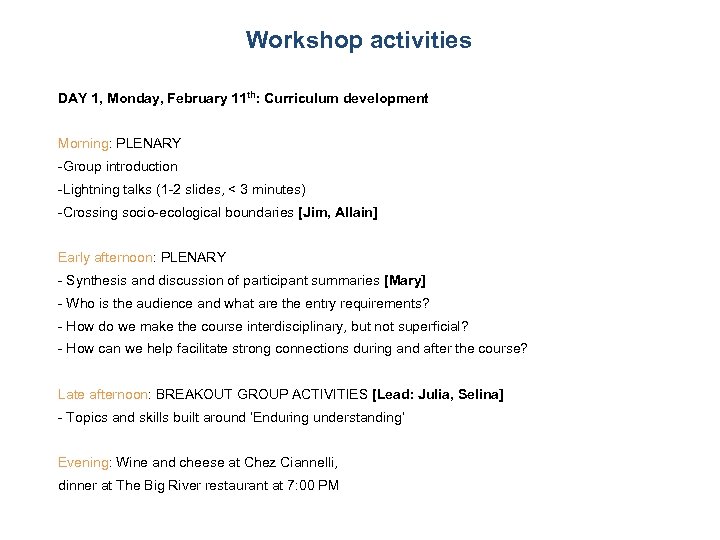 Workshop activities DAY 1, Monday, February 11 th: Curriculum development Morning: PLENARY -Group introduction -Lightning talks (1 -2 slides, < 3 minutes) -Crossing socio-ecological boundaries [Jim, Allain] Early afternoon: PLENARY - Synthesis and discussion of participant summaries [Mary] - Who is the audience and what are the entry requirements? - How do we make the course interdisciplinary, but not superficial? - How can we help facilitate strong connections during and after the course? Late afternoon: BREAKOUT GROUP ACTIVITIES [Lead: Julia, Selina] - Topics and skills built around ‘Enduring understanding’ Evening: Wine and cheese at Chez Ciannelli, dinner at The Big River restaurant at 7: 00 PM
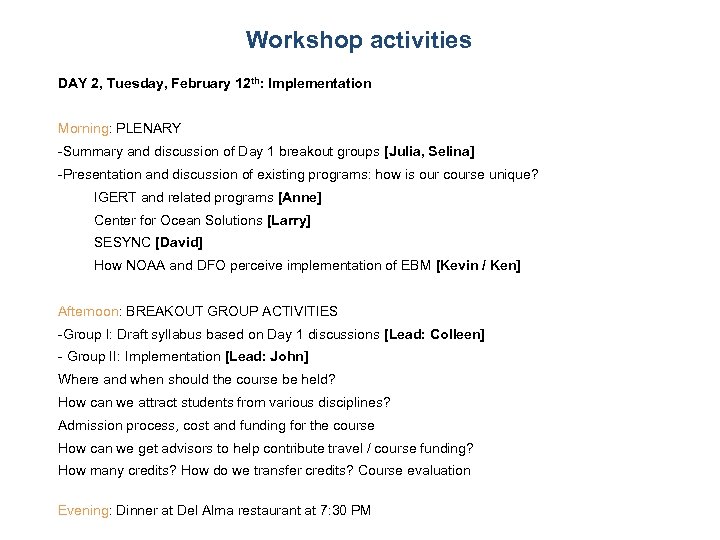 Workshop activities DAY 2, Tuesday, February 12 th: Implementation Morning: PLENARY -Summary and discussion of Day 1 breakout groups [Julia, Selina] -Presentation and discussion of existing programs: how is our course unique? IGERT and related programs [Anne] Center for Ocean Solutions [Larry] SESYNC [David] How NOAA and DFO perceive implementation of EBM [Kevin / Ken] Afternoon: BREAKOUT GROUP ACTIVITIES -Group I: Draft syllabus based on Day 1 discussions [Lead: Colleen] - Group II: Implementation [Lead: John] Where and when should the course be held? How can we attract students from various disciplines? Admission process, cost and funding for the course How can we get advisors to help contribute travel / course funding? How many credits? How do we transfer credits? Course evaluation Evening: Dinner at Del Alma restaurant at 7: 30 PM
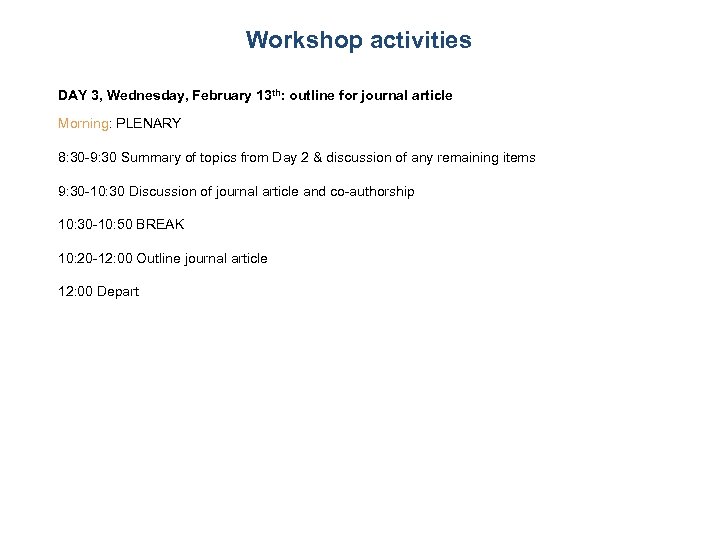 Workshop activities DAY 3, Wednesday, February 13 th: outline for journal article Morning: PLENARY 8: 30 -9: 30 Summary of topics from Day 2 & discussion of any remaining items 9: 30 -10: 30 Discussion of journal article and co-authorship 10: 30 -10: 50 BREAK 10: 20 -12: 00 Outline journal article 12: 00 Depart
 http: //www. marineresearchnetwork. org/activities/ http: //www. youtube. com/watch? v=JPp. FRVog. JIg