 Скачать презентацию Workshop From Event-Driven Business Process Management to Ubiquitous
ab84488c441b7ce1b4efa2fab8b4a6bf.ppt
- Количество слайдов: 28



Workshop From Event-Driven Business Process Management to Ubiquitous Complex Event Processing Service. Wave/FIA , Ghent, 13 Dec 2010 Rainer von Ammon
Some retrospections of the past: Event-Driven Business Process Management 2 nd ed. BPM Workshop 2 nd Service. Wave November 23 -27, 2009 Stockholm
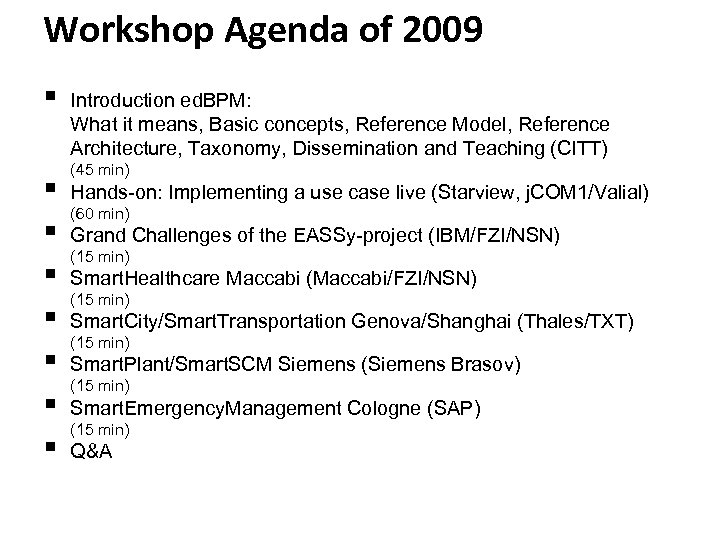
Workshop Agenda of 2009 Introduction ed. BPM: What it means, Basic concepts, Reference Model, Reference Architecture, Taxonomy, Dissemination and Teaching (CITT) (45 min) Hands-on: Implementing a use case live (Starview, j. COM 1/Valial) (60 min) Grand Challenges of the EASSy-project (IBM/FZI/NSN) (15 min) Smart. Healthcare Maccabi (Maccabi/FZI/NSN) (15 min) Smart. City/Smart. Transportation Genova/Shanghai (Thales/TXT) (15 min) Smart. Plant/Smart. SCM Siemens (Siemens Brasov) (15 min) Smart. Emergency. Management Cologne (SAP) (15 min) Q&A
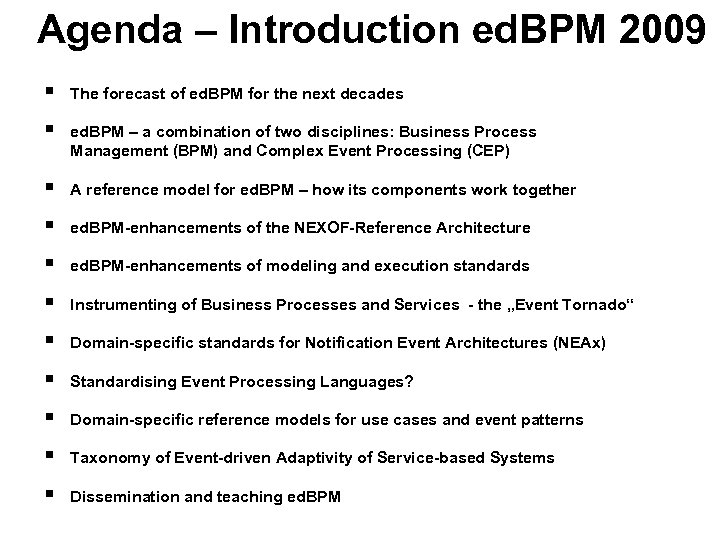
Agenda – Introduction ed. BPM 2009 The forecast of ed. BPM for the next decades ed. BPM – a combination of two disciplines: Business Process Management (BPM) and Complex Event Processing (CEP) A reference model for ed. BPM – how its components work together ed. BPM-enhancements of the NEXOF-Reference Architecture ed. BPM-enhancements of modeling and execution standards Instrumenting of Business Processes and Services - the „Event Tornado“ Domain-specific standards for Notification Event Architectures (NEAx) Standardising Event Processing Languages? Domain-specific reference models for use cases and event patterns Taxonomy of Event-driven Adaptivity of Service-based Systems Dissemination and teaching ed. BPM
Some impressions of our ed. BPM workshop 2009 http: //www. citt-online. com/index. php? id=veranstaltungen&id 3=stockholm 2009&id 4=more Download of the whole presentation http: //www. citt-online. com/downloads/EDBPM-workshop 09. ppt
European FET-Flagship initiative: Pilot Project "Ubiquitous Complex Event Processing“ interdisciplinary with computational socio-geonomics, neuroscience, epigenetics, brain research, epidemic research, weather/global catastrophe emergency management etc. Infoday FET-FLAGSHIP INITIATIVE, Brussels, 30 Sept 2010 Rainer von Ammon / Rüdiger Klein / Miriam Leis / Behrooz Mobasheri / Themis Palpanas / Bernhard Seeger et al.
Proposed consortium partners – will be restricted to 15 Industry: • Deutsche Telekom AG, Bonn, Germany, Shahrok Mosheni, Behrooz Mobasheri • Continental Automotive Gmb. H, Vahrenwalder Str. 9, D-30165 Hannover, Jürgen Broda • Siemens Corporate Technology CEE, Munich/Brasov, Septimiu Nechifor • IBM HRL, Israel, Opher Etzion • Software AG, Darmstadt, Germany, Harald Schöning/Walter Waterfeld • Telecom Italia, Manzalini Antonio • France Telecom • OFFIS, Oldenburg, Germany, Jorge Marx-Gomez SME • CITT Gmb. H, Regensburg, Germany, Rainer von Ammon (SME) • Biomathics, Plamen Simeonov, Berlin, Germany (SME) RTO/University • Fraunhofer IAIS, Bonn, Germany, Rüdiger Klein • University Marburg, Germany, Bernhard Seeger • FZI, Karlsruhe, Germany, Rudi Studer • TNO, The Netherlands, Miriam Leis • University of Trento, Italy, Themis Palpanas • Telefonica Spain, Oscar Jesus Diez • University of Reading, UK, Atta Badii International partnership, e. g. with: • Event Processing-Technical Society (EPTS) • University of Stanford, David Luckham • Caltech Pasadena, Mani Chandy • University of Toronto, Hans-Arno Jacobsen • www. ieee-smartgridworld. org
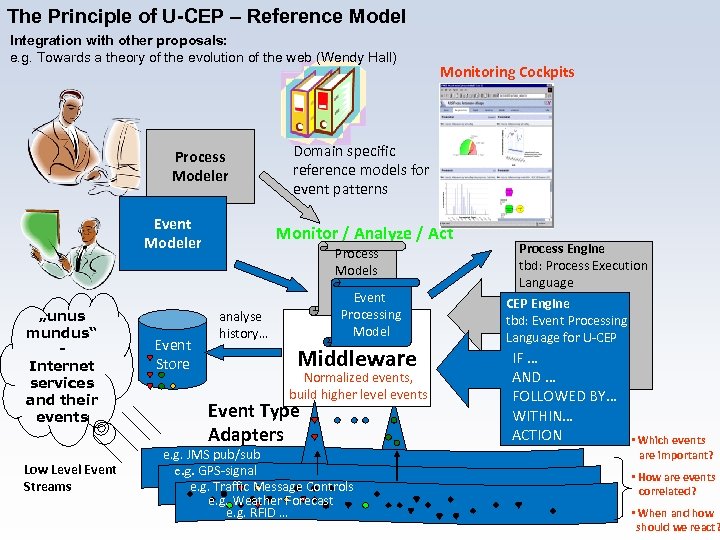
The Principle of U-CEP – Reference Model Integration with other proposals: e. g. Towards a theory of the evolution of the web (Wendy Hall) Process Modeler Event Modeler „unus mundus“ Internet services and their events Low Level Event Streams Event Store Monitoring Cockpits Domain specific reference models for event patterns Monitor / Analyze / Act Process Models Event Processing Model analyse history… Middleware Normalized events, build higher level events Event Type Adapters e. g. JMS pub/sub e. g. GPS-signal e. g. Traffic Message Controls e. g. Weather Forecast e. g. RFID … Process Engine tbd: Process Execution Language CEP Engine tbd: Event Processing Language for U-CEP IF … AND … FOLLOWED BY… WITHIN… ACTION • Which events are important? • How are events correlated? • When and how should we react?
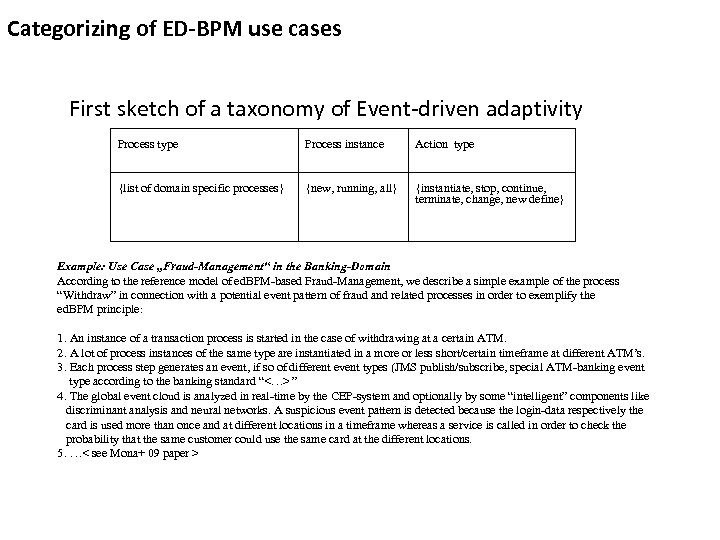
Categorizing of ED-BPM use cases First sketch of a taxonomy of Event-driven adaptivity Process type Process instance Action type {list of domain specific processes} {new, running, all} {instantiate, stop, continue, terminate, change, new define} Example: Use Case „Fraud-Management“ in the Banking-Domain According to the reference model of ed. BPM-based Fraud-Management, we describe a simple example of the process “Withdraw” in connection with a potential event pattern of fraud and related processes in order to exemplify the ed. BPM principle: 1. An instance of a transaction process is started in the case of withdrawing at a certain ATM. 2. A lot of process instances of the same type are instantiated in a more or less short/certain timeframe at different ATM’s. 3. Each process step generates an event, if so of different event types (JMS publish/subscribe, special ATM-banking event type according to the banking standard “<…> ” 4. The global event cloud is analyzed in real-time by the CEP-system and optionally by some “intelligent” components like discriminant analysis and neural networks. A suspicious event pattern is detected because the login-data respectively the card is used more than once and at different locations in a timeframe whereas a service is called in order to check the probability that the same customer could use the same card at the different locations. 5. …< see Mona+ 09 paper >
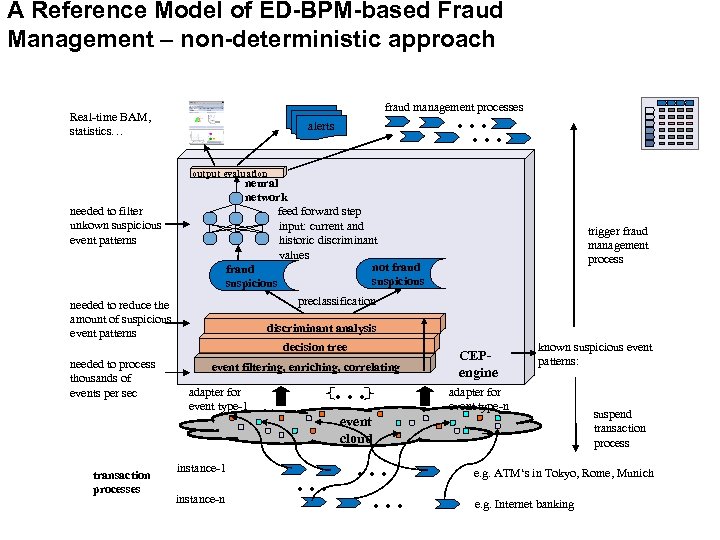
A Reference Model of ED-BPM-based Fraud Management – non-deterministic approach fraud management processes . . . alerts Real-time BAM, statistics… output evaluation neural network feed forward step input: current and historic discriminant values not fraud suspicious needed to filter unkown suspicious event patterns preclassification needed to reduce the amount of suspicious event patterns discriminant analysis decision tree needed to process thousands of events per sec trigger fraud management process event filtering, enriching, correlating . . . adapter for event type-1 CEPengine known suspicious event patterns: adapter for event type-n event cloud transaction processes instance-1 instance-n . . suspend transaction process e. g. ATM‘s in Tokyo, Rome, Munich e. g. Internet banking
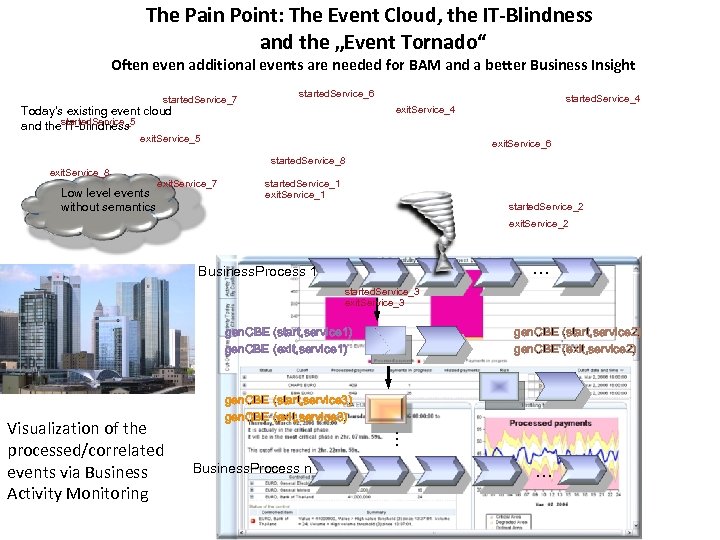
The Pain Point: The Event Cloud, the IT-Blindness and the „Event Tornado“ Often even additional events are needed for BAM and a better Business Insight started. Service_7 started. Service_6 started. Service_4 exit. Service_4 Today‘s existing event cloud and thestarted. Service_5 IT-blindness exit. Service_5 exit. Service_6 started. Service_8 exit. Service_8 Low level events without semantics exit. Service_7 started. Service_1 exit. Service_1 started. Service_2 exit. Service_2 … Business. Process 1 started. Service_3 exit. Service_3 gen. CBE (start, service 1) gen. CBE (exit, service 1) gen. CBE (start, service 3) gen. CBE (exit, service 3) … Visualization of the processed/correlated events via Business Activity Monitoring gen. CBE (start, service 2) gen. CBE (exit, service 2) Business. Process n …
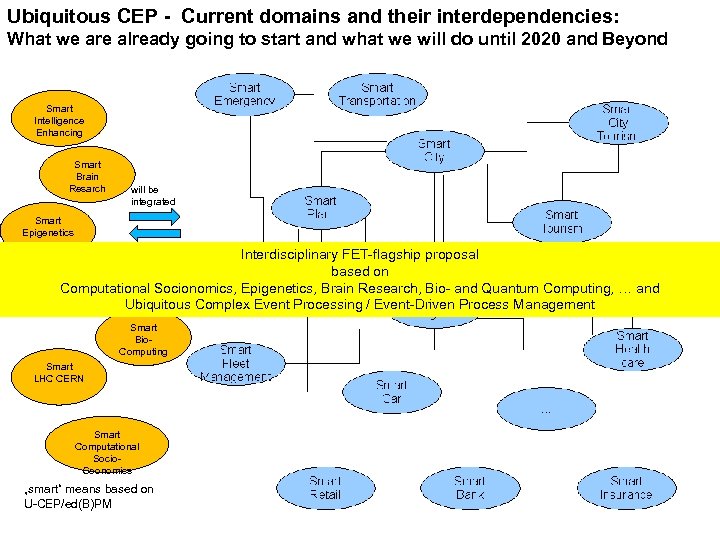
Ubiquitous CEP - Current domains and their interdependencies: What we are already going to start and what we will do until 2020 and Beyond Smart Intelligence Enhancing Smart Brain Resarch will be integrated Smart Epigenetics Interdisciplinary FET-flagship proposal based on Computational Socionomics, Epigenetics, Brain Research, Bio- and Quantum Computing, … and Ubiquitous Complex Event Processing / Event-Driven Process Management Smart Bio. Computing Smart LHC CERN Smart Computational Socio. Geonomics „smart“ means based on U-CEP/ed(B)PM
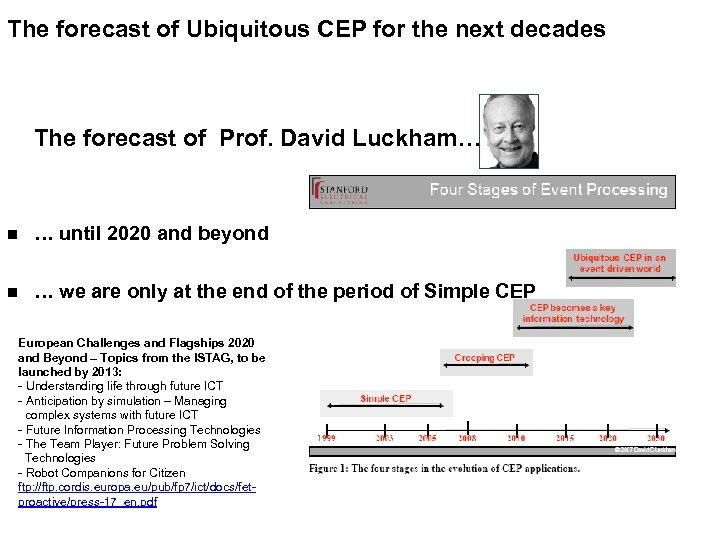
The forecast of Ubiquitous CEP for the next decades The forecast of Prof. David Luckham… … until 2020 and beyond … we are only at the end of the period of Simple CEP European Challenges and Flagships 2020 and Beyond – Topics from the ISTAG, to be launched by 2013: - Understanding life through future ICT - Anticipation by simulation – Managing complex systems with future ICT - Future Information Processing Technologies - The Team Player: Future Problem Solving Technologies - Robot Companions for Citizen ftp: //ftp. cordis. europa. eu/pub/fp 7/ict/docs/fetproactive/press-17_en. pdf
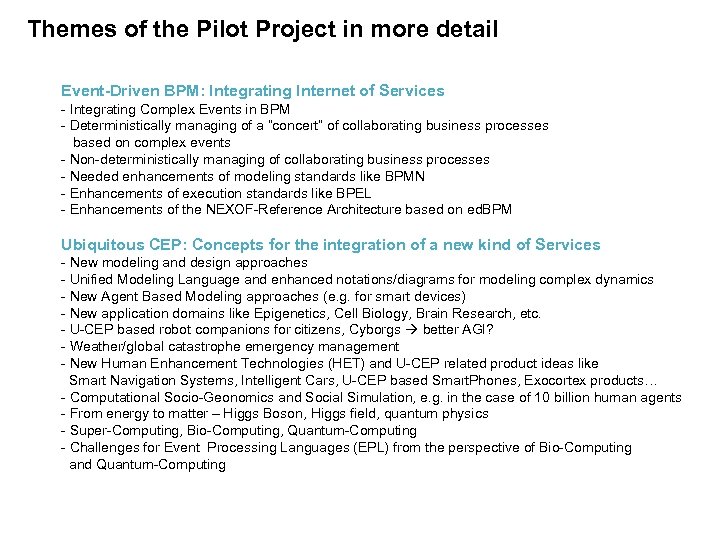
Themes of the Pilot Project in more detail Event-Driven BPM: Integrating Internet of Services - Integrating Complex Events in BPM - Deterministically managing of a “concert” of collaborating business processes based on complex events - Non-deterministically managing of collaborating business processes - Needed enhancements of modeling standards like BPMN - Enhancements of execution standards like BPEL - Enhancements of the NEXOF-Reference Architecture based on ed. BPM Ubiquitous CEP: Concepts for the integration of a new kind of Services - New modeling and design approaches - Unified Modeling Language and enhanced notations/diagrams for modeling complex dynamics - New Agent Based Modeling approaches (e. g. for smart devices) - New application domains like Epigenetics, Cell Biology, Brain Research, etc. - U-CEP based robot companions for citizens, Cyborgs better AGI? - Weather/global catastrophe emergency management - New Human Enhancement Technologies (HET) and U-CEP related product ideas like Smart Navigation Systems, Intelligent Cars, U-CEP based Smart. Phones, Exocortex products… - Computational Socio-Geonomics and Social Simulation, e. g. in the case of 10 billion human agents - From energy to matter – Higgs Boson, Higgs field, quantum physics - Super-Computing, Bio-Computing, Quantum-Computing - Challenges for Event Processing Languages (EPL) from the perspective of Bio-Computing and Quantum-Computing
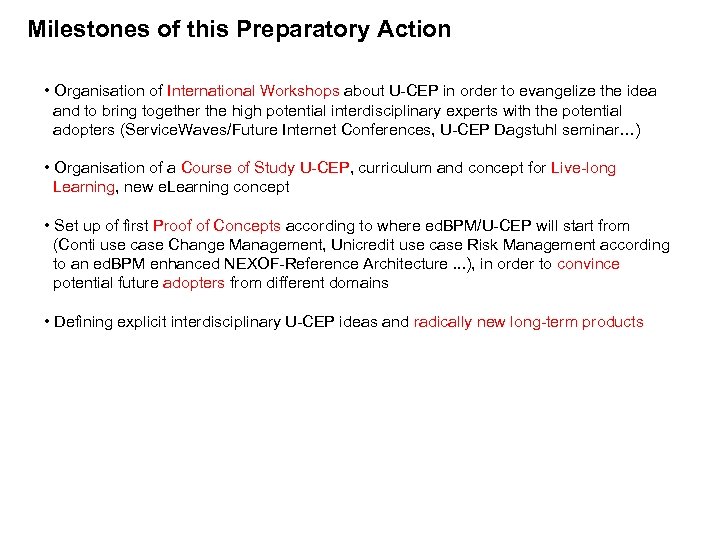
Milestones of this Preparatory Action • Organisation of International Workshops about U-CEP in order to evangelize the idea and to bring together the high potential interdisciplinary experts with the potential adopters (Service. Waves/Future Internet Conferences, U-CEP Dagstuhl seminar…) • Organisation of a Course of Study U-CEP, curriculum and concept for Live-long Learning, new e. Learning concept • Set up of first Proof of Concepts according to where ed. BPM/U-CEP will start from (Conti use case Change Management, Unicredit use case Risk Management according to an ed. BPM enhanced NEXOF-Reference Architecture. . . ), in order to convince potential future adopters from different domains • Defining explicit interdisciplinary U-CEP ideas and radically new long-term products
Additional slides about some interdiscipilnary ideas of the U-CEP flagship sketch Submitted to the January/June 2010 FET-Fworkshops, if needed
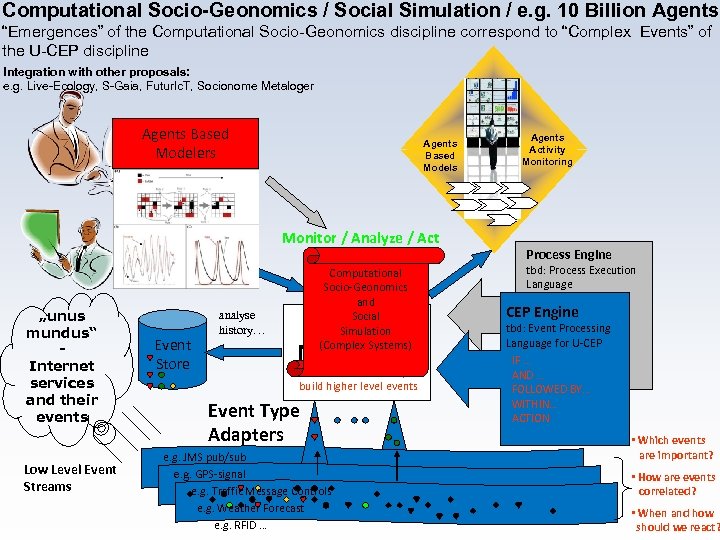
Computational Socio-Geonomics / Social Simulation / e. g. 10 Billion Agents “Emergences” of the Computational Socio-Geonomics discipline correspond to “Complex Events” of the U-CEP discipline Integration with other proposals: e. g. Live-Ecology, S-Gaia, Futur. Ic. T, Socionome Metaloger Agents Based Modelers Process Modeler Event Modeler „unus mundus“ Internet services and their events Low Level Event Streams Event Store Agents Based Models Monitor / Analyze / Act Process Models Computational Socio-Geonomics Eventand Processing Social Model Simulation (Complex Systems) analyse history… Middleware Normalized events, build higher level events Event Type Adapters e. g. JMS pub/sub e. g. GPS-signal e. g. Traffic Message Controls e. g. Weather Forecast e. g. RFID … Agents Activity Monitoring Process Engine tbd: Process Execution Language CEP Engine tbd: Event Processing Language for U-CEP IF … AND … FOLLOWED BY… WITHIN… ACTION • Which events are important? • How are events correlated? • When and how should we react?
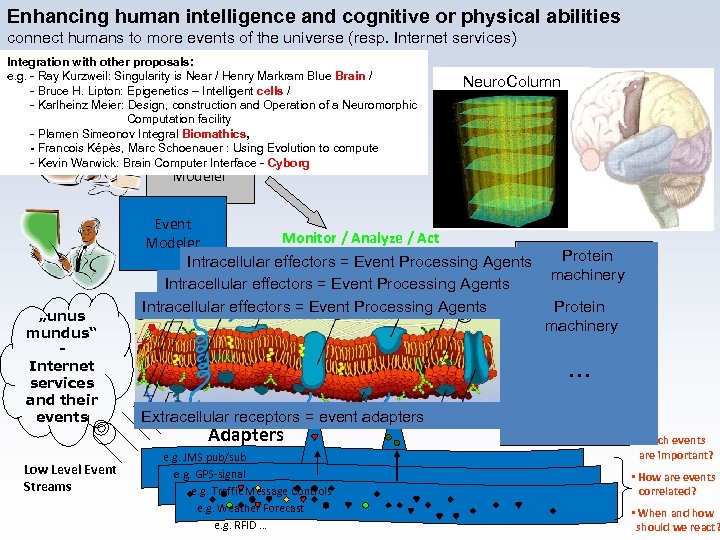
Enhancing human intelligence and cognitive or physical abilities connect humans to more events of the universe (resp. Internet services) Integration with other proposals: e. g. - Ray Kurzweil: Singularity is Near / Henry Markram Blue Brain / - Bruce H. Lipton: Epigenetics – Intelligent cells / - Karlheinz Meier: Design, construction and Operation of a Neuromorphic Computation facility - Plamen Simeonov Integral Biomathics, - Francois Képès, Marc Schoenauer : Using Evolution to compute Process - Kevin Warwick: Brain Computer Interface - Cyborg Neuro. Column Modeler „unus mundus“ Internet services and their events Low Level Event Streams Event Monitor / Analyze / Act Modeler Process Engine Process Protein Intracellular effectors = Event Processing Agents Process Execution tbd: Models machinery Intracellular effectors = Event Processing Agents Language Event Processing Intracellular effectors = Event Processing Agents CEP Engine Protein analyse Model machinery tbd: Event Processing history… Language for U-CEP Event Middleware IF … Store Normalized events, … build higher level events Event Type Extracellular receptors = event adapters Adapters e. g. JMS pub/sub e. g. GPS-signal e. g. Traffic Message Controls e. g. Weather Forecast e. g. RFID … AND … FOLLOWED BY… WITHIN… ACTION • Which events are important? • How are events correlated? • When and how should we react?
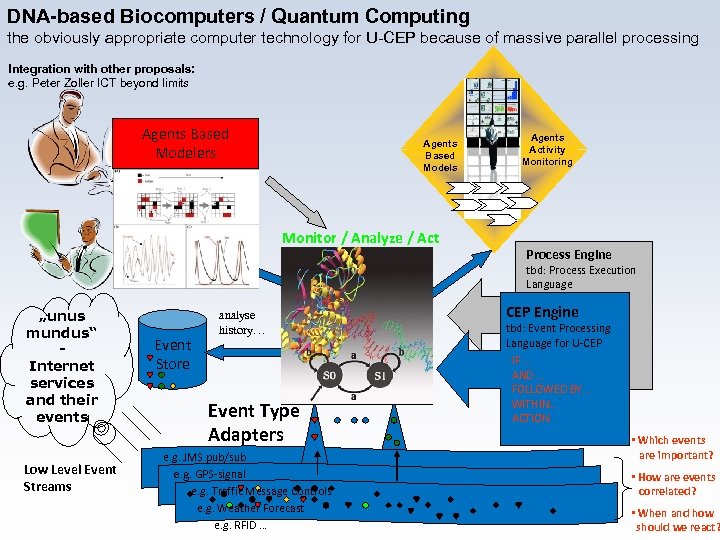
DNA-based Biocomputers / Quantum Computing the obviously appropriate computer technology for U-CEP because of massive parallel processing Integration with other proposals: e. g. Peter Zoller ICT beyond limits Agents Based Modelers Process Modeler Event Modeler „unus mundus“ Internet services and their events Low Level Event Streams Event Store Agents Based Models Monitor / Analyze / Act Process Models Event Processing Model analyse history… Middleware Normalized events, build higher level events Event Type Adapters e. g. JMS pub/sub e. g. GPS-signal e. g. Traffic Message Controls e. g. Weather Forecast e. g. RFID … Agents Activity Monitoring Process Engine tbd: Process Execution Language CEP Engine tbd: Event Processing Language for U-CEP IF … AND … FOLLOWED BY… WITHIN… ACTION • Which events are important? • How are events correlated? • When and how should we react?
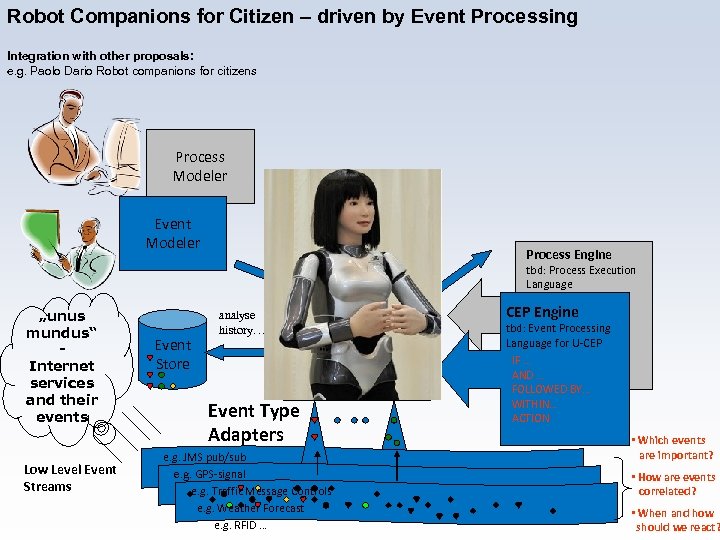
Robot Companions for Citizen – driven by Event Processing Integration with other proposals: e. g. Paolo Dario Robot companions for citizens Process Modeler Event Modeler „unus mundus“ Internet services and their events Low Level Event Streams Event Store Monitor / Analyze / Act Process Models Event Processing Model analyse history… Middleware Normalized events, build higher level events Event Type Adapters e. g. JMS pub/sub e. g. GPS-signal e. g. Traffic Message Controls e. g. Weather Forecast e. g. RFID … Process Engine tbd: Process Execution Language CEP Engine tbd: Event Processing Language for U-CEP IF … AND … FOLLOWED BY… WITHIN… ACTION • Which events are important? • How are events correlated? • When and how should we react?
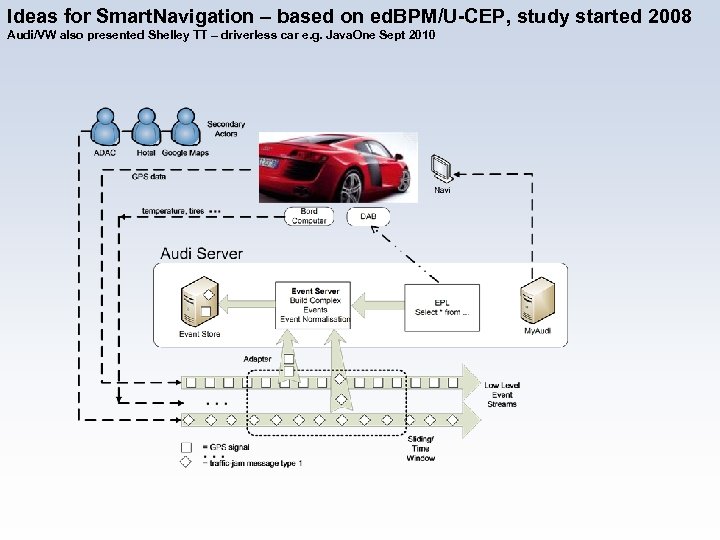
Ideas for Smart. Navigation – based on ed. BPM/U-CEP, study started 2008 Audi/VW also presented Shelley TT – driverless car e. g. Java. One Sept 2010
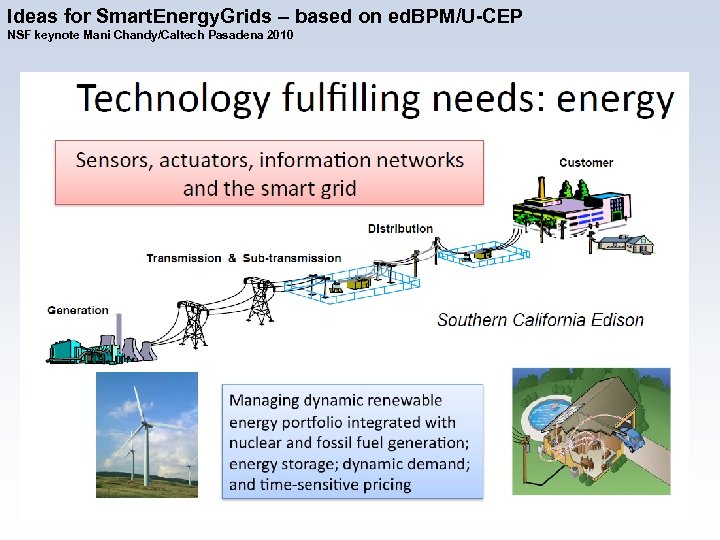
Ideas for Smart. Energy. Grids – based on ed. BPM/U-CEP NSF keynote Mani Chandy/Caltech Pasadena 2010
Some slides about previous related ed. BPM curricula to be enhanced for U-CEP
Dissemination and Teaching ED-BPM
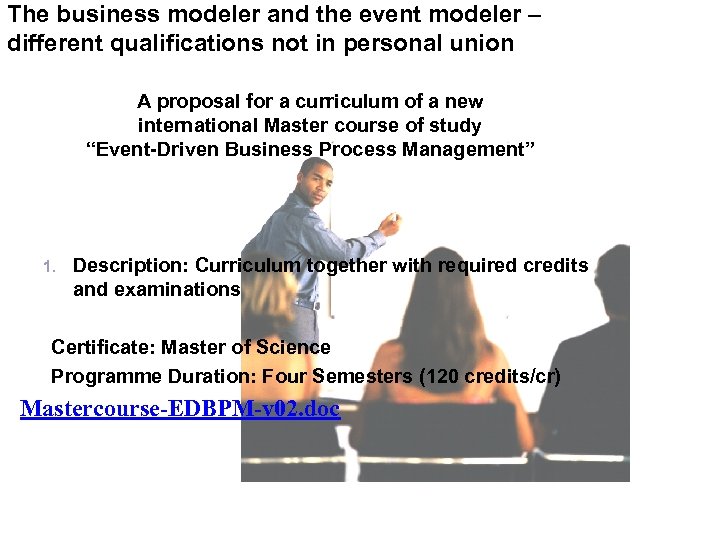
The business modeler and the event modeler – different qualifications not in personal union A proposal for a curriculum of a new international Master course of study “Event-Driven Business Process Management” 1. Description: Curriculum together with required credits and examinations Certificate: Master of Science Programme Duration: Four Semesters (120 credits/cr) Mastercourse-EDBPM-v 02. doc
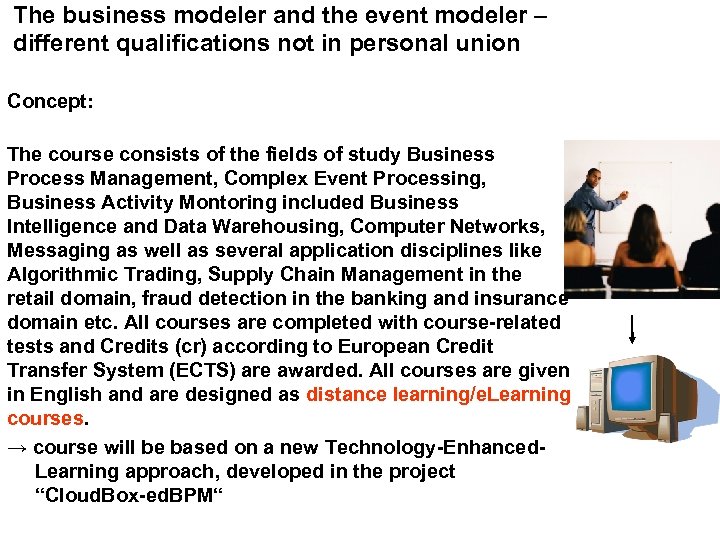
The business modeler and the event modeler – different qualifications not in personal union Concept: The course consists of the fields of study Business Process Management, Complex Event Processing, Business Activity Montoring included Business Intelligence and Data Warehousing, Computer Networks, Messaging as well as several application disciplines like Algorithmic Trading, Supply Chain Management in the retail domain, fraud detection in the banking and insurance domain etc. All courses are completed with course-related tests and Credits (cr) according to European Credit Transfer System (ECTS) are awarded. All courses are given in English and are designed as distance learning/e. Learning courses. → course will be based on a new Technology-Enhanced Learning approach, developed in the project “Cloud. Box-ed. BPM“
Some slides about previous related ed. BPM workshops
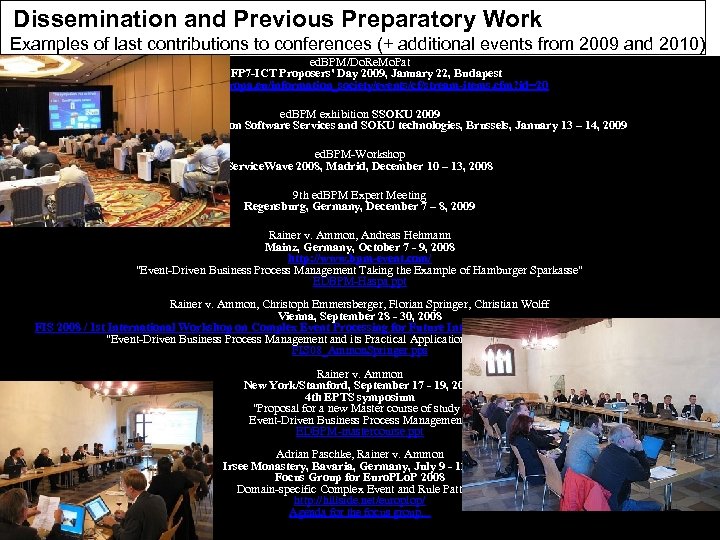
Dissemination and Previous Preparatory Work Examples of last contributions to conferences (+ additional events from 2009 and 2010) ed. BPM/Do. Re. Mo. Pat at FP 7 -ICT Proposers' Day 2009, January 22, Budapest http: //ec. europa. eu/information_society/events/cf/stream-items. cfm? id=20 ed. BPM exhibition SSOKU 2009 1 st European Conference on Software Services and SOKU technologies, Brussels, January 13 – 14, 2009 ed. BPM-Workshop Service. Wave 2008, Madrid, December 10 – 13, 2008 9 th ed. BPM Expert Meeting Regensburg, Germany, December 7 – 8, 2009 Rainer v. Ammon, Andreas Hehmann Mainz, Germany, October 7 - 9, 2008 http: //www. bpm-event. com/ "Event-Driven Business Process Management Taking the Example of Hamburger Sparkasse" EDBPM-Haspa. ppt Rainer v. Ammon, Christoph Emmersberger, Florian Springer, Christian Wolff Vienna, September 28 - 30, 2008 FIS 2008 / 1 st International Workshop on Complex Event Processing for Future Internet - Realizing Reactive Future Internet "Event-Driven Business Process Management and its Practical Application Taking the Example of DHL" FIS 08_Ammon. Springer. pps Rainer v. Ammon New York/Stamford, September 17 - 19, 2008 4 th EPTS symposium "Proposal for a new Master course of study - Event-Driven Business Process Management" EDBPM-mastercourse. ppt Adrian Paschke, Rainer v. Ammon Irsee Monastery, Bavaria, Germany, July 9 - 13, 2008 Focus Group for Euro. PLo. P 2008 Domain-specific Complex Event and Rule Patterns http: //hillside. net/europlop/ Agenda for the focus group. . . 28
Скачать презентацию Workshop From Event-Driven Business Process Management to Ubiquitous
ab84488c441b7ce1b4efa2fab8b4a6bf.ppt