


 Скачать презентацию Workshop for OIE National Focal Points for Aquatic
a1e2886f4cec499895bb908734a45569.ppt
- Количество слайдов: 23
 Workshop for OIE National Focal Points for Aquatic Animals, Byblos, Lebanon, 11– 13 August 2013 Biosecurity in aquaculture Edgar Brun OIE Collaborating Centre on Epidemiology and Risk Assessment for Aquatic Animal Diseases Atlantic Veterinary College
 Biosecurity n A holistic concept for the sustainability of aquaculture (food production) n Aims to protect environment including biological diversity n Based on regulations and standards to be applied at international-, national- and site level
 Biosecurity Every action involved in ● avoiding entry of pathogens (prevention/exclusion) § Into a country § into a farm ● controlling further spread of pathogens (containment) ● reducing consequences of outbreaks (eradication)
 Cultured aquatic animals n are traded world wide as eggs, live animals and products n are kept in open or semi-open systems n are part of the local ecological system ● are continuously exposed to environmental microorganisms (and visa versa) n are more “stressed” than surrounding fellow animals in the wild
 Three levels within biosecurity n National/international level – governmental responsibility n Regional level – shared/industry responsibility n Site level – company/private responsibility
 International/national level n n n International standards (OIE, WTO, Codex) National legal framework Management policy (hazards, surveillance, stamping out, compensation …) Authority for implementing control measures at national, regional and site level Infrastructure ● Lines of command ● Laboratories ● Reporting system ● Information system ● Competence building
 Regional level n Epidemiological unit How is the connection between farms n Can groups of farms be organized into zones n n Regional collaboration Interaction between big intensive companies and small (semi-) extensive private enterprises n Can coordinated measures be implmented at the same time n
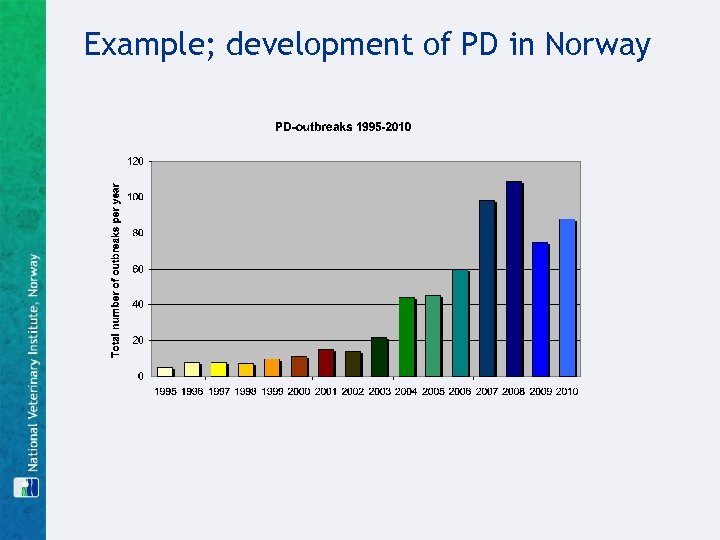 Example; development of PD in Norway
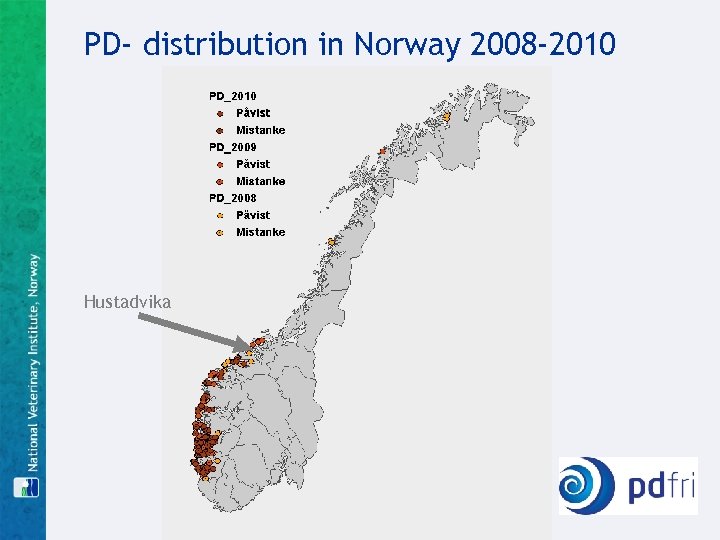 PD- distribution in Norway 2008 -2010 Hustadvika
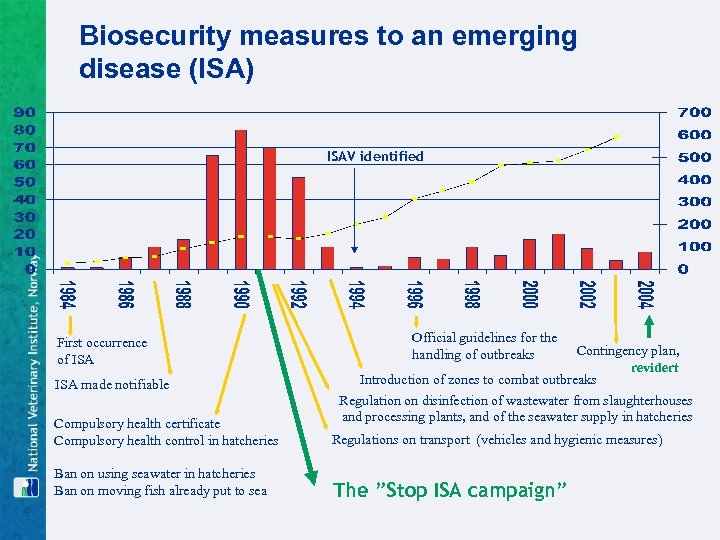 Biosecurity measures to an emerging disease (ISA) ISAV identified First occurrence of ISA made notifiable Official guidelines for the handling of outbreaks Contingency plan, revidert Introduction of zones to combat outbreaks Regulation on disinfection of wastewater from slaughterhouses and processing plants, and of the seawater supply in hatcheries Compulsory health certificate Compulsory health control in hatcheries Regulations on transport (vehicles and hygienic measures) Ban on using seawater in hatcheries Ban on moving fish already put to sea The ”Stop ISA campaign”
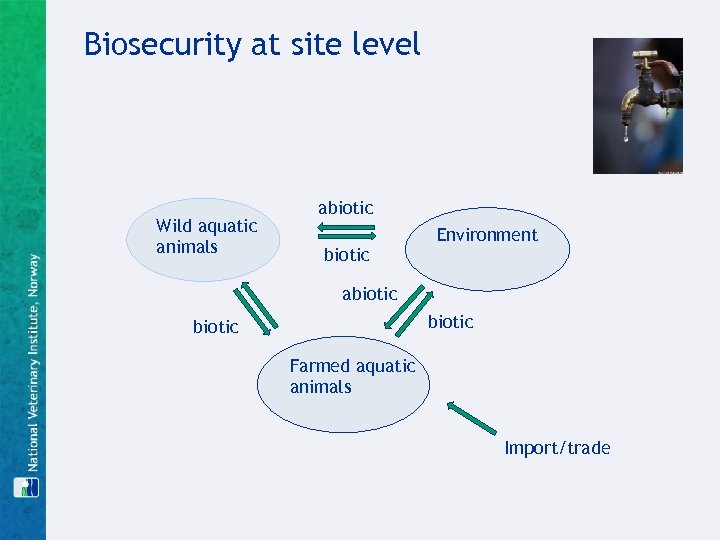 Biosecurity at site level Wild aquatic animals abiotic Environment abiotic Farmed aquatic animals Import/trade
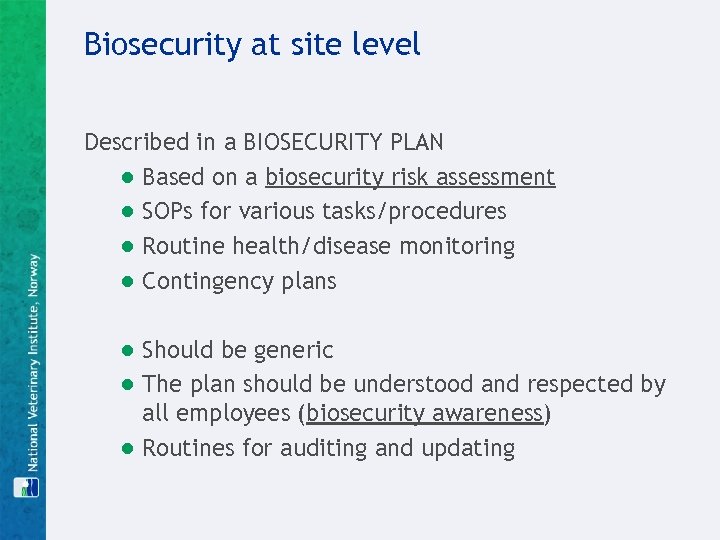 Biosecurity at site level Described in a BIOSECURITY PLAN ● Based on a biosecurity risk assessment ● SOPs for various tasks/procedures ● Routine health/disease monitoring ● Contingency plans ● Should be generic ● The plan should be understood and respected by all employees (biosecurity awareness) ● Routines for auditing and updating
 Biosecurity assessment at site n Risk characterization of the facility n Pathogen exposure n Risk characterization of management n Identification of critical points
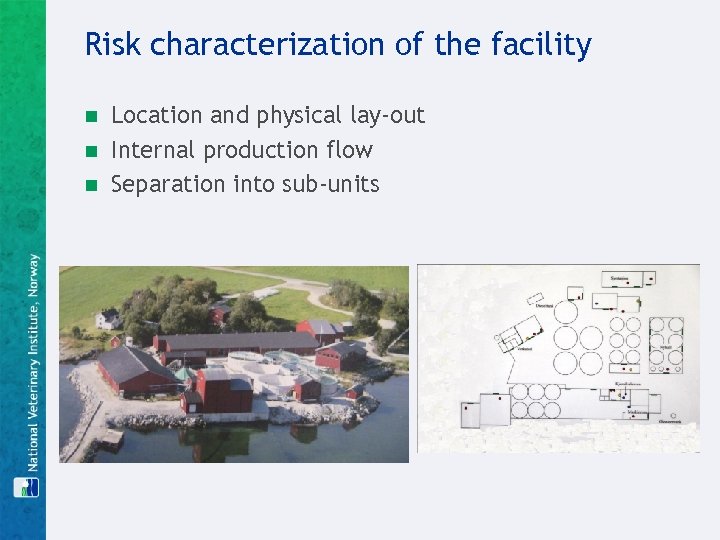 Risk characterization of the facility Location and physical lay-out n Internal production flow n Separation into sub-units n
 Pathogen exposure n Which infectious hazards are threatening the plant, their epidemiology and control measures ● ● ● routes of introduction and spread What do we know about the infectious agents What do we know about the disease Does the farm have susceptible species Available diagnostic test Available vaccines
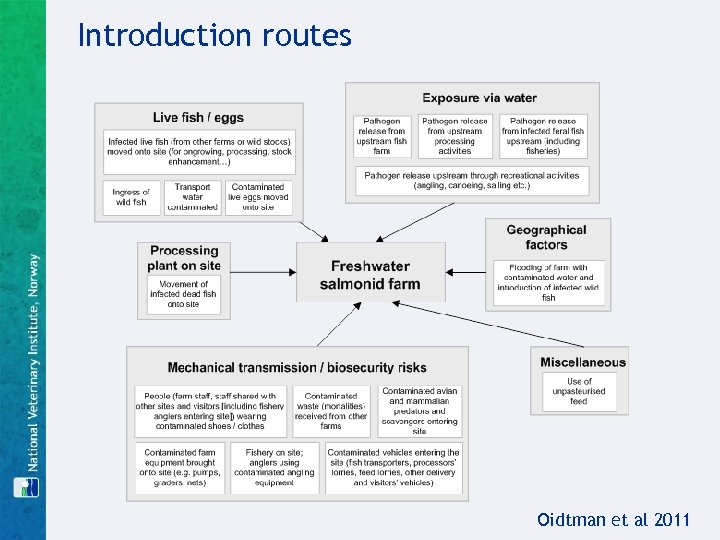 Introduction routes Oidtman et al 2011
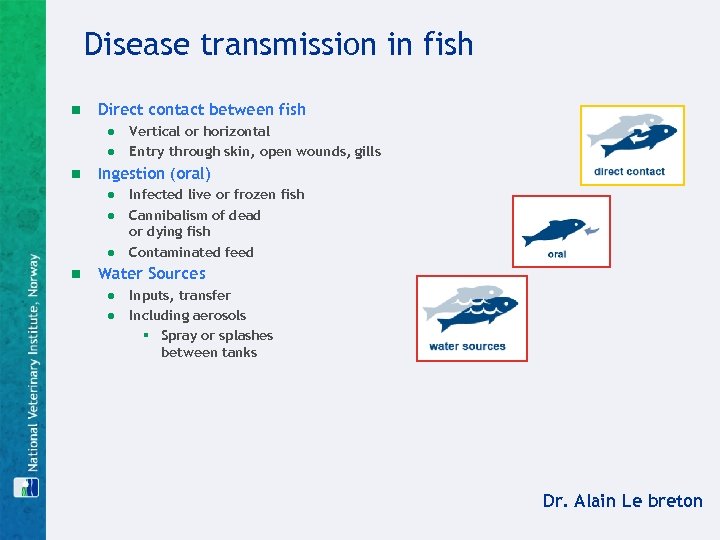 Disease transmission in fish n Direct contact between fish ● Vertical or horizontal ● Entry through skin, open wounds, gills n Ingestion (oral) ● Infected live or frozen fish ● Cannibalism of dead or dying fish ● Contaminated feed n Water Sources ● Inputs, transfer ● Including aerosols § Spray or splashes between tanks Dr. Alain Le breton
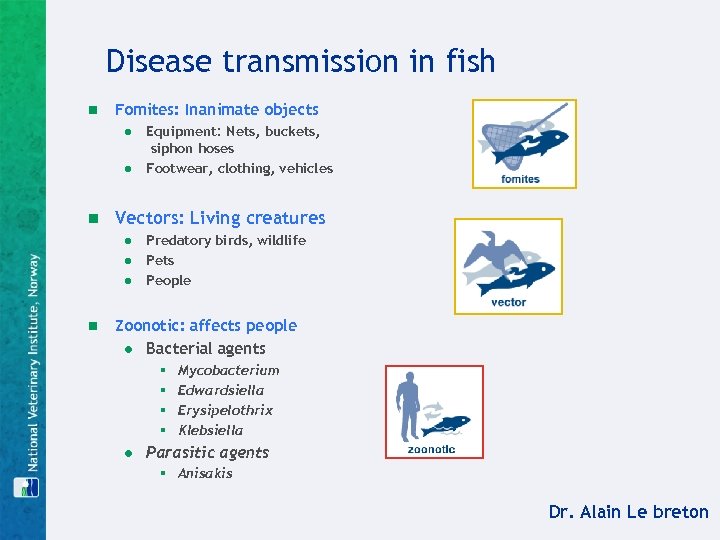 Disease transmission in fish n Fomites: Inanimate objects ● Equipment: Nets, buckets, siphon hoses ● Footwear, clothing, vehicles n Vectors: Living creatures ● Predatory birds, wildlife ● Pets ● People n Zoonotic: affects people ● Bacterial agents § § Mycobacterium Edwardsiella Erysipelothrix Klebsiella ● Parasitic agents § Anisakis Dr. Alain Le breton
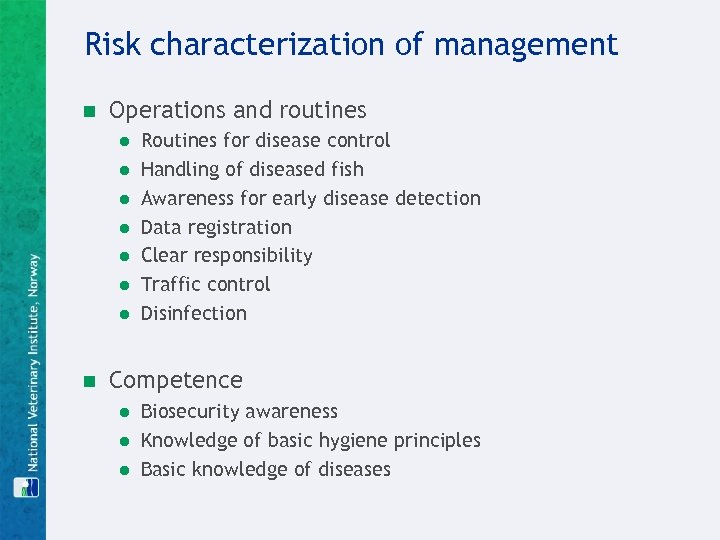 Risk characterization of management n Operations and routines ● ● ● ● n Routines for disease control Handling of diseased fish Awareness for early disease detection Data registration Clear responsibility Traffic control Disinfection Competence ● Biosecurity awareness ● Knowledge of basic hygiene principles ● Basic knowledge of diseases
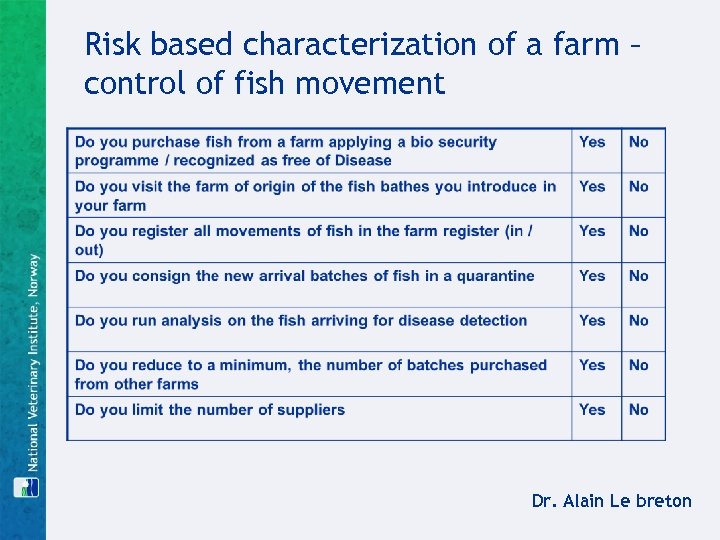 Risk based characterization of a farm – control of fish movement Dr. Alain Le breton
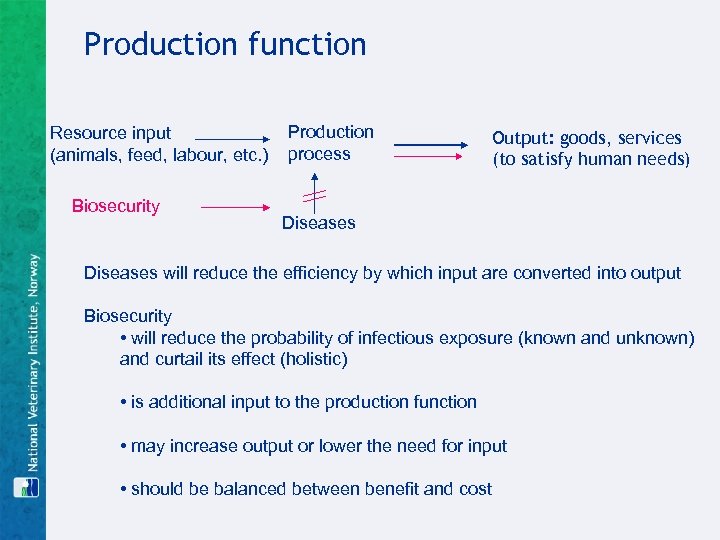 Production function Resource input (animals, feed, labour, etc. ) Biosecurity Production process Output: goods, services (to satisfy human needs) Diseases will reduce the efficiency by which input are converted into output Biosecurity • will reduce the probability of infectious exposure (known and unknown) and curtail its effect (holistic) • is additional input to the production function • may increase output or lower the need for input • should be balanced between benefit and cost
 Core issues to n Balance knowledge on hazards, technical feasibility and cost n Tailor the biosecurity plan according to the specific needs on each individual farm
 Biosecurity n … everybody will sooner or later face the challenge of a disease outbreak n …is an act of responsibility ● to the farmed animals ● to the environment ● to fellow producers ● to society THANK YOU FOR YOUR ATTENTION