


 Скачать презентацию Workshop CROATIA 2009 With the support of the
58171725ea33d84d8172b2b0c057b741.ppt
- Количество слайдов: 61
 Workshop CROATIA 2009 With the support of the European Commission
 Introduction 1. 2. 3. 4. Commitment Why biodegradable and compostable products? European standards Denico Product Range 1. Fibres 2. Bioplastics 5. Conclusion With the support of the European Commission
 1. Commitment Our target Ø Replacement of conventional (packaging)products through environment friendly ones Our task Ø Promotion and implementation of biodegradable and compostable (packaging)products made from renewable resources Ø Insure our leading market position through constant efforts on development and improvements With the support of the European Commission
 2. Why biodegradable and compostable products? Economical arguments Ø Worldwide use : 240 million tonnes of plastic Ø Europe uses yearly : 50 million tonnes of plastic ( demand still increasing) Ø Volatile oil price $40 $ 120 / barrel Ø Oil shortage by 2020 With the support of the European Commission
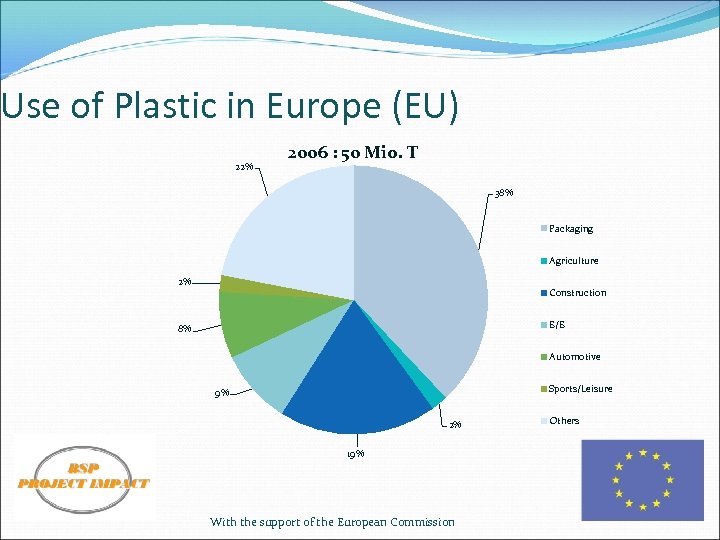 Use of Plastic in Europe (EU) 22% 2006 : 50 Mio. T 38% Packaging Agriculture 2% Construction E/E 8% Automotive Sports/Leisure 9% 2% 19% With the support of the European Commission Others
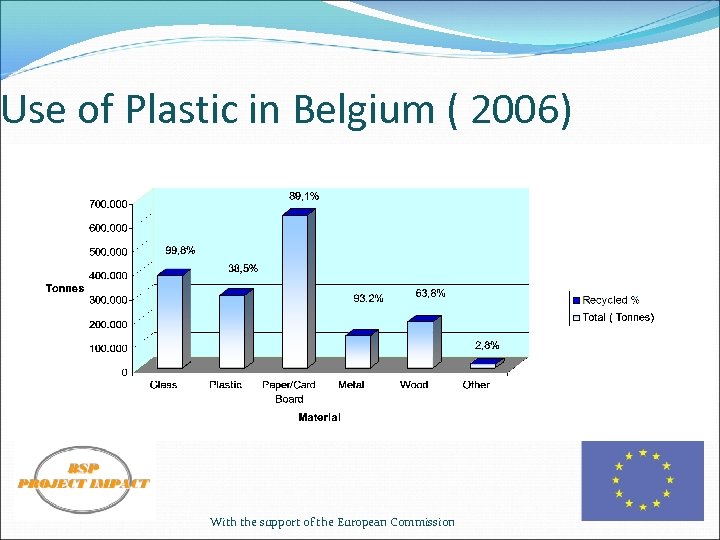 Use of Plastic in Belgium ( 2006) With the support of the European Commission
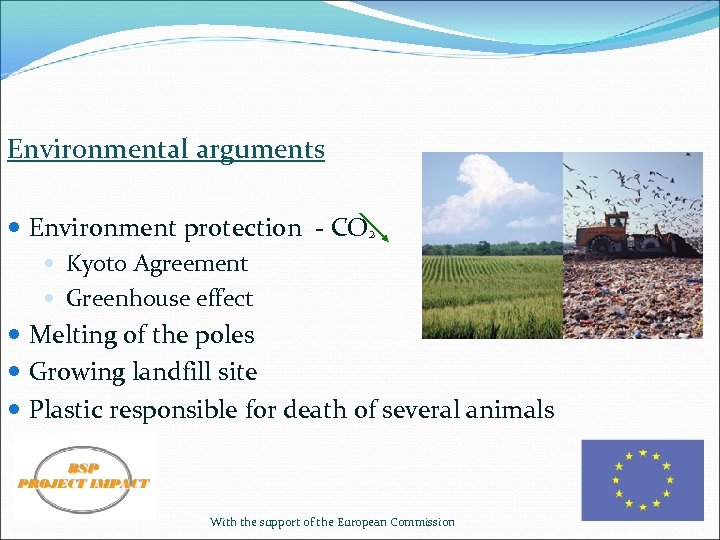 Environmental arguments Environment protection - CO² Kyoto Agreement Greenhouse effect Melting of the poles Growing landfill site Plastic responsible for death of several animals With the support of the European Commission
 European Commission (EC) Environmental Agreements (EA) Sustainable development No legislative action Tackle environmental problems Motivation for new EA : “Report Industry’s Council 2002” : “Building on the Current Situation And Future Prospects of EU Industry Using Renewable Raw Materials (RRM)” With the support of the European Commission
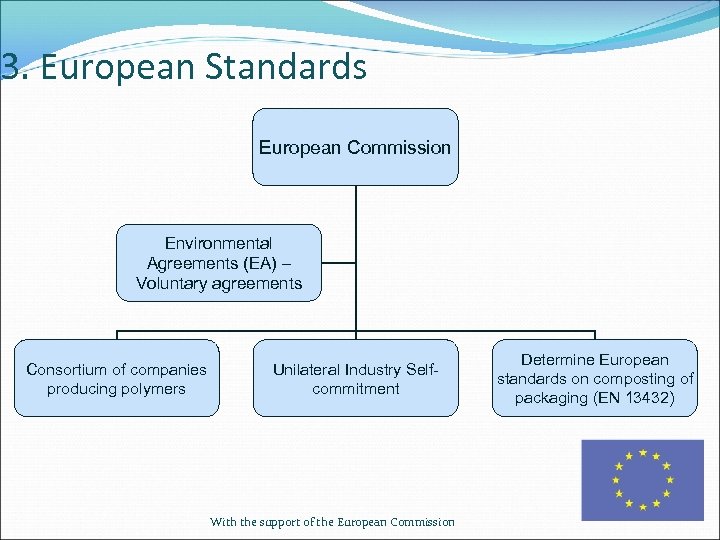 3. European Standards European Commission Environmental Agreements (EA) – Voluntary agreements Consortium of companies producing polymers Unilateral Industry Selfcommitment With the support of the European Commission Determine European standards on composting of packaging (EN 13432)
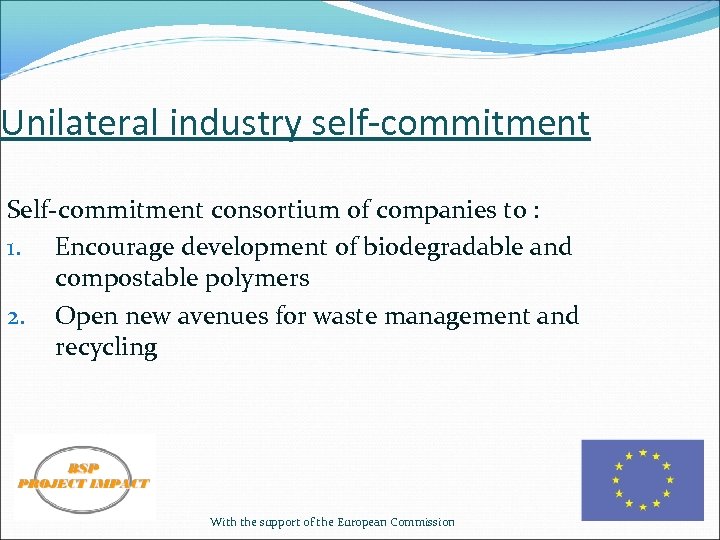 Unilateral industry self-commitment Self-commitment consortium of companies to : 1. Encourage development of biodegradable and compostable polymers 2. Open new avenues for waste management and recycling With the support of the European Commission
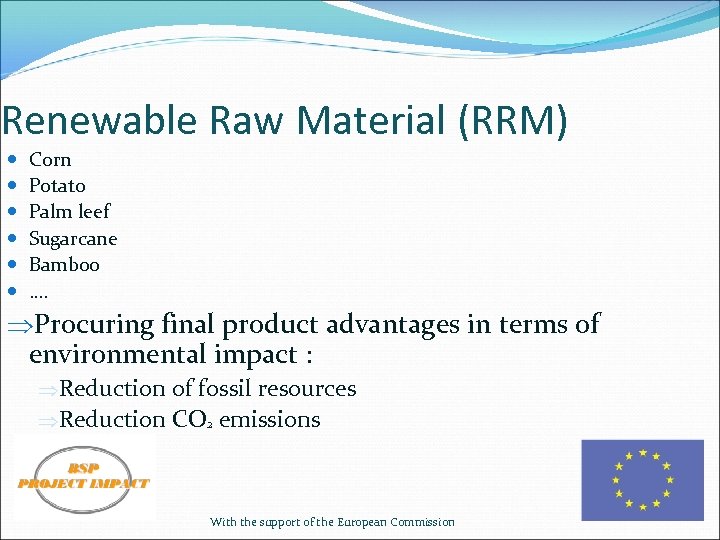 Renewable Raw Material (RRM) Corn Potato Palm leef Sugarcane Bamboo …. ÞProcuring final product advantages in terms of environmental impact : ÞReduction of fossil resources ÞReduction CO² emissions With the support of the European Commission
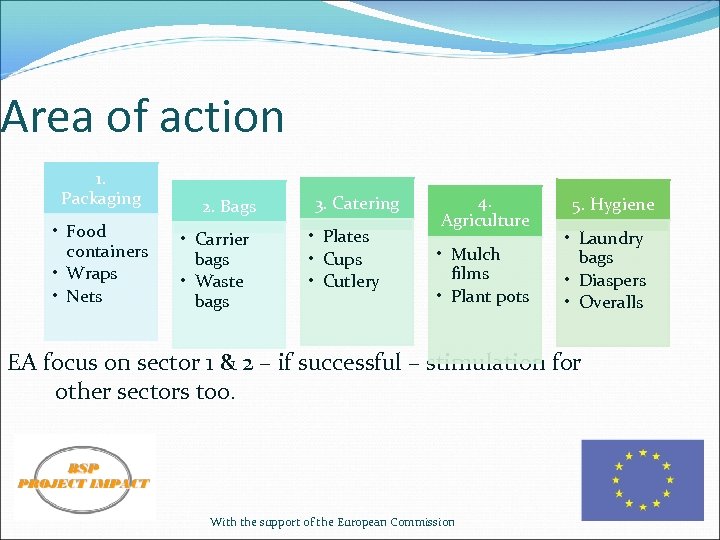 Area of action 1. Packaging • Food containers • Wraps • Nets 2. Bags • Carrier bags • Waste bags 3. Catering • Plates • Cups • Cutlery 4. Agriculture • Mulch films • Plant pots 5. Hygiene • Laundry bags • Diaspers • Overalls EA focus on sector 1 & 2 – if successful – stimulation for other sectors too. With the support of the European Commission
 Proposed action Ø EN 13432 • Biodegredability • Compostability Ø Certification • Biodegredability • Compostability Ø Label OK Compost Home With the support of the European Commission
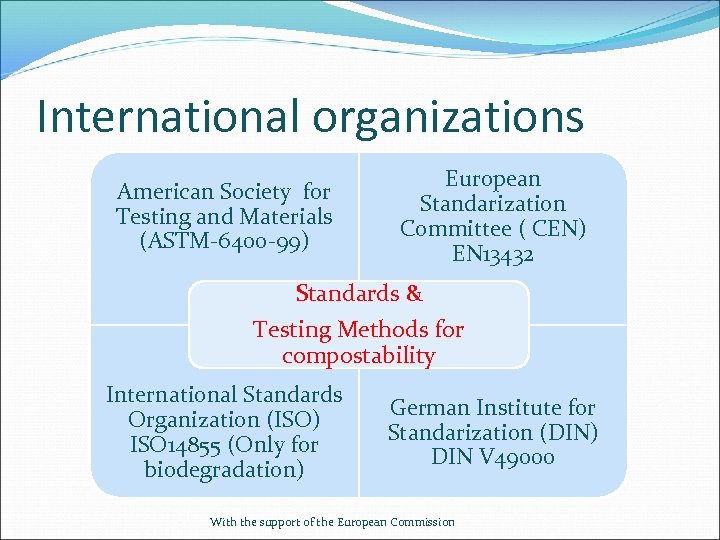 International organizations American Society for Testing and Materials (ASTM-6400 -99) European Standarization Committee ( CEN) EN 13432 Standards & Testing Methods for compostability International Standards Organization (ISO) ISO 14855 (Only for biodegradation) German Institute for Standarization (DIN) DIN V 49000 With the support of the European Commission
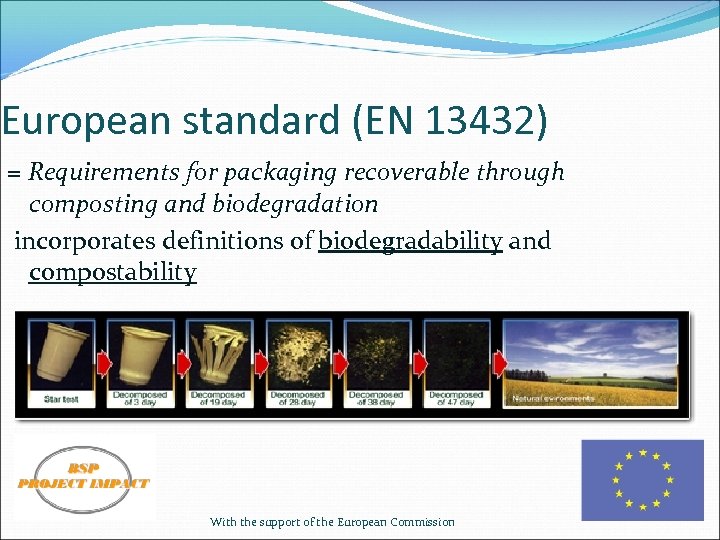 European standard (EN 13432) = Requirements for packaging recoverable through composting and biodegradation incorporates definitions of biodegradability and compostability With the support of the European Commission
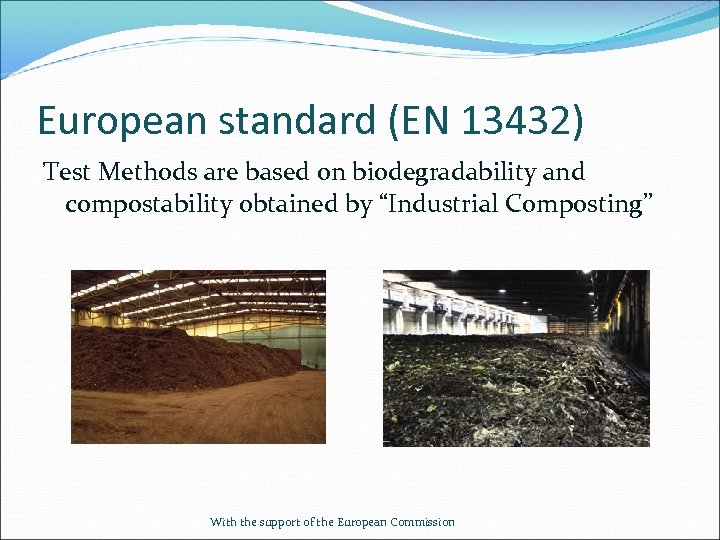 European standard (EN 13432) Test Methods are based on biodegradability and compostability obtained by “Industrial Composting” With the support of the European Commission
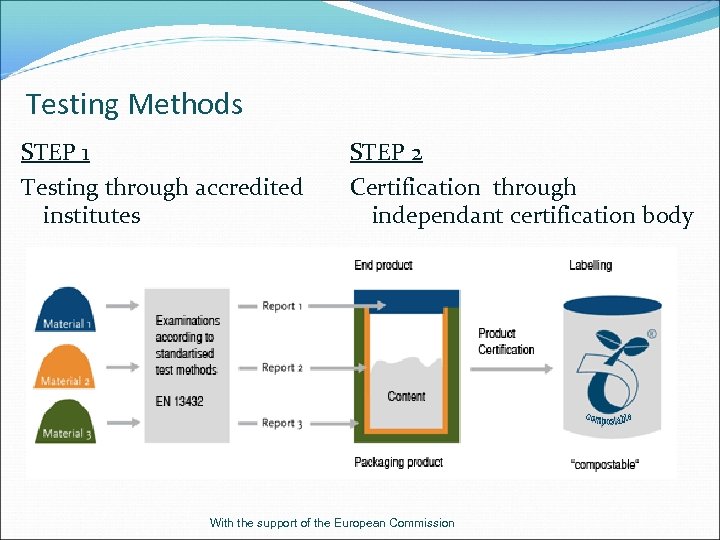 Testing Methods STEP 1 Testing through accredited institutes STEP 2 Certification through independant certification body With the support of the European Commission
 Definition for “Biodegradable” : “ A material or product is called biodegradable under specific environmental conditions if it is able to undergo within a given time a certian degradation process that is caused by biological activity and can be measured by a standarised test method. ” With the support of the European Commission
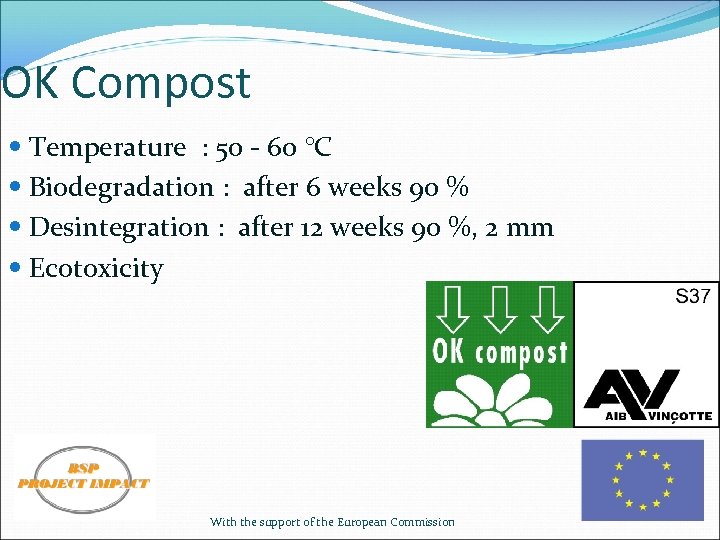 OK Compost Temperature : 50 - 60 °C Biodegradation : after 6 weeks 90 % Desintegration : after 12 weeks 90 %, 2 mm Ecotoxicity With the support of the European Commission
 Definition for “Compostable” : “ For a material to be called compostable is has to be biodegradable and disintegrate in a composting system in such a way that this disintegration occurs during the period of end-use of the compost” With the support of the European Commission
 OK Compost HOME Temperature : 20 - 23 °C Biodegradation: after 9 weeks 90 % Desintegration : after 16 weeks 90 %, 2 mm Ecotoxicity With the support of the European Commission
 Certification Belgian approved laboratory => Organic Waste System – Ghent Step 1 : Verification of the compostability of the materials by approved test laboraties in accordance with test methods described in EN 13432. Step 2 : Certification expert committee AIB Vinçotte (Belgium): Din. Certco (Germany) - OK Compost HOME - Compostable With the support of the European Commission
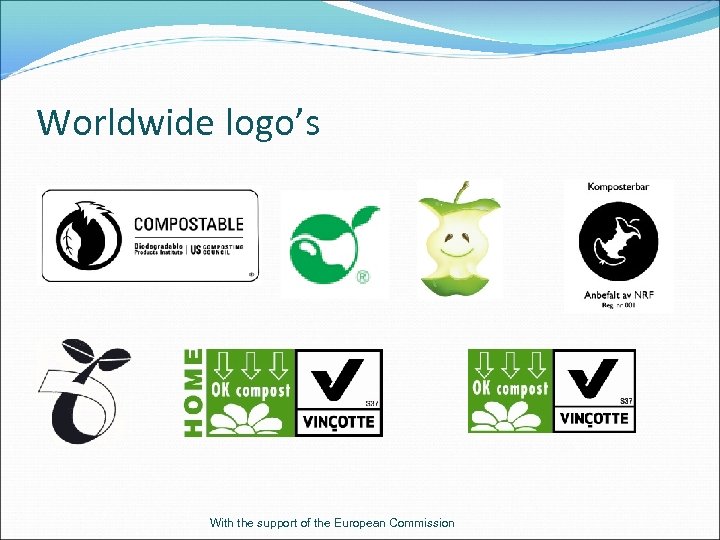 Worldwide logo’s With the support of the European Commission
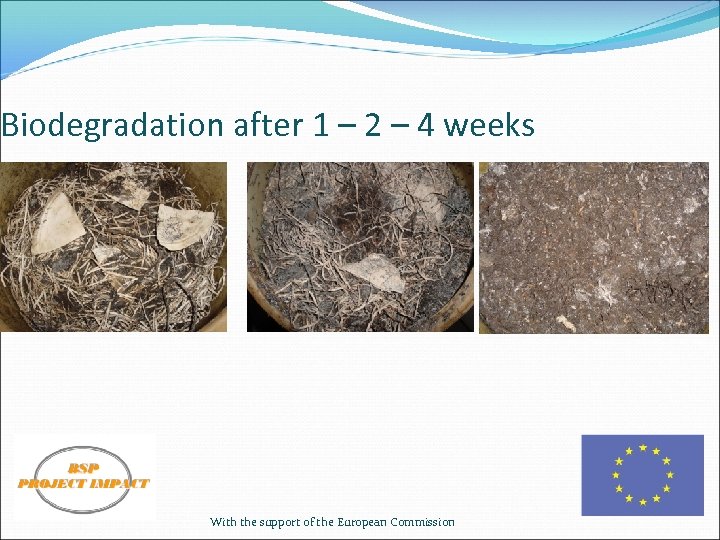 Biodegradation after 1 – 2 – 4 weeks With the support of the European Commission
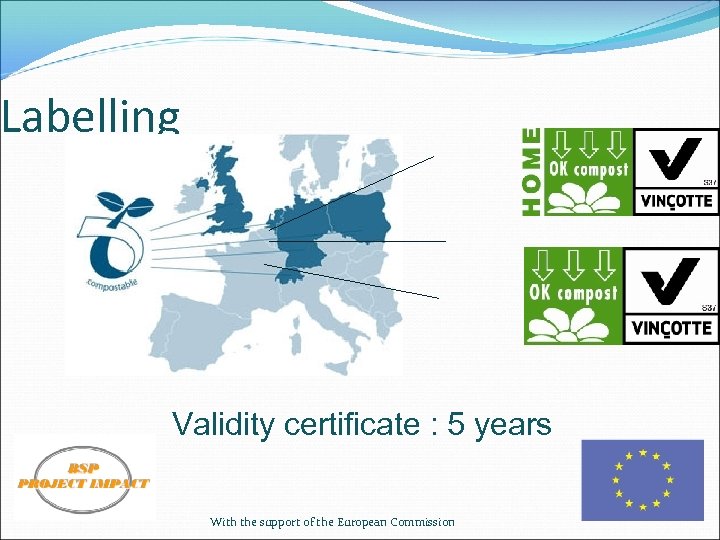 Labelling Validity certificate : 5 years With the support of the European Commission
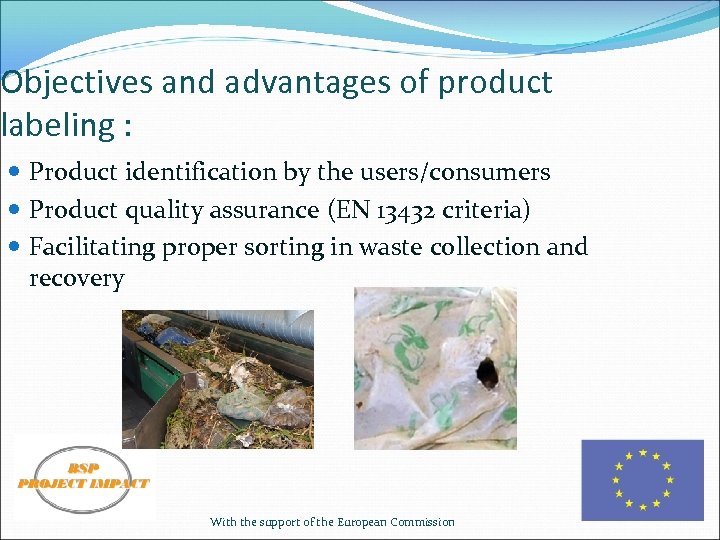 Objectives and advantages of product labeling : Product identification by the users/consumers Product quality assurance (EN 13432 criteria) Facilitating proper sorting in waste collection and recovery With the support of the European Commission
 Belgian Bio. Packaging Non profit organisation to stimulate legislation on BCP’s in Belgium - Promoting home composting - Unique European logo - Open the green waste bin for biodegradable packaging With the support of the European Commission
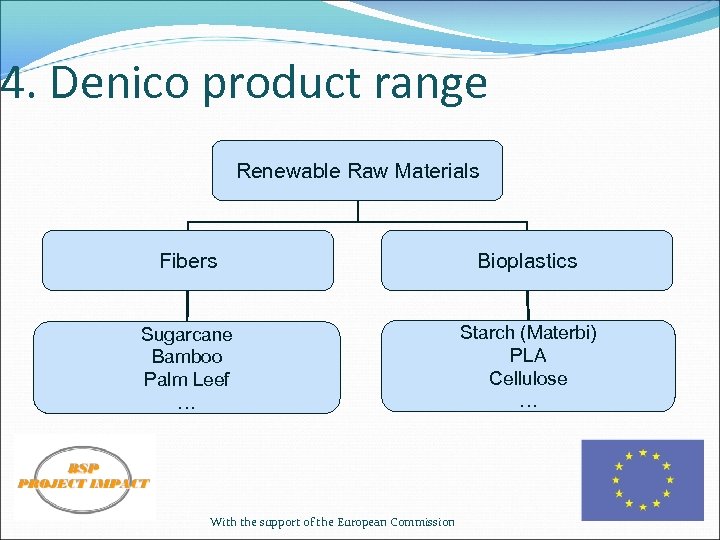 4. Denico product range Renewable Raw Materials Fibers Bioplastics Sugarcane Bamboo Palm Leef … Starch (Materbi) PLA Cellulose … With the support of the European Commission
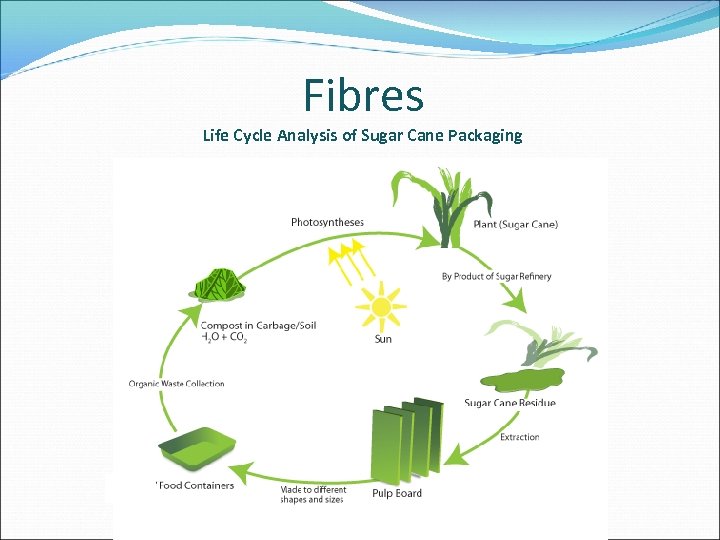 Fibres Life Cycle Analysis of Sugar Cane Packaging
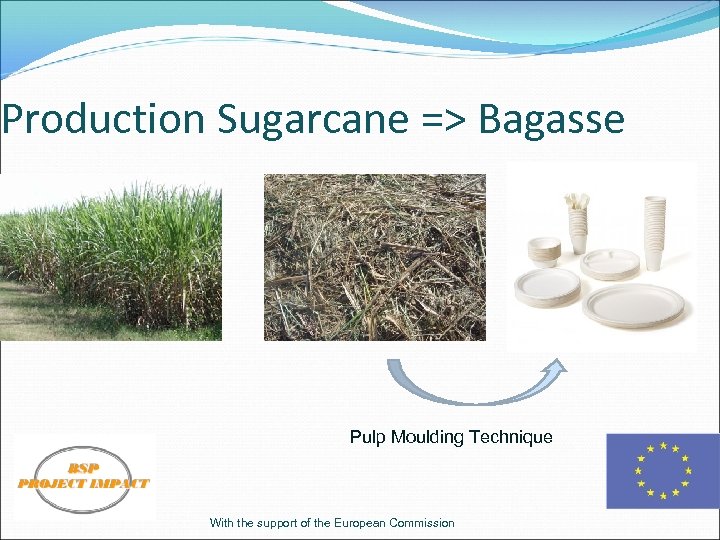 Production Sugarcane => Bagasse Pulp Moulding Technique With the support of the European Commission
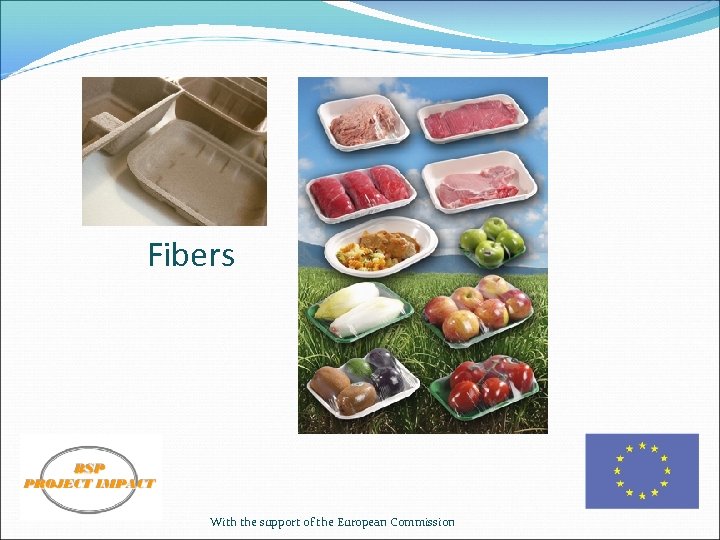 Fibers With the support of the European Commission
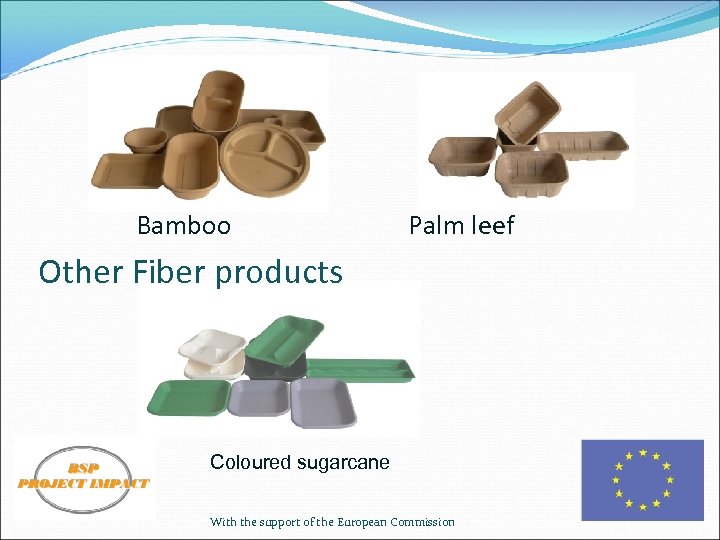 Bamboo Palm leef Other Fiber products Coloured sugarcane With the support of the European Commission
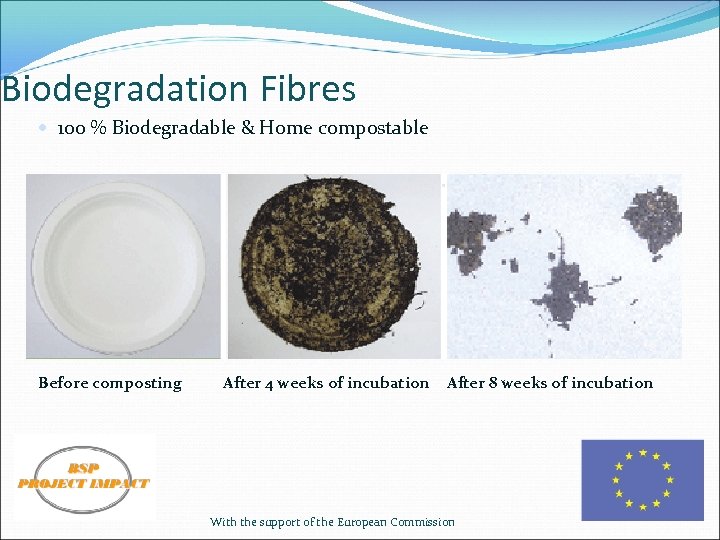 Biodegradation Fibres 100 % Biodegradable & Home compostable Before composting After 4 weeks of incubation After 8 weeks of incubation With the support of the European Commission
 Properties Fibres Food Contact Approved Flexible shapes & size Suitable for thermal applications Microwave/oven + 225°C Freezer - 20°C Water + 100 °C Oil + 150 °C Acid resistance – no discoloration HACCP – ISO – SGS – FDA With the support of the European Commission
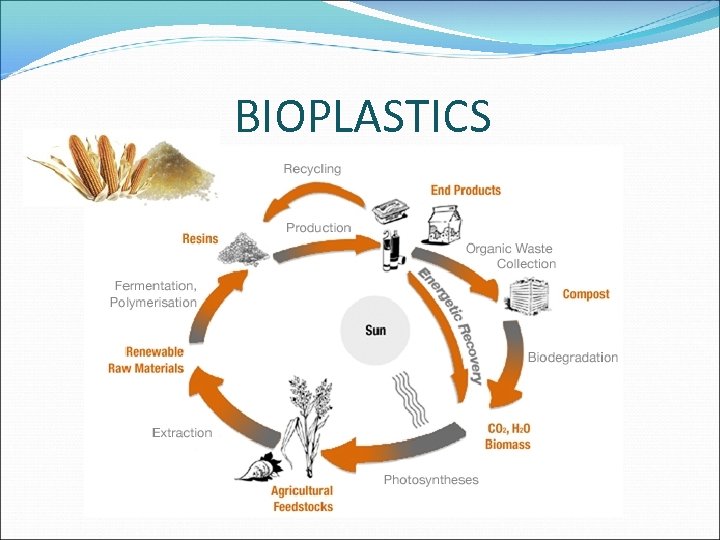 BIOPLASTICS
 Definition Bioplastics = environmentally friendly plastics processed by plastic processing technologies : Film extrusion => flow pack Thermoforming => Food containers Blow moulding => bottles Fibres => clothing And that are : 1. Biodegradable or/and compostable according to relevant standards 2. Based (at least in parts) on renewable raw materials (RRM) With the support of the European Commission
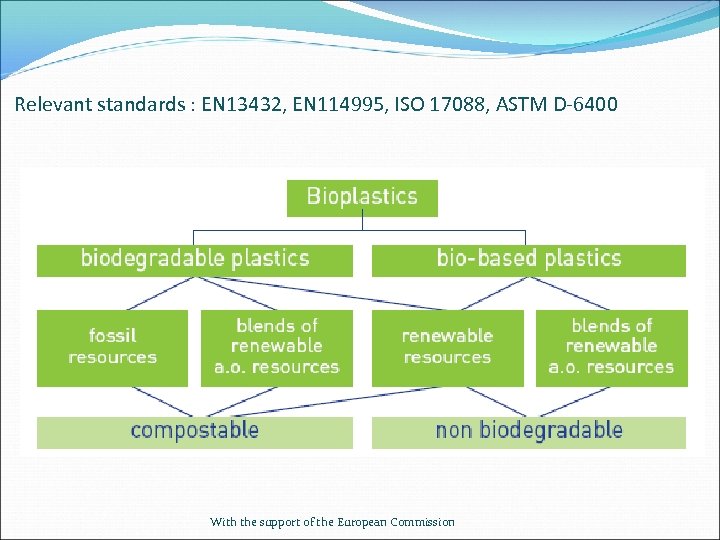 Relevant standards : EN 13432, EN 114995, ISO 17088, ASTM D-6400 With the support of the European Commission
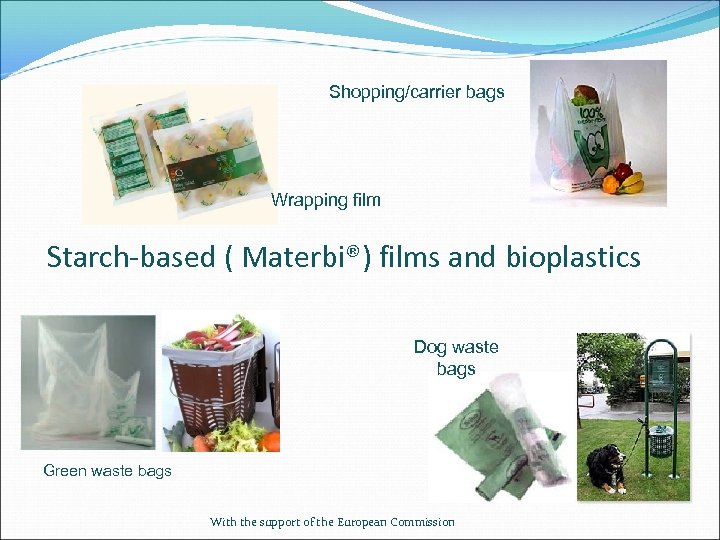 Shopping/carrier bags Wrapping film Starch-based ( Materbi®) films and bioplastics Dog waste bags Green waste bags With the support of the European Commission
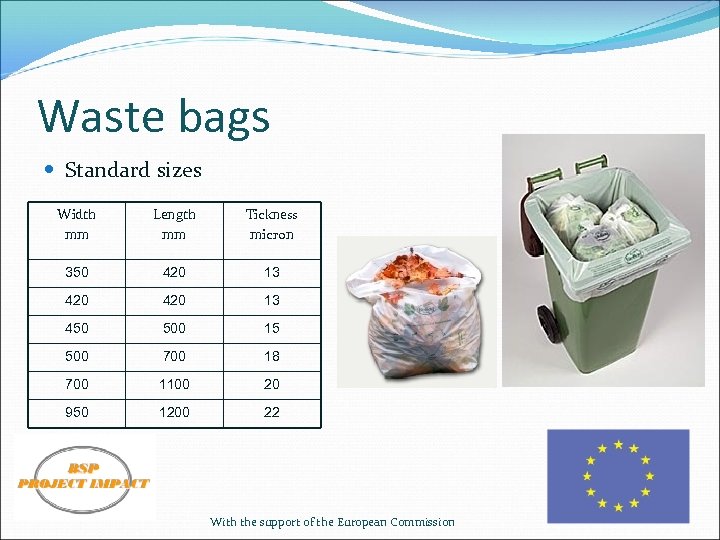 Waste bags Standard sizes Width mm Length mm Tickness micron 350 420 13 450 500 15 500 700 18 700 1100 20 950 1200 22 With the support of the European Commission
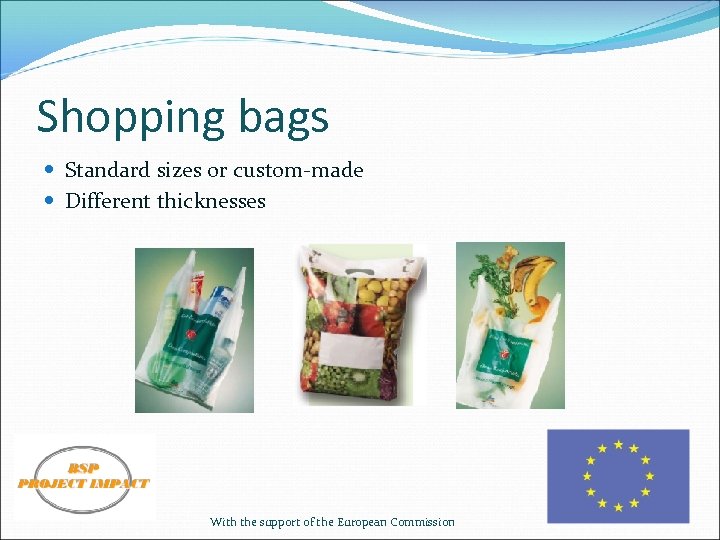 Shopping bags Standard sizes or custom-made Different thicknesses With the support of the European Commission
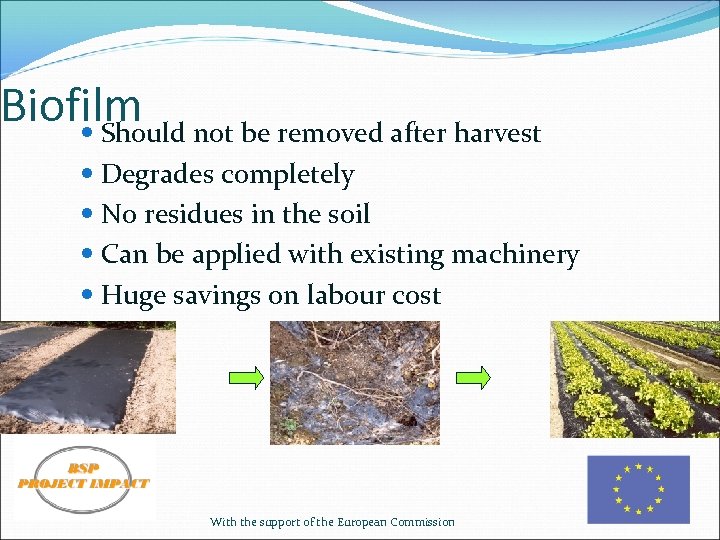 Biofilm not be removed after harvest Should Degrades completely No residues in the soil Can be applied with existing machinery Huge savings on labour cost With the support of the European Commission
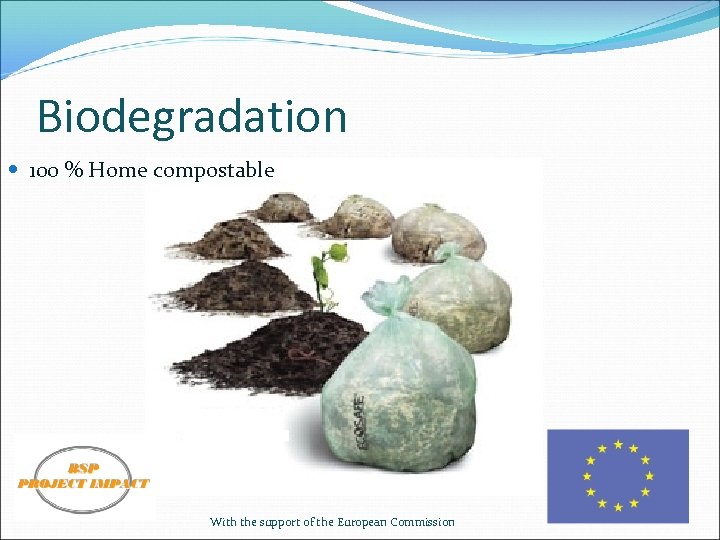 Biodegradation 100 % Home compostable With the support of the European Commission
 Applications - starch Advantages: Abundantly available Printable Home compostable (bags to 120 µm : 10 to 45 days ) Gasbarrier: - low CO 2 permeability - high (water)vapour permeability Our bag complies with EU requirements for packaging in the food industry Our bag "breathes" and reduces the weight of its contents by up to 25% in five days. With the support of the European Commission
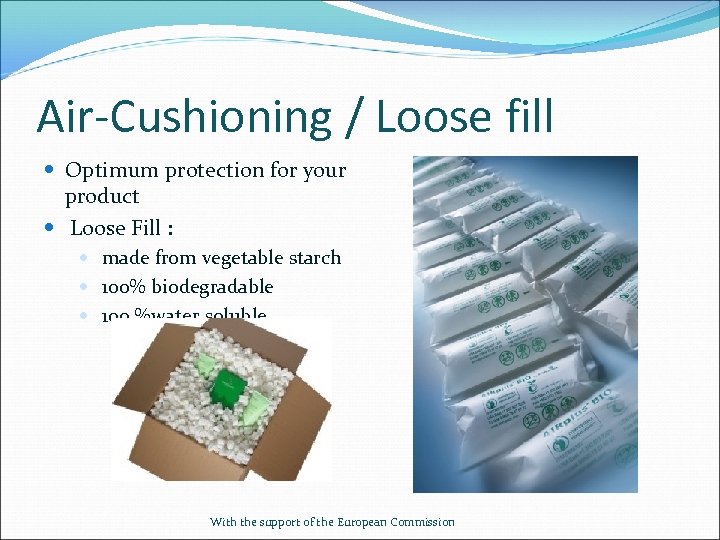 Air-Cushioning / Loose fill Optimum protection for your product Loose Fill : made from vegetable starch 100% biodegradable 100 %water soluble With the support of the European Commission
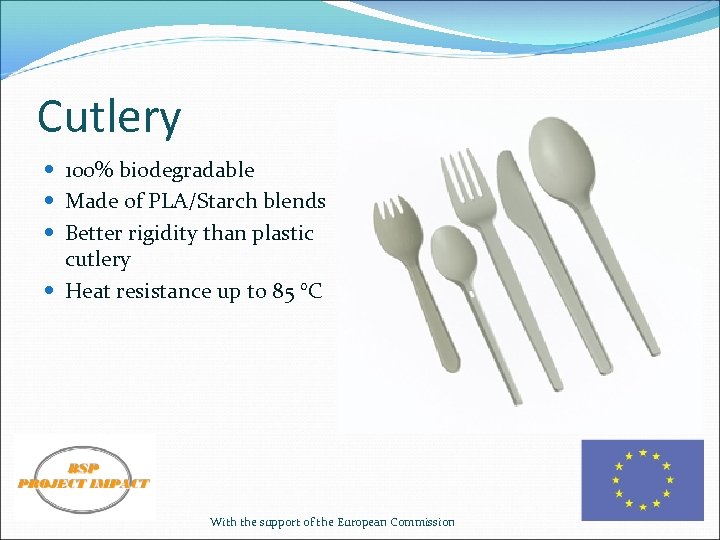 Cutlery 100% biodegradable Made of PLA/Starch blends Better rigidity than plastic cutlery Heat resistance up to 85 °C With the support of the European Commission
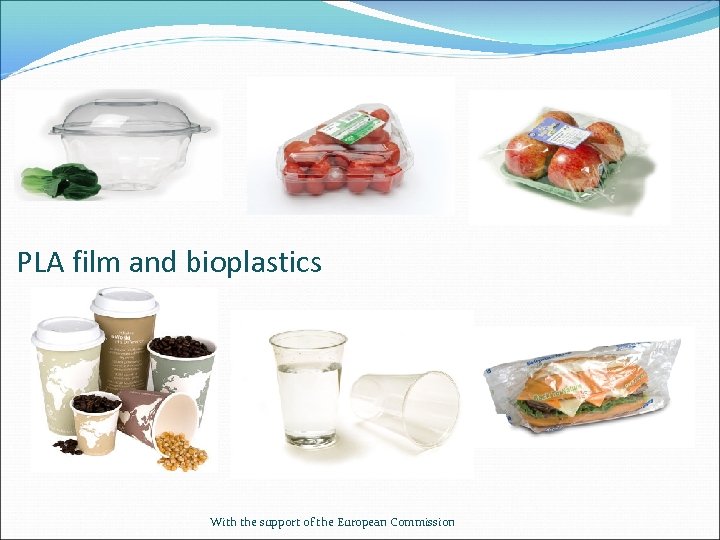 PLA film and bioplastics With the support of the European Commission
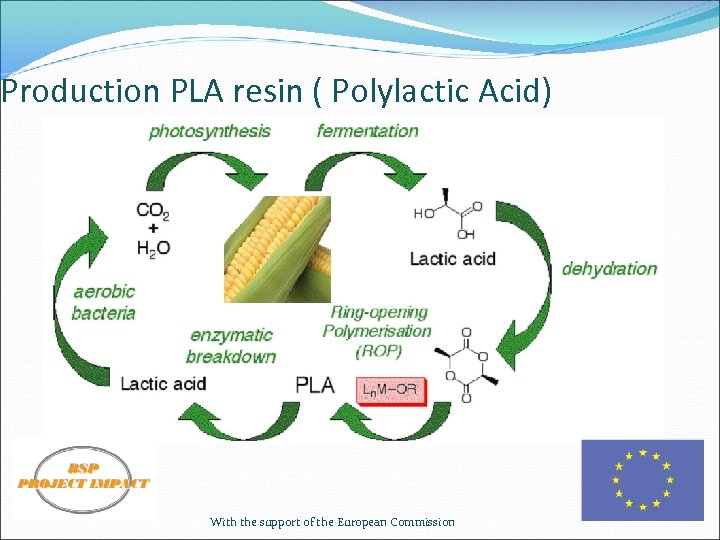 Production PLA resin ( Polylactic Acid) With the support of the European Commission
 Application - PLA (Poly Lactic Acid) (sheet)extrusion: Film extrusion -> flow pack Thermoforming -> Food containers Blow moulding -> bottles Fibres -> clothing With the support of the European Commission
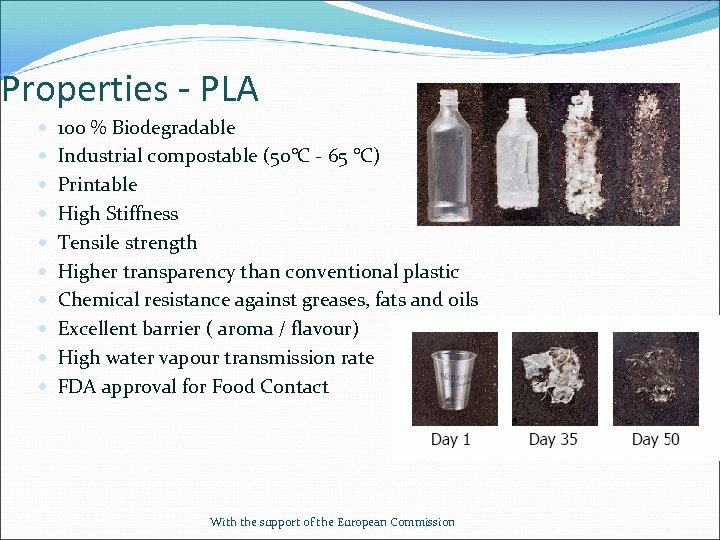 Properties - PLA 100 % Biodegradable Industrial compostable (50°C - 65 °C) Printable High Stiffness Tensile strength Higher transparency than conventional plastic Chemical resistance against greases, fats and oils Excellent barrier ( aroma / flavour) High water vapour transmission rate FDA approval for Food Contact With the support of the European Commission
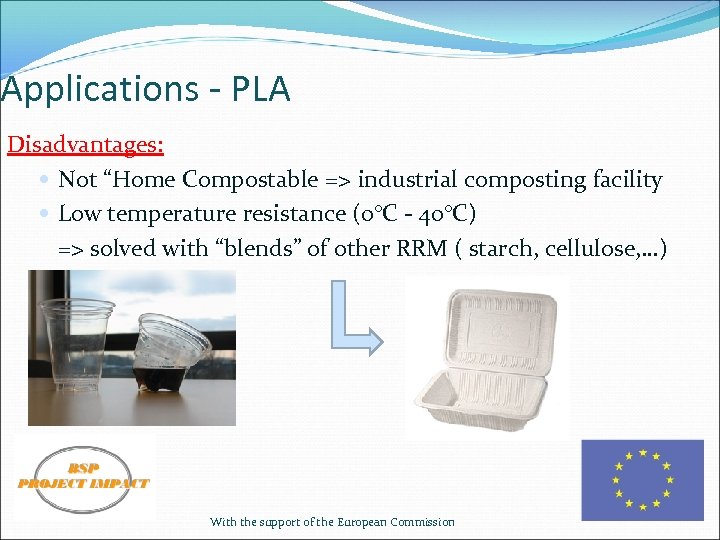 Applications - PLA Disadvantages: Not “Home Compostable => industrial composting facility Low temperature resistance (0°C - 40°C) => solved with “blends” of other RRM ( starch, cellulose, …) With the support of the European Commission
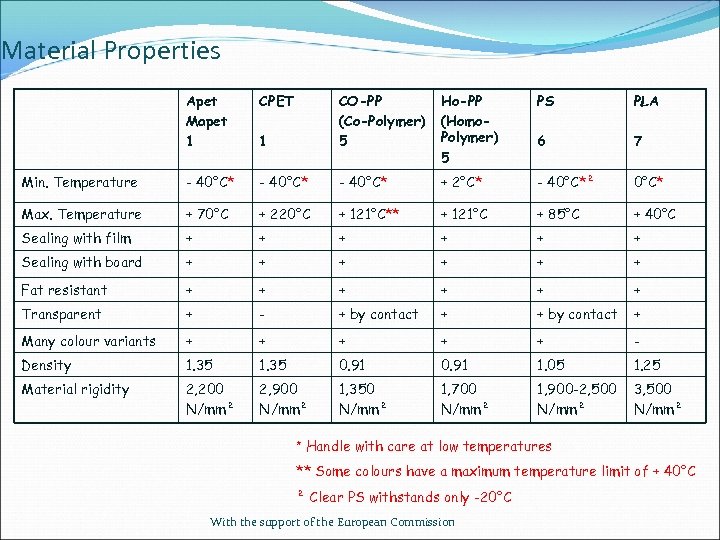 Material Properties Apet Mapet 1 CPET Ho-PP (Homo. Polymer) 5 PS PLA 1 CO-PP (Co-Polymer) 5 6 7 Min. Temperature - 40°C* + 2°C* - 40°C*² 0°C* Max. Temperature + 70°C + 220°C + 121°C** + 121°C + 85°C + 40°C Sealing with film + + + Sealing with board + + + Fat resistant + + + Transparent + - + by contact + Many colour variants + + + - Density 1. 35 0. 91 1. 05 1. 25 Material rigidity 2, 200 N/mm² 2, 900 N/mm² 1, 350 N/mm² 1, 700 N/mm² 1, 900 -2, 500 N/mm² 3, 500 N/mm² * Handle with care at low temperatures ** Some colours have a maximum temperature limit of + 40°C ² Clear PS withstands only -20°C With the support of the European Commission
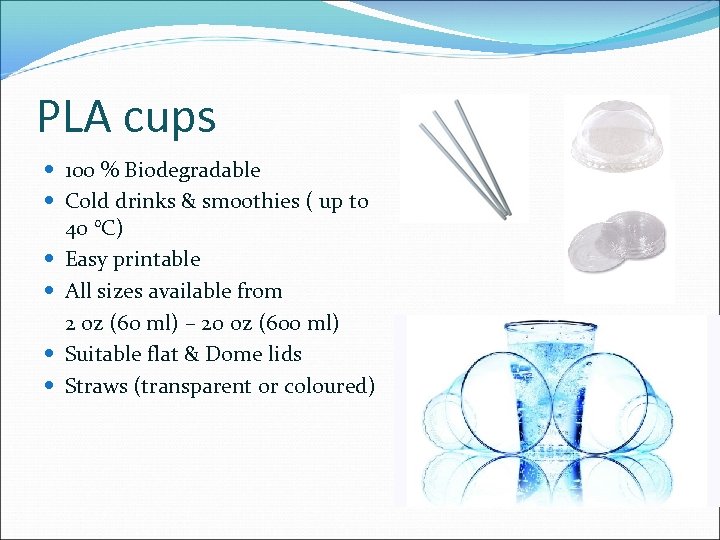 PLA cups 100 % Biodegradable Cold drinks & smoothies ( up to 40 °C) Easy printable All sizes available from 2 oz (60 ml) – 20 oz (600 ml) Suitable flat & Dome lids Straws (transparent or coloured)
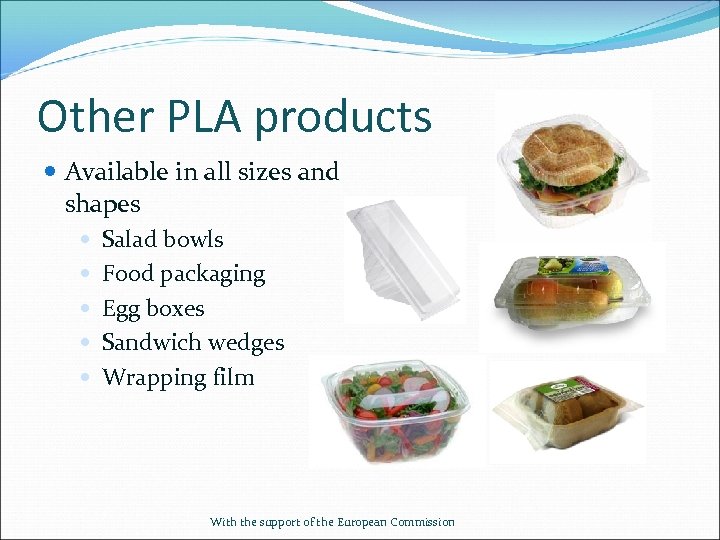 Other PLA products Available in all sizes and shapes Salad bowls Food packaging Egg boxes Sandwich wedges Wrapping film With the support of the European Commission
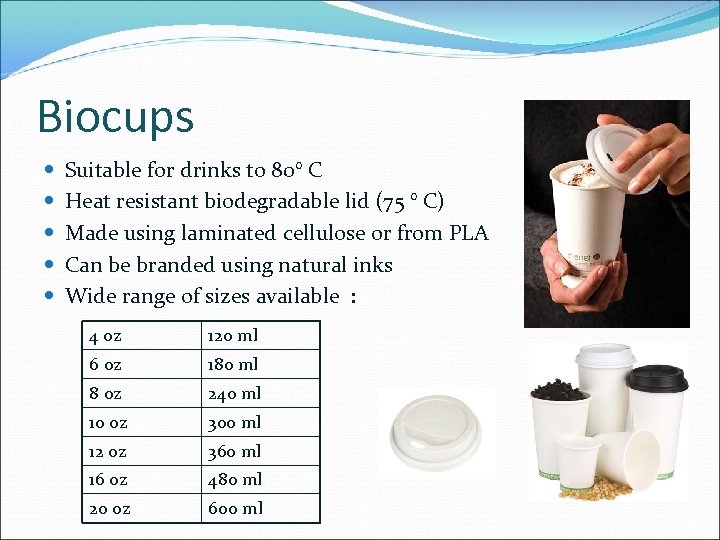 Biocups Suitable for drinks to 80° C Heat resistant biodegradable lid (75 ° C) Made using laminated cellulose or from PLA Can be branded using natural inks Wide range of sizes available : 4 oz 120 ml 6 oz 180 ml 8 oz 240 ml 10 oz 300 ml 12 oz 360 ml 16 oz 480 ml 20 oz 600 ml
 6. Conclusion ØGrowing potential for Biodegradable products Ø Current production : 150 000 tonnes /year ØCommunication + logo + legal frame ØImplementation sorting systems for BCP’s With the support of the European Commission
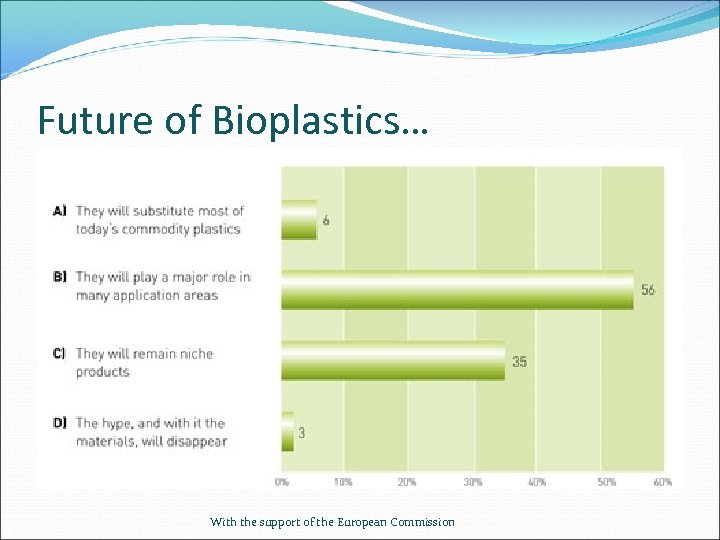 Future of Bioplastics… With the support of the European Commission
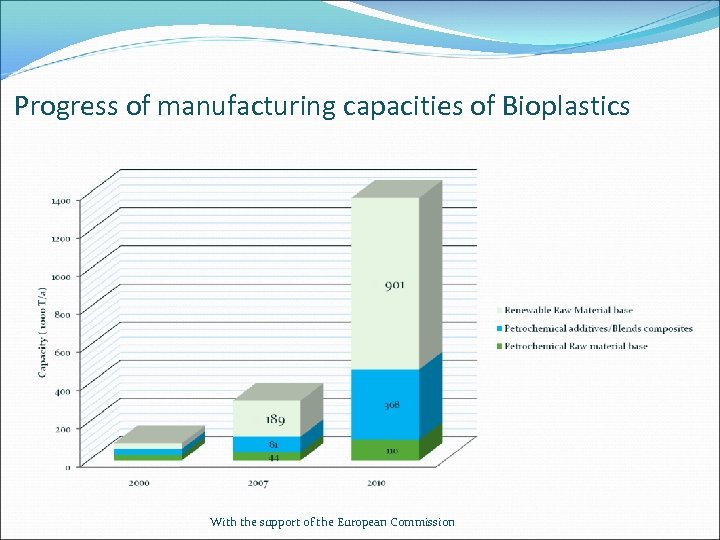 Progress of manufacturing capacities of Bioplastics With the support of the European Commission
 6. Conclusion ØGrowing potential for Biodegradable products Ø Current production : > 150 000 tonnes /year ØCommunication + logo + legal frame ØImplementation sorting systems for BCP’s With the support of the European Commission
 6. Conclusion ØGrowing potential for Biodegradable products Ø Current production : 150 000 tonnes /year ØCommunication + logo + legal frame ØImplementation sorting systems for BCP’s With the support of the European Commission
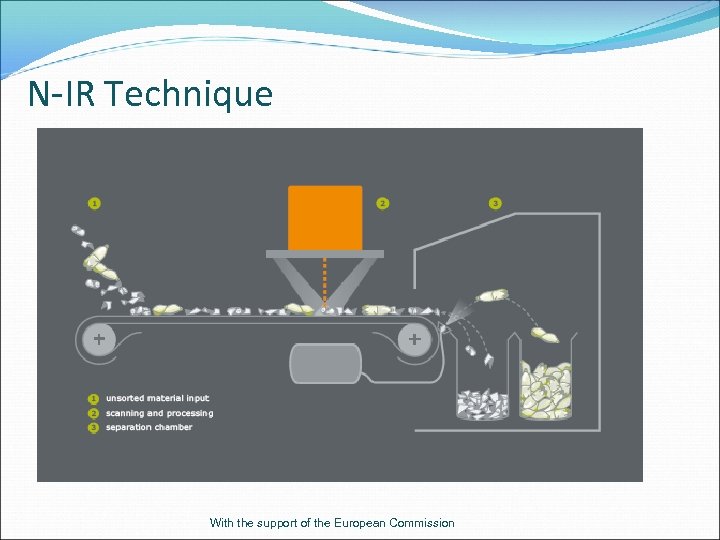 N-IR Technique With the support of the European Commission
 Info Denico Green Products Environment is our engagement Blancefloerlaan 179 E 2050 Antwerpen Belgium tel. : +32. (0)3. 540. 09. 10 fax: +32. (0)3. 540. 09. 19 contact@denico. eu www. denico. eu With the support of the European Commission