


 Скачать презентацию Worklessness and Deprived Communities an academic response Ian
f4c1a6deb570dd943d06aa4b0f2d0c5f.ppt
- Количество слайдов: 9
 Worklessness and Deprived Communities: an academic response Ian Gordon Geography Department, London School of Economics IPPR North seminar, Middlesbrough, February 2005
 Aims – try to talk about • Processes (re)producing concentrated unemployment • What we do(n’t) know about neighbourhood effects • Generally worthwhile policies for all areas (and generally bad bets) • Need for caution in analysis of local data / effects
 Structure • • • How (local) labour markets function Area Effects ? Targeting (pros and cons) Reproducing Concentrations of U/E Generally Worthwhile Elements of Policy
 A Starting Point: perspectives on LLMs • Spatial Labour Markets = real (sets of sub-) markets • tho’ more ‘open’ to supply adjustments than expected, because of vacancy chains – oddness of labour as commodity means: →selection & control problems → more job than price competition (Thurow) → prejudice and ‘bumping down’ → conversion of demand-deficient into structural U/E
 The Neighbourhood Effects Issue • Two kinds of area (as distinct from person/family) effect: – Pressure of demand for labour • operating at levels broader than TTWAs – e. g. extended London region – Social mix • Via peer/role model, information, stigmatisation, infrastructure/services • Operating at relatively local level (streets/quarters) • Real problems in identification – Bias toward over-estimation, even if we try to be careful
 What do(n’t) We Know • Pretty good evidence of significant area/school effects on children – Still weak relative to individual/family effects, – not nec. strongest at bottom end or related to general deprivation (e. g. lone parents) • Very plausible evidence about information network effects – Worse access to informal inf. About (stable) jobs if living in ‘streets’ with high U/E • And reasonable evidence that exit rates from poverty are significantly lower in areas with highest U/E (worst 5%) – But controlling adequately for (strong) residential sorting is still a real problem & likely to bias conclusions – And indiv/h’hld chars still much more significant • Some good new negative findings from Simon Burgess et al (Bristol) – No (negative) effects of area status on personal income changes over 5 or 10 years
 TARGETING – Pros and Cons • Case for spatial / social targeting (of job creation or training) – Imperfect connection of sub-labour markets + exclusionary processes → Bigger bang for (targeted) buck – less deadwood / inflation • BUT – Cause of problems generally in functioning of the core of the LM • (e. g. regional Po. D and bumping down) – Cannot isolate the margins: ‘targeting a leaky bucket’ • always collateral damage – on similarly deserving groups • via displacement of jobs or others in congested entry areas (‘move on up the car’) – Encourages under-estimate of required effort / resources – Diminishing returns to concentrated action (on serious scale) + targeted margins may be inefficient / unnecessarily costly sites for action
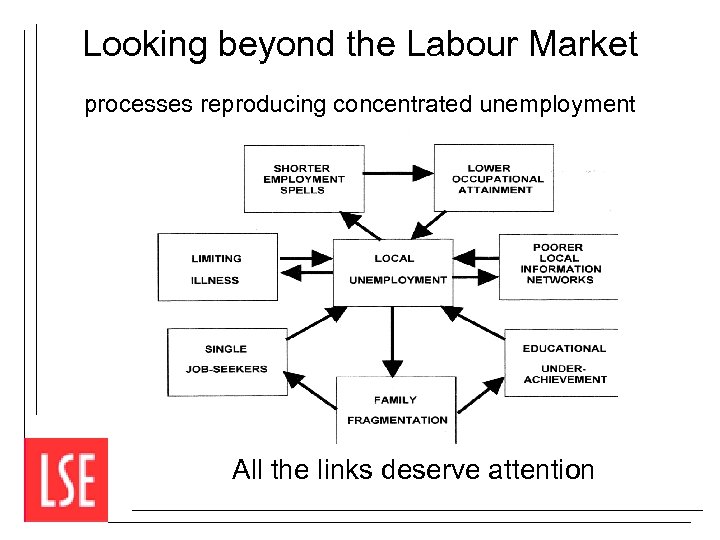 Looking beyond the Labour Market processes reproducing concentrated unemployment All the links deserve attention
 Some Generally Worthwhile Policies • • Promote ‘movement up the car’ – upward mobility for all – for productivity and employability Work harder at equal opportunities – in rel to class/age as well as race/gender (again for both goals) Collaborate with neighbours to secure full employment Po. D across regional labour market (as key to efficient LM) Enhance educational performance at the levels required for access to (locally recruited) middle range jobs – and stable opportunities more generally • Promote collaboration and quality raising initiatives among employers in high turnover activities (e. g. hotels) • Be more willing to protect local jobs (in bad times) than to chase new ones