 Скачать презентацию Working with Older Adults with Substance Use Problems
d8cfc4791b2db91f45e393ecea92668f.ppt
- Количество слайдов: 54



Working with Older Adults with Substance Use Problems Course: Substance Abuse Adelphi University School of Social Work

Acknowledgements The development of this gerontology teaching module was made possible through a Gero Innovations Grant from the CSWE Gero-Ed Center's Master's Advanced Curriculum (MAC) Project and the John A. Hartford Foundation. Adelphi University Project Team: Judy Fenster (Principal Investigator), Philip Rozario, Patricia Joyce, and Bradley Zodikoff.
A Visit with Mrs. Smith is a 78 -year-old woman you have known for 4 years. You’ve always looked forward to your visits with this kind, humorous woman. Over the past year, however, you’ve smelled alcohol on her breath, there’s been a decline in her appearance and hygiene, and she’s been treated for falls she has difficulty explaining. The housekeeper says that several deliveries are made to the house every week, after which she often finds empty wine bottles, although Mrs. Smith never appears to be intoxicated. (Source: CSWE, 1997)
Why Focus on Working with Older Adults with SUDs? § Growth in Elderly Population 1900 – 4% of U. S. population was age 65+ 2006 – 13% of U. S. population was age 65+ 2030 - 20% predicted ALSO: Number of people aged 85> will DOUBLE by 2030 § Baby Boomers use more AODs than their parents – will this trend continue with age? § Co-morbid Medical & Psychiatric Conditions ↑ Use of Prescription Drugs among elderly (+ Alc) ↑ Dementia and other Cognitive Deficits (+ Drugs) ↑ Risk of Depression/Suicide in older subs. users*
Prevalence… §Alcohol and illicit drug use ↓ with age; Prescription drug use ↑ with age. §Most common substance issue for older adults = Alcohol Use. §Prevalence depends on definition of problem: § 3 -15% of older adults are at-risk or problem drinkers. § 3 -8% misuse or abuse prescription, overthe-counter, or illicit drugs.
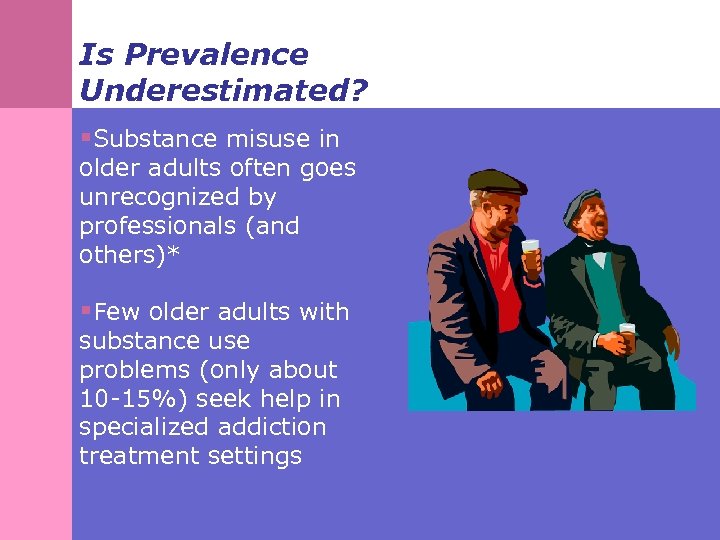
Is Prevalence Underestimated? §Substance misuse in older adults often goes unrecognized by professionals (and others)* §Few older adults with substance use problems (only about 10 -15%) seek help in specialized addiction treatment settings
Drinking Guidelines 1 (or fewer) standard drinks per day < 7 drinks per week* < 3 drinks on any single occasion § Limits for older women should be somewhat § less than for older men. Drinking and using drugs that interact with alcohol is not advised. (Source: NIAAA, 1995; Dufour & Fuller, 1995)
Drinking Guidelines (cont’d) Lower limits for older adults, because with age comes: §Greater use of medications → higher potential for bad reactions (anti-arthritics, anticoagulants, diuretics) §Less efficient liver metabolism → poorer alcohol elimination §Less body mass/fat → higher BAC §Stronger effects at the same BAC (↓ coordination, ↑ alcohol sensitivity, ↓ tolerance)
Defining Substance Use Patterns Among the Elderly § DSM Criteria for Substance Abuse: § Recurrent use resulting in failure to fulfill role obligations § Recurrent use in hazardous situations (e. g. , DWI, operating machinery) § Recurrent use-related legal problems § Continued use despite negative social consequences
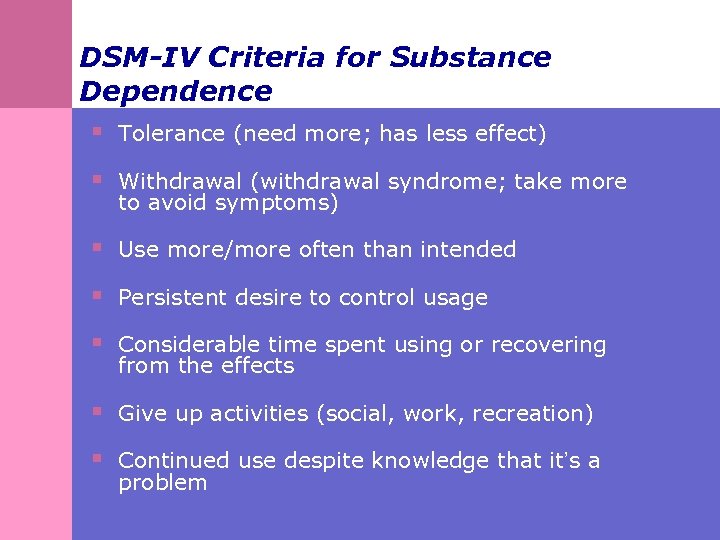
DSM-IV Criteria for Substance Dependence § Tolerance (need more; has less effect) § Withdrawal (withdrawal syndrome; take more to avoid symptoms) § Use more/more often than intended § Persistent desire to control usage § Considerable time spent using or recovering from the effects § Give up activities (social, work, recreation) § Continued use despite knowledge that it’s a problem
Caveats when Using DSM Criteria to Diagnose SUDs in Older Adults § DSM criteria might not fit* § Tolerance and withdrawal may look different in older adults** § Cognitive deficits and prescription drug interactions can make it harder to recognize the substance use as the problem
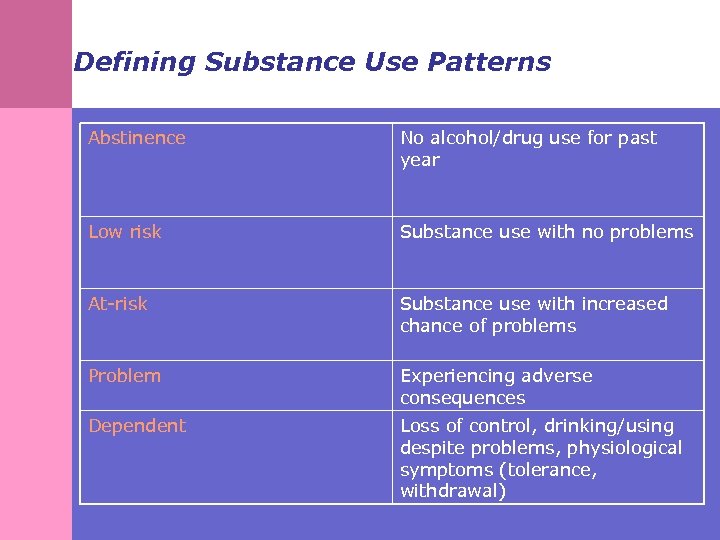
Defining Substance Use Patterns Abstinence No alcohol/drug use for past year Low risk Substance use with no problems At-risk Substance use with increased chance of problems Problem Experiencing adverse consequences Dependent Loss of control, drinking/using despite problems, physiological symptoms (tolerance, withdrawal)
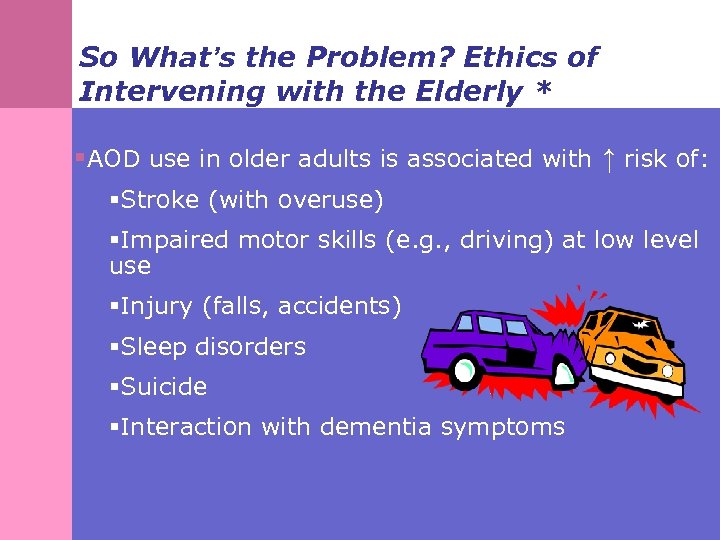
So What’s the Problem? Ethics of Intervening with the Elderly * §AOD use in older adults is associated with ↑ risk of: §Stroke (with overuse) §Impaired motor skills (e. g. , driving) at low level use §Injury (falls, accidents) §Sleep disorders §Suicide §Interaction with dementia symptoms
AOD Use - Effects (cont’d) § Higher blood alcohol concentrations (BAC) & more impairment from dose § Medication effects: § Potential interactions § Increased side effects § Compromised metabolizing* (especially psychoactive medications, benzodiazepines, barbiturates, antidepressants, digoxin, warfarin)
Comparing Older and Younger Adults with SUDs Older adults with substance use disorders: § Tend to be less severely addicted, and suffer fewer family/social consequences of their substance abuse* § Are less likely to seek treatment, but § Are more likely to complete treatment once in it
Treatment Need SAMHSA: By 2020 the number of older people who need substance abuse treatment will increase from 1. 7 million to 4. 4 million. This represents a 70% increase in the rate of treatment need. (Source: Gfoerer, Penne, Pemberton & Folsom, 2003)
General Issues for Older Adults* §Loss (status, people, §Complex medical §Role changes §Multiple meds vocation, routine, health) §Social isolation §Loneliness issues §Sensory deficits §Reduced mobility §Cognitive changes §Financial problems §Impaired self-care §Housing changes § Loss of independence §New care-giving role §Unstructured time
Signs of Potential Substance Use Problems §Anxiety, depression, excessive Decision-making difficulties § mood swings §Blackouts, dizziness §Disorientation §Falls, bruises, burns §Headaches §Incontinence §Memory loss §Unusual response to medications §Poor self-care §Poor nutrition §Sleep problems §Family problems §Financial problems §Social isolation §Increased alcohol tolerance
Co-morbid Conditions Co-morbidity is a serious, common concern among older adults using alcohol*: §Impaired Activities of Daily Living (ADLs) §Psychiatric symptoms, mental disorders §Alzheimer’s disease §Sleep disorders
Screening for Alcohol Use Problems in Older Adults Goals: §Identify at-risk, problem and dependent drinkers §Determine the need for further diagnostic assessment & treatment
Screening for Alcohol Problems 1. Ask: “How often do you have a drink containing alcohol? ” 2. If any usage, follow up with: § “How many days per week do you drink? ” § “How many drinks per day? ” § “How often do you have 3> drinks on one occasion? ”. Then:
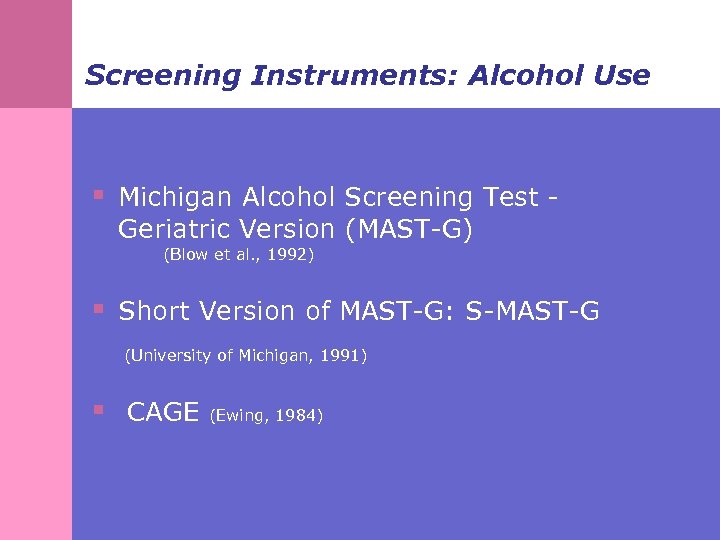
Screening Instruments: Alcohol Use § Michigan Alcohol Screening Test Geriatric Version (MAST-G) (Blow et al. , 1992) § Short Version of MAST-G: S-MAST-G (University of Michigan, 1991) § CAGE (Ewing, 1984)
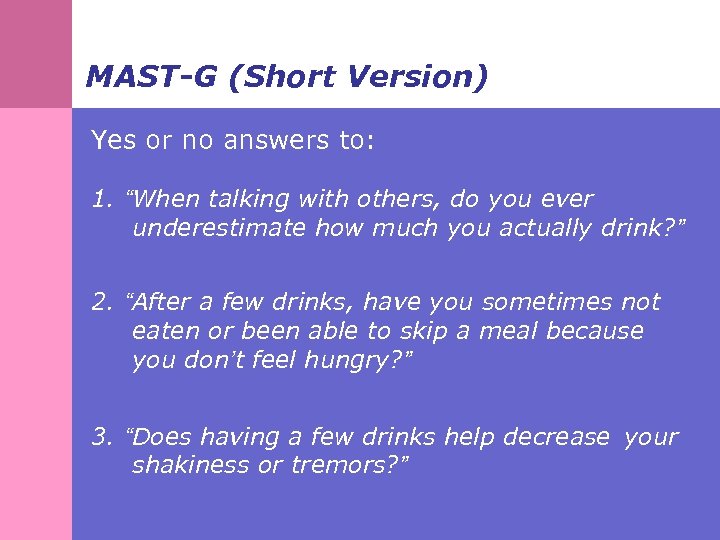
MAST-G (Short Version) Yes or no answers to: 1. “When talking with others, do you ever underestimate how much you actually drink? ” 2. “After a few drinks, have you sometimes not eaten or been able to skip a meal because you don’t feel hungry? ” 3. “Does having a few drinks help decrease your shakiness or tremors? ”
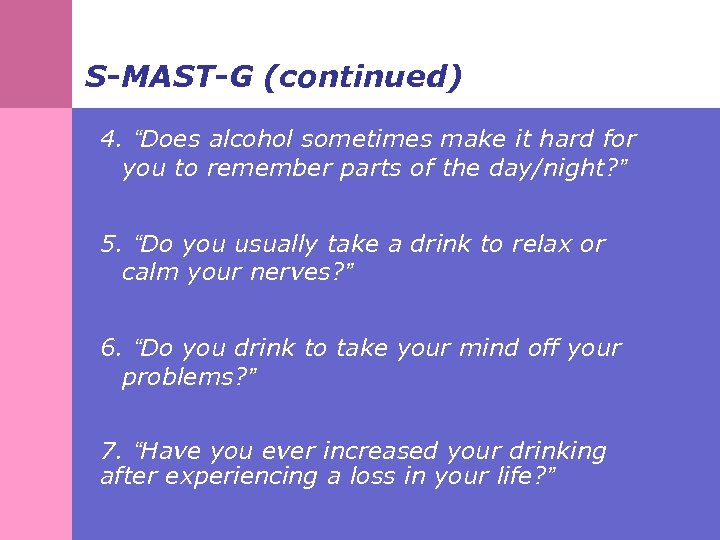
S-MAST-G (continued) 4. “Does alcohol sometimes make it hard for you to remember parts of the day/night? ” 5. “Do you usually take a drink to relax or calm your nerves? ” 6. “Do you drink to take your mind off your problems? ” 7. “Have you ever increased your drinking after experiencing a loss in your life? ”
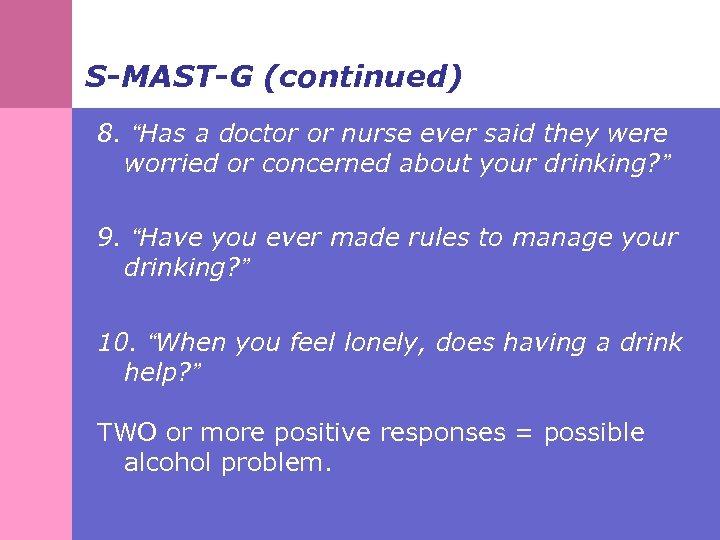
S-MAST-G (continued) 8. “Has a doctor or nurse ever said they were worried or concerned about your drinking? ” 9. “Have you ever made rules to manage your drinking? ” 10. “When you feel lonely, does having a drink help? ” TWO or more positive responses = possible alcohol problem.
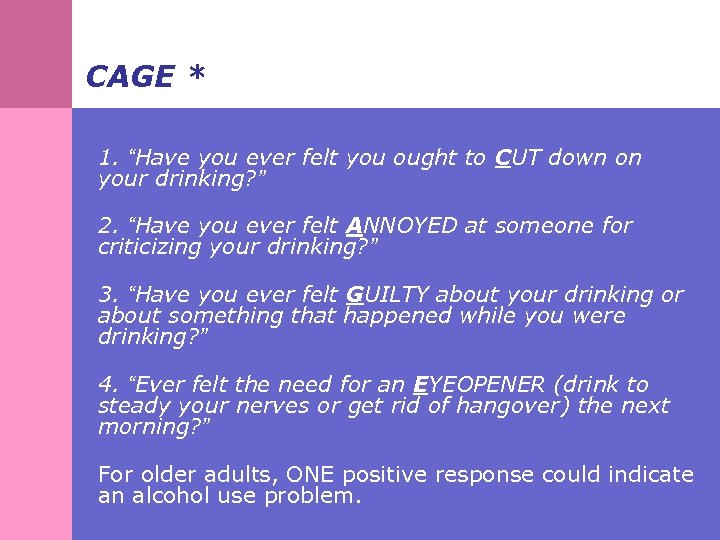
CAGE * 1. “Have you ever felt you ought to CUT down on your drinking? ” 2. “Have you ever felt ANNOYED at someone for criticizing your drinking? ” 3. “Have you ever felt GUILTY about your drinking or about something that happened while you were drinking? ” 4. “Ever felt the need for an EYEOPENER (drink to steady your nerves or get rid of hangover) the next morning? ” For older adults, ONE positive response could indicate an alcohol use problem.
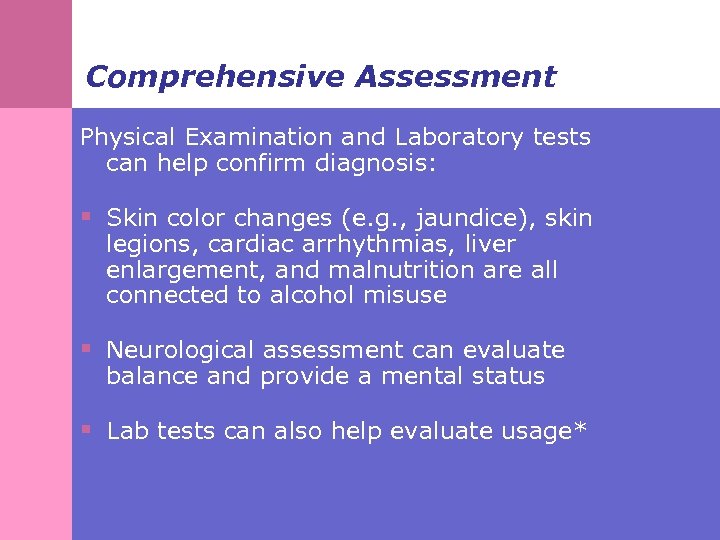
Comprehensive Assessment Physical Examination and Laboratory tests can help confirm diagnosis: § Skin color changes (e. g. , jaundice), skin legions, cardiac arrhythmias, liver enlargement, and malnutrition are all connected to alcohol misuse § Neurological assessment can evaluate balance and provide a mental status § Lab tests can also help evaluate usage*
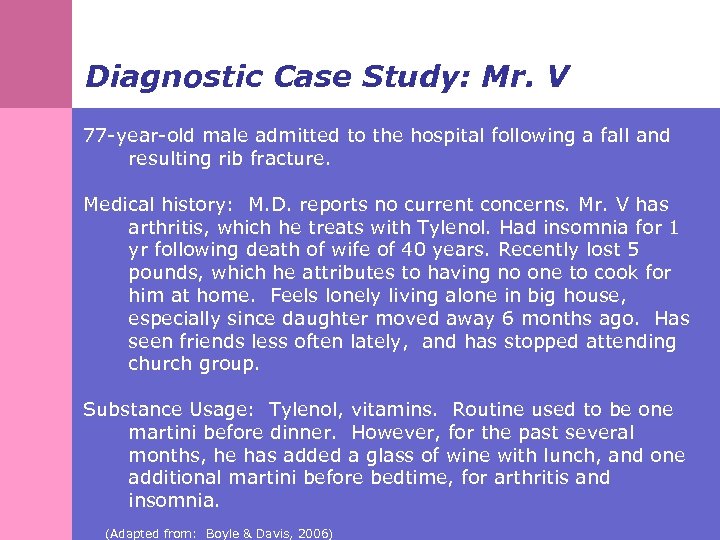
Diagnostic Case Study: Mr. V 77 -year-old male admitted to the hospital following a fall and resulting rib fracture. Medical history: M. D. reports no current concerns. Mr. V has arthritis, which he treats with Tylenol. Had insomnia for 1 yr following death of wife of 40 years. Recently lost 5 pounds, which he attributes to having no one to cook for him at home. Feels lonely living alone in big house, especially since daughter moved away 6 months ago. Has seen friends less often lately, and has stopped attending church group. Substance Usage: Tylenol, vitamins. Routine used to be one martini before dinner. However, for the past several months, he has added a glass of wine with lunch, and one additional martini before bedtime, for arthritis and insomnia. (Adapted from: Boyle & Davis, 2006)
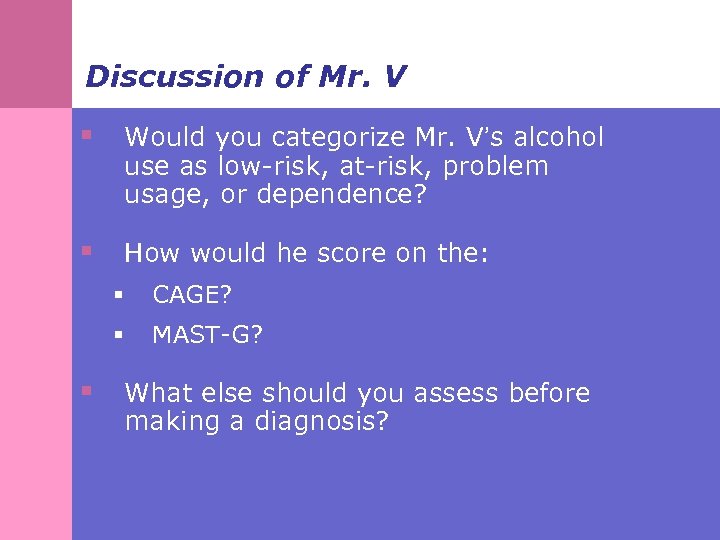
Discussion of Mr. V § Would you categorize Mr. V’s alcohol use as low-risk, at-risk, problem usage, or dependence? § How would he score on the: § CAGE? § MAST-G? § What else should you assess before making a diagnosis?
Screening for Other Drug Use Drug Abuse Screening Test (DAST-10) (Skinner, 1982) “Have you used drugs other than those required for medical reasons? ” “Do you ever feel bad or guilty about your drug use? ” * Ask about dosages of prescription, over-thecounter, and herbal drugs, and about dosing practices. Ask about drug-on-drug and drug/alcohol interaction effects.
Prescription and OTC Drug Use, Misuse and Abuse § Difference between Misuse and Abuse* § Most abused drug among elderly = Benzodiazepines (used for anxiety, insomnia & pain). 17 -23% of drugs prescribed to older adults are Benzos. § Women more likely than men to misuse or abuse psychoactive drugs, and also more likely to mix alcohol with prescription psychoactive drugs.
Screening for Prescription Drug Abuse Signs: § Loss of motivation § Memory loss § Family discord § Trouble sleeping § “Doctor shopping” § Drug-seeking behavior
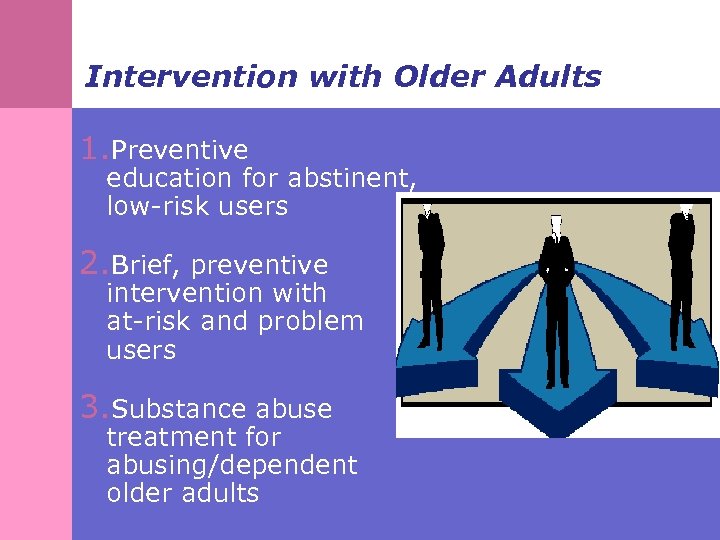
Intervention with Older Adults 1. Preventive education for abstinent, low-risk users 2. Brief, preventive intervention with at-risk and problem users 3. Substance abuse treatment for abusing/dependent older adults
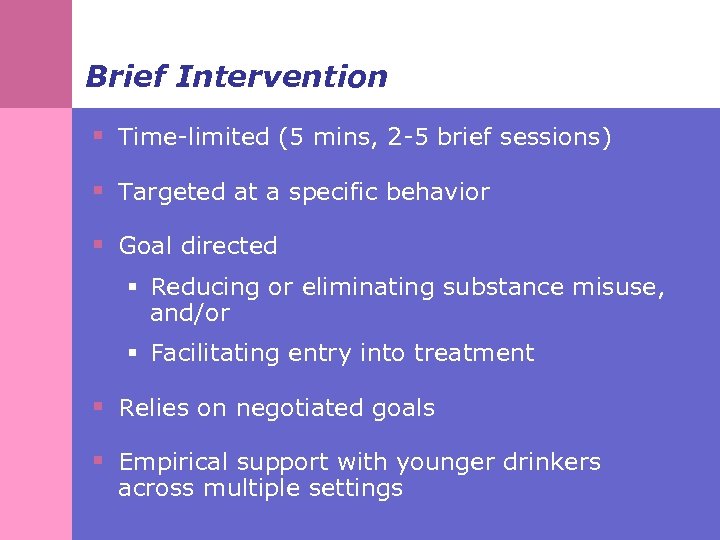
Brief Intervention § Time-limited (5 mins, 2 -5 brief sessions) § Targeted at a specific behavior § Goal directed § Reducing or eliminating substance misuse, and/or § Facilitating entry into treatment § Relies on negotiated goals § Empirical support with younger drinkers across multiple settings
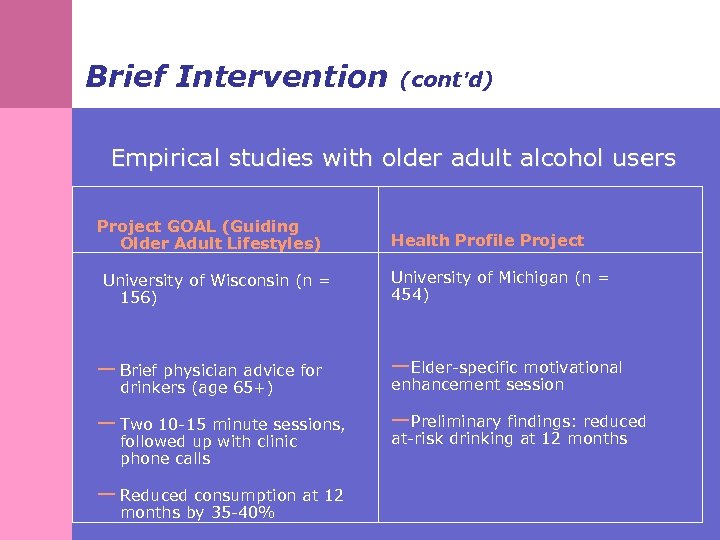
Brief Intervention (cont’d) Empirical studies with older adult alcohol users Project GOAL (Guiding Older Adult Lifestyles) University of Wisconsin (n = 156) Health Profile Project University of Michigan (n = 454) — Brief physician advice for —Elder-specific motivational — Two 10 -15 minute sessions, —Preliminary findings: reduced drinkers (age 65+) followed up with clinic phone calls — Reduced consumption at 12 months by 35 -40% enhancement session at-risk drinking at 12 months
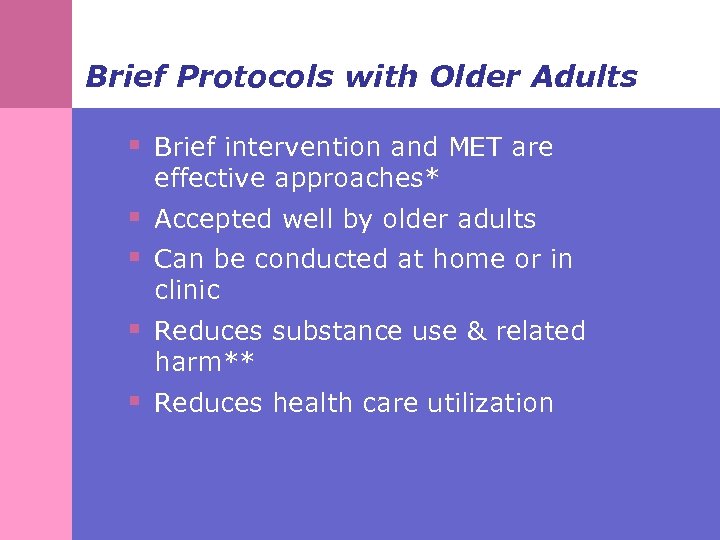
Brief Protocols with Older Adults § Brief intervention and MET are effective approaches* § Accepted well by older adults § Can be conducted at home or in clinic § Reduces substance use & related harm** § Reduces health care utilization
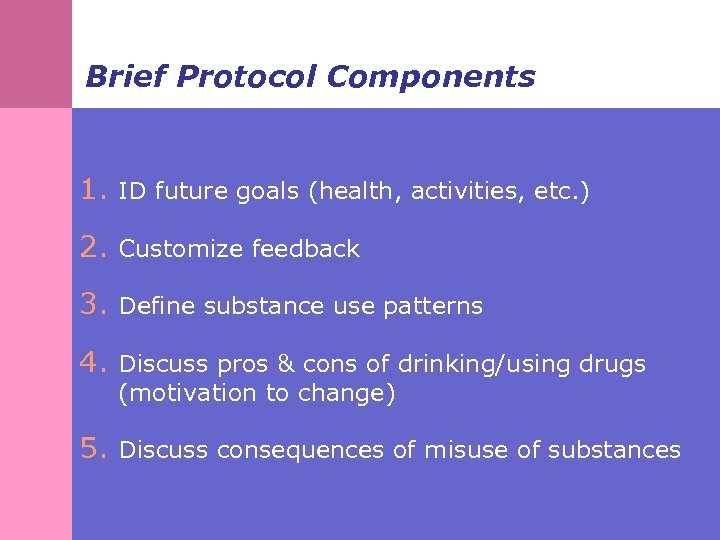
Brief Protocol Components 1. ID future goals (health, activities, etc. ) 2. Customize feedback 3. Define substance use patterns 4. Discuss pros & cons of drinking/using drugs (motivation to change) 5. Discuss consequences of misuse of substances
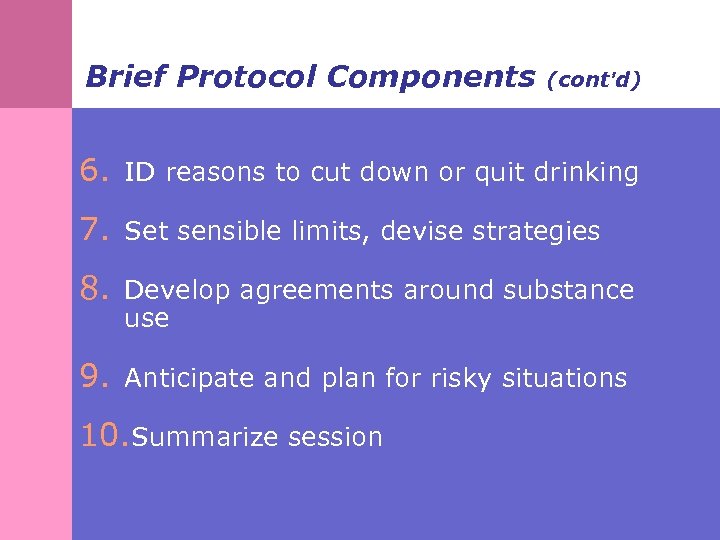
Brief Protocol Components (cont’d) 6. ID reasons to cut down or quit drinking 7. Set sensible limits, devise strategies 8. Develop agreements around substance use 9. Anticipate and plan for risky situations 10. Summarize session
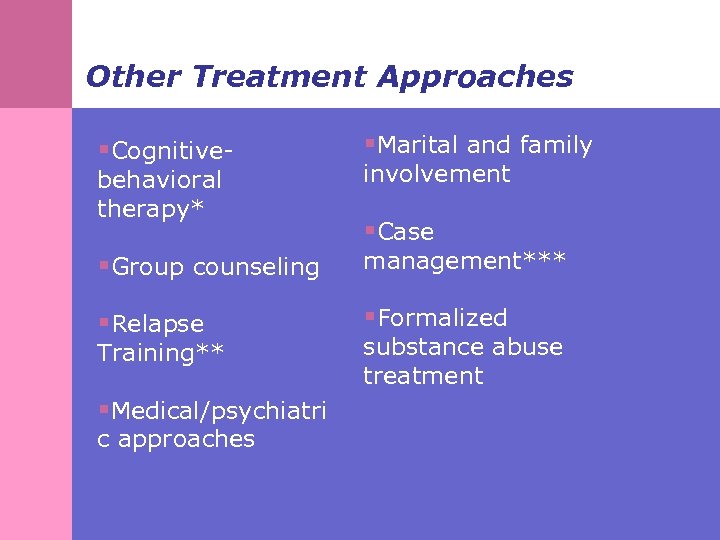
Other Treatment Approaches §Cognitive- §Marital and family behavioral therapy* involvement §Group counseling management*** §Relapse §Formalized Training** §Medical/psychiatri c approaches §Case substance abuse treatment
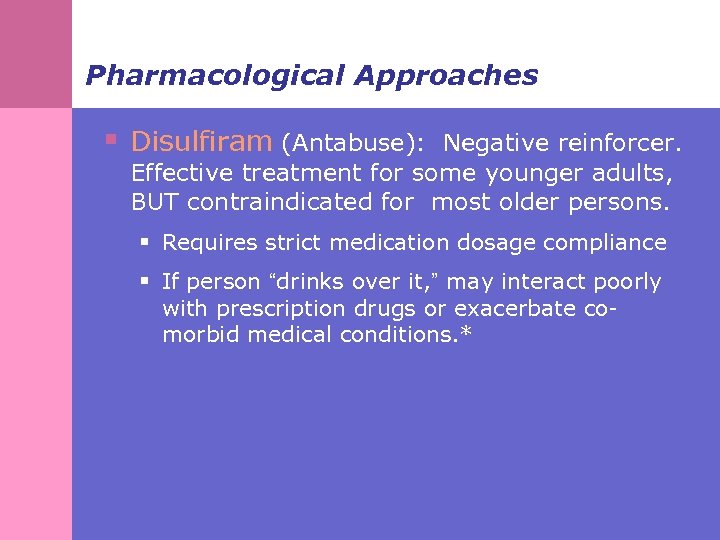
Pharmacological Approaches § Disulfiram (Antabuse): Negative reinforcer. Effective treatment for some younger adults, BUT contraindicated for most older persons. § Requires strict medication dosage compliance § If person “drinks over it, ” may interact poorly with prescription drugs or exacerbate comorbid medical conditions. *
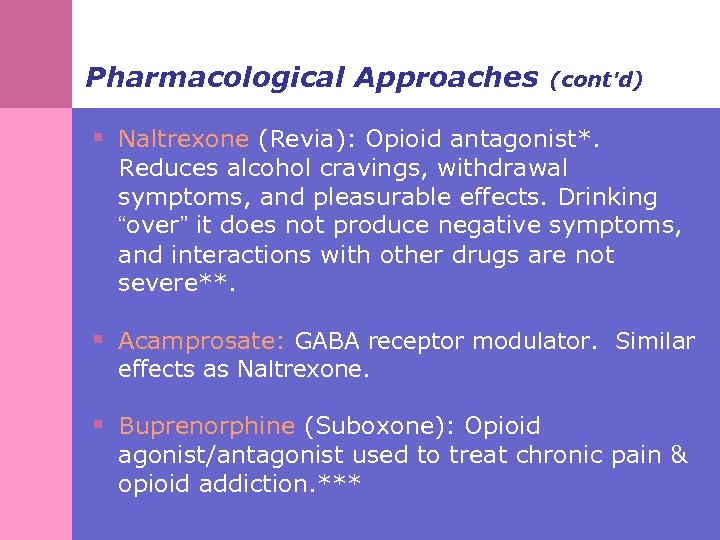
Pharmacological Approaches (cont’d) § Naltrexone (Revia): Opioid antagonist*. Reduces alcohol cravings, withdrawal symptoms, and pleasurable effects. Drinking “over” it does not produce negative symptoms, and interactions with other drugs are not severe**. § Acamprosate: GABA receptor modulator. effects as Naltrexone. § Buprenorphine (Suboxone): Opioid Similar agonist/antagonist used to treat chronic pain & opioid addiction. ***
Elder-Specific Intervention Differs from mixed-age treatment in that it: § Also deals with issues of relevance to older adults -- loss, isolation, prescription drug use, interaction effects, health problems § Utilizes a less confrontational, less hierarchical, and more supportive approach § Relies heavily on motivational interviewing and CBT approaches*
Studies of Elder-Specific Models § Both mixed-age and age-specific treatments have been found effective. § There’s some evidence that elder- specific treatment is even more effective, in terms of treatment initiation, length of stay, treatment completion, and long-term outcome. (Kashner et al. , 1992)
Conclusions § Screening for substance use problems among older adults is effective § Brief interventions are effective § Additional interventions complete a spectrum of effective approaches § Treatment approach depends on client background; assessment of needs, goals, resources; and preferences
Conclusions (cont’d) § Older adults benefit from screening, assessment, referral, prevention, and intervention delivered by social workers who are sensitive to elder issues: § Non-judgmental approach § Motivational § Supportive approach § Age-appropriate goals: Improve health status, rebuild social supports, improve enjoyment of life
Case of Mrs. Smith, revisited… Mrs. Smith is a 78 -year-old woman you have know for 4 years. You’ve always looked forward to your visits with this kind, humorous woman. Over the past year, however, you’ve smelled alcohol on her breath, there’s been a decline in her appearance/hygiene, and she’s been treated for falls she has difficulty explaining. The housekeeper says that several deliveries are made to the house every week, after which she often finds empty wine bottles, although Mrs. Smith never appears to be intoxicated. (Source: CSWE, 1997)
Mrs. Smith – Discussion Questions 1. Are there signs that Mrs. Smith has a drinking problem? 2. What are the pros and cons of discussing this with her? 3. How would you bring it up with her? 4. What response(s) might you expect? 5. If she denies a problem, what would you do? 6. Treatment Plan? (see Brief Protocol slides # 36 & 37) Adapted from: CSWE, 1997
Model Program: Older Adults Technology Services (OATS) Nonprofit org - Engages, trains and supports older adults in using technology to improve their quality of life. Offered at 26 senior centers in NYC. § Engages older adults in learning about digital devices and how they can improve their lives. § Trains them to use computers and other technology tools in a relaxed, senior-friendly environment. § Supports seniors in using technology to connect to family and friends, improve health care, get needed services, earn and manage money, and enjoy a higher standard of living.
OATS (cont’d) § Intergenerational training program: trains high school students to teach computers to older adults. § “Senior Planet” website: digital community that connects older adults to resources, events, commentary - and to each other - through a website and education training program.
Innovations Computer-assisted AOD Screening: Accuracy equal to in-person and paper-and-pen versions. ► Advantages: Privacy, Literacy, Immediacy ► Disadvantages? (Sources: Chan-Pensley, 1999; Lessler et al. , 2000) Telephone Counseling: Can increase access to treatment for seniors with mobility or health problems.
Resources § AARP www. aarp. org § National Center on Addiction and Substance Abuse www. casacolumbia. org § Join Together www. jointogether. org § National Aging Information Center/U. S. Admin. on Aging www. aoa. gov/naic
Resources (cont’d) § SAMHSA’s National Clearinghouse for Alcohol and Drug Information (NCADI) www. samhsa. gov § National Council on the Aging www. ncoa. org § National Institute on Aging, Public Information Office www. nih. gov/nia
Acknowledgements & References § Illustrations: Microsoft Corporation, 2002 § Selected slides: NIAAA Social Work Curriculum on Alcohol Use Disorders (Audrey Begun, Editor), Module 10 C REFERENCES: Blow, F. C. , Brower, K. J. , Schulenberg, J. E. , Demo-Dananberg, L. M. , Young, J. P. & Beresford, T. P. (1992). The Michigan Alcohol Screening Test-Geriatric Version (MAST-G): A new elderly-specific screening instrument. Alcoholism: Clinical and Experimental Research, 16, 372. Boyle, A. R. , & Davis, H. (2006). Early screening and assessment of alcohol and substance abuse in the elderly: Clinical implications. Journal of Addiction Nursing, 17, 95 -103. Chan-Pensley, E. (1999) Alcohol-Use Disorders Identification Test: A comparison between paper and pencil and computerized versions. Alcohol and Alcoholism 34(6), 882– 885. Amodeo, M. , & R. Schofield (Eds). (1997). Social Work Approaches to Alcohol and Other Drug Problems: Case Studies and Teaching Tools ( M. Amodeo, Sr. Ed). Washington, D. C. : Council on Social Work Education. Dufour, M. & Fuller, R. K. (1995). Alcohol in the elderly. Annual Review of Medicine, 46, 123 -32.
References (cont’d) Ewing, J. A. (1984). Detecting alcoholism: The CAGE questionnaire. Journal of the American Medical Association, 252, 1905 -1907. Gfoerer J. , Penne, M. , Pemberton, M. , & Folsom, R. (2003). Substance abuse treatment need among older adults in 2020: the impact of the baby-boom cohort. Drug and Alcohol Dependence, 69, 127 -135. Kashner, T. M. , Rodell, D. I. , Ogden, S. R. , Guggenheim, F. G. , & Karson, C. N. (1992). Outcome and costs of two VA inpatient treatment programs for older alcoholic patients. Hospital Community Psychiatry, 43, 985 -989. Lessler, J. T. , Caspar, R. A. , Penne, A. , & Barker, P. R. (2000). Developing Computer Assisted Interviewing (CAI) for the National Household Survey on Drug Abuse. Journal of Drug Issues 30(1), 9– 34. National Institute on Alcohol Abuse and Alcoholism. (1995). Diagnostic criteria for alcohol abuse and dependence. Alcohol alert no. 30 (PH 359) (pp. 1 -6). Rockville, MD: U. S. Department of Health and Social Services, Public Health Service, National Institutes of Health, NIAAA. Regents of the University of Michigan (1991). Short Form: Michigan Alcohol Screening Test – Geriatric version (S-MAST-G). Skinner, H. (1982). The drug abuse screening test. Addictive Behavior, 7(4), 363 -371.
Скачать презентацию Working with Older Adults with Substance Use Problems
d8cfc4791b2db91f45e393ecea92668f.ppt