


 Скачать презентацию Working with Demand Supply Price Ceilings Government-imposed
54b49c96cba550692475ff7b507a0022.ppt
- Количество слайдов: 54
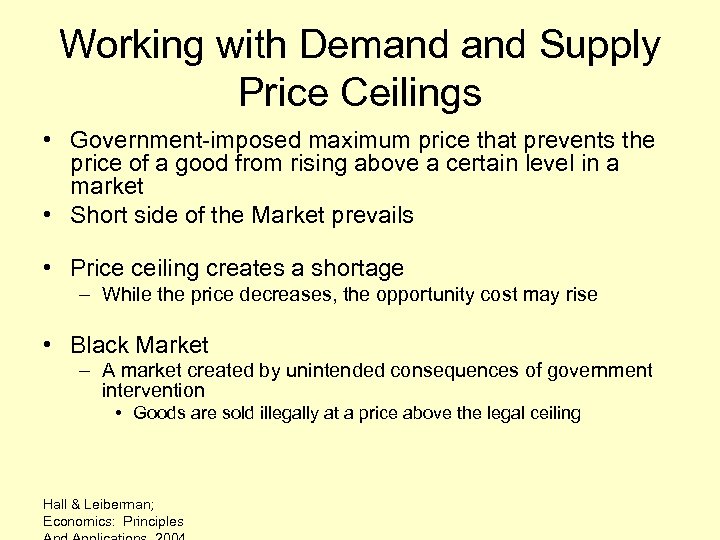 Working with Demand Supply Price Ceilings • Government-imposed maximum price that prevents the price of a good from rising above a certain level in a market • Short side of the Market prevails • Price ceiling creates a shortage – While the price decreases, the opportunity cost may rise • Black Market – A market created by unintended consequences of government intervention • Goods are sold illegally at a price above the legal ceiling Hall & Leiberman; Economics: Principles
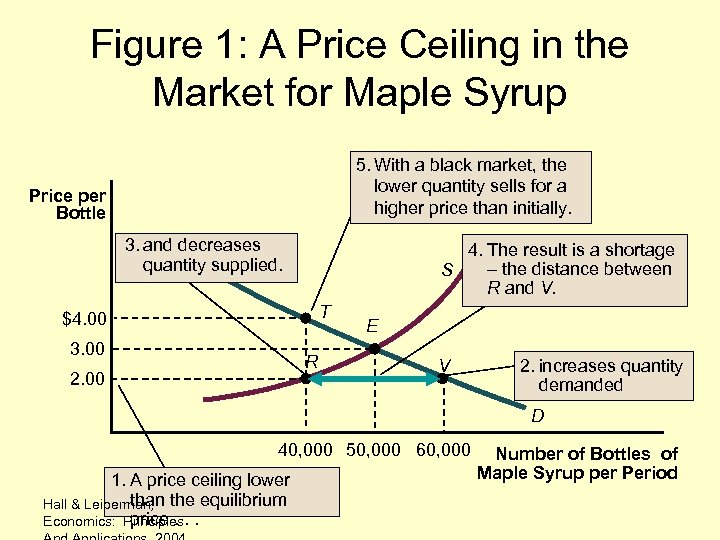 Figure 1: A Price Ceiling in the Market for Maple Syrup 5. With a black market, the lower quantity sells for a higher price than initially. Price per Bottle 3. and decreases quantity supplied. 4. The result is a shortage – the distance between S R and V. T $4. 00 3. 00 R 2. 00 E V 2. increases quantity demanded D 40, 000 50, 000 60, 000 1. A price ceiling lower than Hall & Leiberman; the equilibrium price. Economics: Principles. . Number of Bottles of Maple Syrup per Period
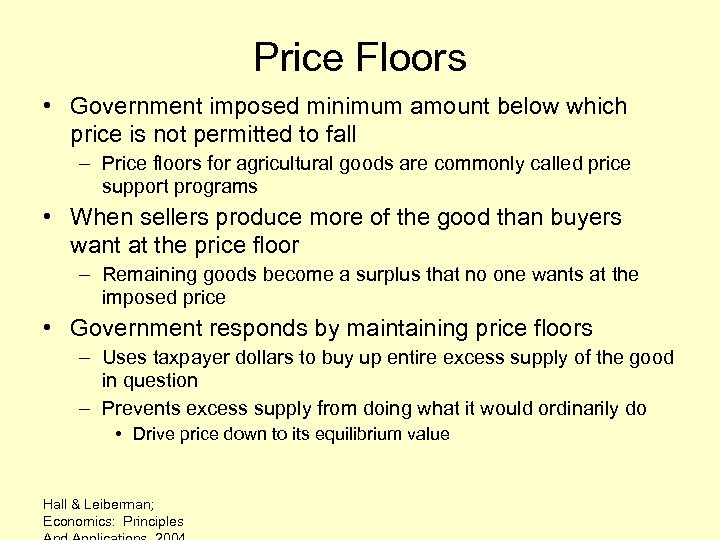 Price Floors • Government imposed minimum amount below which price is not permitted to fall – Price floors for agricultural goods are commonly called price support programs • When sellers produce more of the good than buyers want at the price floor – Remaining goods become a surplus that no one wants at the imposed price • Government responds by maintaining price floors – Uses taxpayer dollars to buy up entire excess supply of the good in question – Prevents excess supply from doing what it would ordinarily do • Drive price down to its equilibrium value Hall & Leiberman; Economics: Principles
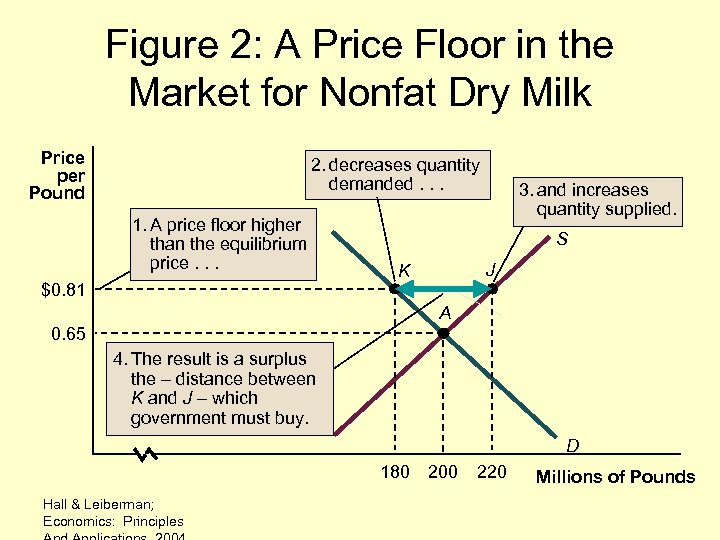 Figure 2: A Price Floor in the Market for Nonfat Dry Milk Price per Pound 2. decreases quantity demanded. . . 1. A price floor higher than the equilibrium price. . . $0. 81 3. and increases quantity supplied. S J K A 0. 65 4. The result is a surplus the – distance between K and J – which government must buy. D 180 Hall & Leiberman; Economics: Principles 200 220 Millions of Pounds
 Limiting Surplus • A price floor creates a surplus of goods – In order to maintain price floor, government must prevent surplus from driving down market price • Government often accomplishes this goal by purchasing surplus with taxpayers dollars • Price floors often get government deeply involved in production decisions – Rather than leaving them to the market Hall & Leiberman; Economics: Principles
 Supplier’s perspective • A producer considers increasing his price • Is it a good idea? • Higher price means more revenue per unit output BUT… • Lower units of quantity sold (downward sloping demand). Hall & Leiberman; Economics: Principles
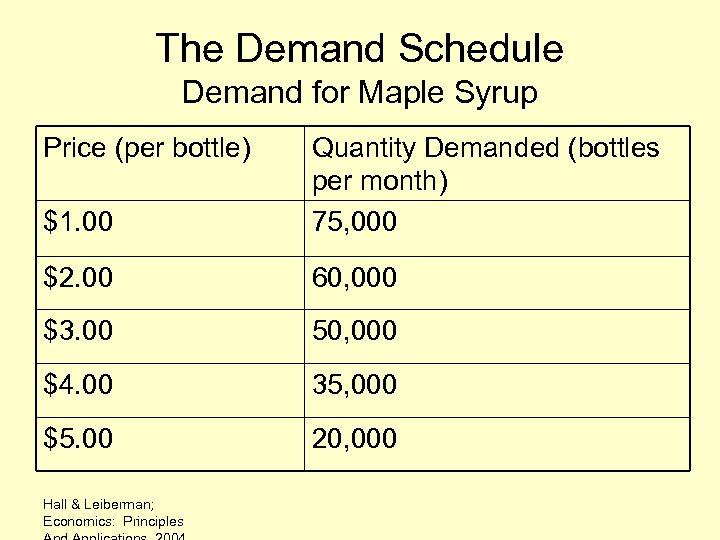 The Demand Schedule Demand for Maple Syrup Price (per bottle) $1. 00 Quantity Demanded (bottles per month) 75, 000 $2. 00 60, 000 $3. 00 50, 000 $4. 00 35, 000 $5. 00 20, 000 Hall & Leiberman; Economics: Principles
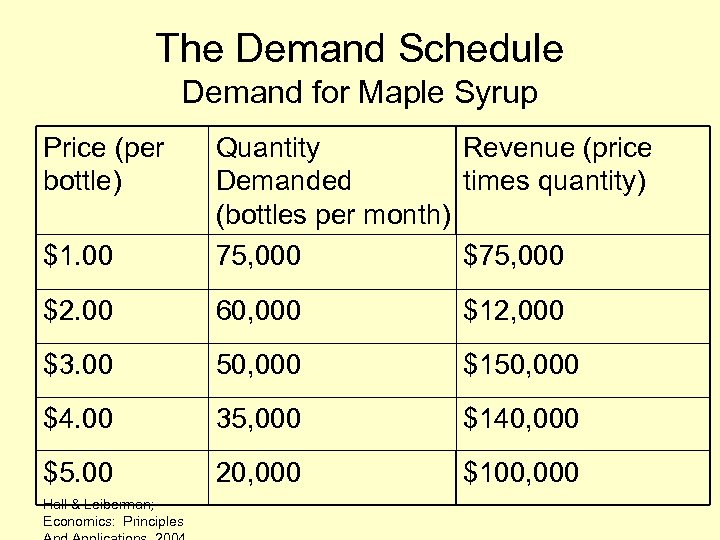 The Demand Schedule Demand for Maple Syrup Price (per bottle) $1. 00 Quantity Revenue (price Demanded times quantity) (bottles per month) 75, 000 $2. 00 60, 000 $12, 000 $3. 00 50, 000 $150, 000 $4. 00 35, 000 $140, 000 $5. 00 20, 000 $100, 000 Hall & Leiberman; Economics: Principles
 The Problem with Rate Change • Rate of change of quantity demanded compared to the change in price is not a good measure of price sensitivity – Doesn’t tell whether a change in price or a change in quantity demanded is a relatively large or relatively small change • Relative means compared to value of price or quantity before change Hall & Leiberman; Economics: Principles
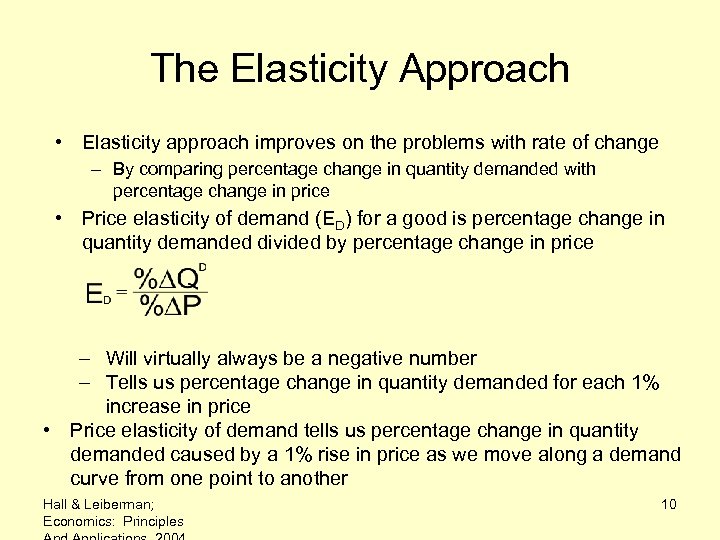 The Elasticity Approach • Elasticity approach improves on the problems with rate of change – By comparing percentage change in quantity demanded with percentage change in price • Price elasticity of demand (ED) for a good is percentage change in quantity demanded divided by percentage change in price – Will virtually always be a negative number – Tells us percentage change in quantity demanded for each 1% increase in price • Price elasticity of demand tells us percentage change in quantity demanded caused by a 1% rise in price as we move along a demand curve from one point to another Hall & Leiberman; Economics: Principles 10
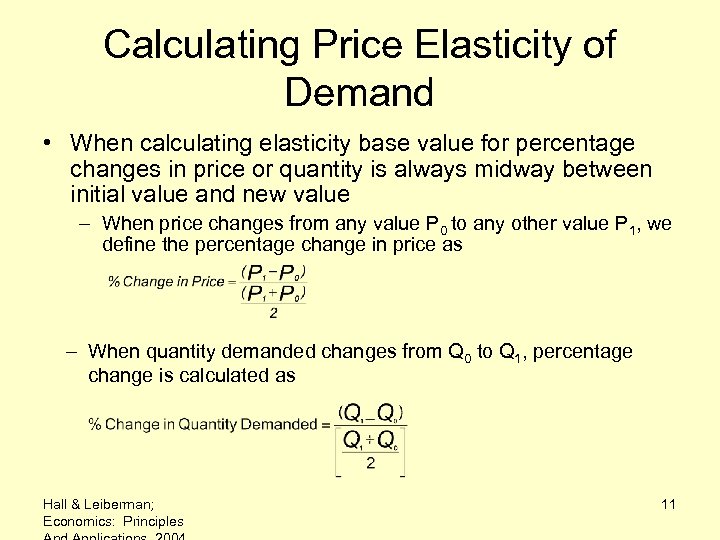 Calculating Price Elasticity of Demand • When calculating elasticity base value for percentage changes in price or quantity is always midway between initial value and new value – When price changes from any value P 0 to any other value P 1, we define the percentage change in price as – When quantity demanded changes from Q 0 to Q 1, percentage change is calculated as Hall & Leiberman; Economics: Principles 11
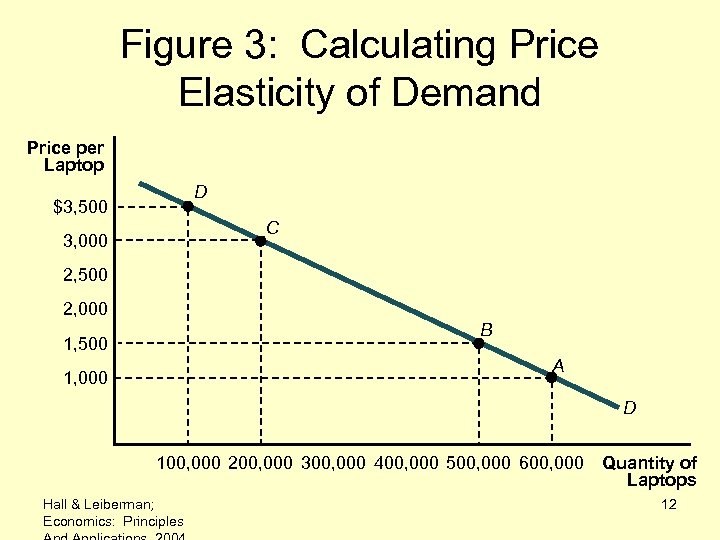 Figure 3: Calculating Price Elasticity of Demand Price per Laptop D $3, 500 C 3, 000 2, 500 2, 000 B 1, 500 A 1, 000 D 100, 000 200, 000 300, 000 400, 000 500, 000 600, 000 Hall & Leiberman; Economics: Principles Quantity of Laptops 12
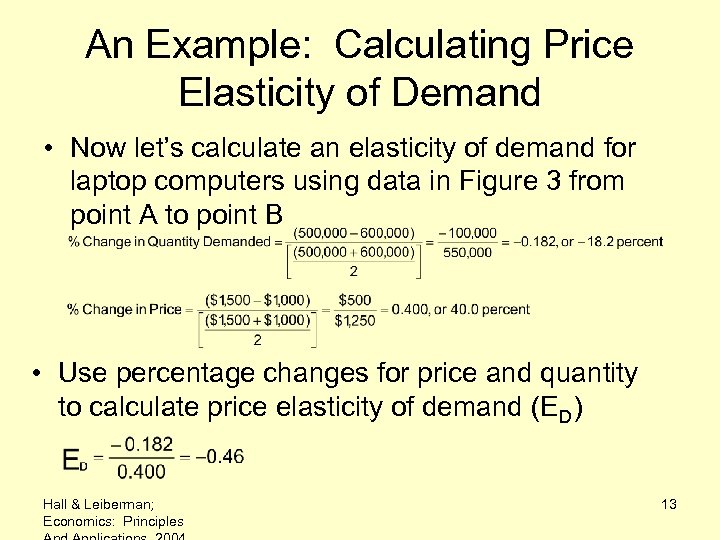 An Example: Calculating Price Elasticity of Demand • Now let’s calculate an elasticity of demand for laptop computers using data in Figure 3 from point A to point B • Use percentage changes for price and quantity to calculate price elasticity of demand (ED) Hall & Leiberman; Economics: Principles 13
 Elasticity and Straight-Line Demand Curves • As we move upward and leftward along a straight-line demand curve – Same absolute increment in price will correspond to smaller and smaller percentage increments in price • Why? • As we move upward and leftward along a straight-line demand curve – Same absolute decrease in quantity corresponds to larger and larger percentage decreases in quantity • As we move upward and leftward by equal distances, percentage change in quantity rises – Percentage change in price falls • Elasticity of demand varies along a straight-line demand curve – Demand becomes more elastic as we move upward and leftward Hall & Leiberman; Economics: Principles
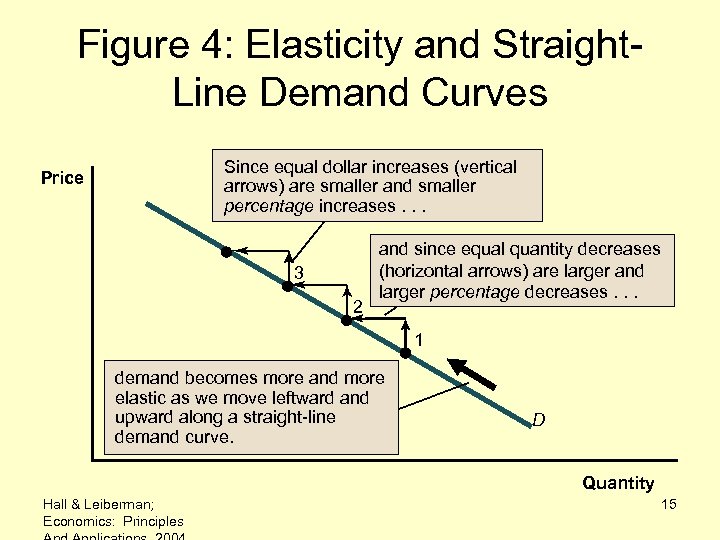 Figure 4: Elasticity and Straight. Line Demand Curves Since equal dollar increases (vertical arrows) are smaller and smaller percentage increases. . . Price 3 2 and since equal quantity decreases (horizontal arrows) are larger and larger percentage decreases. . . 1 demand becomes more and more elastic as we move leftward and upward along a straight-line demand curve. D Quantity Hall & Leiberman; Economics: Principles 15
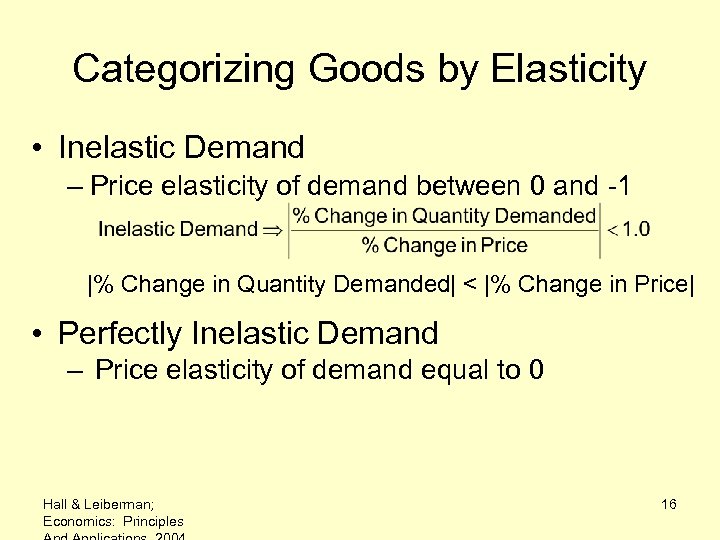 Categorizing Goods by Elasticity • Inelastic Demand – Price elasticity of demand between 0 and -1 |% Change in Quantity Demanded| < |% Change in Price| • Perfectly Inelastic Demand – Price elasticity of demand equal to 0 Hall & Leiberman; Economics: Principles 16
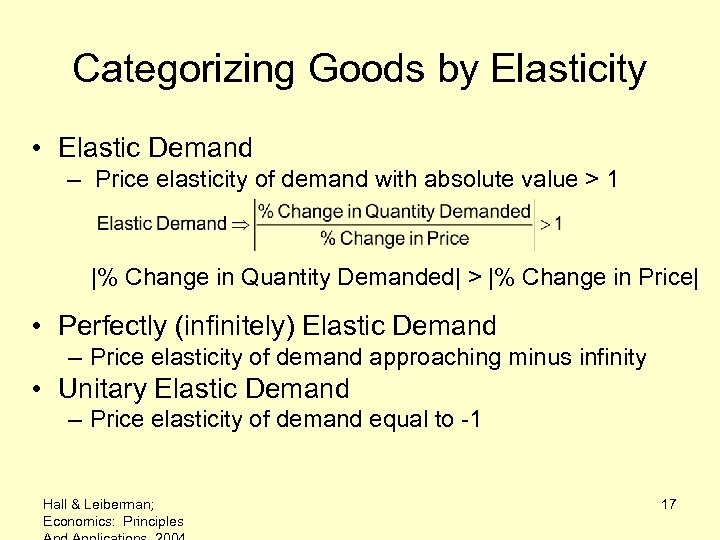 Categorizing Goods by Elasticity • Elastic Demand – Price elasticity of demand with absolute value > 1 |% Change in Quantity Demanded| > |% Change in Price| • Perfectly (infinitely) Elastic Demand – Price elasticity of demand approaching minus infinity • Unitary Elastic Demand – Price elasticity of demand equal to -1 Hall & Leiberman; Economics: Principles 17
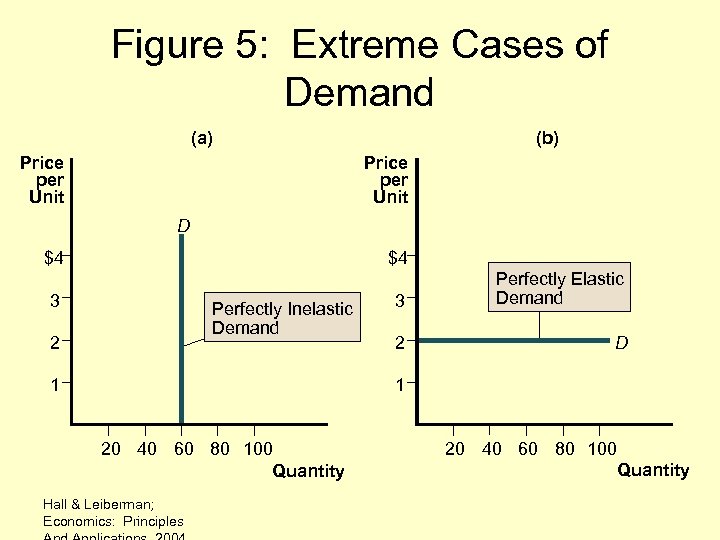 Figure 5: Extreme Cases of Demand (a) Price per Unit (b) Price per Unit D $4 $4 3 Perfectly Inelastic Demand 2 1 3 Perfectly Elastic Demand 2 D 1 20 40 60 80 100 Quantity Hall & Leiberman; Economics: Principles 20 40 60 80 100 Quantity
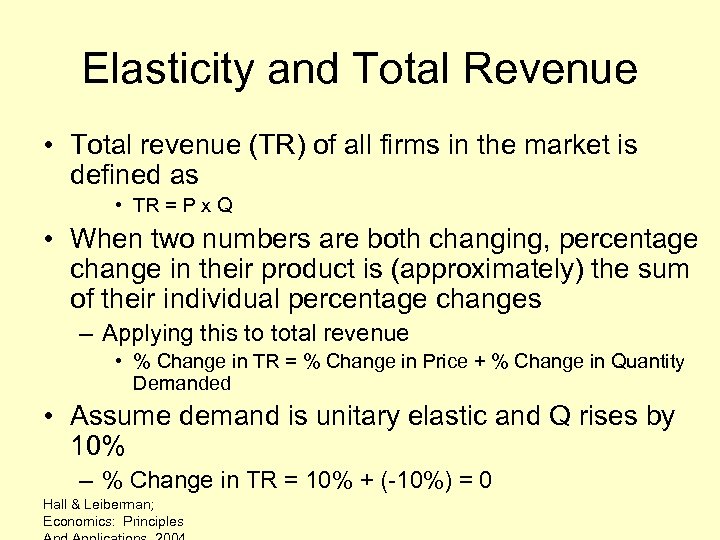 Elasticity and Total Revenue • Total revenue (TR) of all firms in the market is defined as • TR = P x Q • When two numbers are both changing, percentage change in their product is (approximately) the sum of their individual percentage changes – Applying this to total revenue • % Change in TR = % Change in Price + % Change in Quantity Demanded • Assume demand is unitary elastic and Q rises by 10% – % Change in TR = 10% + (-10%) = 0 Hall & Leiberman; Economics: Principles
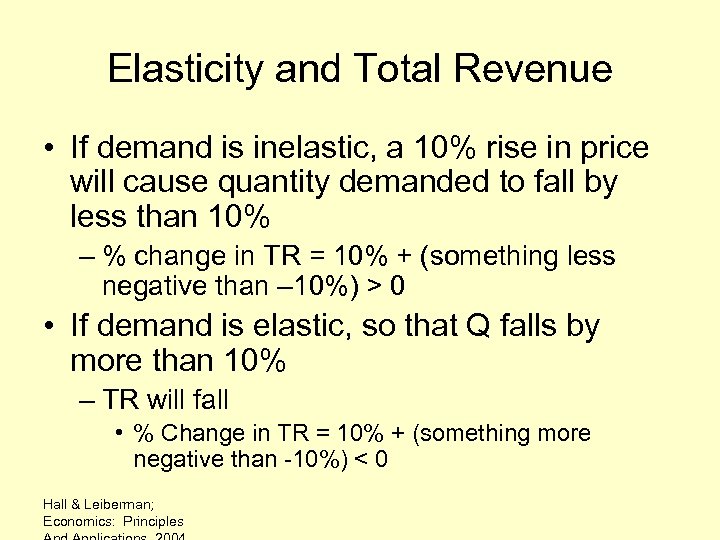 Elasticity and Total Revenue • If demand is inelastic, a 10% rise in price will cause quantity demanded to fall by less than 10% – % change in TR = 10% + (something less negative than – 10%) > 0 • If demand is elastic, so that Q falls by more than 10% – TR will fall • % Change in TR = 10% + (something more negative than -10%) < 0 Hall & Leiberman; Economics: Principles
 Elasticity and Total Revenue • Where demand is inelastic, total revenue moves in same direction as price • Where demand is elastic, total revenue moves in opposite direction from price • Where demand is unitary elastic, total revenue remains the same as price changes • At any point on a demand curve sellers’ total revenue (buyers’ total expenditure) is the area of a rectangle – Width equal to quantity demanded – Height equal to price Hall & Leiberman; Economics: Principles
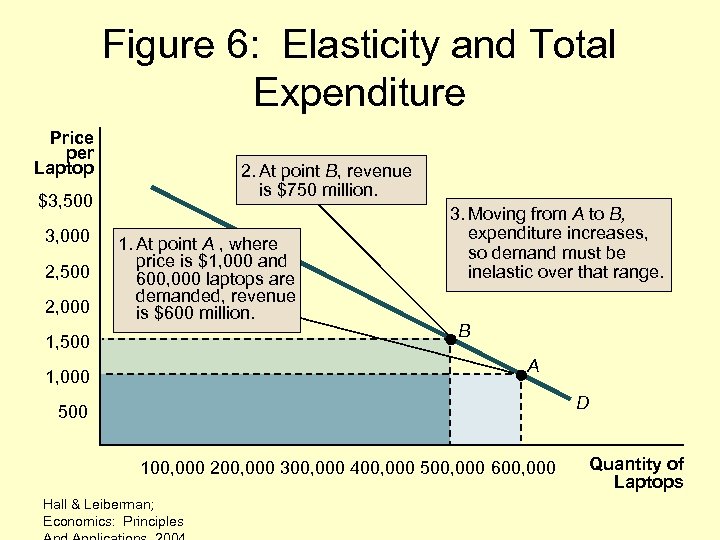 Figure 6: Elasticity and Total Expenditure Price per Laptop 2. At point B, revenue is $750 million. $3, 500 3, 000 2, 500 2, 000 1. At point A , where price is $1, 000 and 600, 000 laptops are demanded, revenue is $600 million. 1, 500 3. Moving from A to B, expenditure increases, so demand must be inelastic over that range. B A 1, 000 D 500 100, 000 200, 000 300, 000 400, 000 500, 000 600, 000 Hall & Leiberman; Economics: Principles Quantity of Laptops
 Availability of Substitutes • Demand is more elastic – If close substitutes are easy to find and buyers can cut back on purchases of the good in question • Demand is less elastic – If close substitutes are difficult to find and buyers can not cut back on purchases of the good in question Hall & Leiberman; Economics: Principles
 Narrowness of Market • More narrowly we define a good, easier it is to find substitutes – More elastic is demand for the good • More broadly we define a good – Harder it is to find substitutes and the less elastic is demand for the good • Different things are assumed constant when we use a narrow definition compared with a broader definition Hall & Leiberman; Economics: Principles
 Necessities vs. Luxuries • The more “necessary” we regard an item, the harder it is to find a substitute – Expect it to be less price elastic • The less “necessary” (luxurious) we regard an item, the easier it is to find a substitute – Expect it to be more price elastic Hall & Leiberman; Economics: Principles
 Time Horizon • Short-run elasticity – Measured a short time after a price change • Long-run elasticity – Measured a year or more after a price change • Usually easier to find substitutes for an item in the long run than in the short run – Therefore, demand tends to be more elastic in the long run than in the short run Hall & Leiberman; Economics: Principles
 Importance in the Buyer’s Budget • The more of their total budgets that households spend on an item – The more elastic is demand for that item • The less of their total budgets that households spend on an item – The less elastic is demand for that item Hall & Leiberman; Economics: Principles
 Using Price Elasticity of Demand: The War on Drugs • Every year U. S. Government spends about $20 billion on efforts to restrict the supply of drugs • Figure 9(a) – Market for heroin without government intervention • Figure 9(b) – Result of government efforts to restrict supply (current policy) • Figure 9(c) – Results of an effective policy of reducing demand Hall & Leiberman; Economics: Principles
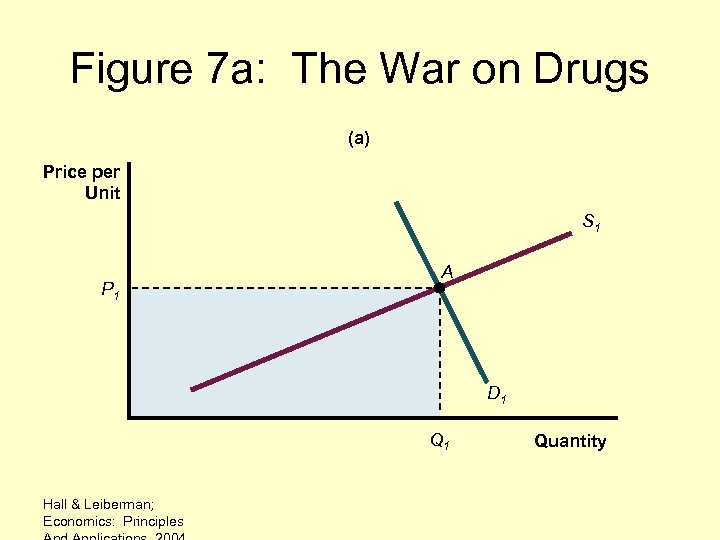 Figure 7 a: The War on Drugs (a) Price per Unit S 1 P 1 A D 1 Q 1 Hall & Leiberman; Economics: Principles Quantity
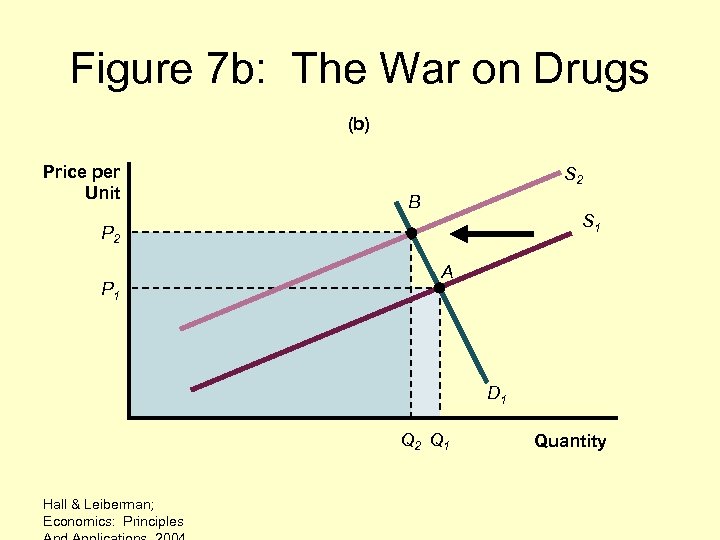 Figure 7 b: The War on Drugs (b) Price per Unit S 2 B S 1 P 2 P 1 A D 1 Q 2 Q 1 Hall & Leiberman; Economics: Principles Quantity
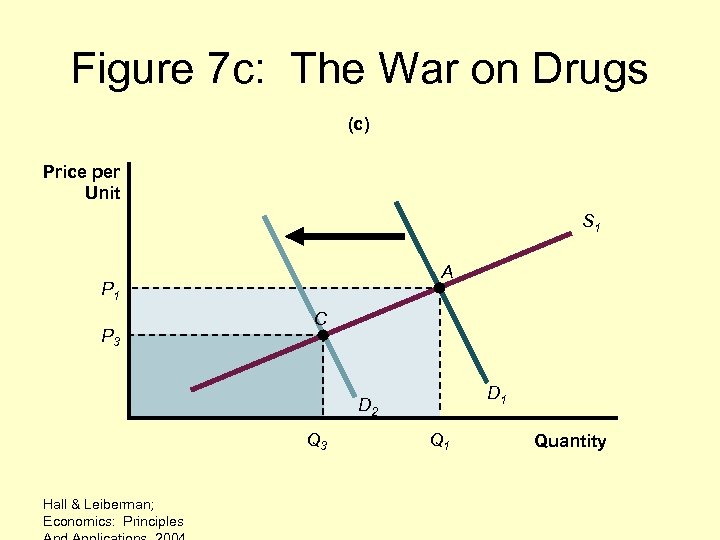 Figure 7 c: The War on Drugs (c) Price per Unit S 1 A P 1 P 3 C D 1 D 2 Q 3 Hall & Leiberman; Economics: Principles Q 1 Quantity
 Using Price Elasticity of Demand: Mass Transit • Elasticity studies show that long-run demand for mass transit is inelastic – Therefore, a rise in fare would increase revenues • However, most cities do not raise transit fares due to – Desire to provide low-income households with affordable transportation – Desire to manage traffic congestion – Desire to limit air pollution in the city • An increase in fares would increase revenue – Would also decrease ridership and require the city to sacrifice these other goals Hall & Leiberman; Economics: Principles
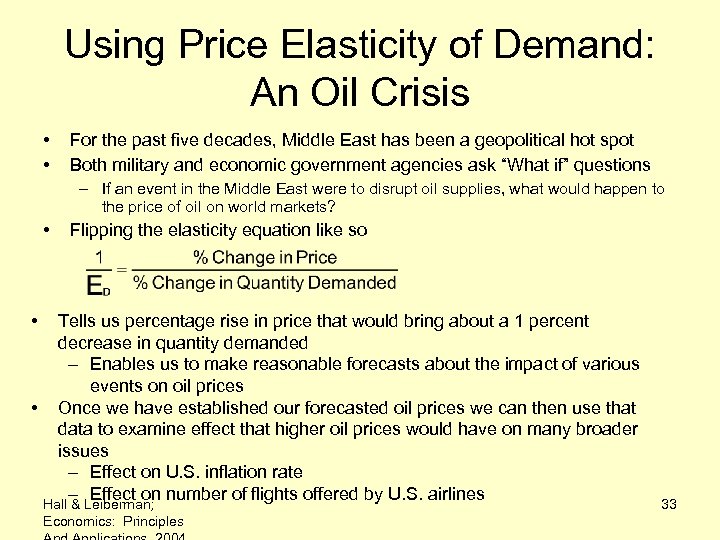 Using Price Elasticity of Demand: An Oil Crisis • • For the past five decades, Middle East has been a geopolitical hot spot Both military and economic government agencies ask “What if” questions – If an event in the Middle East were to disrupt oil supplies, what would happen to the price of oil on world markets? • • • Flipping the elasticity equation like so Tells us percentage rise in price that would bring about a 1 percent decrease in quantity demanded – Enables us to make reasonable forecasts about the impact of various events on oil prices Once we have established our forecasted oil prices we can then use that data to examine effect that higher oil prices would have on many broader issues – Effect on U. S. inflation rate – Effect on number of flights offered by U. S. airlines Hall & Leiberman; Economics: Principles 33
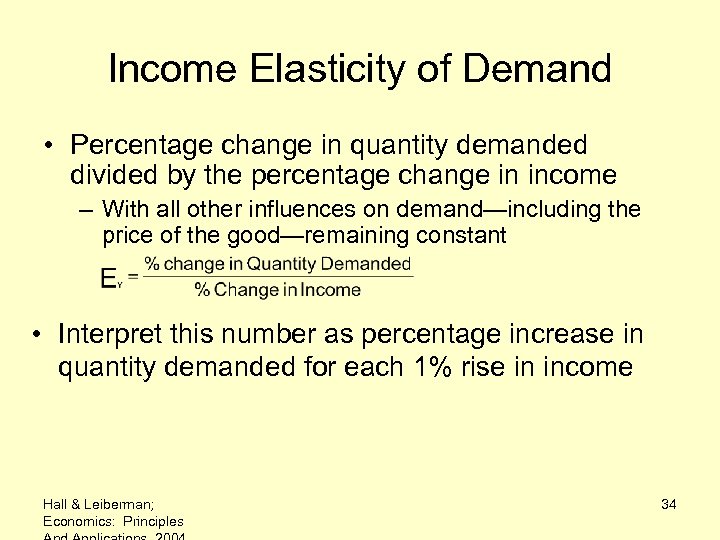 Income Elasticity of Demand • Percentage change in quantity demanded divided by the percentage change in income – With all other influences on demand—including the price of the good—remaining constant • Interpret this number as percentage increase in quantity demanded for each 1% rise in income Hall & Leiberman; Economics: Principles 34
 Income Elasticity of Demand • Income elasticities vs. price elasticities of demand – Price elasticity of demand • Measures effect of change in price of good – Assumes that other influences on demand, including income, remain unchanged – Income elasticity • Measures effect on demand we would observe if income changed and all other influences on demand—including price of the good—remained the same • Instead of letting price vary and holding income constant, now we are letting income vary and holding price constant Hall & Leiberman; Economics: Principles
 Income Elasticity of Demand • Another difference between price and income elasticity of demand – Price elasticity measures sensitivity of demand to price as we move along a demand curve from one point to another – Income elasticity tells us relative shift in demand curve—increase in quantity demanded at a given price • While a price elasticity is virtually always negative – Income elasticity can be positive or negative Hall & Leiberman; Economics: Principles
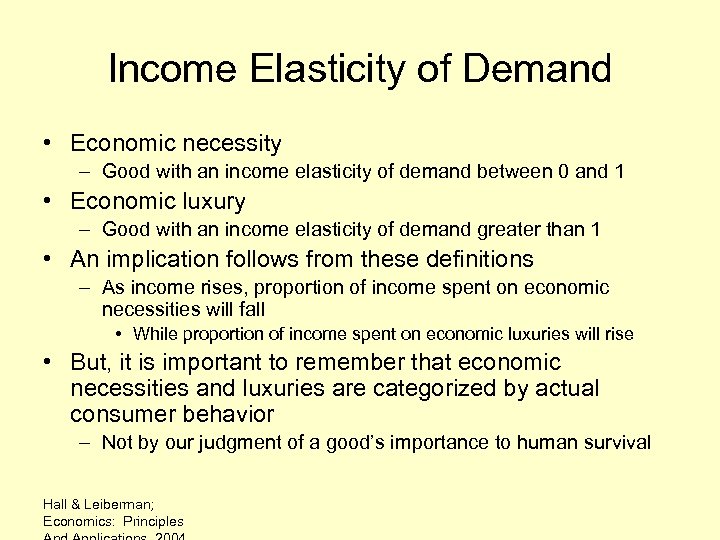 Income Elasticity of Demand • Economic necessity – Good with an income elasticity of demand between 0 and 1 • Economic luxury – Good with an income elasticity of demand greater than 1 • An implication follows from these definitions – As income rises, proportion of income spent on economic necessities will fall • While proportion of income spent on economic luxuries will rise • But, it is important to remember that economic necessities and luxuries are categorized by actual consumer behavior – Not by our judgment of a good’s importance to human survival Hall & Leiberman; Economics: Principles
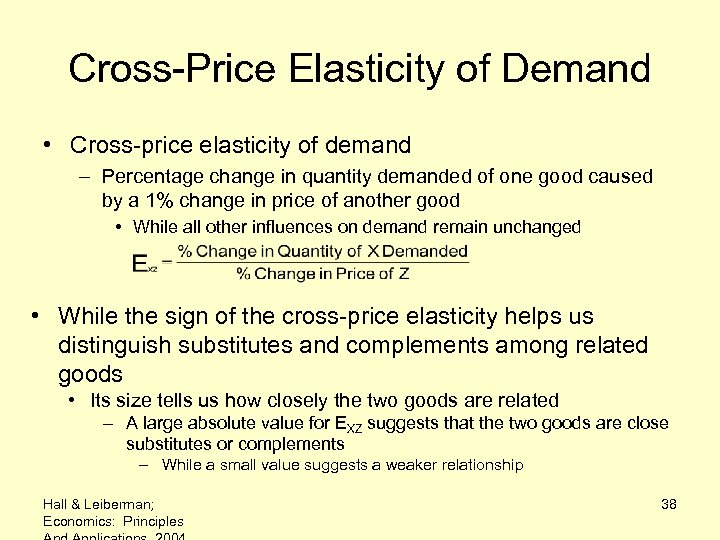 Cross-Price Elasticity of Demand • Cross-price elasticity of demand – Percentage change in quantity demanded of one good caused by a 1% change in price of another good • While all other influences on demand remain unchanged • While the sign of the cross-price elasticity helps us distinguish substitutes and complements among related goods • Its size tells us how closely the two goods are related – A large absolute value for EXZ suggests that the two goods are close substitutes or complements – While a small value suggests a weaker relationship Hall & Leiberman; Economics: Principles 38
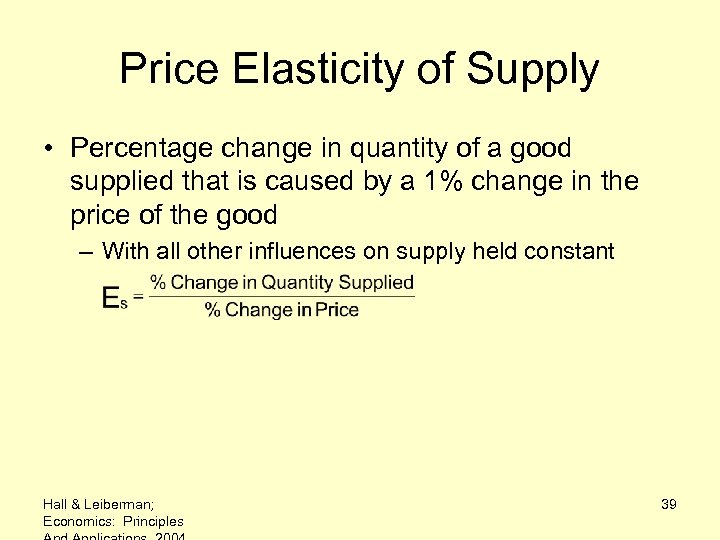 Price Elasticity of Supply • Percentage change in quantity of a good supplied that is caused by a 1% change in the price of the good – With all other influences on supply held constant Hall & Leiberman; Economics: Principles 39
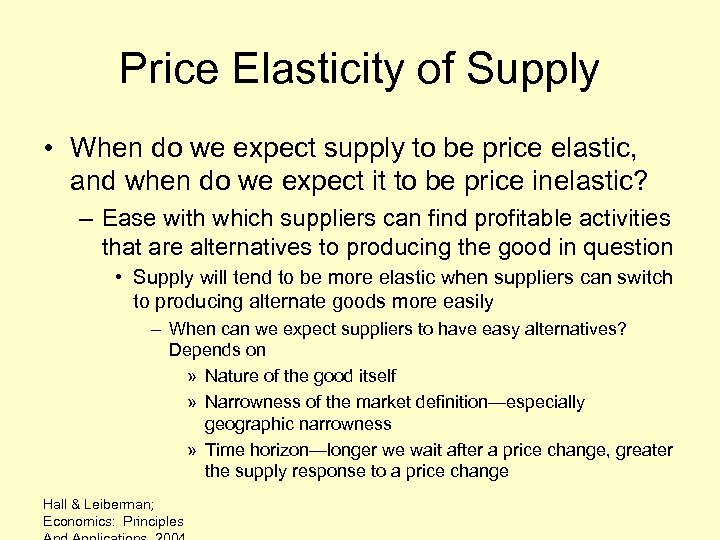 Price Elasticity of Supply • When do we expect supply to be price elastic, and when do we expect it to be price inelastic? – Ease with which suppliers can find profitable activities that are alternatives to producing the good in question • Supply will tend to be more elastic when suppliers can switch to producing alternate goods more easily – When can we expect suppliers to have easy alternatives? Depends on » Nature of the good itself » Narrowness of the market definition—especially geographic narrowness » Time horizon—longer we wait after a price change, greater the supply response to a price change Hall & Leiberman; Economics: Principles
 Price Elasticity of Supply • Extreme cases of supply elasticity – Perfectly inelastic supply curve is a vertical line • Many markets display almost completely inelastic supply curves over very short periods of time – Perfectly elastic supply curve is a horizontal line Hall & Leiberman; Economics: Principles
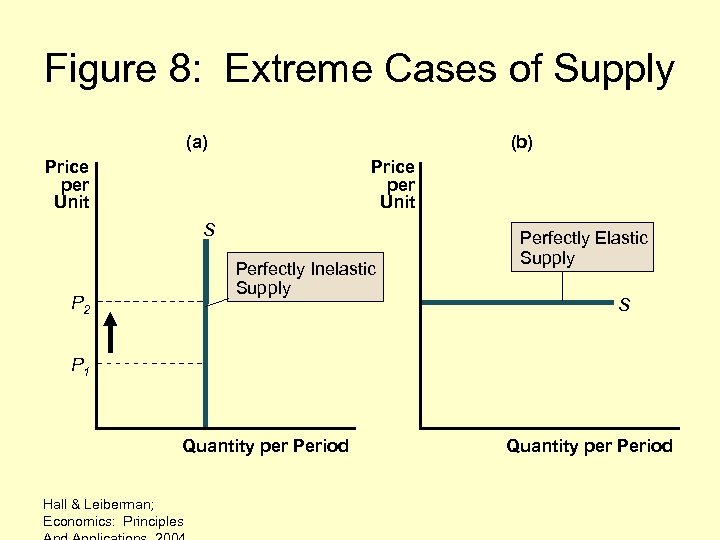 Figure 8: Extreme Cases of Supply (a) (b) Price per Unit S Perfectly Inelastic Supply P 2 Perfectly Elastic Supply S P 1 Quantity per Period Hall & Leiberman; Economics: Principles Quantity per Period
 The Tax on Airline Travel: Taxes and Market Equilibrium • A tax on a particular good or service is called an excise tax – Shifts market supply curve upward by amount of tax • For each quantity supplied, the new, higher curve tells us firms’ gross price, and the original, lower curve tells us the net price • Who really pays excise taxes? – Buyers and sellers share in the payment of an excise tax • Called tax shifting – Process that causes some of tax collected from one side of market (sellers) to be paid by other side of market (buyers) Hall & Leiberman; Economics: Principles
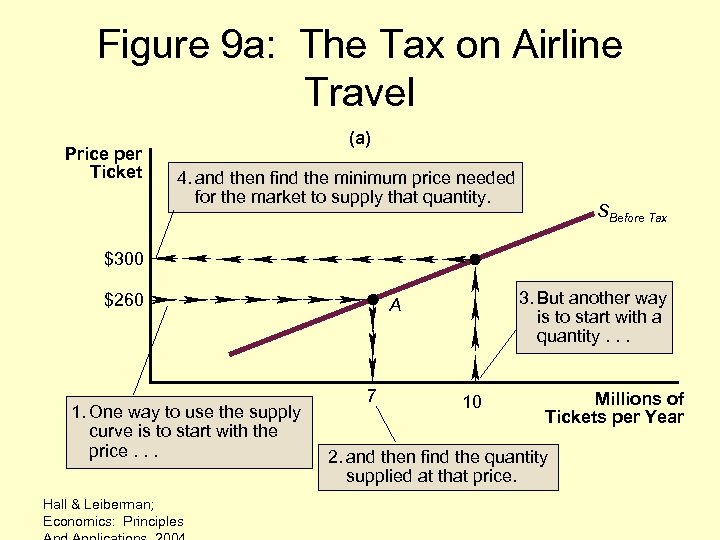 Figure 9 a: The Tax on Airline Travel Price per Ticket (a) 4. and then find the minimum price needed for the market to supply that quantity. SBefore Tax $300 $260 1. One way to use the supply curve is to start with the price. . . Hall & Leiberman; Economics: Principles 3. But another way is to start with a quantity. . . A 7 10 Millions of Tickets per Year 2. and then find the quantity supplied at that price.
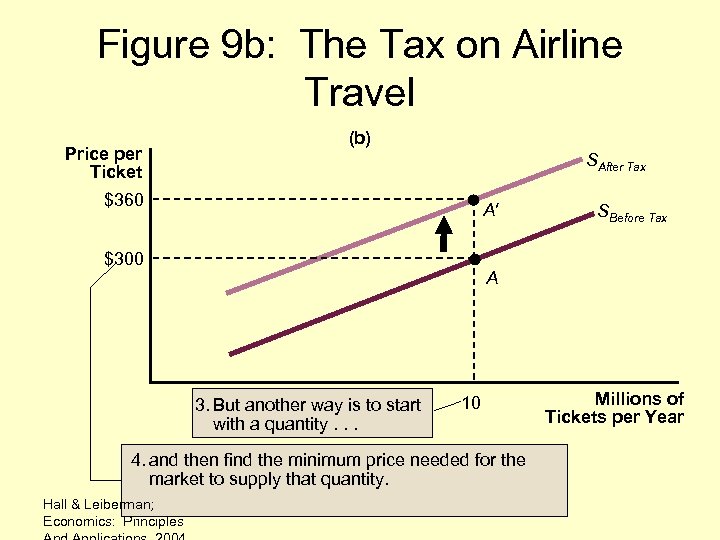 Figure 9 b: The Tax on Airline Travel Price per Ticket (b) SAfter Tax $360 A' $300 A 3. But another way is to start with a quantity. . . 10 4. and then find the minimum price needed for the market to supply that quantity. Hall & Leiberman; Economics: Principles SBefore Tax Millions of Tickets per Year
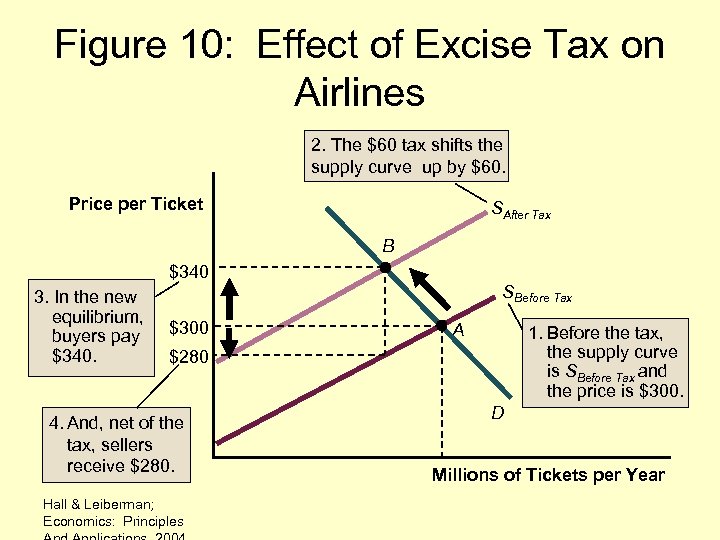 Figure 10: Effect of Excise Tax on Airlines 2. The $60 tax shifts the supply curve up by $60. Price per Ticket SAfter Tax B $340 3. In the new equilibrium, buyers pay $340. $300 SBefore Tax A 1. Before the tax, the supply curve is SBefore Tax and the price is $300. $280 4. And, net of the tax, sellers receive $280. Hall & Leiberman; Economics: Principles D Millions of Tickets per Year
 Tax Incidence and Demand Elasticity • In most cases excise tax will be shared by both buyer and seller – For a given supply curve, the more elastic is demand, the more of an excise tax is paid by sellers – The more inelastic is demand, the more of the tax is paid by buyers Hall & Leiberman; Economics: Principles
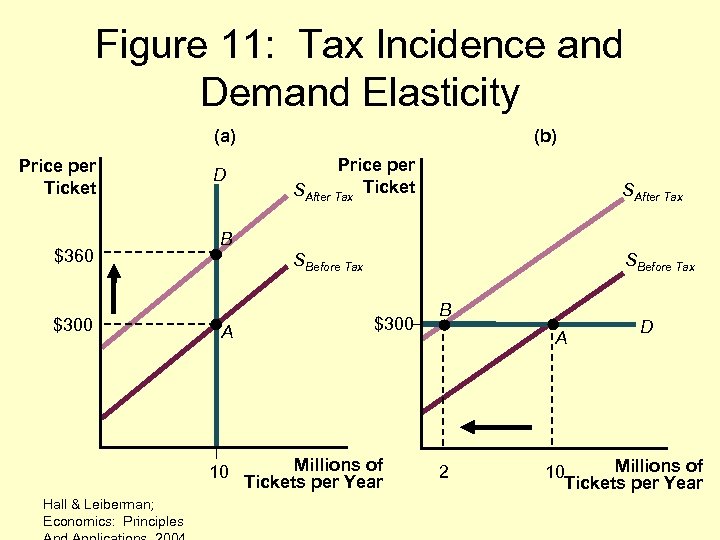 Figure 11: Tax Incidence and Demand Elasticity (a) Price per Ticket $360 $300 Price per SAfter Tax Ticket SAfter Tax SBefore Tax D SBefore Tax B A 10 Hall & Leiberman; Economics: Principles (b) $300 Millions of Tickets per Year B A 2 D Millions of 10 Tickets per Year
 Tax Incidence and Supply Elasticity • Although there are extreme cases of supply elasticity, in general the following is true – For a given demand curve, the more elastic is supply, the more of an excise tax is paid by buyers – The more inelastic is supply, the more of the tax is paid by sellers Hall & Leiberman; Economics: Principles
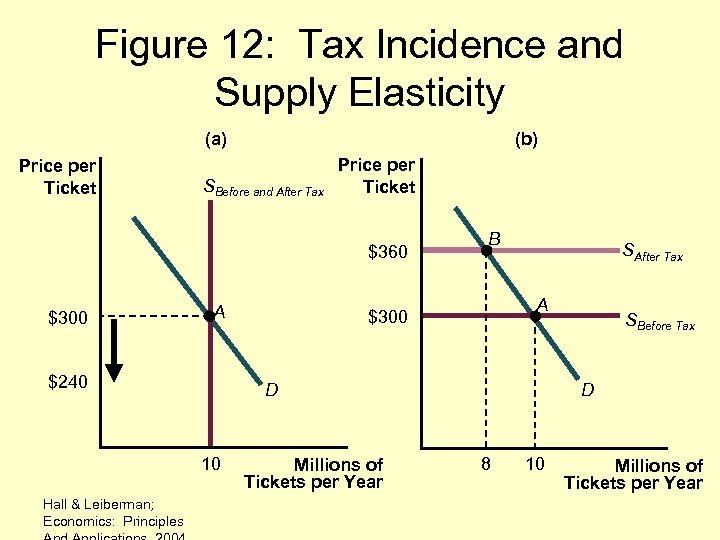 Figure 12: Tax Incidence and Supply Elasticity (a) Price per Ticket (b) SBefore and After Tax Price per Ticket $360 $300 A $240 SAfter Tax A $300 D 10 Hall & Leiberman; Economics: Principles B Millions of Tickets per Year SBefore Tax D 8 10 Millions of Tickets per Year
 The Market For Food • Shrinking and unstable incomes are problems for farmers • The market for farm goods would reach an equilibrium if it were allowed to do so • But farming seems to be special – Notion of small family farm has tremendous political appeal – Farmers have banded together to form powerful and effective government lobbies • Result has been continual government interference with supply and demand in agricultural markets around the world Hall & Leiberman; Economics: Principles
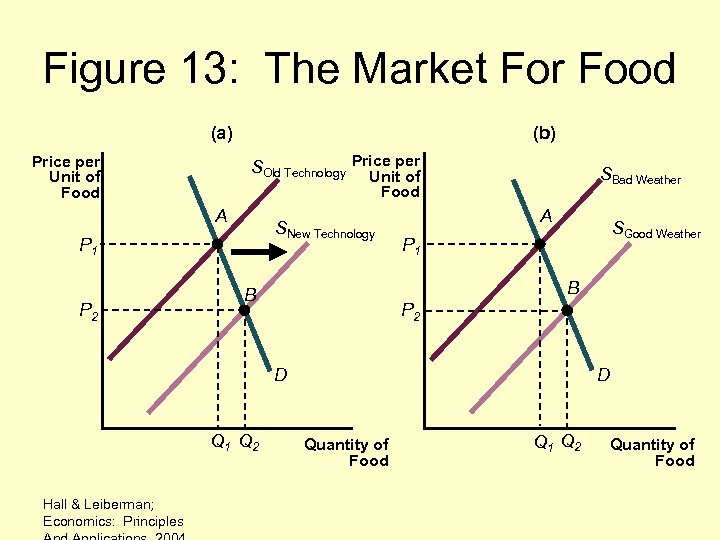 Figure 13: The Market For Food (a) (b) SOld Technology Price per Unit of Food A SNew Technology P 1 P 2 SBad Weather A SGood Weather P 1 B B P 2 D Q 1 Q 2 Hall & Leiberman; Economics: Principles D Quantity of Food Q 1 Q 2 Quantity of Food
 Health Insurance and the Market for Health Care • Health insurance has definite benefits to our society • Our current health care system keeps patients from facing the full opportunity cost of their health care decisions – Can cause people to over consume health care • Health insurance reduces buyers’ incentives to monitor their health care expenditures closely or to shop around for Hall & Leiberman; high-quality low-cost care Economics: Principles
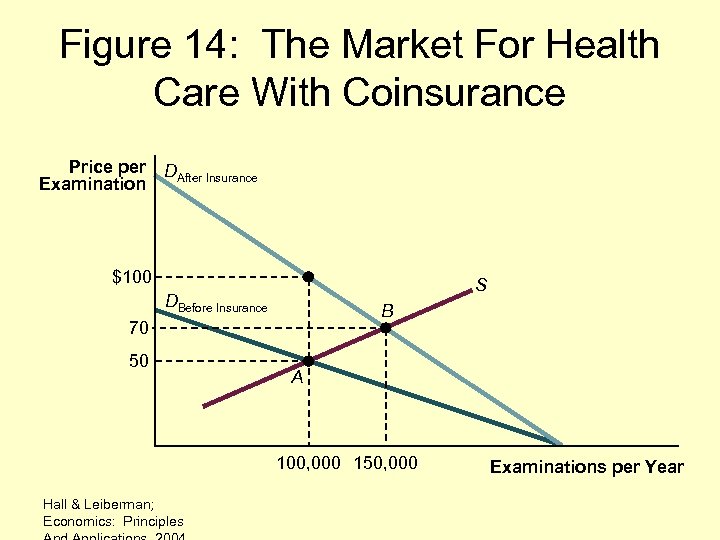 Figure 14: The Market For Health Care With Coinsurance Price per DAfter Insurance Examination $100 S DBefore Insurance B 70 50 A 100, 000 150, 000 Hall & Leiberman; Economics: Principles Examinations per Year