


 Скачать презентацию Working paper No EFV-02 -04 GRPE Informal
59e9b2d9b9ed3d28d661e52564cced81.ppt
- Количество слайдов: 32
 Working paper No. : EFV-02 -04 (GRPE Informal Group on EFV, 2 nd Meeting, 30/31 October 2008) Evaluation of Hybrid System and Plug-in Hybrid System In Japanese Fuel Efficiency Regulation Akihiko HOSHI Deputy Director Environment Division Road Transport Bureau Ministry of Land, Infrastructure, Transport and Tourism October 2008 Ministry of Land, Infrastructure, Transport and Tourism
 Agenda 1. Top Runner Approach for FE regulation 2. Fuel Efficiency regulation for HDVs ・ Simulation Test Method ・ for HD HEV Test 3. Fuel Efficiency Regulation for LDVs ・ Conventional Test Method ・ for LD HEV Test ・ Challenge for PHEV Evaluation 4. IPT Bus : PHEV for HDVs
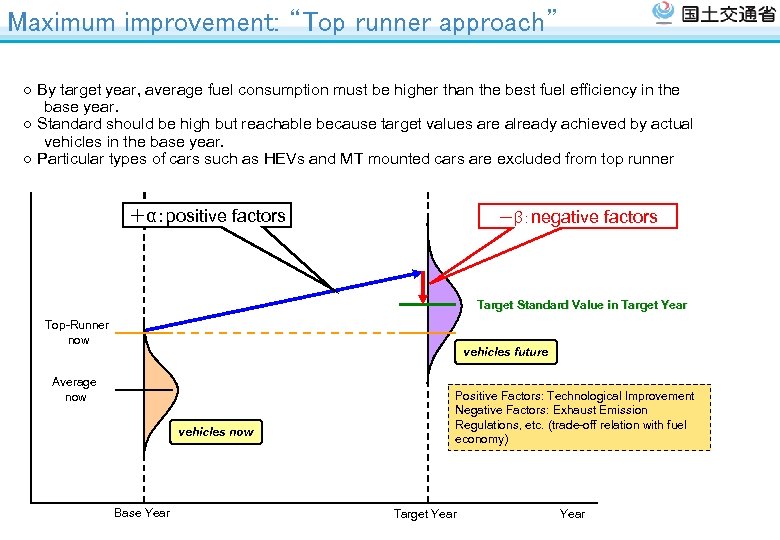 Maximum improvement: “Top runner approach” ○ By target year, average fuel consumption must be higher than the best fuel efficiency in the base year. ○ Standard should be high but reachable because target values are already achieved by actual vehicles in the base year. ○ Particular types of cars such as HEVs and MT mounted cars are excluded from top runner +α:positive factors -β:negative factors Target Standard Value in Target Year Top-Runner now vehicles future Average now vehicles now Base Year Positive Factors: Technological Improvement Negative Factors: Exhaust Emission Regulations, etc. (trade-off relation with fuel economy) Target Year
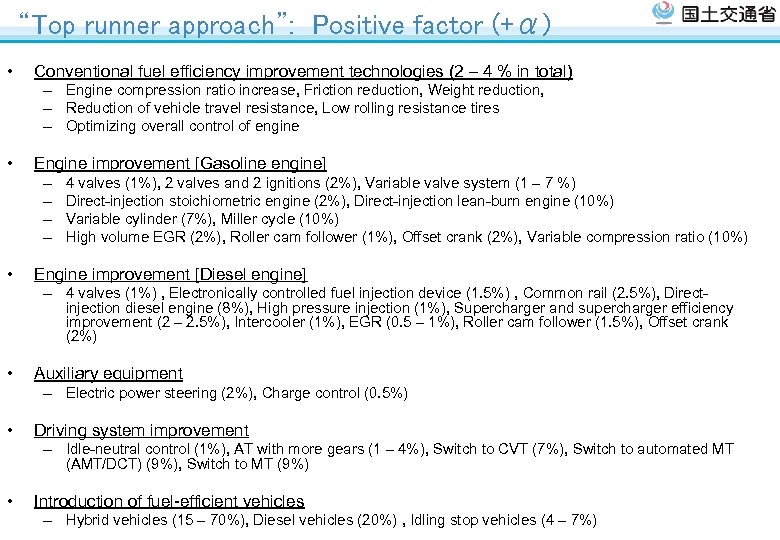 “Top runner approach”: Positive factor (+α) • Conventional fuel efficiency improvement technologies (2 – 4 % in total) – Engine compression ratio increase, Friction reduction, Weight reduction, – Reduction of vehicle travel resistance, Low rolling resistance tires – Optimizing overall control of engine • Engine improvement [Gasoline engine] – – • 4 valves (1%), 2 valves and 2 ignitions (2%), Variable valve system (1 – 7 %) Direct-injection stoichiometric engine (2%), Direct-injection lean-burn engine (10%) Variable cylinder (7%), Miller cycle (10%) High volume EGR (2%), Roller cam follower (1%), Offset crank (2%), Variable compression ratio (10%) Engine improvement [Diesel engine] – 4 valves (1%) , Electronically controlled fuel injection device (1. 5%) , Common rail (2. 5%), Directinjection diesel engine (8%), High pressure injection (1%), Supercharger and supercharger efficiency improvement (2 – 2. 5%), Intercooler (1%), EGR (0. 5 – 1%), Roller cam follower (1. 5%), Offset crank (2%) • Auxiliary equipment – Electric power steering (2%), Charge control (0. 5%) • Driving system improvement – Idle-neutral control (1%), AT with more gears (1 – 4%), Switch to CVT (7%), Switch to automated MT (AMT/DCT) (9%), Switch to MT (9%) • Introduction of fuel-efficient vehicles – Hybrid vehicles (15 – 70%), Diesel vehicles (20%) , Idling stop vehicles (4 – 7%)
 “Top runner approach”: Negative factor (-β) • Exhaust emission regulations (▲ 3 to ▲ 7. 5% in total) – Caused by technologies used on diesel vehicles and directinjection lean-burn vehicles in response to the 2009 exhaust emission regulations. – Technologies considered were engine body improvement (NOx reduction by improving EGR, PM reduction by high pressure injection, etc. ) and aftertreatment devices such as NOx occlusion reduction catalyst and continuous regeneration type DPF, etc. • Safety regulations (▲ 0. 1 to ▲ 1. 4% in total) – Caused by increased weight and travel resistance as a result of measures against/for offset crash, pedestrian protection, ISOFIX, etc. • Noise regulations(▲ 0. 1% in total)
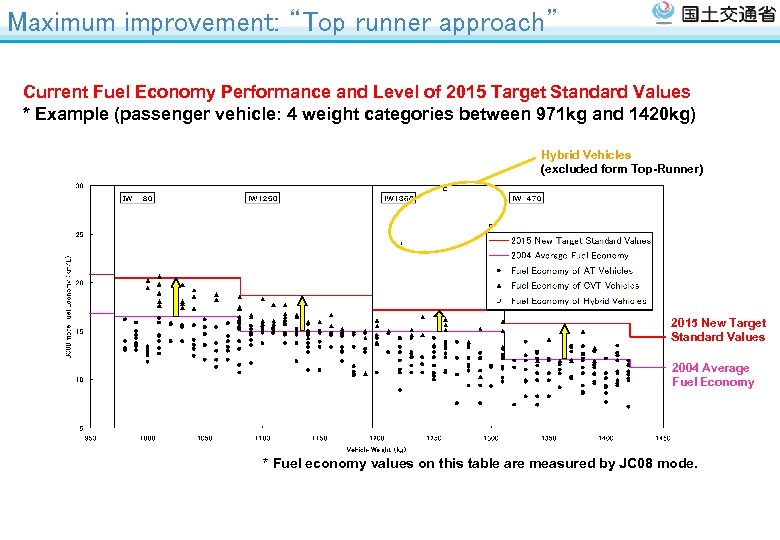 Maximum improvement: “Top runner approach” Current Fuel Economy Performance and Level of 2015 Target Standard Values * Example (passenger vehicle: 4 weight categories between 971 kg and 1420 kg) Hybrid Vehicles (excluded form Top-Runner) 2015 New Target Standard Values 2004 Average Fuel Economy * Fuel economy values on this table are measured by JC 08 mode.
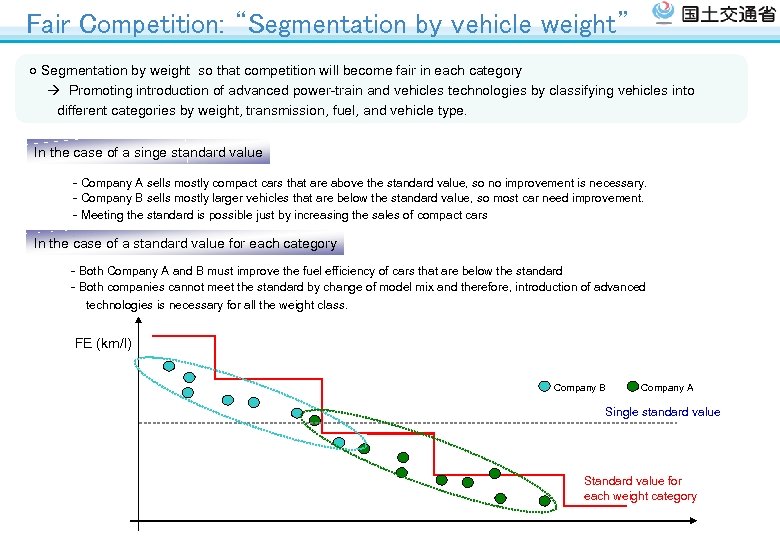 Fair Competition: “Segmentation by vehicle weight” ○ Segmentation by weight so that competition will become fair in each category Promoting introduction of advanced power-train and vehicles technologies by classifying vehicles into different categories by weight, transmission, fuel, and vehicle type. In the case of a singe standard value - Company A sells mostly compact cars that are above the standard value, so no improvement is necessary. - Company B sells mostly larger vehicles that are below the standard value, so most car need improvement. - Meeting the standard is possible just by increasing the sales of compact cars In the case of a standard value for each category - Both Company A and B must improve the fuel efficiency of cars that are below the standard - Both companies cannot meet the standard by change of model mix and therefore, introduction of advanced technologies is necessary for all the weight class. FE (km/l) Company B Company A Single standard value Standard value for each weight category
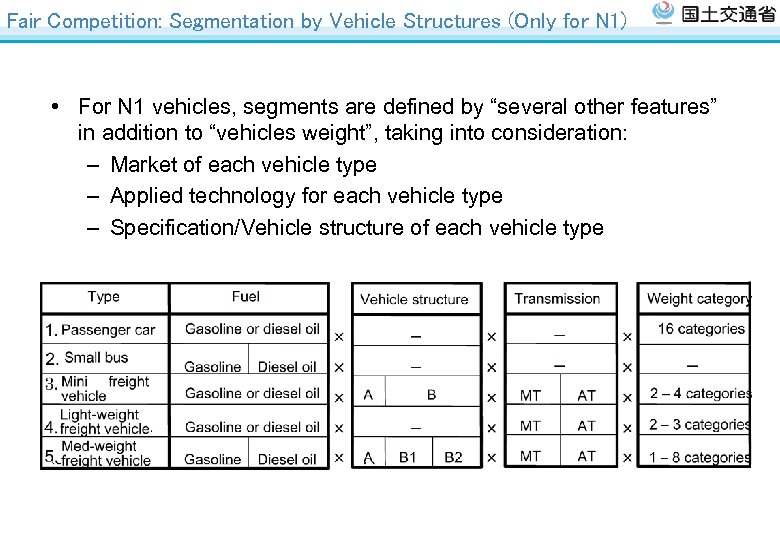 Fair Competition: Segmentation by Vehicle Structures (Only for N 1) • For N 1 vehicles, segments are defined by “several other features” in addition to “vehicles weight”, taking into consideration: – Market of each vehicle type – Applied technology for each vehicle type – Specification/Vehicle structure of each vehicle type
 Agenda 1. Top Runner Approach 2. Fuel Efficiency regulation for HDVs ・ Simulation Test under JE 05 ・ HD HEV Test 3. Fuel Efficiency Regulation for LDVs ・ Conventional Test Method ・ for LD HEV Test ・ Challenge for PHEV Evaluation 4. IPT Bus : PHEV for HDVs
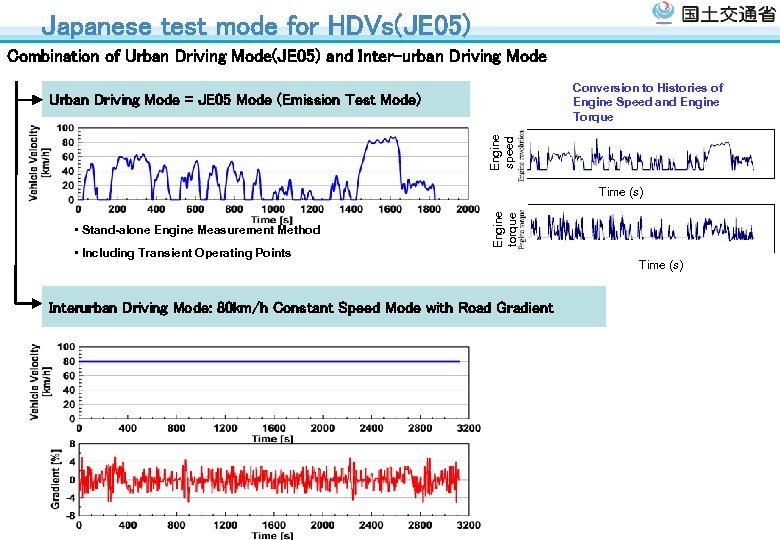 Japanese test mode for HDVs(JE 05) Combination of Urban Driving Mode(JE 05) and Inter-urban Driving Mode Conversion to Histories of Engine Speed and Engine Torque Engine speed Urban Driving Mode = JE 05 Mode (Emission Test Mode) • Stand-alone Engine Measurement Method • Including Transient Operating Points Engine torque Time (s) Interurban Driving Mode: 80 km/h Constant Speed Mode with Road Gradient Time (s)
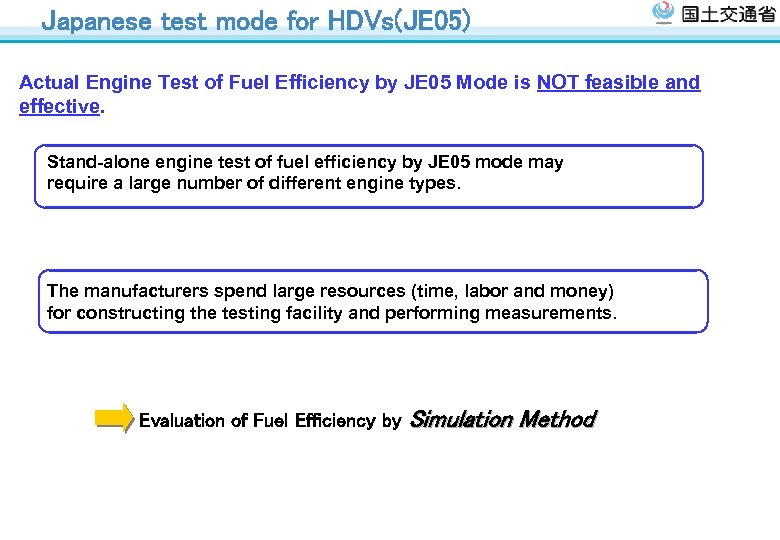 Japanese test mode for HDVs(JE 05) Actual Engine Test of Fuel Efficiency by JE 05 Mode is NOT feasible and effective. Stand-alone engine test of fuel efficiency by JE 05 mode may require a large number of different engine types. The manufacturers spend large resources (time, labor and money) for constructing the testing facility and performing measurements. Evaluation of Fuel Efficiency by Simulation Method
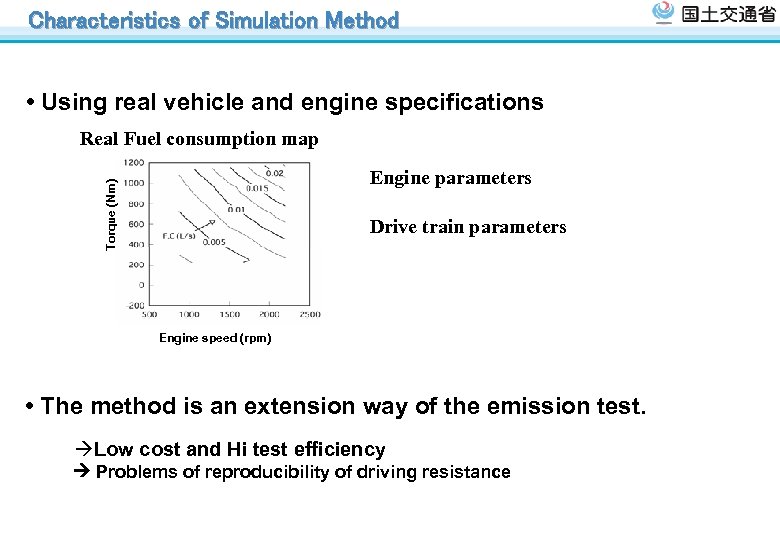 Characteristics of Simulation Method • Using real vehicle and engine specifications Real Fuel consumption map Torque (Nm) Engine parameters Drive train parameters Engine speed (rpm) • The method is an extension way of the emission test. Low cost and Hi test efficiency Problems of reproducibility of driving resistance
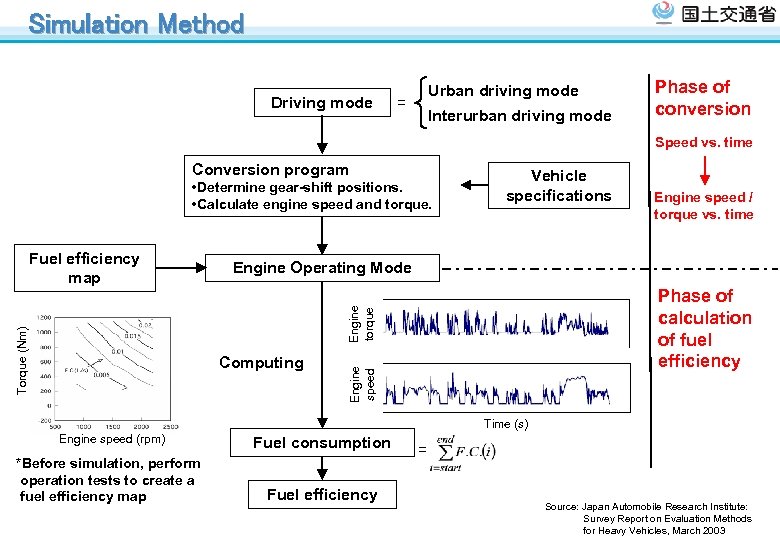 Simulation Method Driving mode Urban driving mode = Interurban driving mode Phase of conversion Speed vs. time Conversion program • Determine gear-shift positions. • Calculate engine speed and torque. Phase of calculation of fuel efficiency Computing Engine speed Torque (Nm) Engine speed / torque vs. time Engine Operating Mode Engine torque Fuel efficiency map Vehicle specifications Time (s) Engine speed (rpm) Fuel consumption *Before simulation, perform operation tests to create a fuel efficiency map Fuel efficiency = Source: Japan Automobile Research Institute: Survey Report on Evaluation Methods for Heavy Vehicles, March 2003
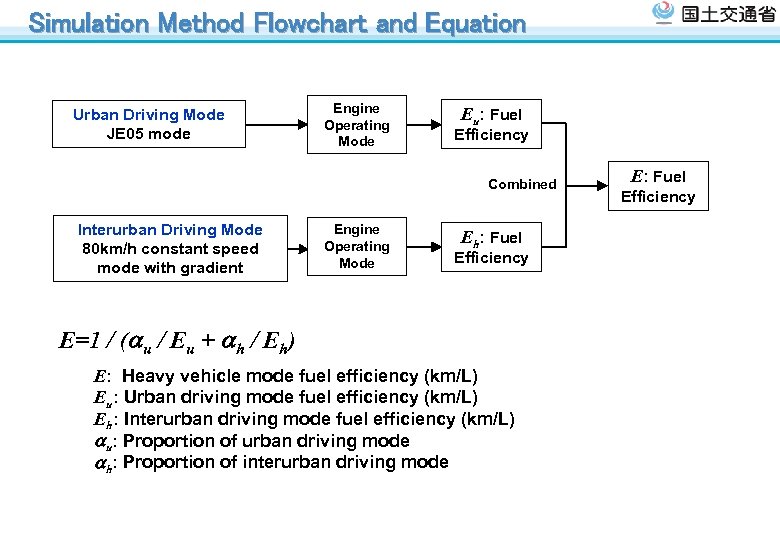 Simulation Method Flowchart and Equation Urban Driving Mode JE 05 mode Engine Operating Mode Eu: Fuel Efficiency Combined Interurban Driving Mode 80 km/h constant speed mode with gradient Engine Operating Mode Eh: Fuel Efficiency E=1 / (au / Eu + ah / Eh) E: Heavy vehicle mode fuel efficiency (km/L) Eu: Urban driving mode fuel efficiency (km/L) Eh: Interurban driving mode fuel efficiency (km/L) au: Proportion of urban driving mode ah: Proportion of interurban driving mode E: Fuel Efficiency
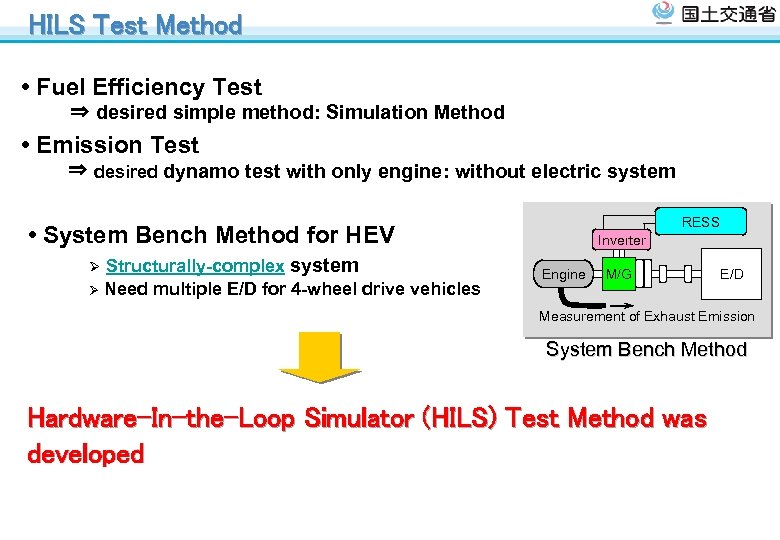 HILS Test Method • Fuel Efficiency Test ⇒ desired simple method: Simulation Method • Emission Test ⇒ desired dynamo test with only engine: without electric system RESS • System Bench Method for HEV Structurally-complex system Ø Need multiple E/D for 4 -wheel drive vehicles Ø Inverter Engine M/G E/D Measurement of Exhaust Emission System Bench Method Hardware-In-the-Loop Simulator (HILS) Test Method was developed
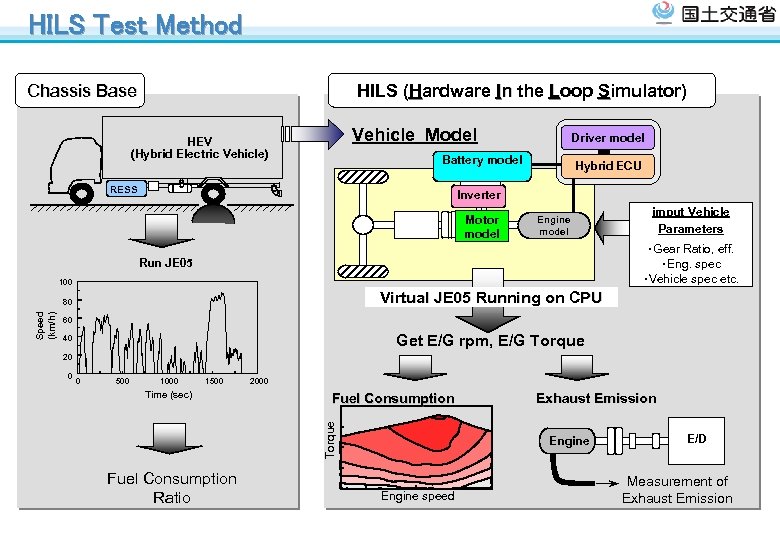 HILS Test Method HILS (Hardware In the Loop Simulator) Chassis Base Vehicle Model HEV (Hybrid Electric Vehicle) Driver model Battery model RESS Hybrid ECU Inverter Motor model Engine model ・Gear Ratio, eff. ・Eng. spec ・Vehicle spec etc. Run JE 05 100 Virtual JE 05 Running on CPU 80 60 Get E/G rpm, E/G Torque 40 20 0 0 500 1000 1500 Time (sec) 2000 Fuel Consumption Torque Speed (km/h) imput Vehicle Parameters Fuel Consumption Ratio Exhaust Emission Engine speed E/D Measurement of Exhaust Emission
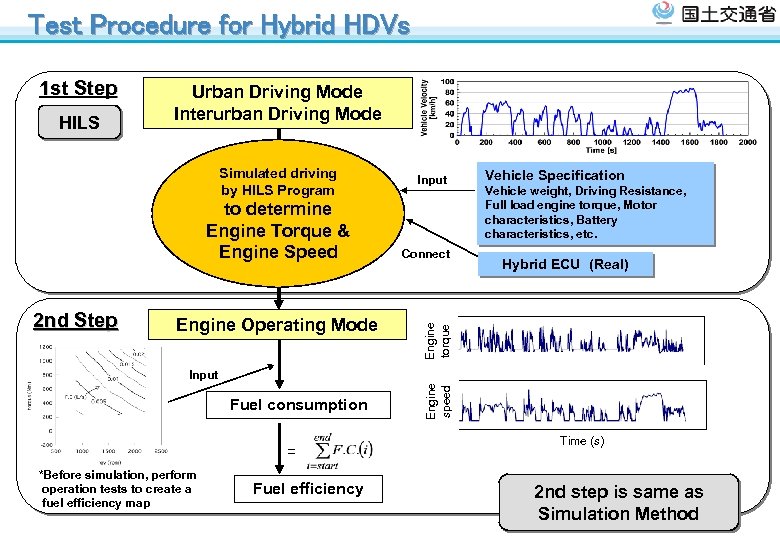 Test Procedure for Hybrid HDVs HILS Urban Driving Mode Interurban Driving Mode Simulated driving by HILS Program to determine Engine Torque & Engine Speed 2 nd Step Engine Operating Mode Input Connect Vehicle Specification Vehicle weight, Driving Resistance, Full load engine torque, Motor characteristics, Battery characteristics, etc. Hybrid ECU (Real) Engine torque 1 st Step Fuel consumption = *Before simulation, perform operation tests to create a fuel efficiency map Fuel efficiency Engine speed Input エンジン燃費マップ Time (s) 2 nd step is same as Simulation Method
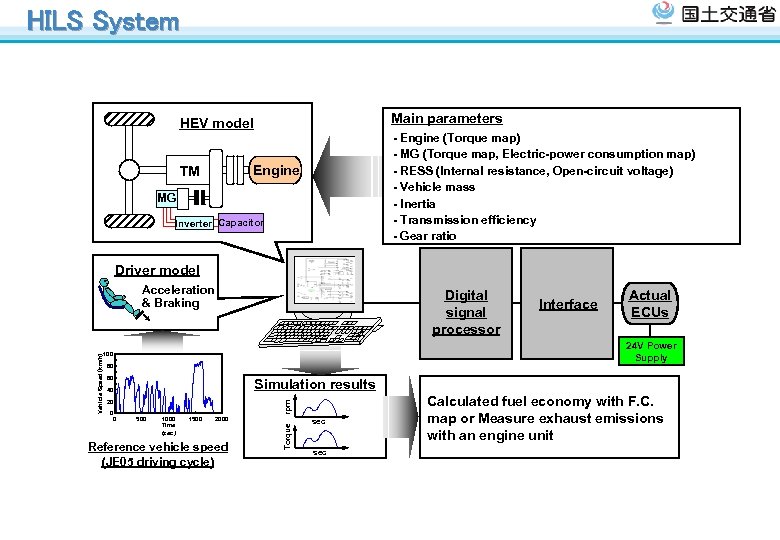 HILS System Main parameters HEV model - Engine (Torque map) - MG (Torque map, Electric-power consumption map) - RESS (Internal resistance, Open-circuit voltage) - Vehicle mass - Inertia - Transmission efficiency - Gear ratio Engine TM MG Inverter Capacitor Driver model Digital signal processor 80 60 Actual ECUs Simulation results 40 20 0 0 Interface 24 V Power Supply 100 500 1000 Time (sec) 1500 2000 Reference vehicle speed (JE 05 driving cycle) Torque rpm Vehicle Speed (km/h) Acceleration & Braking sec Calculated fuel economy with F. C. map or Measure exhaust emissions with an engine unit
 Agenda 1. Top Runner Approach 2. Fuel Efficiency Standard for HDVs ・ Simulation Test Method ・ for HD HEV Test 3. Fuel Efficiency Standard for LDVs ・ Conventional Test Method ・ for LD HEV Test ・ Challenge for PHEV Evaluation 4. IPT Bus : PHEV for HDVs
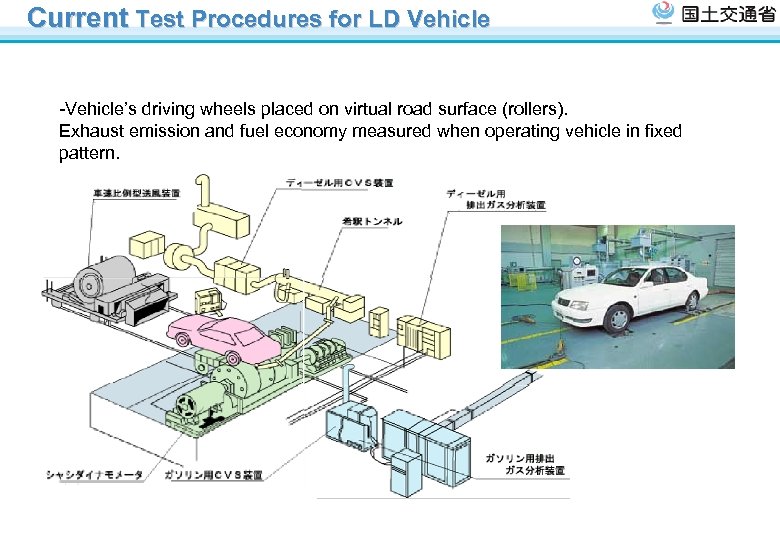 Current Test Procedures for LD Vehicle -Vehicle’s driving wheels placed on virtual road surface (rollers). Exhaust emission and fuel economy measured when operating vehicle in fixed pattern.
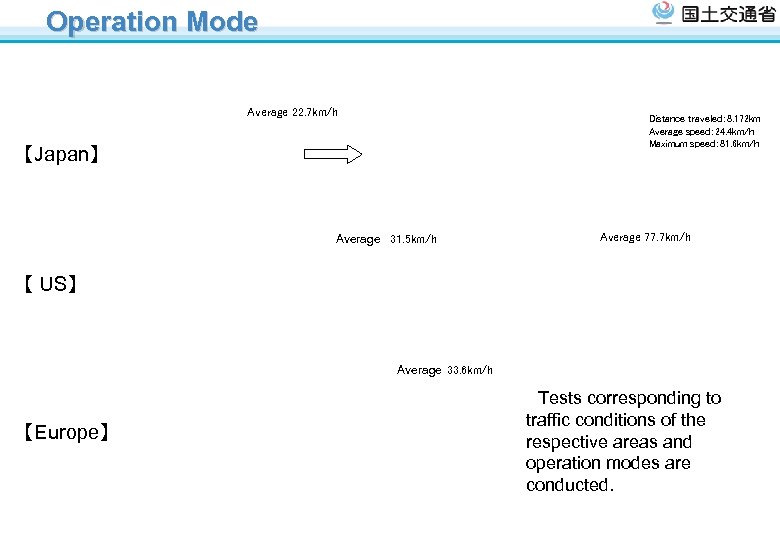 Operation Mode Average 22. 7 km/h Distance traveled: 8. 172 km Average speed: 24. 4 km/h Maximum speed: 81. 6 km/h 【Japan】 Average 31. 5 km/h Average 77. 7 km/h 【 US】 Average 33. 6 km/h 【Europe】 Tests corresponding to traffic conditions of the respective areas and operation modes are conducted.
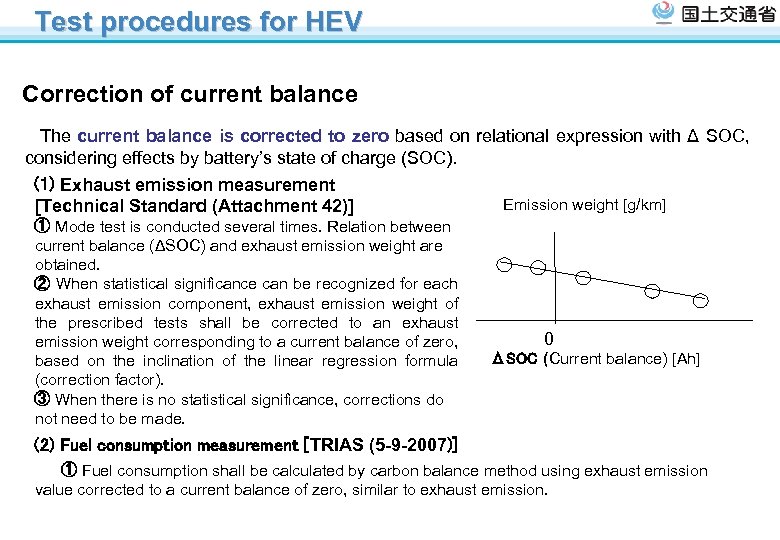 Test procedures for HEV Correction of current balance The current balance is corrected to zero based on relational expression with Δ SOC, considering effects by battery’s state of charge (SOC). (1) Exhaust emission measurement [Technical Standard (Attachment 42)] ① Mode test is conducted several times. Relation between current balance (ΔSOC) and exhaust emission weight are obtained. ② When statistical significance can be recognized for each exhaust emission component, exhaust emission weight of the prescribed tests shall be corrected to an exhaust emission weight corresponding to a current balance of zero, based on the inclination of the linear regression formula (correction factor). ③ When there is no statistical significance, corrections do not need to be made. Emission weight [g/km] 0 ΔSOC (Current balance) [Ah] (2) Fuel consumption measurement [TRIAS (5 -9 -2007)] ① Fuel consumption shall be calculated by carbon balance method using exhaust emission value corrected to a current balance of zero, similar to exhaust emission.
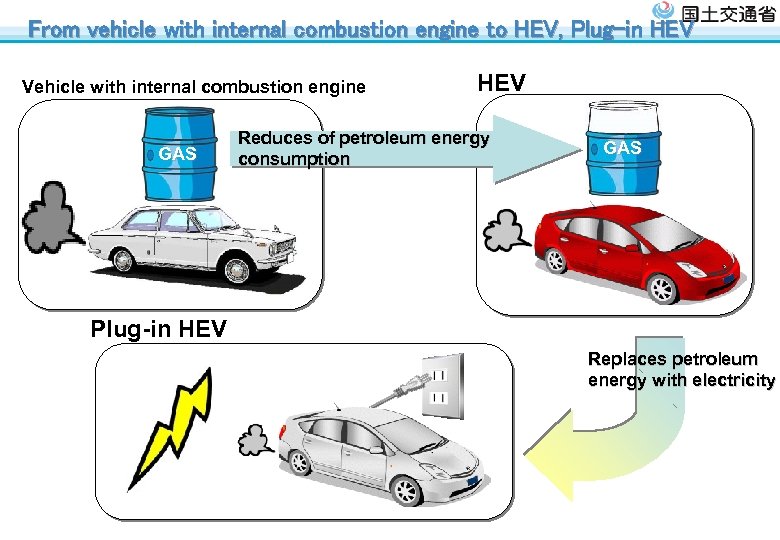 From vehicle with internal combustion engine to HEV, Plug-in HEV Vehicle with internal combustion engine GAS HEV Reduces of petroleum energy consumption GAS Plug-in HEV Replaces petroleum energy with electricity
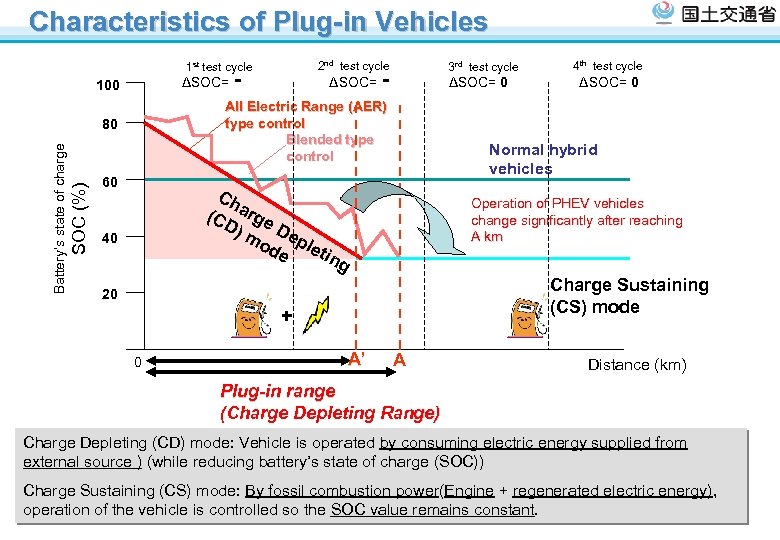 Characteristics of Plug-in Vehicles 2 nd test cycle 1 st test cycle ΔSOC= 100 SOC (%) ΔSOC= - ΔSOC= 0 All Electric Range (AER) type control Blended type control 80 Battery’s state of charge - 3 rd test cycle 60 Operation of PHEV vehicles change significantly after reaching A km Charge Sustaining (CS) mode 20 + 0 ΔSOC= 0 Normal hybrid vehicles Ch (C arge D) mo Dep de letin g 40 4 th test cycle A’ A Distance (km) Plug-in range (Charge Depleting Range) Charge Depleting (CD) mode: Vehicle is operated by consuming electric energy supplied from external source ) (while reducing battery’s state of charge (SOC)) Charge Sustaining (CS) mode: By fossil combustion power(Engine + regenerated electric energy), operation of the vehicle is controlled so the SOC value remains constant.
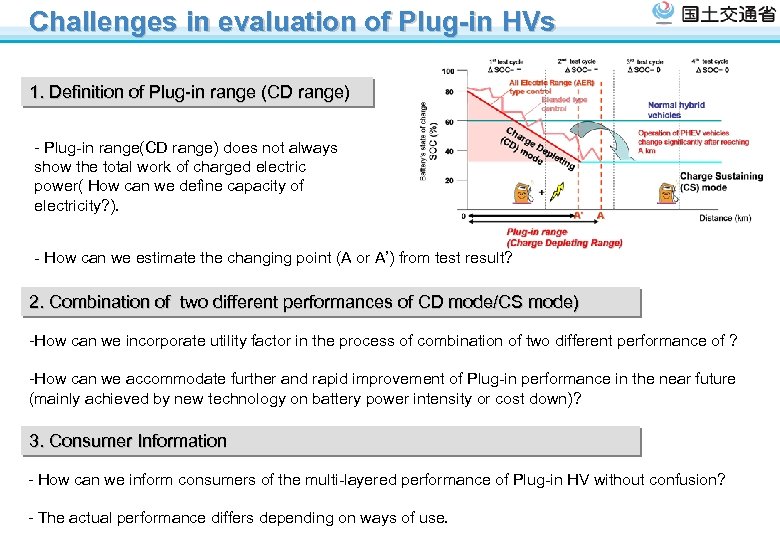 Challenges in evaluation of Plug-in HVs 1. Definition of Plug-in range (CD range) - Plug-in range(CD range) does not always show the total work of charged electric power( How can we define capacity of electricity? ). - How can we estimate the changing point (A or A’) from test result? 2. Combination of two different performances of CD mode/CS mode) -How can we incorporate utility factor in the process of combination of two different performance of ? -How can we accommodate further and rapid improvement of Plug-in performance in the near future (mainly achieved by new technology on battery power intensity or cost down)? 3. Consumer Information - How can we inform consumers of the multi-layered performance of Plug-in HV without confusion? - The actual performance differs depending on ways of use.
 Agenda 1. Top Runner Approach 2. Fuel Efficiency Standard for HD Vehicle ・ Simulation Test Method ・ for HD HEV Test 3. Fuel Efficiency Standard for LD Vehicle ・ Conventional Test Method ・ for LD HEV Test ・ Challenge for PHEV Evaluation 4. IPT Bus : PHEV for HD Vehicle
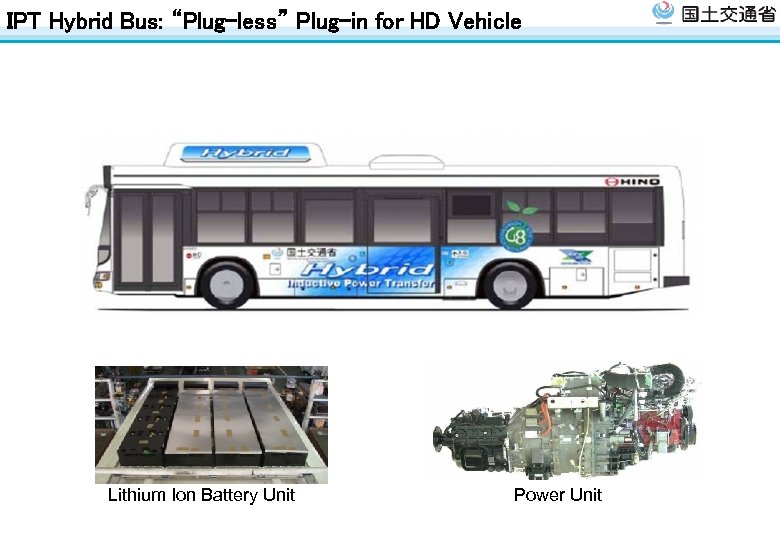 IPT Hybrid Bus: “Plug-less” Plug-in for HD Vehicle Lithium Ion Battery Unit Power Unit
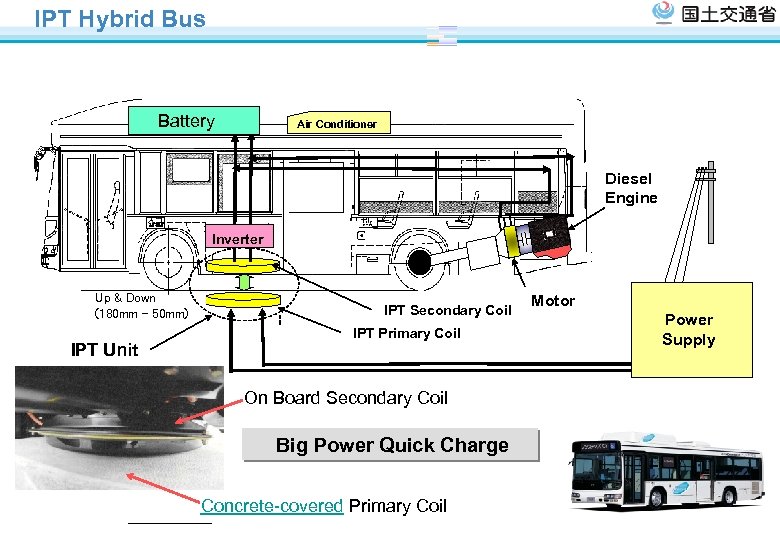 IPT Hybrid Bus Battery Air Conditioner Diesel Engine Inverter Up & Down (180 mm – 50 mm) IPT Unit IPT Secondary Coil IPT Primary Coil On Board Secondary Coil Big Power Quick Charge Concrete-covered Primary Coil Motor Power Supply
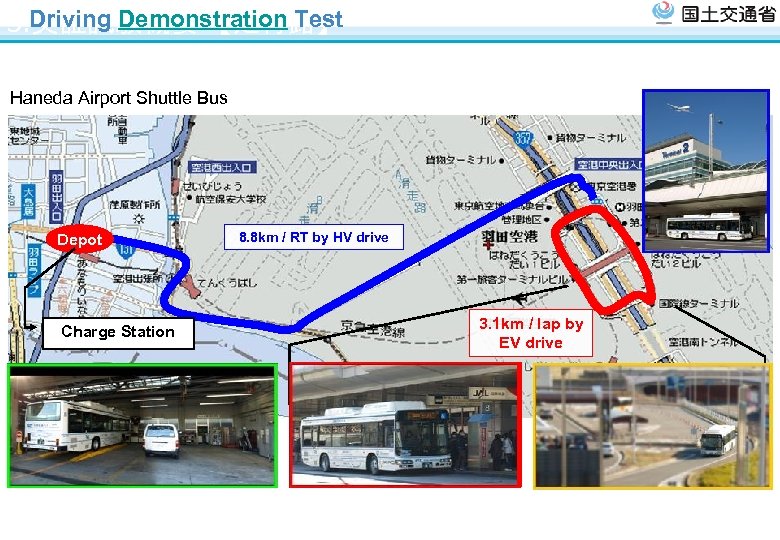 Driving Demonstration Test 3. 実証試験概要 【走行路】 Haneda Airport Shuttle Bus Depot 8. 8 km / RT by HV drive 3. 1 km / lap by EV drive Charge Station 第一ターミナル 国際線ターミナル 写真 写真
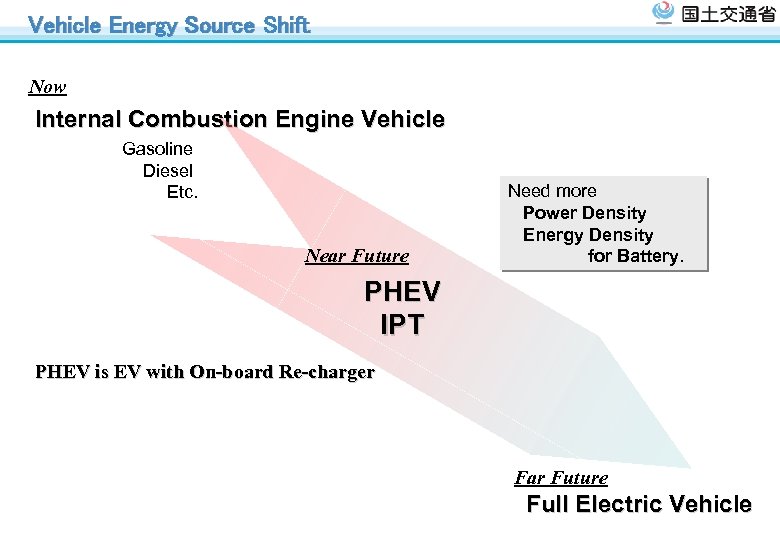 Vehicle Energy Source Shift Now Internal Combustion Engine Vehicle Gasoline Diesel Etc. Near Future Need more Power Density Energy Density for Battery. PHEV IPT PHEV is EV with On-board Re-charger Far Future Full Electric Vehicle
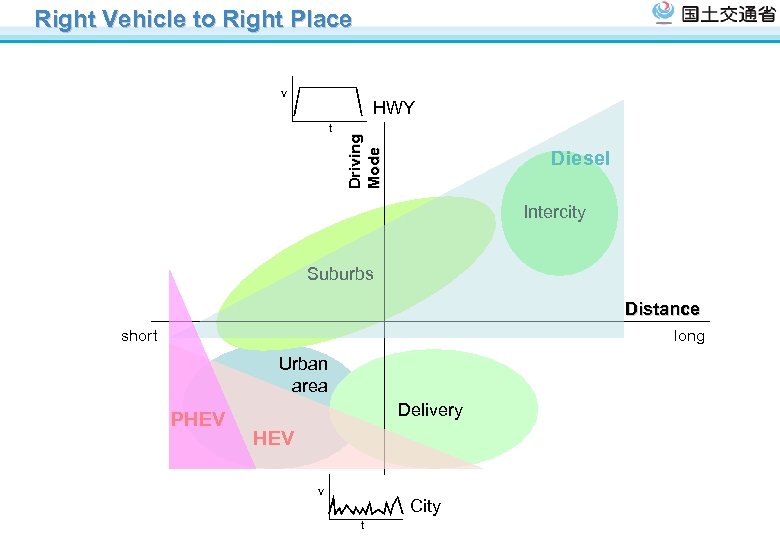 Right Vehicle to Right Place v t Driving Mode HWY Diesel Intercity Suburbs Distance short long Urban area PHEV Delivery HEV v City t
 Thank you all for listening so attentively For further questions: Akihiko HOSHI Environment Division Road Transport Bureau Ministry of Land, Infrastructure, Transport and Tourism E-mail: hoshi-a 2 rd@mlit. go. jp Tel: +81 3 5253 8604