 Скачать презентацию Working on psychological flexibility to reduce stressand increase
990fd9f64ef8a02fca4800d437874bcb.ppt
- Количество слайдов: 15



Working on psychological flexibility to reduce stressand increase corporate wellbeing in correction officers of a prison in Italy Alessandra Chianese Silvia Cau Giovambattista Presti
Absence of wellness in the Italian prisons • In Italy the deaths in prison is a hot issue • Over the past 11 years 1. 800 prisoners died in prison, 1/3 of which committed suicide • This created a lot of interest by the media, but there is still little interest regarding guards • 70 prison guards committed suicide in recent years
Italian political initiative • To prevent further suicides, the Italian Ministry of Justice, has decided to organize training courses on organizational well-being in all Italian prisons • These guidelines do not give details on how to perform the training • We decided to use this issue in order to prevent and recognize situations of stress and burn out. Reasons of this might be the suicides of colleagues: communication, organizational wellbeing and burn out.
Settings… We worked in three prisons: 1. Rebibbia new complex Subjects: approximately 140 in 6 sessions 2. Rebibbia”third house” Subjects: 28 in 3 sessions 3. Regina Coeli Subjects: 31 in 2 sessions The training lasted a total of 3 days and techniques used were: indoor training education theater, outdoor training (only in Rebibbia prison), and the ACT training.
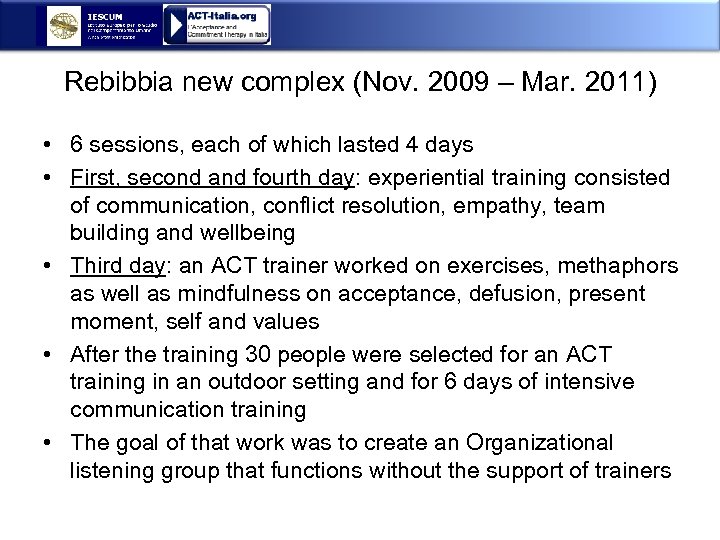
Rebibbia new complex (Nov. 2009 – Mar. 2011) • 6 sessions, each of which lasted 4 days • First, second and fourth day: experiential training consisted of communication, conflict resolution, empathy, team building and wellbeing • Third day: an ACT trainer worked on exercises, methaphors as well as mindfulness on acceptance, defusion, present moment, self and values • After the training 30 people were selected for an ACT training in an outdoor setting and for 6 days of intensive communication training • The goal of that work was to create an Organizational listening group that functions without the support of trainers
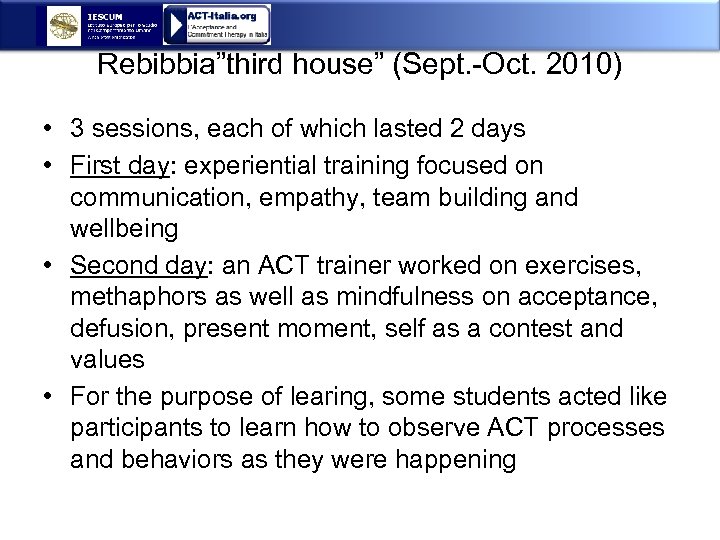
Rebibbia”third house” (Sept. -Oct. 2010) • 3 sessions, each of which lasted 2 days • First day: experiential training focused on communication, empathy, team building and wellbeing • Second day: an ACT trainer worked on exercises, methaphors as well as mindfulness on acceptance, defusion, present moment, self as a contest and values • For the purpose of learing, some students acted like participants to learn how to observe ACT processes and behaviors as they were happening
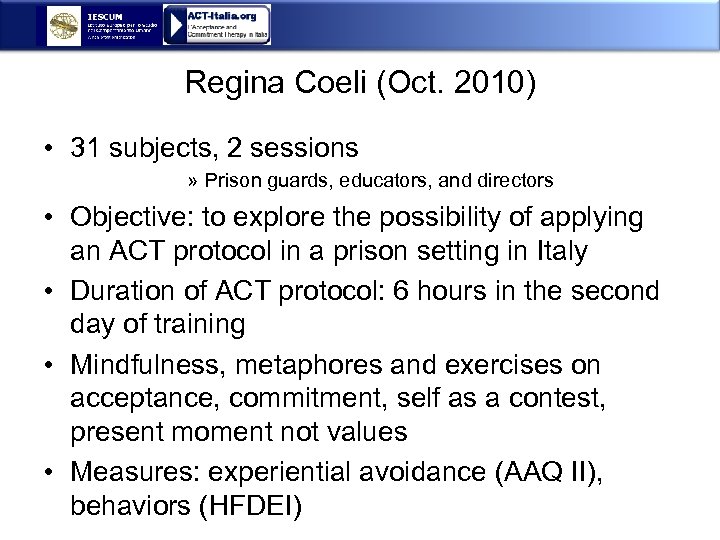
Regina Coeli (Oct. 2010) • 31 subjects, 2 sessions » Prison guards, educators, and directors • Objective: to explore the possibility of applying an ACT protocol in a prison setting in Italy • Duration of ACT protocol: 6 hours in the second day of training • Mindfulness, metaphores and exercises on acceptance, commitment, self as a contest, present moment not values • Measures: experiential avoidance (AAQ II), behaviors (HFDEI)
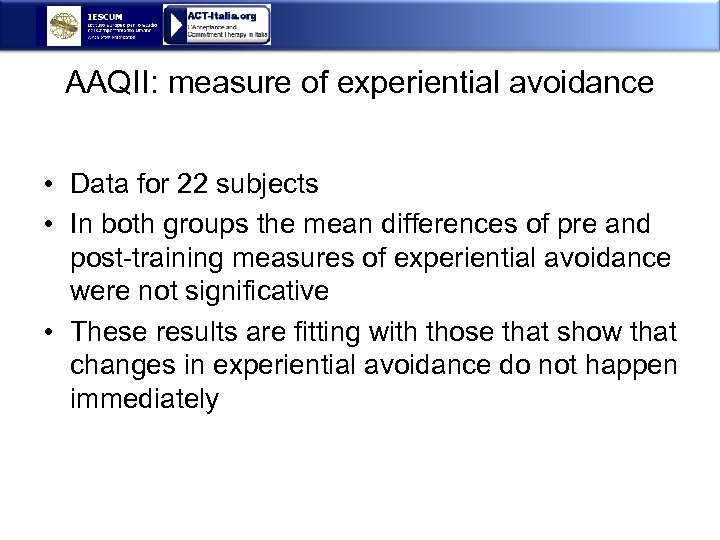
AAQII: measure of experiential avoidance • Data for 22 subjects • In both groups the mean differences of pre and post-training measures of experiential avoidance were not significative • These results are fitting with those that show that changes in experiential avoidance do not happen immediately
HFDEI exaflex functional dimensional experiential interview • Used as an observation tool of ACT processes by some observers • 20 subjects data at t 0 (pre-training), t 1 (ACT day training), t 2 (post-training) • We calculated the average points assigned by observers on each processes: F Fisher test of each glm for acceptance (p 0, 000), commitment (p 0, 000), defusion (p 0, 000), present moment(p 0, 001) and self processes (p 0, 134) • Behaviors changed (except self as a contest) in the post-training results
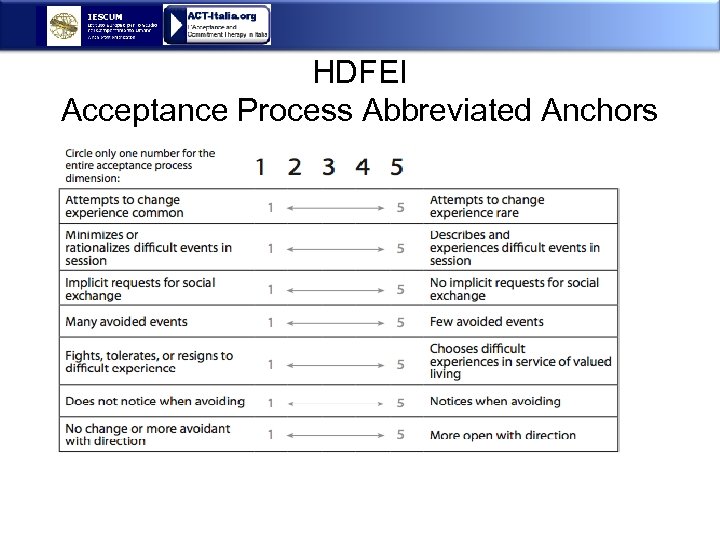
HDFEI Acceptance Process Abbreviated Anchors
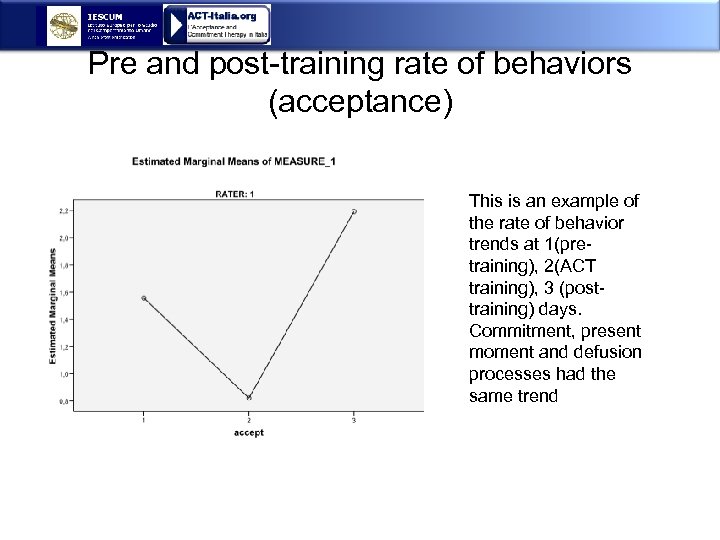
Pre and post-training rate of behaviors (acceptance) This is an example of the rate of behavior trends at 1(pretraining), 2(ACT training), 3 (posttraining) days. Commitment, present moment and defusion processes had the same trend
Weak points • Minimal number of ACT training hours • Training in the same setting where partecipants worked • Pre and post-training evaluations were too close together to measure experiential avoidance • Absence of a follow-up measure for experiential avoidance (AAQII) and observation (HFDEI)
Strong points • First use of an ACT training in italian public administration • Use psychological flexibility in an inflexible setting like prisons are • Test an ACT protocol in work setting in Italy for the first time • From the satisfaction evaluation, an interest to repeat this training in the future emerged • Public administration allowed us to use scientific measures for future research
Future development • Use the Organizational listening group of Rebibbia to apply the Regina Coeli protocol • More ACT training instead of only 6 hours • Training in a different setting • Take follow-up measure for experiential avoidance (AAQ II) • Take psychological wellbeing valid measure • Refine observation (HFDEI) • Measure ACT efficacy training in improve wellbeing

We’ll see you next year with the results!!
Скачать презентацию Working on psychological flexibility to reduce stressand increase
990fd9f64ef8a02fca4800d437874bcb.ppt