


 Скачать презентацию Working at Heights and Driver Fatigue Laws Risks
f67a582d7b450facb79867b5d8b0f58f.ppt
- Количество слайдов: 28
 Working at Heights and Driver Fatigue Laws ‘Risks and Duties for Processors’ AMIC seminar, Sydney, Oct 29 th 2008 Luke Fraser, ALTA Executive Director
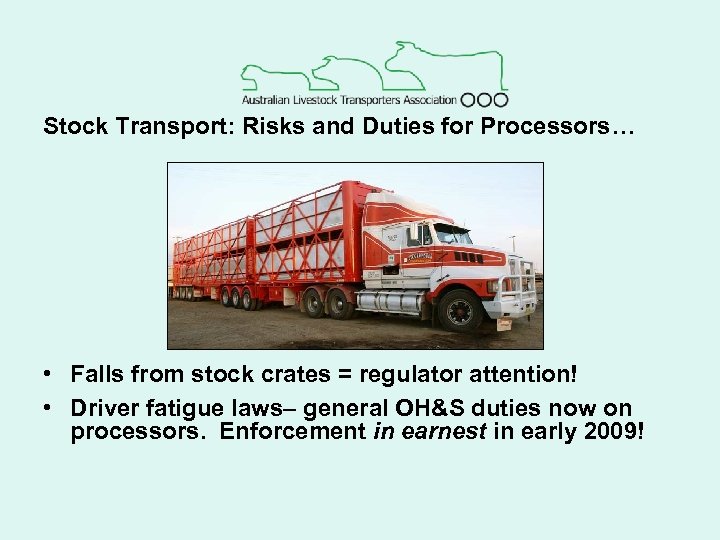 Stock Transport: Risks and Duties for Processors… • Falls from stock crates = regulator attention! • Driver fatigue laws– general OH&S duties now on processors. Enforcement in earnest in early 2009!
 Working at Heights
 Falls from stock crates – ALTA position: “It doesn’t happen often” doesn’t cut it! 1. How can the problem be addressed? 2. Who is responsible for the problem?
 How can the problem be addressed? 1. Examine risk: = likelihood/consequence 2. Isolate contributing factors: - safety gear crate condition, training, policy, etc 3. Risk assessment/mitigation strategy
 ‘Who is responsible? ’ Important ‘who does what’ in response to it. Where thinking appears to be going: • Processor to provide a safe ‘workplace’ • Carrier has to provide a safe ‘workplace’ • Both ‘workplaces’ interact to create safety
 So for carriers…might looks like: Right gear, safe stock crates, company risk plan and policy, drivers trained and informed And for processors…might look like: Providing level, drained loading surface, safe ramps, no overhead obstacles.
 For extra processor peace of mind… Establish policy of only using carriers where you can cite company working at heights policy. Alternative processor scenario Invest in plant ladders, harness systems, gantries etc…but risk prosecution when carriers get it wrong, aren’t trained, don’t use, etc
 Key messages… • Make carriers accountable for their own behaviour on your property • Document your policy, communicate it. • Keep talking to us and OH&S authorities • Be consistent – one rule for all or forget it
 New HV Driver Fatigue Laws
 Why the change? Beyond the Midnight Oil: Fatigue In Transport Senate Inquiry (2000) • • • Fatigue in road transport a major killer Pushes drivers towards drugs, speeding Road accidents cost Australia $17 billion a year New laws are required Customers need to be part of the solution 2006 State/Territory/Feds all vote for the laws
 What some customers are saying: “I just organise the kill – it’s a carrier issue” “Just another headache I don’t need” “I’m not changing my approach for this crap” So what are these laws really for?
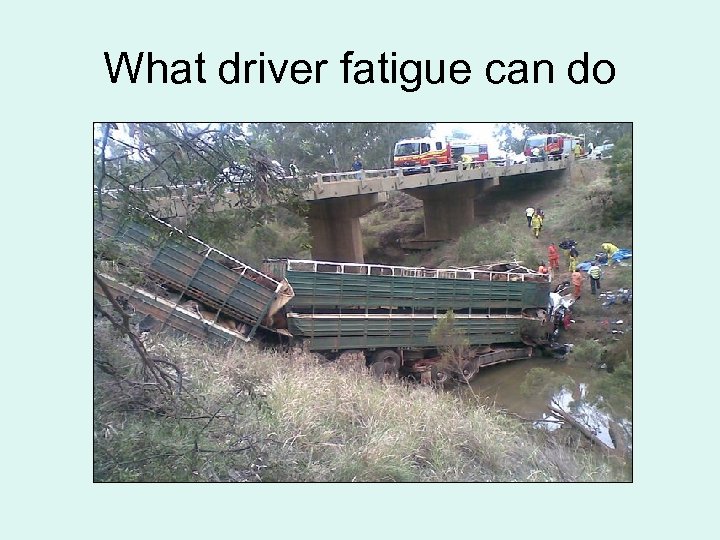 What driver fatigue can do
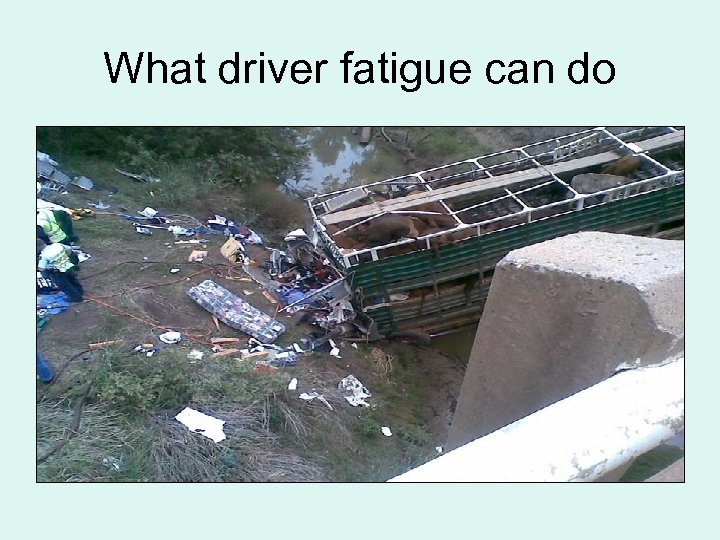 What driver fatigue can do
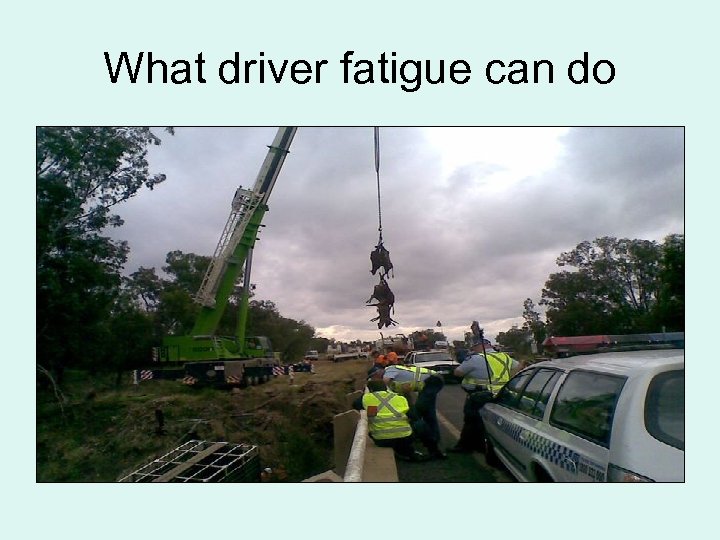 What driver fatigue can do
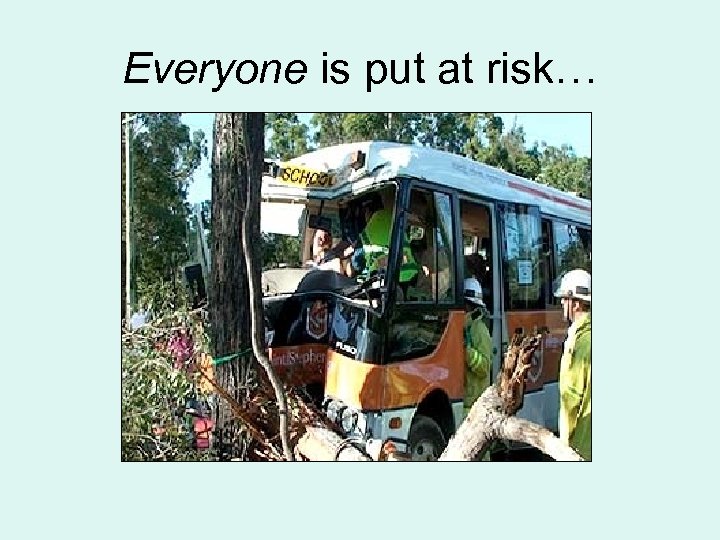 Everyone is put at risk…
 THE CHAIN OF RESPONSIBILITY New legislation affects the driver but also: • The employer of the driver • The prime contractor of the driver • The operator of a vehicle • The scheduler of the goods and of the driver • The consignor (sender) of the goods for transport • The consignee (receiver) of the goods for transport • The loading manager of the goods • The loader and the unloader of the goods
 YOUR COMMON DUTY All parties in the chain of responsibility must take reasonable steps to ensure a driver does not: • Drive while fatigued • Drive in breach of legal working hours • Drive in breach of another law to avoid breaching fatigue laws (ie break speed limit).
 PENALTIES ARE REAL Successful investigation = consequences • • • Laws define fatigue risks as severe First fine $5, 000 Second fine $10, 000 5 X corporate multiplier (that’s you!) Courts garnish profits of serial offenders
 The culture change for processors…
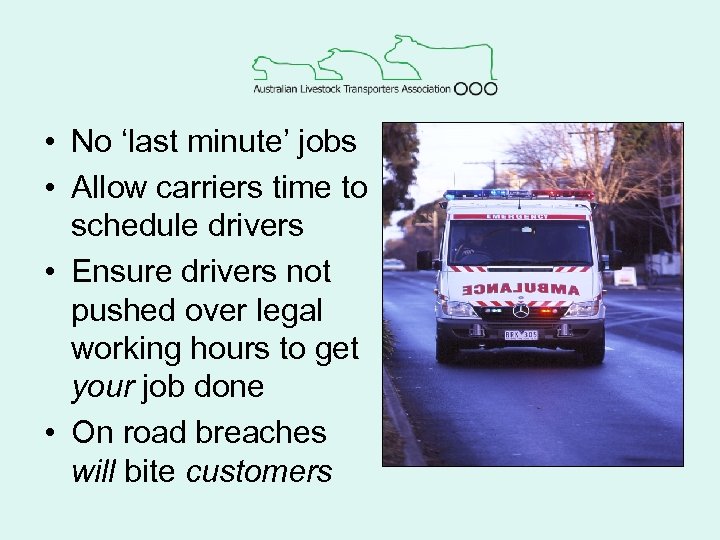 • No ‘last minute’ jobs • Allow carriers time to schedule drivers • Ensure drivers not pushed over legal working hours to get your job done • On road breaches will bite customers
 Cooperation and mutual accountability Carriers must live within allotted work hours Typically 12 -14 working hours per day Those contributing to the problem pursued Early notice fixes 90% of these issues!!!
 Best defence for processors: don’t buy in to the carrier’s fatigue responsibilities… • Carriers have significant scheduling, training and recordkeeping requirements to manage these new laws • Don’t second guess them if they say it can’t be done for fatigue reasons – rework the schedule. • Don’t talk to their driver and tell him where and when. • Organise the job early with the carrier. • Recognise the fatigue issue is theirs to manage • Help the schedules become legal through good planning
 Let’s be practical… • How many jobs are really ‘last minute’? • Kill chain operations often reliable • Your livestock managers have a role to play • ‘When they get a job, tell the carrier at the time!’ • Gives them time to get fresh drivers ready • ‘Emphasise to buyers that having stock ready for pickup at assigned times is important!’
 Legal contracts for every job? • Not practical – 99% verbal contracts! • Common sense and culture change will greatly limit your exposure to risk • Document the culture change – consider buyer induction training on fatigue laws and how to deal with truck scheduling
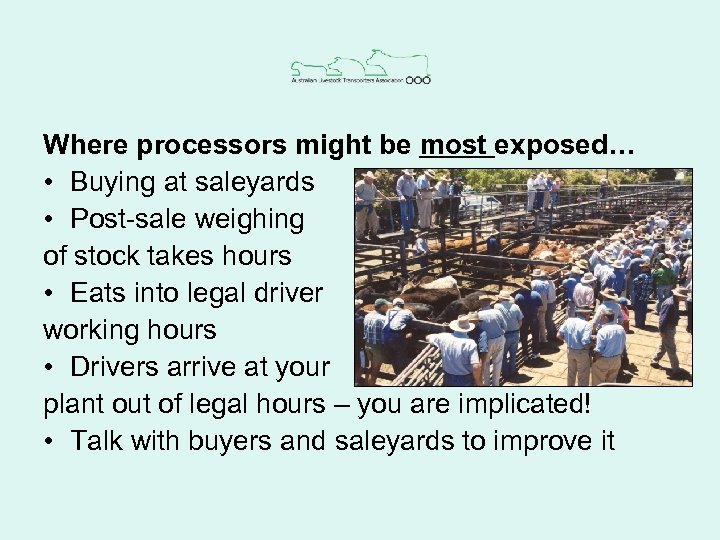 Where processors might be most exposed… • Buying at saleyards • Post-sale weighing of stock takes hours • Eats into legal driver working hours • Drivers arrive at your plant out of legal hours – you are implicated! • Talk with buyers and saleyards to improve it
 Summing up… • Fatigue laws are not going away! • Nobody can fight the safety argument in this • Cooperation required by all • Driver and customer culture needs to change • You have a role to play – help keep it legal!
 Thank you…questions? Our website: www. alta. org. au