


 Скачать презентацию Workforce Performance Report January 2014 Jayne Halford Deputy
7e70ff825a5b22a6f89994fdddfd0a86.ppt
- Количество слайдов: 6
 Workforce Performance Report January 2014 Jayne Halford Deputy Director of HR Caring, safe and excellent 1
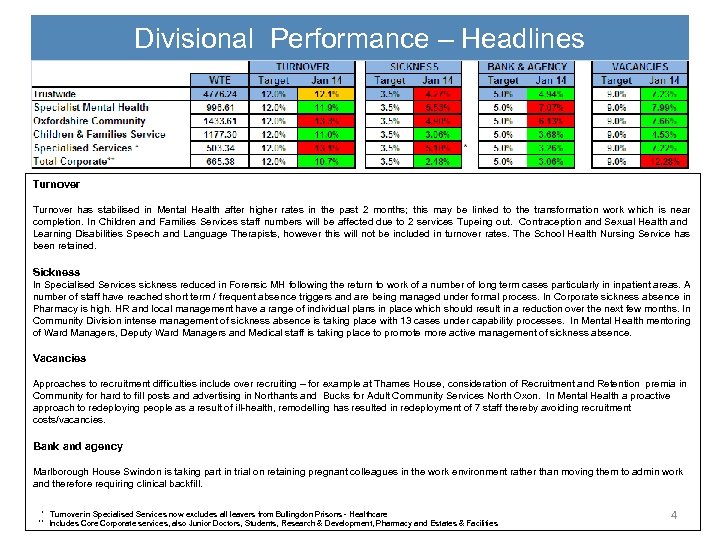 Divisional Performance – Headlines Turnover has stabilised in Mental Health after higher rates in the past 2 months; this may be linked to the transformation work which is near completion. In Children and Families Services staff numbers will be affected due to 2 services Tupeing out. Contraception and Sexual Health and Learning Disabilities Speech and Language Therapists, however this will not be included in turnover rates. The School Health Nursing Service has been retained. Sickness In Specialised Services sickness reduced in Forensic MH following the return to work of a number of long term cases particularly in inpatient areas. A number of staff have reached short term / frequent absence triggers and are being managed under formal process. In Corporate sickness absence in Pharmacy is high. HR and local management have a range of individual plans in place which should result in a reduction over the next few months. In Community Division intense management of sickness absence is taking place with 13 cases under capability processes. In Mental Health mentoring of Ward Managers, Deputy Ward Managers and Medical staff is taking place to promote more active management of sickness absence. Vacancies Approaches to recruitment difficulties include over recruiting – for example at Thames House, consideration of Recruitment and Retention premia in Community for hard to fill posts and advertising in Northants and Bucks for Adult Community Services North Oxon. In Mental Health a proactive approach to redeploying people as a result of ill-health, remodelling has resulted in redeployment of 7 staff thereby avoiding recruitment costs/vacancies. Bank and agency Marlborough House Swindon is taking part in trial on retaining pregnant colleagues in the work environment rather than moving them to admin work and therefore requiring clinical backfill. * Turnover in Specialised Services now excludes all leavers from Bullingdon Prisons - Healthcare ** Includes Core Corporate services, also Junior Doctors, Students, Research & Development, Pharmacy and Estates & Facilities 4
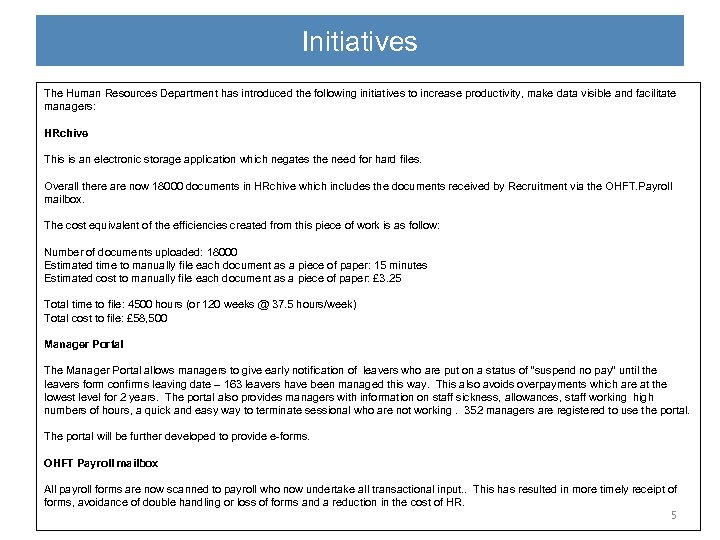 Initiatives The Human Resources Department has introduced the following initiatives to increase productivity, make data visible and facilitate managers: HRchive This is an electronic storage application which negates the need for hard files. Overall there are now 18000 documents in HRchive which includes the documents received by Recruitment via the OHFT. Payroll mailbox. The cost equivalent of the efficiencies created from this piece of work is as follow: Number of documents uploaded: 18000 Estimated time to manually file each document as a piece of paper: 15 minutes Estimated cost to manually file each document as a piece of paper: £ 3. 25 Total time to file: 4500 hours (or 120 weeks @ 37. 5 hours/week) Total cost to file: £ 58, 500 Manager Portal The Manager Portal allows managers to give early notification of leavers who are put on a status of “suspend no pay” until the leavers form confirms leaving date – 163 leavers have been managed this way. This also avoids overpayments which are at the lowest level for 2 years. The portal also provides managers with information on staff sickness, allowances, staff working high numbers of hours, a quick and easy way to terminate sessional who are not working. 352 managers are registered to use the portal. The portal will be further developed to provide e-forms. OHFT Payroll mailbox All payroll forms are now scanned to payroll who now undertake all transactional input. . This has resulted in more timely receipt of forms, avoidance of double handling or loss of forms and a reduction in the cost of HR. 5
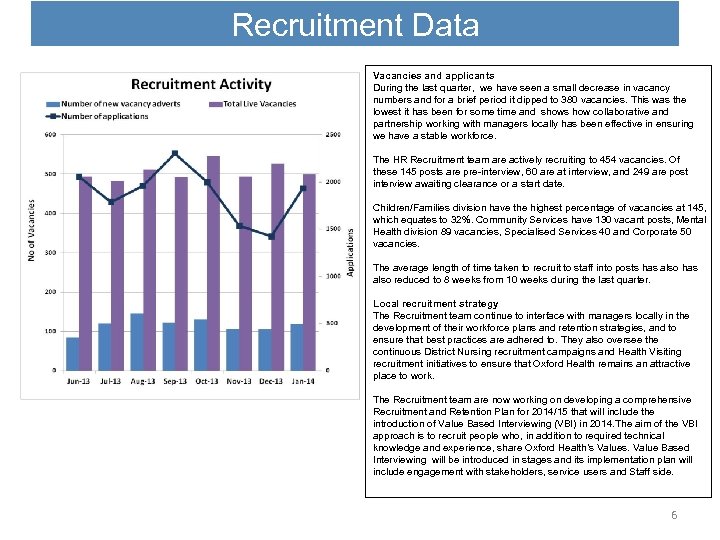 Recruitment Data Vacancies and applicants During the last quarter, we have seen a small decrease in vacancy numbers and for a brief period it dipped to 380 vacancies. This was the lowest it has been for some time and shows how collaborative and partnership working with managers locally has been effective in ensuring we have a stable workforce. The HR Recruitment team are actively recruiting to 454 vacancies. Of these 145 posts are pre-interview, 60 are at interview, and 249 are post interview awaiting clearance or a start date. Children/Families division have the highest percentage of vacancies at 145, which equates to 32%. Community Services have 130 vacant posts, Mental Health division 89 vacancies, Specialised Services 40 and Corporate 50 vacancies. The average length of time taken to recruit to staff into posts has also reduced to 8 weeks from 10 weeks during the last quarter. Local recruitment strategy The Recruitment team continue to interface with managers locally in the development of their workforce plans and retention strategies, and to ensure that best practices are adhered to. They also oversee the continuous District Nursing recruitment campaigns and Health Visiting recruitment initiatives to ensure that Oxford Health remains an attractive place to work. The Recruitment team are now working on developing a comprehensive Recruitment and Retention Plan for 2014/15 that will include the introduction of Value Based Interviewing (VBI) in 2014. The aim of the VBI approach is to recruit people who, in addition to required technical knowledge and experience, share Oxford Health’s Values. Value Based Interviewing will be introduced in stages and its implementation plan will include engagement with stakeholders, service users and Staff side. 6
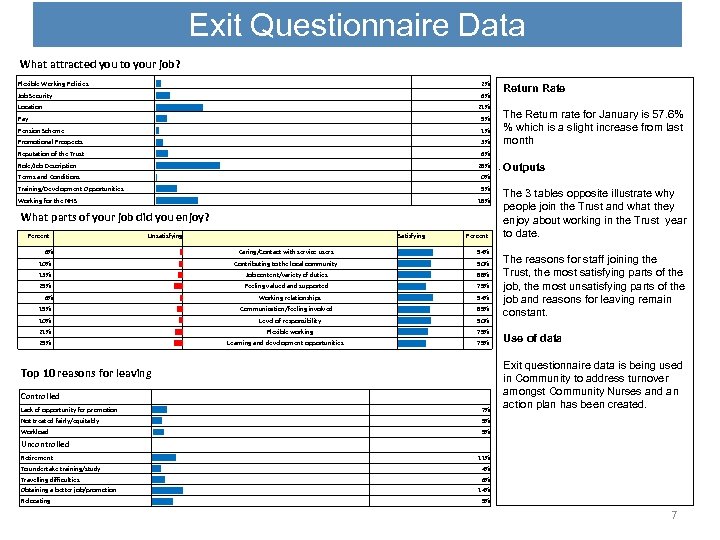 Exit Questionnaire Data What attracted you to your job? Flexible Working Policies |||||| 2% Job Security ||||||||| 6% Location ||||||||||||||||||||||||||||||| Pay ||||||| 5% Pension Scheme ||| 1% Promotional Prospects ||||| 3% Reputation of the Trust |||||||| Role/Job Description ||||||||||||||||||||||||||||||||||||||||||| Terms and Conditions | Training/Development Opportunities |||||||||||||| Working for the NHS |||||||||||||||||||||||||||| 21% The Return rate for January is 57. 6% % which is a slight increase from last month 6% 28% 0% 9% 18% What parts of your job did you enjoy? Percent Return Rate Unsatisfying Satisfying 6% Percent ||| Caring/Contact with service users ||||||||||||||||||||||| 94% ||||| 10% Contributing to the local community |||||||||||||||||||||| 90% 13% |||||| Job content/variety of duties |||||||||||||||||||||| 88% 25% |||||| Feeling valued and supported ||||||||||||||||||| 75% ||||||||||||||||||||||| 94% ||||||||||||||||||||| 85% 6% ||| Working relationships 15% ||||||| Communication/feeling involved 10% ||||| Level of responsibility |||||||||||||||||||||| 90% 21% ||||| Flexible working |||||||||||||||||||| 79% 25% ||||||||||||||||||||||||| 75% Learning and development opportunities Top 10 reasons for leaving Controlled Lack of opportunity for promotion |||||||||| 7% Not treated fairly/equitably ||||||||||||||| The 3 tables opposite illustrate why people join the Trust and what they enjoy about working in the Trust year to date. The reasons for staff joining the Trust, the most satisfying parts of the job, the most unsatisfying parts of the job and reasons for leaving remain constant. Use of data Exit questionnaire data is being used in Community to address turnover amongst Community Nurses and an action plan has been created. 5% Workload . Outputs 5% Uncontrolled Retirement |||||||||||||||| To undertake training/study |||||| Travelling difficulties ||||||||| Obtaining a better job/promotion ||||||||||||||||||||| Relocating |||||||||||||| 11% 4% 6% 14% 9% 7
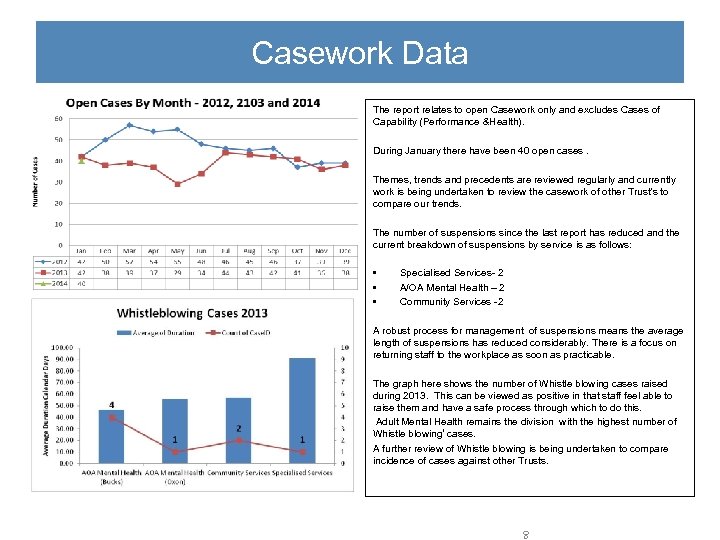 Casework Data The report relates to open Casework only and excludes Cases of Capability (Performance &Health). During January there have been 40 open cases. Themes, trends and precedents are reviewed regularly and currently work is being undertaken to review the casework of other Trust’s to compare our trends. The number of suspensions since the last report has reduced and the current breakdown of suspensions by service is as follows: • • • Specialised Services- 2 A/OA Mental Health – 2 Community Services -2 A robust process for management of suspensions means the average length of suspensions has reduced considerably. There is a focus on returning staff to the workplace as soon as practicable. The graph here shows the number of Whistle blowing cases raised during 2013. This can be viewed as positive in that staff feel able to raise them and have a safe process through which to do this. Adult Mental Health remains the division with the highest number of Whistle blowing‘ cases. A further review of Whistle blowing is being undertaken to compare incidence of cases against other Trusts. 8